.svg)

An enterprise prospect's security review lands with three questions you can't answer cleanly: where's your record of processing activities, what's your procedure when a customer asks for their data, and how do you handle cookie consent? Right now the answers are a spreadsheet, a shared inbox and "we're working on it." So you search for the best data privacy software, and the first page hands you platforms priced and staffed for companies with a privacy department.
That mismatch is the honest starting point for this guide.
"Privacy software" is one label on two very different kinds of product, and most rankings only cover one of them. I read each vendor's own pages, sorted 11 tools by which privacy jobs they actually document, and ranked them for the buyer I hear from most: a SaaS company with no dedicated privacy team that has to get real about GDPR, CCPA and the growing list of US state laws without buying an enterprise rollout.
What Data Privacy Management Software Does and Why Best Data Privacy Software Lists Disagree
Data privacy management software runs the operating side of a privacy program across laws, rather than checking one regulation's boxes. It's the system where consent gets recorded, where a customer's access or deletion request gets tracked to completion, where you keep the map of what personal data you hold and why, and where you run the assessments regulators and customers ask for.
The reason lists disagree is that the category grew from two directions. Some vendors started with the privacy job itself (cookie consent, then request handling, then data mapping). Others started with security compliance and added privacy frameworks. A list that mixes them without saying so ranks a cookie-consent platform against a compliance automation tool as if they did the same thing, and they don't.
The need itself is not new. A Hacker News commenter, smurda, summed up how it played out after California's law arrived:
"it was mostly big companies with A LOT of users that got more DSARs, so they adopted workflows and tools to alleviate the pain" smurda, Hacker News, 2026-01-01 (a commenter's view, not research)
What has changed is who feels the pain. Smaller companies now get the same requests and the same customer questionnaires, and they don't have the privacy staff to absorb them.
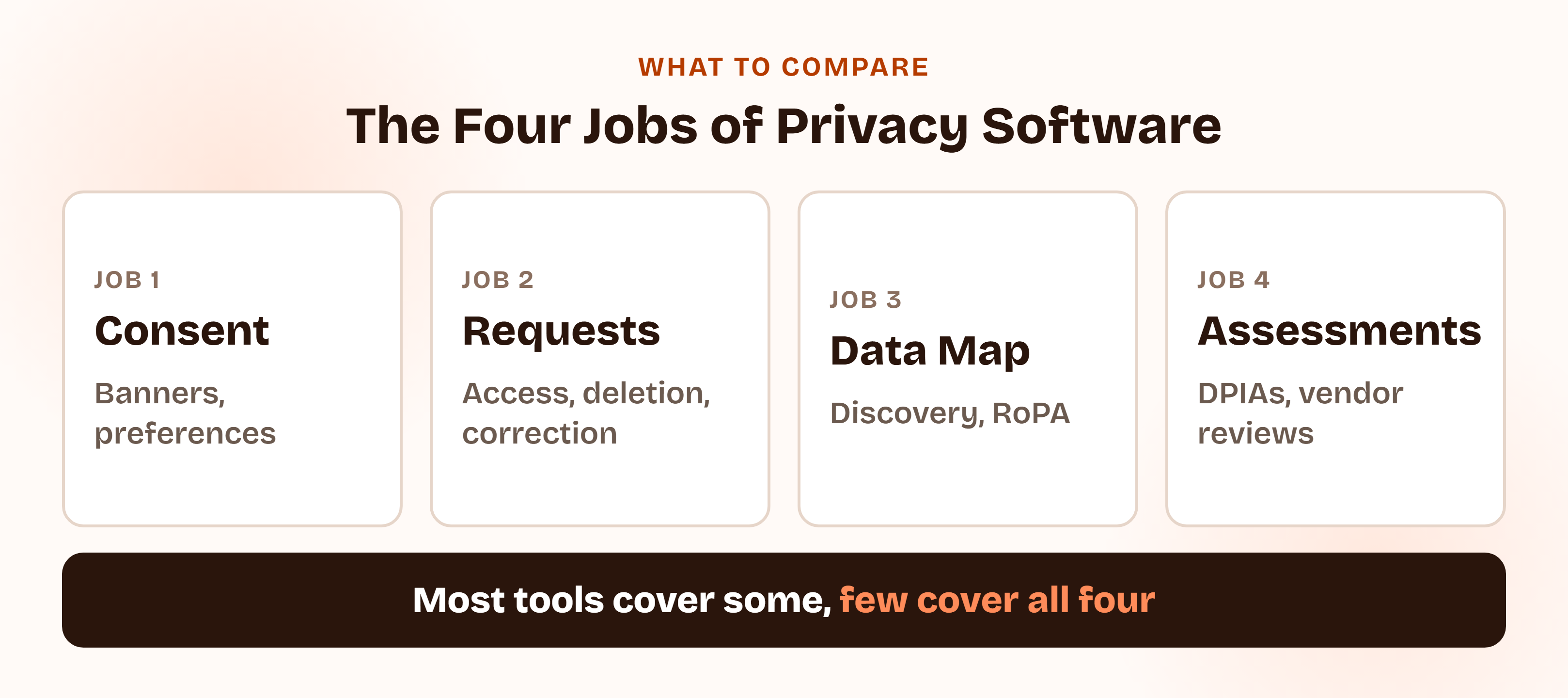
The Four Jobs Behind Every Data Privacy Tools Comparison
Every serious comparison of data privacy tools comes down to four jobs. I scored each vendor against them, because a tool that does one brilliantly and skips the others is a different purchase from one that covers all four adequately.
- Consent and preferences. The banner on your site and app, the record of what each visitor agreed to, and the preference center behind it.
- Rights requests. Access, deletion and correction requests from people, tracked from intake through identity check to fulfillment. The clock is real: under GDPR you must respond "without undue delay and in any event within one month of receipt," extendable by two further months where necessary (Article 12(3)). Under CCPA, businesses must respond within 45 calendar days, extendable by another 45 if they notify the consumer, per the California Attorney General.
- Data mapping and records of processing. Knowing what personal data sits where, and keeping the Article 30 record of processing activities (RoPA) current. Some tools discover data automatically by connecting to your systems. Others give you a structured place to document it.
- Assessments. Data protection impact assessments (DPIAs), privacy impact assessments and vendor privacy reviews.
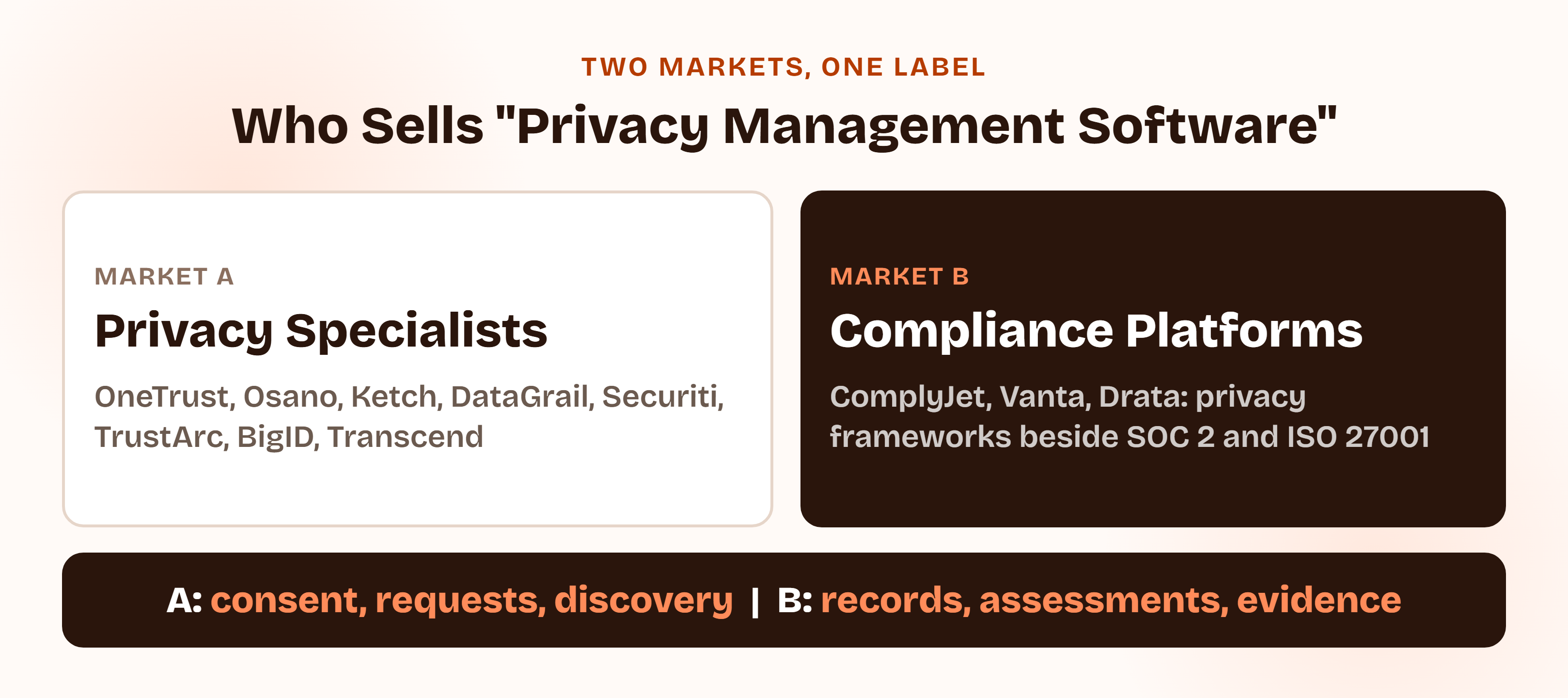
Two Markets Sold as Privacy Management Software
The split that matters most is this one, and few rankings state it.
Privacy-specialist platforms (OneTrust, TrustArc, Securiti, BigID, DataGrail, Osano, Transcend, Ketch) are built around the four jobs, usually with deep consent and request tooling, and often aimed at companies with a privacy or legal team running them. Compliance-automation platforms with privacy frameworks (ComplyJet, Vanta, Drata) are built around security compliance such as SOC 2 and ISO 27001, and carry GDPR, CCPA and ISO 27701 alongside them: policies, records, assessments, vendor tracking, evidence.
The second group is the right answer more often than people expect if your privacy obligations arrive through customer questionnaires and audits. It's the wrong answer if your core problem is a consent banner on a high-traffic site or a large, steady volume of consumer requests. I've ranked with that difference in mind and said which is which in every entry.
Data Privacy Software vs. GDPR and CCPA Compliance Software
This article is deliberately law-agnostic. If you already know you need help with one law, ComplyJet has narrower guides:
Only need one law or standard?
For GDPR on its own, read ComplyJet's best GDPR compliance software comparison. For California, read the best CCPA compliance software comparison. For the privacy management system standard that extends ISO 27001, read the best ISO 27701 software comparison. This guide ranks tools by how well they run a whole privacy program across laws, so several vendors appear in more than one of these, ranked against a different yardstick each time.
Privacy Questions in Customer Reviews?
Privacy and security compliance on one program.
ComplyJet carries GDPR, CCPA and ISO 27701 alongside SOC 2 and ISO 27001, so a customer's privacy questions don't become a second project. Talk through which frameworks your customers are asking about.
How I Evaluated These 11 Best Data Privacy Software Tools
I didn't rank from a roundup or a review-site grid. For each vendor I read its own current product pages and wrote down which of the four jobs it documents, then checked five things:
- Coverage of the four jobs. Consent, rights requests, data mapping and RoPA, assessments. Wider isn't automatically better, but a gap should be a choice you're making.
- Reach for a company under about 200 people. Can a team without a privacy department realistically run it, and does the vendor say who it's for?
- Pricing transparency. What's published, and where it isn't, what buyers actually report paying.
- Staffing burden. How much of the work the tool assumes you'll do yourself.
- Support model. Who helps you get from sign-up to a working program.
Three rules kept the list honest. Where a figure came only from a vendor's own marketing, I said so. Where a vendor publishes no price, I used buyer-reported medians from Vendr's marketplace pages, read on 2026-09-30, and labeled them as third-party data, not list prices. And where I couldn't verify a claim on the vendor's own site, I left it out.
The ranking order matters, so here's how to read it. Tools rank higher when they cover more of the four jobs and are reachable for a lean team.
The enterprise-depth platforms (#7 to #11) rank lower because of reach and price, not quality: at very large data estates and request volumes, several of them are the stronger product. Also, ComplyJet publishes this blog and is ranked #4.
I checked its claims against its own live pages the same way I checked everyone else's, and I've listed what it doesn't do in the same detail as the others.
I left out consent-banner-only tools, data catalogs and GRC suites that don't document a privacy product, since they answer a narrower or different question.
Quick Comparison: 11 Best Data Privacy Software Tools at a Glance
| Tool | Type | Best for | Pricing | Standout feature |
|---|---|---|---|---|
| OneTrust | Specialist | Teams wanting the most complete suite | Not published (Vendr buyer-reported median $12,000/yr) | Privacy operations plus regulatory intelligence from "1,700 legal experts across 300 jurisdictions" |
| Osano | Specialist | Mid-market teams wanting one suite | Not readable on its site (Vendr median $8,750/yr) | Consent, requests, data mapping and vendor privacy scoring in one platform |
| Ketch | Specialist | Consent first, with a free start | Free, $150/mo, $499/mo (annual), Pro custom | Published tiers from $0 to custom |
| ComplyJet | Compliance platform | Early-stage SaaS with privacy driven by customers | $7,999/year Core, $9,999/year Plus (3-year plan, up to 50 employees) | RoPA, request workflows, DPIA templates and DPA tracking inside a security compliance program |
| Vanta | Compliance platform | Teams already on Vanta adding privacy frameworks | Not published | Privacy Management: data inventory, RoPA, DPIAs, LIAs and TRAs |
| Drata | Compliance platform | Teams already on Drata mapping privacy controls | Not published | CCPA and GDPR control mapping tied to vendor assessments and risk |
| DataGrail | Specialist | Consumer brands with heavy request volume | Not published (Vendr median $50,000/yr) | 2,500+ integrations and an AI privacy agent |
| Securiti | Specialist | Organizations that need privacy and data security together | Not published (Vendr median $49,841/yr) | Privacy inside a wider Data Command Center |
| TrustArc | Specialist | Teams that want assessments, research and certifications | Not published (Vendr median $15,660/yr) | Privacy Studio, Governance Suite and Assurance Services |
| BigID | Specialist | Large, sprawling data estates | Not published | Privacy workflows driven by discovered data |
| Transcend | Specialist | Engineering-led enterprises enforcing policy at runtime | Not published (Vendr average $76,075/yr) | Policy engine that enforces consent and data rules in real time |
The 11 Best Data Privacy Software Tools in 2026
The order reflects how much of the four jobs each tool documents and how reachable it is for a lean team, not a claim that number one is best for you. The How to Choose section below is where fit gets decided.
1. OneTrust: Best Data Privacy Software for Enterprise Breadth
Screenshot of OneTrust's homepage, captured 2026-09-30, for informational purposes only.
OneTrust is the category default, and for completeness of scope it's hard to argue with. Its privacy automation page lists privacy operations (data and activity mapping, privacy risk assessments, incident response), DSAR automation from intake through fulfillment, digital policy management for privacy notices, and incident management for breach notification, with consent and preference tooling sold as its own product area.
The distinctive piece is regulatory content. OneTrust says its DataGuidance regulatory intelligence draws on "1,700 legal experts across 300 jurisdictions," which matters if you operate in many countries and need someone else tracking rule changes. The platform also carries adjacent modules for third-party risk and AI governance, so a growing privacy program can stay on one vendor.
Two practical notes. OneTrust publishes no list pricing; Vendr's marketplace shows a median of $12,000 a year across 309 buyer purchases, with a range from $1,620 to $48,215. That's a third-party figure, not a quote. And the experience depends on how it's deployed. One developer described being told to use OneTrust's cookie banner with its default text unchanged:
"use an off-the-shelf product (OneTrust), and to not customize it any way" adamlett, Hacker News, 2024-03-18 (one developer's deployment story, not a product verdict)
Key features:
- Privacy operations, DSAR automation, policy management and incident management in one suite
- DataGuidance regulatory intelligence ("1,700 legal experts across 300 jurisdictions" per OneTrust)
- Modules for third-party risk and AI governance on the same platform
- Named technology and service partners including Microsoft, Snowflake, Deloitte and Grant Thornton
Pros
- Broadest documented scope in the category
- Regulatory content backed by a large legal research team
- A single vendor for privacy, third-party risk and AI governance as you scale
Cons
- No published pricing; modular, so cost follows the scope you buy
- Built for privacy, data, security and marketing owners, which is more staffing than a lean company has
- Deployment discipline matters: defaults left unreviewed are the usual failure, per the account above
Pricing: Not published. Vendr's buyer-reported data (read 2026-09-30) puts the median of $12,000 a year, range $1,620 to $48,215, across 309 purchases. That's a third-party figure, not a OneTrust price.
Best for: Organizations with a privacy or legal team that want the most complete single-vendor suite and multi-jurisdiction regulatory content.
2. Osano: Best Data Privacy Software for Mid-Market Teams That Want One Suite
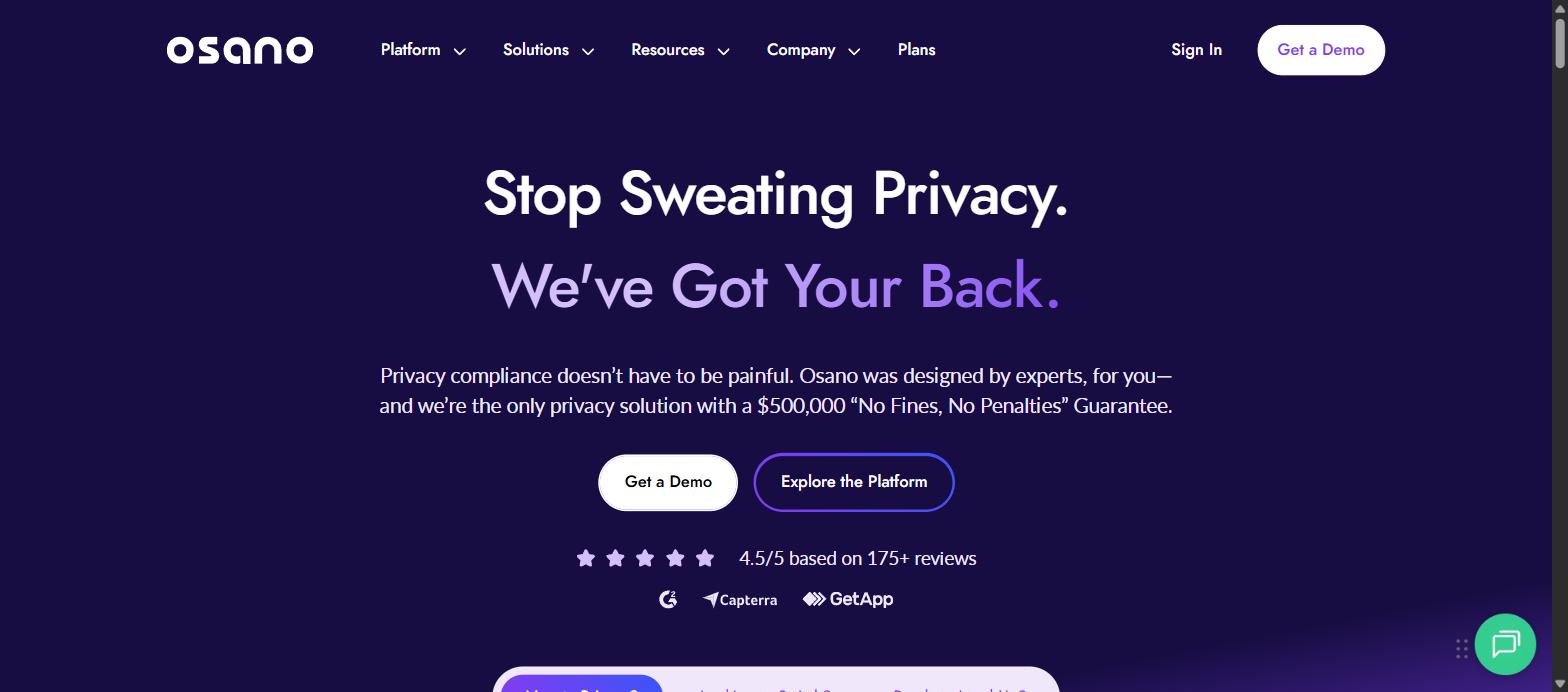
Screenshot of Osano's homepage, captured 2026-09-30, for informational purposes only.
Osano sells itself as the simple, all-in-one data privacy platform, and its product list backs up the "all-in-one" part: cookie consent that manages consent across data privacy laws in "50+ countries," subject rights management that automates the DSAR workflow, data mapping for discovering and classifying personal data stores, assessments with custom or pre-built templates, and a unified consent and preference hub.
Two features are less common.
Its vendor privacy risk product publishes a privacy score for "more than 11,000 vendors" and tracks lawsuits and privacy policy changes. And its Compliance Check monitors your website for gaps in consent, subject rights and policy management. Osano also advertises a $500,000 "No Fines, No Penalties" guarantee and says it's the only privacy solution offering one. That's a marketing claim, and I didn't read the guarantee's terms, so read them before it counts in your decision.
Osano displays a 4.5/5 rating based on 175+ reviews on its own homepage, plus a G2 reviewer's comment that they were up and running "within 4 days." Pricing is the soft spot: the pricing pages I could load didn't show figures. Vendr's figures show a median of $8,750 a year across 44 purchases, range $2,572 to $20,500, and lists traffic, domains and feature tier as the cost drivers.
Key features:
- Cookie consent for privacy laws in "50+ countries" and a unified consent and preference hub
- Subject rights (DSAR) workflow automation
- Data mapping, plus custom and pre-built assessment templates
- Vendor privacy scoring for "more than 11,000 vendors"
- Compliance Check website monitoring; free 30-day trial
Pros
- One platform covers all four jobs, which is rare at this price band
- Fast to start: a free trial and a reviewer-reported four-day setup
- Vendor privacy scoring and website monitoring are useful extras for a small team
Cons
- No pricing visible on the pages I could load; buyer-reported figures vary widely by traffic and tier
- Aimed at mid-market to enterprise organizations, so the smallest teams may pay for more than they use
- The guarantee and the rating are vendor statements I couldn't verify independently
Pricing: Not readable on Osano's site when I checked. Buyer-reported contracts on Vendr (2026-09-30) show a median of $8,750 a year, range $2,572 to $20,500, across 44 purchases. Third-party, not a quote.
Best for: Mid-market companies that want consent, requests, mapping and assessments from one vendor without an enterprise suite's weight.
3. Ketch: Best Data Privacy Software for Consent With Published Pricing
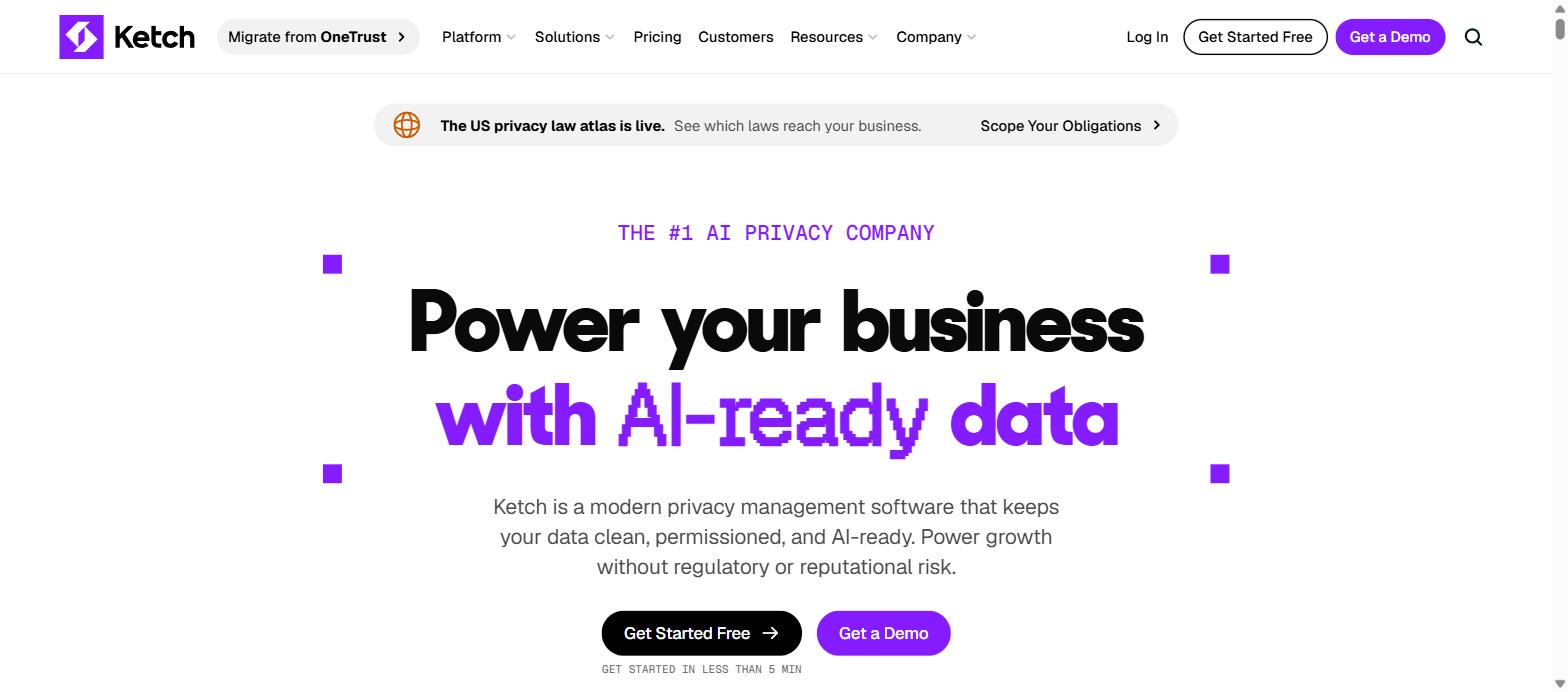
Screenshot of Ketch's homepage, captured 2026-09-30, for informational purposes only.
Ketch organizes its platform into three capabilities: Discovery (data mapping, classification and AI governance), Permissioning (consent management, DSR automation and risk management) and Growth (marketing preferences and progressive consent). It says more than 3,500 brands use it, and it positions itself less as privacy software and more as permissioning infrastructure for marketing and data teams.
What earns it a top-three spot here is something most vendors in this list don't do: it publishes its tiers. The pricing page lists a Free plan at $0 a month for up to 5,000 unique users, Starter at $150 a month for up to 30,000, Plus at $499 a month billed annually for up to 100,000, and a custom Pro tier above that.
Read the tier table closely, though. Core consent management is in every tier, but DSR automation is an add-on on Plus and included only in Pro, and data mapping and risk management are Pro-only. So the price you see is the price for consent. If rights requests or mapping are your main problem, the real number is the custom one. Ketch's own homepage shows a 4.6/5 rating from 175 reviews, which is a vendor-reported figure.
"Thank you for making software that lawyers can use. I can make adjustments quickly and confidently within Ketch without needing to speak code." John Dombrowski, The RealReal (as featured on Ketch's homepage)
Key features:
- Consent management in every tier, including Free
- DSR automation (add-on on Plus, included in Pro)
- Data mapping and risk management (Pro)
- Marketing preference management (Pro)
- Customizable banners, privacy law templates and tracker scanning on all tiers
Pros
- The clearest published pricing of any full-category vendor
- A free tier lets a small team start without a sales call
- A customer testimonial calls it "software that lawyers can use," which points to an interface built for non-engineers
Cons
- DSR automation and data mapping sit in higher tiers, so the headline price covers consent only
- Tiers are metered by monthly unique users, so cost rises with traffic
- Marketing and retail orientation; less obviously a fit for a B2B SaaS company with few website visitors
Pricing: Published: Free ($0, up to 5,000 unique users a month), Starter ($150 a month, up to 30,000), Plus ($499 a month billed annually, up to 100,000), Pro (custom). Checked on ketch.com/pricing 2026-09-30.
Best for: Teams whose first need is a consent banner and preference center, who want to see real prices before talking to sales.
4. ComplyJet: Best Data Privacy Software for Lean SaaS Privacy Programs
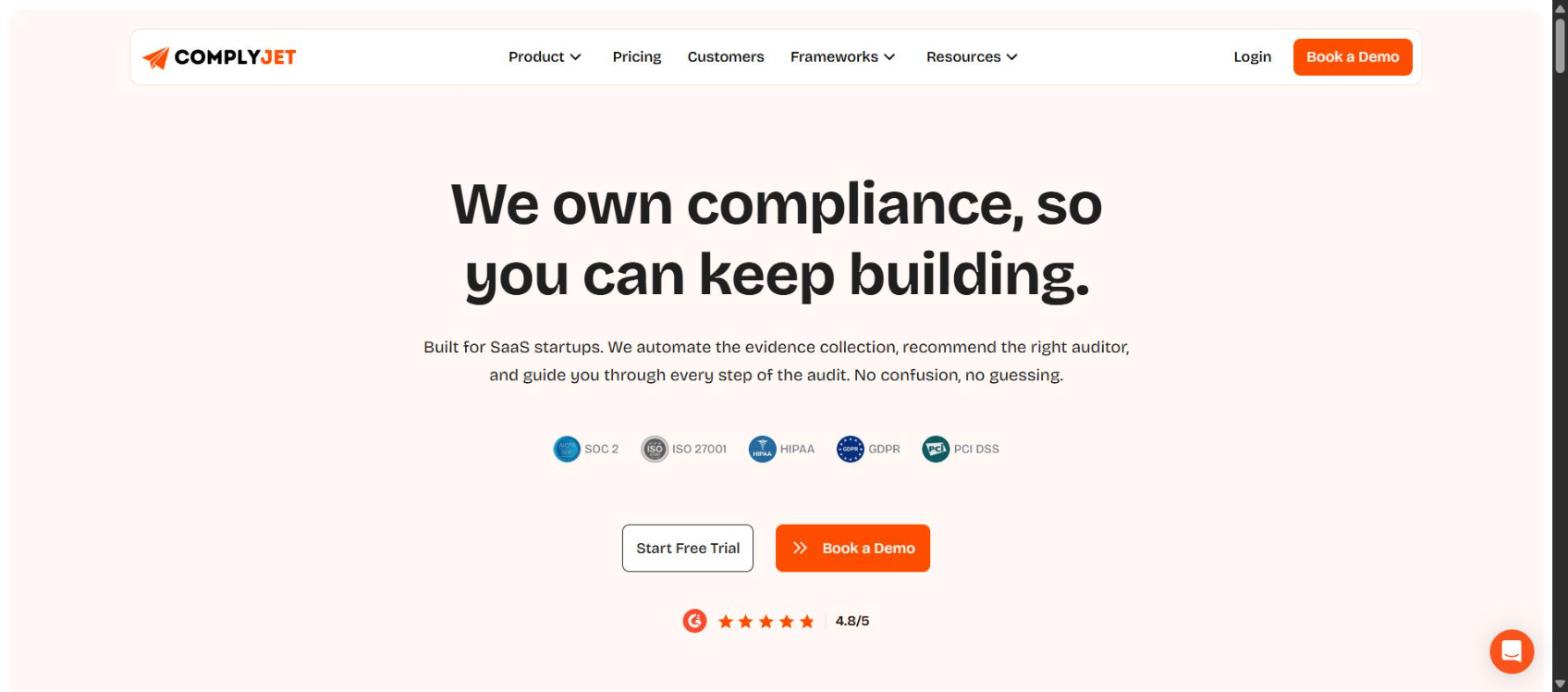
Screenshot of ComplyJet's homepage, captured 2026-09-30, for informational purposes only.
ComplyJet is a compliance automation platform, not a cookie-consent or data-discovery product, and its privacy story is strongest for the early-stage SaaS company whose privacy obligations arrive through customers and audits. Its frameworks page lists GDPR, CCPA, ISO 27701 and ISO 27018 among 20 frameworks, and its GDPR page is specific about what sits behind the name.
That page documents policy templates for privacy notices, data processing agreements, cookie policies and breach response plans; a record of processing activities (ROPA) "built and maintained automatically"; "structured workflows for handling SARs, deletion requests, and rectification requests"; DPIA templates and workflows; tracking of data processing agreements with processors and sub-processors; breach notification readiness covering the 72-hour requirement; and vendor risk management for third-party processors.
Underneath it runs the usual platform: 350+ integrations, continuous monitoring of the technical and organizational measures behind GDPR Article 32, a Trust Center, and a team that guides you through the process instead of leaving you alone with the software.
Pricing is flat and per company: $7,999 a year for Core and $9,999 a year for Plus on the 3-year plan, up to 50 employees. Core covers one framework package and Plus two, per its pricing page. As a team grows from five people to thirty or forty inside that band, the price stays the same. One disclosure: ComplyJet publishes this blog, and I've written its limits as plainly as the others'.
Here's where it stops.
The GDPR page documents no consent management (no banner or preference center), no cookie scanner beyond a cookie policy template, no automated discovery of personal data beyond the ROPA, and no international-transfer tooling. CCPA and ISO 27701 appear on the frameworks list, but neither has its own page, so I can confirm they're listed and nothing more specific. If you need a consent banner or high-volume request handling, #1 to #3 and #7 are the tools for that job.
Key features:
- GDPR policy templates: privacy notices, DPAs, cookie policies, breach response plans
- ROPA built and maintained automatically; DPIA templates and workflows
- Workflows for SARs, deletion and rectification requests
- DPA tracking for processors and sub-processors; vendor risk management on every plan
- 350+ integrations, continuous monitoring, Trust Center; GDPR, CCPA, ISO 27701 and ISO 27018 among 20 frameworks
Pros
- Privacy sits inside one security compliance program instead of becoming a second tool and a second bill
- Flat, published per-company pricing with no per-seat creep
- A team that guides you through the work, useful for a first privacy program
Cons
- No consent banner or preference center, and no cookie scanning tool
- No automated personal-data discovery beyond the ROPA, and no international-transfer tooling on the GDPR page
- CCPA and ISO 27701 are listed as frameworks but have no dedicated pages; check what each includes
- Smaller and newer than OneTrust or Vanta, with a small G2 base: 4.9 out of 5 from 16 reviews as of 2026-09-29
- Core is one framework package and Plus two, so a program spanning several frameworks needs a conversation about scope
Pricing: $7,999/year Core and $9,999/year Plus on a 3-year plan, up to 50 employees, published at complyjet.com/pricing. Flat per company, not per seat.
Best for: Early-stage SaaS companies whose privacy work is driven by enterprise customers and audits, and who want it inside a single compliance program.
Privacy Inside Your Compliance Program
See what ComplyJet covers for GDPR and CCPA.
Walk through the ROPA, request workflows, DPIA templates and DPA tracking on ComplyJet's GDPR page, and ask about CCPA and ISO 27701 scope for your stack. A team guides you through it, at one flat per-company price.
5. Vanta: Best Data Privacy Software for Teams Already on Vanta
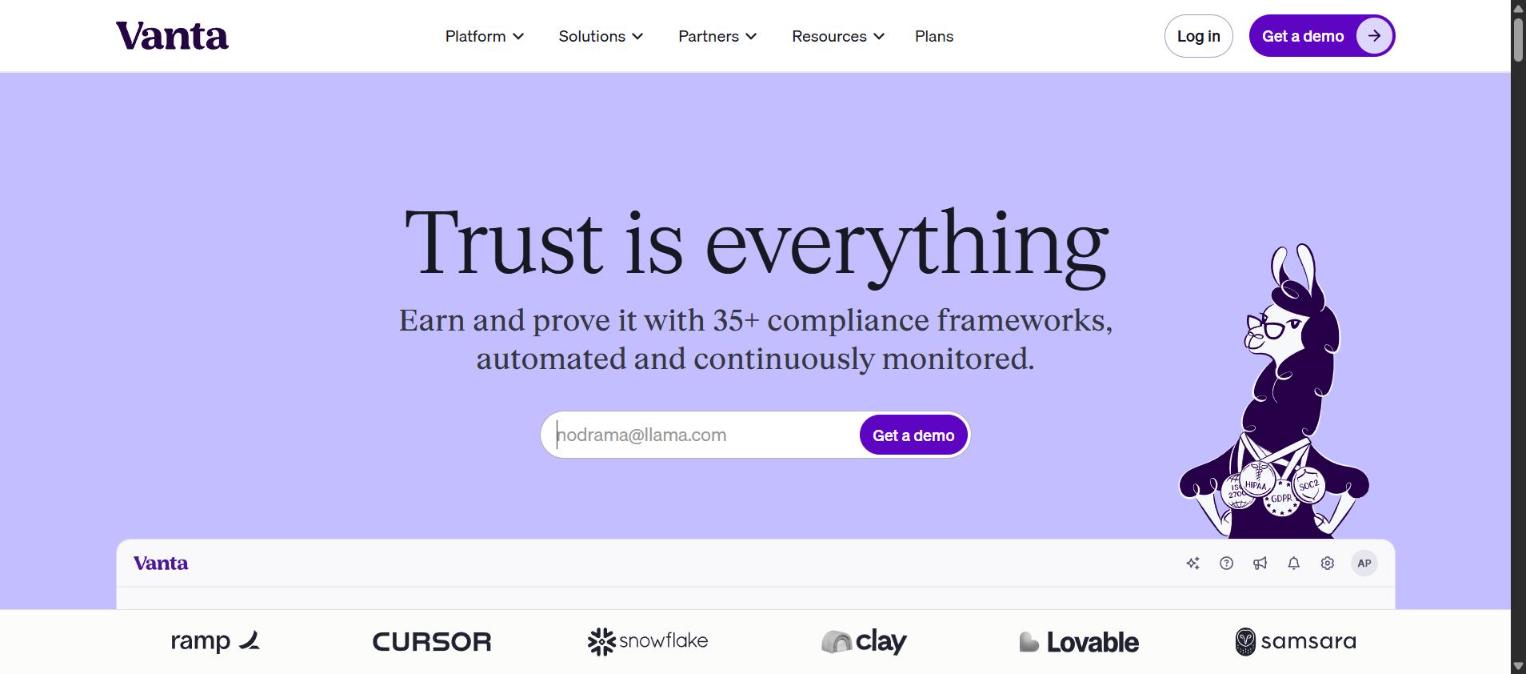
Screenshot of Vanta's homepage, captured 2026-09-30, for informational purposes only.
Vanta is the compliance-automation category default, and its privacy product is newer than its security one.
Its Privacy Management help article describes three pieces: a data inventory and ROPA hub for recording processing activities and exporting records for GDPR, ISO 27701, ISO 27018 and its US data privacy framework; assessments for authoring and approving DPIAs, legitimate interest assessments and transfer risk assessments; and custom fields for aligning records to your organization. You need a current Vanta plan with a privacy framework enabled to use it.
Vanta's Privacy Foundations page lists GDPR, US data privacy (CCPA/CPRA, CTDPA, VCDPA), ISO 27701 and ISO 27018, and says organizations with a SOC 2 or ISO 27001 foundation can reach key privacy framework compliance "in as little as a week." That timeline is a vendor claim.
The same page says Vanta manages "user consent, data removal requests, and privacy notices," while the Privacy Management help article documents only inventory, ROPA and assessments. Ask in the demo exactly what the consumer-rights piece does in practice.
Vanta's pricing page shows four tiers (Essentials, Plus, Professional, Enterprise) with no dollar figures and no privacy mention, so treat privacy as something to price explicitly during the quote.
Key features:
- Data inventory and ROPA exports for GDPR, ISO 27701, ISO 27018 and USDP
- DPIA, LIA and TRA authoring and approval inside the platform
- Privacy frameworks: GDPR, CCPA/CPRA, CTDPA, VCDPA, ISO 27701, ISO 27018
- Runs on the same connected program as SOC 2 and ISO 27001
Pros
- Privacy work reuses evidence you already collect for SOC 2 or ISO 27001
- Explicit assessment tooling (DPIA, LIA, TRA), which several compliance platforms lack
- Large, well-known vendor with a broad integration base
Cons
- The help article documents no DSAR, consent or cookie tooling
- Privacy Management requires a current plan with a privacy framework enabled
- No published pricing, and the pricing page doesn't mention privacy
Pricing: Not published. Vanta's pricing page lists four tiers without dollar figures; quotes are personalized.
Best for: Teams already running SOC 2 or ISO 27001 on Vanta that need a structured RoPA and DPIA process for GDPR or ISO 27701.
6. Drata: Best Data Privacy Software for Teams Already on Drata
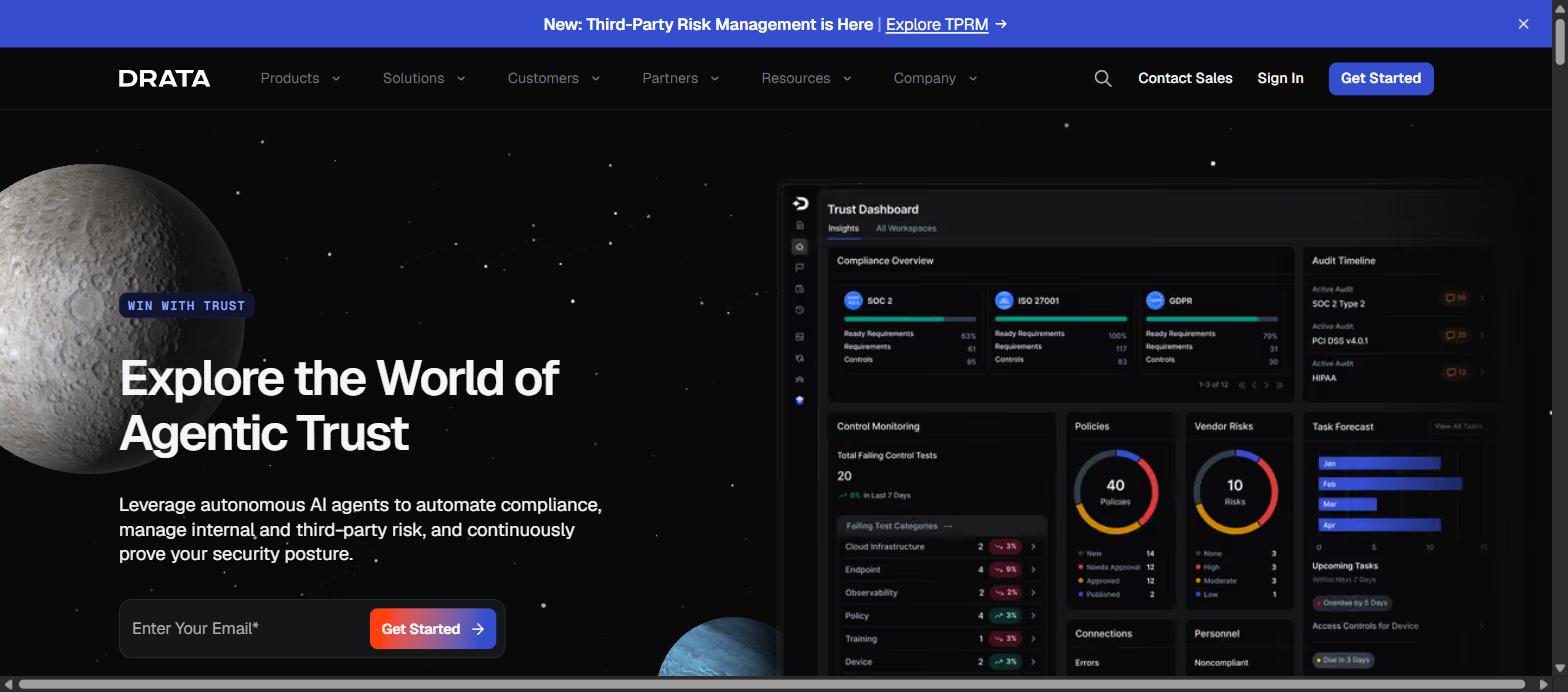
Screenshot of Drata's homepage, captured 2026-09-30, for informational purposes only.
Drata approaches privacy as a control-mapping problem. Its CCPA page describes mapping CCPA requirements "to a centralized, control-centric structure," extending CCPA requirements to vendor assessments so enterprises can evaluate how third parties collect, use and protect personal data, and linking privacy risks directly to CCPA controls, ownership and evidence. It also lists a "Map Consumer Data" capability that ties controls to the systems that handle consumer data.
Beyond CCPA, Drata's framework list includes GDPR, ISO 27701 and ISO 27018, so a company already on Drata for SOC 2 can add privacy frameworks to one evidence base. What I didn't find on the CCPA page is explicit DSAR handling; it refers to "support request readiness," which is a readiness posture, not a request workflow. As with Vanta, ask what request handling looks like in the product before you assume it's there.
Drata publishes no pricing on the pages I read.
Key features:
- CCPA requirements mapped to controls, owners and evidence
- Vendor assessments extended to third-party data handling
- "Map Consumer Data" ties controls to systems holding consumer data
- GDPR, ISO 27701 and ISO 27018 alongside SOC 2 and ISO 27001
Pros
- Privacy controls share evidence and ownership with the rest of your compliance program
- Privacy risks link directly to controls and owners
- Established vendor for multi-framework programs
Cons
- No explicit DSAR workflow found on its CCPA page
- No consent management or cookie tooling described
- No published pricing
Pricing: Not published.
Best for: Teams already on Drata that want privacy frameworks mapped into the same control set.
Already Running SOC 2?
Add privacy without buying a second platform.
If SOC 2 or ISO 27001 is already in motion, ComplyJet's GDPR ROPA, request workflows and DPIA templates sit on the same connected program, with a team guiding the work and one flat per-company price.
7. DataGrail: Best Data Privacy Software for DSAR Automation at Scale
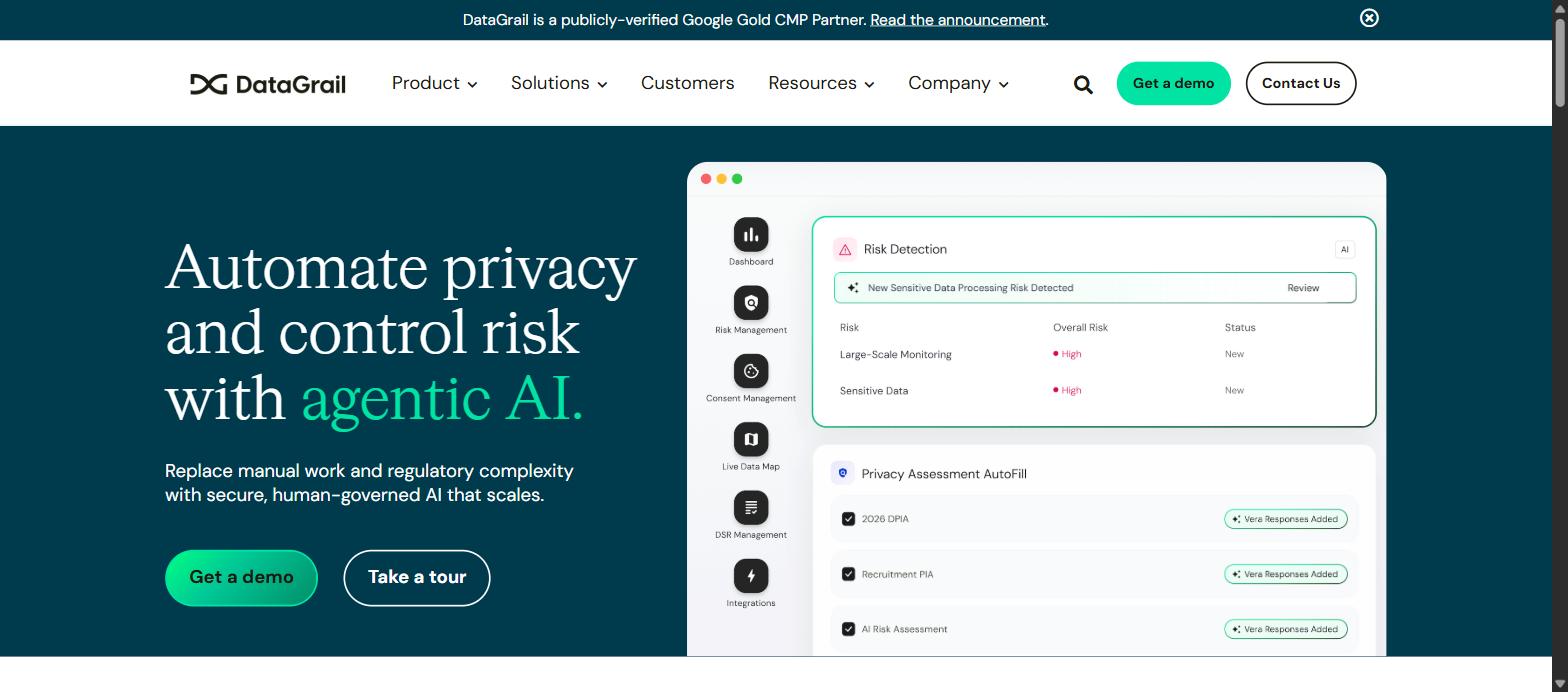
Screenshot of DataGrail's homepage, captured 2026-09-30, for informational purposes only.
DataGrail calls itself the agentic data privacy platform, built for non-technical privacy teams. Its product list covers a Live Data Map, consent management, a Request Manager for fulfilling data subject requests across applications, privacy assessments (PIAs, DPIAs and AI risk assessments), a risk register, and Vera, an AI privacy agent.
The headline number is integration breadth: DataGrail states 2,500+ integrations, which matters because request fulfillment is only as good as its reach into the systems holding the data. It also says it runs single-tenant and doesn't train models on customer data. Both are vendor statements I'd ask to see in writing.
It's priced for the customers it names, which include HubSpot, nCino and MLS. Vendr lists a median of $50,000 a year across 73 purchases, with a range from $20,000 to $365,500, and lists data subject volume, request volume, connected systems and modules as the drivers. That's the highest median in the privacy-specialist group aside from Transcend's average.
Key features:
- Request Manager for DSAR fulfillment across applications
- Live Data Map and privacy assessments (PIAs, DPIAs, AI risk)
- Consent management and a risk register
- Vera AI privacy agent; 2,500+ integrations (vendor-stated)
Pros
- Deep request automation for companies that receive real volume
- Integration breadth reduces manual fulfillment work
- Designed for privacy teams without heavy engineering support
Cons
- No published pricing; buyer-reported median around $50,000 a year is well above a lean company's budget
- Built for enterprise consumer brands; likely more than a B2B SaaS team with low request volume needs
- Key claims (single-tenant, no model training) are vendor statements
Pricing: Not published. Buyer-reported contracts on Vendr (2026-09-30) show a median of $50,000 a year, range $20,000 to $365,500, across 73 purchases. Third-party, not a quote.
Best for: Consumer-facing companies with a privacy team and a steady, significant volume of rights requests.
8. Securiti: Best Data Privacy Software for Data Discovery Across Clouds
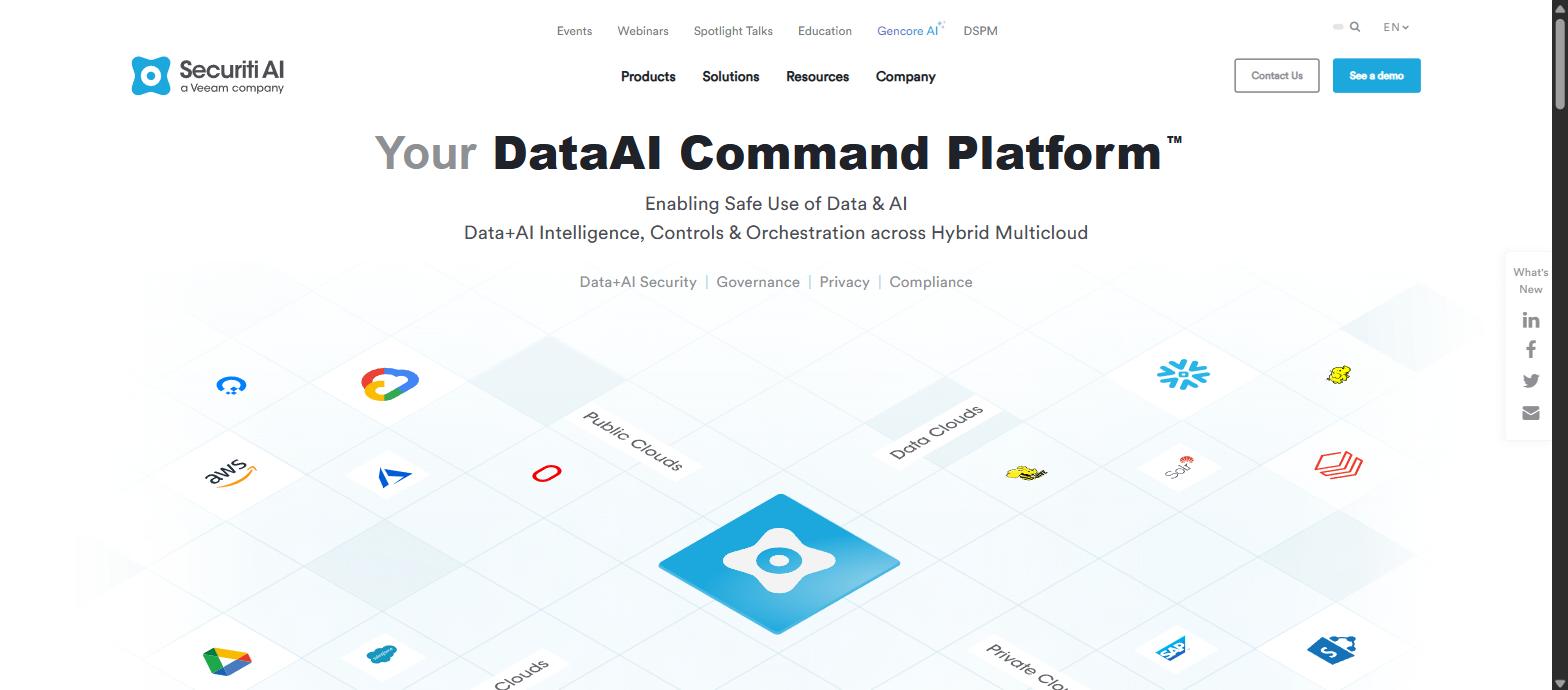
Screenshot of Securiti's homepage, captured 2026-09-30, for informational purposes only.
Securiti sells privacy as one part of a wider Data Command Center, described as a unified platform for data and AI security, governance, privacy and compliance across hybrid multicloud and SaaS environments. Its privacy product list covers DSR automation from request intake to report delivery, consent management including mobile apps, data mapping with automated RoPA reports, assessment automation, breach management and a consumer-facing Privacy Center.
That framing is the point and the catch. If your security and data teams are already evaluating data security posture tooling, privacy arrives on the same discovery engine. If they aren't, you're buying a large platform for one of its modules. Securiti names finance, healthcare, telecom, retail and manufacturing as target industries, and publishes no pricing.
Vendr reports a buyer-reported median of $49,841 a year with a range from $4,650 to $80,612, a third-party figure that will vary with the modules you activate.
Key features:
- DSR automation from intake to secure report delivery
- Consent management including mobile app consent
- Data mapping with automated RoPA reports
- Assessment automation, breach management and a Privacy Center
Pros
- Privacy, data security and governance share one discovery layer
- Covers all four jobs, including automated RoPA
- Suited to complex, multi-cloud data estates
Cons
- No published pricing; buyer-reported median near $50,000 a year
- Enterprise orientation; more platform than a lean team will use
- Value depends on adopting it beyond privacy
Pricing: Not published. Buyer-reported contracts on Vendr (2026-09-30) show a median of $49,841 a year, range $4,650 to $80,612. Third-party, not a quote.
Best for: Enterprises that want privacy on the same platform as data security and governance.
9. TrustArc: Best Data Privacy Software for Assessments and Certifications
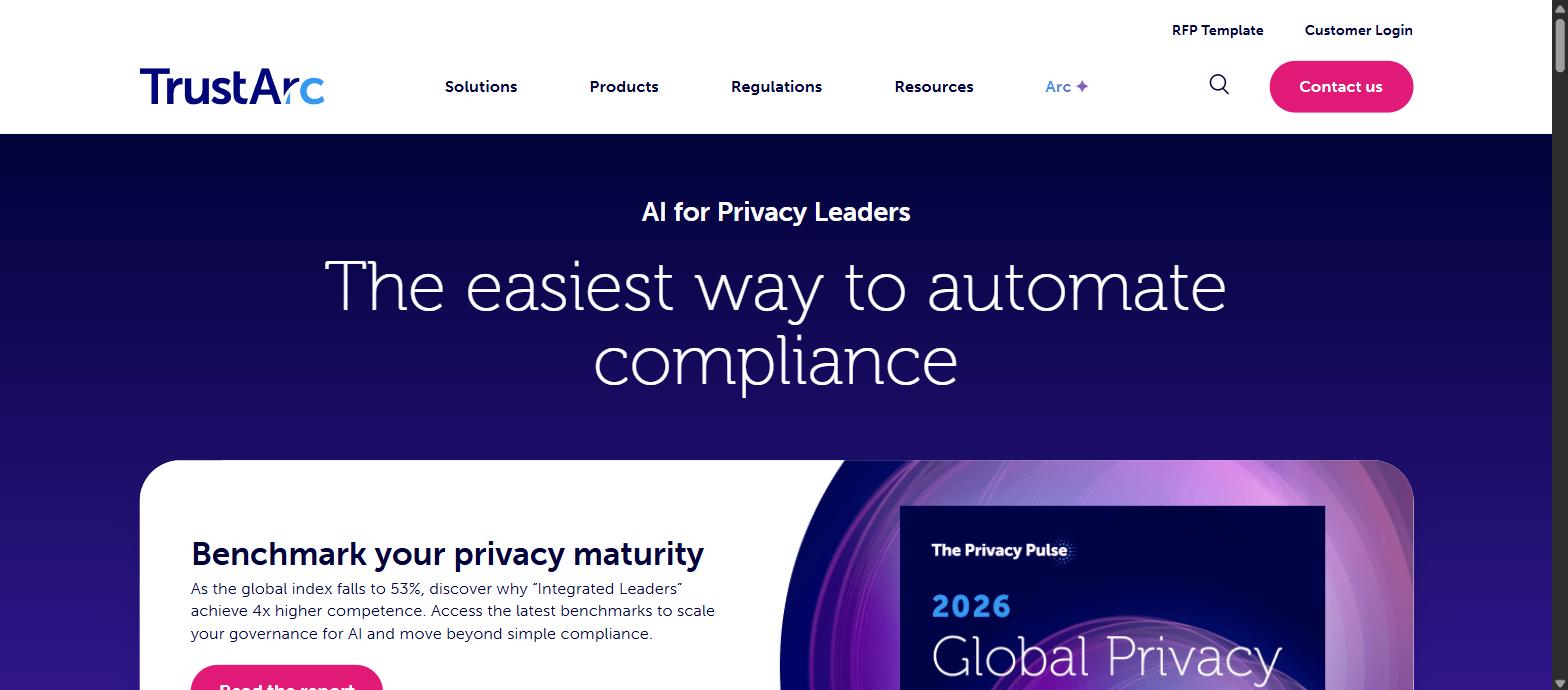
Screenshot of TrustArc's homepage, captured 2026-09-30, for informational purposes only.
TrustArc structures its offering in three parts. Privacy Studio covers a Cookie Consent Manager, a Consent and Preference Manager, an Individual Rights Manager and a Trust Center. The Governance Suite covers PrivacyCentral, a Data Mapping and Risk Manager, an Assessment Manager and Nymity Research. Assurance Services adds certifications, including CCPA/CPRA Validation and GDPR Validation among others.
The assurance and research side is what separates TrustArc from pure software vendors. If you need third-party validation of your privacy practices or a research library behind your assessments, it's a real option. TrustArc says it serves more than 1,500 companies and names enterprise brands among them.
Pricing isn't published. Vendr reports a buyer-reported median of $15,660 a year across 54 purchases, range $8,096 to $43,985. It's modular, so the number depends on which products you pair.
Key features:
- Privacy Studio: cookie consent, preferences, individual rights, Trust Center
- Governance Suite: data mapping, risk, assessments, Nymity Research
- Assurance Services: privacy certifications and validations
- Coverage including GDPR, CCPA/CPRA, Virginia CDPA and India's DPDPA
Pros
- Assessment and research depth few rivals match
- Certification and validation services go beyond software
- Covers all four jobs
Cons
- No published pricing; modular buying
- Enterprise orientation ("premier enterprise compliance" in its own words)
- More product to configure than a first-time program needs
Pricing: Not published. Buyer-reported contracts on Vendr (2026-09-30) show a median of $15,660 a year, range $8,096 to $43,985, across 54 purchases. Third-party, not a quote.
Best for: Organizations that want assessments, regulatory research and third-party privacy validation alongside software.
10. BigID: Best Data Privacy Software for Data-Centric Privacy
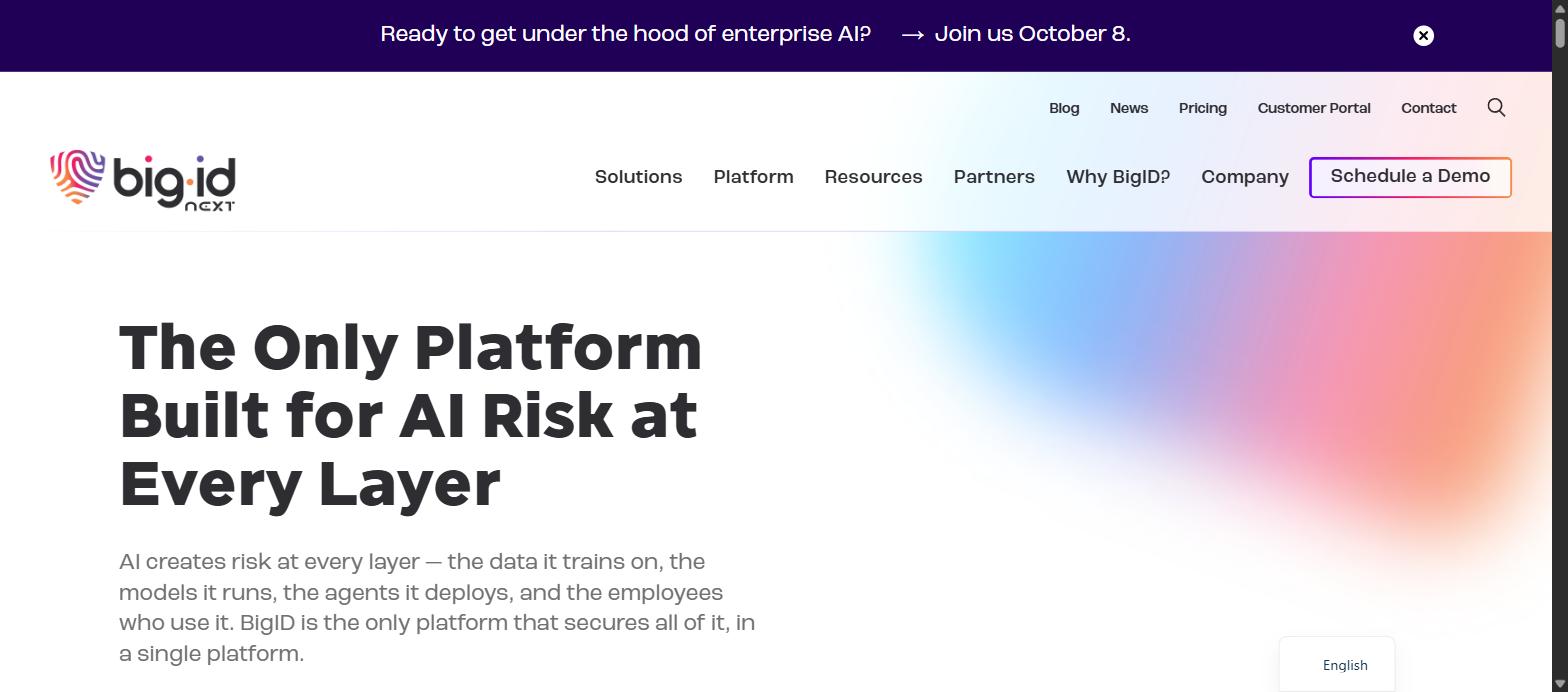
Screenshot of BigID's homepage, captured 2026-09-30, for informational purposes only.
BigID's argument is that most privacy tools manage forms and checklists disconnected from the actual data. Its privacy product connects workflows to discovery: data discovery and classification, data rights automation (access, deletion, correction, redaction and validation), consent and cookies, RoPA mapping, PIAs and DPIAs, and retention and deletion enforcement.
That makes it the natural pick for a company whose hard problem is knowing where personal data lives across cloud, SaaS and on-premises systems. A discovery-led product generally means connecting it to your data stores before it produces value, so expect a real implementation, not a same-week setup. That's my read of the approach, not a BigID statement.
BigID publishes no pricing, and I couldn't find a buyer-reported figure (Vendr's page for it returned an error), so I won't guess a number.
Key features:
- Data discovery and classification across cloud, SaaS and on-premises
- Data rights automation: access, deletion, correction, redaction, validation
- RoPA mapping and PIAs/DPIAs built on discovered data
- Retention and deletion enforcement with audit evidence
Pros
- Privacy workflows grounded in discovered data, not manual inventories
- Strong on retention and deletion enforcement
- Covers all four jobs
Cons
- No published pricing and no buyer-reported figure found
- Aimed at large data estates; more implementation effort than a lean team wants
- No customer quote or rating to cite from its privacy page
Pricing: Not published; no third-party figure found.
Best for: Organizations with large, scattered data estates where discovery accuracy is the main problem.
11. Transcend: Best Data Privacy Software for Runtime Data Governance
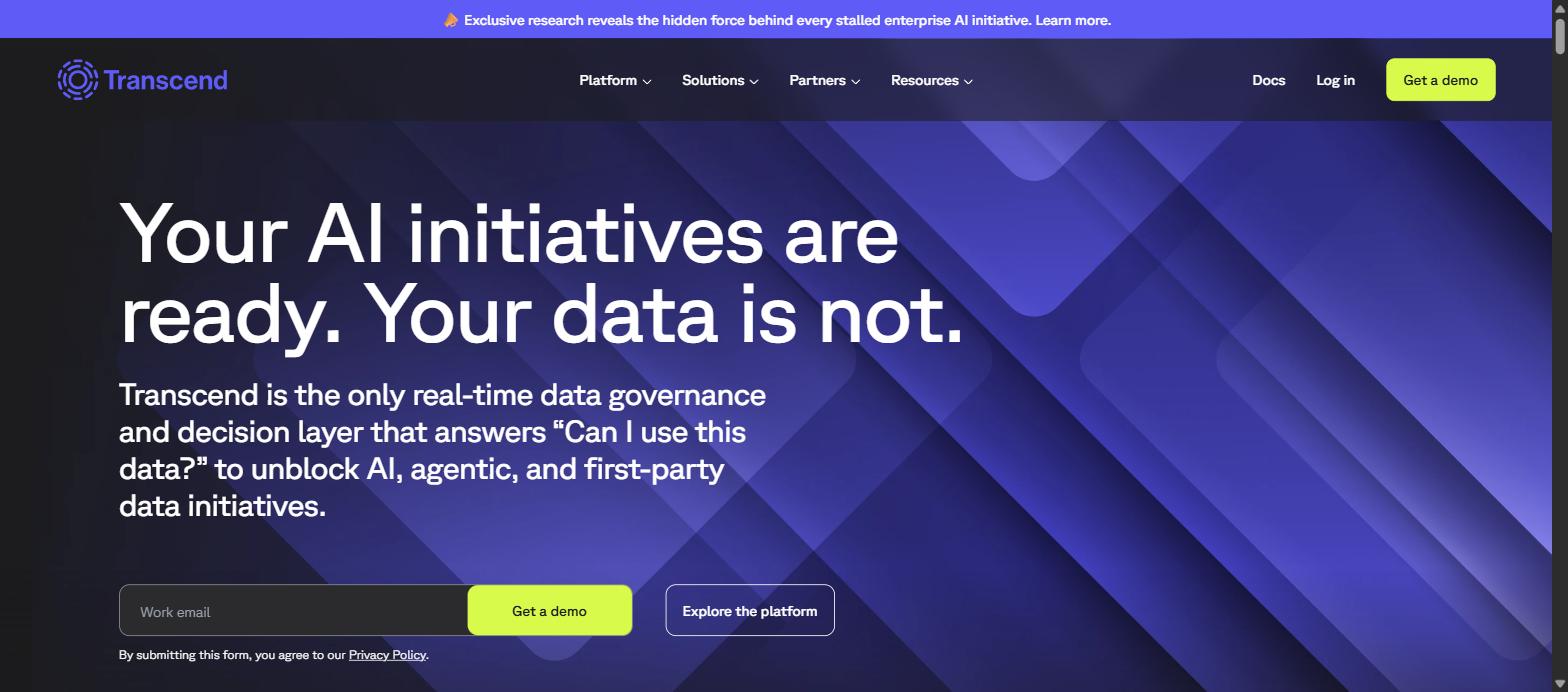
Screenshot of Transcend's homepage, captured 2026-09-30, for informational purposes only.
Transcend describes itself as a real-time data governance and decision layer that answers "Can I use this data?" Its components include a Policy Engine that encodes business policy, regulatory context and customer permissions into real-time decisions, consent and preference management, DSR automation, data governance with column-level classification, and AI governance through runtime enforcement.
The pitch is enforcement, not documentation: rather than recording what you intend, it applies the rules where data is used. Transcend says competitors like OneTrust, Securiti and BigID solve single components, which is a positioning claim rather than a verified comparison. The approach suits engineering-led organizations with data and AI initiatives to govern.
Pricing isn't published. Vendr lists an average contract value of $76,075 a year, the highest in this set, so it's rarely the first tool for a lean company.
Key features:
- Policy Engine that turns policy and consent into real-time decisions
- Consent and preference management; DSR automation
- Column-level data classification updated in real time
- AI governance through runtime enforcement
Pros
- Enforces privacy rules where data is used, not only in documents
- Strong fit for engineering-led data and AI programs
- Covers consent, rights requests and governance in one layer
Cons
- No published pricing; Vendr average near $76,000 a year
- Enterprise and engineering-led; heavy for small teams
- Its "only vendor" positioning is a vendor claim, not an independent finding
Pricing: Not published. Vendr's marketplace data (2026-09-30) lists an average contract value of $76,075 a year. Third-party, not a quote.
Best for: Enterprises with engineering-led data programs that want privacy and consent enforced at runtime.
How to Choose Data Privacy Software for Your Company
The list gets you to a shortlist. If you're working out how to choose data privacy software, these five questions get you to a choice.
Start With the Data Privacy Compliance Software Job You Actually Have
Write down which of the four jobs is causing the real pain this quarter.
If it's a customer asking for a RoPA and a DPIA, you need records and assessments, and a compliance platform with privacy frameworks covers that. If it's a consent banner on a high-traffic site, you need a consent tool. If it's hundreds of rights requests a month, you need request automation with deep integrations. Buying data privacy compliance software for all four jobs at once is how small teams end up with an enterprise contract and a spreadsheet anyway.
Company Stage and Team Size
Under about 50 people with no privacy owner, favor tools that come with guidance and a bounded scope: #2 to #6 here. Between roughly 50 and 500, with a named privacy or legal owner, the specialist tools open up. Above that, with real request volume and several jurisdictions, the enterprise suites are built for you.
Budget and Pricing Model for Privacy Compliance Software
Ask whether the price is per company, per traffic tier, per request volume or per module, because each scales differently. Flat per-company pricing stays predictable as you grow, which is worth weighing when you compare privacy compliance software on price. Traffic-metered pricing, common in consent tools, rises with your site.
Module-based pricing rises with scope. The buyer-reported medians above run from $8,750 to $50,000 a year for the specialists (Transcend's average is higher still), before implementation, which is a useful range to hold a quote against.
Which Laws You Need to Cover
List the laws you actually face: GDPR if you handle EU or UK residents' data, CCPA/CPRA and the other US state laws if you sell to consumers or businesses in those states. Then check the vendor's own page for each. "Supports CCPA" can mean a policy template, a control mapping or a full request workflow, and the difference decides whether it solves your problem.
When Customers Are the Ones Asking for Privacy Software
A lot of buyers in this position aren't being pushed by a regulator. They're being pushed by an enterprise customer's questionnaire.
In that case the tool's job is to make your answers true and provable: current records, documented assessments, processor agreements on file. A compliance platform that already runs your security evidence can do that without a second system. And if your only privacy need is a cookie banner, one Hacker News commenter made a point worth weighing against the marketing:
"you don't need TrustArc, OneTrust or other shady products on every website" whstl, Hacker News, 2025-01-25 (a developer's opinion on cookie banners specifically)
That's one opinion about cookie banners and it isn't legal advice, but it's a fair prompt to confirm what your obligations actually require before you buy more than that.
Choosing Between a Specialist and a Platform?
Talk it through with a team that has seen both.
If your privacy work is driven by customer questionnaires and audits, ComplyJet can show you how GDPR, CCPA and ISO 27701 fit inside one compliance program. If a specialist is the better fit, that's a useful answer to get before you sign.
FAQs
What Is Data Privacy Management Software?
It's software that runs the operating side of a privacy program across laws: consent records, rights requests, data mapping and records of processing, and assessments. It's broader than a one-law compliance tool and broader than a cookie banner.
What Is the Difference Between Privacy Management Software and Consent Management Software?
Consent management is one of the four jobs: the banner, the preference center and the record of what each visitor agreed to. Privacy management software covers consent plus rights requests, data mapping and assessments. Some vendors sell both as one suite, and some sell consent alone.
Do Startups Need Data Privacy Software?
Not always a dedicated tool. A startup needs the outputs: a privacy notice, a record of processing, a way to handle access and deletion requests, and assessments for high-risk processing. Many early-stage companies meet those inside a compliance automation platform, and add a consent tool only when their site or app needs one.
How Much Does Data Privacy Management Software Cost?
It varies by vendor model. Ketch publishes tiers from free to $499 a month on annual billing, and ComplyJet publishes flat pricing from $7,999 a year. Most specialists don't publish prices. Vendr's buyer-reported medians (2026-09-30) run from $8,750 a year for Osano to $15,660 for TrustArc and about $50,000 for DataGrail and Securiti, before implementation.
Can Vanta or Drata Handle GDPR and CCPA?
Both list GDPR and CCPA among their frameworks and map them to controls and evidence. Vanta also documents a Privacy Management product with data inventory, RoPA and DPIAs. Neither's documentation that I read describes a consent banner or a full rights-request workflow, so confirm that in a demo if you need one.
Does Data Privacy Software Handle DSAR Requests?
Most specialist platforms do, with intake, identity verification and fulfillment across connected systems. Compliance platforms vary: ComplyJet documents request workflows for SARs, deletion and rectification, while Vanta's and Drata's pages I read don't describe full request handling. Check how the vendor handles your volume.
Is Data Privacy Software the Same as GDPR Compliance Software?
No. GDPR compliance software is scoped to one regulation, while data privacy software runs a program across GDPR, CCPA and other laws. ComplyJet's best GDPR compliance software comparison covers the single-law case.
How Long Do You Have to Respond to a DSAR Under GDPR and CCPA?
Under GDPR Article 12(3), within one month of receipt, extendable by two further months where necessary, with notice to the person. Under CCPA, within 45 calendar days, extendable by another 45 if the business notifies the consumer, per the California Attorney General.
Which Data Privacy Software Is Best for a Small SaaS Company?
It depends on which job hurts. For a consent banner with a free start, Ketch. For one suite across all four jobs, Osano. For privacy driven by customer questionnaires inside a compliance program, ComplyJet, Vanta or Drata. The enterprise suites fit once request volume and jurisdictions grow.
Final Thoughts on the Best Data Privacy Software
Every tool here can run part of a privacy program, and the differences are in which part. The specialists go deepest on consent, requests and data discovery. The compliance platforms are the more practical fit when your privacy work comes from customers and audits and you'd rather not run two systems.
If you take one thing from this guide, let it be the two-markets split. Decide which of the four jobs is actually hurting, then read the vendor's own page for that job before you believe the category label. ComplyJet is the considered choice for a lean SaaS team that wants privacy inside its compliance program, with the limits I listed above.
Free Demo
See how ComplyJet handles privacy and security together.
Talk to ComplyJet about GDPR, CCPA and ISO 27701 alongside SOC 2 and ISO 27001, with a team that guides you through it and flat per-company pricing.
Related Reading on the Best Data Privacy Software
- Best GDPR Compliance Software, for the single-law comparison focused on GDPR.
- Best CCPA Compliance Software, for the California-specific ranking.
- Best ISO 27701 Software, for the privacy management system standard.
- CCPA Compliance Guide, for requirements, rights and a checklist.
- GDPR Compliance Requirements, for what GDPR actually asks of a SaaS company.
- Best GRC Software, for teams weighing a wider governance, risk and compliance platform.
- Best Trust Center Software, for publishing your privacy and security posture to customers.
Sources: Vendor capabilities read from each vendor's own pages on 2026-09-30: OneTrust privacy automation, Osano, Ketch and Ketch pricing, Vanta Privacy Management, Vanta Privacy Foundations and Vanta pricing, Drata CCPA, DataGrail, Securiti, TrustArc, BigID privacy, Transcend, and ComplyJet's frameworks, GDPR and pricing pages. Legal timelines: GDPR Article 12 and the California Attorney General's CCPA page. Buyer-reported pricing from Vendr: OneTrust, TrustArc, Osano, DataGrail, Securiti and Transcend, flagged in-text as third-party. Practitioner comments: Hacker News items 46450134, 42820710 and 39743557.