Executive Summary
Someone sends you a security questionnaire with a line that reads "describe your AI TRiSM program." Or a vendor email says their product "delivers AI TRiSM." You nod, then quietly search the term.
AI TRiSM stands for AI trust, risk and security management. Gartner coined the term and, in its 2025 market guide, describes four layers of technical capability that enforce AI governance policy: AI governance, AI runtime inspection and enforcement, information governance, and infrastructure and stack. It is an analyst framework, not a standard, a regulation or a certification.
That last sentence matters more than it looks. Vendors use AI TRiSM as a product category, and it is also a useful checklist of the jobs an organization has to do to use AI safely. The AI TRiSM Gartner market guide is the source of the four-layer model, and the older "pillar" lists you will find online come from vendors. I use the AI TRiSM framework in this piece as a scoping checklist, not as something to buy.
Two of the four layers are new to AI. The other two are ordinary security and data controls pointed at AI, and a company that already runs SOC 2 or ISO 27001 is partly doing them. That is why a small team can start smaller than most vendor pages suggest.
By the end you will know what each layer covers, why the lists of "pillars" disagree with each other, how AI TRiSM sits beside AI governance, the NIST AI RMF and ISO 42001, and which layers to build first.
Here's what I'll cover:
- What the term means and who uses it
- The four layers, and what each one produces as evidence
- Why pillar lists and layer lists are different models
- How it maps to the NIST AI RMF and ISO 42001
- What software each layer needs, and a first-90-days order for a small team
This article explains the concept. If you are comparing platforms, see our guide to the best AI risk management software, and for building the program itself, see how to build an AI governance framework.
What AI TRiSM Means: AI Trust, Risk and Security Management Defined
AI TRiSM is short for AI trust, risk and security management, a Gartner term for the controls that keep AI systems reliable, secure and aligned with what an organization intends them to do across their life cycle. It bundles three jobs that usually belong to three different teams.
- Trust: can you explain, rely on and audit what the model does?
- Risk: what could go wrong, how likely is it, and how bad would it be?
- Security: who or what could misuse, attack or leak from the system?
The MIT AI Risk Repository, which is not a vendor, describes AI TRiSM in the same three parts (AI trust management, AI risk management and AI security management) and says it is meant to apply across the whole life cycle of an AI system.
Where the Term Came From and Who Uses It
Every vendor page attributes the term to Gartner. Palo Alto Networks says Gartner developed it, and Bigeye says the first version, in 2022, had five capability areas before the current four-layer model replaced it. Gartner's own pages were not readable when I researched this piece, so the Gartner details below are attributed to the sources that describe them.
AvePoint, writing in August 2025, summarizes Gartner's 2025 TRiSM report, and Mindgard describes that edition as the third edition of the Market Guide for AI Trust, Risk and Security Management. In practice that means a market guide: analyst research on a category of products, written for buyers.
Quick take
When someone says "AI TRiSM," ask which of two things they mean: the Gartner four-layer market model, or a vendor's own list of pillars. They are not the same, and the difference is covered below.
AI TRiSM Is a Framework, Not a Standard or a Certificate
No AI TRiSM standard, regulation, audit or certificate exists in any source I reviewed. Nobody can be "AI TRiSM compliant," and a vendor that says so is borrowing the label.
That is the practical difference from ISO 42001, which a company can be certified against, and from the NIST AI RMF, which is voluntary guidance. Those two are what a customer or auditor can actually check, which is why they come up later in this piece.
ISO 42001
The certifiable baseline for the governance layer
AI TRiSM is not something you can be certified against, but ISO 42001 is. ComplyJet's ISO 42001 workspace provides ISO 42001-specific policies, a structured AI risk assessment workflow, AI impact assessment templates and automated evidence collection, with a team that drives the process. Most startups can reach certification in 3 to 6 months, per our framework page.
Why AI TRiSM Matters Now for Companies That Are Not Building Models
Most companies are not training models. They are calling an API from their product, and their staff are pasting work into chat tools. That is where the TRiSM questions land: who approved this, what data went where, and who can see the output.
Four situations bring it up fastest:
- Unapproved AI use. Staff adopt tools nobody reviewed. We cover the detection and policy side in our guide to shadow AI risk.
- Data leaving through prompts and outputs. Customer data pasted into a public tool, or model output that exposes something it should not. See generative AI security risks.
- Third-party models and AI suppliers. The model is someone else's, but the risk sits with you. Our AI vendor risk management guide covers the due diligence.
- Customer security reviews. Enterprise buyers now ask AI questions next to the SOC 2 ones, and "we have a policy" is no longer a complete answer.
AvePoint's summary of the 2025 report lists internal oversharing, where employees enter confidential or regulated data into generative AI tools, as a bigger threat than external attackers. It also says many organizations are still in a "governance on paper" phase, with policies but without the operational controls to enforce them.
Watch out
"Governance on paper" is the failure the four-layer model exists to prevent. A policy that nothing enforces, and no evidence that anyone checked, is the first thing an auditor or enterprise buyer will see through.
The Four AI TRiSM Layers in Gartner's Market Guide
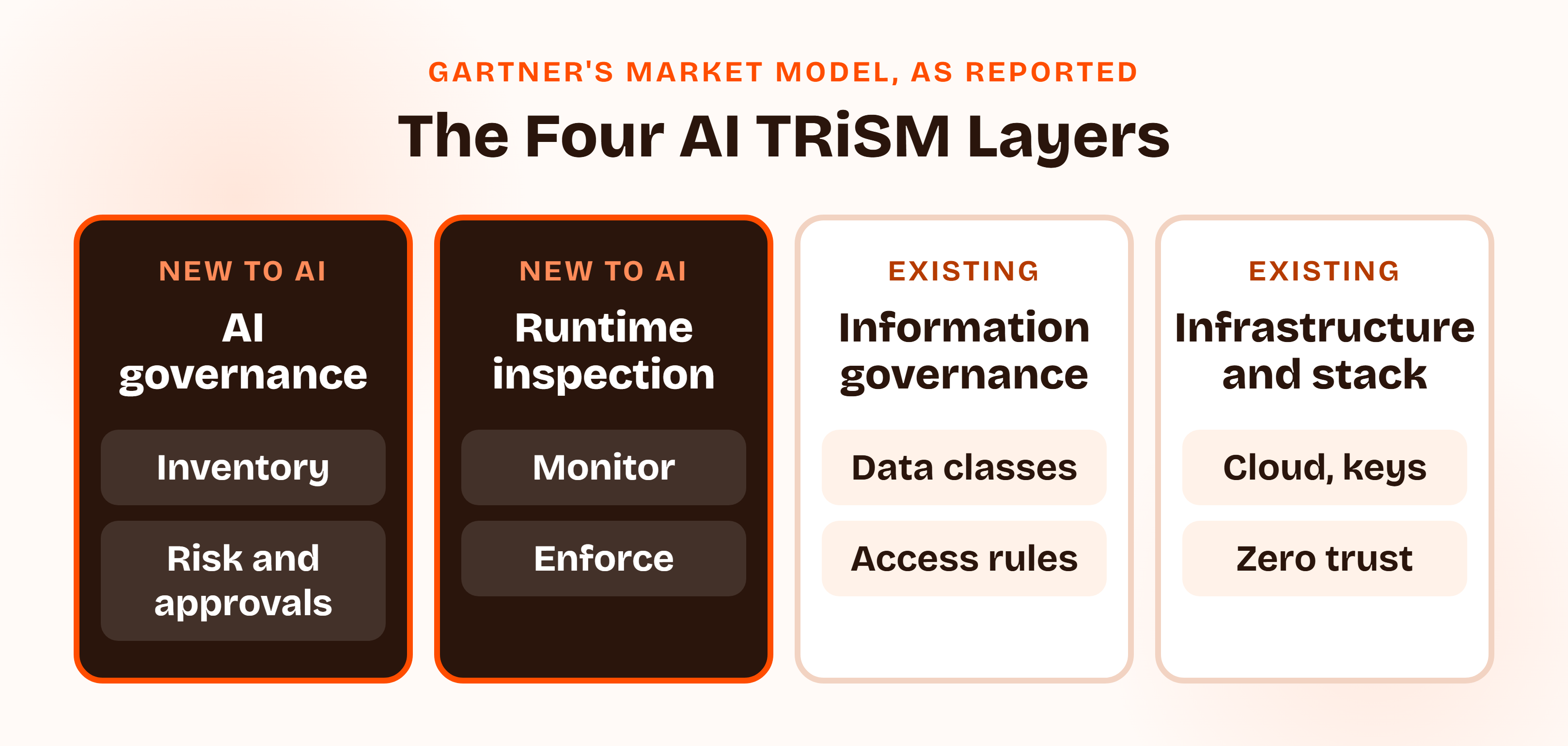
Gartner's market guide, as Mindgard describes it, defines the AI TRiSM market as four layers of technical capability that enforce AI governance policy: AI governance, AI runtime inspection and enforcement, information governance, and infrastructure and stack. Per Mindgard, the top two are new to AI and are consolidating into a distinct market segment, while the bottom two are traditional technology focused on AI.
| Layer | What it does | Evidence it produces | New to AI or existing |
|---|---|---|---|
| AI governance | Inventory of models, APIs, plugins and agents; documented use cases and risks; risk scoring and approvals; traceability from input to output | AI inventory, risk register, approval records | New |
| AI runtime inspection and enforcement | Monitors AI activity in production; automated controls such as redaction and prompt blocking; drift and misuse detection; alerts | Logs, alerts, blocked-event records | New |
| Information governance | Classifies data to decide what AI may use; access and usage restrictions; retention rules extended to AI outputs; tracking sensitive data through training, prompting and retrieval | Data classification, access reviews, retention settings | Existing, applied to AI |
| Infrastructure and stack | Secures models, APIs and compute like other critical infrastructure; protects keys and weights; hardens execution environments; zero trust; audit readiness | Standard cloud, endpoint and key-management evidence | Existing, applied to AI |
The layer detail comes from AvePoint's and Palo Alto Networks' descriptions of the guide. Both are vendors, so treat the specific examples as illustrative, not as Gartner's wording.
Note
Sources disagree on the order. Bigeye builds up from infrastructure and calls information governance the foundational layer. Mindgard calls AI governance the foundation. I present the four as a set, not a hierarchy, because none of the sources I read shows Gartner ranking them.
AI Governance Layer: Inventory, Risk Scoring and Approvals
For a small company this layer is a list of AI in use, an owner for each system, a risk tier and an approval record. It is where ISO 42001 and the NIST AI RMF do most of their work.
Start with how to build an AI governance framework for the roles and inventory, and the AI risk assessment guide for scoring.
Verdict: the layer a compliance team can start on tomorrow, with no new software.
Runtime Inspection and Enforcement Layer: Watching AI Where It Acts
This is the newest and most tool-heavy layer: guardrails, prompt and output filtering, and anomaly alerts. For many small teams it means provider settings or a gateway in front of one or two AI features, not a program.
It is also not what a compliance platform does. A runtime tool sits in the request path and acts on live traffic, and a compliance workspace holds the records that show you chose and reviewed those controls.
Verdict: buy for the customer-facing AI feature that can do real harm, and document the decision for the rest.
Information Governance Layer: Controlling What Data AI Can Reach
Bigeye argues this is the layer most implementations miss, and I agree it is easy to skip because it looks like old data work. It is the layer that answers "what can the model see?"
If you already classify data and review access for SOC 2 or ISO 27001, you have the raw material. Our guide on whether SOC 2 covers AI shows where that existing work stops.
Verdict: extend the data rules you already have to AI tools and outputs before buying anything.
Infrastructure and Stack Layer: The Traditional Controls Underneath
Endpoint, network, cloud and key management, applied to AI workloads. A company with a current SOC 2 report or ISO 27001 certificate is mostly extending evidence it already collects to the AI components.
Verdict: usually the smallest gap for a startup that is already audited.
Do the Layers Change for AI Agents?
The four layers still apply. Palo Alto's guide covers how AI TRiSM applies to models, applications and agents, and the runtime layer matters most once AI can take actions rather than only produce text.
Bigeye reports that Gartner published a market guide for guardian agents in February 2026 to address agentic systems. I could not read Gartner's page to confirm that, so treat it as Bigeye's report. For a company with a few AI features and no autonomous agents, the four layers above are enough to start.
AI TRiSM Pillars vs Layers: Why the Lists You Find Online Disagree
If you have read three AI TRiSM pages, you have probably seen three different lists. They are different models, not different opinions about one model.
| Source | Model | Items |
|---|---|---|
| Check Point, Darktrace, Abnormal | Four pillars (the older vocabulary) | Explainability and model monitoring; ModelOps; AI application security; privacy and data protection |
| Bigeye's account of the first version | Five capability areas | Explainability; ModelOps; data anomaly detection; adversarial attack resistance; data protection |
| Gartner's current market model, as reported by Mindgard, Palo Alto and AvePoint | Four layers | AI governance; runtime inspection and enforcement; information governance; infrastructure and stack |
| Portkey | Five pillars (its own list) | Explainability and transparency; model monitoring and governance; security and data protection; bias detection and fairness; compliance and auditability |
| CrowdStrike | Four components (its own list) | Governance and compliance; trustworthiness and transparency; security risk and management; lifecycle monitoring and maintenance |
Verdict: use the four layers to scope a program, and the older pillars as a topic checklist. The layers map to evidence you can collect. The older pillars (explainability, model operations, application security, privacy) are still a sensible list of technical topics to confirm you have covered somewhere.
A vendor that sells one pillar will usually tell you that pillar is the foundation. Check which model a page is using before you compare two of them.
AI TRiSM vs AI Governance vs Responsible AI vs AI Security
These are not competing options. They answer different questions: what do we value (responsible AI), what are our rules and who decides (AI governance), how do we enforce and prove it technically (AI TRiSM), and how do we stop attackers and leaks (AI security).
| Dimension | Responsible AI | AI governance | AI TRiSM |
|---|---|---|---|
| What it is | The principles: fairness, transparency, accountability | The rules, owners and approvals | The technical capabilities that enforce the rules, plus governance as the first layer |
| Typical owner | Leadership, ethics or legal | Compliance, risk or a governance committee | Security, data and platform teams together |
| Output | A statement of principles | Policies, inventory, risk decisions | Logs, controls, enforcement and evidence |
| Who checks it | Rarely anyone external | An auditor or customer, if you are certified or reviewed | A buyer or auditor asking for evidence of controls |
| Verdict | Values with no mechanism | The decision layer | The enforcement and proof layer |
Vendor pages disagree on scope. Some describe AI TRiSM as the runtime enforcement layer only, while the four-layer model described above includes governance as its first layer. I use the broader one.
AI governance without enforcement is a document nobody checks, and enforcement without governance is a set of controls with no definition of acceptable. That framing is common across vendor explainers, and I find it holds up in practice.
For the governance side, see the AI governance policy guide for the rules and the AI model governance guide for model-level records.
How AI TRiSM Maps to NIST AI RMF and ISO 42001
AI TRiSM tells you which jobs the technology has to do. The NIST AI RMF and ISO 42001 tell you how to organize the work so that someone else can check it.
AI TRiSM vs NIST AI RMF: Govern, Map, Measure and Manage
The NIST AI Risk Management Framework is voluntary guidance organized around four functions: Govern, Map, Measure and Manage. Our NIST AI RMF explainer covers them in depth.
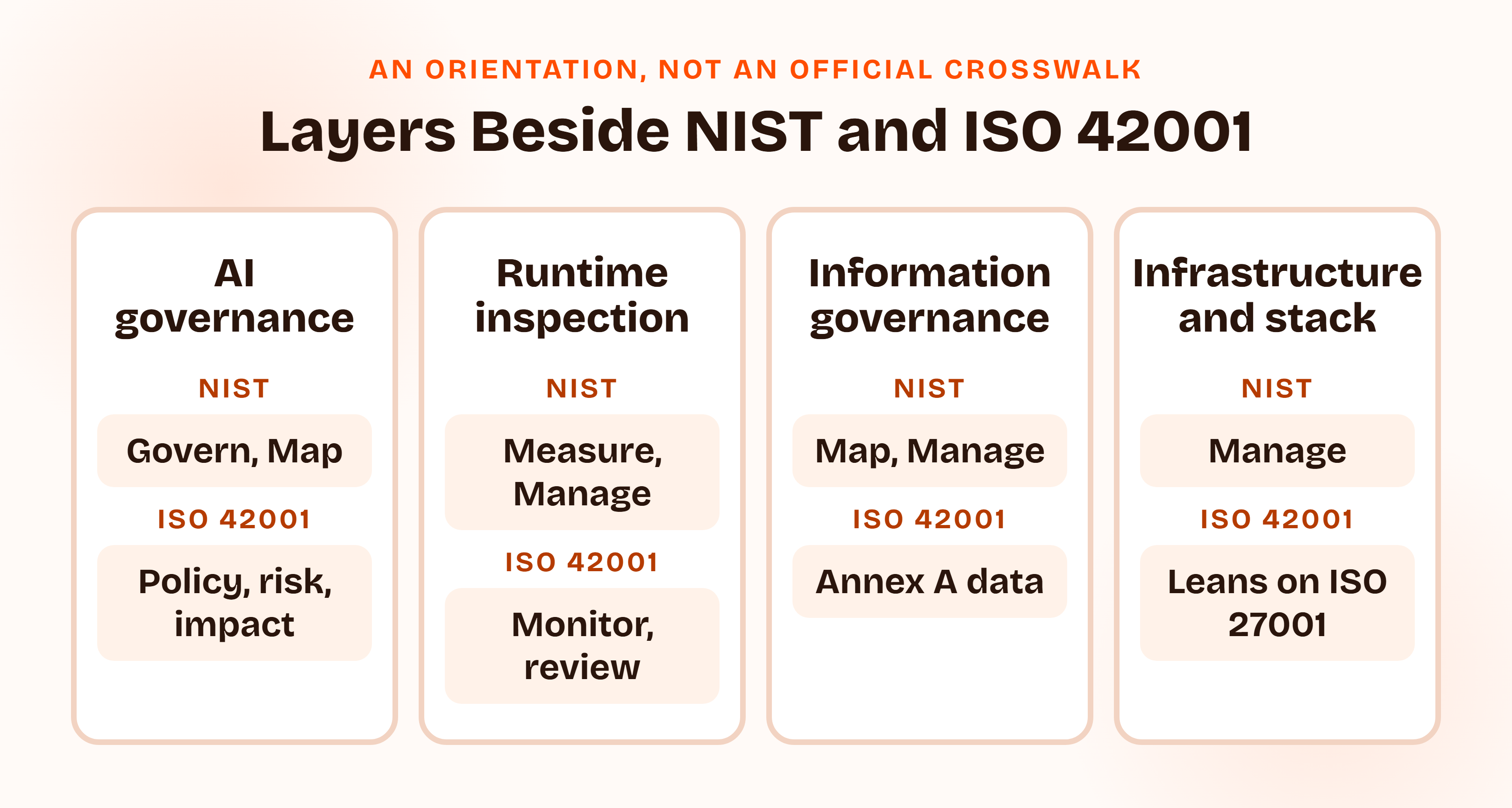
| TRiSM layer | Closest NIST AI RMF functions | What the pairing gives you |
|---|---|---|
| AI governance | Govern and Map | Roles, inventory, context and intended use of each system |
| Runtime inspection and enforcement | Measure and Manage | Testing, monitoring and responding to what systems do in production |
| Information governance | Map and Manage | Understanding the data a system touches and controlling it |
| Infrastructure and stack | Manage | Security treatment of the underlying systems |
This is an orientation table I built, not an official crosswalk, and NIST publishes its own crosswalks. Use it to see where the two overlap, not to claim equivalence.
AI TRiSM vs ISO 42001: The Certifiable Baseline
ISO 42001 is the standard for an AI management system, and it is the one in this comparison that an accredited auditor can certify. Our ISO 42001 guide walks through the clauses and Annex A controls. The standard's text is paywalled, so the table below describes the requirements by topic and not by quotation.
| TRiSM layer | What ISO 42001 gives you | Where it stops |
|---|---|---|
| AI governance | AI policy, assigned roles, AI risk assessment and treatment, AI system impact assessment, Annex A controls across the AI system life cycle | It does not tell you which tool to use |
| Runtime inspection and enforcement | Requirements to monitor, measure and review the management system | It does not specify runtime tooling or test coverage |
| Information governance | Annex A controls on data used by AI systems | Data classification tooling is up to you |
| Infrastructure and stack | Relies on information security controls such as ISO 27001 | See ISO 42001 vs ISO 27001 for the split |
Watch out
ISO 42001 certification shows that a management system exists and works. It does not prove that a particular guardrail blocks a particular prompt injection. Certification and runtime testing answer different questions.
The EU AI Act belongs here as a driver. Its high-risk obligations call for risk management, data governance, logging and human oversight, which line up with the layers. Our EU AI Act compliance guide has the obligations and dates.
AI TRiSM Tools: What Software Each Layer Needs
"AI TRiSM tools" is a market label, not one product type. Here is a category map, not a ranking.
| Layer | Tool category | What to ask a vendor | Where ComplyJet fits |
|---|---|---|---|
| AI governance | Governance and risk platforms: inventory, risk assessment, policy packs, evidence | Does it keep an inventory current, and what evidence can an auditor export? | Yes: ISO 42001 policy templates, an AI risk assessment workflow, impact assessments and evidence collection |
| Runtime inspection and enforcement | Guardrails, gateways, red-teaming and monitoring tools | What traffic does it see, and what does it block by default? | No: ComplyJet is not a runtime guardrail |
| Information governance | Data classification and data security tools applied to AI | Can it find sensitive data in prompts, retrieval stores and outputs? | Partly: supply chain documentation for model providers and datasets, not data discovery |
| Infrastructure and stack | Cloud, endpoint and key-management security | Does it cover AI workloads and APIs? | Evidence collection through 350+ integrations, not the controls themselves |
The ComplyJet column is limited to what our ISO 42001 framework page states. For how the governance platforms compare with each other, see the best AI risk management software comparison.
Try this yourself
List every AI tool your company uses. Next to each, write which of the four layers it already gives you: a provider's data-retention setting is information governance, a single sign-on rule is infrastructure. Circle the layer with nothing next to it. Ten minutes, and you will know where to look first.
AI TRiSM Implementation for a Small Team: A First-90-Days Order
You do not need all four layers on day one, and you do not need to buy a product called AI TRiSM. You need to know what AI you run, set rules, control the data and watch the risky systems. The owners below are my suggestions, not requirements.
- Inventory every AI use, including shadow AI. Owner: whoever runs IT or security. Evidence: a dated AI inventory. See shadow AI risk.
- Tier systems by risk and score the top ones. Owner: compliance or the CTO. Evidence: a risk register. See the AI risk assessment guide.
- Write the acceptable-use and governance policy. Owner: compliance. Evidence: a signed policy. See the AI governance policy guide.
- Set data rules for AI tools. Owner: whoever owns data access. Evidence: a data-class-by-tool matrix and access reviews.
- Vet third-party AI suppliers. Owner: security or procurement. Evidence: supplier reviews. See AI vendor risk management.
- Add proportionate runtime controls to the one or two customer-facing AI features. Owner: engineering. Evidence: configuration records and a test log.
- Review every quarter and keep the evidence. Owner: the governance owner.

| Team size | Real effort in the first 90 days | Document as a decision, not a project |
|---|---|---|
| About 10 people | Steps 1 to 3 and the data rules | Runtime tooling beyond provider settings |
| About 30 people | Steps 1 to 5 | Custom runtime monitoring |
| About 50 people | Steps 1 to 6 for customer-facing features | Anything with no customer-facing AI |
Opinion, mine: the table is how I would sequence it, not a benchmark.
ComplyJet customers
A small AI company, audit-ready with a team guiding it
Raghuram Vadapally, Managing Director and Head of Software Engineering at Synexar AI, says ComplyJet has helped the team "stay organized and audit-ready at all times." Synexar, a company of 2 to 10 people, completed SOC 2 Type 1 and HIPAA reports in the same quarter. The engagement covered those two frameworks, not ISO 42001 or AI TRiSM.
AI TRiSM Mistakes That Leave the Gap Open
Most of these are easy to make because the term sounds like a product.
- Treating AI TRiSM as something you can be certified or compliant with. It looks like a vendor claiming "AI TRiSM compliance." Fix: ask which standard or framework the claim maps to.
- Buying a runtime tool before you know what AI you run. It looks like a guardrail on one feature while shadow AI goes unseen. Fix: inventory first.
- Stopping at the policy. It looks like a signed document and no enforcement. Fix: attach at least one control and one piece of evidence to each rule.
- Using the older pillar list as if it were Gartner's current model. It looks like a program built on explainability and ModelOps only. Fix: scope with the four layers.
- Skipping information governance because it feels like old data work. It looks like strong prompts and weak data access. Fix: extend your existing data rules to AI tools.
- Treating one vendor's layer as the whole framework. It looks like a data-security product sold as "AI TRiSM." Fix: map any tool to the layer it covers and note the gaps.
- Repeating analyst forecasts as results. It looks like a stat with no date or source. Fix: cite the report, its date and who describes it.
FAQs
What Is AI TRiSM?
AI TRiSM stands for AI trust, risk and security management. It is a Gartner term for the controls that keep AI systems reliable, secure and aligned with an organization's intent, usually described as four layers: AI governance, runtime inspection and enforcement, information governance, and infrastructure and stack.
Who Created AI TRiSM?
Gartner coined the term. Palo Alto Networks and Bigeye both attribute it to Gartner, and Bigeye places the first version in 2022. The current four-layer model comes from Gartner's market guide, which AvePoint and Mindgard summarize for 2025.
What Are the Four Layers of AI TRiSM?
AI governance (inventory, risk scoring, approvals), AI runtime inspection and enforcement (monitoring and controls in production), information governance (what data AI can access) and infrastructure and stack (traditional security applied to AI workloads). Sources disagree on their order, so treat them as a set.
What Are the Pillars of AI TRiSM?
"Pillars" is the older vocabulary: explainability and model monitoring, ModelOps, AI application security, and privacy. Vendors such as Check Point, Darktrace and Abnormal use it, and others write their own lists. The four layers are the current way to scope a program.
Is AI TRiSM the Same as AI Governance?
No. AI governance sets the rules, owners and approvals. AI TRiSM is broader: it includes governance as its first layer and adds the technical capabilities that enforce the rules and produce evidence. Governance without enforcement is paper, and enforcement without governance has no definition of acceptable. See the AI governance framework guide.
Is AI TRiSM a Standard or a Certification?
No. It is an analyst framework. No source I reviewed describes a standard, audit or certificate for it. If you need something certifiable, ISO 42001 is the AI management system standard, and the NIST AI RMF is voluntary guidance.
Does ISO 42001 Cover AI TRiSM?
Partly. ISO 42001 covers the governance layer well and touches monitoring, data and security through its requirements and controls, but it does not specify runtime tooling. Treat it as the certifiable baseline and add runtime and data controls where your risk needs them.
Does a Startup Need AI TRiSM?
You do not need to buy something called AI TRiSM, but you do need the jobs it describes. Start with an inventory, a risk tier, a policy and data rules, which a small team can do without new software. Add runtime controls for the AI features customers use.
Book a demo
Put the governance layer in place before a customer asks
Talk through how to keep your AI policies, risk and impact assessments and evidence audit-ready under ISO 42001, for a team your size. ComplyJet is compliance automation: we do not provide runtime guardrails or certify anything as AI TRiSM compliant.
Related Reading
- Best AI risk management software: the buyer's comparison of platforms that cover these layers
- How to build an AI governance framework: building the governance layer step by step
- AI risk assessment: scoring a system before deciding which controls it needs
- NIST AI Risk Management Framework: the voluntary framework the layers map onto
- What is ISO 42001: the certifiable standard for the governance layer
- Shadow AI risk: the inventory problem that comes first
- AI vendor risk management: controlling third-party AI suppliers