Related Articles
No items found.
.svg)

A customer security questionnaire lands in your inbox, and one line asks whether you're "ISO 42001 certified or working toward it." You built an AI feature into your product eight months ago. Nobody on the team has heard the term before today.
So, what is ISO 42001 in plain terms? It's the international standard for an AI Management System (AIMS), published jointly by ISO and the International Electrotechnical Commission (IEC) in December 2023 as ISO/IEC 42001:2023. It sets out how an organization governs the way it designs, develops, deploys, or uses AI responsibly, and certification against it proves that governance system actually works, day to day, not just that a policy exists somewhere in a shared drive.
This guide is written for founders, security leads, and product leaders at early-stage SaaS companies deciding whether ISO 42001 is relevant to them yet, not for an enterprise AI governance team already deep into implementation.
Here's what I'll cover:
One quick disambiguation before the rest of this guide: ISO 42001 the standard is not the same thing as an AI governance policy document. The next section draws that line clearly, and if drafting the policy document itself is what actually brought you here, ComplyJet's guide to writing an AI governance policy is the more direct read.
ISO 42001 is the AIMS standard: the international standard that specifies requirements for an Artificial Intelligence Management System, or AIMS. Its full name is ISO/IEC 42001:2023, published jointly by the International Organization for Standardization (ISO) and the International Electrotechnical Commission (IEC) in December 2023, the first global standard of its kind.
An AIMS isn't a checklist you complete once. Like any AIMS standard, ISO 42001 defines an ongoing system of policies, processes, risk assessments, and controls that governs how an organization builds or uses AI responsibly, reviewed and improved on a real cycle, the same way an information security management system never really "finishes."
AIMS stands for AI Management System. It's worth defining plainly and early, since the acronym gets used constantly in AI compliance content as if everyone already knows what it means.
An AIMS runs on the same Plan-Do-Check-Act logic as an ISO 27001 Information Security Management System (ISMS): build the system, run it, check whether it's actually working, then improve it based on what you find. If your team already holds ISO 27001, a meaningful amount of the operating muscle an AIMS needs, documented scope, management review, internal audit, corrective action, is already in place. You're extending a habit, not building one from nothing.
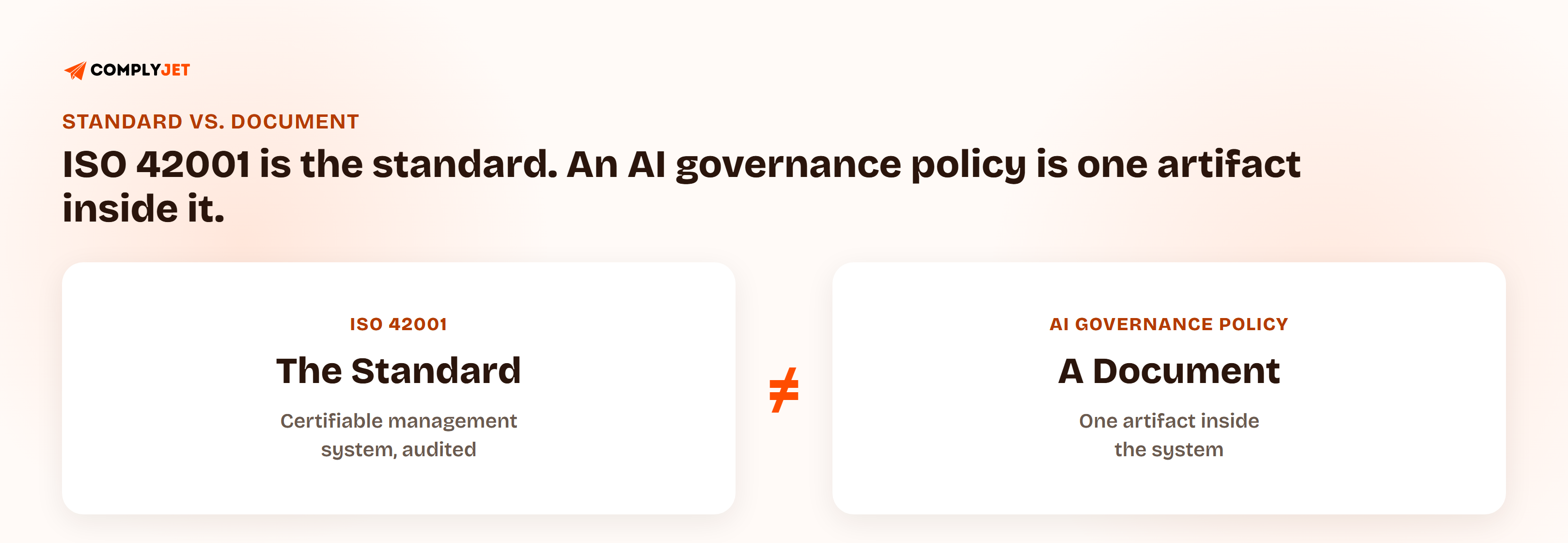
Here's the confusion worth naming directly: ISO 42001 is the certifiable standard for the management system. An AI governance policy is a document. They get used almost interchangeably in some vendor content, and that's a real problem for anyone trying to figure out what they actually need to do.
A company can write a thorough AI governance policy and never pursue ISO 42001 certification at all. A company can also hold ISO 42001 certification with its AI governance policy sitting as just one artifact inside a much larger system, alongside risk assessments, impact assessments, training records, and audit evidence.
ComplyJet's own guide to the topic puts it plainly: under ISO 42001, the AI governance policy is a core component of the AI management system, not a stand-in for the system itself.
If drafting that policy document is genuinely your next step, not evaluating the standard itself, ComplyJet's AI governance policy guide covers what to put in one. This article stays focused on the standard.
ISO 42001 is a voluntary, certifiable standard. It isn't a legal or regulatory requirement in most jurisdictions today. Nobody is required by law to hold it the way, say, a payment processor is required to meet PCI DSS.
That said, "voluntary" doesn't mean "optional to ignore." Enterprise customers evaluating AI vendors are increasingly asking about it directly in security reviews and procurement questionnaires, the same way SOC 2 and ISO 27001 went from nice-to-have to table stakes over the last decade. A-LIGN's own research frames it as a standard likely to become an industry benchmark even without a legal mandate behind it, and that's consistent with what we're seeing across the frameworks ComplyJet supports.
Who actually needs to care isn't limited to companies selling AI as their core product. It's any organization that designs, develops, deploys, or supplies AI systems, which now includes a SaaS company that shipped one LLM-powered feature last quarter just as much as a company built around AI from day one.
The startups asking me about ISO 42001 right now aren't AI companies in the way people mean that term. They're SaaS teams that added one AI feature, closed one enterprise deal that asked hard questions about it, and realized they had no structured answer. That gap is exactly what an AIMS closes, and it doesn't require enterprise headcount to close it. — Upendra Varma, CTO at ComplyJet
A lean, right-sized AIMS is realistic at that size, not just something a large enterprise with a dedicated AI governance team can pull off. It just needs to be scoped to what the company is actually doing with AI, not modeled on how a 2,000-person enterprise would do it.
The stakes here aren't theoretical. Three things are converging at once: the EU AI Act's obligations are phasing in through 2026 and 2027 and demand exactly the governance discipline ISO 42001 formalizes (risk management, documentation, human oversight, monitoring), customer security questionnaires are starting to name ISO 42001 specifically rather than asking generic "how do you handle AI" questions, and AI vendor risk has become a standard line item in enterprise procurement diligence, not an edge case.
None of that requires starting from zero if you already hold another framework. Drata has disclosed that its existing SOC 2, ISO 27001, and privacy framework work already covered roughly 35-40% of ISO 42001's requirements when it pursued its own certification, a genuinely useful data point for any team wondering how much of this overlaps with work they've already done.
Real-world proof this isn't just enterprise theater: AWS, Anthropic, and Microsoft all now hold ISO 42001 certification for specific AI products and services (Amazon Bedrock and Textract, Claude and Anthropic's AI research activities, and Microsoft's Azure AI Foundry Models and Copilot products, respectively). None of that requires a 20-person team to match their scope. It confirms the standard is being actively used as a real evaluation signal, not a paper credential nobody checks.
ISO 42001 has two structural pieces: 10 clauses that define the management system itself, and Annex A, a catalogue of controls an organization selects from based on its own AI risk profile. This is where the concrete ISO 42001 requirements actually live, not just a name-check of "10 clauses." Both pieces are confirmed consistently across ISO's harmonized structure (the same skeleton ISO 27001, ISO 9001, and ISO 22301 all share) and every certification-body source we checked.
| Clause | What it actually requires |
|---|---|
| 1. Scope | Defines what the standard covers; no organization-specific requirement |
| 2. Normative references | Points to related standards used for shared terms and definitions; no organization-specific requirement |
| 3. Terms and definitions | Shared vocabulary for the standard; no organization-specific requirement |
| 4. Context of the organization | Understand the organization, its interested parties, and the scope of the AIMS |
| 5. Leadership | Top management commits to the AIMS, sets AI policy, and assigns roles and responsibilities |
| 6. Planning | Assess AI-related risks and opportunities, and set AIMS objectives to address them |
| 7. Support | Provide the resources, competence, awareness, and documented information the AIMS needs |
| 8. Operation | Run the operational core: AI risk assessment, AI system impact assessment, and lifecycle controls |
| 9. Performance evaluation | Monitor, measure, internally audit, and formally review the AIMS |
| 10. Improvement | Correct nonconformities and drive continual improvement based on what evaluation finds |
Clauses 4 through 10 are the mandatory, auditable core. Clauses 1 through 3 are front matter, the same convention this standard shares with ISO 27001 and ISO 22301, so if you've read a ComplyJet guide to either of those, this structure will already look familiar.
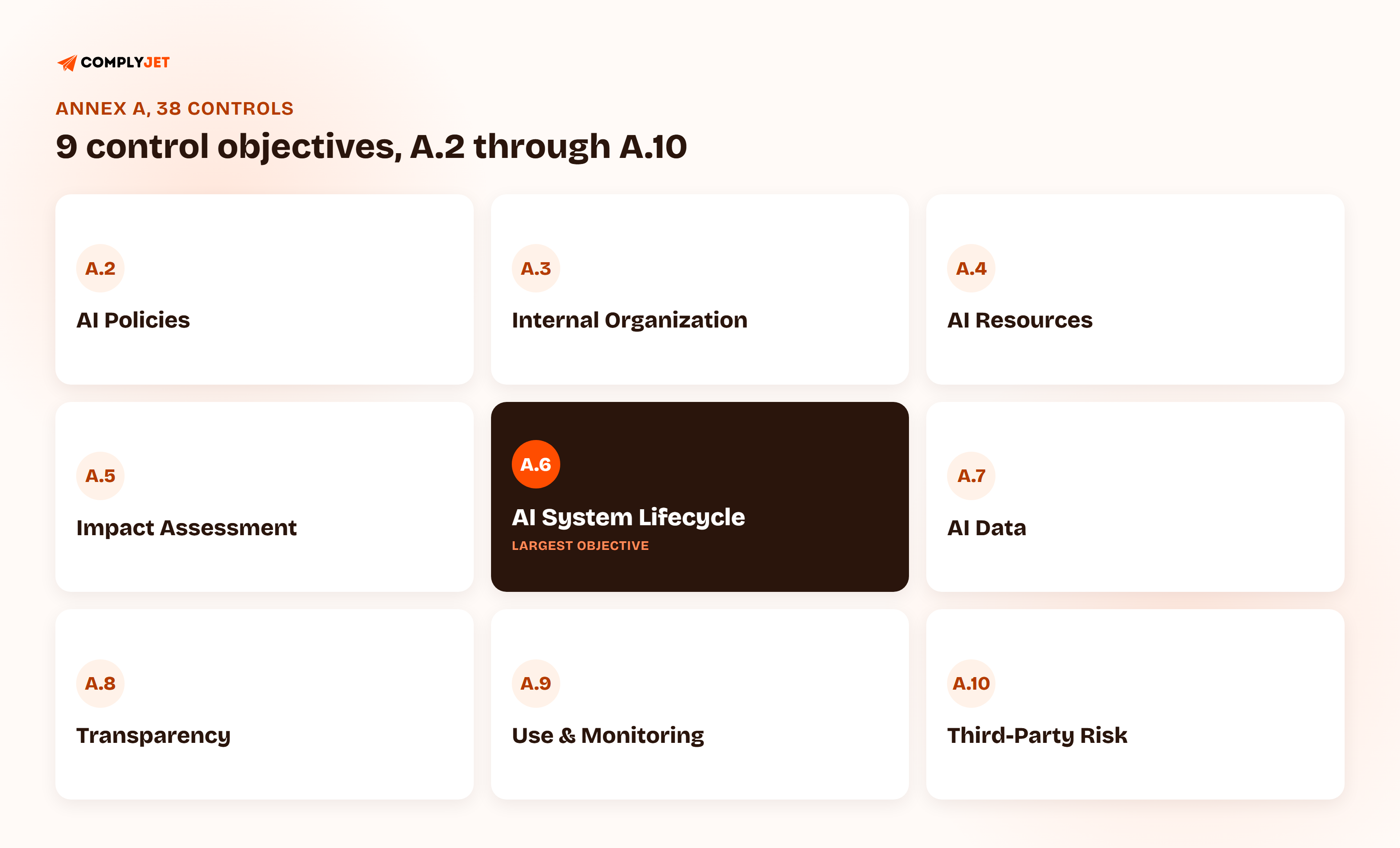
Annex A contains the 38 ISO 42001 controls, grouped under 9 control objectives numbered A.2 through A.10. Sources don't fully agree on this number: Vanta's dedicated Annex A controls page states 38, and OneTrust's blog states 39.
38 is the correct figure. Vanta's controls page lists all 9 objectives and 38 controls by name, and six further independent, non-competing sources (Konfirmity, ISMS.online, Mindsetcyber, RiskProfs, Tempo Audits, and DeepInspect) all converge on the same count. OneTrust's 39 is the outlier here, unsupported by any other source checked.
ISO's own standard preview page returns a 403 on direct access, a recurring block on ISO.org rather than a content issue, so it couldn't serve as a direct additional confirmation. The weight of agreement across seven independent sources is strong enough to state 38 with confidence.
The 9 objective categories, in plain language:
The certification path, sourced from certification-body process documentation, runs in this order:
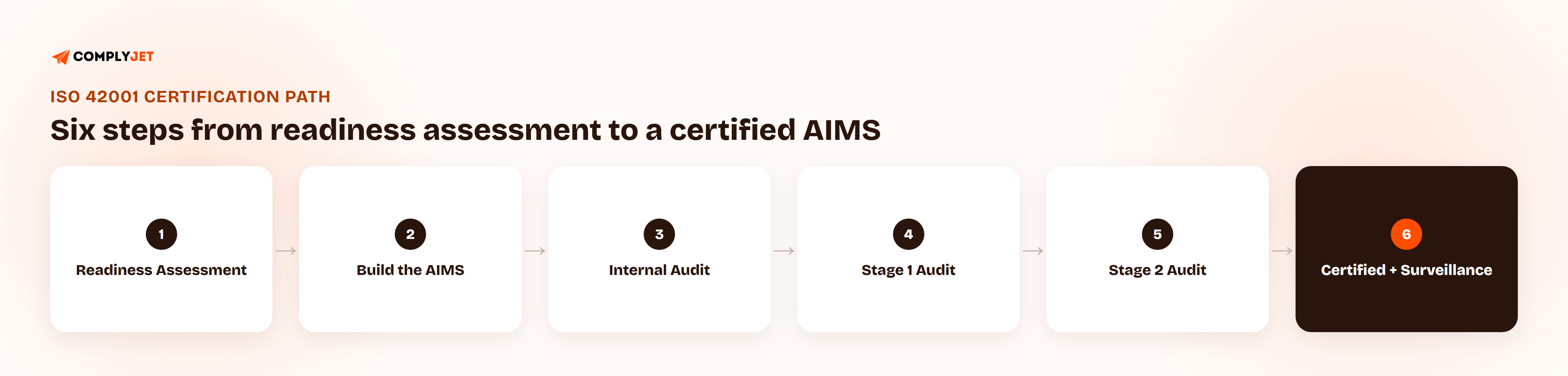
This is overview depth on purpose. Every organization's starting point is different, and a genuinely useful step-by-step walkthrough depends on specifics this guide isn't scoped to assume.
| Starting point | Realistic timeline |
|---|---|
| No existing management system | Several months to roughly a year, depending on team size and how much of the AIMS has to be built from scratch |
| Already running an ISO 27001 ISMS | Meaningfully shorter, since scope, management review, and internal audit can extend rather than start over |
One concrete data point competitors rarely state: the gap between Stage 1 and Stage 2 audits typically shouldn't exceed six months. If it does, some certification bodies will require re-verifying the Stage 1 findings before Stage 2 proceeds, which is a real reason not to let readiness work drag once Stage 1 is booked.
Current sources put a small organization's first-year, all-in cost, gap analysis, consulting if used, audit fees, and tooling, roughly in the $15,000-$60,000 range, varying significantly with scope, whether outside consultants are involved, and organization size. Treat this as a rough orientation figure, not a quote.
A full cost breakdown, with audit fees separated from consulting and tooling costs by organization size, deserves deeper treatment than an overview like this one can give it. What's here is enough to get oriented with, not a firm quote.
ISO 42001 shares the same Annex SL high-level management-system structure as ISO 27001, the identical clause-numbering logic (context, leadership, planning, support, operation, performance evaluation, improvement) mapped onto AI governance instead of information security. An organization already certified to ISO 27001 has a real head start, for the same reason an ISO 27001-certified company finds ISO 22301 lighter to add than building from zero.
This is a brief pointer, not a full comparison. For the complete side-by-side breakdown, including where the two frameworks' controls genuinely overlap and where they diverge, see ComplyJet's dedicated ISO 27001 and AI compliance comparison. This article stays focused on defining ISO 42001 itself.
ComplyJet directly supports and certifies ISO 42001, not as an adjacent framework we mention in passing, but as one we actively build for. That includes ISO 42001-specific policy and procedure templates, a structured AI risk assessment framework, and AI impact assessment templates covering bias, transparency, and fairness.
It also includes automated evidence collection across 350+ integrations, AI supply chain documentation for the model providers and third-party AI components you depend on, and a vetted network of independent ISO 42001 auditors with a dedicated workspace for Stage 1 and Stage 2 audits.
Pricing is flat and per-company, not per-seat, so the cost stays predictable as your team grows from a five-person startup to 30 or 40 people during the certification journey. That's not the cheap option. It's the considered one for a team that's thinking carefully about what compliance actually needs to cost as it scales.
If your next step is drafting the AI governance policy document itself rather than evaluating certification, ComplyJet's AI governance policy guide is the more direct read.
ISO 42001 is the international standard for an AI Management System (AIMS), published jointly by ISO and IEC in December 2023. It sets out how an organization governs the way it designs, develops, deploys, or uses AI, and certification proves that governance system actually works. See the definition section above for the full breakdown.
No. It's a voluntary, certifiable standard, not a legal requirement in most jurisdictions today. It's increasingly expected contractually, though, especially in enterprise procurement and security questionnaires. See the "who needs it" section above for more detail.
Any organization that designs, develops, deploys, or supplies AI systems, not just companies selling AI as their core product. A SaaS company with a single AI-powered feature counts. The full section above covers what that looks like realistically at startup scale.
An AI Management System (AIMS) is an ongoing system of policies, processes, risk assessments, and controls governing how an organization builds or uses AI responsibly. It's not a single document. See the AIMS sub-section above for the full definition.
ISO 27001 secures information; ISO 42001 governs AI systems. They share the same Annex SL high-level structure, which gives an ISO 27001-certified organization a real head start. See the relationship section above, and ComplyJet's full ISO 27001-vs-ISO 42001 comparison for the complete breakdown.
Realistically, several months to roughly a year, depending heavily on your starting point and whether you already hold ISO 27001. See the certification timeline section above for the full range.
38 controls across 9 objectives, numbered A.2 through A.10. One source (OneTrust) states 39; the majority of independently checked sources converge on 38, which this guide verified directly against Vanta's dedicated controls page and five additional independent sources. See the Annex A section above for the full list of objectives.
December 2023, published jointly by ISO and IEC as ISO/IEC 42001:2023, independently corroborated across multiple sources including Drata, OneTrust, KPMG, and Microsoft's own compliance documentation.
Sources: Annex A control count (38 controls, 9 objectives) independently verified against Vanta's ISO 42001 controls guide, ISMS.online's Annex A controls guide, and Mindsetcyber's Annex A controls list, against OneTrust's outlier figure of 39 in "Managing AI Compliance with ISO 42001".
Publication date and standard framing cross-checked against A-LIGN's ISO 42001 explainer and KPMG Switzerland's ISO/IEC 42001 overview. Framework-overlap statistic sourced to Drata's own disclosed ISO 42001 certification experience.
Certification examples sourced to Anthropic's ISO 42001 certification announcement and AWS's ISO/IEC 42001:2023 certification announcement; Microsoft's parallel certification of Azure AI Foundry Models and Security Copilot is publicly announced on Microsoft's own Azure blog.



© 2026 ComplyJet. All rights reserved.

