.svg)

More than 20% of organizations reported a breach targeting AI models or applications, according to IBM's 2026 Cost of a Data Breach study. The most common weak points were compromised APIs, applications or plug-ins (27%) and cloud misconfigurations affecting AI workloads (27%), which puts the weakness in the systems around the model, not necessarily in the model. Governing a model means governing what surrounds it too.
That is the case for AI model governance. It is the set of records, approval gates, monitoring and named owners that control one AI model from the day you build or select it until you retire it: what the model is for, how it was tested, what it is allowed to do, how it is watched after launch, and who answers when it drifts or fails.
Quick take
Three artifacts carry most of the weight: a model record, a monitoring plan with thresholds, and an owner who is not the person who approved the launch. For a team under 50, that is a few pages per model, not a program.
Note
This guide works at the level of a single model. For the company-wide program, see the AI governance framework guide. For approved-tool rules and a policy document, see the AI governance policy page. For scoring risk, see the AI risk assessment guide. For buying someone else's AI, see AI vendor risk management, and for unapproved tools, shadow AI risk.
By the end, you will know what to write down for every production model, which signals to watch and what to do when one trips, and who should be accountable at each step.
Here's what I'll cover:
- How AI model governance differs from AI governance and model risk management
- Which models you need to govern, including the ones you did not train
- The model record: what goes in it, with a filled-in example
- Approval gates across the AI model lifecycle
- AI model monitoring, from signal to decision
- Owners, approvers and the evidence an auditor will ask to see
- How it all maps to ISO 42001, NIST AI RMF and the EU AI Act
What AI Model Governance Is, and How It Differs From AI Governance and Model Risk Management
AI model governance is the discipline of controlling a single AI model across its life: documenting it, approving it before launch, monitoring it in use, assigning an accountable owner, and retiring it deliberately.
The idea is older than generative AI. Banks have managed model risk for years, and the guidance behind it, issued by the Federal Reserve and the OCC in 2011 and adopted by the FDIC in 2017, covers "model development, implementation, and use; model validation; and governance, policies, and controls." AI keeps those needs and adds new ones. Models learn from data you may not fully see, change behavior when a vendor updates them, and are often run by another company.
AI Model Governance vs AI Governance vs AI Model Risk Management
The three terms get used interchangeably. They are not the same job.
| Term | Scope | The question it answers | Where to go deeper |
|---|---|---|---|
| AI governance | The whole organization | Who decides how we use AI, and under which rules? | AI governance framework |
| AI model governance | One model | What is this model, is it fit for launch, and who answers for it? | This guide |
| AI model risk management | One model, from a risk angle | Where can this model be wrong, and has someone independent challenged it? | AI risk assessment |
| MLOps | The tooling | How do we train, ship and run models reliably? | Your engineering stack |
MLOps is how models get shipped. Governance is the set of decisions about whether they should be, and under what conditions.
An AI Model Governance Framework in Five Pieces
You do not need a heavy AI model governance framework to govern a model. You need five things, each of which gets its own section below.
| Piece | What it is | Section |
|---|---|---|
| Model record | One document describing the model, its purpose, tests and limits | AI model documentation |
| Lifecycle gates | Approval points from proposal to retirement | The AI model lifecycle |
| Monitoring plan | Signals, thresholds and responses | AI model monitoring |
| Owner and approver | Named people, different people | AI model accountability |
| Evidence trail | The artifacts an auditor or customer will request | The checklist |
If you have not set up the company-level program yet, build that first. The AI governance framework guide covers roles, the AI inventory and risk tiers, and this guide assumes that inventory exists.
ISO 42001
ISO 42001 expects documented controls across the AI system lifecycle
ComplyJet's ISO 42001 workspace helps you document and monitor your AI model providers, datasets and third-party AI components, with 350+ integrations tracking infrastructure controls across your AI stack.
Why AI Model Governance Matters Before a Customer or Auditor Asks
The Stanford 2025 AI Index reports that "the number of reported AI-related incidents rose to 233 in 2024, a record high and a 56.4% increase over 2023." Those are only the incidents that got reported. The direction is the point.
What goes wrong in practice is rarely dramatic. It is quiet.
A Hacker News commenter argued in July 2026 that model drift is not the only issue, and that they had "seen more failures caused by changes around the model," such as APIs, retrieval quality, data pipelines and permissions. Another commenter running agents in production put the quiet version bluntly: "yesterday's 95% success rate is today's 70%."
Neither is a security incident. Both are the kind of change a governed model has a record, a threshold and an owner for.
Expect enterprise security reviews to ask which models you run, what they were tested on and who is accountable for them. A model nobody on the team can describe in a paragraph is a deal risk before it is a technical one.
Watch out
Governance is not a launch review. Most of the evidence an auditor wants is produced after launch: monitoring output, change history, incident notes. A model approved once and never looked at again is the weakest position to be in.
Which Models Need AI Model Governance: Built, Fine-Tuned and Called
Not every team trains models, and many never will. The question is what you still have to govern when you did not train the model.
| Situation | What you control | What you do not | What you still record |
|---|---|---|---|
| You train the model | Data, code, tests, release | Nothing material | Everything in the model record below |
| You fine-tune an open or vendor model | Fine-tuning data, evaluation, release | The base model's training | Base model and version, your data, your evals |
| You call a third-party model through an API | Prompts, retrieval, configuration, evals, release | The model itself and when it changes | Pinned version, prompt and configuration, your eval set, change log |
The third row is where most startups sit. Not training the model does not remove the duty to know which version runs in production and to test it on your own tasks. The vendor's published benchmarks describe their test set, not your tickets, contracts or customers.
For the vendor side of the same model, such as what the provider does with your data, see the AI vendor risk management guide. This guide is about what you do with the model once you have chosen it.
Pro tip
Treat a prompt change like a code change. If a rewritten system prompt can change what your product tells customers, it deserves a version number, a diff and a re-run of your eval set before it ships.
AI Model Documentation: The Model Record Every Production Model Needs
The first thing a security reviewer asks for is not your policy. It is a description of the model. If the answer lives in one engineer's head, the review stalls.
What an AI Model Card Includes, and Where It Came From
The term comes from a research paper. In their 2019 FAT* paper, Model Cards for Model Reporting, Mitchell and colleagues defined model cards as "short documents accompanying trained machine learning models that provide benchmarked evaluation in a variety of conditions."
A model card is the outward-facing summary. For governance, you also need the internal version with approvals and an owner, which I call the model record. One page per model is enough.
| Field | What to write | Why a reviewer wants it |
|---|---|---|
| Purpose and out-of-scope uses | What the model is for, and what it must not be used for | Defines what "working" means |
| Model and version | Name, provider, exact version, or build hash | Proves what was running on a given date |
| Data sources | What it was trained, fine-tuned or grounded on | Shows where customer data may touch it |
| Evaluation results | Test set, metrics, date, who ran it | Evidence it was tested before launch |
| Known limitations | Where it is weak, with examples | Stops overclaiming |
| Risk tier | Low, medium or high, from your tiering scheme | Sets how strict the gates are |
| Owner and approver | Two named people | Answers "who is accountable" |
| Monitoring plan | Signals, thresholds, responses | Shows you look after launch |
| Change history | Dated entries for every version, prompt or data change | Lets you reconstruct the past |
| Retirement criteria | When it gets switched off | Prevents zombie models |

A Filled-In Model Record for a Support-Ticket Classifier
Here is what the record looks like for a small, concrete model. This is an invented illustration, not a real customer.
| Field | Example entry |
|---|---|
| Purpose | Tag inbound support tickets by topic and urgency, then route them. Not used to decide refunds or close tickets. |
| Model and version | Third-party API model, pinned to a dated version, plus our prompt v7 |
| Data sources | Ticket text only. Customer names and emails masked before the call. |
| Evaluation | 200 hand-labeled tickets, scored by category and urgency, rerun on every change |
| Known limitations | Weaker on tickets under ten words and on non-English text |
| Risk tier | Medium: errors delay customers but cannot expose their data |
| Owner / approver | Head of support operations / engineering lead |
| Monitoring | Weekly eval re-run, monthly sample review, alert on a 5-point accuracy drop |
| Change history | Prompt v6 to v7, with eval result attached |
| Retirement | Replace if accuracy stays below target for two consecutive months |
Notice what is missing: nothing about the model's internals. For a model you call, the useful record is about your use of it.
Several standards ask for this documentation, though none dictates a template.
- ISO 42001 has controls on documenting AI system design and development (A.6.2.3) and technical documentation for users, partners and authorities (A.6.2.7).
- NIST AI RMF says in MAP 2.2: "Documentation provides sufficient information to assist relevant AI actors when making informed decisions and taking subsequent actions."
- EU AI Act: Article 11 requires providers of high-risk systems to draw up technical documentation before launch and keep it up to date, and lets start-ups provide the Annex IV elements in a simplified manner.
The crosswalk further down lays these side by side.
ComplyJet customers
Audit-ready evidence for an AI product
Raghuram Vadapally, Managing Director and Head of Software Engineering at Synexar AI, whose platform turns doctors' dictations into structured reports, calls ComplyJet "an indispensable part of our compliance workflow." Read their SOC 2 and HIPAA story.
The AI Model Lifecycle: Approval Gates From Build to Retirement
A model moves through stages whether or not you name them. Governance names them and puts a question at each door.
| Stage | Gate question | Who signs | Evidence produced |
|---|---|---|---|
| Propose | Is this use case allowed, and what tier is it? | Owner and compliance reviewer | Use case entry and tier |
| Build or select | Do we know the data, version and provider? | Owner | Draft model record |
| Test | Does it meet the targets on our own eval set? | Engineer, reviewed by approver | Eval results with date |
| Approve for launch | Are limits, monitoring and owner in place? | Approver, different from owner | Signed approval |
| Operate | Are signals inside thresholds? | Owner | Monitoring output |
| Change | Does this change need a re-review? | Owner, approver for high tier | Change log entry |
| Retire | Has it been switched off and its data handled? | Owner | Retirement record |
These map onto ISO 42001's lifecycle controls: verification and validation with representative test data and release criteria (A.6.2.4), deployment with pre-deployment checks and approvals (A.6.2.5), and operation and monitoring (A.6.2.6).

The arrow from operating back to testing is the part most teams miss. A change is a new approval, not an update. These are the usual triggers:
- A new model version from the provider, even a minor one
- A change to the prompt, retrieval index or configuration
- New training or fine-tuning data
- A new use case, or a new type of customer data flowing through
- A rise in user complaints or manual overrides
Try this yourself
Pick one production model and set a 60-second timer. Can you name its exact version, the date it last changed, and who approved that change? If any of the three takes longer than a minute, that gap is what an auditor will find first.
AI Model Monitoring: Signals, Thresholds and Who Acts
Launch review ends. The risk does not. AI model monitoring is how you notice that the model you approved is no longer the model that is running.
A useful plan watches seven kinds of signal, and attaches a trigger and a recipient to each.
| Signal | How to measure it | Example trigger | Who is told |
|---|---|---|---|
| Quality | Re-run a fixed eval set on a schedule | Accuracy drops 5 points | Model owner |
| Input drift | Compare incoming data to the launch sample | New topic or language over a set share of traffic | Model owner |
| Output safety | Flag blocked, unsafe or off-policy responses | Flag rate doubles week over week | Owner and security |
| Human feedback | Track overrides, thumbs-down, complaints | Override rate crosses a set level | Owner and support lead |
| Latency and cost | Response time and spend per request | Sustained rise over budget | Engineering |
| Provider changes | Watch release notes and version strings | Version string changes | Owner and approver |
| Incidents | Log every wrong or harmful output that reached a customer | Any customer-impacting event | Approver and compliance |
The fixed eval set matters more than any dashboard. It is a stable set of examples, ideally from your own data, that you re-score whenever anything changes. Without one, "the model got worse" is an opinion.
From Signal to Decision: A Four-Step Response Ladder
A signal that nobody acts on is a log line. The ladder turns each signal into a decision with a named person attached.
- Continue. Signals are inside thresholds. The owner records the check and moves on.
- Review. A threshold trips. The owner investigates within an agreed window and writes down the cause.
- Restrict. The cause is confirmed or unknown and the impact is real. Narrow the model's use, add human review or fall back to the previous version.
- Retire. The model cannot be brought back inside its targets. Switch it off and record the decision.
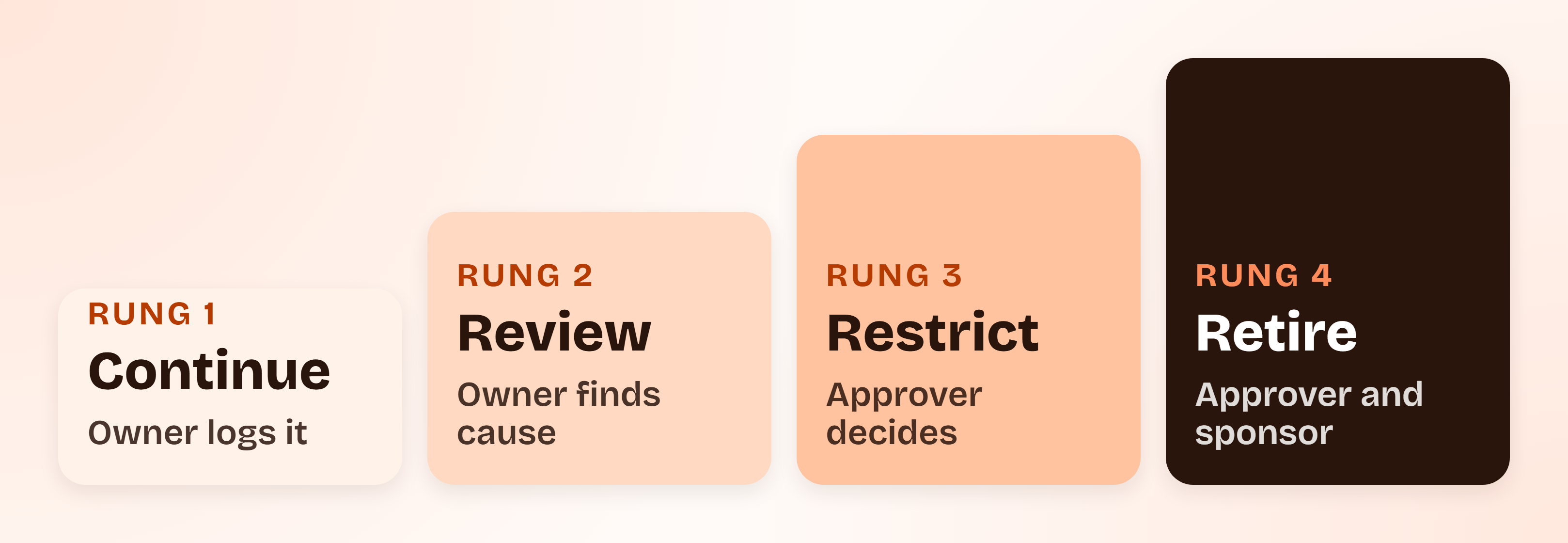
The frameworks describe the same loop. NIST's AI RMF MANAGE 4.1 calls for "post-deployment AI system monitoring plans" that include mechanisms for "appeal and override, decommissioning, incident response, recovery, and change management." For providers of high-risk systems, EU AI Act Article 72 requires a post-market monitoring system based on a plan that is part of the technical documentation, and Article 12 says such systems "shall technically allow for the automatic recording of events (logs) over the lifetime of the system."
Watch out
An alert with no owner is a log line, not governance. Before you add a metric to a dashboard, write down who is told when it trips and what they are expected to do within what time.
AI Model Accountability: Owners, Approvers and Escalation
Governance fails quietly when everyone is responsible for the model and nobody is accountable for it. AI model accountability is a short list of named roles.
| Role | What they do | Who usually fills it at a small company |
|---|---|---|
| Model owner | Answers for the model's behavior, runs the monitoring | The product or engineering lead who owns the feature |
| Approver | Signs off the launch and high-tier changes | A different engineering lead or the CTO |
| Builder | Builds, tunes and tests | An engineer or data scientist |
| Compliance or security reviewer | Checks documentation, data handling and evidence | Security or compliance lead |
| Executive sponsor | Accepts residual risk and breaks ties | CEO or CTO |
The owner and the approver should not be the same person. Bank model risk practice calls the underlying idea effective challenge: someone with enough knowledge to question the result, and enough independence to say no.
NIST's GOVERN 2.1 points the same way. It asks that roles and lines of communication for mapping, measuring and managing AI risks "are documented and are clear to individuals and teams throughout the organization," and its playbook advises separating development functions from testing functions to allow independent oversight. ISO 42001 control A.3.2 requires AI roles and responsibilities to be defined and allocated.
Quick take
At a 15-person company, one engineer may have built the model and be its best-placed owner. That is fine. Add a second person only as approver, at least for medium and high-tier models, and record both names. The point is a second pair of eyes, not a committee.
For company-level roles, such as who chairs AI decisions, see the AI governance framework guide.
AI Model Governance Checklist: What an Auditor or Customer Will Ask to See
An auditor or a customer's security team will not ask for your philosophy. They will ask for artifacts. This AI model governance checklist is the list in the order requests usually come.
| They ask for | The artifact that answers it | Where it should live |
|---|---|---|
| A list of the models you run | The AI inventory, with the model record linked | Your inventory or GRC tool |
| A description of one model | The model record | Version-controlled docs |
| Proof it was tested | Eval results with date and dataset | The model record, or your repo |
| Who approved the launch | Signed approval, with names and date | Ticket or approval log |
| Proof you watch it | Monitoring output for the last period | Dashboards, exported on a schedule |
| What went wrong and what you did | Incident and decision log | Incident tracker |
| What changed and when | Change history with re-approvals | Model record and ticket history |
| How a model is retired | A retirement record | Ticket and model record |
A quick self-review before an audit:
- Every production model has a current record.
- Every record names an owner and a different approver.
- Every model has a version you can name today.
- Every model has a fixed eval set and a last-run date.
- Every alert has a recipient and a response time.
- Every change in the past quarter has a log entry.
SOC 2 will not substitute for any of this. The report tests your controls, not your model's behavior, which is covered in does SOC 2 cover AI.
Mapping AI Model Governance to ISO 42001, NIST AI RMF and the EU AI Act
Three frameworks come up most often. They overlap more than they differ, and most of what is in this guide satisfies pieces of all three.
| Artifact | ISO 42001 | NIST AI RMF | EU AI Act (providers of high-risk systems) |
|---|---|---|---|
| Model record and documentation | A.6.2.3, A.6.2.7 | MAP 2.2 | Article 11, Annex IV |
| Testing and approval | A.6.2.4, A.6.2.5 | MEASURE function | Annex IV item 2 (validation and testing) |
| Monitoring | A.6.2.6 | MANAGE 4.1 | Article 72, Annex IV item 9 |
| Logs and incident tracking | A.6.2.8 | MANAGE 4.3 | Article 12 |
| Roles and accountability | A.3.2 | GOVERN 2.1 | Provider and deployer duties |
Scope matters here. The EU AI Act's documentation, logging and post-market monitoring duties fall on providers of high-risk systems, not on every company that uses AI.
After the Digital Omnibus, the Annex III high-risk obligations apply from 2 December 2027, and our EU AI Act compliance guide tracks the timeline, with EU AI Act risk classification explaining which tier you are in. NIST's AI RMF, released in January 2023, is voluntary. ISO 42001 is certifiable, and our guides on what ISO 42001 is, the ISO 42001 checklist and the NIST AI RMF go deeper on each.
A Worked Example: AI Model Governance for a Support-Ticket Classifier
Here is the whole system applied to one small model. The company, numbers and events below are invented to show the mechanics.
A 30-person SaaS company uses an API model to tag and route support tickets. It builds the model record shown earlier, tiers the model as medium, names the head of support operations as owner and an engineering lead as approver, and pins the model to a dated version. It scores 200 hand-labeled tickets and sets a target of 90% accurate topic tags.
The monitoring plan has three rules:
| Signal | Threshold | Response |
|---|---|---|
| Weekly eval re-run | Accuracy below 90% | Review within three working days |
| Weekly eval re-run | Accuracy below 85% | Restrict: send all urgent tickets to a human queue |
| Provider version change | Any | Re-run the eval before the new version takes traffic |
Two months later the provider announces an update to the model. The owner re-runs the 200 tickets on the new version before switching, and accuracy on urgency drops from 92% to 84%. The ladder fires at the restrict rung: the company stays on the pinned version, logs the result, and schedules a prompt revision. The change log records the finding and the decision, with the approver's name.
Nothing in that story is sophisticated. It works because the version was pinned, the eval set was fixed, the threshold was written down in advance and a named person was told.
AI Model Governance Best Practices: Mistakes That Undermine It
The best AI model governance best practices are easiest to see in reverse. These are the failures that show up most, and they are easy to fall into.
- A record written once and never updated. The record that was true at launch is false after the third prompt change. Make updating it part of the change ticket.
- "We use a vendor, so it is their problem." The vendor owns their model. You own how it behaves in your product, on your data, for your customers.
- Dashboards with no thresholds. A chart tells you something moved. A threshold tells you when to act.
- The builder approves their own work. It is the quickest way to ship a blind spot.
- No pinned version. If a provider can change the model underneath you without notice, you cannot explain last month's behavior.
- No fixed eval set. Without one, every quality claim is an anecdote.
- Governing the model but not the layer around it. Prompts, retrieval, permissions and data pipelines change behavior as much as weights do. Include them in the record and the change log.
FAQs
What Is AI Model Governance?
It is the set of records, approval gates, monitoring and named owners that control one AI model across its life. It covers what the model is for, how it was tested, who approved it, how it is watched after launch and when it is retired. It works at the level of a single model, below company-wide AI governance.
What Is the Difference Between AI Governance and AI Model Governance?
AI governance covers the whole organization: who decides how AI is used, under which rules and with which roles. AI model governance covers one model: its record, its gates, its monitoring and its owner. You need both, and the model-level work should sit inside the company-level program.
What Should an AI Model Card Include?
A model card should state the model's purpose and out-of-scope uses, version, data sources, evaluation results, known limitations and risks. For internal governance, add the risk tier, owner, approver, monitoring plan, change history and retirement criteria, which turns the card into a model record.
Who Owns AI Model Governance?
The model owner answers for each model's behavior and monitoring. A separate approver signs off launch and significant changes. Company-level ownership, such as who sets the rules, usually sits with a CTO, head of security or compliance lead. Avoid the owner approving their own launch.
How Do You Monitor an AI Model in Production?
Re-run a fixed eval set on a schedule, watch input drift, output safety flags, user overrides, latency and cost, and track provider version changes. Give each signal a threshold and a named recipient, and link thresholds to a response: continue, review, restrict or retire.
Do You Need AI Model Governance if You Only Use Third-Party Models?
Yes, in a lighter form. You do not control the model, but you control the version you pin, the prompts, your eval set and when you ship changes. A short record, a pinned version, a fixed eval set and a named owner cover most of what a customer or auditor will ask.
How Often Should You Review an AI Model?
Match the review to the risk tier and to change. Monitor continuously or weekly for anything customer-facing, review medium and high-tier models at least quarterly, and re-review any time the version, prompt, data or use case changes. Treat the schedule as a minimum and the change triggers as the rule.
What Documentation Does ISO 42001 Require for an AI System?
ISO 42001's Annex A has controls on documenting AI system design and development (A.6.2.3), technical documentation for users, partners and authorities (A.6.2.7) and event logs across the lifecycle (A.6.2.8). It does not prescribe a template, so a model record covering these areas is a reasonable way to meet them.
Does the EU AI Act Require Model Documentation?
For providers of high-risk AI systems, yes: Article 11 requires technical documentation drawn up before launch and kept up to date, with Annex IV listing its contents. It does not apply this way to every company using AI, and the high-risk Annex III obligations now apply from 2 December 2027.
Book a demo
Get your models audit-ready without the spreadsheet sprawl
Talk through the models you run, how they would be recorded, monitored and owned, and what a customer or auditor would expect to see for a team your size.
Related Reading
- AI governance framework: the company-wide program, roles, inventory and risk tiers around your models
- AI governance policy: approved-tool rules and a policy you can adapt
- AI risk assessment: how to score the risks of one AI system
- AI vendor risk management: what to ask the provider behind a model you call
- Shadow AI risk: finding and governing AI tools nobody approved
- What is ISO 42001: the standard behind the lifecycle controls mapped above
- ISO 42001 checklist: a step-by-step path to certification
- NIST AI risk management framework: the voluntary framework behind the GOVERN, MAP, MEASURE and MANAGE references
- EU AI Act compliance guide: who the documentation and monitoring duties apply to, and when
- Does SOC 2 cover AI?: where a SOC 2 report stops on model behavior