A prospect's vendor questionnaire lands in your inbox with one line highlighted: "Please provide a copy of your WISP." You have access control rules in one doc, an incident checklist in another, and a password policy in the HR folder. Nothing is called a WISP, and nothing says who is in charge of security.
That is what a WISP template fixes. It pulls the scattered pieces into one program, and it is the document several state laws and the FTC Safeguards Rule expect you to be able to produce.
A WISP, short for written information security program (or plan), is a written document that names who owns security, records the risks you assessed, sets out the administrative, technical and physical safeguards you use against them, covers vendors, training and incidents, and says how often you review it all. The words "plan" and "program" are used interchangeably, but the Massachusetts regulation says "program".
Quick answer
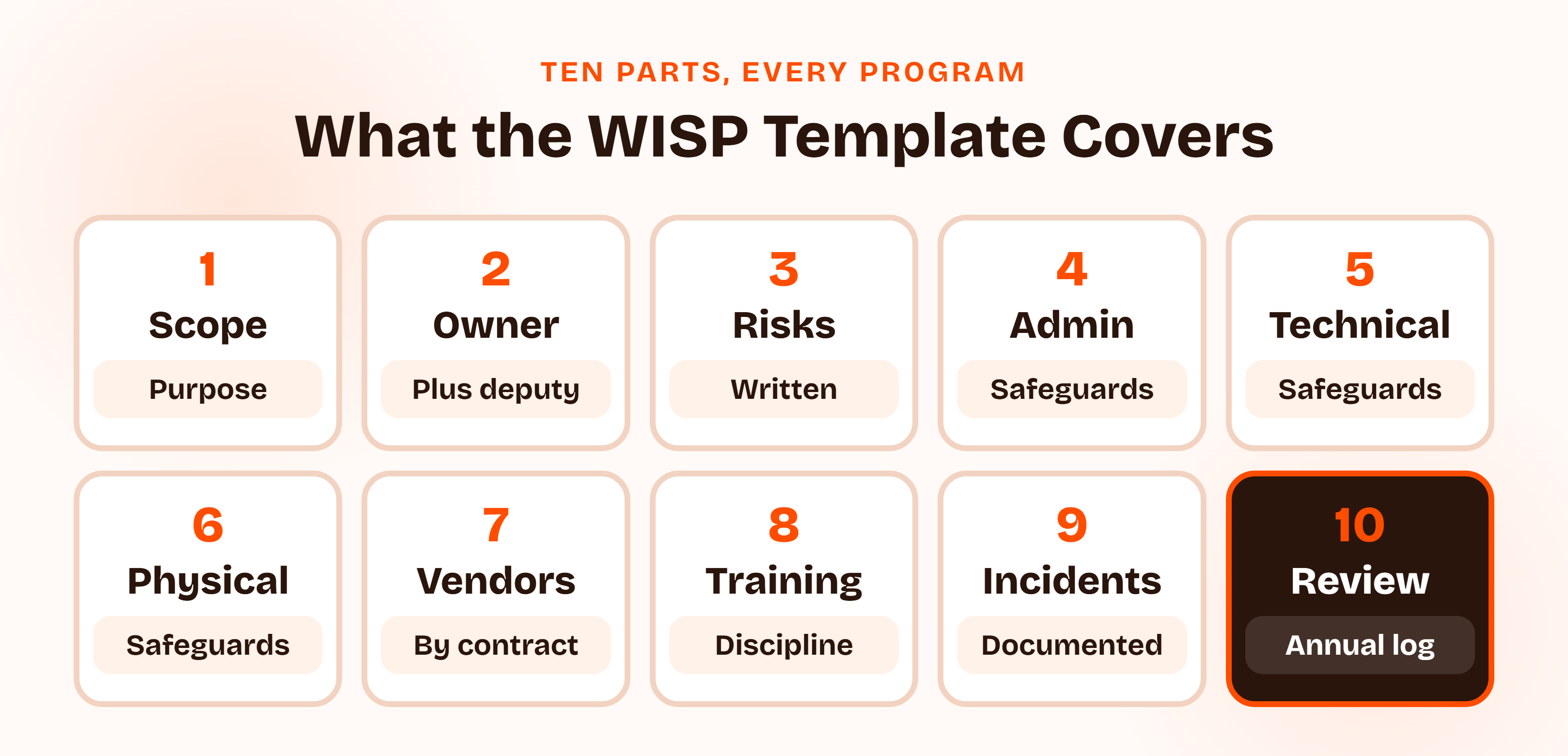
A WISP needs ten parts: purpose and scope, a named owner, a risk assessment, administrative safeguards, technical safeguards, physical safeguards, service provider oversight, training and discipline, incident response and documentation, and a review cycle with a revision log. No single national law says every business needs one. Where you do business, what data you hold and your sector decide it. Our recommended default for a startup: a short document that points to your detailed policies, reviewed once a year.
By the end of this guide you will know which laws reach your company, what to put in each section and the rule behind it, and you will have a free, ungated PDF with sample clauses to adapt.
Here's what I'll cover:
- What a WISP is, and how it differs from your information security policy
- Who needs one: Massachusetts 201 CMR 17.00, Oregon, New York, the FTC Safeguards Rule and the IRS template for tax preparers
- The ten sections every WISP template must include, each tied to the rule or control behind it
- How to right-size a WISP for a startup or small business
- How the same document supports SOC 2, ISO 27001 and HIPAA evidence
- Free sample clauses, a rollout plan, the evidence to keep and the mistakes that fail reviews
What Is a WISP Template, and What Does It Not Replace?
A WISP template (also searched as a written information security plan template) is a ready-to-adapt written information security program: a document with fixed sections, filled sample wording and blanks for the facts only you know, such as your systems, your owner and your vendors. The template is the skeleton. The program is what you actually run, and a regulator or customer will ask to see evidence of both.
One thing to settle early. A document called a "plan" and one called a "program" are the same thing here. What matters is the content.
WISP vs Information Security Policy, Risk Management Policy and Incident Response Plan
If you searched for an information security policy, you may be on the wrong page. Our information security policy guide covers the short governance statement that top management approves and that ISO 27001 clause 5.2 asks for. This article is about the larger WISP: the program document that names the owner, the risk assessment, the safeguards, the vendor and training duties and the review cycle.
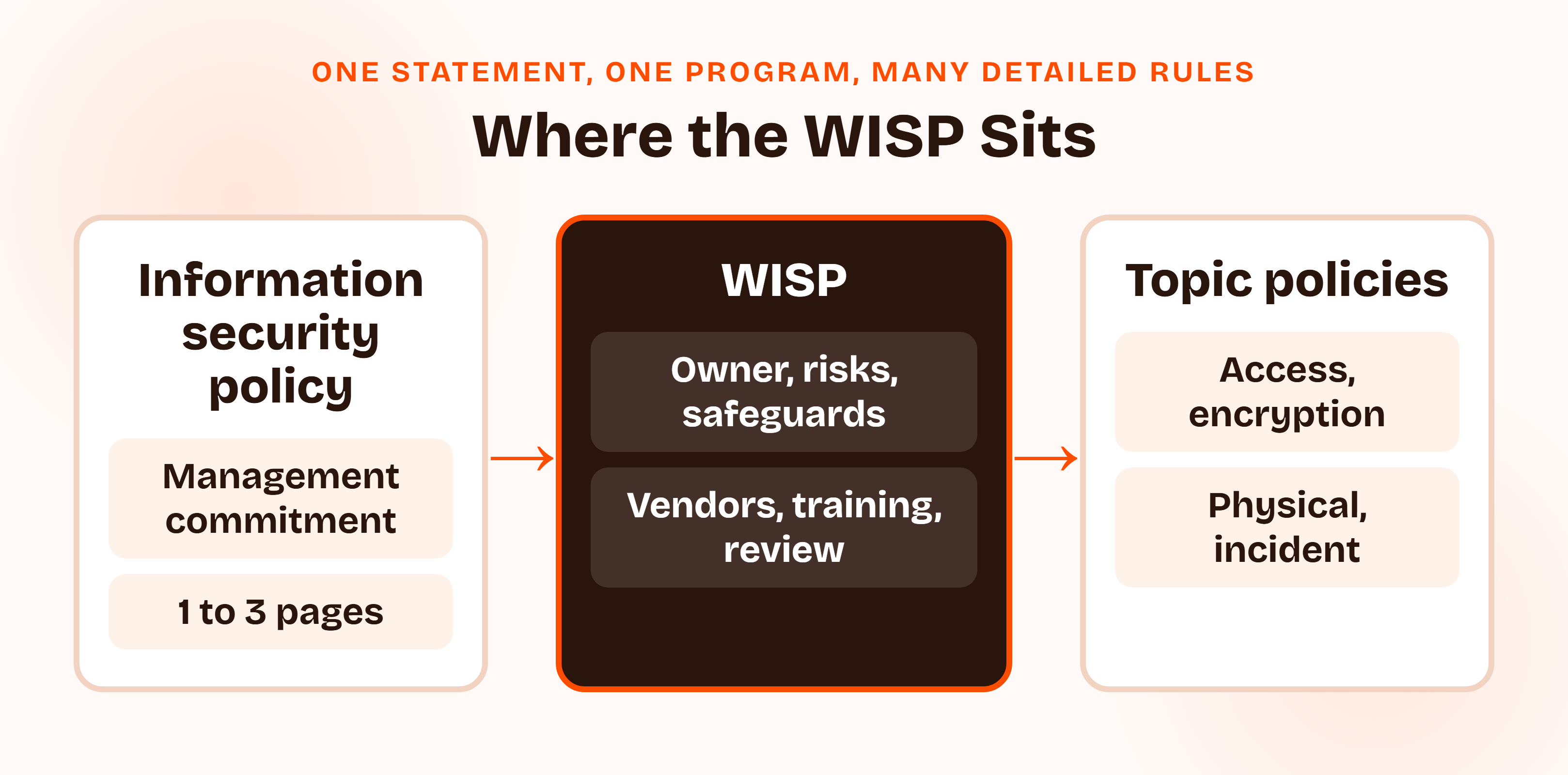
The two work together. The policy states the intent. The WISP shows how you carry it out, and the WISP vs information security policy question comes down to length and detail: one is a statement, the other is a program.
| Document | The question it answers | Who signs it | Typical length |
|---|---|---|---|
| Information security policy | What is management's commitment to security? | CEO or board | 1 to 3 pages |
| WISP | Who runs security, which risks and safeguards, and how is it reviewed? | CEO, with a named program owner | 8 to 15 pages for a startup |
| Risk management policy | How do we find, score and treat risk? | Risk or security lead | 3 to 6 pages |
| Incident response plan | What do we do in the first hours of an incident? | Security lead | 5 to 10 pages |
| Topic policies (access control, encryption, physical security) | How exactly is this one control run? | Control owner | 2 to 5 pages each |
The page lengths in that table are our recommended defaults for a startup, not requirements.
Pro tip
Your WISP can point to the topic policies instead of repeating them. "Access to systems holding personal information follows the Access Control Policy" is a complete sentence in a WISP. That is how a ten-page document stays accurate. Copy a rule into two places and one of them will go stale.
SOC 2
Preparing for SOC 2?
The audit is the moment most startups first need their policies to exist and agree with each other. ComplyJet helps you draft, distribute and track them in one place.
Who Needs a WISP? State Requirements and Federal Rules
No single national law says every business needs a WISP. The duty comes from where your customers and employees live, what personal data you hold and which sector you operate in. Here is how the main WISP requirements read, state by state and federal.
| Law | Who it reaches | What it says about a program |
|---|---|---|
| Massachusetts, 201 CMR 17.00 | Anyone who owns or licenses personal information about a Massachusetts resident, wherever the company is based | A "comprehensive information security program that is written in one or more readily accessible parts" |
| Oregon, ORS 646A.622 | Covered entities and vendors handling Oregon residents' personal information | "Reasonable safeguards"; an information security program with listed safeguards is a way to comply |
| New York, GBL 899-bb (SHIELD Act) | Businesses holding private information of New York residents | "Reasonable safeguards"; a data security program with listed safeguards counts as compliance, with a lighter test for small businesses |
| FTC Safeguards Rule, 16 CFR 314 | Financial institutions under FTC jurisdiction | A written risk assessment, a written incident response plan and a set of program elements |
| IRS (Publication 5708 sample plan) | Professional tax preparers | A written data security plan; the IRS publishes a sample |
| HIPAA Security Rule, 45 CFR 164.316 | Covered entities and business associates | Policies and procedures kept in written form, retained six years |
Note
Among the state laws and the FTC rule, only Massachusetts and the FTC rule use the word "written" about the program itself in the text we read. Oregon and New York ask for reasonable safeguards and treat a program as the way to show you have them. A written program is still how you prove it. Other states have their own versions, so check where your customers are.
WISP Massachusetts: 201 CMR 17.00 Requirements Explained
For a WISP Massachusetts is the reference point, because its rule is the most specific, and it reaches out of state. The regulation applies to every person that "owns or licenses" personal information about a Massachusetts resident. That phrase is defined broadly in 17.02: you receive, store, maintain, process or otherwise have access to the information in connection with goods, services or employment.
A ten-person SaaS company in Texas with one Massachusetts customer's employee data is in scope.
"Personal information" has a narrow definition. It is a resident's first and last name (or first initial and last name) combined with at least one of: a Social Security number, a driver's license or state ID number, or a financial account or card number. Publicly available information is excluded. The program still has to cover paper and electronic records.
Section 17.03(1) says the program must contain administrative, technical and physical safeguards appropriate to four things: the size, scope and type of business, the resources available, the amount of stored data, and the need for security and confidentiality of consumer and employee information. That sizing language is why a startup's WISP can be short.
Section 17.03(2) then lists what every program must include. Here it is mapped to the WISP sections you will write.
| 201 CMR 17.03(2) element | What it requires | WISP section |
|---|---|---|
| (a) | Designating one or more employees to maintain the program | Program owner |
| (b) | Identifying and assessing foreseeable internal and external risks to electronic, paper and other records, with training, policy compliance and detection of system failures | Risk assessment |
| (c) | Security policies for storing, accessing and transporting records outside business premises | Technical and physical safeguards |
| (d) | Disciplinary measures for violations | Training and discipline |
| (e) | Preventing terminated employees from accessing records | Technical safeguards |
| (f) | Overseeing service providers: select capable ones and require safeguards by contract | Service providers |
| (g) | Reasonable restrictions on physical access, with records in locked facilities or containers | Physical safeguards |
| (h) | Regular monitoring that the program works, and upgrading safeguards as needed | Review and monitoring |
| (i) | Reviewing the scope of security measures at least annually or on a material change | Review and revision log |
| (j) | Documenting responsive actions for any breach of security, with a mandatory post-incident review | Incident response |
Section 17.04 adds eight computer system elements for anyone who stores or transmits personal information electronically, "to the extent technically feasible": secure user authentication, secure access control, encryption of transmitted records across public networks and wirelessly, reasonable monitoring, encryption of personal information on laptops and portable devices, up-to-date firewalls and patches, up-to-date malware protection, and employee training on the security system. These feed the technical safeguards section.
Watch out
The regulation implements Massachusetts General Laws chapter 93H. Treat the 17.03 and 17.04 lists as the minimum, not the whole job. We cite the regulation text itself, and this guide is not legal advice.
State WISP Requirements Beyond Massachusetts: Oregon and New York
The state WISP requirements outside Massachusetts are phrased as reasonable safeguards, not as a ten-point list.
Oregon requires covered entities and vendors to "develop, implement and maintain reasonable safeguards to protect the security, confidentiality and integrity of personal information." ORS 646A.622(2) then lists a route to compliance: follow a stronger state or federal law, comply with Gramm-Leach-Bliley or HIPAA regulations where they apply, or implement an information security program with listed administrative, technical and physical safeguards.
The listed safeguards include designating an employee to coordinate the program, identifying foreseeable risks, training staff, selecting service providers that can keep safeguards in place and requiring it by contract, and reviewing user access privileges.
A small-business owner complies if the program is sized to the business.
New York's SHIELD Act, in General Business Law 899-bb, uses the same two-step shape. It requires "reasonable safeguards," treats a data security program with listed administrative, technical and physical safeguards as compliance, and gives small businesses a lighter, size-appropriate test.
The statute defines a small business as one with fewer than fifty employees, or under $3 million in gross annual revenue in each of the last three fiscal years, or under $5 million in year-end total assets. Failure to comply is treated as a violation of GBL 349, and the New York Attorney General enforces.
Neither statute is a template. Both reward the same document: a written program that covers the listed safeguards. If your customers sit in more states than these, our US state privacy laws list is a good place to see which data rules reach you.
Quick take: write one program to the strictest rule you are subject to, then note inside the WISP which laws it answers.
WISP for Tax Preparers: IRS Publication 5708 and the FTC Safeguards Rule
If you landed here from the IRS template, this section on a WISP for tax preparers is for you. The IRS states that "federal law requires all professional tax preparers to create and implement a data security plan," and publishes Publication 5708, "Creating a Written Information Security Plan for your Tax & Accounting Practice," as a sample for smaller practices.
Publication 4557, "Safeguarding Taxpayer Data," is the companion security guidance. The IRS describes the sample as a starting point, not a final template.
The FTC Safeguards Rule, 16 CFR Part 314, implements sections 501 and 505(b)(2) of the Gramm-Leach-Bliley Act. Section 314.4 lists what the program must include:
- A designated qualified individual to oversee and implement it
- A written risk assessment
- Safeguards, including encryption of customer information and multi-factor authentication
- Regular testing or monitoring of key controls
- Security awareness training
- Oversight of service providers, by contract
- Evaluation and adjustment of the program
- A written incident response plan
- A written report from the qualified individual to the board or a senior officer at least annually
- Notice to the FTC of qualifying events affecting at least 500 consumers, no later than 30 days after discovery
Section 314.6 exempts institutions that hold customer information on fewer than 5,000 consumers from some of these items: the written risk assessment details in 314.4(b)(1), the testing provisions in (d)(2), the written incident response plan in (h) and the annual board report in (i).
If you are a tax or accounting practice, start from the IRS sample and the sections below. If you are a SaaS company, take the structure and skip the tax-specific wording. Section 314.4 is a good checklist for either.
What a WISP Template Must Include: Ten Sections Mapped to the Rule Behind Each
Every one of these WISP requirements asks for the same bones. The table shows ten sections, the state and federal text that drives each, and the audit areas the same section serves. ISO 27001 and SOC 2 do not require a document titled "WISP". The columns show where a section's content lands as evidence.
| WISP section | 201 CMR | 16 CFR 314.4 | ISO 27001:2022 | SOC 2 area |
|---|---|---|---|---|
| 1. Purpose and scope | 17.01, 17.03(1) | (b) risk assessment scope | Clause 4.3 scope, 5.2 policy | CC1 control environment |
| 2. Program owner | 17.03(2)(a) | (a) qualified individual | Clause 5.3 roles | CC1, CC2 |
| 3. Risk assessment | 17.03(2)(b) | (b) written risk assessment | Clause 6.1.2 | CC3 risk assessment |
| 4. Administrative safeguards | 17.03(2)(c), (e) | (c) | Annex A 5.1, 6.1 to 6.7 | CC5, CC6 |
| 5. Technical safeguards | 17.04(1) to (7) | (c), (d) | Annex A 8.x | CC6, CC7 |
| 6. Physical safeguards | 17.03(2)(g) | (c) | Annex A 7.x | CC6 |
| 7. Service providers | 17.03(2)(f) | (f) | Annex A 5.19, 5.20 | CC9 vendors |
| 8. Training and discipline | 17.03(2)(d), 17.04(8) | (e) | Annex A 6.3, 6.4 | CC1, CC2 |
| 9. Incident response | 17.03(2)(j) | (h), (j) | Annex A 5.24 to 5.28 | CC7 |
| 10. Review and revision log | 17.03(2)(h), (i) | (g), (i) | Clauses 9.2, 9.3, 10 | CC4 monitoring |
The ISO and SOC 2 references are the audit areas a section supports, not requirements to hold a WISP.
Pro tip
Number your WISP sections the same way every time and keep one row per section in a table like this one. When a questionnaire asks "where in your program do you cover vendor oversight?", you answer with a section number, not a search through three folders.
WISP Template Section 1: Program Owner and Scope
Start with who. Massachusetts says to designate "one or more employees" to maintain the program, and the FTC rule calls the role a qualified individual. In a 20-person company that is usually the head of engineering, the CTO or whoever signs the customer security reviews.
Name a role, not only a person, and name a deputy. When the founder is also the only technical person, the deputy and a reporting line to the CEO keep the program from collapsing when that person is on leave.
The scope sentence matters just as much. Say which systems, which office locations, which people (employees, contractors, interns) and which records, paper as well as electronic, the program covers.
WISP Template Section 2: The Risk Assessment Regulators Read First
Both Massachusetts and the FTC rule build the program on a risk assessment. Section 17.03(2)(b) asks you to identify and assess reasonably foreseeable internal and external risks to records containing personal information, and to evaluate whether current safeguards limit them. The FTC rule says the assessment "shall be written."
Keep it small and real. Five rows can be enough for an early-stage company:
| Asset | Threat | Existing safeguard | Decision |
|---|---|---|---|
| Customer database in the cloud | Stolen credentials | MFA, least-privilege roles | Accept, review quarterly |
| Laptops with exported customer files | Loss or theft | Full-disk encryption | Mitigated |
| Shared drive with HR records | Over-broad access | Access reviews | Tighten permissions |
| Payroll vendor | Vendor breach | Contract clause, annual review | Monitor |
| Paper onboarding forms | Left on desks | Locked cabinet | Move to digital, shred originals |
Our risk management policy guide walks through scoring and treatment if you need more than a table.
WISP Template Section 3: Administrative, Technical and Physical Safeguards
This is the heart of the document, and it is where a WISP most often turns into fiction. Write only what you actually do, then link to the detailed policy.
| Layer | What the WISP states | Detailed policy |
|---|---|---|
| Administrative | Owner and deputy, onboarding and offboarding, access reviews, acceptable use, disciplinary measures | Access control policy |
| Technical | Unique user IDs and MFA, encryption in transit and at rest, encrypted laptops, patching, malware protection, logging and monitoring, firewall | Data encryption policy |
| Physical | Locked storage for paper records, controlled office access, visitor handling, secure disposal | Physical security policy |
Two Massachusetts details are easy to miss. Section 17.03(2)(c) asks for security policies on storing, accessing and transporting records outside business premises, which in 2026 means remote work and personal devices. Section 17.03(2)(e) asks you to prevent terminated employees from accessing records, so offboarding needs a same-day access removal step you can evidence.
WISP Template Sections 4 to 6: Vendors, Training and Incident Documentation
Service providers. Both 17.03(2)(f) and 314.4(f) ask for two steps: select providers that can keep appropriate safeguards, then require those safeguards by contract. Keep a vendor list with what data each vendor touches. Our vendor management policy guide covers the review cycle.
Training and discipline. Staff, including temporary and contract workers, need training on the program and on handling personal information, and the program must state the consequences of violating it. Our security awareness training policy guide covers cadence and records.
Incident response. The regulation asks for two outputs after any breach of security: documented responsive actions and a mandatory post-incident review of what changed. The FTC rule adds a written incident response plan. The WISP carries a short section that names who declares an incident and points to your plan.
WISP Template Section 7: Annual Review and Revision History
Section 17.03(2)(i) requires reviewing the scope of your security measures at least annually, or whenever there is a material change in business practices that may reasonably affect the security of personal information. The FTC rule asks you to evaluate and adjust the program based on testing, operational changes and risk assessments.
Put the triggers in the document:
- A new system or vendor that holds personal information
- A new category of data, such as starting to collect government IDs
- A new office or a major change in how people work
- A security incident, once the post-incident review is done
- A new law or a new customer commitment
Then add a revision log at the end: version, date, what changed, who approved it. It is a small table that earns its keep the first time someone asks "when did this last change?"
WISP Template for Small Business and SaaS Startups: How to Right-Size It
A WISP template for small business use starts from the sizing language in the law itself. Massachusetts ties safeguards to size, resources, stored data and sensitivity. Oregon lets a small-business owner comply with a program sized to the business. New York defines a small business and lightens the test. A five-person company does not need a sixty-page manual.
Here is how we would scale it. These are our recommended defaults, not legal thresholds.
| Company size | What the WISP looks like | Owner | Review |
|---|---|---|---|
| Under 10 people | 5 to 8 pages, one owner plus a deputy, five-row risk table, links to short topic policies | Founder or CTO | Annually, plus on any vendor change |
| 10 to 50 people | 8 to 15 pages, a risk register, vendor list, training records, an incident log | Security or engineering lead | Annually, with a quarterly check of access and vendors |
| 50 to 200 people | Full set of topic policies, formal risk process, board or senior-leader reporting | Dedicated security or compliance owner | Annually, with documented management review |
Most of your first WISP is facts, not prose. Know your systems, your data types, the states your customers live in and your vendors before you open the template.
What does a customer questionnaire actually want? Usually a yes to "do you maintain a written information security program?" and a copy or a summary. A two-sentence answer works: "Yes. Our program is approved by our CEO, owned by our head of engineering, reviewed annually and covers administrative, technical and physical safeguards. A summary is available on request."
Watch out
A free template does not make you compliant. The document is the easy part. The decisions inside it (who owns this, which vendors have access, how long you keep records) are the work, and an auditor or a customer will test them.
Customer Story
"It made SOC 2 and ISO 27001 readiness clear and manageable with automated workflows, evidence collection, and expert support."
David Orr, COO, Romina Day
One WISP Template, Many Audits: SOC 2, ISO 27001 and HIPAA
Once the WISP exists, the same document does double duty. Each framework asks for the same underlying facts in a different shape.
| Framework | Where the WISP supplies evidence | What an auditor samples |
|---|---|---|
| SOC 2 | Control environment and policies (CC1, CC5), risk assessment (CC3), vendor management (CC9) | The approved document, the risk register, vendor reviews, training records |
| ISO 27001 | Clause 5.2 policy, 5.3 roles, 6.1.2 risk assessment, Annex A supplier and training controls | Management approval, risk assessment records, review minutes |
| HIPAA | 45 CFR 164.316 documentation: policies in written form and retained six years | Written policies, risk analysis records, retention |
No SOC 2 criterion and no ISO 27001 control requires a document titled "WISP". HIPAA does not use the word either. What they all test is the content: an owner, an assessed risk, safeguards that work, controlled vendors, trained people, a record of incidents and a review cycle. A WISP that covers those ten sections gives you that content in one place.
For health data specifically, HIPAA's documentation standard says policies and procedures must be maintained "in written (which may be electronic) form," and the documentation retained for six years from creation or last effective date. Our HIPAA compliance plan guide covers the health-data program in more depth.
Free WISP Template: Sample Clauses You Can Adapt and Download
This section answers the "wisp template free" search directly. This WISP example is real wording, not a skeleton. Treat it as a written information security plan template: replace each [bracketed value] with your own fact, delete anything that does not apply and have counsel review the final version. Each clause names the rule it serves.
WISP Example: Sample Clauses for Each Section
Sample clause: Purpose and scope (17.03(1))
[Company] maintains this written information security program to protect personal information and other confidential data it holds, in paper and electronic form. It contains administrative, technical and physical safeguards appropriate to [Company]'s size, resources, the amount of data it stores and the sensitivity of that data. It applies to all employees, contractors, interns and any other person given access to [Company] systems or records.
Sample clause: Program owner (17.03(2)(a), 314.4(a))
The [Head of Engineering] is the Program Owner and is responsible for implementing and maintaining this program. The [VP of Operations] is the deputy. The Program Owner reports to the [CEO] in writing at least once a year on the state of the program, open risks and incidents.
Sample clause: Risk assessment (17.03(2)(b), 314.4(b))
The Program Owner will assess reasonably foreseeable internal and external risks to the security, confidentiality and integrity of records containing personal information at least [annually] and whenever a material change occurs. The assessment is recorded in writing in the risk register, which lists each asset, the threat, the safeguards in place, the decision taken and the owner.
Sample clause: Access and authentication (17.04(1), (2))
Every person with access to [Company] systems receives a unique user ID. Multi-factor authentication is required for [all production, cloud and email systems]. Access to records containing personal information is limited to people who need it to do their job. Vendor-supplied default passwords are not permitted. User access is reviewed [quarterly], and access is removed on the day a person leaves.
Sample clause: Encryption and devices (17.04(3), (5), 314.4(c))
Personal information is encrypted when transmitted across public networks or wirelessly, and when stored on laptops or other portable devices. [Company] [also encrypts personal information at rest in its production databases]. Company laptops use full-disk encryption and automatic screen lock. Personal information is not stored on personal devices or removable media unless the Program Owner has approved it.
Sample clause: Remote work and records off premises (17.03(2)(c))
Records containing personal information may be taken or accessed outside [Company] premises only on approved devices over approved connections. Paper records may not be removed from the office unless the Program Owner has approved it. Lost or stolen devices and records must be reported to the Program Owner [within 24 hours].
Sample clause: Physical safeguards (17.03(2)(g))
Paper records containing personal information are kept in locked [cabinets or rooms] with access limited to [named roles]. Visitors are signed in and escorted. Paper and media are destroyed by [shredding or certified disposal] when no longer needed for business or legal reasons.
Sample clause: Service providers (17.03(2)(f), 314.4(f))
Before a vendor receives personal information, the Program Owner will take reasonable steps to confirm the vendor can maintain appropriate safeguards. [Company] requires each such vendor, by written contract, to implement and maintain safeguards for that information. [Company] keeps a vendor list showing what data each vendor can access and reviews it [annually].
Sample clause: Training and discipline (17.03(2)(d), 17.04(8), 314.4(e))
All personnel, including temporary and contract workers, complete security awareness training when they join and [annually] after that. Training covers this program, handling of personal information and how to report an incident. Violating this program may lead to disciplinary action, up to and including termination of employment or contract.
Sample clause: Incident response (17.03(2)(j), 314.4(h))
Suspected incidents are reported to the Program Owner immediately. The Program Owner decides whether a breach of security has occurred, follows the [Incident Response Plan] and records the actions taken. After every incident, [Company] holds a post-incident review and documents any change made to its practices.
Sample clause: Review and revision (17.03(2)(h), (i), 314.4(g))
The Program Owner will review the scope of this program at least [annually] and whenever a material change in business practices may affect the security of personal information, including a new system, a new type of data, a new vendor or an incident. Each review and change is recorded in the revision log, and the [CEO] approves the updated version.
Free Template
Download the Free WISP Template (PDF)
All ten sections with sample clauses, a control-mapping table for 201 CMR 17.00, the FTC Safeguards Rule, SOC 2 and ISO 27001, a risk register, a vendor list and a revision log.
Customization Checklist: Replace Every Bracket and Delete What Does Not Apply
A free WISP template is only as useful as the facts you put into it.
Before you edit a single clause, gather these facts:
- The list of systems that store or process personal information, and where each one lives
- The kinds of personal data you hold, and about residents of which states
- Headcount, offices and who works remotely
- Every vendor with access to that data
- Who will be the Program Owner and the deputy
- Which topic policies already exist and which need to be written
Then delete any clause you cannot back with a real control. A short WISP you follow beats a long one you do not.
How to Roll Out Your WISP Template and Prove It Works
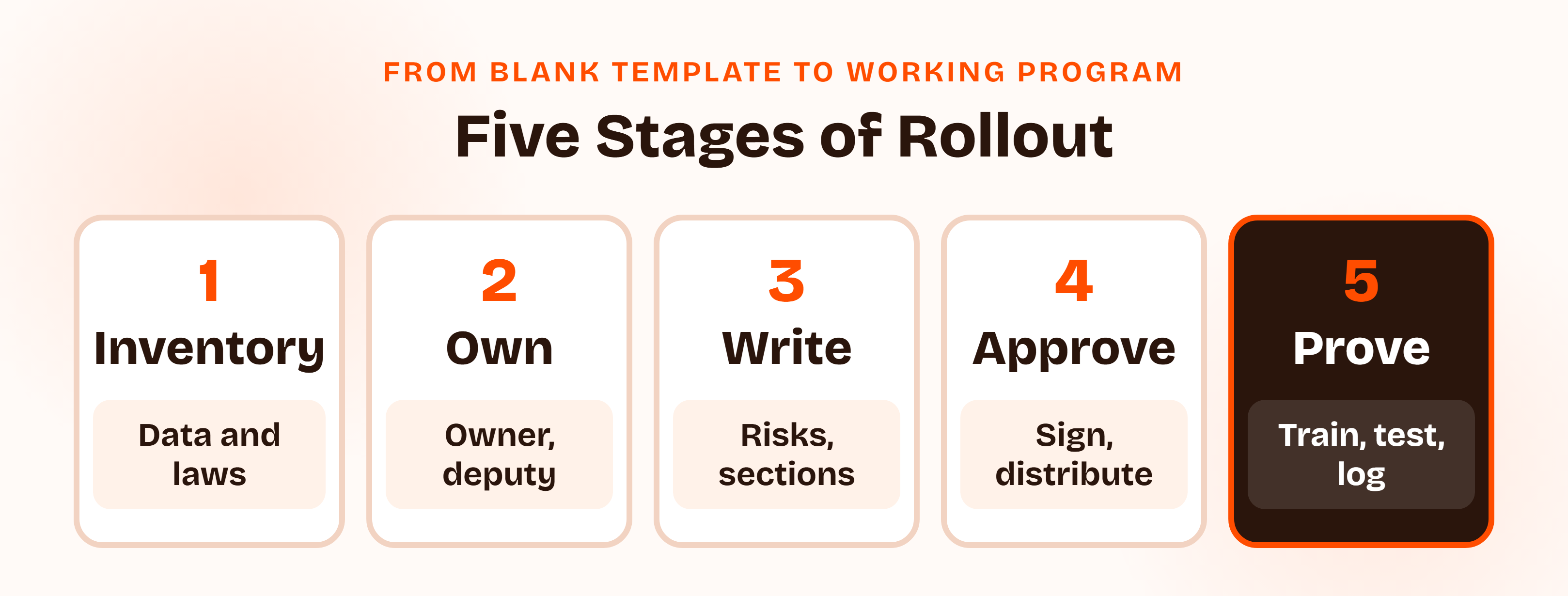
A WISP template on a shared drive protects nobody. The rollout is where it becomes a program.
- Inventory data and systems. Know where personal information lives, in cloud tools, laptops and paper.
- Decide which laws apply. Use the table above, and add any rule from your customers' states or your sector.
- Name the owner and the deputy. Get both to accept in writing.
- Assess risks. Fill the risk register with real assets and real decisions.
- Write the ten sections. Adapt the sample clauses and link to your topic policies.
- Get management approval. The CEO or board signs and dates version 1.0.
- Distribute and collect acknowledgments. Every person in scope confirms they have read it.
- Train. Run onboarding and annual training, and keep the records.
- Test and review. Check access removal, restore a backup, review vendors, then log what you found.
The proof is a folder of dated records, not the document alone. These are the items a customer, an auditor or a state attorney general would ask to see:
| Evidence | What it shows |
|---|---|
| Approved WISP with version and date | The program exists and management stands behind it |
| Risk register with decisions | The assessment is written and current |
| Acknowledgment records | People in scope have read it |
| Training completion records | Staff were trained |
| Vendor list, contracts and reviews | Service provider oversight is real |
| Incident log with post-incident reviews | Responsive actions are documented |
| Annual review record and revision log | The program is reviewed at least annually |
Try this yourself: pick one clause, such as "access is removed on the day a person leaves," and find the last three records that prove it. If you cannot produce them in ten minutes, the clause either needs a better process or an honest rewrite.
WISP Template Mistakes That Fail Audits and Questionnaires
These are easy to get wrong, and they are the ones that turn a decent program into a problem.
- Another company's name is still in the template. It happens more than you would expect, and it tells a reader nobody checked the document.
- The owner is named but never told. A role in a PDF is not a person who knows they own the program.
- The risk assessment is missing or was a one-time exercise. Both Massachusetts and the FTC rule build the program on it.
- Vendor oversight has no contract language. A vendor list without a security clause in the agreement covers only half of 17.03(2)(f).
- Written once and never reviewed. Section 17.03(2)(i) says at least annually or on a material change.
- The WISP claims safeguards the systems do not have. This is the worst one, because it turns a gap into a misstatement. If laptops are not encrypted yet, say so and add a dated plan.
How ComplyJet Helps You Keep Your WISP Current
Your WISP template is only as good as the evidence behind it, and that is where we come in. ComplyJet's policy management is built to draft, distribute and track policies: AI-assisted drafting from a library of 30+ templates mapped to SOC 2, ISO 27001, HIPAA and GDPR, distribution to your team, every acknowledgment logged with name, date and policy version, and automated reminders when a policy is due for review.
Security awareness training is logged as evidence, and 350+ integrations collect system evidence automatically.
Be clear on scope. We are not a law firm, we do not certify compliance with Massachusetts or any other state law, and you decide and own the program. We keep the documents, acknowledgments, training and evidence in one place so the program holds up when someone asks.
Compliance Automation
Turn your WISP into audit-ready evidence
See how ComplyJet distributes policies, tracks acknowledgments and records security training for SOC 2, ISO 27001, HIPAA and GDPR.
FAQs
What Is a WISP?
A WISP is a written information security program (sometimes called a plan). It documents who is responsible for security, the risks you assessed, the safeguards you use, how you manage vendors, training and incidents, and how often you review it. Massachusetts requires one in regulation text, and the FTC Safeguards Rule requires a program with written elements for covered financial institutions.
Is a WISP Required by Law?
Sometimes. Massachusetts 201 CMR 17.00 requires a written program from anyone who owns or licenses personal information about a Massachusetts resident. The FTC Safeguards Rule and IRS guidance reach financial institutions and tax preparers. Oregon and New York require reasonable safeguards and treat a program as the way to show them. If none of these reaches you, customers and auditors will still ask for one.
What Is the Difference Between a WISP and an Information Security Policy?
The information security policy is the short statement of management's commitment, the document ISO 27001 clause 5.2 asks for. The WISP is the larger program document that adds the owner, risk assessment, safeguards, vendor and training duties and review cycle. Most companies need both, and the WISP can link to the policy.
Does the Massachusetts WISP Rule Apply to Companies Outside Massachusetts?
Yes, if you own or license personal information about a Massachusetts resident. The regulation defines "owns or licenses" as receiving, storing, maintaining, processing or otherwise having access to that information in connection with goods, services or employment, and says nothing about where the company is located.
How Often Should a WISP Be Reviewed?
At least once a year, and whenever there is a material change in business practices that may affect the security of personal information. Massachusetts says this in 17.03(2)(i). Treat a new vendor, a new data type, a new office or a security incident as a trigger.
Can a Non-Tax Business Use the IRS WISP Template?
You can borrow its structure, but it is written for tax and accounting practices. It refers to tax software, taxpayer data and IRS rules that a SaaS company does not face. Use the IRS sample for ideas on layout, and adapt the sections to your own systems, data and vendors.
Is a WISP Required for SOC 2?
No SOC 2 criterion names a WISP. The auditor tests whether you have the underlying content: governance and policies, a risk assessment, vendor management, training and incident handling. A WISP is a convenient way to document it in one place.
Is a Free WISP Template Enough?
It is a good start, not a finish. A template cannot know your systems, vendors, data types or the states your customers live in. Fill every bracket with a real fact, delete what you do not do and have counsel review it. The customer or regulator will test the facts, not the formatting.
Related Reading
- Information Security Policy: the short governance statement a WISP sits beneath
- Data Retention Policy: how long to keep the records your WISP protects
- Third-Party Risk Management Policy: the deeper vendor review process behind the service provider section
- US State Privacy Laws List: which state data rules reach your customers
This guide and the template are for general information and are not legal advice. Have counsel review the final program, especially where state or sector rules apply.