.svg)

A customer security questionnaire asks a simple-sounding question: "Is all sensitive data encrypted at rest and in transit?" You know the production database is encrypted. You're less sure about the weekly backups, the staging environment, or the logs your monitoring tool has been quietly collecting for a year.
A data encryption policy is a written document that defines what data an organization must encrypt, where (at rest, in transit, or both), and under which compliance requirements. It's built on data classification, deciding which data is sensitive enough to require encryption, and maps to whichever frameworks actually apply: SOC 2, ISO 27001, HIPAA, PCI DSS, or GDPR.
Quick answer
A data encryption policy covers three things: a data classification scheme that decides what counts as sensitive, encryption requirements split between data at rest and data in transit, and a mapping to the compliance frameworks that actually apply. It's the scoping document. A separate cryptography policy covers the technical how: approved algorithms and key management.
By the end of this guide, you'll have a complete answer to what your company actually needs to encrypt, backed by a real downloadable template, not a form to fill out to get one emailed to you.
Here's what I'll cover:
- What a data encryption policy actually is, and how it differs from a cryptography policy
- Why a written policy matters, not just good encryption habits
- What data actually needs to be encrypted, organized by classification tier
- The at-rest vs. in-transit split, and where most companies leave a real gap
- How requirements differ across SOC 2, ISO 27001, HIPAA, PCI DSS, and GDPR
- A free, downloadable template with real sample clauses
- How to roll it out, and the mistakes that get flagged in an audit
What Is a Data Encryption Policy?
A data encryption policy is the document that scopes what data must be encrypted and where. Not the algorithm, not the key rotation schedule, the boundary. It answers one question clearly enough that an engineer, an auditor, or a customer's security reviewer can all read it the same way: does this data need to be encrypted, and under what circumstances.
That's a different thing from general encryption best-practices advice, which is the reasoning behind the boundary. A policy is the artifact a company adopts and hands to an auditor. Best practices are why the boundary sits where it does.
Most companies write one for the first time under pressure: a customer security questionnaire asks the question directly, a SOC 2 or ISO 27001 audit is starting, or someone realizes that "we encrypt the important stuff" was never actually written down anywhere a reviewer could check.
Quick take
A data encryption policy is the scoping document: what gets encrypted, and where. It's not the same as knowing how to configure encryption correctly, that's a separate, more technical document. Most teams eventually need both, but only the written policy satisfies an auditor asking for evidence.
How This Differs From ComplyJet's Cryptography Policy Guide
This article scopes what data must be encrypted and where, at rest, in transit, or both, organized by classification tier. It's not a substitute for ComplyJet's own Cryptography Policy guide, which covers how encryption itself gets implemented and governed: approved algorithms like AES-256, key generation, rotation, revocation, and the full key-management lifecycle.
If you already have a cryptography policy, or need one specifically for algorithm selection and key management, that guide goes further on the technical implementation than this article does. This one is the scoping document that usually comes first, and it's the one with a downloadable template built around classification and scope rather than algorithms.
Note
These two pages work together, not in competition. Start here to define what needs protecting and where. Move to the cryptography policy once you're ready to document exactly how that protection gets implemented, down to the algorithm and key-management level.
Why a Written Data Encryption Policy Matters
Unencrypted sensitive data, customer PII, credentials, financial records, shows up constantly in breach post-mortems as the thing that turned a bad incident into a catastrophic one. It's also one of the first things a SOC 2 or ISO 27001 auditor, or a customer's security reviewer, asks to see scoped in writing.
"We encrypt our database" and "we have a written data encryption policy that defines what must be encrypted and why" are not the same claim. Auditors and security questionnaires ask for the second one. A verbal assurance that the team is careful doesn't show up as evidence anywhere.
A written policy also removes ambiguity for the people building new systems. Instead of a case-by-case judgment call on every new data store or integration, an engineer has a clear answer: check the classification tier, apply the matching requirement. That answer doesn't erode as the team and the systems it maintains keep growing.
Watch out
"Informal practice isn't a policy" trips up most unwritten controls, not just encryption. If a reviewer can't point to a document that defines the scope, it doesn't count as a control, no matter how careful the team actually is in practice.
What Data Should Be Encrypted
Most guidance on this topic names a vague "sensitive data" category and moves on. That's not usable. A data encryption policy needs a real classification structure behind it, one that tells an engineer or reviewer exactly which tier a given data type falls into and what that tier requires.
Data Classification and Encryption: A Tier-Based Approach
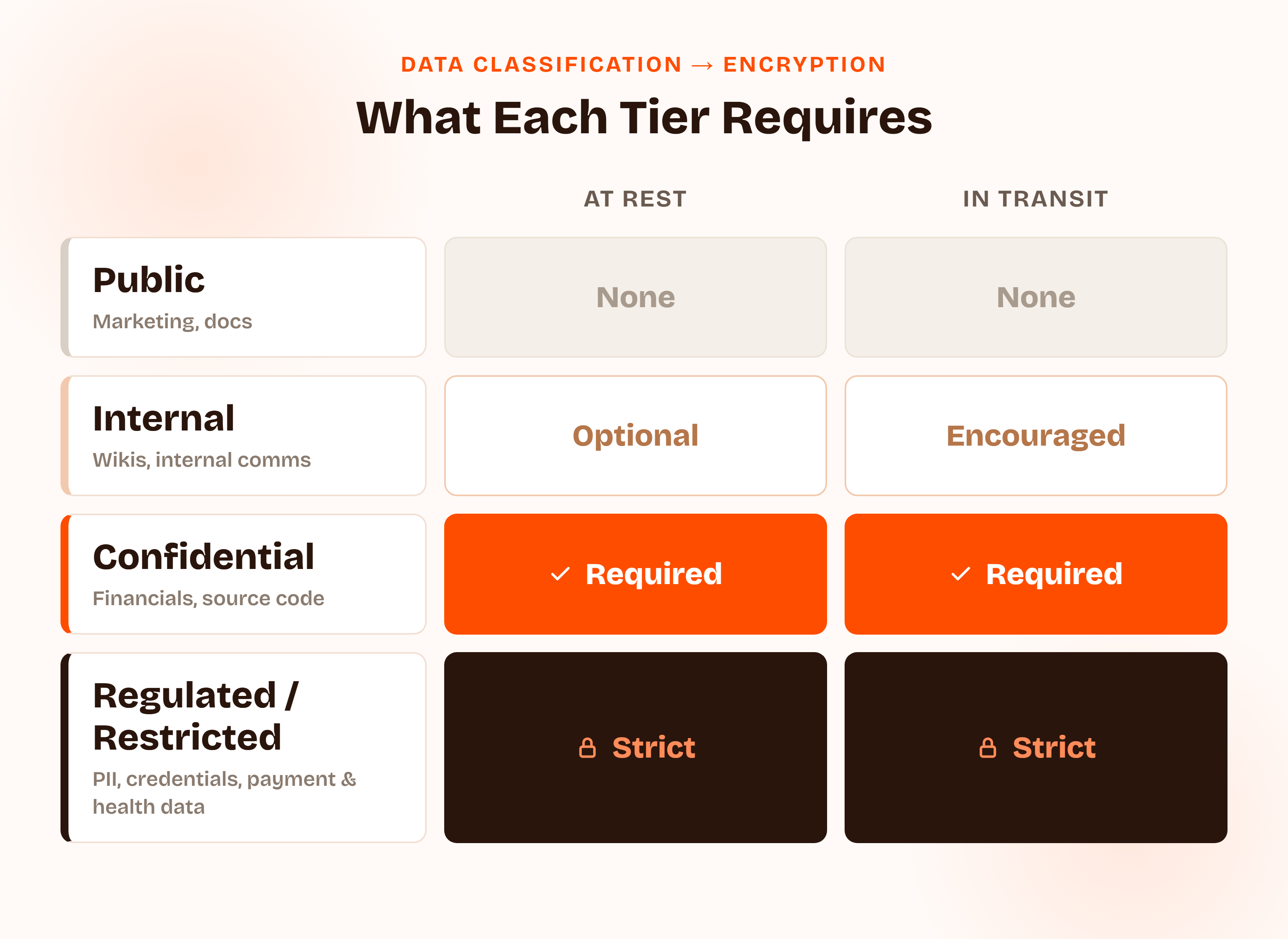
The practical rule: if exposing a piece of data would cause real regulatory, financial, or reputational harm, it belongs in a tier that requires encryption both at rest and in transit, not just one or the other.
| Classification tier | Examples | Encryption requirement |
|---|---|---|
| Public | Marketing content, published documentation | None required |
| Internal | Internal wikis, non-sensitive internal communications | Encouraged in transit; not mandatory at rest |
| Confidential | Business plans, internal financial data, source code | Required at rest and in transit |
| Regulated / Restricted | Customer PII, credentials, payment data, health data | Required at rest and in transit, with the strictest access controls |
Note
Most competing templates name "sensitive data" as a single bucket. A tiered structure like this one is what actually lets an engineer make a fast, consistent decision about a new data store without escalating every time.
Common Categories That Get Missed
- Backups and archived data. Production data gets encrypted; the weekly backup of that same data quietly doesn't.
- Logs and monitoring data. Application logs can capture sensitive fields (tokens, form submissions, user identifiers) without anyone deciding that should happen.
- Non-production and staging environments. Treated as lower-risk by default, even when they contain copies of real production data.
- Data held by third-party vendors and subprocessors. The policy should scope this explicitly rather than assume a vendor's own practices are good enough.
Data Encryption Policy Requirements: Data at Rest and in Transit
Every credible data encryption policy is organized around this split, and for good reason: the two states face different threats and need different controls. Stored data gets attacked by someone with access to the storage itself. Data in transit gets attacked by someone intercepting the network.
Encrypting Data at Rest
Data at rest is anything stored: databases, file systems, backups, and cloud storage. A policy should require full-disk or database-level encryption for stored sensitive data, encrypted backups with keys managed separately from the data they protect, and a firm rule against plaintext sensitive data showing up in logs or exports.
Note
This article intentionally doesn't specify an exact algorithm or key length. ComplyJet's Cryptography Policy guide owns that detail, current approved algorithms, key generation, and rotation, so the two documents stay complementary instead of duplicating each other.
Encrypting Data in Transit
Data in transit is anything moving: API calls, internal service-to-service traffic, file transfers, email. A policy should require encryption for all sensitive data in transit, including internal traffic between services, and explicitly disallow legacy, insecure protocols rather than leaving that implicit.
Why Most Companies Get This Half Right
The most common gap isn't a missing policy. It's a policy that only covers half of it: customer-facing traffic gets HTTPS, and internal service-to-service traffic or backups quietly stay unencrypted, on the assumption that an internal network is inherently safe. It isn't, and it's the single most common finding in the mistakes section below.
Data Encryption Policy Requirements by Framework: SOC 2, ISO 27001, HIPAA, PCI DSS, and GDPR
Most pages covering this topic name the relevant frameworks in passing and move on. What actually helps a reader is knowing what each framework expects from a data encryption policy specifically, at the level of detail that's confirmable today.
| Framework | Where encryption requirements live | What it actually requires |
|---|---|---|
| SOC 2 | Trust Services Criteria (risk-based control, not a fixed rule) | No mandated algorithm; expects encryption decisions justified against the company's own risk assessment and data classification |
| ISO 27001 | Annex A control 8.24, Use of Cryptography | Requires documented rules for appropriate cryptography use; leaves algorithm selection to the organization |
| HIPAA | Security Rule Technical Safeguards, 45 CFR §164.312(a)(2)(iv) and §164.312(e)(2)(ii) | Currently "addressable," meaning encryption or an equivalent alternative must be implemented and justified; a proposed 2026 update would remove the addressable designation and make encryption mandatory |
| PCI DSS 4.0 | Requirements 3.5-3.6 (stored cardholder data) and Requirement 4.2 (transmission) | Requires protecting stored cardholder data and its encryption keys, plus strong cryptography (TLS 1.2 or higher) for transmission over open, untrusted networks |
| GDPR | Article 32, Security of Processing | Names encryption directly as an example "appropriate technical measure"; doesn't mandate it outright but treats it as evidence of meeting the requirement |
Encryption Policy for SOC 2 and ISO 27001
SOC 2 doesn't set a fixed numeric encryption rule. It's a risk-based control under the Trust Services Criteria, and an auditor expects the company to justify what's encrypted, and what isn't, against its own risk assessment and data classification, not against a universal checklist.
ISO 27001's requirements live under Annex A control 8.24, Use of Cryptography, which calls for documented rules on appropriate cryptography use without prescribing a specific algorithm. For the algorithm-and-key-management-specific breakdown, ComplyJet's Cryptography Policy guide covers that in detail.
HIPAA Encryption Requirements
Under the current HIPAA Security Rule, encryption of electronic protected health information (ePHI) at rest and in transit is an "addressable" implementation specification under 45 CFR §164.312(a)(2)(iv) and §164.312(e)(2)(ii), meaning a covered entity must implement it or document an equivalent alternative safeguard, not skip it entirely.
That's changing. HHS published a Notice of Proposed Rulemaking in December 2024 that would eliminate the addressable designation and make encryption a required specification outright, with AES-256 at rest and TLS 1.2 or higher in transit named directly. As of this writing, that update is proposed, not finalized, so treat it as the direction HIPAA is heading rather than a current mandate.
PCI DSS Encryption Requirements and GDPR
PCI DSS 4.0 is the most explicit of the five on encryption specifics. Requirements 3.5 and 3.6 require protecting stored cardholder data and the cryptographic keys that secure it, including documented key-management processes. Requirement 4.2 requires strong cryptography, TLS 1.2 or higher, for transmitting cardholder data over open, untrusted networks.
GDPR doesn't mandate encryption by name, but Article 32 names it directly as an example "appropriate technical measure" for securing personal data. A documented data encryption policy is commonly cited as evidence of meeting that requirement, even without a specific legal mandate to encrypt.
Every framework asks a version of the same question: what did you decide needs protecting, and can you show your reasoning. A data encryption policy is that reasoning, written down once and reused across every framework that asks. -- Upendra Varma, CTO at ComplyJet
Data Encryption Policy Template: A Free Example You Can Download
Here's what a real data encryption policy clause looks like, not just a description of what one should contain.
Sample clause: Data Classification and Encryption Requirements
All company data is classified as Public, Internal, Confidential, or Regulated/Restricted. Data classified as Confidential or Regulated/Restricted must be encrypted at rest using company-approved encryption standards and encrypted in transit whenever it moves across a network, including internal service-to-service traffic. Backups of Confidential or Regulated/Restricted data must be encrypted with keys managed separately from the backup itself.
Sample clause: Data in Transit
All Confidential and Regulated/Restricted data transmitted over any network, public or internal, must use a current, company-approved transport encryption protocol. Legacy protocols no longer considered secure are explicitly prohibited. Exceptions require documented approval and a compensating control, logged under this policy's exceptions process.
Free Template
Download the Free Data Encryption Policy Template (PDF)
The full classification-tier table, at-rest and in-transit requirements, and framework-specific notes for SOC 2, ISO 27001, HIPAA, PCI DSS, and GDPR readers to adapt.
Rolling Out a Data Encryption Policy
Writing the policy is the easy half. Rolling it out means confirming what's actually encrypted today matches what the policy says should be, not filing an aspirational document away after the audit that prompted it.
- Assign an owner, usually the IT or security lead, accountable for the policy and its enforcement.
- Classify existing data against the tiers defined above, system by system.
- Identify any unencrypted sensitive data, currently at rest or in transit, against that classification.
- Remediate gaps, prioritized by classification tier, Regulated/Restricted first.
- Get leadership to formally approve the policy once it reflects reality, not before.
- Set a review cadence tied to new systems and data types, not just a fixed calendar date.
Keeping the Policy Accurate as Systems Change
New systems and data stores should get classified against the same tiers before launch, not audited in after the fact once something's already in production. That's the difference between a policy that stays accurate and one that quietly drifts from what's actually deployed.
Vendor and subprocessor encryption practices deserve the same scrutiny. Check them against this same policy as part of vendor onboarding, not as an assumption that a vendor's own security page is good enough.
Action step
Before rollout is considered complete, walk every production data store against the classification table and confirm its actual encryption status matches its assigned tier. A policy that hasn't been checked against reality yet isn't rolled out, it's just written.
Data Encryption Policy Best Practices: Common Mistakes to Avoid
- Encrypting customer-facing traffic but not internal traffic. HTTPS gets enabled for the public-facing app; service-to-service calls inside the network stay plaintext, on the assumption an internal network is inherently safe.
- Encrypting production data but not its backups. Or encrypting the backup with keys stored right next to it, which defeats the point.
- No real data classification behind the policy. "Sensitive data" stays an undefined term, and enforcement becomes inconsistent because nobody has a clear rule to apply.
- Treating HTTPS as the whole answer. Transport encryption for customer traffic is one requirement among several, not a substitute for a documented policy an auditor can actually review.
- No process for checking vendor and subprocessor encryption practices. The policy covers internal systems well and leaves a real gap at every third party that touches the same data.
- Writing the policy once and never revisiting it. New systems, new data types, and new frameworks come into scope, and a policy that never gets reviewed goes stale exactly where it matters most.
How ComplyJet Supports Your Data Encryption Policy
Writing the policy is the starting point. Proving it's actually enforced, system by system, is the part that eats time during audit prep, especially once a reviewer starts asking for evidence instead of a description.
We help teams turn a written data encryption policy into evidence-backed controls as part of a broader SOC 2, ISO 27001, HIPAA, or PCI DSS program: AI-assisted policy drafting to get the document itself right, plus integrations that pull encryption status across connected systems instead of leaving that to a manual audit-week scramble.
Compliance Automation
Turn your data encryption policy into an enforced control
ComplyJet pairs AI-assisted policy drafting with integrations that pull real encryption status across your connected systems, mapped to SOC 2, ISO 27001, HIPAA, and PCI DSS.
FAQs
What Should a Data Encryption Policy Include?
Data classification tiers, at-rest requirements, in-transit requirements, a mapping to the frameworks that apply, named ownership, and a review cadence tied to new systems, not just a fixed date. The full breakdown with examples is in the sections above.
What Data Needs to Be Encrypted?
Any data that would cause real regulatory, financial, or reputational harm if exposed: customer PII, credentials, payment data, and health data, at minimum. That requirement typically extends to backups, logs, and non-production copies of the same data, which is exactly where most policies leave a gap.
Is Encryption Required for SOC 2 Compliance?
SOC 2 doesn't mandate a fixed encryption rule. What it requires is that encryption decisions be justified against the company's own risk assessment and data classification, and documented in a written policy an auditor can review.
What Is the Difference Between a Data Encryption Policy and a Cryptography Policy?
A data encryption policy defines what data must be encrypted and where. A cryptography policy defines how encryption gets implemented: approved algorithms, key generation, and key management. See the disambiguation section above for the full distinction.
Does GDPR Require Encryption?
Not by explicit mandate, but Article 32 names encryption directly as an example of an "appropriate technical measure" for securing personal data. A documented data encryption policy is commonly cited as evidence of meeting that requirement.
What Is the Difference Between Encryption at Rest and Encryption in Transit?
Encryption at rest protects stored data: databases, backups, file storage. Encryption in transit protects data moving across a network: API calls, internal service traffic, file transfers. A complete policy requires both, not just whichever one is easier to implement first.
Do I Need a Data Encryption Policy If I Already Have a Cryptography Policy?
Yes, for most teams pursuing a framework audit. The two are complementary, not redundant. The data encryption policy scopes what needs protecting; the cryptography policy governs how that protection actually gets implemented.
Who Is Responsible for a Data Encryption Policy?
Typically the IT or security lead owns the document and its enforcement. Classification decisions for specific data types often need input from legal or compliance and from the teams that actually generate that data, since they know its real sensitivity best.
Related Reading
- Cryptography Policy, the algorithm-selection and key-management-lifecycle guide this policy's technical implementation points to.
- Data Classification Policy, the broader classification framework this article's tier table is built on.
- Data Management Policy, the top-level data-handling policy this and other data-specific policies roll up into.
- Information Security Policy, the organization-wide security policy this control-specific policy sits under.
- Data Retention Policy, for readers whose encryption questions are really about how long data, and its encrypted copies, should be kept.
Sources: NIST SP 800-63B-4, Digital Identity Guidelines; ISO/IEC 27001:2022 Annex A control 8.24, Use of Cryptography; 45 CFR §164.312, HIPAA Security Rule Technical Safeguards; HHS HIPAA Security Rule NPRM, December 2024, summarized by HIPAA Journal; PCI DSS 4.0 Requirements 3.5, 3.6, and 4.2, per HeroDevs' summary of PCI DSS 4.0 Requirement 4; GDPR Article 32, Security of Processing.