Executive Summary
A salesperson pastes a customer's contract into a free chatbot to "tighten the wording" before a call. Nobody told them they could not, and nobody told them they could. That gap is exactly what an AI acceptable use policy exists to close.
An AI acceptable use policy is the short document that tells employees which AI tools they may use, which data they may put into each one, when they must say AI helped with their work, and what happens when the rules are broken.
The real question is not whether to ban or allow AI. It is which tools are approved for which data, and whether a non-technical employee can work that out in ten seconds without asking anyone.
This page is the rulebook employees read. The program behind it (who owns AI risk, how systems are assessed, how regulation applies) lives in our AI governance policy guide, and the general rules for devices, email and networks live in the acceptable use policy guide. This page covers neither.
By the end, you will have a four-tier table that answers "can I use ChatGPT for this", the full sample policy written out clause by clause, a pasting card, a disclosure table, an enforcement ladder and a free, ungated PDF you can edit.
Here's what I'll cover:
- What an AI acceptable use policy is, and how it differs from its two neighbors
- Why a ban fails and where the leaks actually happen
- Four tiers of AI tools matched to four classes of data
- Nine clauses with sample wording
- When employees must disclose AI use
- An enforcement ladder that treats a mistake differently from a cover-up
- A 30-day rollout, and the free PDF
This guide is practical information, not legal advice. Have counsel or your HR lead review the final policy before you publish it.
What an AI Acceptable Use Policy Is, and What It Is Not
A company usually ends up with three policies that touch AI, and they are easy to confuse. This section separates them so you write the right one.
What Is an AI Acceptable Use Policy? One Sentence, Then the Boundaries
An AI acceptable use policy is a short employee-facing document that sets which generative AI tools staff may use, which classes of company data may go into each, what must be disclosed and reviewed, and what the consequences are for breaking the rules.
A few terms, in plain English.
A generative AI tool is software that produces text, code, images or audio from a prompt (ChatGPT, Copilot, Gemini and the AI features now built into everyday apps). A prompt is anything you type, paste or upload into it. Company data is anything the business holds that is not already public: customer information, contracts, source code, plans, credentials. AI-assisted work is any output where an AI tool wrote, edited or analyzed part of the content.
AI Acceptable Use Policy vs AI Governance Policy vs Your General AUP
| Policy | The question it answers | Who reads it | Typical length |
|---|---|---|---|
| General acceptable use policy | How do I use company devices, accounts, email and networks? | Every employee | 2 to 4 pages |
| AI acceptable use policy | Which AI tools can I use, with which data, and what do I have to tell people? | Every employee and contractor | 1 to 2 pages |
| AI governance policy | Who decides, and how are AI systems built, assessed and monitored? | Leadership, security, product | 5 to 15 pages |
Quick take
A one-page employee policy backed by one named owner beats a thirty-page program nobody reads. Write the short document first, then let the governance program grow underneath it.
Employee AI Policy Scope: Who the AI Acceptable Use Policy Covers
An AI acceptable use policy for employees must also name contractors, interns and any vendor staff using company accounts. The people most likely to paste something they should not are often the ones outside the onboarding process, so the scope clause names them explicitly.
Vendors that use AI on your data are a separate question. A contractor using ChatGPT is bound by this policy. A vendor running your customer data through its own AI features is a vendor risk issue, covered in AI vendor risk management.
Why Banning ChatGPT Is Not an AI Policy
"No AI tools at work" is a rule, not a policy, and it does not survive the first deadline. A ban moves the same use to personal accounts and phones, where the company has no visibility and no contract.
Microsoft and LinkedIn's 2024 Work Trend Index puts numbers on it: 75% of knowledge workers already use AI at work, and 78% of AI users bring their own AI tools to work (published 8 May 2024). Your team is in that group whether or not a policy says so.
ChatGPT Acceptable Use Policy: Allow It, Limit It or Block It
The useful question is not "is ChatGPT allowed". It is which version of it, with which data. These are the routes where company data actually leaves:
- Pasting into a chat window, especially from a personal account with default settings
- Meeting recorders and notetaker bots that join calls and store transcripts in a vendor's cloud
- Browser extensions and copilots that read whatever tab is open
- Coding assistants with access to a repository
- Agents that can act on email, calendar or accounts on someone's behalf
- AI features that switch on inside tools you already pay for, often by default
The risks behind each route are covered in generative AI security risks, and finding what is already in use is the job of shadow AI risk. Neither is repeated here.
Watch out
A policy that says "do not use AI" while the sales team's CRM has an AI button is a policy everyone is already breaking. Write the rules for the world your team actually works in.
There is a commercial reason too. Enterprise security questionnaires and auditors now ask whether you have an AI policy, who owns it and whether staff have acknowledged it. A policy that exists, is signed and is current is the evidence. A ban nobody follows is not.
ISO 42001
Building AI governance customers can trust?
ISO 42001 is the international standard for AI management systems. See how ComplyJet helps AI startups build the policies, risk assessments and training records it expects.
Approved AI Tools Tiers: What Employees May Use With Which Data
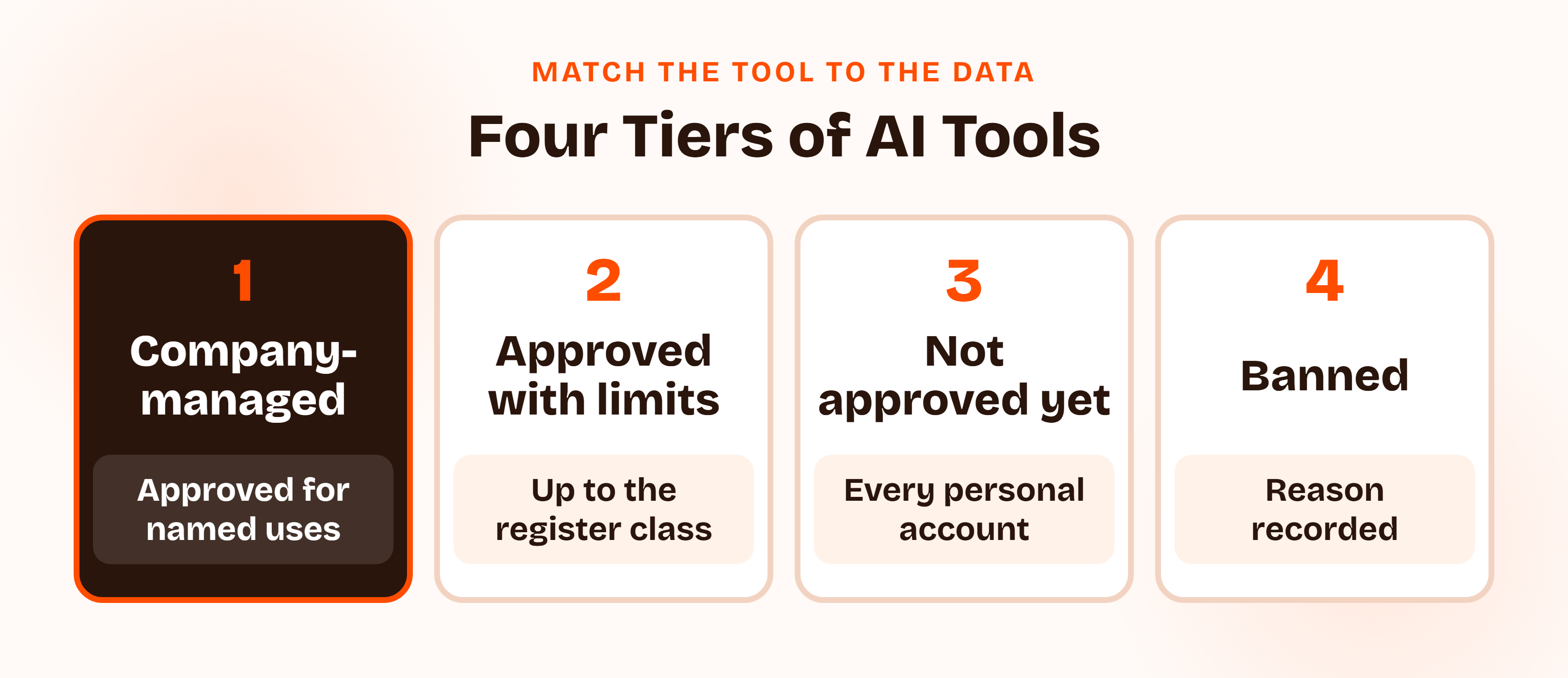
A policy that says "use approved tools only" has not answered anything until the tools and the data are matched. This table is the spine of the whole document, and it is the answer to "can I use ChatGPT for this".
The Approved AI Tools List: Company-Managed, Approved With Limits, Not Approved, Banned
| Tier | What qualifies | Who decides | Default |
|---|---|---|---|
| Tier 1: Company-managed | A company-owned account or workspace, signed data terms, training on your data switched off, and an admin who can add and remove users | Tool owner, with security sign-off | Approved for named use cases |
| Tier 2: Approved with limits | Reviewed for specific tasks and data classes only (for example, an AI feature inside an existing SaaS product) | Tool owner | Approved up to the class on the register |
| Tier 3: Not approved yet | Anything not on the register, including every personal account, of any product | Nobody has reviewed it | Not allowed for company data |
| Tier 4: Banned | Reviewed and refused, with the reason written next to it | Policy owner | Never |
The sentence that does the most work in this table is "including every personal account, of any product". A free personal account and a company-managed plan of the same product are different tools, because terms, retention, training use and admin visibility can all differ.
The policy does not need to assert what any vendor does. It tells employees to use the company workspace, and it tells the tool owner to check the actual plan's terms and settings before a tool reaches Tier 1.
Keep the register itself short: tool name, tier, allowed data classes, owner, date reviewed. Appendix A of the PDF is a blank one.
AI Data Classification Rules: Which Data Goes in Which Tier
Match four data classes to the four tiers and you have the policy's rules in one grid. The classes follow the usual four-level model; the data classification policy guide defines them in full.
| Data class | Examples for a SaaS startup | Tier 1 | Tier 2 | Tier 3 | Tier 4 |
|---|---|---|---|---|---|
| Public | Published blog posts, public docs, marketing copy | Allowed | Allowed | Allowed with approval | Never |
| Internal | Planning notes, meeting agendas, internal wikis | Allowed | Allowed | Never | Never |
| Confidential | Customer contracts, source code, pricing, unreleased roadmaps | Allowed | Never | Never | Never |
| Restricted | Credentials and secrets, regulated personal or health data, payment data | Allowed with approval | Never | Never | Never |
Pro tip
If your company has not classified its data, start with two buckets: anything you would publish, and everything else. Refine later. A rough rule people follow beats a perfect one they cannot remember.
The "Can I Paste This?" Card: Five Questions in Ten Seconds
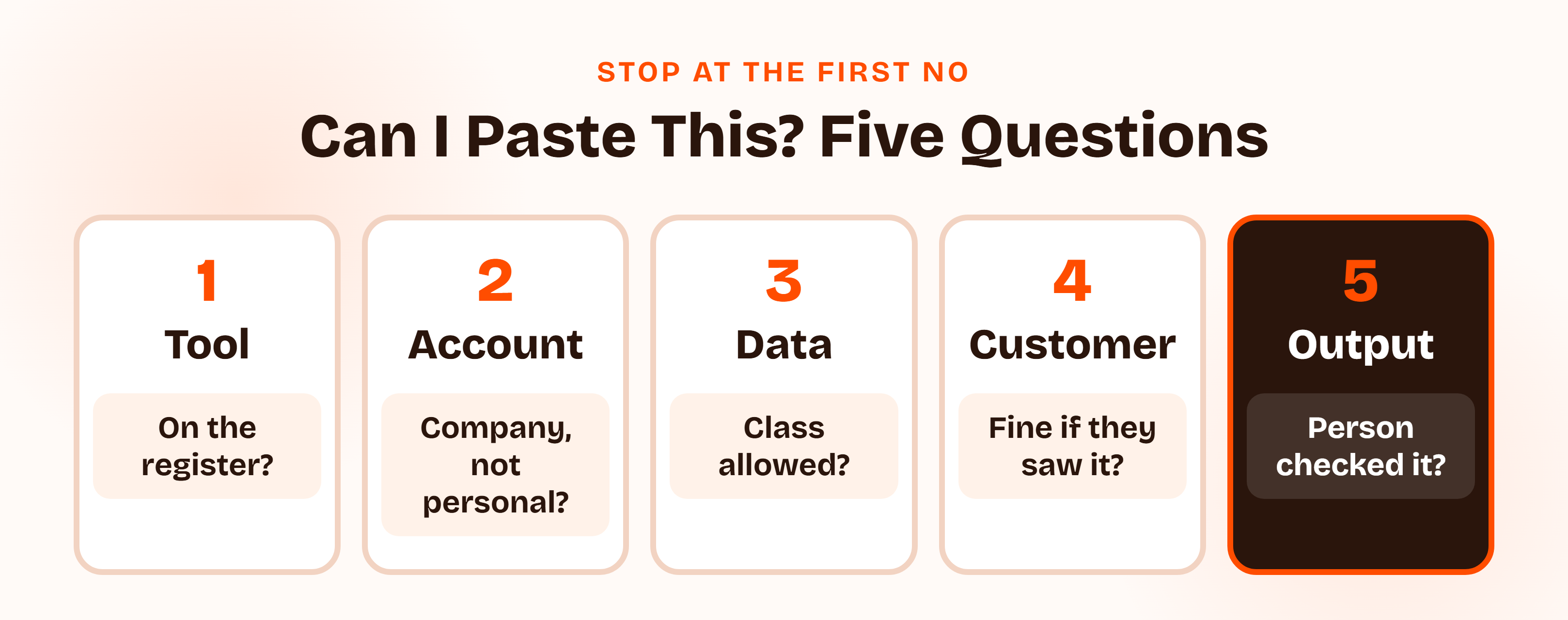
Rules in a table work for the policy owner. Employees need something shorter at the moment they are about to hit enter. Run these five questions in order, and stop at the first "no":
- Is this tool on the register?
- Am I logged in with my company account, not a personal one?
- Does the data class in the register allow this tool to take it?
- Would I be comfortable if the customer saw exactly what I am pasting?
- If I am about to share the output outside the company, has a person checked it?
Print it on a single card. Appendix B of the PDF is the ready-to-use version.
Try this yourself: ask three colleagues to run their last real prompt through the card. Where they disagree is where your policy is vague.
Personal Accounts, Agents, Meeting Recorders and Browser Extensions
Most AI policies are written as if AI means a chat window. In practice the tools that cause the surprises are different, so the policy gives each a one-line rule:
| Tool class | Default rule |
|---|---|
| Personal accounts | Tier 3. Never used for anything above Public data |
| Meeting recorders and notetaker bots | Not allowed to join a call without the host's approval and every participant's awareness; stored transcripts count as the highest class discussed |
| Browser extensions and copilots | Tier 3 until reviewed, because they can read every open tab |
| Coding assistants | Allowed only in a company-managed workspace; restricted data such as secrets and keys never go in |
| Agents that act on accounts | Banned until the policy owner approves a specific use, with the permissions written down |
| AI features inside existing SaaS | Tier 2 once reviewed; switched off until then where the admin can do so |
Who approves a new tool, and how it is assessed, belong to the governance program: see the AI governance committee guide and the AI risk assessment guide.
AI Acceptable Use Policy Template: The Sample Wording, Clause by Clause
Here is the document itself. Each clause says what it must do, gives sample wording you can paste into your own policy, and ends with a one-line verdict. Square brackets are for you to fill in. Tool names are categories, never endorsements.
The sample wording is a starting point for review by counsel and your HR lead. It is not legal advice.
AI Acceptable Use Policy Clause 1: Purpose, Scope and Definitions
This clause says who is covered and what counts as an AI tool, including the embedded features, agents and recorders most policies forget.
Sample wording
1.1 This policy sets the rules for using AI tools in work for [Company Name]. It applies to all employees, contractors, interns and any other person using [Company Name] accounts, data or devices.
1.2 "AI tool" means any software that generates, summarizes, translates, transcribes or analyzes content using machine learning, including chat assistants, coding assistants, meeting recorders, browser extensions, agents, and AI features built into other software.
1.3 "Company data" means any information held by [Company Name] that is not public. Data is classified as Public, Internal, Confidential or Restricted under the [Data Classification Policy].
1.2 "AI tool" means any software that generates, summarizes, translates, transcribes or analyzes content using machine learning, including chat assistants, coding assistants, meeting recorders, browser extensions, agents, and AI features built into other software.
1.3 "Company data" means any information held by [Company Name] that is not public. Data is classified as Public, Internal, Confidential or Restricted under the [Data Classification Policy].
Verdict: if the definition says "chatbots" only, the policy is already out of date.
AI Acceptable Use Policy Clause 2: Approved Tools and the Tool Register
This clause creates the tiers and names who keeps the register.
Sample wording
2.1 AI tools are placed in one of four tiers: Tier 1 (company-managed), Tier 2 (approved with limits), Tier 3 (not approved) and Tier 4 (banned).
2.2 The approved tools and the data classes each may receive are listed in the AI Tool Register, owned by [Role]. The register is available at [location].
2.3 Any AI tool not on the register is Tier 3 until reviewed. A personal account on any tool, including a tool that is Tier 1 when used through the company workspace, is Tier 3.
2.4 Requests to add a tool are made using the form in Appendix A and answered within [5] working days.
2.2 The approved tools and the data classes each may receive are listed in the AI Tool Register, owned by [Role]. The register is available at [location].
2.3 Any AI tool not on the register is Tier 3 until reviewed. A personal account on any tool, including a tool that is Tier 1 when used through the company workspace, is Tier 3.
2.4 Requests to add a tool are made using the form in Appendix A and answered within [5] working days.
Verdict: "not on the register means not approved" is the clause that makes the rest enforceable.
Generative AI Acceptable Use Policy Clause 3: Permitted Uses
Say yes first. A policy that opens with prohibitions teaches people to hide their use.
Sample wording
3.1 You are encouraged to use approved AI tools for drafting and editing text, summarizing public or Internal material, brainstorming, explaining code, translating Internal text, and similar productivity tasks.
3.2 Use the tier of the tool and the class of the data to decide what is allowed, as set out in Section 4 and Appendix B.
3.3 If you are unsure whether a use is allowed, ask [Role or channel] before you proceed.
3.2 Use the tier of the tool and the class of the data to decide what is allowed, as set out in Section 4 and Appendix B.
3.3 If you are unsure whether a use is allowed, ask [Role or channel] before you proceed.
Verdict: permission and a way to ask beat a list of bans.
AI Acceptable Use Policy Clause 4: Data Rules and Prohibited Inputs
This is the clause the grid above compresses into sentences.
Sample wording
4.1 Public data may be used with Tier 1 and Tier 2 tools. Internal data may be used with Tier 1 and Tier 2 tools. Confidential data may be used with Tier 1 tools only. Restricted data may be used with a Tier 1 tool only after written approval from [Role] for that use case.
4.2 You must never enter the following into any AI tool unless a Tier 1 approval says otherwise: passwords, API keys and other secrets; regulated personal or health data; payment card data; customer data without a contract that allows it; other people's confidential information.
4.3 Where possible, remove names and identifiers or use sample data.
4.4 Use only your company account or workspace. Do not use a personal account for any company data above Public.
4.2 You must never enter the following into any AI tool unless a Tier 1 approval says otherwise: passwords, API keys and other secrets; regulated personal or health data; payment card data; customer data without a contract that allows it; other people's confidential information.
4.3 Where possible, remove names and identifiers or use sample data.
4.4 Use only your company account or workspace. Do not use a personal account for any company data above Public.
Verdict: examples beat the word "sensitive". People cannot apply a category they cannot picture.
AI Acceptable Use Policy Clause 5: Human Review and Accountability
The employee owns the output, whichever tool wrote it.
Sample wording
5.1 You are responsible for any work you produce with AI assistance. Check facts, sources, figures and code before you use or share them.
5.2 AI output must be reviewed by a person before it is sent to a customer, published, merged into production, or relied on for a business decision.
5.3 AI tools must not be the sole basis for decisions about hiring, firing, promotion, discipline, credit, or any person's legal rights.
5.2 AI output must be reviewed by a person before it is sent to a customer, published, merged into production, or relied on for a business decision.
5.3 AI tools must not be the sole basis for decisions about hiring, firing, promotion, discipline, credit, or any person's legal rights.
Verdict: "the model said so" is never an acceptable explanation to a customer.
AI Acceptable Use Policy Clause 6: Disclosure of AI Use
The next section expands this. The clause itself stays short.
Sample wording
6.1 You must tell your manager when AI materially shaped a work product, if asked.
6.2 You must disclose AI use in a deliverable to a customer or other outside party when a contract, law or [Company Name] policy requires it, using the wording in Appendix B or the wording the contract specifies.
6.3 You must not present AI output as the work of a named individual who did not review it.
6.2 You must disclose AI use in a deliverable to a customer or other outside party when a contract, law or [Company Name] policy requires it, using the wording in Appendix B or the wording the contract specifies.
6.3 You must not present AI output as the work of a named individual who did not review it.
Verdict: disclosure rules that cannot be applied in practice will be ignored. Tie them to triggers.
AI Acceptable Use Policy Clause 7: Intellectual Property and Customer Obligations
This clause is the one most likely to need counsel, so keep the sample plain and flag it for review.
Sample wording
7.1 Do not enter material owned by a third party, or covered by a customer contract, into an AI tool unless the contract or licence permits it.
7.2 Do not assume AI output is free of third-party rights. Treat it as a draft that needs review before it is used in a product, a publication or a customer deliverable.
7.3 Before using AI on work delivered to a customer, check the customer agreement for restrictions on AI use or subprocessors. If in doubt, ask [Role].
7.2 Do not assume AI output is free of third-party rights. Treat it as a draft that needs review before it is used in a product, a publication or a customer deliverable.
7.3 Before using AI on work delivered to a customer, check the customer agreement for restrictions on AI use or subprocessors. If in doubt, ask [Role].
Verdict: a customer's contract can be stricter than your policy. Read it before you paste anything under it.
AI Acceptable Use Policy Clause 8: Reporting Incidents and Concerns
Employees report fast only when reporting is safe.
Sample wording
8.1 If you enter data into an AI tool that this policy does not allow, report it to [channel or Role] within [24] hours of noticing.
8.2 Prompt, honest reporting will be treated as a mitigating factor. Concealing a mistake will not.
8.3 [Company Name] will not retaliate against anyone who reports a concern about AI use in good faith.
8.2 Prompt, honest reporting will be treated as a mitigating factor. Concealing a mistake will not.
8.3 [Company Name] will not retaliate against anyone who reports a concern about AI use in good faith.
Verdict: a no-blame window for self-reports gets you more reports than any penalty clause. The reporting culture behind this clause is the same one described in the code of conduct policy guide.
AI Acceptable Use Policy Clause 9: Exceptions, Violations and Review
The last clause connects the policy to enforcement and keeps it current.
Sample wording
9.1 Exceptions are requested in writing, approved by [Role], recorded in the AI Tool Register, and expire after [12] months unless renewed.
9.2 Violations of this policy are handled under the enforcement steps in Appendix C and [Company Name]'s existing disciplinary process.
9.3 This policy is reviewed at least [annually], and after any significant new AI tool, customer requirement or change in law. Every person covered by it acknowledges it at onboarding and at each review.
9.2 Violations of this policy are handled under the enforcement steps in Appendix C and [Company Name]'s existing disciplinary process.
9.3 This policy is reviewed at least [annually], and after any significant new AI tool, customer requirement or change in law. Every person covered by it acknowledges it at onboarding and at each review.
Verdict: an exception that never expires is a loophole with paperwork.
AI Acceptable Use Policy Example: One Clause Filled In for a 25-Person SaaS Team
Here is Clause 4 completed for an illustrative company. It is invented for demonstration and does not describe a real business.
The team has three groups of AI users: sales, support and engineering. The policy owner has put one company-managed chat workspace on the register at Tier 1, an AI feature inside the support desk at Tier 2, and banned a browser extension after a review.
| Group | What they do | Tool and tier | Data allowed |
|---|---|---|---|
| Sales | Draft outreach, summarize public company news | Company chat workspace (Tier 1) | Public and Internal; never customer contracts without approval |
| Support | Draft replies, summarize tickets | AI feature in the support desk (Tier 2) | Internal only; no payment details, no credentials |
| Engineering | Explain code, write tests | Company-managed coding assistant (Tier 1) | Confidential code allowed; secrets and keys never |
Written this way, the policy answers the salesperson's question before they ask it.
AI Use Disclosure: When Employees Must Say AI Helped
"Disclose everything" cannot be enforced, and "disclose nothing" is a contract risk. The workable rule ties disclosure to triggers.
| Output type | Disclosure rule | Why |
|---|---|---|
| Internal draft or note | None needed | No outside party relies on it |
| Customer deliverable | Disclose if the contract or law requires it; human sign-off always | The customer's terms can be stricter than yours |
| Code in the product | Human review before merge; note it in the pull request if your engineering policy asks | Review is the control, not a label |
| Marketing or published content | Human edit before publishing; label where law or platform rules require | Accuracy and rights are the risk |
| Hiring or HR decisions | Never AI-only; tell the manager how AI was used | People decisions carry legal weight |
| Regulated outputs | Follow the regulator's rule; ask [Role] first | Obligations come from the rule, not your policy |
Sample wording where an external label is needed:
Sample wording
This content was created with the assistance of AI tools and reviewed by [Company Name].
Law enters in two places.
The EU AI Act's Article 4, as amended by Regulation (EU) 2026/1744 in July 2026, requires providers and deployers of AI systems to "take measures to support the development of AI literacy" of their staff and others using AI on their behalf.
The same article states that the duty "does not require providers or deployers to guarantee any specific level of AI literacy of any individual" (Article 4, as published on artificialintelligenceact.eu). Training and acknowledgement under this policy are a straightforward way to evidence that effort.
Article 50 sets separate transparency rules for particular uses, such as interactive systems and deepfakes. The full picture is in the EU AI Act compliance guide.
Important
The AI use disclosure rule in your policy is internal. Legal disclosure duties come from contracts and law and need counsel's advice for your situation.
AI Policy Enforcement: From a Quiet Word to Access Removal
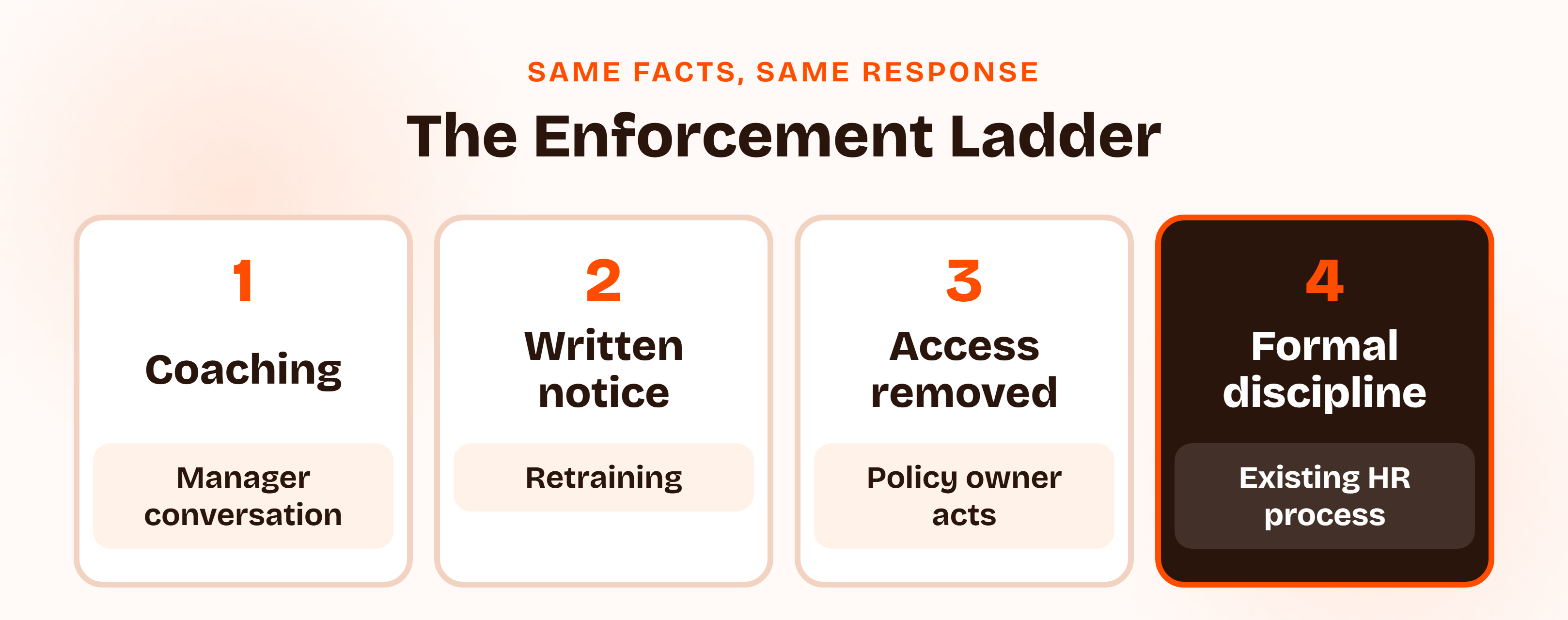
AI policy enforcement is where most policies go quiet. A policy with no consequences is a suggestion. A policy with only severe consequences makes people hide mistakes. The workable position sits between them, and the rule underneath is consistency: the same facts get the same response, whoever the person is.
A Four-Step Enforcement Ladder
| Step | Typical trigger | Who acts | What is recorded |
|---|---|---|---|
| 1. Coaching conversation | First minor breach, such as an unreviewed draft or a Tier 3 tool used with Public data | Manager | A short note in the policy owner's log |
| 2. Written notice and retraining | A repeat, or Internal data in a Tier 3 tool | Manager and HR | Written notice, training completed, new acknowledgement |
| 3. Tool access removed | Confidential data in a banned tool, or ignoring step 2 | Policy owner | Access change, reason, review date |
| 4. Formal discipline | Restricted data exposed, concealment, or deliberate circumvention | HR under the existing process | Per the company's disciplinary policy |
The existing disciplinary route is where step 4 lands, so the AI policy does not invent a second one. The HR security policy guide covers that route.
What Counts as a Different Class of Event
Not every breach is the same size, and treating them alike is how a policy loses credibility. Three things move an event up the ladder:
- The data class. Customer or Restricted data in a banned tool is a different event from a formatting mistake.
- The pattern. One slip is coaching. The same slip three times is a decision.
- Concealment. An unreported paste, found later, is more serious than the same paste reported within a day.
Monitoring Without Surveillance
Tell people what you check, and check only that. A small team can reasonably say it reviews the tool register, SaaS and expense records, and access logs it already holds, and that it will tell staff if that changes. Say so in the policy, in plain words, so nobody learns about it during a disciplinary meeting.
Pro tip
Announce a no-blame window for self-reported mistakes during the first 90 days of the policy. You will learn more about how people actually use AI from that window than from any control.
Rolling Out and Reviewing the AI Acceptable Use Policy
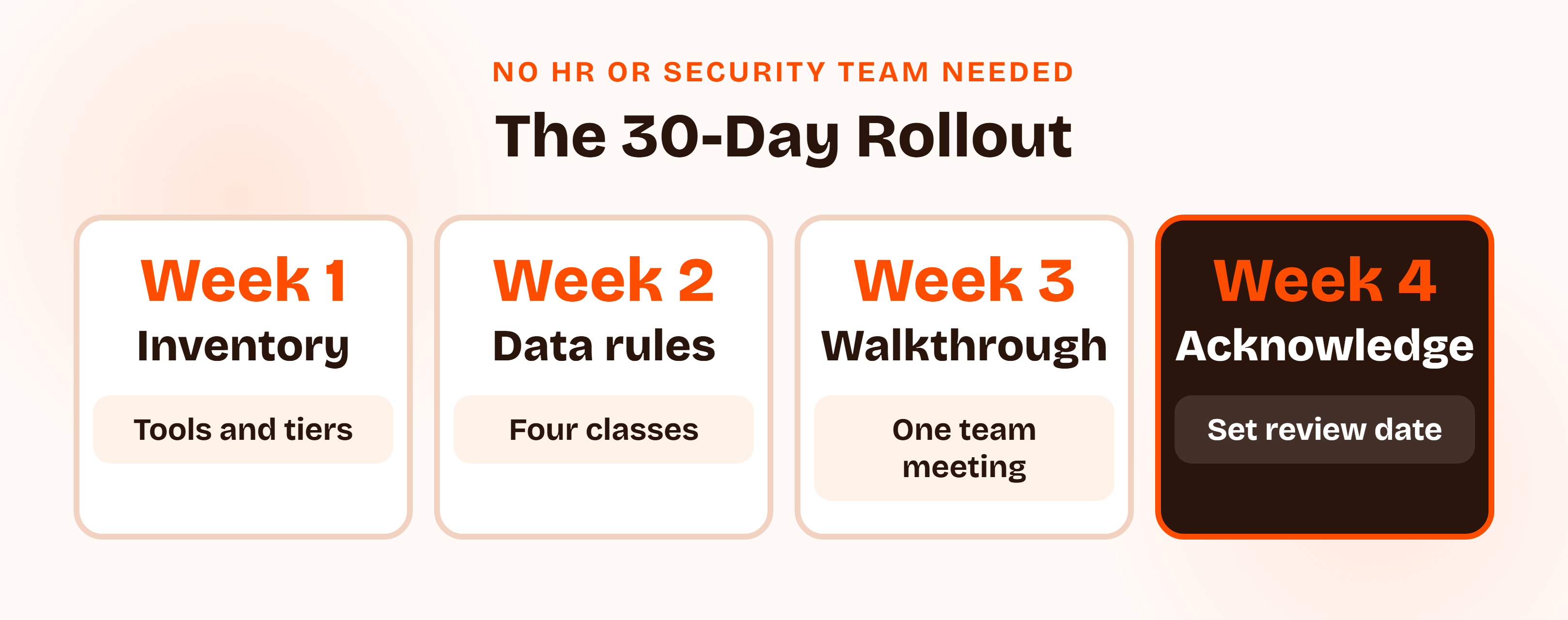
A policy nobody has seen is not a control. A team without HR or security staff can do the whole rollout in 30 days:
- Week 1: inventory the tools people already use. Ask in a team meeting and by short survey; promise no penalty for answers during this week.
- Week 1: decide the four tiers and fill the register, including the notetaker bots and browser extensions people did not mention.
- Week 2: set the data classes, using the two-bucket start if you have to.
- Week 3: walk the whole team through the policy in one meeting, using the pasting card and two or three real examples from the inventory.
- Week 3 to 4: collect acknowledgements and file them where an auditor or customer can ask for them.
- Week 4: set the review date and name who runs it.
Review at least once a year, and sooner after a new tool request spike, a customer or auditor finding, a contract that adds AI terms, or a change in law. Acknowledge at onboarding and at each review.
The Approval Request: Five Fields and a Time Limit
"Get approval" is only a rule if there is a form and a deadline. A request needs five fields: what data will go in, which plan and terms apply, who will own the tool, what the tool is for, and when it will be reviewed again. The policy promises an answer within [5] working days. For the questions a reviewer should ask about a tool, see the five-question vetting in the shadow AI risk guide.
If you work toward SOC 2 or ISO 27001, an acceptable use policy and a vendor review are documents auditors already ask for, and this one extends them to AI. The acceptable use policy guide covers that mapping.
Customer Story
A small AI team that got audit-ready fast
NextSolutions AI, a team of 2 to 10 building AI receptionist services for healthcare practices, saw its compliance dashboard show every task complete within about a month of onboarding, then moved quickly through the SOC 2 Type 1 audit and added HIPAA and SOC 2 Type 2.
Free AI Acceptable Use Policy Template: The PDF You Can Download and Edit
The free AI acceptable use policy below is an ungated PDF. No form, no email, no account. It is a policy you can edit and publish the same day, once counsel or your HR lead has read it.
The PDF carries the nine clauses written out above, Appendix A (the AI Tool Register and approval request), Appendix B (the "can I paste this" card and the disclosure wording), Appendix C (the enforcement steps and acknowledgement form), a changes log and a customization checklist. Every number that is a company choice, such as response times and review dates, is a bracket.
Free Template
Download the Free AI Acceptable Use Policy (PDF)
Nine clauses with sample wording, an AI tool register, a pasting card, disclosure wording, an enforcement ladder and an acknowledgement form. No email required.
How to Fill In the AI Acceptable Use Policy Template: Five Steps
- List the tools in use. Include notetaker bots, extensions and AI features in existing apps.
- Assign tiers. Put anything unreviewed in Tier 3 and anything refused in Tier 4, with a reason.
- Set the data classes. Use your existing classification, or the two-bucket start.
- Choose the enforcement and review windows. Fill every bracket: response times, report window, review date.
- Get counsel or HR review. Then publish, run the walkthrough and collect acknowledgements.
AI Acceptable Use Policy Checklist Before You Publish
- ☐ The definition of "AI tool" includes recorders, extensions, agents and embedded features
- ☐ The register names every tool actually in use, with a tier and an owner
- ☐ The data classes are defined with examples your team recognizes
- ☐ Personal accounts are Tier 3, and the reason is written down
- ☐ Contractors and interns are named in the scope
- ☐ The approval request has five fields and a response time
- ☐ The disclosure table says what to do for customer deliverables
- ☐ The enforcement ladder points to your existing disciplinary process
- ☐ Reporting is safe: a no-blame window and a no-retaliation line
- ☐ Someone owns the register and the review date
- ☐ Counsel or HR has read it
- ☐ A new hire could answer "can I paste this" without asking anyone
AI Acceptable Use Policy Mistakes That Leave Staff Guessing
Most failures are not about the rules. They are about rules that cannot be applied at 4 p.m. on a Friday.
- A blanket ban. It pushes use onto personal accounts and removes your only chance to give people a safe default. Fix: name approved tools.
- Approved tools named nowhere. "Approved tools only" without a list is a trap. Fix: publish the register.
- "Sensitive" with no examples. People cannot apply a category they cannot picture. Fix: give three examples per data class.
- Ignoring embedded AI and agents. The leak is often a feature, not a chatbot. Fix: define AI tool broadly in Clause 1.
- A policy longer than anyone reads. Past two pages, the card carries the load. Fix: keep the employee policy short and put detail in appendices.
- No owner for the register. An unowned list is out of date within a month. Fix: name a role and a review date.
- Acknowledging once and never reviewing. Tools and contracts change faster than annual policy cycles. Fix: review after triggers, not only on the calendar.
How ComplyJet Helps You Keep an AI Policy Current
A policy is a document. An AI management system is a document that stays true. ComplyJet's ISO 42001 offering includes AIMS policy and procedure templates, a structured AI risk assessment workflow, AI impact assessment templates, AI supply chain tracking for model providers and third-party AI components, and employee training with acknowledgement tracking, with a team that guides you through the process.
To be precise about scope: ComplyJet is not a law firm, and the template on this page is a starting point, not legal advice. ComplyJet does not monitor or block how your employees use AI tools. The policy, the register and the review stay with you, and counsel handles the legal questions.
Free Demo
Keep your AI policies, training and records in one place
See how ComplyJet helps a startup build AI governance documentation and track employee acknowledgement without spreadsheets.
FAQs
What Is an AI Acceptable Use Policy?
An AI acceptable use policy is a short document that tells employees which AI tools they may use, which data they may enter into each, when AI use must be disclosed and what the consequences are for breaking the rules. It is separate from your general acceptable use policy and from your AI governance program.
What Should an AI Acceptable Use Policy Include?
At minimum: scope and definitions, approved tools with tiers, data rules by class, human review, disclosure, incident reporting, enforcement and a review date. The nine clauses above cover all of these, and the PDF adds the register, the pasting card and the acknowledgement form.
Can Employees Use ChatGPT at Work?
Yes, if your policy says how. The answer depends on the account and the data: a company-managed workspace may take Internal or Confidential data, while a personal account should take Public data at most. Write the answer into the tier table so nobody has to guess. A good ChatGPT acceptable use policy names the plan, not just the product.
What Data Should Never Be Entered Into AI Tools?
Passwords, API keys and other secrets, regulated personal or health data, payment card data, customer data without a contract that allows it, and other people's confidential information. A Tier 1 approval with written authorization can change that for a specific use case.
Do Employees Have to Disclose AI Use?
Not for every draft. Disclose when a contract, law or company rule requires it, and keep human review in place for customer deliverables, code and people decisions. Internal drafts usually need no label.
What Happens If an Employee Breaks the AI Acceptable Use Policy?
The response should scale with the data class, the pattern and whether the person reported the mistake. A four-step ladder runs from a coaching conversation to formal discipline, and prompt self-reporting counts as a mitigating factor.
Is an AI Acceptable Use Policy Different From an AI Governance Policy?
Yes. The acceptable use policy is what staff read and follow. The AI governance policy covers who decides, how AI systems are assessed and how regulation applies. A small team can start with the first and add the second later.
How Often Should an AI Acceptable Use Policy Be Updated?
At least once a year, and sooner after a new tool request spike, a customer or auditor finding, a contract that adds AI terms or a change in law. Acknowledge it at onboarding and at each review.
Should We Ban ChatGPT at Work or Allow It With Rules?
Allow it with rules. A ban moves use to personal accounts and phones, where you have no visibility. Approved tools, data tiers and a way to ask give people a safe default.
Do Contractors Have to Follow the AI Acceptable Use Policy?
Yes, if they use company accounts, data or devices. Name them in the scope clause and collect the same acknowledgement as employees. A vendor using AI on your data is a vendor-risk matter and belongs in your vendor review.
Related Reading
- AI governance policy: the program-level policy this page sits under
- Acceptable use policy: the general AUP for devices, email and networks
- Shadow AI risk: detecting and preventing unapproved AI use
- Data classification policy: defining the four data classes
- Generative AI security risks: the risks this policy controls
- AI governance committee and AI risk assessment: who approves tools and how they are assessed
- AI vendor risk management: vendors that use AI on your data
- EU AI Act compliance guide: the regulatory side