.svg)

A customer's security questionnaire lands with a line that looks simple: "Attach your vendor management policy and a current list of vendors with access to our data." You have a corporate card statement, a Slack channel full of "can I sign up for this?" and a vague memory that someone approved the analytics tool last spring.
A vendor management policy template is an adoptable document that governs how a company works with vendors across the whole relationship: who can request one, how it gets approved, what the contract must say, what access it receives, how often it is reviewed, and how the relationship ends. A good one gives every vendor an owner and every stage an artifact an auditor can inspect.
Quick answer
A vendor management policy template covers nine things: purpose and scope, roles and ownership, vendor request and approval, selection criteria and an approved vendor list, contract requirements, onboarding, ongoing review, exceptions, and offboarding. It maps to SOC 2 (CC9.2), ISO 27001 (Annex A 5.19 to 5.23), HIPAA, GDPR, and PCI DSS.
By the end of this guide, you'll have a complete vendor management policy template you can adapt in an afternoon, plus the reasoning for each section so you can defend it in an audit.
Here's what I'll cover:
- What a vendor management policy template is, and how it differs from a third-party risk management policy
- The six-stage vendor lifecycle your template has to cover
- The nine sections to include, with selection criteria, contract requirements, onboarding, and offboarding in detail
- What SOC 2, ISO 27001, HIPAA, GDPR, and PCI DSS expect from your vendor process
- A free, downloadable template with real sample clauses
- How to roll it out, and the mistakes that get vendor programs flagged
What Is a Vendor Management Policy Template?
A vendor management policy template is a reusable document that sets the rules for buying from and working with vendors. You fill in your own owners, thresholds, and systems, then formally adopt it.
It is the rulebook, not the checklist. The policy says who may approve a purchase and what a contract must contain. A procedure is the sequence of steps someone follows on a given Tuesday to onboard a tool. Most teams need both, but the policy is the one an auditor reads first.
Quick take
A vendor management policy answers "who is allowed to bring a vendor in, and under what rules?" It does not try to score how risky each vendor is. That is a different document.
How This Differs From ComplyJet's Third-Party Risk Management Policy
ComplyJet's third-party risk management policy guide is the risk-assessment document. It sorts vendors into tiers by the data and systems they touch, sets how deep due diligence goes for each tier, and maps that process to SOC 2 and ISO 27001.
This article is the lifecycle and ownership document. It covers who can request a vendor, how the approved vendor list is kept, what the onboarding checklist looks like, how contracts are standardized, when a vendor is reviewed, and what happens at exit. If you need the scoring and tiering method, read that guide. If you need the rules for running the whole relationship, this is the one, and it comes with a downloadable PDF.
Note
These two documents are meant to be used together. The vendor management policy calls the risk assessment at the approval step, and the risk assessment tells the policy how much scrutiny a given vendor gets. Once both exist, vendor risk management metrics show you whether the program is actually working.
Why Every Company Needs a Vendor Management Policy Template
Third parties are now part of the breach story, not a side note. The share of breaches involving a third party doubled from 15% to 30% in Verizon's 2025 Data Breach Investigations Report, which analyzed 12,195 confirmed breaches. Source: Verizon 2025 Data Breach Investigations Report.
For a startup, the exposure usually starts smaller and quieter. Someone signs up for a design tool with a personal card, connects it to the company Google Workspace, and uploads a customer spreadsheet to test a feature. Nobody decided that. It just happened, and no one owns the relationship.
Practitioners describe the same pattern. In a 1 August 2024 Hacker News thread on shadow IT, one commenter wrote that they see employees "putting crucial information across seemingly every SaaS they'd heard of" instead of the place it is meant to go.
A written policy fixes the boring part of that problem. It says who approves, what gets checked first, and who is on the hook when the vendor changes its terms or gets breached.
- Auditors ask for the document and the inventory. Both a policy and a current vendor list are standard evidence requests.
- Customers ask the same thing in questionnaires. Enterprise buyers routinely want to know how you vet your own vendors.
- Departures leave live integrations behind. When a person who set up a tool leaves, the tool keeps its access unless a rule says otherwise.
Watch out
"We are careful about who we buy from" is not a policy. If a reviewer cannot point to a document with named owners and an approval step, the control does not exist for audit purposes.
If you are heading into your first audit, the vendor process is one of the criteria your auditor will test directly, and it is far easier to build it before the audit window opens. ComplyJet's SOC 2 program walks early-stage teams through this and the rest of the control set.
SOC 2
Getting ready for your first SOC 2?
See how ComplyJet takes an early-stage team from policies like this one to a completed audit, with a team guiding you through it.
The Vendor Management Lifecycle Your Template Must Cover
Every vendor goes through the same six stages whether or not you write them down. The policy's job is to attach an owner and an artifact to each one.
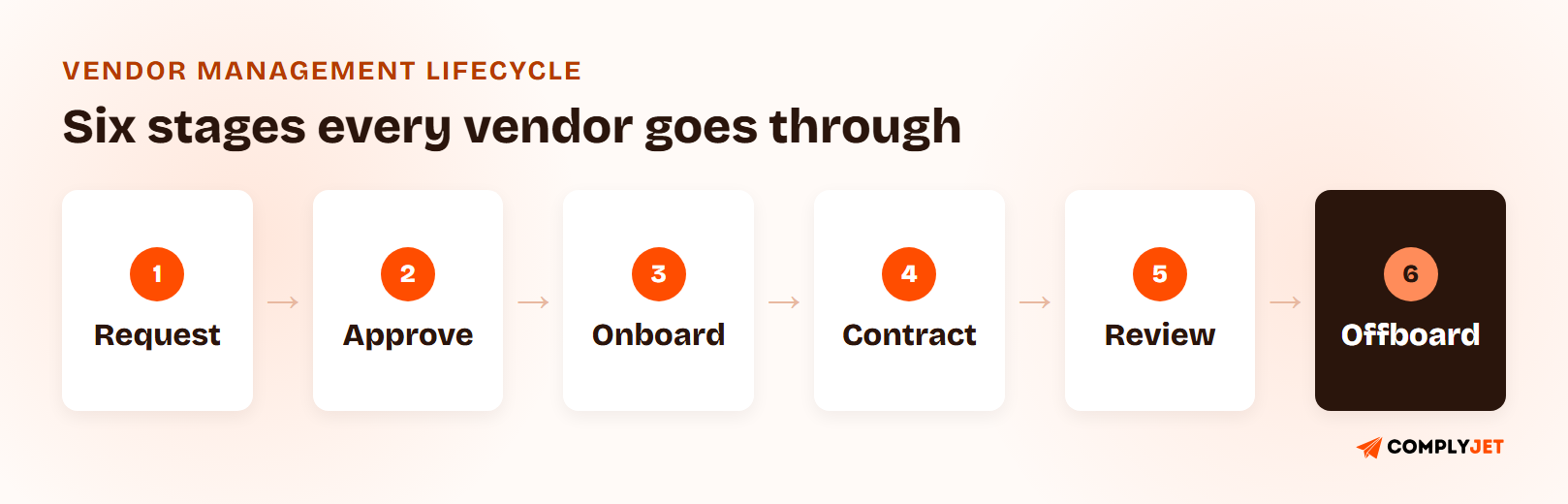
The stages in that chain map to the evidence an auditor asks for:
| Stage | Who owns it | Evidence it leaves behind |
|---|---|---|
| Request | The team that wants the tool | A logged request stating business need and data involved |
| Approve | Security or IT lead, plus a budget owner | A recorded approval and the vendor's risk tier |
| Onboard | IT or the business owner | Access granted through SSO, least privilege, data-shared inventory |
| Contract | Legal, finance, or the founder | A signed agreement with the required security clauses |
| Review | The named vendor owner | An annual review record, with the latest compliance report on file |
| Offboard | IT, with the vendor owner | Access removed, data returned or deleted, confirmation on file |
This is the vendor management lifecycle in one table, and the rest of the policy is the detail behind each row.
What to Include in a Vendor Management Policy Template
A complete vendor management policy template has nine sections. Each one exists because a reviewer will check it.
| Section | What it covers | Why reviewers check it |
|---|---|---|
| Purpose and scope | Which vendors and purchases the policy applies to, including free tools and contractors | Free and trial tools are where shadow vendors hide |
| Roles and ownership | Who approves, who owns each vendor, who keeps the list | A vendor with no owner never gets reviewed |
| Request and approval | How a new vendor is requested and who signs off | Shows purchases are controlled, not ad hoc |
| Selection criteria and approved vendor list | What a vendor must show before approval, and the master list | The list is the inventory auditors ask for first |
| Contract requirements | Minimum security and data clauses | Prevents signing paper that gives you no recourse |
| Onboarding | Access, integration, and data-sharing setup | Access is the real risk, not the invoice |
| Ongoing review | How often vendors are reassessed and what triggers an early review | Approval at signing goes stale within a year |
| Exceptions | How a deviation is documented and approved | Undocumented exceptions become audit findings |
| Offboarding | Access removal, data return, and confirmation | The stage most policies skip |
Some teams call this a supplier management policy or a third-party vendor management policy. The document a reviewer expects to see is the same.
Vendor Selection Criteria and the Approved Vendor List
Selection criteria are the questions a vendor has to answer before it gets approved. Keep them short enough that people actually apply them.
- Business need: what problem it solves and whether an existing approved vendor already covers it
- Data involved: what categories of company or customer data it will touch, matched to your data classification policy
- Security evidence: a current SOC 2 report, ISO 27001 certificate, or equivalent, and how recent it is
- Continuity and exit: how you get your data out if the vendor fails or you leave
Ask what the security evidence actually covers, not only whether it exists. Rob Black, reviewing a potential vendor's SOC 2 report in an August 2022 LinkedIn post, found the audit scope left out subprocessors named on the vendor's own privacy page, and wrote: "Their SOC 2 report did not allay my fears." A commenter on that post put the burden on the buyer: a vendor program built on a checkbox and no review "is on them, not the vendor."
Vendors that pass go on the approved vendor list, a single master record with the vendor's purpose, owner, data shared, contract renewal date, and last review date. The list is the source of truth. If a tool is not on it, it is not approved, whatever the card statement says.
Vendor Contract Requirements Every Policy Should Set
The policy should name the minimum terms a vendor contract must contain, so negotiation does not depend on who happens to be signing that day. Unusual terms go through the exceptions process.

- Confidentiality covering your data and any customer data the vendor can reach
- Security obligations that match the risk of the data involved
- Breach notification with a stated time window, so you can meet your own obligations to customers
- Subprocessor approval, so the vendor cannot pass your data to a new party silently
- Data return and deletion at termination, with written confirmation
- Compliance report delivery, such as a current SOC 2 report each year
- Termination assistance, so an exit does not strand your data
Where personal data is involved, a data processing agreement is part of this set. Where the vendor handles protected health information, a business associate agreement is required, and ComplyJet's HIPAA business associate agreement guide covers what it must contain.
The Vendor Onboarding Process: Access, Data, and Sign-Off
Onboarding is where an approved vendor becomes a live risk. A workable vendor onboarding process is short and repeatable:
- Confirm the approval and contract are on file before any account is created or data is shared.
- Connect through SSO where the vendor supports it, so your identity provider controls who logs in and offboarding is a single change.
- Grant least-privilege access, scoped to the data and systems the vendor's purpose actually needs.
- Record what data is shared and where it lives, next to the entry on the approved vendor list.
- Assign the vendor owner by name, not by team.
- Schedule the first review at the time of onboarding, not when someone remembers.
Nothing in that list is expensive. The discipline is doing it before the vendor is in use, not after.
Teams that go through this with ComplyJet describe the process as guided rather than left to guesswork. As Andy Brock, Director of Technology at PatientFocus, puts it: "ComplyJet helped us move much quicker than expected through SOC 2 by intuitively guiding us through what we needed."
Customer Stories
See how other early-stage teams got audit-ready
Read what founders and engineering leads say about working with the ComplyJet team through their first audit.
Vendor Offboarding in a Vendor Management Policy Template: Access and Data
Offboarding is the stage most vendor policies skip, and it is the one where data quietly stays behind. A contract that ends without a deletion confirmation is a liability that is still open.
Your template should require, in order:
- Revoke access for every account and integration, including API keys and OAuth grants, and record the date.
- Retrieve your data in a usable format before the account closes.
- Request written confirmation of deletion, with the timeline the contract promised.
- Remove the vendor from the approved vendor list and mark it as offboarded, keeping the record for audit history.
Action step
Add an offboarding date to every entry on your approved vendor list at onboarding time. When the contract renewal date arrives, the decision to renew or exit is forced, instead of the tool auto-renewing unnoticed.
Vendor Management Policy Requirements by Framework: SOC 2, ISO 27001, HIPAA, GDPR, and PCI DSS
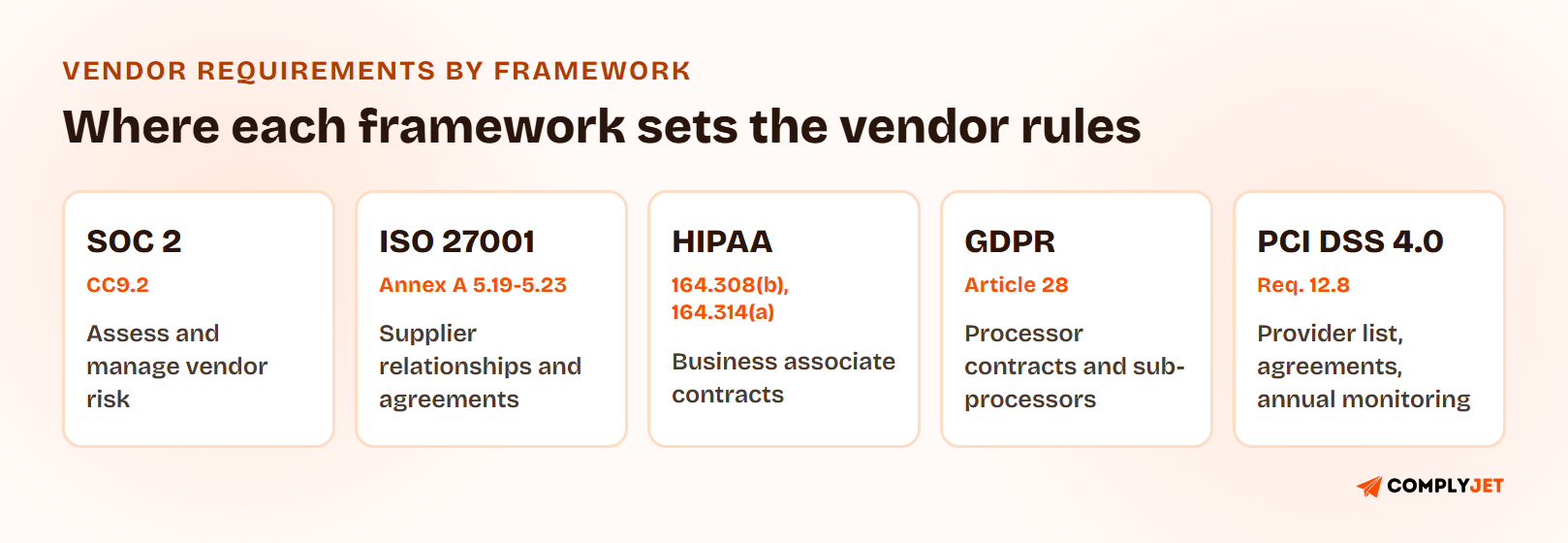
No framework hands you a vendor policy to copy. Each one sets an expectation, and a single well-built vendor management policy can meet all of them because the lifecycle stages overlap.
| Framework | Where it lives | What it expects |
|---|---|---|
| SOC 2 | Common Criteria CC9.2 | The entity assesses and manages risks associated with vendors and business partners |
| ISO 27001:2022 | Annex A 5.19 to 5.23 | Information security in supplier relationships, supplier agreements, ICT supply chain, monitoring and change management of supplier services, and cloud services |
| HIPAA | 45 CFR 164.308(b) and 164.314(a) | A written contract with each business associate that binds it to the Security Rule, covers subcontractors, and requires reporting of security incidents |
| GDPR | Article 28 | A binding contract with each processor, processing only on documented instructions, and approval for any sub-processor |
| PCI DSS 4.0 | Requirement 12.8 | A maintained list of third-party service providers, written agreements, due diligence before engagement, and monitoring of their compliance status at least annually |
Vendor Management Policy for SOC 2 and ISO 27001
For SOC 2, the vendor criterion is CC9.2: the entity assesses and manages risks associated with vendors and business partners. Auditors typically look for a defined engagement process, a vendor inventory, contract terms, and evidence of periodic review, which are the artifacts in the lifecycle table above.
ISO 27001:2022 splits the same ground across five Annex A controls, 5.19 through 5.23: supplier relationships, supplier agreements, the ICT supply chain, monitoring and change management, and cloud services. Source: ISMS.online on Annex A 5.19. Your contract requirements and review cadence sections answer most of it.
HIPAA, GDPR, and PCI DSS Vendor Requirements
HIPAA is the most explicit about paper. Under 45 CFR 164.314(a), the business associate contract must require the vendor to comply with the Security Rule, bind its own subcontractors, and report security incidents to you.
GDPR Article 28 requires a binding contract with any processor and gives the controller control over sub-processors. Read the full text at GDPR Article 28.
PCI DSS 4.0 Requirement 12.8 asks for a list of service providers with a description of each service, written agreements, due diligence before engagement, and a program to monitor their compliance status at least annually. Source: Mitratech on PCI DSS third-party service provider requirements.
Companies treat vendor management as five separate obligations because each framework names it differently. It is one lifecycle. Write the policy once, map it once, and every reviewer gets the same answer. — Upendra Varma, CTO at ComplyJet
Vendor Management Policy Template: A Free Example You Can Download
The clearest way to see how this works is to read real language. Here are two sections of the template written out in full.
Vendor Management Policy Example: Two Sample Clauses
Sample clause: Vendor Request and Approval
No employee may purchase, subscribe to, or connect a third-party product or service that will access company or customer data without prior approval. Requests are submitted to the Security Lead with the business purpose, data categories involved, and proposed owner. A vendor may only be used once it appears on the Approved Vendor List. Free and trial accounts are subject to the same approval requirement.
Sample clause: Vendor Offboarding
When a vendor relationship ends, the Vendor Owner must, within 30 days of termination, revoke all user accounts, API keys, and integrations; retrieve company data in a usable format; and obtain written confirmation that remaining company data has been deleted. The Security Lead records completion on the Approved Vendor List and retains the record for the period defined in the Data Retention Policy.
Free Template
Download the Free Vendor Management Policy Template (PDF)
All nine sections above with sample clauses, an approved vendor list layout, and a framework mapping table for SOC 2, ISO 27001, HIPAA, GDPR, and PCI DSS.
Rolling Out a Vendor Management Policy Template
Writing the document is the easy half. A vendor process only works if the existing vendors get pulled into it, not just the next one you buy.
- Build the first inventory. Pull vendors from your corporate card and expense statements, your identity provider's connected apps, and your accounting system. Someone always finds a tool nobody remembered.
- Assign a named owner to each vendor. A person, not a department.
- Sort them by the data they touch, using your risk management policy or the tiering in the third-party risk guide, so review effort goes where the exposure is.
- Get the policy formally approved by leadership, so it is adopted and not a draft.
- Announce the request path in the channel where people already ask, and make it a single form or ticket.
- Set the review calendar. As a working rule, review vendors with access to customer data every year and lower-risk vendors on renewal.
That review cadence is a recommendation, not a framework requirement. The frameworks expect periodic review and leave the interval to you, so pick one you will actually keep and write it down.
Practitioners disagree on how strict the gate should be. In the same Hacker News thread, one commenter argued that a process where "Approval is practically a rubber stamp" still beats "who knows what they're doing," while another said no technology service should be bought without a risk assessment first. Your policy has to pick a side, and the exceptions log is where the compromise gets written down.
Pro tip
Tie the approved vendor list to your finance process. If a new recurring charge cannot be matched to an entry on the list, finance flags it. That one link catches most shadow vendors.
Vendor Management Policy Template Mistakes That Fail Audits
- Writing the policy but never building the vendor list. The document says every vendor is approved, and the inventory shows otherwise.
- Owners assigned to teams instead of people. Nobody in "Engineering" feels responsible for reviewing a vendor's SOC 2 report.
- Approval at purchase only. A vendor approved two years ago with an expired report is still on the list.
- Contract terms left to whoever signs. Without a minimum clause set, breach notification and data deletion vary deal to deal.
- No exceptions log. A legacy vendor that cannot meet the standard goes unaddressed instead of being formally accepted with a reason.
- Skipping offboarding. Accounts, API keys, and data outlive the contract.
- Treating free tools as out of scope. A free tier connected to production data is still a vendor with access to your data.
How ComplyJet Supports Your Vendor Management Program
A policy gets you through the document request. The harder part is proving it is followed, cycle after cycle, without a scramble for screenshots.
We help early-stage teams do that as part of a broader SOC 2, ISO 27001, HIPAA, or GDPR program: AI-assisted policy drafting to get the document right, integrations that pull the technical evidence an auditor asks for, and a team that guides you through the process instead of leaving you alone with the software. If you are comparing tools for vendor tracking specifically, our roundup of the best vendor risk management software is a good place to start.
Compliance Automation
Turn your vendor policy into an audit-ready control
ComplyJet pairs AI-assisted policy drafting with integrations that pull the evidence auditors ask for, across SOC 2, ISO 27001, HIPAA, and GDPR.
FAQs
What Is a Vendor Management Policy?
A vendor management policy is a formally adopted document that sets the rules for how a company selects, approves, contracts with, monitors, and exits vendors. It assigns owners and defines the evidence each stage leaves behind.
What Should a Vendor Management Policy Template Include?
Purpose and scope, roles and ownership, a request and approval process, selection criteria with an approved vendor list, minimum contract requirements, onboarding, ongoing review, an exceptions process, and offboarding. The "What to Include" section above explains each one.
What Is the Difference Between a Vendor Management Policy and a Third-Party Risk Management Policy?
The vendor management policy governs the lifecycle: who approves vendors, what the contract says, how they are onboarded, reviewed, and exited. The third-party risk management policy governs how risky each vendor is and how deep the due diligence goes. Most programs need both, and they reference each other.
Who Is Responsible for Vendor Management?
Each vendor needs a named business owner, and the policy needs a single accountable owner, usually the security or IT lead, who keeps the approved vendor list and approves new requests. Finance and legal support on budget and contract terms.
How Do You Onboard a New Vendor?
Confirm approval and a signed contract, connect through SSO where possible, grant least-privilege access, record the data shared, assign a named owner, and schedule the first review. Do all of it before the vendor is in use.
How Often Should Vendors Be Reviewed?
The frameworks expect periodic review without fixing an interval. A practical working rule is annually for vendors with access to customer data, and at renewal for lower-risk vendors, plus an early review after any breach or major change at the vendor.
Is a Vendor Management Policy Required for SOC 2?
SOC 2 criterion CC9.2 requires the entity to assess and manage risks associated with vendors and business partners. The criteria do not name a document, but a written policy is the standard way to show a defined, repeatable process to an auditor.
Is There a Free Vendor Management Policy Template PDF?
Yes. This article includes a downloadable vendor management policy template PDF with all nine sections, sample clauses, an approved vendor list layout, and a framework mapping table.
Related Reading
- Third-Party Risk Management Policy, the risk-assessment and tiering companion to this policy.
- Vendor Risk Management Metrics, the KPIs and KRIs for measuring whether the program works.
- Best Vendor Risk Management Software, for teams comparing tools.
- Risk Management Policy, the broader risk framework vendor tiers plug into.
- Information Security Policy, the top-level policy this one rolls up into.
Sources: Verizon 2025 Data Breach Investigations Report; AICPA Trust Services Criteria, CC9.2; ISO 27001:2022 Annex A 5.19 to 5.23; 45 CFR 164.308(b) and 164.314(a), HIPAA Security Rule; GDPR Article 28; PCI DSS 4.0 Requirement 12.8 summary.