.svg)

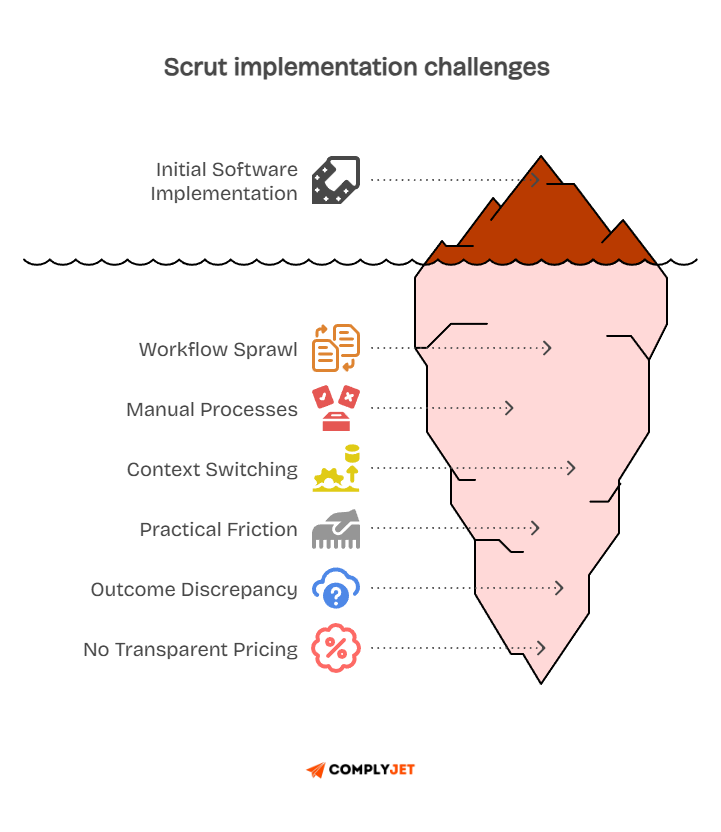
Scrut Automation is a solid GRC platform. It helps you track risks and manage security tasks in one place. Many SaaS teams pick it to get their first SOC 2 or ISO 27001 done. It looks polished. The workflows feel modern. But once you go live, gaps start to show.
You might find yourself juggling extra spreadsheets or hiring a separate auditor, or explaining to your engineers why yet another task popped up with no real context.
That's when the question kicks in: Is Scrut really the best fit for your team?
You're not alone. Many founders are trying to switch before their next audit, because Scrut's great on paper but not always in practice.
Most fast-moving teams don't want "more dashboards." They want a compliance platform that works with their stack without slowing them down.
This guide breaks down the top 9 Scrut alternatives in 2026.
You'll see how they differ on pricing, use cases, integrations, and actual user feedback. Whether you need affordable compliance software or deeper automation, you'll find your match here.
Can your platform help you pass an audit faster under budget to win enterprise deals?
Talk to our founders to know how it's done!
Now, let's unpack what Scrut automation actually offers and where it falls short compared to smarter options.
What's Scrut Automation and what does it offer?
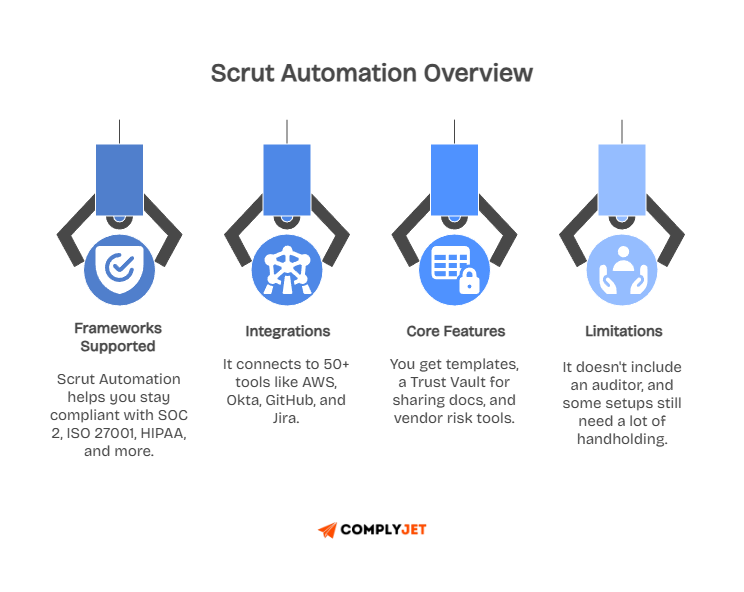
Scrut Automation helps you stay compliant with SOC 2, ISO 27001, HIPAA, and more. It focuses on risk-based workflows and cuts down manual work using automation. You get templates, a Trust Vault for sharing docs, and vendor risk tools.
It connects to 50+ tools like AWS, Okta, GitHub, and Jira. The pricing starts around $15,000/year. G2 users give it a 4.9/5, mostly for ease of use and support quality. But it doesn't include an auditor, and some setups still need a lot of handholding.
Scrut Automation sits in a busy compliance market, yet it still holds attention because it promises clear automation and simple risk tracking.
You may hear founders talk about the appeal. Scrut gives you a way to pull evidence from your systems and store it in one place. It also helps you track risks with simple scores. This removes clutter that many teams face when they start their first SOC 2 or ISO 27001 project.
What Scrut Automation Software Tries to Deliver
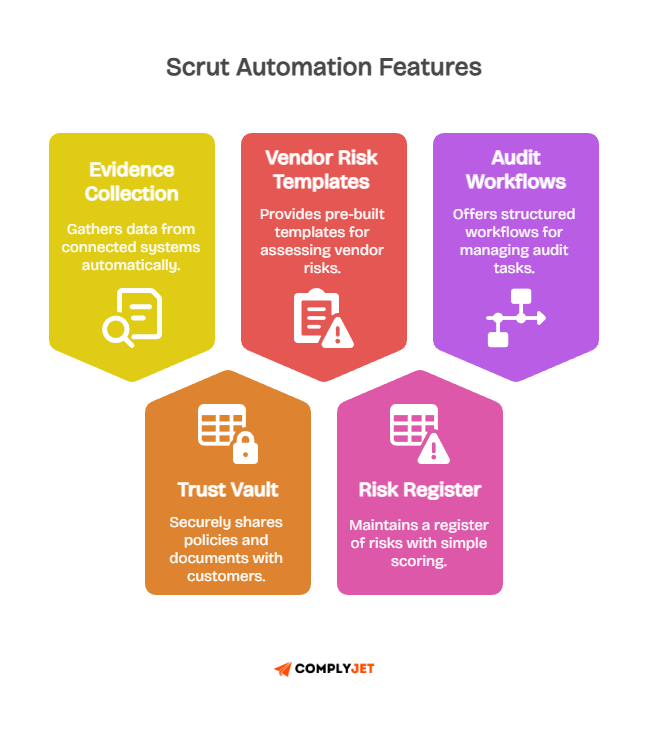
Scrut automation software brings a set of features that aim to reduce manual work. It links to cloud tools, checks controls, and gives you alerts when something breaks. You get a sense of your compliance posture without digging through files.
Scrut includes key components that many teams expect:
- Evidence collection from linked systems
- A Trust Vault to share policies with customers
- Vendor risk templates
- A risk register with simple scoring
- A set of workflows for your audit tasks
This setup can help you keep your proofs fresh during the year. It also gives your sales team a simple way to show buyers your security story.
Where Scrut Automation Stands Strong
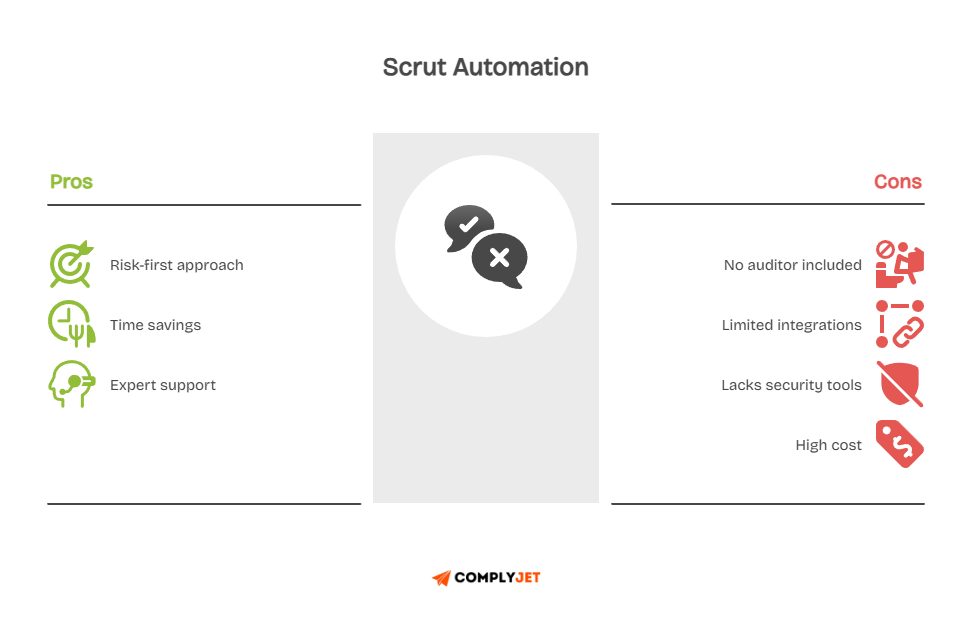
Scrut automation compliance focuses on a "risk-first" view. This means you learn which controls matter most. Many mid-stage teams find this useful because it brings order to a messy space.
Scrut also helps reduce time spent on manual tasks. Some reports show teams cutting seventy percent of the usual effort by letting the platform gather logs and proofs. This creates room for engineers to work on the product instead of screenshots.
Scrut customers also praise expert support. You get access to security staff who guide you on common questions. This matters if you do not have a full security team.
Where Scrut Automation Falls
You should review the flip side, too. Scrut does not include an auditor. You must hire and manage your own. This creates extra work during your audit cycle.
You also see limits with integrations. Scrut supports about fifty services. Newer competitors support far more. If you use tools that Scrut does not connect with, you will handle more work by hand.
Scrut also lacks security tools. There is no penetration testing and no active threat watch. If your buyers expect deeper security, you must buy those services from other vendors.
The price can also feel high. Fifteen thousand dollars per year is hard for early startups. You might only need one framework, yet you still pay the full cost.
Who Scrut Automation Fits Best
Scrut fits mid-stage SaaS teams that want structure and have room in their budget. These teams handle one or two frameworks and want a clean system to stay compliant. They also want expert help, but do not need built-in audits or deep security tools.
This sets the stage for the next part, where you look at platforms that match different needs and budgets.
Top 9 Scrut Automation Alternatives & Competitors in 2026
You've seen what Scrut Automation does well. But depending on your team size, budget, or frameworks, you may want something more focused. These 9 Scrut competitors solve different needs. Some are faster. Some are cheaper. Some include services Scrut leaves out.
Each of these tools can replace Scrut Automation for the right use case. Whether you're a solo founder chasing SOC 2 or a growing team juggling HIPAA and ISO 27001, there's a better fit here. Let's break them down.
1. ComplyJet
If you want a fast, affordable way to get SOC 2 or ISO 27001. ComplyJet does it under $5,000/year. It's built for early-stage SaaS teams selling to security-aware buyers.
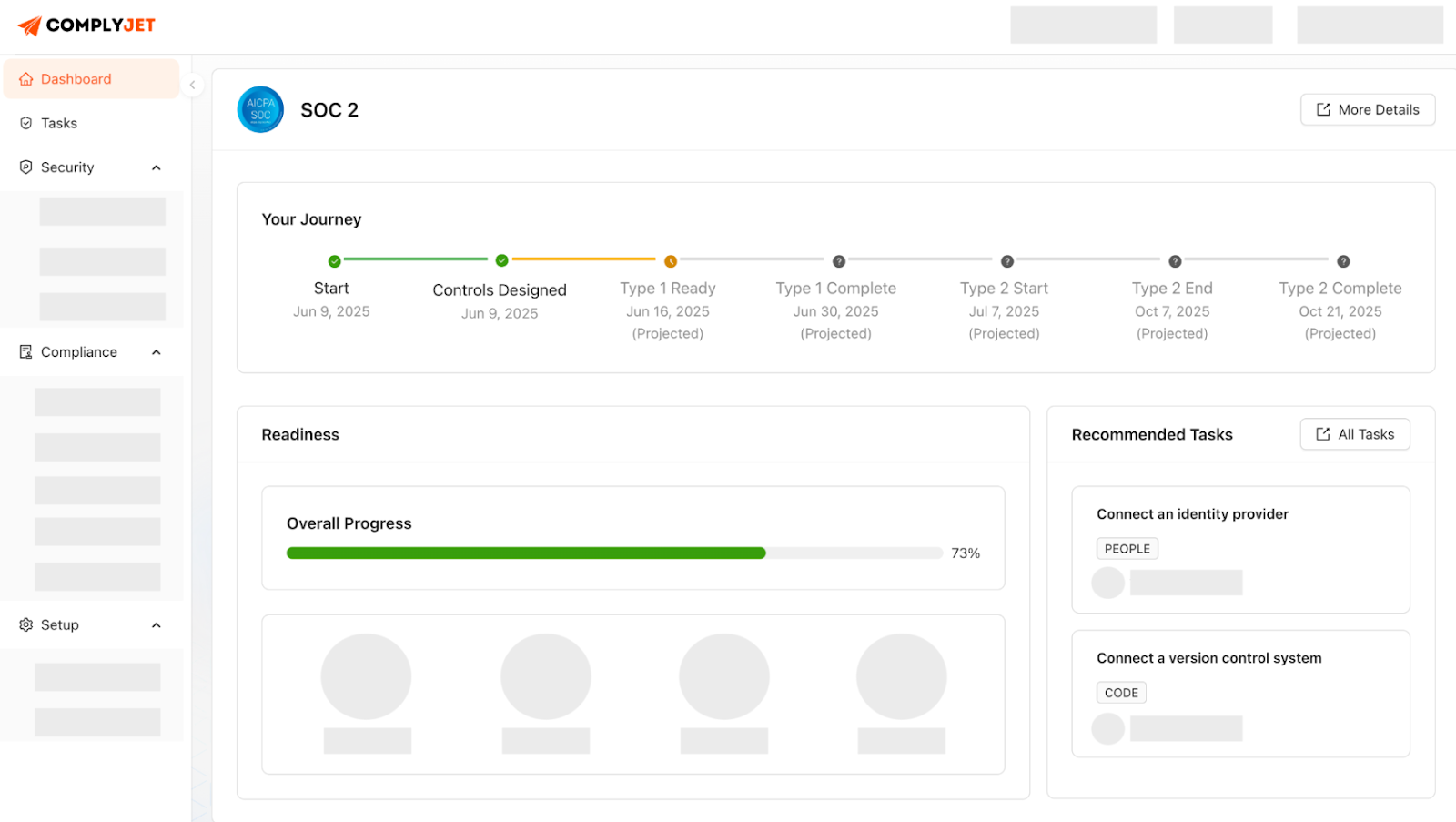
The platform comes with automation for evidence, policies, risk, and vendors. It has over 200 integrations and a built-in Trust Centre to close deals faster. You also get access to audit firms.
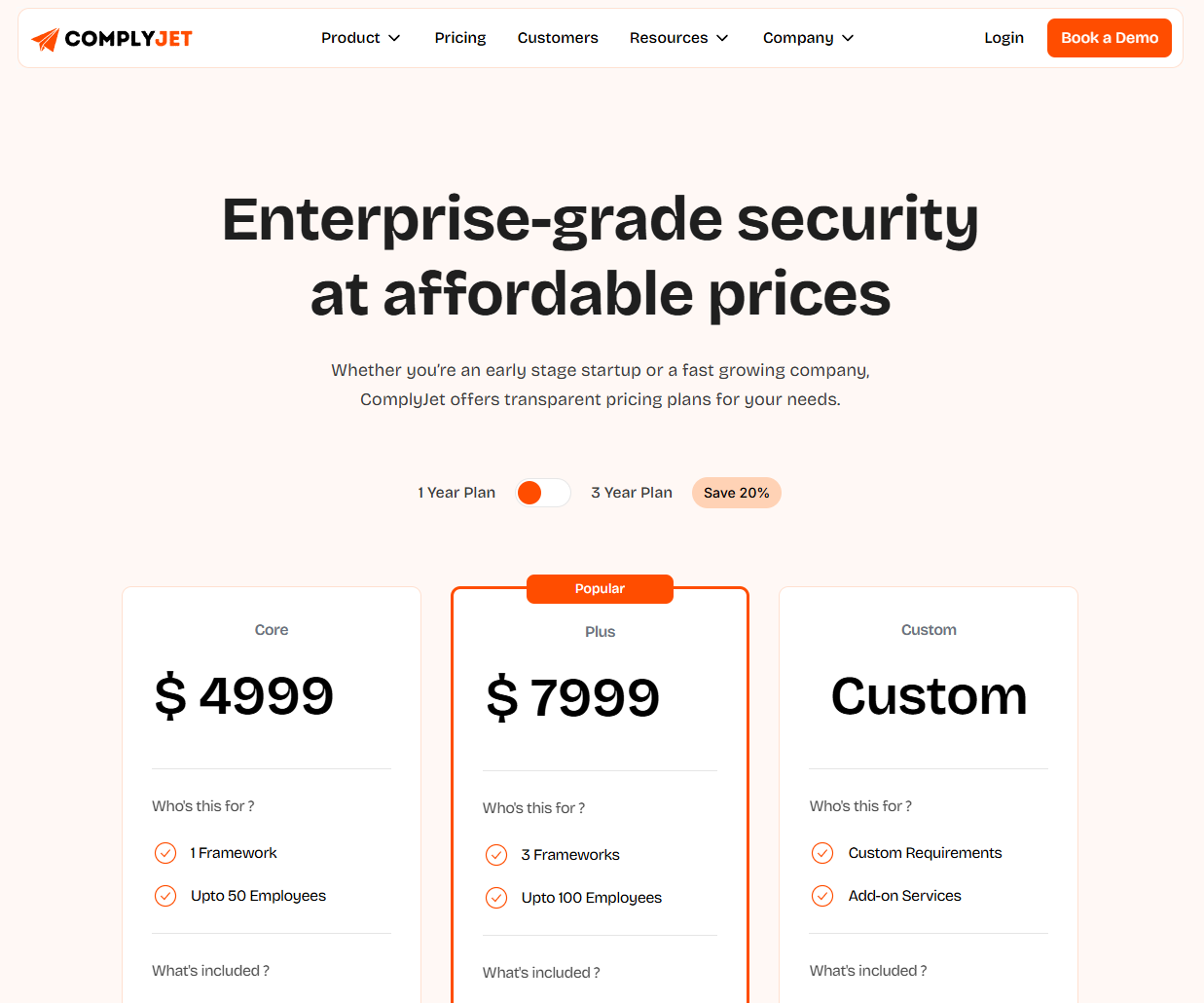
Pricing is $5,000 to $10,000 per year. This includes one framework, automation, Slack support, and a real audit path. Most users are audit-ready in 2–3 weeks.
Scrut costs more and doesn't include audit partners. ComplyJet keeps things simpler and cheaper without cutting core features.
Pros:
- Real audit-ready platform
- Flat pricing by team size
- Full-featured free trial
Cons:
- Less suited for 5+ frameworks
- No deep customisation
Looking to reduce compliance costs? Start your free trial with ComplyJet
2. Delve
Delve helps you pass SOC 2 quickly. Some users report getting compliant in one week. That's possible because Delve focuses only on first-time audits.

It uses AI agents to complete tasks and pick only the controls you need. You get human support through Slack and a free Trust Report to share with customers.
Delve pricing is around $12,000 per year. This includes both the platform and audit. You don't have to pay extra for the add-ons.
Scrut Automation is more flexible but not so fast. Delve is built for speed and simplicity.
Pros:
- Includes audit in price
- Fastest SOC 2
- No unnecessary features
Cons:
- Not ideal for multi-framework teams
- Less control mapping depth
3. Scytale
If your stack is all AWS, Scytale is worth a close look. It connects directly to over 30 AWS services with zero setup.
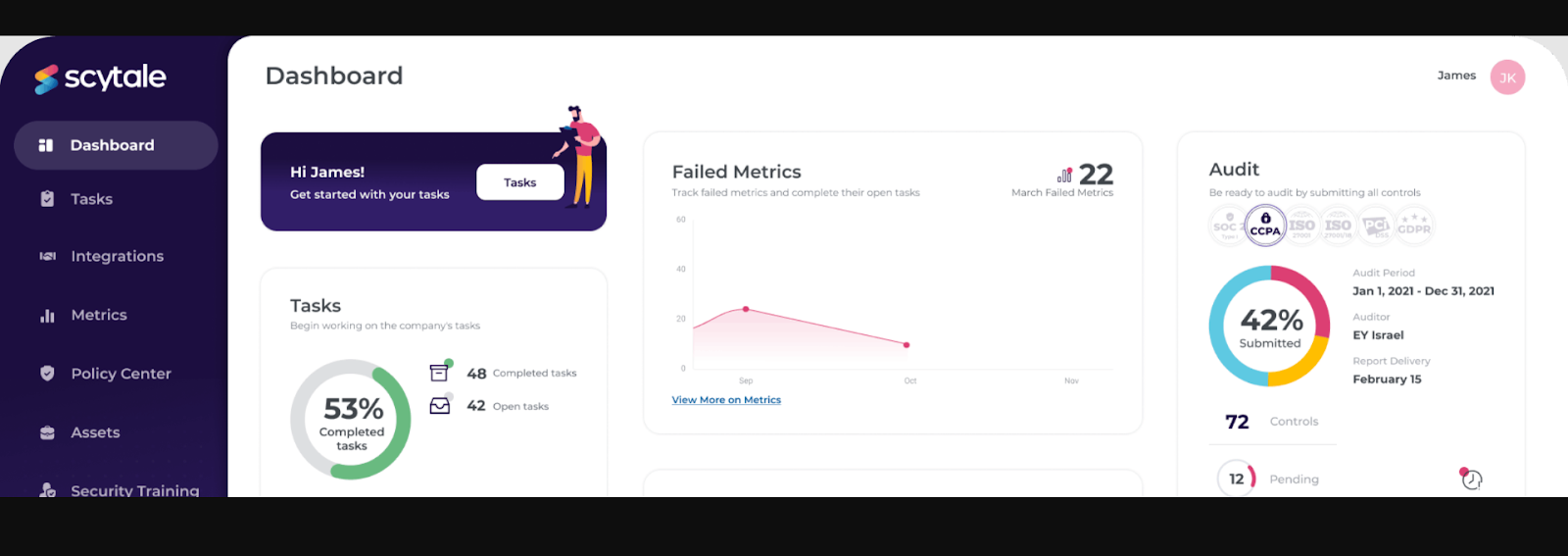
The platform offers continuous monitoring, AWS-native alerts, and custom framework mapping. It handles SOC 2, ISO 27001, ISO 42001, GDPR, and more.
Scytale's pricing is custom but typically ranges from $5,000 to $20,000. It depends on usage and frameworks.
Scrut supports AWS, but Scytale runs on it. If AWS-native is your goal, Scytale gives you deeper coverage.
Pros:
- Built on AWS
- Real-time AWS alerting
- Strong for ISO 42001 and GDPR
Cons:
- Limited to AWS
- No bundled audit option
4. StrikeGraph
StrikeGraph works well if you want to start with one framework and add more later.
StrikeGraph's pricing starts at $9,000 for a single framework, with each extra costing $2,000 to $8,000.
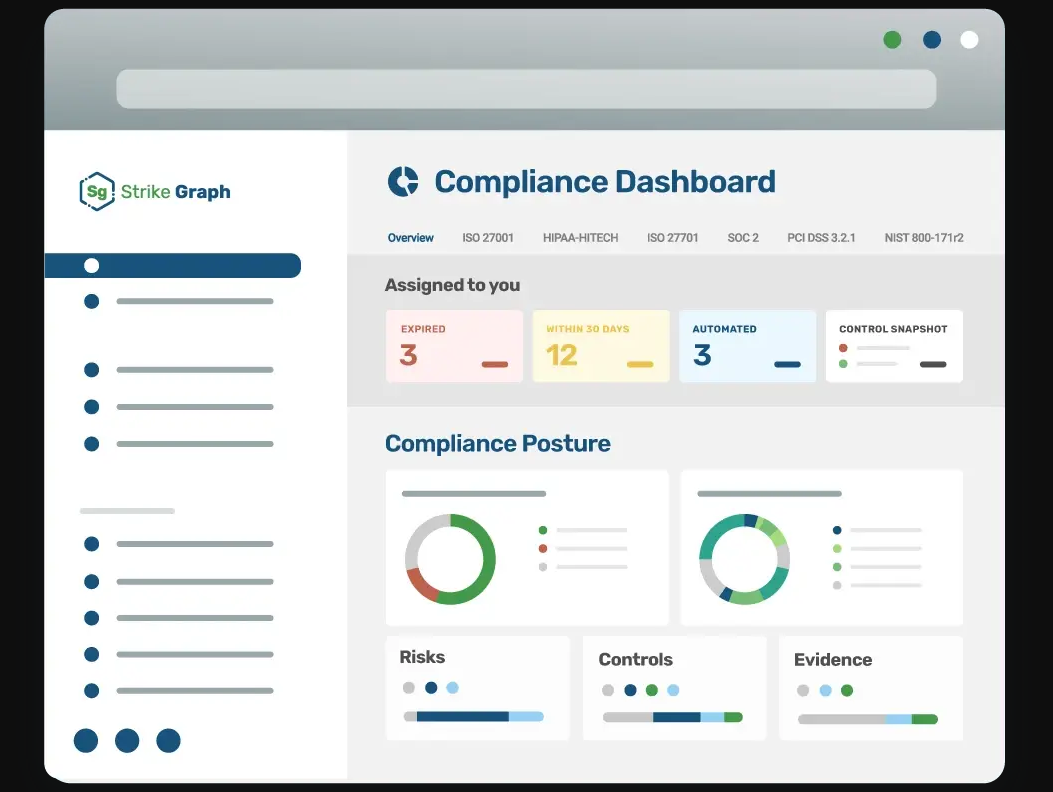
The tool offers automated controls, AI-based monitoring, and a risk dashboard. You can also get a dedicated compliance advocate if needed.
StrikeGraph supports 10+ frameworks like SOC 2, GDPR, and HIPAA. It's ideal for teams growing into more frameworks over time.
Scrut offers a bundled platform, but StrikeGraph gives more flexibility with lower starting costs.
Pros:
- Modular pricing
- Concierge option available
- AI-native dashboard
Cons:
- Extra frameworks add up
- Smaller integration list
5. Oneleet
Oneleet adds real security to compliance. You get vulnerability scans, attack surface monitoring, dark web alerts, and pentesting.

It includes a compliance platform that automates SOC 2, ISO 27001, and HIPAA tasks. Their team also includes vCISOs who guide you through risk remediation.
Oneleet pricing is custom, often between $10,000 and $25,000. This covers the platform and security work.
Scrut doesn't offer these services. Oneleet gives security-focused founders peace of mind.
Pros:
- Real security tools included
- OSCE-certified testers
- vCISO guidance
Cons:
- Pricing depends on the scope
- Less useful without security needs
Read: OneLeet vs Delve: SOC 2 Pricing, Features, Reviews [2025].
6. Hyperproof
Hyperproof helps mid-market and enterprise teams scale across 100+ frameworks. It uses AI to manage controls, vendors, and risks.

It connects to 70+ tools and automates audit workflows. You also get control, deduplication, and custom alerts.
Hyperproof pricing starts at $22,000 and goes beyond $50,000 depending on modules.
Scrut fits smaller programs. Hyperproof suits companies with global operations and deeper internal risk needs.
Pros:
- 100+ frameworks
- Strong vendor risk tools
- AI-based evidence system
Cons:
- Steep learning curve
- Pricing is on the higher side
7. AuditBoard
AuditBoard is built for enterprise GRC. Over half of Fortune 500 firms use it. It connects audit, risk, and compliance data across business units.
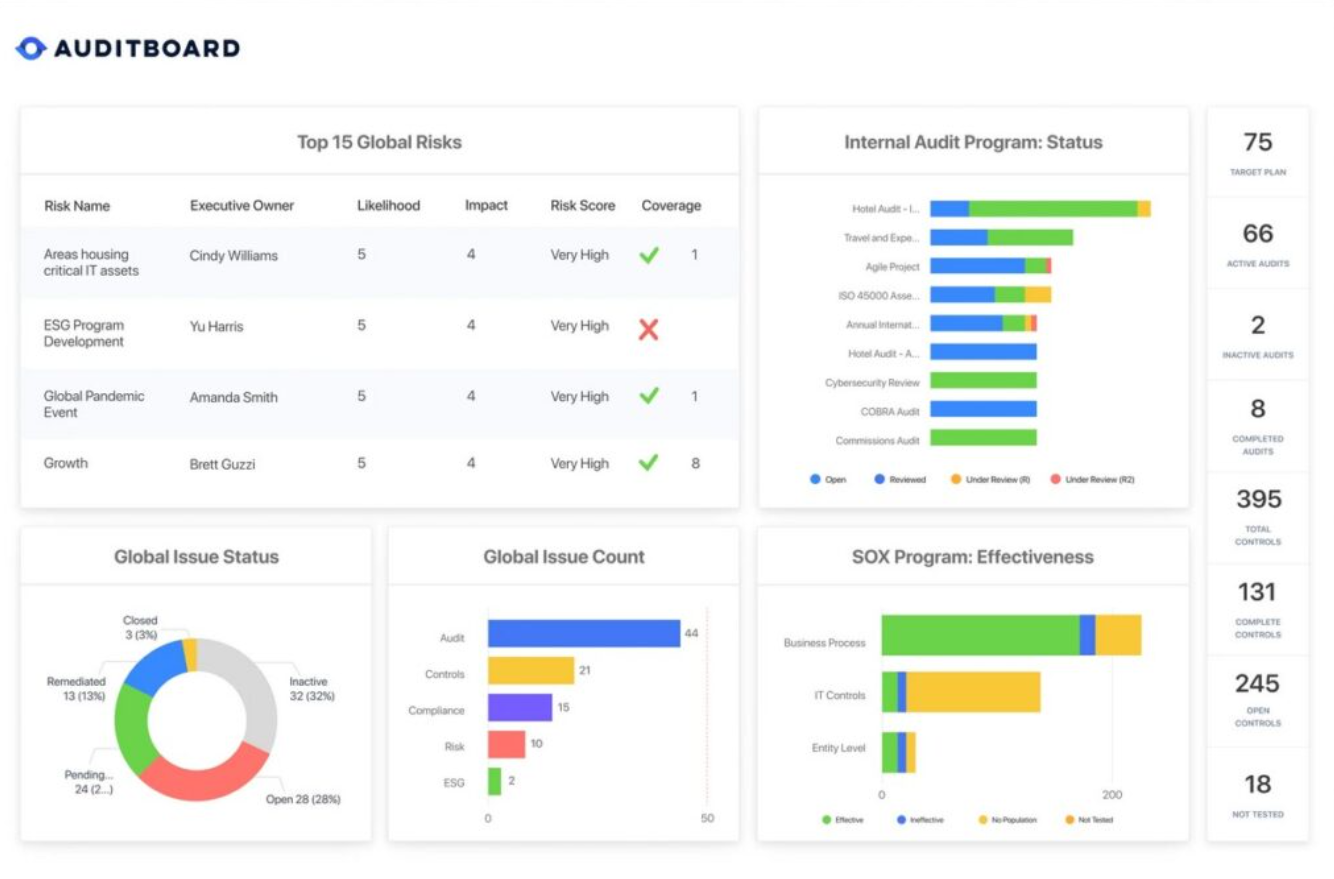
Features include role testing, audit planning, and live dashboards. It also uses AI for analytics and automation.
Auditboard’s pricing is custom. It usually exceeds $100,000 per year. Implementation takes time but scales well.
Scrut doesn't try to serve the enterprise. AuditBoard is purpose-built for it.
Pros:
- Proven at enterprise scale
- Strong analytics and dashboards
- Full GRC suite
Cons:
- High price point
- Long setup cycle
8. Thoropass
Thoropass combines compliance software with audit services. Your auditor works inside the same platform from the start.
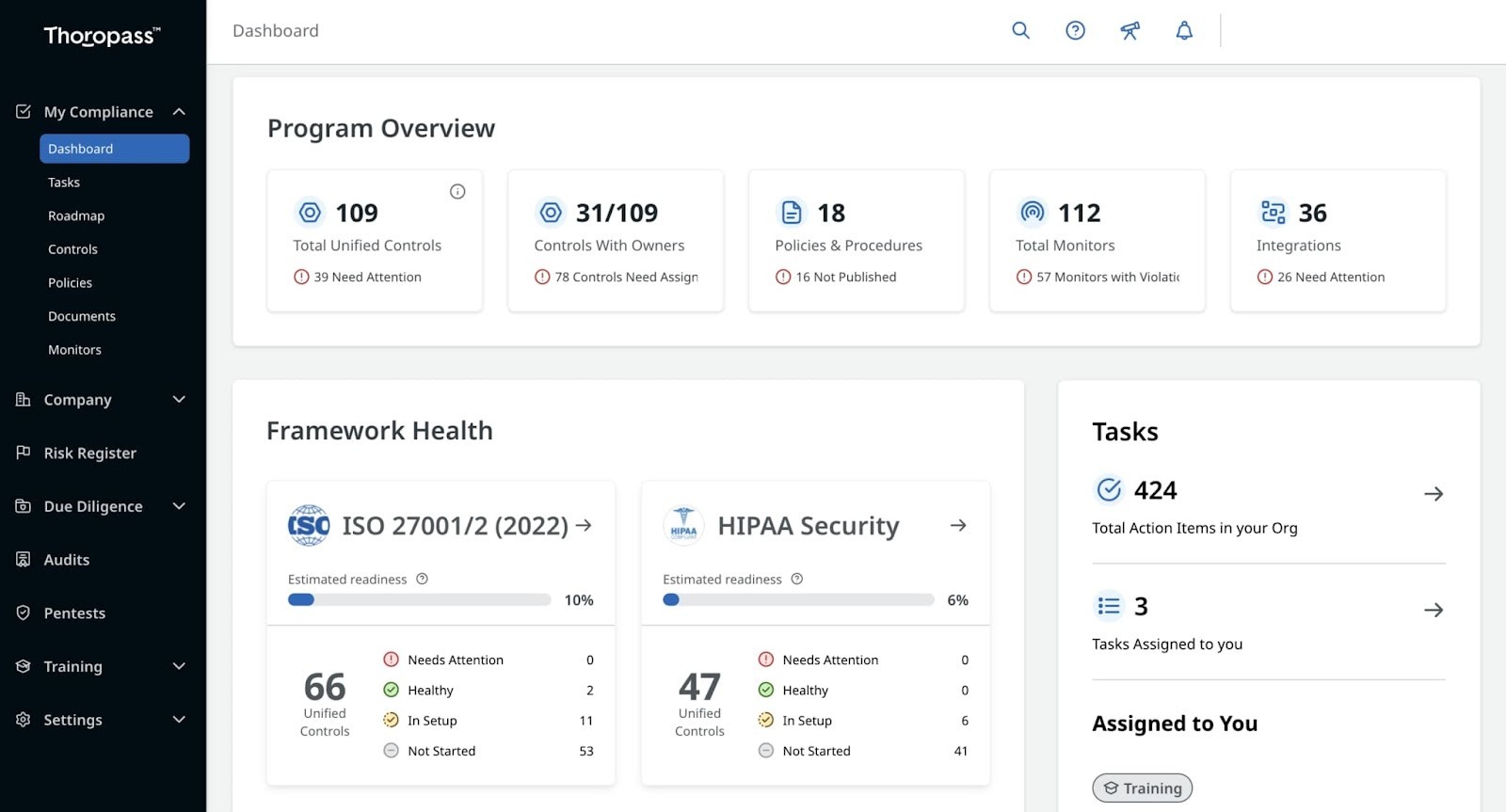
It supports SOC 2, ISO 27001, PCI DSS, and HITRUST. You get automated evidence, control mapping, and issue tracking.
Median annual cost is $30,728. The Thoropass pricing audit is included and scoped upfront. This avoids surprises later.
Scrut helps you get audit-ready. Thoropass runs the audit itself. For fast-growing teams, this is a huge time-saver.
Pros:
- Audit firm included
- No handoffs
Cons:
- Pricey for startups
- Better fit for funded teams
9. LogicGate
LogicGate offers 40+ pre-built apps for audit, risk, policy, and more. You can build workflows with no code and assign custom rules.
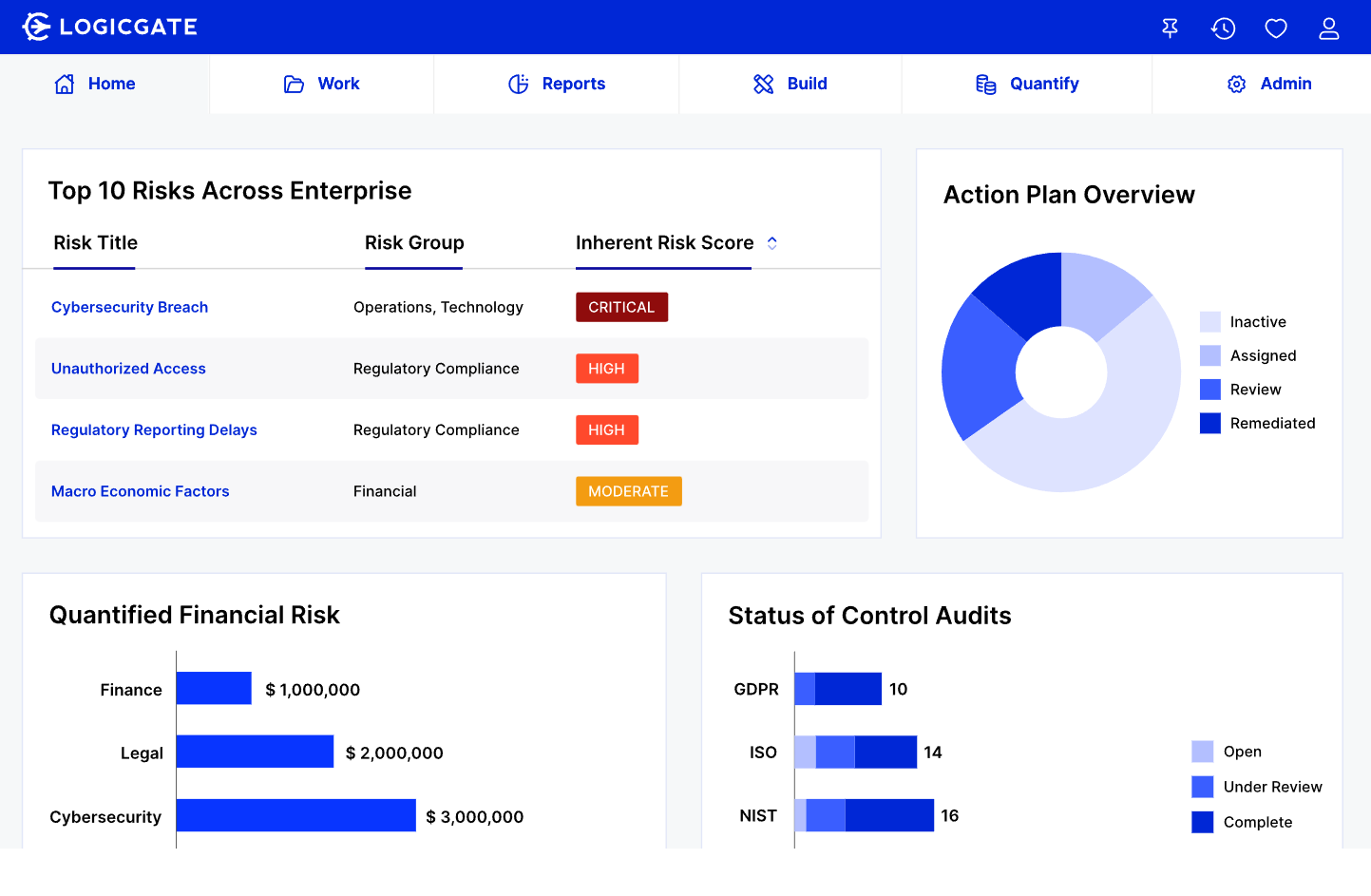
Logicgate's pricing is modular, so you pay only for what you use. Median spend is $52,567 per year. You only pay for admin users.
Scrut follows a fixed structure. LogicGate fits teams with specific workflows and dedicated compliance managers.
Pros:
- High flexibility
- No-code customization
- Scales with company growth
Cons:
- High total cost
- Takes time to configure
Now that you've seen how these 9 tools compare, we'll walk through the side-by-side direct comparison that breaks them down by features, pricing, and fit. That'll help you zero in on what works best for your team.
How Scrut Compares to Top Competitors?
You've read through the details. But sometimes, a side-by-side snapshot helps make the call. Here's how Scrut Automation stacks up against nine top alternatives. These aren't feature dumps. Each comparison shows what changes in your workflow, cost, or audit prep when you switch.
This section answers the real question: How does Scrut Automation compare to competitors across pricing, frameworks, and buyer fit?
Scrut vs ComplyJet
- Cost: Scrut starts at $15,000/year. ComplyJet starts at $5,400 and includes more for startups.
- Audit-Readiness: ComplyJet bundles audits and partners with auditors. Scrut doesn't include audit support.
- Ease of Use: ComplyJet has AI workflows, faster onboarding, and direct Slack support. Scrut has more setup steps.
Best fit: Early-stage SaaS teams looking for fast, affordable audit-readiness.
Scrut vs Delve
- Price: Delve offers an all-in SOC 2 package for $12,000, including audit. Scrut requires extra for the audit.
- Speed: Delve users have completed SOC 2 in under 10 days. Scrut takes longer depending on team size and setup.
- Automation: Delve uses AI agents to guide workflows. Scrut uses traditional task-based flows.
Best fit: Founders who need SOC 2 quickly to close deals.
Scrut vs StrikeGraph
- Pricing Model: StrikeGraph starts at $9,000 and charges per framework. Scrut uses fixed platform pricing.
- Framework Flexibility: StrikeGraph is modular. You can add frameworks as you grow.
- Compliance Design: StrikeGraph is ideal for startups expanding into 2–3 frameworks.
Best fit: Teams scaling frameworks over time without paying upfront for everything.
Scrut vs Scytale
- Infra Compatibility: Scytale is built for AWS-first stacks. Scrut supports AWS but has fewer native hooks.
- Monitoring: Scytale offers real-time alerts and deeper native integrations with GuardDuty and Config.
- Pricing: Scytale pricing is custom and usage-based. Scrut is fixed but lacks native AWS depth.
Best fit: Teams with 100% AWS infra looking for native compliance automation.
Scrut vs Oneleet
- Security Add-Ons: Oneleet includes pentesting, vulnerability scans, and dark web monitoring. Scrut doesn't.
- Compliance Fit: Oneleet is for teams where security is part of the sales process.
- Support Model: Oneleet includes a vCISO. Scrut provides infosec guidance but no full-service security.
Best fit: Startups that sell into security-first buyers and want to avoid buying security tools separately.
Scrut vs Thoropass
- Audit Model: Thoropass includes the auditor. Scrut doesn't.
- Workflow: Thoropass runs audit and compliance in one interface. Scrut requires separate coordination.
- Time Savings: Thoropass reduces audit prep time with a built-in review process.
Best fit: Teams that want audit execution and compliance automation in one place.
Scrut vs Hyperproof
- Framework Support: Hyperproof supports 100+ frameworks. Scrut covers 50+.
- Team Scale: Hyperproof is built for risk teams and compliance leads. Scrut fits smaller orgs with leaner ops.
- Customisation: Hyperproof supports control mapping across multiple business units.
Best fit: Mid-market or enterprise teams managing multiple frameworks and business functions.
Scrut vs AuditBoard
- Scale: AuditBoard is used by 50% of the Fortune 500. Scrut focuses on mid-market SaaS.
- Functionality: AuditBoard includes audit planning, risk workflows, and full GRC modules. Scrut is lighter.
- Pricing: AuditBoard starts at above $100,000. Scrut is around $15,000.
Best fit: Large enterprises needing full GRC coverage with dedicated teams.
Scrut vs LogicGate
- Customisation: LogicGate gives you no-code tools to build your own risk and compliance workflows.
- Modularity: You choose which modules to pay for. Scrut includes fixed modules in its pricing.
- Learning Curve: LogicGate needs a dedicated compliance owner to configure apps.
Best fit: Teams with internal compliance leads who want full control and custom setups.
Comparison Table: Pricing, Features and Best Use Case
By now, you've seen how each Scrut Automation competitor fits different needs. But sometimes, a table makes things clear. You might be comparing two platforms with similar pricing or wondering who offers more for your use case. This table breaks that down.
We've compared starting price, frameworks supported, integration depth, G2 ratings, security coverage, and the ideal use case. This helps you make choices based on your team's current status, rather than on the vendor's expectations.
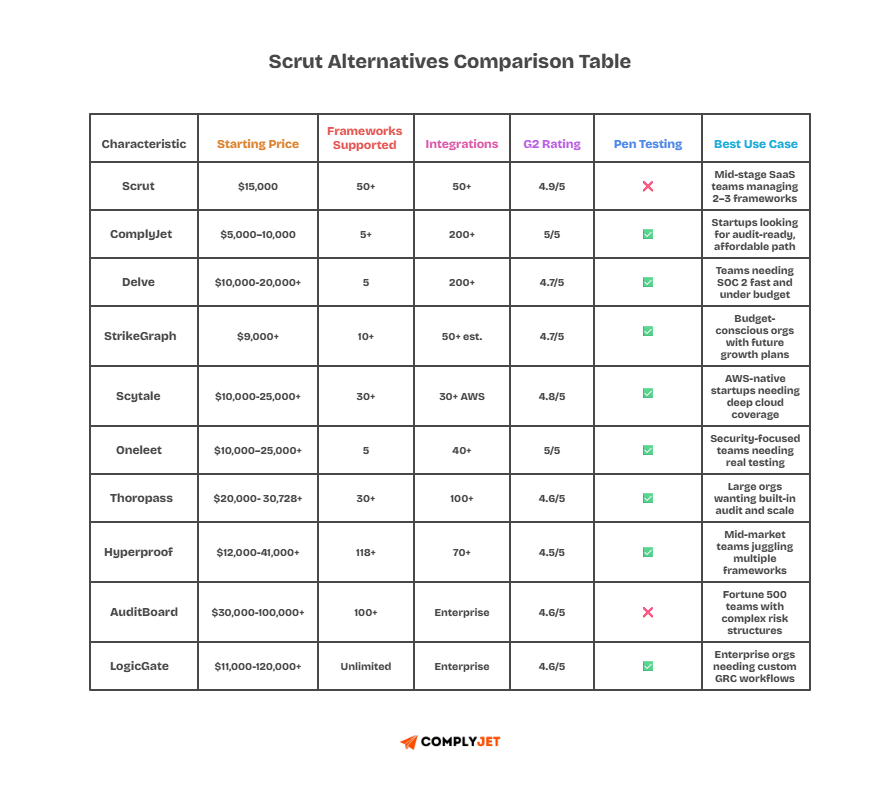
This breakdown helps answer common questions from SaaS founders.
Now that you've seen where Scrut Automation fits and where it doesn't, let's look at a simple checklist to help you decide which alternative is right for you.
Key Factors to Consider Before Choosing a Scrut Alternative
Choosing a compliance platform feels like choosing a co-founder. It's common to get excited by features, but what really matters is how it fits your pace and budget. The right Scrut alternative should perfectly match your use case.
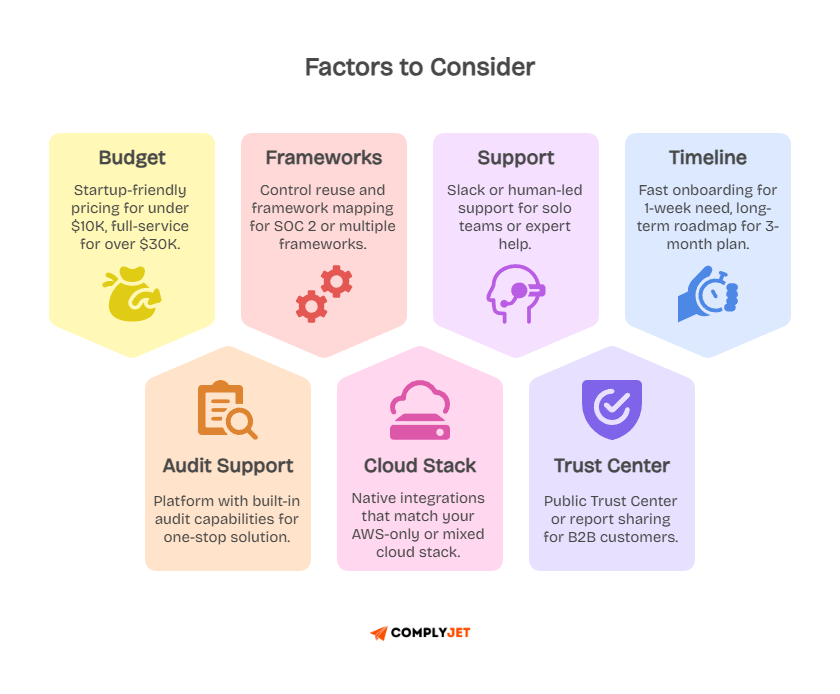
This checklist categorises essential aspects: budget, audit model, frameworks, cloud stack, support, and speed of implementation. It is designed for founders like you who aim to make quick decisions and avoid wasting time.
Budget
Start by defining your ceiling.
- If you're working with less than $10K/year, ComplyJet, Delve, and StrikeGraph are your best bets.
- If your budget is $30K or more, platforms like Thoropass or Hyperproof become viable.
Scrut sits in the mid-tier at $15K. If you don't need all its features, you'll overpay.

Audit Needs
Audits take time. Managing auditors takes even more.
- Tools like Thoropass include the auditor from day one. Everything stays in-platform.
- Platforms like Scrut or Hyperproof require you to coordinate your own audit.
If you don't want to manage vendors, go with a built-in audit solution.
Framework Coverage
Your compliance goals shape your platform choice.
- If you only need SOC 2, Delve or ComplyJet offer speed and affordability.
- If you're handling SOC 2 + HIPAA + ISO, look at ComplyJet, StrikeGraph, or Hyperproof.
Scrut supports multiple frameworks, but check how well it shares controls across them.
Cloud Stack Compatibility
Choose a platform that fits your infrastructure.
- If you're 100% AWS, Scytale gives you real-time alerts with no setup needed.
- If your stack is mixed or Azure-heavy, ComplyJet and Hyperproof offer broader integrations.
Scrut supports 50+ tools, but lacks deep native hooks into AWS compared to Scytale.
Support Model
Compliance is heavy. Good support makes or breaks the experience.
- ComplyJet and Oneleet offer Slack-based human support.
- LogicGate and AuditBoard require in-house GRC leads for setup.
- Scrut offers expert assistance, but not full-service help.
Know if you want to be guided or left alone.
Trust Center and Sales Enablement
Deals get stuck on security reviews. A public Trust Center can unblock them.
- ComplyJet, Hyperproof, and Scytale offer automated Trust Center features.
- Delve includes a shareable Trust Report.
- Scrut provides a Trust Vault, but not all plans include it.
If you're in B2B SaaS, this is a must-have.
Timeline to Compliance
Your runway may shape your pick more than your roadmap.
- Need SOC 2 in 1 week? Choose ComplyJet.
- Need a 3-month rollout with risk scoring? Hyperproof fits better.
Don't buy a 12-month plan for a 2-week need.
These are the key filters to use when browsing top compliance automation tools similar to Scrut Automation. It's what lets you skip bad demos and focus on tools built for your kind of SaaS.
Next, we will address the most commonly searched questions about founders, such as whether Scrut Automation is user-friendly and how the switching process works. This will conclude our discussion.
Frequently Asked Questions about Scrut Alternatives
Is Scrut Automation easy to learn for non-security teams?
Most non-security teams can learn Scrut Automation with some guidance, but there's a learning curve. The interface feels clean, but setup and evidence mapping take time if you've never handled GRC tools before.
It helps to have someone technical on board. You'll need to configure controls, manage vendor lists, and integrate systems like AWS or GitHub. That's where teams often hit friction without in-house security experience.
Scrut does offer help from its InfoSec team, which softens the curve. But without a compliance context, some concepts can feel abstract. If you're a founder doing this for the first time, expect a few onboarding sessions.
What are some free trials available for Scrut Automation alternatives?
Several compliance platforms now offer free trials. That means full access, not limited demos. ComplyJet gives you a real sandbox where you can integrate your tools and test policies before paying.
Delve also offers onboarding calls and access to their AI workflows before you sign a contract. StrikeGraph includes a Launch tier for early testing, though some features are locked.
Scrut doesn't currently offer a public free trial. You need to book a demo, then go through their sales process. For early-stage teams, that slows down your decision-making.
Which companies offer compliance solutions like Scrut Automation for GDPR and SOC 2?
Many tools now support both GDPR and SOC 2. Scrut Automation includes both frameworks out of the box. But so do ComplyJet, Hyperproof, StrikeGraph, and Oneleet.
If your company needs GDPR as part of EU operations, check if the platform has data residency options. For SOC 2, look for automated evidence collection and pre-mapped controls.
Some platforms, like Scytale, lean heavily into cloud-native integrations. Others, like LogicGate, let you build your own workflows. Choose based on how much guidance or control your team needs.
What are the disadvantages of using Scrut Automation over competitors?
Scrut's biggest strength is its risk-first approach. But that also creates complexity. That's great if you know what you're doing. Not ideal if you're a founder learning on the go.
Another tradeoff: Scrut doesn't bundle the audit. You still need to coordinate with a separate CPA. Tools like Thoropass and ComplyJet simplify this by including audit partners from day one.
Scrut's pricing is also fixed. The $15,000 tier covers most things, but doesn't scale well if you're a 5-person team doing only SOC 2. That's where platforms like Delve or StrikeGraph have an edge.
Is Scrut Automation a GRC tool or just a compliance platform?
Scrut positions itself as a GRC tool. It handles governance, risk, and compliance, not just SOC 2 checklists. You get a dynamic risk register, vendor scoring, and real-time control monitoring.
But it's still lighter than heavy enterprise GRCs like LogicGate or AuditBoard. For startups or mid-size companies, that's a good thing. You avoid bloat. But if you need granular controls or enterprise reporting, Scrut might fall short.
It's more than compliance, but not a full-stack enterprise GRC yet. Think of it as a middle-tier GRC system built for growing SaaS companies.
Conclusion
There is no one-size-fits-all tool for compliance. What works for a 50-person fintech company may not suit a 5-person AI startup. It's essential to find a solution that aligns with your technology stack, timeline, and budget, without hindering your team's productivity.
Scrut Automation addresses a genuine need for audit readiness, but it's not the only option available to you.
You've seen how tools like ComplyJet, Thoropass, Delve, and others compare. Some provide better audit coordination, some are more budget-friendly, and others are better suited for AWS or multi-framework compliance.
If you're looking for straightforward workflows, rapid setup, and a support team that acts as your compliance partner rather than just providing software, ComplyJet may be the best choice for you.
Ready to explore ComplyJet? Book a free demo with the founders today!
We will guide you through the platform and help you compare your options, even if you're not ready to make a switch just yet.