.svg)

If you're comparing Scrut vs Delve, the choice is less complicated than most comparison pages make it seem. The real question is what you value more: deeper compliance infrastructure for the long term, or a faster, more hands-off path to your first certification.
Here's the short version. Scrut is a full-scale GRC platform with deep risk management, cloud posture monitoring, and 60+ out-of-the-box frameworks—making it a stronger fit for teams that expect their compliance needs to grow beyond a single certification. Delve takes a more automation-first approach, using AI agents to handle evidence collection end to end, alongside live Slack access to compliance experts. It's designed for lean teams that want to get audit-ready as quickly as possible.
Quick answer
Scrut = GRC breadth, multi-framework scale, deep risk and cloud-posture monitoring, for teams that expect to add frameworks over time. Delve = agentic-AI speed, minimal internal setup, live expert support, for lean teams racing to a first certification. Pick based on whether you're optimizing for depth or for speed.
Neither platform is the objectively better product. They're built on two different bets about how compliance work should get done, and most "which is better" content skips that framing entirely to get to a pitch. The delve or scrut question keeps coming up precisely because both platforms' landing pages make the tradeoff sound smaller than it actually is.
By the end of this article, you'll know exactly which one fits your team, not just a feature list for each. Here's what's ahead:
- What actually separates Scrut's and Delve's approach to compliance
- Why picking wrong here costs more than an awkward vendor switch
- A side-by-side look at both platforms, dimension by dimension
- Where each platform pulls ahead on framework coverage, setup, and monitoring depth
- What a real SOC 2 implementation timeline looks like on each
- A decision framework for teams stuck between the two
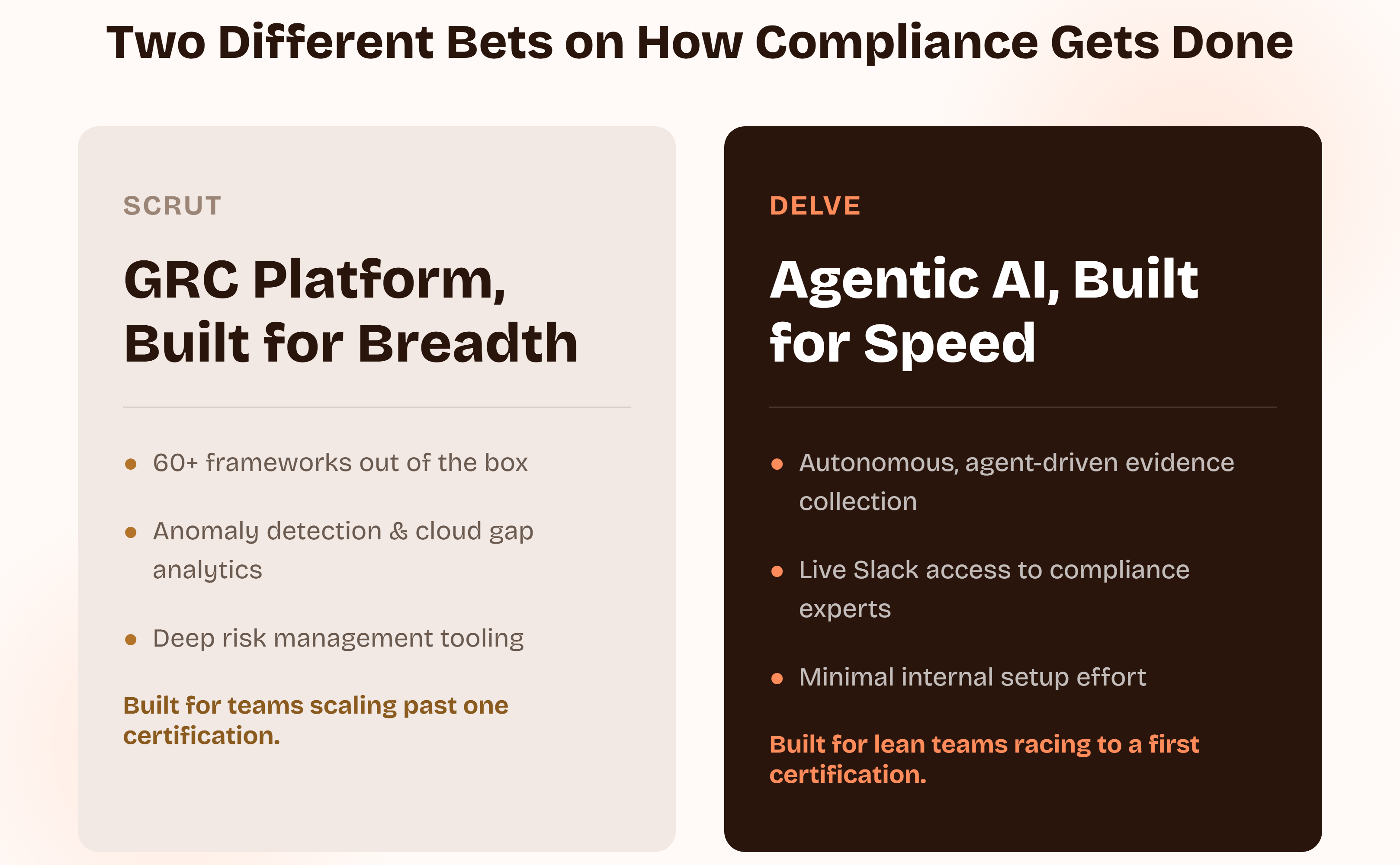
Scrut vs Delve: Two Different Bets on How Compliance Gets Done
A feature checklist is the wrong place to start a scrut vs delve comparison, because both platforms automate roughly the same core tasks: evidence collection, control monitoring, audit prep. What separates them is the model underneath: whether an AI agent runs the work autonomously, or a full GRC platform gives your team the tooling to run it.
Scrut grew as a risk-management-first platform, and that shows in what it's built around: anomaly detection, cloud gap analytics, and a framework library broad enough to support scaling across multiple certifications. Delve grew around a narrower bet: that AI agents could run compliance busywork, screenshots, cloud scans, PR checks, questionnaire auto-fill, end to end, with a live human on Slack for anything the agent can't handle.
Scrut: A Full GRC Platform Built for Breadth
Scrut packages risk management and compliance automation into one platform, positioning itself around teams that need more than a single certification handled. Reviewers consistently point to its cloud posture monitoring and anomaly detection as genuine differentiators, not just marketing language, alongside a framework list that covers SOC 2, ISO 27001, GDPR, HIPAA, and PCI DSS out of the box.
Pros
- Deep risk management tooling, including anomaly detection and cloud gap analytics, not just checklist automation.
- 60+ frameworks supported out of the box, useful for teams that expect to add certifications over time.
- Strong G2 review signal at scale: 4.9 out of 5 across 1,299 reviews.
Cons
- More platform to configure upfront, which can slow down a team that only needs one certification fast.
- Support model leans more toward structured platform tooling than the always-on concierge access Delve reviewers describe.
- The framework breadth that helps a scaling team is unused overhead for a team that will only ever need SOC 2.
Delve: Agentic AI Built for Speed
Delve's pitch is narrower and sharper: AI agents that behave autonomously instead of just automating individual steps, running tasks like cloud scans and PR checks without constant supervision. Reviewers consistently cite the smooth setup experience and direct Slack access to compliance experts with sub-5-minute response times as the platform's real strength.
Pros
- Agentic automation that runs evidence collection largely unsupervised, cutting internal setup time.
- Live Slack access to compliance experts, with reviewers reporting sub-5-minute response times.
- Smooth onboarding, especially for teams already somewhat familiar with SOC 2 or ISO 27001.
Cons
- Narrower framework scope than a full GRC platform, less built out for teams adding certifications later.
- Less depth on risk management and cloud posture monitoring than a platform built around that from day one.
- Smaller review base than Scrut (4.7 out of 5 across 136 reviews on G2), worth weighing alongside the rating itself.
That split, GRC depth versus agentic speed, is the throughline for every section below.
Most teams don't lose time picking between Scrut and Delve. They lose time picking one because it looked faster or looked deeper on a landing page, then discovering months later that the tradeoff they never actually weighed, framework scalability or risk-monitoring depth, was the one that mattered for their audit. — Editor's Note
Why the Scrut vs Delve Decision Actually Matters
Picking wrong here doesn't just mean an awkward vendor switch later. It means real cost, in one direction or the other.
Choose Scrut when a lean team only needed a fast first SOC 2, and you've paid for risk-management depth and framework breadth that sit unused for a year. Choose Delve when you already know ISO 27001 or HIPAA is coming within the next 12 months, and you'll likely rebuild framework mapping and control work that a broader GRC platform would have handled the first time.
Both mistakes cost the same thing in the end: budget and audit-timeline slippage, during the exact window you can least afford either.
Note
This isn't a "which platform is more mature" question. Both are established, well-reviewed vendors. The cost of picking wrong is a mismatch between what you actually need in the next 12 months and what you signed up for today, not a mismatch in product quality.
Scrut vs Delve at a Glance
Here's the side-by-side, dimension by dimension:
| Dimension | Scrut | Delve |
|---|---|---|
| Core model | Full GRC platform, risk-management-led | Agentic AI, autonomous task execution |
| Framework coverage | 60+ frameworks out of the box | Narrower, startup-first set |
| Risk and cloud posture | Anomaly detection, cloud gap analytics | Not a core focus |
| Setup and onboarding | More structured platform configuration | Largely agent-driven, minimal manual setup |
| Support model | Platform-based support tooling | Live Slack access, sub-5-minute reviewer-reported response |
| G2 signal | 4.9 / 5, 1,299 reviews | 4.7 / 5, 136 reviews |
| Best for | Teams scaling across multiple frameworks | Lean teams racing to a first certification |
Treat this as the starting map, not the whole decision. A platform that wins on paper in one row can still be the wrong fit once you weigh how fast your team actually plans to add frameworks. A real scrut delve comparison needs to go dimension by dimension from here, not stop at a single table.
Delve vs Scrut: Where the Two Platforms Actually Pull Apart
The delve vs scrut comparison gets more useful once you go dimension by dimension instead of stopping at "GRC platform" versus "AI agent." Here's where each one actually pulls ahead.
Framework Coverage and Multi-Framework Scaling
Scrut's broader out-of-the-box framework list is the concrete version of its "built for breadth" positioning: SOC 2, ISO 27001, GDPR, HIPAA, and PCI DSS are all supported natively, which matters the moment a team needs more than one. Delve's set is narrower and skews toward the certifications a first-time compliance team is most likely to need first.
Neither vendor publishes an exact figure for what re-scoping to a second framework costs in hours, so treat this directionally: a team that starts on SOC 2 with Scrut and later adds ISO 27001 is more likely to reuse existing control mappings than a team doing the same thing on a platform built around a single fast certification.
Setup Speed and Support Model
Delve's agentic model is built to compress the setup phase: agents collect screenshots, scan cloud infrastructure, and check pull requests without a person driving each step, and reviewers consistently cite sub-5-minute Slack response times from live compliance experts when something needs a human. Scrut's setup is more structured by design, trading some of that initial speed for deeper risk and cloud-posture configuration upfront.
That tradeoff cuts both ways. A team that wants to be audit-ready fast, with minimal internal lift, tends to favor Delve's model. A team that wants ongoing risk visibility built in from day one, not bolted on later, tends to favor Scrut's.
Risk and Cloud Posture Monitoring Depth
Scrut's anomaly detection and cloud gap analytics are a real differentiator reviewers call out repeatedly, not just a feature-list entry, and they matter most to a team that wants continuous risk visibility rather than a one-time audit push. Delve's scope stays narrower here, focused on task automation rather than ongoing risk monitoring.
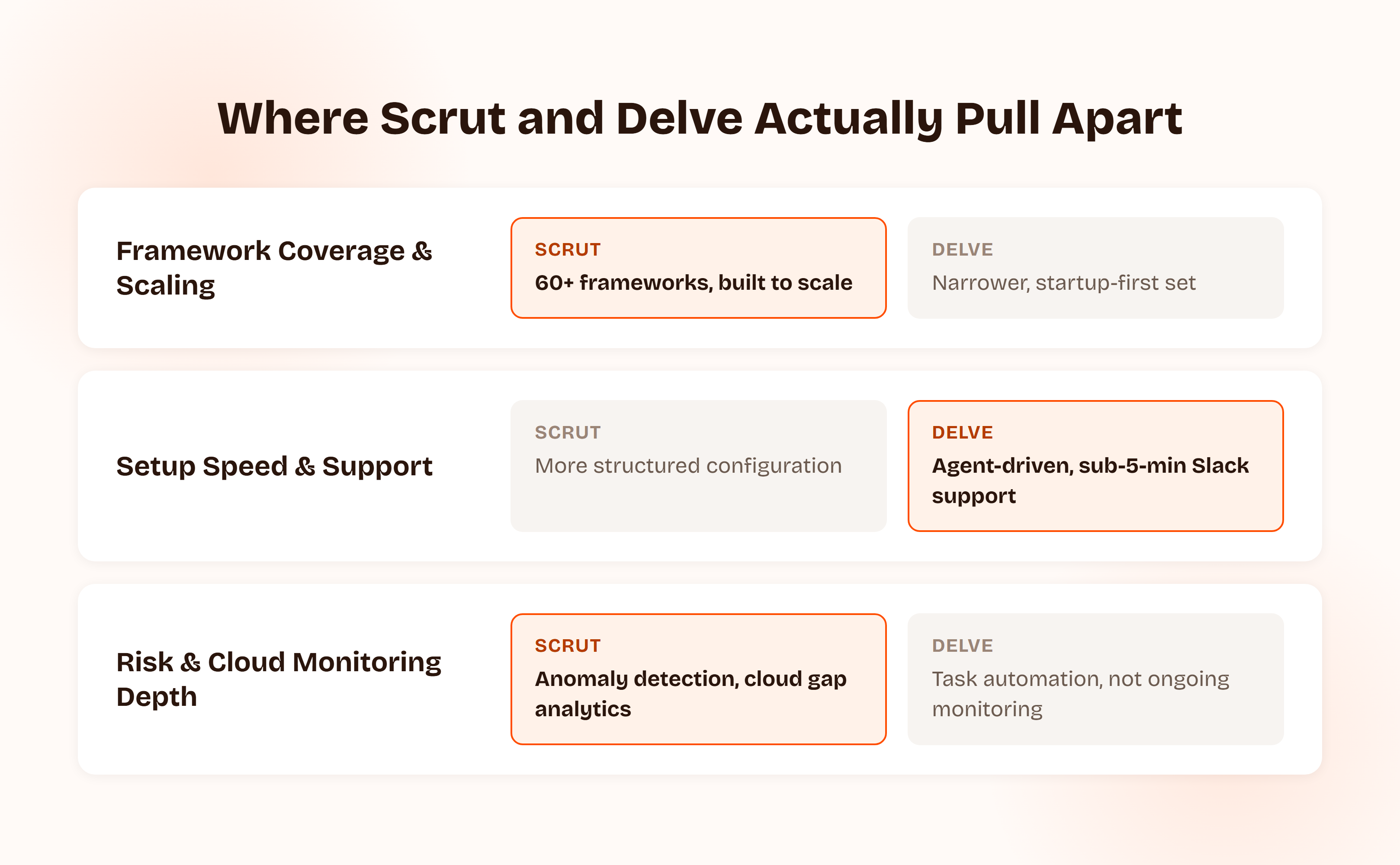
Put side by side like this, the pattern holds across all three dimensions: Scrut pulls ahead wherever depth and scale matter, Delve pulls ahead wherever speed and simplicity matter.
| Where each pulls ahead | Winner |
|---|---|
| Fastest path to a first certification | Delve |
| Live, fast expert support during setup | Delve |
| Framework breadth for future scaling | Scrut |
| Ongoing risk and cloud posture monitoring | Scrut |
| Larger, deeper review base | Scrut |
Scrut vs Delve SOC 2: The Real Implementation Timeline
Neither vendor publishes a guaranteed timeline, so what follows is directional, based on how each platform's model changes the shape of a typical SOC 2 Type 1 or Type 2 buildout, not a guaranteed number.
| Phase | Scrut | Delve |
|---|---|---|
| Kickoff and scoping | More upfront configuration across the frameworks you select | Faster, since scope typically starts narrower |
| Evidence collection | Platform-guided, connected through integrations | Largely agent-driven, compressing this phase |
| Control implementation | Deeper risk-mapping work if adding more than one framework | Lighter, scoped to the certification at hand |
| Audit-readiness review | Structured platform checks | Live Slack-based expert review |
| Auditor engagement | Coordinated through the platform | Coordinated through the platform |
For a team running the scrut vs delve soc 2 decision specifically, the timeline difference above is the concrete version of the depth-versus-speed tradeoff already introduced. Delve's agent-driven evidence collection tends to compress the early phases; Scrut's broader framework setup tends to add time upfront, but only if you're scoping more than one certification at once.
Scrut vs Delve Pricing: What Each Platform Actually Costs
Neither Scrut nor Delve publishes list pricing, and no source reviewed for this article, including Sprinto's and Smartly's own published comparisons and G2's aggregate data, has independently verified a dollar figure for either. Anyone searching for a scrut vs delve pricing number today won't find a verified one anywhere, including here.
What's directionally true instead: both platforms quote based on company size and framework count, and both bundle services a line-item price alone won't reflect, Delve's concierge-style Slack support on one side, Scrut's broader risk and cloud-monitoring tooling on the other.
Here's how the cost of all three platforms actually compares, side by side:
| Pricing dimension | Scrut | Delve | ComplyJet |
|---|---|---|---|
| Pricing basis | Custom quote, sized to team and framework count | Custom quote, sized to team and framework count | One flat fee per company |
| Changes as you hire | Typically yes, quotes scale with headcount | Typically yes, quotes scale with headcount | No, the fee stays the same as the team grows |
| Published price list | None | None | None |
Note
A flat, per-company fee doesn't creep up every time you hire. A per-seat or headcount-scaled quote can look competitive at signup and then quietly get more expensive every quarter your team grows, right as you're also trying to budget for the audit itself. Predictability over the life of the program is worth weighing alongside the number you're quoted on day one.
What Delve's Recent Scrutiny Means for This Decision
Delve has faced public scrutiny recently over how some of its automated SOC 2 reports were generated, following whistleblower allegations and TechCrunch's reporting on the story. We've already covered the full, independently sourced breakdown of what was alleged and how Delve responded in our Delve alternatives guide, so we won't re-litigate it here.
The point worth making in this specific comparison: due diligence on a vendor's recent history is a legitimate part of the scrut vs delve decision, not a scare tactic, and it belongs in the same conversation as framework fit and support model.
Scrut vs Delve: Which One Should You Actually Pick
Strip away the feature lists, and the decision comes down to one honest question: are you optimizing for depth, or for speed?
- A team expecting to add frameworks within the next year, or that wants deep risk and cloud-posture visibility, fits Scrut. The setup takes longer upfront, but you won't be rebuilding framework-mapping work later.
- A lean team doing its first certification with minimal internal bandwidth, that values fast Slack-based expert access over platform depth, fits Delve. You'll be audit-ready sooner, with less internal lift.
- A team weighing both mainly on upfront cost should read the pricing section above again before deciding. "Faster" and "cheaper" aren't the same claim, and neither vendor's pricing is public enough to settle it on cost alone.
ComplyJet
Flat per-company pricing, not per seat
If you want hands-on audit support and predictable pricing without picking between Scrut's depth and Delve's speed, ComplyJet's flat per-company fee stays the same as your team grows.
Neither answer is universal. A 15-person startup racing toward a first enterprise deal and a 60-person team already planning its ISO 27001 push can land on opposite sides of this same question, and both would be right for their own team.
Common Mistakes When Choosing Between Scrut and Delve
Readers running a quick scrut delve comparison tend to make the same handful of mistakes before they've even opened either platform's site.
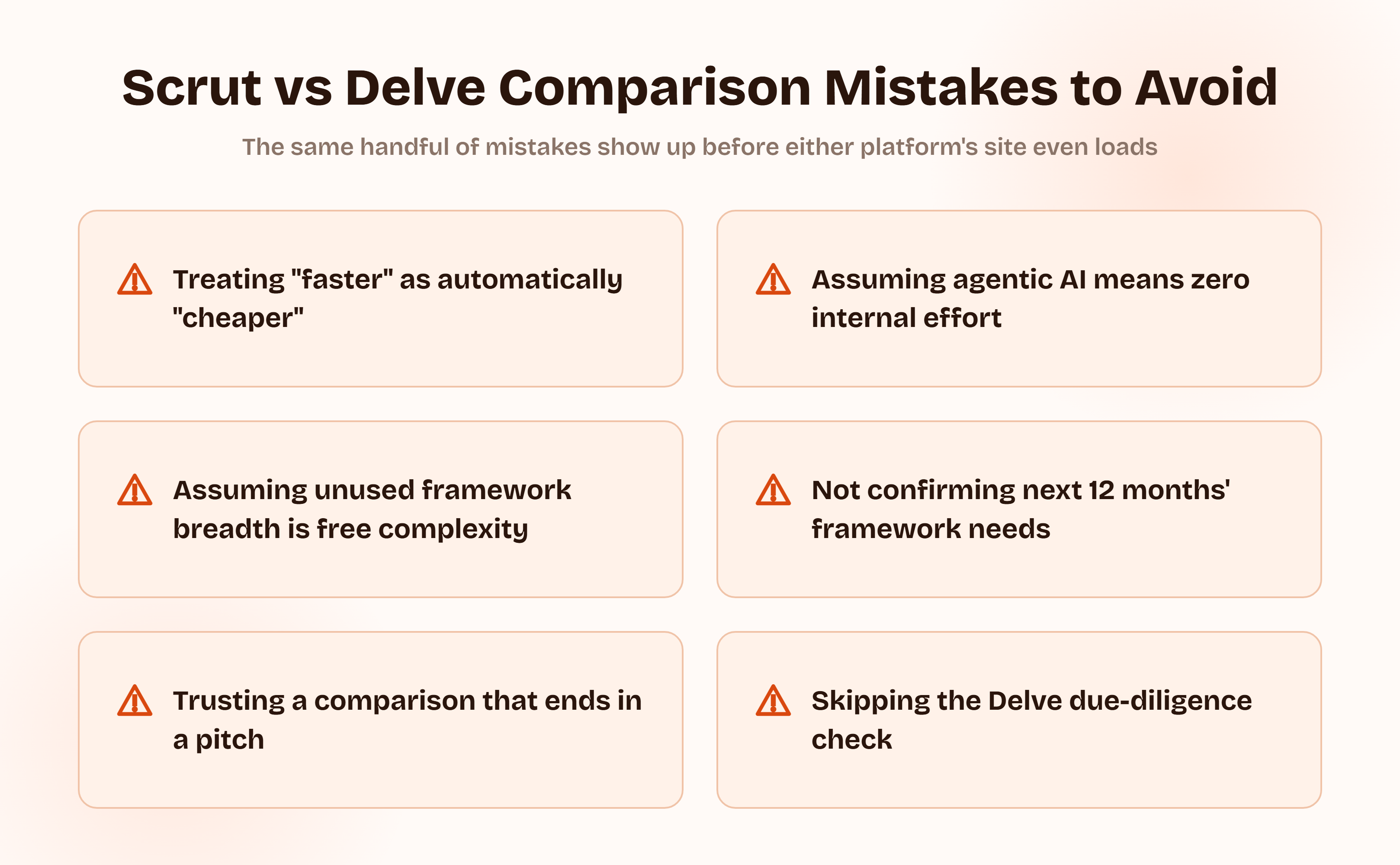
- Treating "faster" as automatically "cheaper." Speed and price are different claims, and neither vendor's pricing confirms either one publicly.
- Assuming Delve's agentic model means zero internal effort. Someone on your team still owns the relationship, reviews what the agents surface, and signs off before an auditor sees anything.
- Assuming Scrut's framework breadth is free complexity you won't have to manage. Unused framework support doesn't cost money, but configuring it still costs time.
- Not confirming which frameworks you'll actually need in the next 12 months before committing. This single question decides more of the scrut vs delve outcome than any feature comparison.
- Treating a competing vendor's own "Scrut vs Delve" article as neutral. If the comparison ends with a pitch for a third platform, its specific claims about either company are marketing, not fact.
- Skipping the recent Delve scrutiny as a due-diligence step entirely. Read the sourced breakdown before assuming it's irrelevant to your decision.
Most of these mistakes share the same root cause: comparing Scrut and Delve as if they were interchangeable line items instead of two different bets on how compliance work gets done.
How ComplyJet Fits Into the Scrut vs Delve Decision
If you don't want to choose between Scrut's depth and Delve's speed, ComplyJet offers a third path: hands-on compliance support without the complexity or unpredictable pricing.
We offer flat, per-company pricing rather than per-seat costs, and our team works with you through the compliance process end to end—not just through a software dashboard or support queue.
If your priority is getting compliance done with a team that actually guides you through it, ComplyJet is built for that.
ComplyJet
A team that guides you through the process
Not "delve or scrut," but a genuine third path for teams where neither platform's tradeoff is the actual fit.
FAQs
Which Is Better, Scrut or Delve?
There's no universal winner. Scrut is better if you want GRC depth, risk and cloud-posture monitoring, and multi-framework scalability. Delve is better if you want the fastest path to a first certification with minimal internal lift and live Slack-based expert support. The right one depends on what your team actually needs in the next 12 months, not which platform looks more impressive on paper.
Is Delve Faster Than Scrut?
Generally yes, for a first certification. Delve's agentic model is built to compress setup and evidence collection specifically. But "faster" doesn't capture what a team gives up in framework breadth and ongoing risk-monitoring depth, both of which matter more the moment you need a second certification.
Is Scrut vs Delve Relevant for Startups Specifically?
Yes, and it's arguably the most common version of this decision. A pre-compliance-team startup racing toward a first enterprise deal tends to lean Delve; a startup that already knows it needs SOC 2 now and ISO 27001 or HIPAA soon tends to lean Scrut.
Do Scrut and Delve Support the Same Compliance Frameworks?
Both support SOC 2. Scrut's list extends further out of the box, including ISO 27001, GDPR, HIPAA, and PCI DSS, while Delve's coverage is narrower and skews toward the certifications a first-time team is most likely to need. Confirm your specific framework against each vendor's current list before deciding.
Has Delve's Recent Scrutiny Affected Its Product?
We cover this in full, with sources, in our Delve alternatives guide. The short version: Delve faced whistleblower allegations and public reporting on its automated report generation, and issued an official response. Worth reading before you sign, not a reason to rule Delve out on its own.
Related Reading
- Top SOC 2 Alternatives to Delve: the full sourced breakdown of the recent Delve scrutiny and a wider 12-platform alternatives list.
- Oneleet vs Secureframe: another head-to-head comparison in the same genre, for readers still widening their shortlist.
- Oneleet vs Vanta vs Drata: a 3-way comparison for readers considering more than two platforms.
- Top SOC 2 Compliance Platforms for AI Companies: for readers who are specifically an AI/ML company, where Scrut is separately ranked.