.svg)

You've probably heard about Scrut Automation if you're dealing with SOC 2, ISO 27001, or anything in between.
What you haven't heard clearly is whether Scrut's pricing in 2026 actually makes sense for your business.
If you've already looked into Scrut competitors, you know costs can escalate quickly. One framework can lead to three, and one audit may turn into four. When you factor in internal efforts, external audits, penetration tests, and more, the total expenses can become unclear.
At ComplyJet, we frequently hear from SaaS teams who wonder whether they're spending too much or underestimating their needs. This breakdown seeks to clarify those uncertainties.
We're not here to repeat sales slides.
You'll get a hard look at real costs and actual time savings, and you'll see where hidden budget traps show up before and after you sign.
We'll compare their numbers with competitors, show you real user savings over 3 years, and share the exact phrases teams use to negotiate better deals.
Whether you're compliance-first or still on spreadsheets, this guide will help you make the call.
Let's break it down.
What Drives Compliance Costs in 2026?
You feel compliance getting more expensive each year. That is not your imagination.
In 2026, security reviews have increased scrutiny, audits last a lot longer, and buyers look for proof across multiple frameworks.
Most founders start by trying to manage compliance manually. It might feel cheaper at first. Then the hidden costs slowly emerge over time, through people and audit pressure.
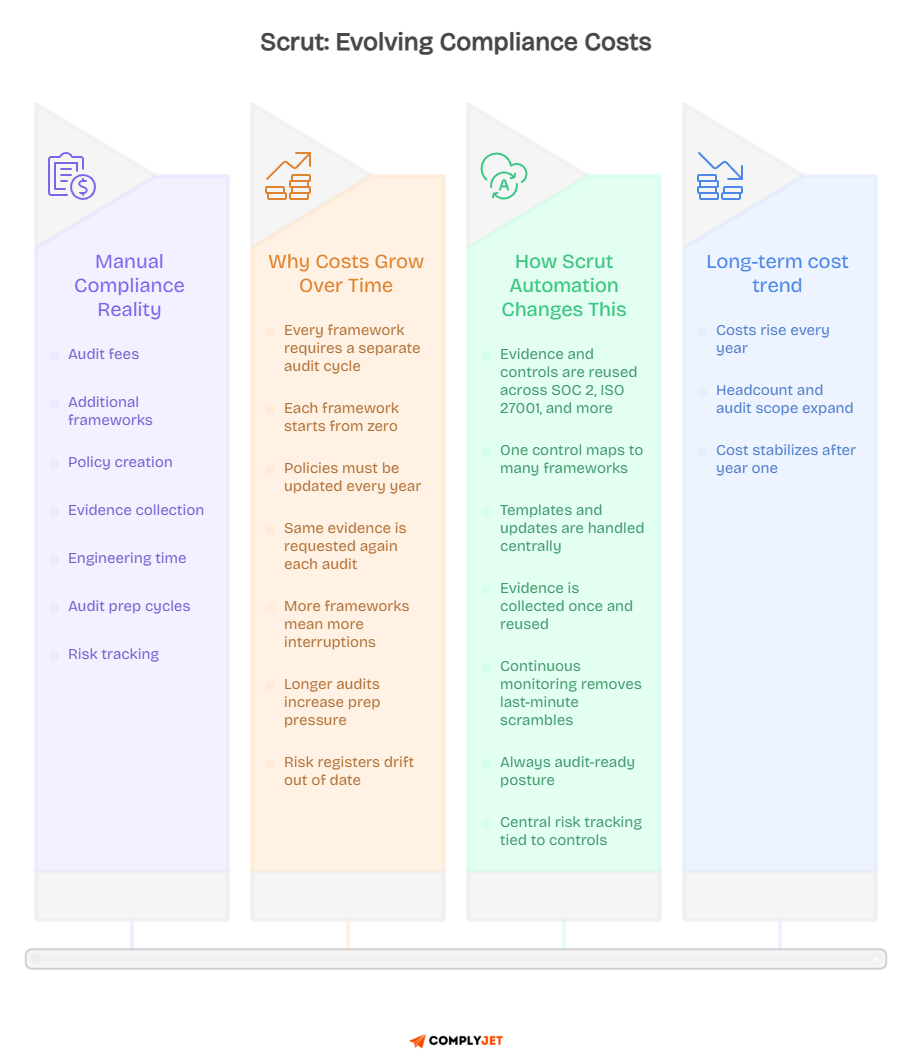
Manual compliance costs add up fast
Manual compliance looks simple on paper. In reality, you pay in many tiny, invisible ways. Audits cost real cash, and policies usually take weeks to write. Evidence collection pulls engineers away from product work.
SOC 2 audit costs usually range from $15,000 to $40,000. ISO 27001 adds another $15,000 or more. Labour time can exceed 300 hours per year, according to audit firm benchmarks from the AICPA and ISO regulatory bodies.
Managing frameworks separately eats time
Each framework speaks a different language with a different focus. SOC 2 focuses on controls, while ISO 27001 focuses on risk. But HIPAA focuses on access and training. Managing them separately multiplies work.
Teams repeat the same tasks three times only to realise later. Evidence gets uploaded again, and the security review begins from scratch.
This is where Scrut automation is valuable, as it reuses controls and evidence across various compliance frameworks.
For a deeper breakdown, read: Scrut Review 2026
Why is compliance automation the default?
By 2026, most growth-stage SaaS teams will use compliance automation. Gartner reports that over 65% of companies with 50+ employees have adopted. The reason is simple. Time saved turns into lower risk and faster sales cycles.
Scrut pricing is built around this shift. Automation reduces repeat work, tracks controls daily, and lowers audit prep hours year over year.
This is why Scrut's unified approach claims to slash compliance costs. But does it hold up when you look at real pricing and long-term ROI? That is where the next section starts.
What Drives Scrut Automation Pricing in 2026?
Scrut Automation doesn't publish a fixed price list. That's because their pricing depends on three main factors: the number of compliance frameworks you need, the number of users in scope, and the number of systems you want to integrate.
The more complex your setup is, the higher your quote will be. But unlike tools that charge for every add-on, Scrut groups most features into one plan.
This model helps reduce confusion, especially if you're dealing with more than one framework. But it can also make it harder to compare Scrut's pricing unless you know what's included and what isn't.
What Influences Scrut's Pricing Plans
The first lever is frameworks. Scrut includes over 50 frameworks in every plan by default. So whether you're tackling SOC 2, ISO 27001, or GDPR together, the price stays bundled.
Competitors usually charge more per framework, which adds up to a much longer bill as your needs grow.
The second lever is user count. Scrut doesn't charge by user. Whether you're a 5-person startup or a 500-person team, the price is flat. That's different from platforms that limit seats or scale pricing as your team expands.
The third lever is integration scope. Scrut connects with over 80 tools across cloud, code, HR, and IT systems. If you are managing multiple cloud accounts or developer tools, the complexity of integration increases. However, Scrut does not charge for each connector. Instead, having more integrations typically elevates you to a higher pricing tier.
Scrut's Price Range by Company Stage
According to AWS Marketplace, Scrut pricing ranges from around $15,000/year to more than $50,000/year, depending on the frameworks and the number of employees.
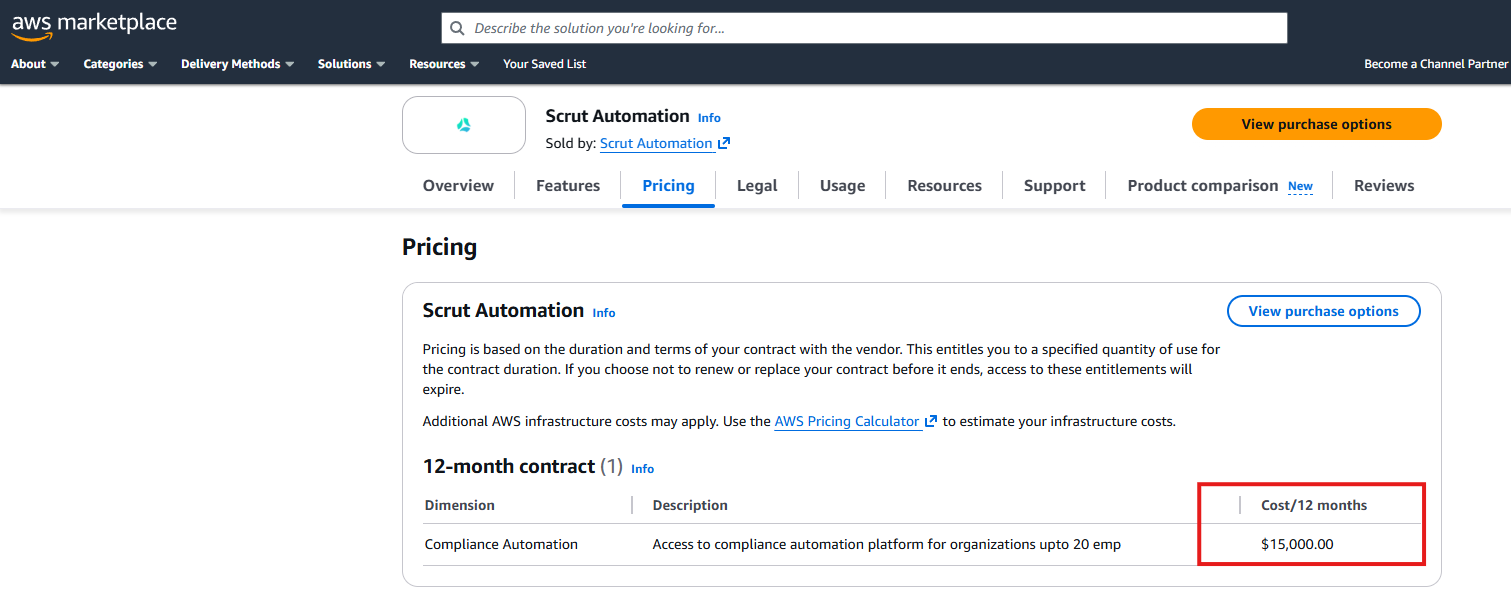
For smaller teams focused on one or two frameworks, Scrut pricing usually starts around $15,000 to $20,000 per year. These are early-stage setups with simple cloud footprints and under 50 employees.
Mid-size SaaS companies pursuing SOC 2, ISO 27001, or HIPAA certification usually fall in the $18,000 to $30,000 range. These teams often want real-time monitoring and vendor risk management built in.
Large orgs with 5 or more certifications, multiple cloud regions, and dedicated security staff may see quotes of up to $40,000.
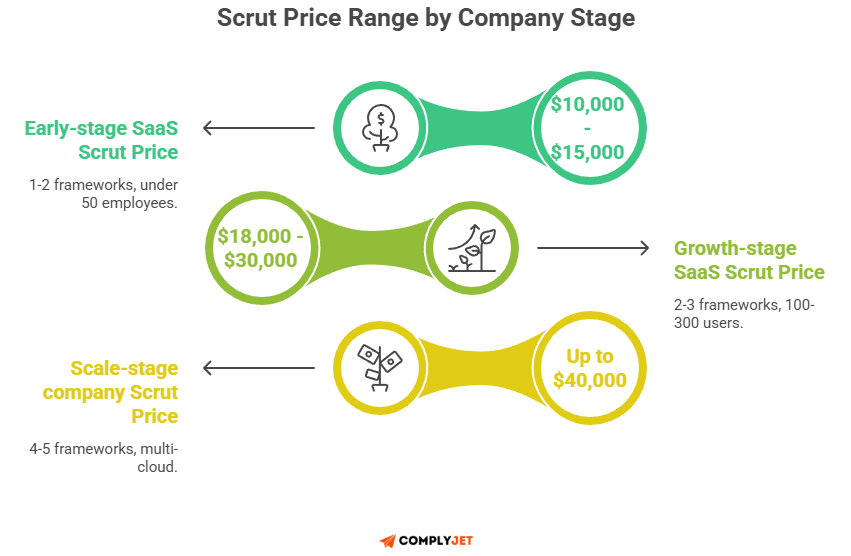
At this stage, most organizations are automating continuous compliance, tracking risks across teams, and managing vendor assessments in various regions.
Why Scrut Looks Cheaper, Until It Doesn't
Scrut automation pricing looks flat compared to competitors. Most of them often quote $12K-$20K per framework. Add ISO or HIPAA, and the framework premium increases by another $4K to $10K. That's how you can end up at $40K or more without hesitation.
Scrut avoids this by taking an "everything-included" stance. But it still adjusts pricing quietly behind the scenes. More frameworks don't cost extra, but complexity still affects the number. You won't see a line item saying why.
For example, a Drata customer with SOC 2 + ISO 27001 might get a $28K quote. The same use case with Scrut would be around $22K. That gap widens if you throw in more integrations or want better support.
For more comparison, refer: Price comparison between Scrut competitors and alternatives
Scrut's value is clean when you're managing more than one framework. You avoid the "framework tax" that applies to Vanta and Drata quotes. That said, it's still not built for low-budget single-cert use cases.
Scrut works well when you're scaling across SOC 2, ISO 27001, and GDPR. If you're a startup chasing just SOC 2 Type 1, platforms like ComplyJet or Sprinto are usually leaner and faster to deploy.
Next up, let's break down what Scrut's pricing actually includes and where the real costs start sneaking in.
Hidden Costs & Add-Ons You Shouldn't Ignore
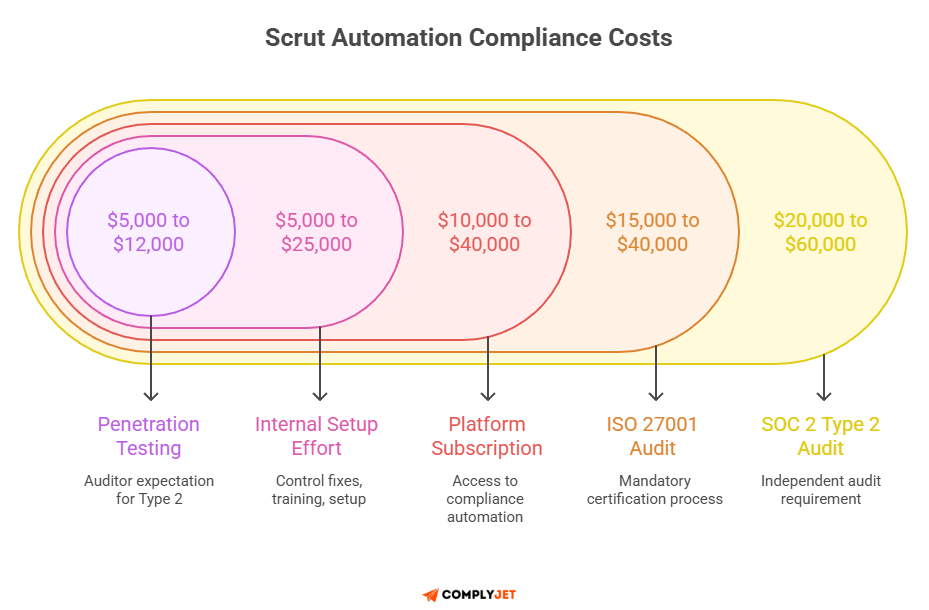
Scrut's platform price might look straightforward. But the total spend rarely stops there. You'll still need audits, pentests, internal work, and ongoing effort.
These extra add-ons are necessary and only show up after you sign teh contract. And they cost more than teams usually expect.
Users feel the price could be better aligned with the features offered, as highlighted here.
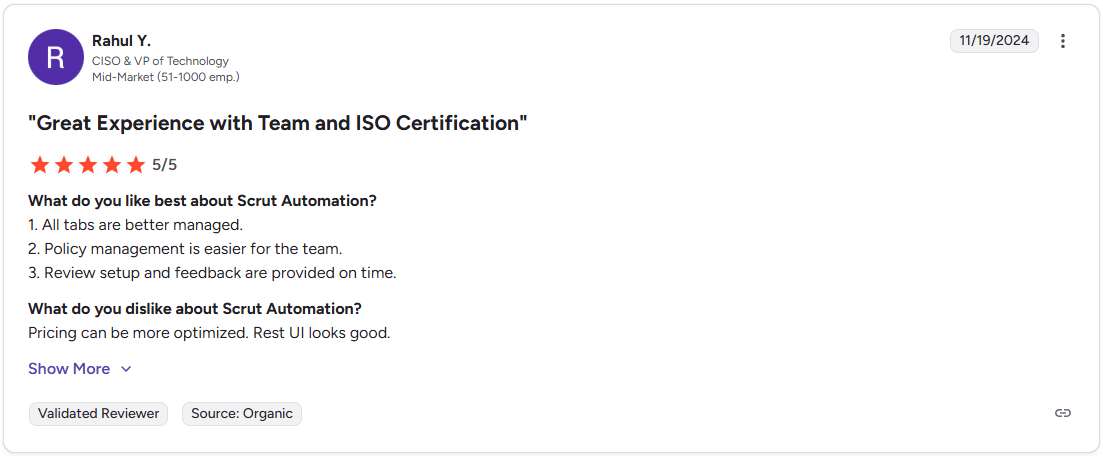
This section breaks down those hidden costs. You'll see why even a $15K subscription can turn into a $60K first year. Especially when pursuing SOC 2 or ISO 27001 under a tight deadline.
1. Audits
Scrut doesn't perform audits. You'll still have to pay third-party firms for SOC 2 Type 2 or HIPAA assessments. These fees are separate but required. A SOC 2 Type 2 audit can range from $20K to $60K. ISO 27001 certification usually adds another $15K to $40K, depending on the scope.
If you're doing both frameworks together, the total audit bill can land around $50K. That is excluding any penalties you might impose for delays or missed controls. Scrut helps reduce preparation effort, but the auditor still sends the invoice.
2. Penetration testing
Most auditors now expect a recent pentest. For SOC 2 Type 2, this is often mandatory. Scrut doesn't bundle this in. You'll either run it yourself or pay their partner to do it. Costs range from $5K to $12K.
If you're an early-stage startup, skip this for Type 1. But once you reach Type 2 or ISO audits, it's expected. Delaying this step shifts the cost into a stressful deadline later in your cycle.
3. Internal effort
Scrut automation reduces grunt work, but your team still shows up. Setup takes hours. Fixing controls takes more. Training everyone takes a significant amount of time.
Many mid-stage teams dedicate 100-200 hours over the course of a year. With an internal cost of $50 per hour, this amounts to a minimum of $5,000 to $10,000.
In larger organizations or multi-framework projects, the costs can exceed $25,000. While the platform assists, it's ultimately your staff that handles the majority of the workload.
4. Complexity scaling with company size
Smaller teams move faster but often start from zero. Bigger orgs bring in more systems, tools, and approvals. Scrut works for both, but your effort changes.
Early startups might finish setup in 2 weeks. A 500-person org can take 2 months or more.
The same pricing tier can feel very different across companies. Comparing implementation complexity is essential, particularly for measuring ROI across different team sizes.
5. Renewal pricing and vendor lock-in risk
One big difference between Scrut and other vendors is renewal stability. Customers of other compliance automation platforms often report price increases of 40-50% after year one. Drata shows similar patterns.
Scrut has stayed more stable, but it still comes down to your contract.
If you don't cap future increases during the first negotiation, you could pay 2x by year three. That shift is what traps many teams. They plan for the first-year price, but not the future costs.
Even with a $15K/year subscription, the actual year-one cost can exceed $60K. Scrut's automation reduces waste, but if you're not prepared for these add-ons, they will stack soon.
Scrut vs Drata vs Vanta vs Sprinto
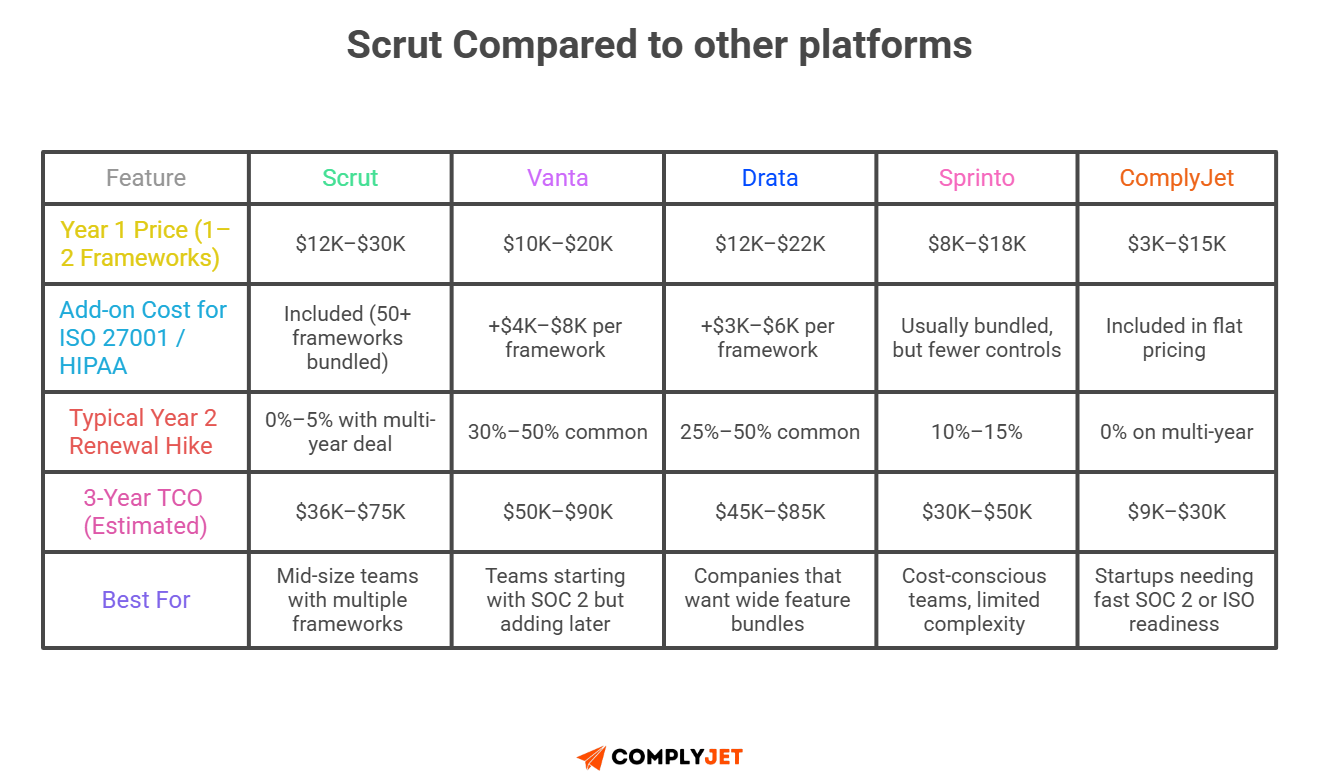
Scrut's pricing may look higher at first glance, but it's essential to consider the long-term value. The proper comparison unfolds over three years, especially when you factor in additional frameworks or renewal fees. This section will compare Scrut with top competitors like Vanta, Drata, and Sprinto on total cost and pricing trends.
Additionally, we'll highlight how ComplyJet fits in if you're seeking a more streamlined, AI-driven solution without the complexity of pricing or renewal issues.
Entry-level pricing
Most vendors start around $10K to $15 per year for a single framework. Scrut fits here. Sprinto can go lower. Vanta and Drata start similarly, but usually rise fast as soon as you expand.
This is where per-framework charges come in. Vanta and Drata often add $3K to $8K for ISO 27001, HIPAA, or PCI. Scrut pricing includes 50+ frameworks upfront. No separate charges. That adds up fast if you're planning multiple certifications.
Framework traps and upgrade cliffs
Scrut doesn't charge extra for frameworks. The other platforms do. If you're starting with SOC 2 but plan to add ISO 27001, your cost could double. Sprinto offers better bundling, but fewer controls and integrations.
This is where Scrut pricing vs Vanta can look misleading. You'll see similar year-one pricing. But Vanta's ISO add-on might cost an extra $7K. Scrut includes it. The real issue isn't the initial fee; it's the sudden increase in costs that occurs after onboarding.
Features vs bloat: what do you really use?
Most platforms now offer evidence collection, trust pages, risk registers, and dashboards. But many teams only use 60 to 70 percent of what's included. Drata tend to bundle flashy extras, like policy hubs or access reviews, that go unused.
Scrut stays tighter on features, focusing on automation depth instead of width. ComplyJet leans even further in that direction. It keeps things lean with AI workflows and focuses on speed-to-audit.
Renewal behaviour: the silent budget killer
Here's where fundamental cost differences show up. Vanta often raises prices 50 percent or more after year one. Drata does the same. Sprinto is steadier but limited in scale. Scrut pricing has been more stable, especially on multi-year contracts.
If you don't negotiate renewal caps, vendors like Vanta will eat your margin in year two. Scrut customers report more predictable pricing. That makes it easier to plan a 3-year budget.
Don't just compare first-year pricing; calculate your 3-year TCO. This is where inflated renewals and add-on pitfalls can become significant budget leaks.
Read to explore other Scrut alternatives: Top 9 Scrut Competitors & Alternatives Compared [2025]
3-Year ROI Analysis of Scrut Automation Pricing
When you look at the Scrut pricing ROI, year one can feel heavy. Setup takes time. Audits feel close. Costs stack early. The real return shows up later, once systems settle and effort drops.
Compliance automation savings grow with time. That's the core idea. Scrut is built for reuse. Evidence collected once carries forward. Controls stay live. By year two, most teams feel the shift clearly.
How does effort drop over time?
In year one, teams spend the most energy. Controls get mapped. Gaps get fixed. Policies get rolled out. Case studies show audit prep hours dropping by nearly 60 percent after the first cycle, according to Scrut's published data.
By year two, work becomes a review rather than a rebuild. Many of their customers reported faster audits and fewer internal reviews once monitoring stayed active as highlighted by this Scrut user.
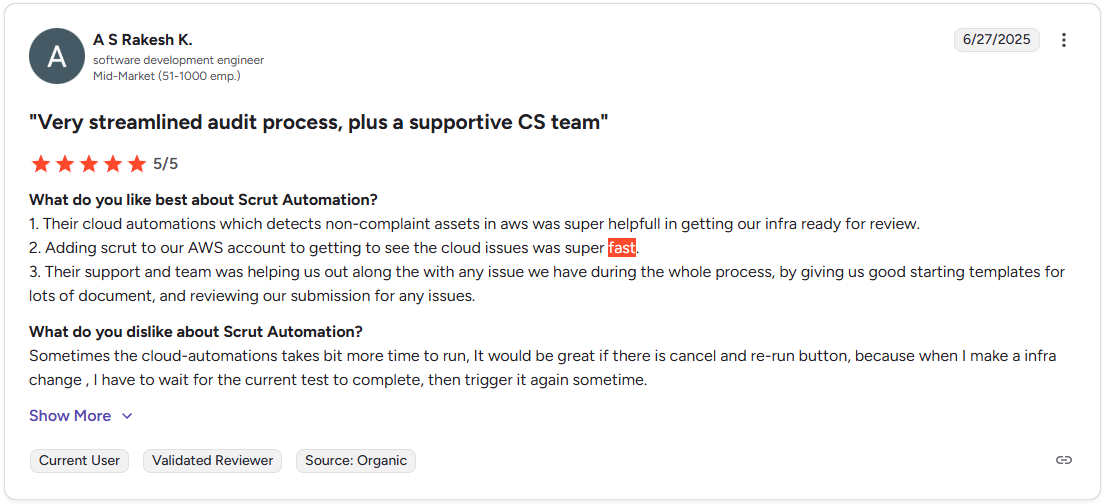
That steady state is where the Scrut customer cost benefit becomes visible.
Startup profile: SOC 2 only
A startup chasing SOC 2 Type 2 feels pain early. Year one includes setup, policy work, and audit prep. That can mean 120 to 150 internal hours. With Scrut, later years often drop below 40 hours.
That shift matters. Fewer hours mean less founder time lost. Over three years, many startups recover the full platform cost through saved effort alone.
Mid-size team: SOC 2 plus ISO 27001
Mid-size teams achieve the highest ROI. Managing two frameworks manually creates repetitive work. Scrut reduces that overlap. The case studies show shared controls that cut preparation time across both audits.
Year one still carries weight. Years two and three flatten. Teams often save 200 to 300 hours across three years. That translates directly into savings from compliance automation.
Enterprise profile: Four to five frameworks
Enterprises gain from scale. More frameworks mean more reuse. Scrut's value compounds here. Internal reports show audit cycles shortening once controls are mapped and evidence remains live.
Across three years, enterprises often avoid penalties tied to missed controls or late audits. That avoided risk is part of ROI, even if it never hits an invoice.
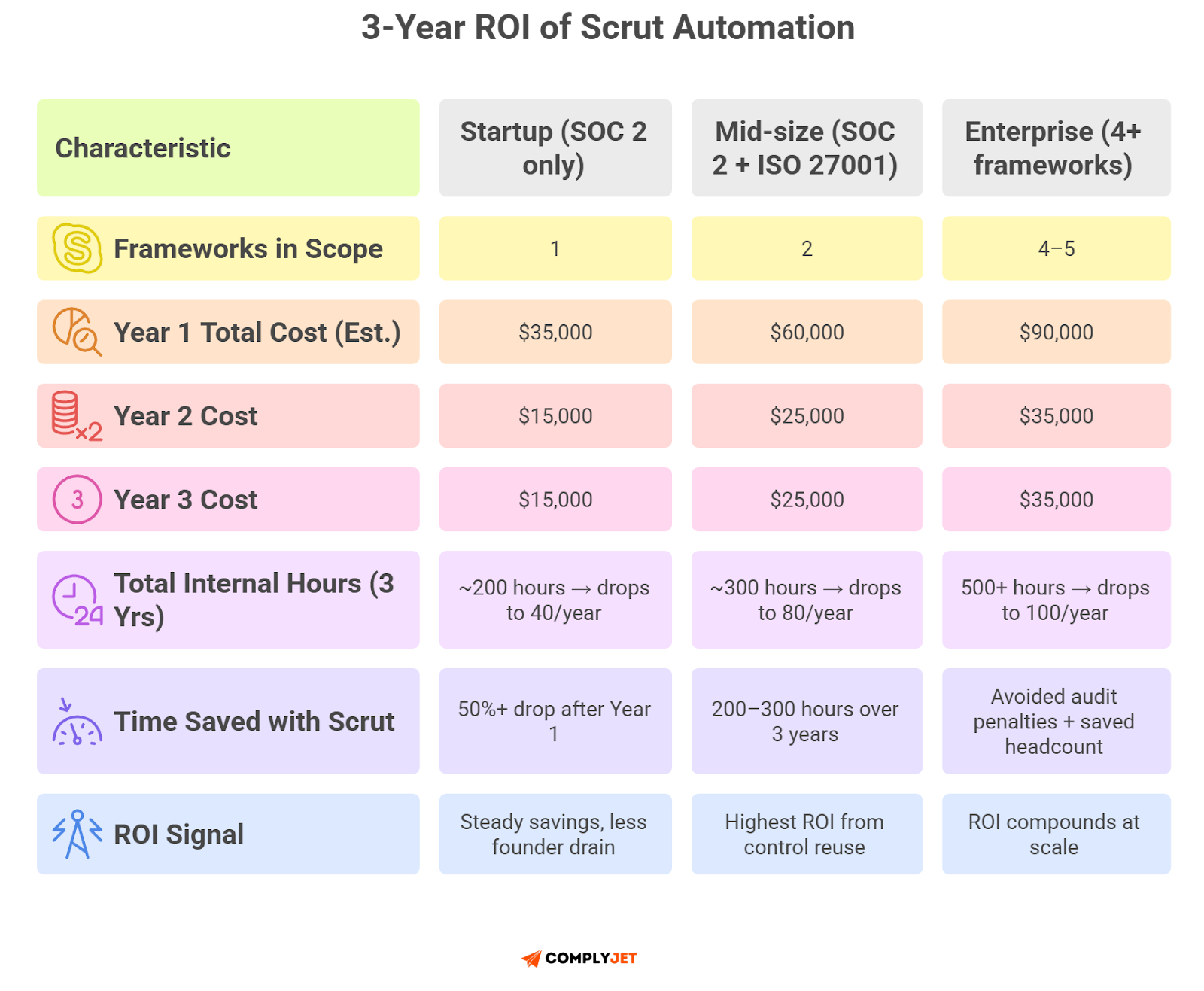
By year three, most teams see clear returns in time and cost. Many also realize that ComplyJet offers a similar ROI with far less setup friction. Book a demo now!
The following section compares where that difference shows up in real budgets.
Negotiating Scrut Pricing: What You Can Actually Get
Scrut talks a lot about pricing transparency. But like most vendors, the first number they send is rarely the final deal. If you're genuinely committed to making a purchase, mastering Scrut price negotiation can help you save thousands, provided you understand the practical strategies that really make a difference.
This section walks through what's flexible, what isn't, and where to push. You'll also get example phrases that founders use during honest conversations with Scrut's sales team.
What's on the table
Most discounts come from multi-year terms. If you're willing to commit for two or three years, you can get 10 to 25 percent off. Some teams also get implementation fees waived or support upgrades included.
Scrut often offers help with setting up integrations or assigning a customer success manager if your contract is over $20K. These aren't advertised, but they're negotiable during the sales process.
Where they don't budge
There are a few things Scrut won't move on. They don't charge per framework, so they won't discount for "just SOC 2." That's their model. They also won't guarantee audit outcomes or success rates. No serious platform will.
Their audit partners bill separately, so you can't wrap audit costs into the platform fee. You'll need to negotiate that directly with the auditor.
Watch for contract red flags
Auto-renewals are common. Scrut uses a 30-day cancellation window. If you miss it, you're locked for another year. Push for a 60-day notice instead. Also, look for vague renewal language. Ask for a 3 percent cap on annual increases.
Audit coordination clauses can be fuzzy. Make sure it's clear who manages auditor access, document sharing, and scope. Teams have run into issues when this isn't spelled out.
Phrases that work in real deals
Startups usually say something like: "We're early-stage. Can you match Sprinto's $9K quote if we commit to two years?"
Series A and B companies go with: "We're comparing Scrut vs Vanta. If you can hit $20K flat and cap renewals, we're ready to sign this month."
Enterprise teams lean on leverage: "We're managing 5 frameworks. Can you include a dedicated CSM, full implementation, and hold price flat for 3 years?"
Quote Box: "Most teams save 15–25% on Scrut if they come with a Vanta quote in hand."
Timing makes a difference.
End-of-quarter deals usually come with more room. Scrut reps often push for quota before deadlines. That's your window. If you're not ready to buy now, line up your budget cycle to match their quarter close.
Knowing what Scrut flexes on helps you hold the line. In the next section, you'll see how those savings stack up in actual three-year scenarios.
Who Should (and Shouldn't) Pay for Scrut in 2026
Scrut isn't the right fit for everyone. It's powerful, but that power comes with complexity and cost. If you're a lean team chasing your first SOC 2, there are cheaper paths to take. But if you're scaling across frameworks, it can be worth every dollar.
This breaks down who actually benefits from Scrut pricing in 2026, and who's better off looking elsewhere. It's not just about features. It's about timing, team size, and the number of moving parts you're managing.
When Scrut is a smart move
If you are managing three or more frameworks, such as SOC 2, ISO 27001, and HIPAA, Scrut simplifies the process. Their platform eliminates duplicated efforts, and the unified pricing ensures you won't incur extra charges for new requirements.
You'll also need someone on your team who owns security. Scrut works best when there's a lead who understands risk, can manage policies, and run point with auditors. That person helps unlock value faster.
When Scrut is probably too much
Early-stage teams with a single framework and no full-time security owner often find Scrut heavy. You end up paying for features you won't use yet. If your budget is under $8K, you'll feel the squeeze.
For these teams, lightweight tools might be a better match. Or you could wait six months, get SOC 2 Type 1 manually, and then upgrade when you need more structure.
What to do instead
ComplyJet is designed for lean, cloud-native teams seeking quick compliance without unnecessary complexities.
You benefit from automation and audit preparation, all without excessive pricing layers or enterprise overhead.
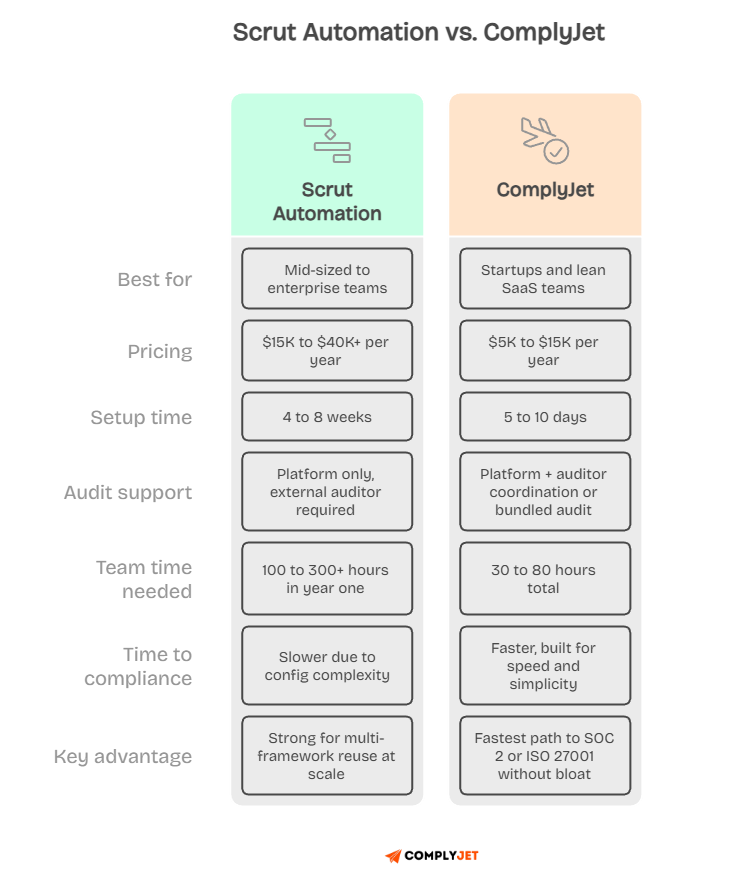
Scrut is solid, but only if you're ready for the tool's size.
In the final section, we'll conclude by discussing what this investment actually entails and how it performs throughout a complete compliance cycle.
Frequently Asked Questions About Scrut Pricing
How much is Scrut Automation pricing for SOC 2 in 2026 if you include onboarding fees?
Scrut Automation pricing for SOC 2 often falls in the platform subscription range of $10,000 to $30,000 per year, and you may also see a one-time onboarding or setup fee of $1,000 to $5,000, depending on scope and rollout support.
Treat onboarding as part of the real Scrut price, because it hits before you see savings.
What do Scrut Automation pricing plans cover beyond evidence collection and dashboards?
Scrut positions its platform as more than evidence automation. It supports configurable workflows, control and framework management, and broader GRC-style components that teams use for ongoing compliance operations, not just audit prep.
If you plan to use deeper workflow configuration, it can affect which tier you land in, even if it is not shown as a separate add-on line item.
Can Scrut pricing increase at renewal in 2026, and what contract terms should I ask for?
Yes. Scrut's terms indicate fees can be revised at the end of an initial or renewal term based on the order form, and they also reference exchange-rate-related adjustments.
Ask for a written renewal uplift cap, clearer renewal notice timelines, and clarity on how currency adjustments apply to your contract.
What is the real first-year cost of Scrut Automation when you include SOC 2 audit fees and penetration testing?
The Scrut Automation subscription is only one line item. The real first-year cost usually includes SOC 2 Type 2 audit fees, penetration testing, and internal time for remediation and policy rollout.
That's how a "platform quote" can turn into a much larger total spend once audits and security testing are added.
How does Scrut pricing compare when you need SOC 2 + ISO 27001 together in 2026?
If you need SOC 2 + ISO 27001, Scrut pricing can look better over time because frameworks are bundled rather than charged as separate add-ons.
The ROI shows up when you reuse controls and evidence across frameworks and avoid paying a “framework tax” that some tools apply when you add ISO after SOC 2.
Is Scrut cheaper if I purchase through AWS Marketplace?
Scrut is available on AWS Marketplace. AWS Marketplace listings commonly note that software charges are subject to the contract terms and that separate AWS infrastructure charges may apply based on usage and deployment.
So AWS Marketplace can simplify procurement, but it does not automatically reduce the total cost.
How should I compare Scrut pricing vs Vanta vs Drata for SOC 2 + ISO 27001 in 2026?
To compare Scrut pricing vs Vanta vs Drata, force every vendor into the same 3-year model: platform fee, onboarding cost, and renewal assumptions.
Scrut's own published SOC 2 cost content frames the software subscription around $10,000 to $30,000 annually, plus potential onboarding fees, which gives you a baseline for your spreadsheet.
Then standardize the triggers for price increases, such as adding frameworks, entities, integrations, and support tiers.
What should I ask Scrut sales to negotiate in 2026 to avoid renewal price increases?
To protect your budget, negotiate renewal caps, clearer renewal notice terms, and any implementation or support upgrades you'll need later. The most important question to push is how your Scrut pricing plans change as you add more integrations, entities, or frameworks, even if the plan looks "all-inclusive" on paper.
Read: Negotiating Scrut Pricing: What You Can Actually Get
Does Scrut Automation include vendor risk management, or is it an add-on that impacts Scrut pricing plans?
This is one of the most common surprises. Scrut Automation may include vendor workflows, but the depth of vendor risk management and how it scales can impact your tier and your effective Scrut pricing plans.
If vendor assessments and security questionnaires are a big part of your program, ask how that affects your quote before signing.
Conclusion
Scrut Automation is a strong platform, but it's not a one-size-fits-all solution.
The Scrut Automation pricing review indicates that while the platform fee is predictable, the total cost of compliance, including audits, effort, and testing, can range from $60K to $100K in the first year for growing teams.
If you're managing 3 or more frameworks, have a security lead, and want long-term ROI through automation, Scrut is worth it in 2026.
It saves time, reduces audit prep, and supports deep coverage of the framework. But if you're a smaller team working on just SOC 2 with a limited budget, it may feel like overkill.
Before signing, confirm that what you're paying for aligns with your company's current needs, not just future projections. If you want faster setup and lower upfront costs, ComplyJet may be a better starting point.
Want to explore a lower-cost option with faster setup? Start your free trial now!