.svg)

DORA enforcement has been live since January 17, 2025. If you’re reading this, you’re past the “should we do this?” phase and firmly into “which tool do we actually use?” Every compliance platform seems to claim DORA support now, but most were built for SOC 2 or ISO 27001 first and bolted DORA on afterward. The Register of Information, tiered NCA incident reporting, and TPRM workflows that DORA actually requires? Handled manually, or not at all.
I reviewed 10 DORA compliance software tools, looking specifically at what matters for DORA: native Register of Information support, incident reporting workflows, TPRM depth, and whether “DORA compliance” is a real product feature or a checkbox on a frameworks page. This list is for EU banks, fintechs, investment firms, insurance companies, and ICT third-party providers in scope for the Digital Operational Resilience Act.
DORA’s Five Pillars: ICT Risk, Incident Reporting, and Why Your Existing GRC Tool Probably Misses Three
The tools you used for SOC 2 or ISO 27001 are control-attestation platforms. They check whether policies exist, collect evidence that controls are in place, and help you pass an audit. That works for certification frameworks. DORA is different.
Key insight
Most GRC tools handle ICT risk management well. The Register of Information, NCA incident reporting, and deep TPRM are where the gaps appear.
DORA has five pillars: ICT risk management, ICT-related incident reporting to national competent authorities (NCAs), digital operational resilience testing, third-party ICT risk management, and information and intelligence sharing. Most compliance tools handle the first pillar reasonably well. The others are where the gaps show.
The Register of Information is the clearest example. It’s a structured regulatory submission to your NCA documenting every ICT third-party provider, the services they provide, and how critical those services are to your operations. This isn’t a policy document or an internal control record. It’s a regulatory filing with a specific format, specific fields, and specific submission deadlines. Most GRC tools can’t generate it, let alone validate it before submission.
Incident reporting under DORA is similarly specific: three report types (initial notification, intermediate report, final report), each with its own timeline and NCA submission channel. A generic incident management workflow doesn’t cover this. Dedicated incident reporting software for DORA compliance has these workflows built in as first-class features, not as a side configuration.
If you’re evaluating DORA compliance software, the first question to ask is: does this tool handle the Register of Information and NCA incident reporting natively, or am I still building those manually on the side?
How We Reviewed and Picked These 10 DORA Compliance Software Tools
Not every tool that says “DORA” on its website actually handles DORA. Here’s how I cut through that:
Why it matters
The first question to ask any vendor: can your tool generate a submission-ready Register of Information, or is that still a spreadsheet I build myself?
- DORA-specific coverage: Does the tool map controls to all five DORA pillars, or just ICT risk management?
- Register of Information: Can it generate a submission-ready RoI, or is that a spreadsheet you build yourself?
- Incident reporting workflows: Does it support tiered NCA reporting timelines (initial notification, intermediate report, final report)?
- TPRM depth: Can it handle vendor assessment, CTPP (critical third-party providers) classification, and fourth-party dependency mapping?
- Rating and review volume: Actual user signal from DORA compliance software reviews on G2 and Capterra, not vendor marketing.
- Pricing transparency: Whether pricing is published or contact-only matters for teams working with real budget constraints.
Quick Comparison: Top DORA Compliance Software at a Glance
| Tool | Best for | Pricing | Standout DORA feature |
|---|---|---|---|
| Vanta | Multi-framework compliance + DORA extension | Contact for pricing | 400+ integrations; evidence reuse from ISO 27001 and NIS 2 |
| Drata | Continuous DORA control monitoring | Contact for pricing | AI-powered ICT risk analysis; centralized CTPP governance |
| ComplyJet | Startups pursuing first-time DORA compliance | From $5,000/yr (flat) | Guided outcome delivery; flat per-company pricing |
| Secureframe | Fast-growing companies, multi-framework | Contact for pricing | 110 DORA-aligned automated controls; EU support team |
| Sprinto | SaaS teams, multi-framework | From ~$7,000/yr | 102 SCF controls mapped to DORA; autonomous monitoring |
| Formalize | DORA-native; Register of Information | Contact for pricing | One-click RoI generation with built-in NCA validator |
| 3rdRisk (Diligent) | TPRM-first DORA compliance | Contact for pricing | 99-level supply chain mapping; 10-day implementation |
| OneTrust | Enterprise GRC + DORA | Contact for pricing | First-to-market automated Register of Information creation |
| ProcessUnity | Enterprise TPRM, fourth-party risk | Contact for pricing | 370,000+ vendor profiles; CIF classification workflows |
| SAI360 | All five DORA pillars in one platform | Contact for pricing | Unified IT risk, BCM, and TPRM |
ComplyJet handles the full DORA compliance stack: policies, controls, evidence collection, and your audit. Book a free demo to see it in action.
The 10 Best DORA Compliance Software in 2026
1. Vanta

Vanta is the compliance automation market leader, and it has a dedicated DORA product. If your team is already using Vanta for SOC 2 or ISO 27001, adding DORA here makes genuine sense: up to 50% of your ISO 27001 evidence maps directly to DORA controls, and the 400+ integrations you’ve already connected keep working. Our Vanta pricing guide has a detailed breakdown of what each tier includes.
Where Vanta shines is in continuous automation. Controls check hourly. Shadow IT is detected via IdP and SSO signals. Third-party vendor assessments run automatically. For a financial entity managing multiple EU frameworks at once, that evidence reuse alone can save weeks of work.
The limitation is architectural. Vanta was built for SOC 2 first, and DORA was added later. For the Register of Information, tiered NCA incident reporting, and deep TPRM, you’ll find gaps compared to purpose-built DORA tools. It handles the compliance automation layer well. The operational resilience specifics require more manual work.
“
What I appreciate most about Vanta is its ability to manage compliance across various frameworks. The platform offers a wide range of templates and policy generators, ensuring that you don't overlook any required sections. Vanta also integrates with numerous vendors, allowing for automated testing of both user management and potential vulnerabilities within your infrastructure.
Mario K.
Via G2 ↗Key features:
- Pre-mapped DORA controls with automated hourly checks
- Framework overlap: reuse up to 50% of ISO 27001 evidence for DORA
- ICT incident reporting and logging mapped to DORA requirements
- Vendor management and third-party risk assessment
- 400+ integrations with cloud, code, identity, and device tools
- AI-powered questionnaire automation and policy drafting
Pros of Vanta
- Largest integration library in this category (400+)
- Multi-framework evidence reuse is genuinely useful if you’re running ISO 27001 or NIS 2 alongside DORA
- AI-powered questionnaire automation reduces manual work significantly
- Strong auditor familiarity: most auditors have worked with Vanta before
Cons of Vanta
- Pricing is contact-only and scales with users and integrations
- DORA is a newer addition on a SOC 2-first architecture; Register of Information and NCA reporting are not first-class features
- Limited for complex fourth-party TPRM scenarios
Pricing: Contact for pricing. Four tiers: Essentials, Plus, Professional, Enterprise. No public pricing.
Best for: Mid-market EU financial entities already using Vanta for SOC 2 or ISO 27001 who want to extend into DORA without migrating their evidence stack.
2. Drata

Drata has a genuinely dedicated DORA product, not just a checkbox on a frameworks page. The continuous control monitoring layer is where it differentiates: when a DORA-relevant control fails, Drata’s AI-powered analysis tells you specifically why and which regulatory article it maps to. For a compliance team that doesn’t want to chase down root causes manually, that matters. Our Drata review covers the platform in more depth.
The cross-framework control mapping is Drata’s strongest argument for multi-regulation environments. One control can satisfy DORA, ISO 27001, and NIS 2 simultaneously. If your organization is managing all three, you’re not rebuilding your evidence stack for each framework.
The DORA-specific features are solid but worth validating before you commit: some reviewers have noted that the DORA Registry and certain AI features were still rolling out at the time of their review. Pricing is also opaque, and Drata skews toward enterprise complexity in both product and cost.
“
The best feature Drata has is the mapping of recurring requirements of different frameworks to generic Drata Controls, meaning if multiple of your frameworks require the same thing, you only have one control you need to comply with to satisfy all the requirements.
★★★★★Verified User· Small Business
Via G2 ↗Key features:
- Continuous control monitoring with AI-powered issue analysis linked to DORA regulatory articles
- ICT risk management with evidence tied directly to DORA requirements
- Centralized governance of critical ICT third-party service providers (CTPPs)
- Cross-mapped controls: one control satisfies DORA, ISO 27001, and NIS 2
- Trust Center for sharing compliance documentation with regulators
- Custom workflow orchestration across responsible teams
Pros of Drata
- Strong continuous monitoring: no manual evidence collection cycles
- AI analysis explains why controls fail, not just that they failed
- Cross-framework mapping is genuine: evidence collected once satisfies multiple obligations
- 4.7/5 across 1,153 reviews; consistently well-rated
Cons of Drata
- Pricing is not public; third-party estimates range from $7,500 to $100,000+ depending on tier
- Some DORA-specific features were noted as not fully live in user reviews
- Skews toward enterprise in complexity and cost; not a fast setup for small teams
Pricing: Contact for pricing. Foundation, Advanced, and Enterprise tiers. Third-party estimates: $7,500 to $100,000+ annually.
Best for: Mid-market and enterprise financial institutions managing DORA alongside SOC 2, ISO 27001, and NIS 2 in a single platform.
3. ComplyJet
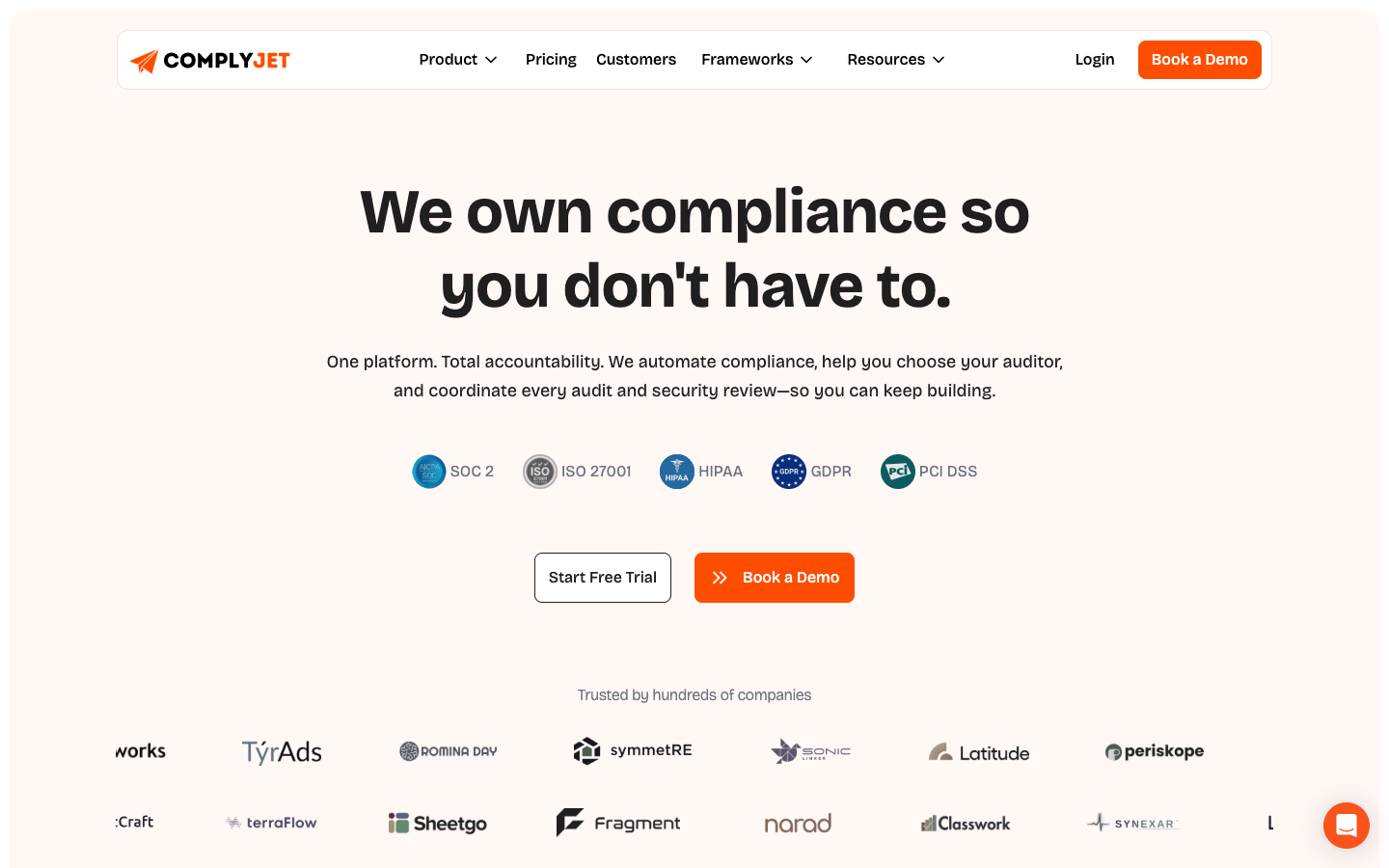
Most DORA compliance software is priced for enterprise procurement teams and built for security engineers who have time to configure it. ComplyJet takes the opposite approach: it’s built for startups and scale-ups that need to get DORA done cleanly and credibly, without a six-figure contract or months of setup overhead.
The model is outcome-driven. ComplyJet’s team guides you through the full process, from gap assessment and policy drafting to evidence collection and audit readiness. DORA is mapped alongside SOC 2, ISO 27001, GDPR, NIS 2, and 25+ other frameworks in a single control set, so evidence collected for one framework carries over. The 350+ integrations handle the automated evidence collection. You don’t configure the platform and then figure out compliance on your own.
The pricing is publicly listed and flat: $5,000 per year for a single framework, $8,000 for two (for example, DORA plus SOC 2). That price doesn’t change whether your team is 10 or 50 people, which matters when you’re paying per-seat elsewhere and hiring.
For large financial institutions with complex ICT supply chains, fourth-party TPRM requirements, or enterprise procurement cycles, this is not the right tool. For a fintech or startup coming to DORA for the first time and wanting a guided path rather than just software access, it is.
Key features:
- DORA mapped alongside SOC 2, ISO 27001, HIPAA, GDPR, PCI DSS, NIS 2, and 25+ other frameworks in a single control set
- AI-assisted policy drafting aligned to DORA requirements
- 350+ integrations for automated evidence collection
- Continuous monitoring and real-time compliance dashboard
- Trust Center for sharing compliance status with enterprise prospects and regulators
- Cross-framework control mapping: evidence collected once satisfies multiple frameworks
Pros of ComplyJet
- Flat per-company pricing (cost stays fixed whether you have 10 or 50 people)
- Team guides you through the process end to end: not just software access
- 350+ integrations, AI-assisted policy drafting, audit partner network included
- Multi-framework out of the box: DORA plus SOC 2 or ISO 27001 without separate contracts
Cons of ComplyJet
- Not built for large enterprises with complex TPRM or fourth-party risk requirements
- No dedicated TPRM module for deep supply chain mapping
- Newer to market than Vanta or Drata
“
The platform makes it simple: it splits the work into four buckets with clear, bite-sized tasks we could fit into our routine. No sales gauntlet or upselling. The clearest, most sensible option.
Artur G· CTO · Symmetre
Via complyjet.com ↗
Pricing: $5,000/year (single framework), $8,000/year (two frameworks, e.g. DORA + SOC 2). Flat per-company, not per-seat.
Best for: Startups and scale-ups pursuing DORA for the first time, particularly those needing DORA alongside SOC 2 or ISO 27001 without per-seat pricing that compounds as you hire.
4. Secureframe
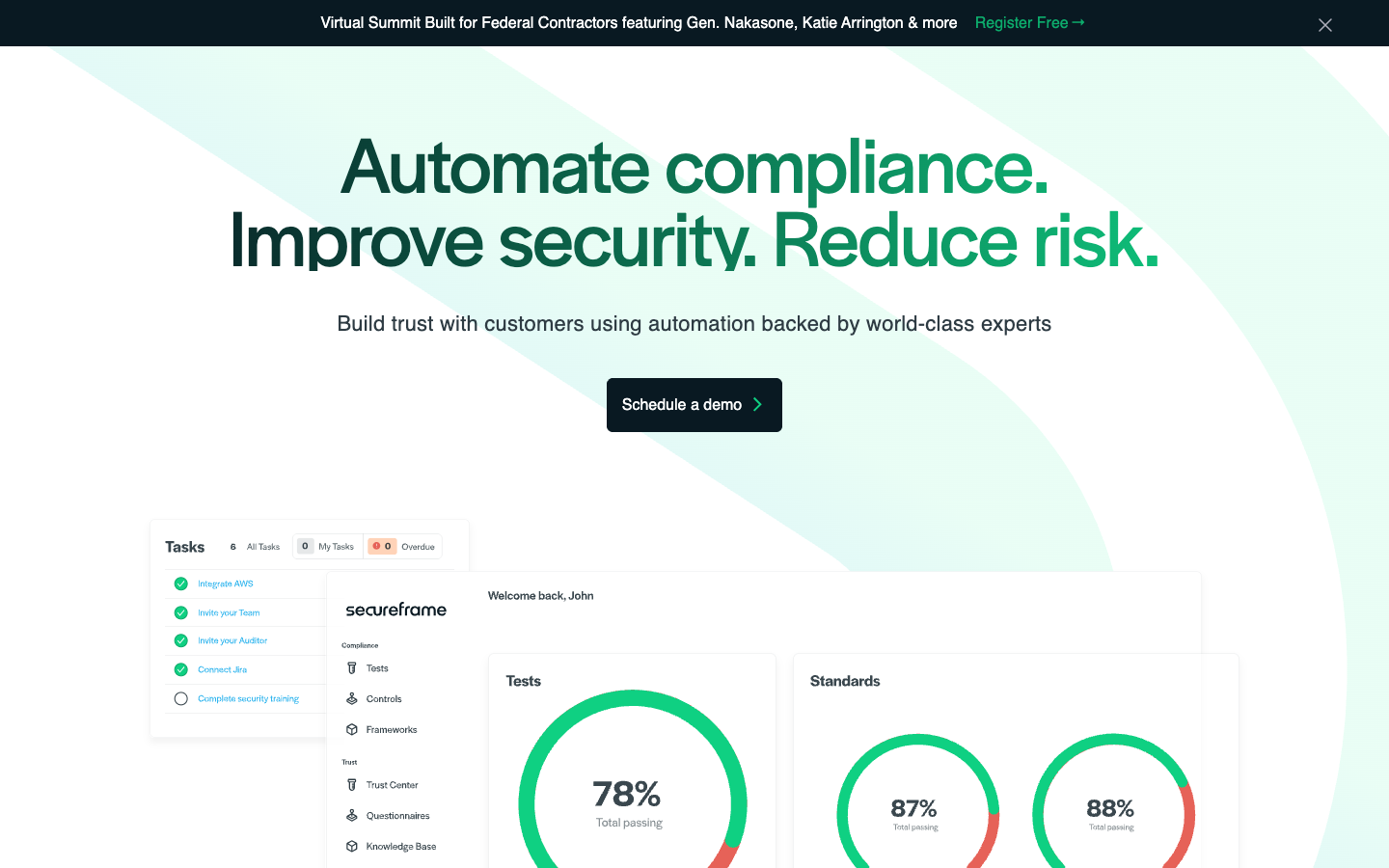
Secureframe built out formal EU DORA support with 110 automated controls specifically aligned to the regulation, expert-developed policy templates vetted by former compliance auditors, and a dedicated EU-based support team for European regulatory questions. For a growing company that wants a platform handling DORA as part of a broader compliance program, it’s a strong option.
The 4.7/5 rating across 789 reviews reflects a consistently good customer experience, particularly around support quality. Secureframe also offers an EU data center option, which matters for financial entities with data residency requirements.
The DORA support is solid, but it’s built on a SOC 2-first architecture rather than native DORA design. The Register of Information is not a first-class feature, and TPRM depth in the base tier is limited. If DORA is your primary obligation and the RoI is critical, validate this carefully before committing.
“
Throughout the entire process from initial discussions to evidence review with our auditing team, Secureframe's customer support was quick to provide assistance. The platform made organizing compliance evidence straightforward through integrations and control monitoring simplified maintaining compliance goals.
★★★★★Shaun K.· 2-10 employees
Via Capterra ↗Key features:
- 110 automated controls aligned to EU DORA requirements
- Expert-developed DORA policy templates vetted by former compliance auditors
- Continuous monitoring via integrations with your existing tech stack
- Third-party risk management (Complete tier and above)
- EU-based support team for European regulatory questions
- 48+ frameworks supported in one platform
Pros of Secureframe
- 4.7/5 across 789 reviews; strong reputation for support quality
- 110 DORA-specific controls is a concrete, verifiable number (not just “DORA supported”)
- EU data center available for data residency requirements
- Kleiner Perkins-backed: well-resourced vendor with enterprise stability
Cons of Secureframe
- SOC 2-first platform; DORA is a formal addition, not native architecture
- Register of Information not a first-class feature
- Limited TPRM depth in the base tier; advanced TPRM requires an upgrade
- Pricing not public
Pricing: Contact for pricing. Fundamentals, Complete, and Defense tiers. Third-party sources estimate starting around $7,500/year.
Best for: Fast-growing startups and mid-market companies that want strong multi-framework compliance coverage including DORA, with reliable customer support and an EU data center option.
5. Sprinto
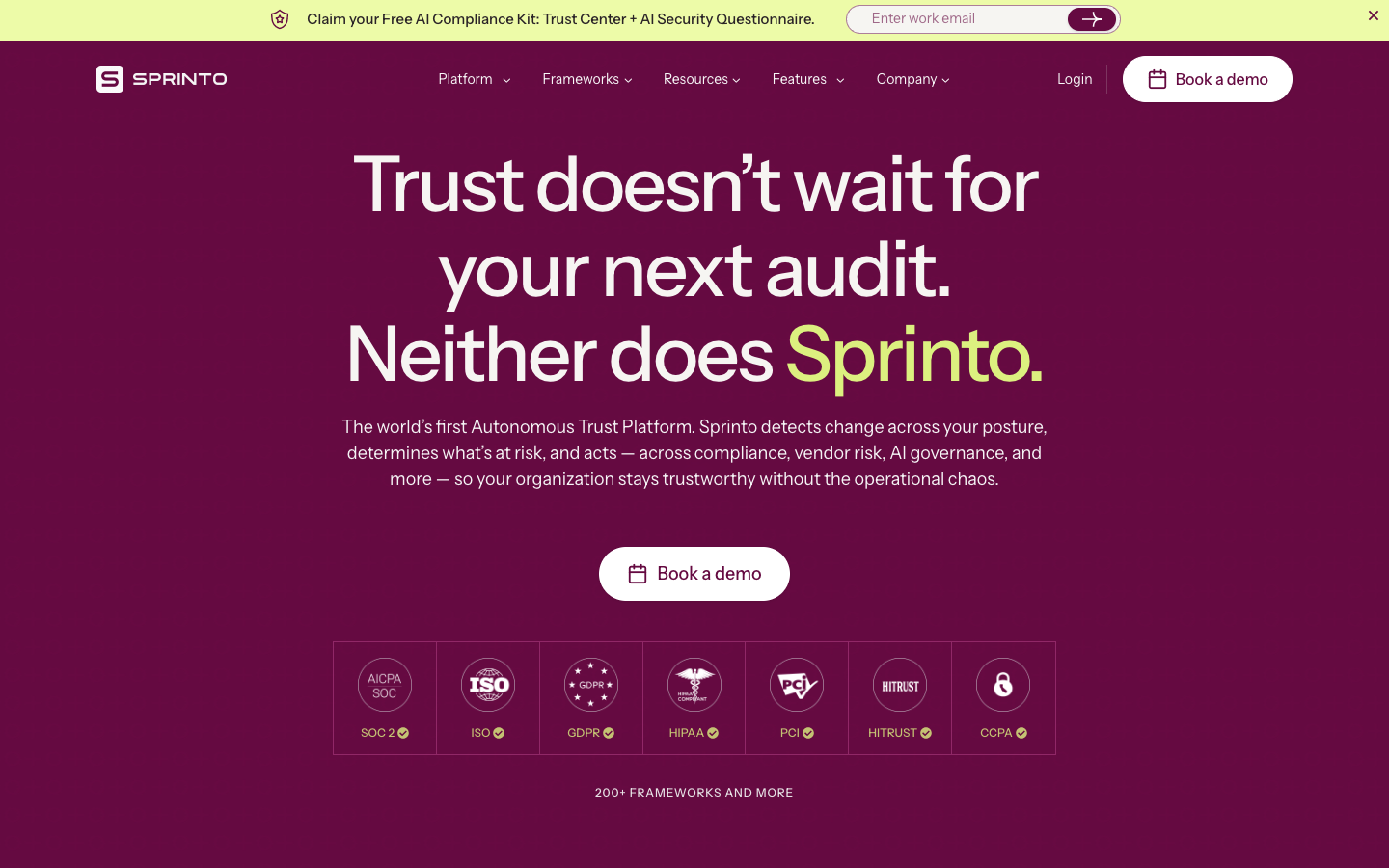
Sprinto calls itself an autonomous trust platform, and that framing is accurate: it continuously monitors controls, collects evidence, and surfaces compliance posture changes without a human in the loop. For DORA, it maps the regulation’s requirements to 102 built-in SCF (Secure Controls Framework) controls, which in turn map to ISO 27001 and SOC 2. You can cover DORA alongside other frameworks without rebuilding your control library from scratch. Our Sprinto review has more detail on the platform’s broader capabilities.
The 4.8/5 rating across 1,477 reviews is the highest of any multi-framework platform in this list. Sprinto also publishes partial pricing, which is rare in this category: Starter tiers begin around $7,000 to $9,000 per year.
The honest limitation for DORA specifically: Sprinto maps to DORA through SCF rather than native DORA architecture. There’s no dedicated Register of Information export. The reviews praising Sprinto are overwhelmingly about SOC 2 and ISO 27001, not DORA. If DORA-native features are your primary requirement, look at Formalize or 3rdRisk.
“
Sprinto offers extensive integration and cloud stacks because it has the ability to plug in directly into your cloud services such as AWS or GitHub.
★★★★★Verified User
Via G2 ↗Key features:
- 102 SCF controls mapped to DORA’s five pillars
- Automated evidence collection and real-time compliance dashboard
- ICT risk management, incident response readiness, and resilience testing support
- Third-party ICT risk management module
- Multi-entity management (Zones) for complex organizational structures
- 200+ native integrations
Pros of Sprinto
- Highest review rating of any multi-framework platform in this list (4.8/5 across 1,477 reviews)
- Autonomous monitoring reduces manual compliance work by approximately 70%
- Partial pricing transparency, which is genuinely unusual in this category
- Strong multi-framework coverage for teams doing SOC 2 and DORA simultaneously
Cons of Sprinto
- DORA support is via SCF mapping, not DORA-native architecture
- No dedicated Register of Information export
- User reviews focus heavily on SOC 2 and ISO 27001; limited DORA-specific evidence in public reviews
Pricing: Starter $7,000–$9,000/yr; Professional $9,000–$10,000/yr; Advanced $10,000–$15,000/yr; Enterprise: contact for pricing.
Best for: SaaS companies and financial services organizations wanting DORA compliance alongside SOC 2 or ISO 27001, with strong autonomous monitoring and the most transparent pricing in the multi-framework category.
6. Formalize
If your primary obligation is DORA and you need to produce a regulator-ready Register of Information, Formalize is the most purpose-built tool on this list. Everything is organized around DORA’s actual regulatory structure: guided logic maps your data to specific DORA articles, RTS references, and EBA technical standards, so your compliance team doesn’t need to interpret the regulation themselves.
The standout feature is the Register of Information workflow. One-click generation, built-in validation that checks completeness and consistency before submission, and a free DORA ROI Validator tool you can use to check your register before it reaches your NCA. No other tool on this list makes the RoI this central to the product.
The 4.9/5 rating across 194 reviews is the highest of any tool here. The reviews that mention DORA specifically cite the RoI generation and submission support as the deciding factor. Formalize also supports NIS2, ISO 27001, GDPR, and SOC 2, but DORA is the core product.
The trade-off is narrower breadth than the multi-framework platforms. If you need DORA plus SOC 2 at scale, with deep infrastructure integrations and enterprise GRC workflows, Vanta or Drata are better fits.
“
We purchased the DORA Framework and the tool helps us clearly visualise our compliance. Support has been great from the start and invaluable in creating and submitting our Information Register.
★★★★★Verified User
Via G2 ↗Key features:
- One-click Register of Information generation with built-in completeness and consistency validation
- Guided logic mapping data to applicable DORA articles, RTS, and EBA references
- DORA ROI Validator: free tool to check your register before NCA submission
- ICT risk management, incident handling, resilience testing, and TPRM in one platform
- Dashboard visibility across all five DORA resilience activities
- Supports EBA Outsourcing Guidelines alongside DORA
Pros of Formalize
- Highest review rating on this list (4.9/5 across 194 reviews)
- Purpose-built for DORA, not retrofitted onto a SOC 2 or GRC platform
- Register of Information is a first-class feature, not an export workaround
- Free DORA ROI Validator available before you commit to the platform
- 14-day free trial available
Cons of Formalize
- Narrower framework coverage than Vanta, Drata, or Sprinto
- Pricing not public; no published funding or integrations count
- Smaller company: less brand recognition than the enterprise GRC platforms
Pricing: Contact for pricing. 14-day free trial available.
Best for: Financial entities and ICT third-party providers whose primary compliance obligation is DORA and who need to produce a submission-ready Register of Information.
7. 3rdRisk (now a Diligent brand)

3rdRisk was built in the Netherlands specifically for third-party risk management in EU-regulated environments. It’s the most TPRM-focused tool on this list: the core value proposition is managing your ICT third-party supply chain under DORA, from initial vendor assessment through the Register of Information submission and ongoing monitoring.
The supply chain visibility goes deeper than any other tool here: 3rdRisk tracks third-party relationships up to 99 levels, which matters for DORA’s concentration risk requirements. The Register of Information is native, with single-click export. Implementation is 10 days, guaranteed.
In January 2026, 3rdRisk was acquired by Diligent and is now marketed as a Diligent brand. It’s also recognized in the 2026 Gartner Magic Quadrant for Third-Party Risk Management Tools. The acquisition brings more resources and roadmap stability, though it also creates some near-term uncertainty about product direction that’s worth monitoring.
The limitation is scope. 3rdRisk is a TPRM platform, not a full GRC or compliance automation suite. If you need DORA policy management, control testing, or incident reporting workflows alongside TPRM, you’ll need to layer another tool on top or handle those separately.
“
An end-to-end solution providing off the shelf standard best practice workflows and vendor risk capabilities with limited implementation effort. Gained control over vendor management and understanding of risk exposure for outsourced services.
★★★★★Wesley H.· Mid-size
Via Capterra ↗Key features:
- DORA Register of Information with single-click export
- Automated third-party risk assessments for ICT service providers
- Supply chain visibility tracking relationships up to 99 levels (concentration risk)
- Health Check Monitor for RoI data quality and completeness before NCA submission
- Pre-built DORA controls library and best-practice templates
- 10-day guaranteed implementation
Pros of 3rdRisk
- Most DORA TPRM-native platform in this list
- 99-level supply chain mapping for concentration risk analysis
- European-built with deep EU regulatory knowledge built in
- Gartner Magic Quadrant-recognized; now backed by Diligent
- Fastest implementation of any tool here (10 days)
Cons of 3rdRisk
- TPRM-focused only: not a full compliance automation platform
- No review listing on major platforms; limited third-party review data
- Diligent acquisition creates some product roadmap uncertainty in the near term
- Pricing is contact-only with four tiers
Pricing: Contact for pricing. Four tiers: Overview, Insight, Manage, Optimise.
Best for: EU financial institutions where DORA’s third-party ICT risk requirements are the primary concern and a fast implementation timeline is a constraint.
8. OneTrust
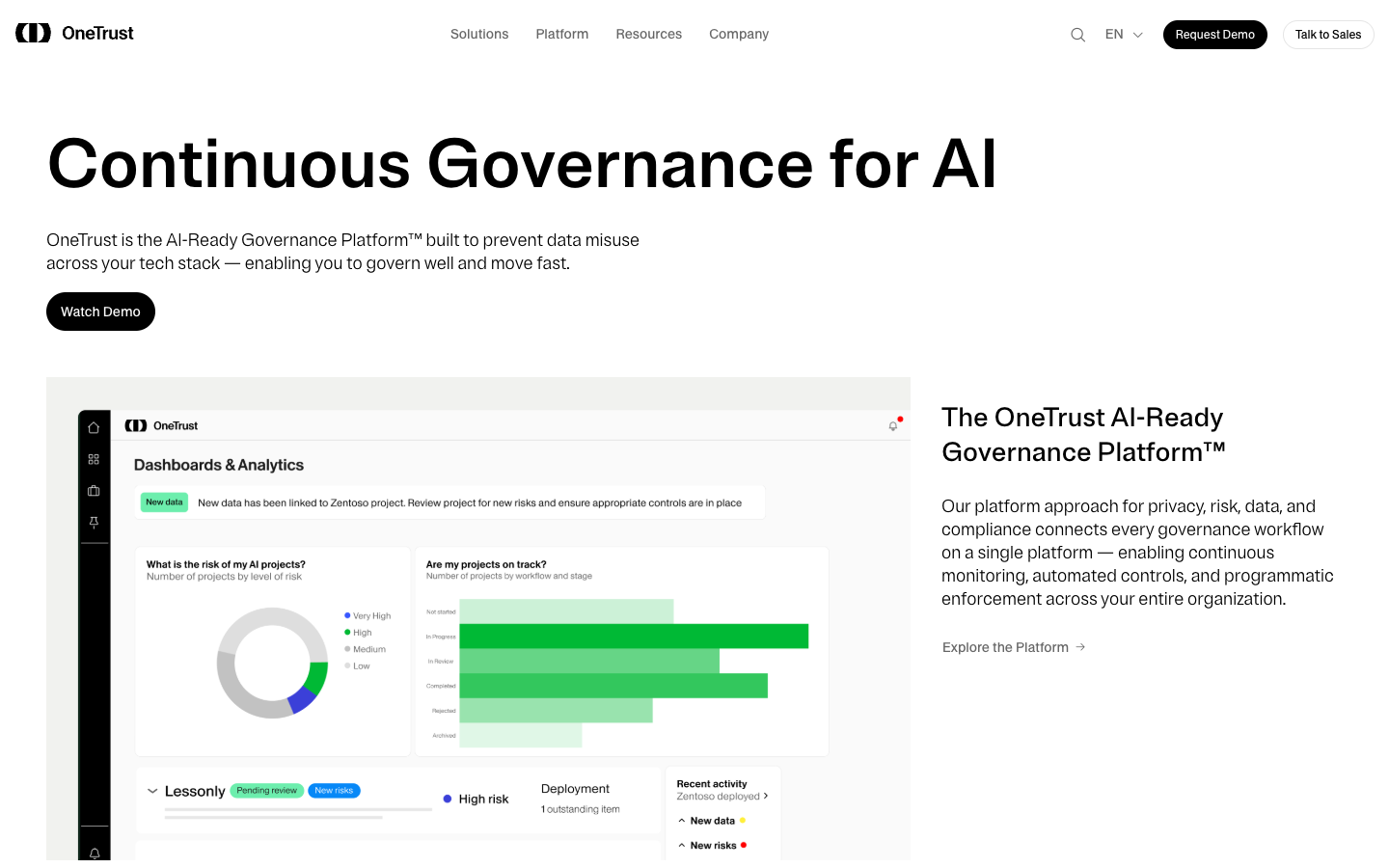
OneTrust is an enterprise trust intelligence platform with a comprehensive DORA module, including what it claimed was the first automated Register of Information generation in the market. For large financial institutions that need to manage DORA alongside GDPR, NIS 2, and broader privacy compliance in a single platform, OneTrust’s depth across all of those areas is genuinely useful.
The DataGuidance layer is worth noting: it’s a regulatory research platform covering 300 jurisdictions in 100 languages, which means your compliance team has live regulatory intelligence alongside their compliance workflows. If you operate across multiple EU member states with different NCA requirements, that matters.
The practical challenges are setup complexity and cost. The 4.4/5 rating across 283 reviews is the lowest of the non-specialist tools in this list, and the most common criticism is that implementation is complex and the learning curve is steep. This is not a platform you configure in a few weeks.
“
I love OneTrust Tech Risk & Compliance for its powerful automation capabilities that significantly reduce the effort and time needed to manage workflows. However, I find the initial setup to be complex and challenging, requiring considerable time and effort, with a steep learning curve that can be daunting for newcomers.
★★★★☆Verified User
Via G2 ↗Key features:
- Automated DORA Register of Information report creation (first-to-market)
- ICT Third-Party Risk Management with data-centric vendor risk identification
- IT Risk Management: full inventory and monitoring of IT ecosystem risk
- Compliance Automation for ICT control oversight with evidence frameworks
- DataGuidance: regulatory research covering 300 jurisdictions and 100 languages
- Incident Management workflows
Pros of OneTrust
- First-to-market automated RoI report creation
- Unified DORA, GDPR, and NIS 2 coverage in one platform
- Strong regulatory research layer (DataGuidance) for multi-jurisdiction teams
- Enterprise scale and stability: $4.5B valuation, 112 integrations
Cons of OneTrust
- Complex setup with a steep learning curve; the 4.4/5 rating across 283 reviews reflects this
- Enterprise-only pricing with no public tiers
- Not suitable for startups or mid-market teams with limited implementation resources
Pricing: Contact for pricing. Priced based on admin users and inventory size.
Best for: Large enterprises and financial institutions managing DORA alongside GDPR, NIS 2, and other EU privacy and compliance obligations in a single unified platform.
9. ProcessUnity

ProcessUnity is the most enterprise-grade TPRM platform in this list. The Global Risk Exchange contains 370,000+ curated vendor profiles and 18,000 completed assessments, which means a significant portion of the vendor risk data your team needs for DORA is already there. CIF (Critical or Important Function) classification workflows, fourth-party dependency mapping, and pre-built connectors for SecurityScorecard, BitSight, and RiskRecon are all built in.
The Forrester Wave named ProcessUnity a leader in Third-Party Risk Management, and that positioning holds for DORA specifically. If your ICT supply chain is large, multi-tiered, and geographically distributed, this is the platform designed for that scale.
The cost reflects it. Third-party estimates put ProcessUnity in the $75,000 to $200,000+ per year range. It’s built for large financial institutions with a dedicated GRC team, not for fintechs or scale-ups. The review volume is also limited (45 reviews), which makes it harder to assess based on user feedback alone.
“
I find ProcessUnity TPRM Platform to be a highly configurable SaaS tool with an intuitive UI that allows a savvy business user to administer the tool without IT intervention. This configurability supports rapid adaptation to regulatory changes or business needs. ProcessUnity has a high quality support team with quick response times. In the 7 years I've been using the tool we have experienced only two service interruptions.
★★★★★Verified User· Enterprise
Via G2 ↗Key features:
- Centralized data model covering vendors, services, legal entities, intragroup, and fourth-party relationships
- Register of Information reporting with automated regulatory data exports
- CIF vendor risk classification workflows
- Global Risk Exchange: 370,000+ curated vendor profiles, 18,000+ completed assessments
- Pre-built connectors for SecurityScorecard, BitSight, RiskRecon, and Black Kite
- DORA and NIS2 compliance templates
Pros of ProcessUnity
- Deepest TPRM capability in this list: fourth-party mapping, concentration risk, CIF classification
- 370,000+ vendor profiles in the Global Risk Exchange
- Forrester Wave leader in Third-Party Risk Management
- AI-based control reviews reduce manual assessment workload
Cons of ProcessUnity
- Enterprise-only pricing: estimated $75,000 to $200,000+ per year
- Not a full compliance automation platform; TPRM-focused
- Limited review volume (4.5/5 across 46 reviews); harder to validate at scale
- Implementation complexity is comparable to OneTrust
Pricing: Contact for pricing. Enterprise only. Third-party estimates: $75,000–$200,000+/year.
Best for: Large financial institutions with complex, multi-tiered ICT vendor ecosystems needing deep TPRM, CIF classification, and fourth-party visibility under DORA.
10. SAI360

SAI360 is a mature enterprise GRC platform that maps to all five DORA pillars through integrated modules: IT risk management, incident management, TPRM, business continuity, regulatory compliance, and operational risk. The business continuity module is particularly strong, which is directly relevant to DORA’s operational resilience testing pillar. Trusted by 33% of Fortune 500 companies, it’s now owned by Symphony Technology Group.
The difference between SAI360 and the TPRM-specialist tools (3rdRisk, ProcessUnity) is breadth. SAI360 covers the full GRC stack, not just third-party risk. If your DORA compliance sits within a broader enterprise GRC program that includes SOX, COSO, CSRD, and operational risk, having it all in one platform is worth the configuration overhead.
That overhead is real. The 4.1/5 rating across 106 reviews is the lowest of any non-specialist tool here, and the most common feedback is about configuration complexity. This is not a platform that ships a DORA template and you’re done. It’s a platform you configure for your organization over months.
“
SAI360 brings IT risk into a single system, using AI to help teams act faster. The customizable platform and responsive support team enhance the ability to tailor workflows and manage compliance effectively.
★★★★☆Verified User· Enterprise
Via G2 ↗Key features:
- IT Risk Management aligned to NIST and ISO 27001 with DORA overlay
- Incident Management: end-to-end from capture to root cause analysis, including NCA reporting support
- Third-Party Risk Management: vendor onboarding, monitoring, and oversight
- Business Continuity Management: automated plan creation, testing, and revision
- Regulatory Compliance: real-time oversight with requirement-to-risk mapping
- 20+ configurable modules
Pros of SAI360
- Covers all five DORA pillars in a single platform (rare in this list)
- Strong BCM module: directly relevant to DORA’s operational resilience testing requirements
- Trusted by 33% of Fortune 500 companies
- STG ownership provides stable enterprise backing
Cons of SAI360
- Lowest review rating in this list (4.1/5 across 106 reviews); configuration complexity is the recurring issue
- Enterprise-only; no pricing transparency
- Overkill for teams whose only obligation is DORA rather than broader enterprise GRC
Pricing: Contact for pricing. Modular, per-user, per-edition.
Best for: Large financial institutions already running SAI360 for enterprise GRC who need to extend their existing program to cover DORA’s five pillars.
How to Choose DORA Compliance Software
Do you actually need DORA-native, or will multi-framework cover you?
Free Demo
DORA compliance without the enterprise price tag
Flat pricing, 350+ integrations, guided DORA + SOC 2 or ISO 27001.
The most important question before you evaluate anything is whether DORA is your primary compliance obligation or one of several. The answer changes the shortlist completely.
If the Register of Information and NCA incident reporting are your core requirements, DORA-native tools (Formalize, 3rdRisk) are built for exactly that. They handle DORA’s regulatory specifics as first-class features, not bolt-ons.
If you’re pursuing DORA alongside SOC 2, ISO 27001, or NIS 2, multi-framework platforms (Vanta, Drata, Sprinto, ComplyJet) make more sense. Evidence collected for one framework carries over to others, reducing the overall compliance workload.
How complex is your third-party ICT supply chain?
DORA’s TPRM requirements vary significantly based on your organization’s ICT footprint. A fintech using five cloud providers is a different problem than a bank with 200 ICT vendors, subcontractors, and fourth-party dependencies.
For simple supply chains, most compliance platforms handle vendor assessment adequately. For complex, multi-tiered supply chains with concentration risk, dedicated TPRM platforms (3rdRisk, ProcessUnity) are worth the investment.
Is Cloud-Based DORA Compliance Software the Right Deployment Model?
Almost every tool on this list is SaaS and cloud-based. On-prem options are essentially nonexistent in this category. If your organization has data residency requirements, the relevant question is whether the vendor has an EU data center. Secureframe and OneTrust both offer EU data center options. Confirm this with any vendor before committing, particularly if you’re operating under strict data localization requirements.
What’s your implementation timeline?
DORA is already in force. If you’re working against an active regulatory deadline, implementation speed matters. 3rdRisk guarantees 10-day implementation for TPRM. ComplyJet’s guided process is designed to move quickly for first-time compliance teams. Enterprise platforms (SAI360, ProcessUnity, OneTrust) require months of configuration and should not be chosen if speed is a hard constraint.
Best DORA Compliance Software for Enterprises vs. Startups vs. Scale-ups
Your organization’s size and compliance maturity should drive the shortlist more than any feature comparison.
Startup (1–50 people, first-time DORA compliance): ComplyJet, Sprinto, Secureframe. Flat or transparent pricing, guided onboarding, minimal configuration overhead. You’re not running a dedicated GRC team.
Scale-up (50–250 people, multi-framework): Vanta, Drata, Formalize. Strong automation, broader framework coverage, proven user reviews. You need DORA alongside other certifications and want a platform that scales with headcount.
Enterprise (250+ people, complex ICT ecosystem): OneTrust, ProcessUnity, SAI360. TPRM depth, regulatory research, modular GRC architecture. You have a GRC team, a procurement cycle, and a complex ICT supply chain that needs proper mapping.
ComplyJet handles the full DORA compliance stack: policies, controls, evidence collection, and your audit. Book a free demo to see it in action.
Frequently Asked Questions
What’s the best DORA compliance software for financial companies?
It depends on what you need most. For generating and submitting the Register of Information, Formalize is the most purpose-built option. For DORA alongside multi-framework compliance (SOC 2, ISO 27001, NIS 2), Vanta or Drata are the strongest platforms. For startups that need DORA plus SOC 2 at flat, predictable pricing, ComplyJet is worth evaluating.
What is the best DORA compliance software for banks?
Banks typically need the full stack: TPRM, incident reporting, BCM, and DORA governance in one place. For large banks with complex ICT supply chains, ProcessUnity, 3rdRisk, or OneTrust are the most capable options. For smaller banks pursuing DORA compliance for the first time, ComplyJet or Formalize are more practical starting points.
Does DORA compliance software handle the Register of Information?
Not all of them, and this is one of the most important things to verify before you commit. Formalize and 3rdRisk generate submission-ready RoIs natively. Vanta, Drata, and OneTrust support the Register of Information as part of their DORA features. Sprinto and Secureframe, as of this writing, don’t have a dedicated RoI export. Ask specifically about RoI generation in any demo you run.
What’s the difference between DORA and ISO 27001 compliance software?
ISO 27001 is a certification: you implement controls, collect evidence, pass an external audit, and receive a certificate. DORA is an ongoing regulatory obligation with mandatory NCA reporting, resilience testing requirements, and tiered incident reporting timelines.
A tool built for ISO 27001 vs SOC 2 handles control attestation well; it won’t necessarily handle NCA incident submissions or Register of Information filings. Some platforms (Vanta, Drata, ComplyJet) cover both. DORA-native platforms are purpose-built for the operational resilience obligations that ISO 27001 doesn’t address.
Final Thoughts
DORA is live. The practical question now is whether the tool you pick actually handles the parts that are unique to DORA: the Register of Information, tiered NCA incident reporting, and TPRM at scale. Most platforms handle the policy and controls layer well. The rest varies significantly.
Free Demo
Get DORA-ready with a team behind you
ComplyJet guides startups through DORA, SOC 2, and ISO 27001 from day one.
For startups and scale-ups pursuing DORA alongside SOC 2 or ISO 27001, ComplyJet is worth looking at: publicly listed flat pricing, 350+ integrations, and a team that guides you through the compliance process rather than leaving you to configure the platform yourself.
If you’re a startup pursuing DORA compliance for the first time, ComplyJet is built for you: flat pricing, 350+ integrations, and a team that guides you through the process end to end.