.svg)

You’ve decided you need CCPA compliance. You search for ccpa compliance software and get back something that looks like two different categories trying to occupy the same search result: cookie consent banners, full GRC platforms, DSAR automation tools, and privacy management suites, all claiming to do the same job. None of them show you a price without a demo call.
The category is genuinely confusing because CCPA isn’t one problem: it’s five. You need consent management (cookie banners, Do Not Sell opt-outs), a data subject access request (DSAR) workflow, a data inventory, an updated privacy policy, and vendor contracts that include data processing terms. Some of these tools handle one. Some handle all five. Most claim to handle all five but were built around one.
I reviewed 10 CCPA compliance software platforms, looking at what they actually cover, what they cost, and what kind of team they’re built for. If you’re a startup also working toward SOC 2 or ISO 27001, that changes the answer significantly, and I’ve flagged exactly where a GRC platform makes more sense than a standalone privacy tool.
What California Consumer Privacy Act Software Needs to Cover
The California Consumer Privacy Act isn’t a single checkbox. It creates five categories of obligation that map directly to what software needs to do.
Key insight
If you're also doing SOC 2, ISO 27001, or HIPAA, a GRC platform that covers CCPA as one of many frameworks is almost always more efficient.
The first is consent management: displaying a “Do Not Sell or Share My Personal Information” link, setting up compliant cookie banners for California visitors, and honoring Global Privacy Control signals. The second is DSAR management: when a California consumer requests to know, delete, or correct their data, you have 45 days to respond.
The third is data mapping: you need to know what personal data you collect, where it lives, and which third parties receive it. The fourth is privacy policy maintenance: your policy must disclose categories of data collected and sold. The fifth is vendor contracts: every third party that processes California consumer data needs a contract with specific data processing terms.
This is why “CCPA compliance software” splits into two answers. If you only need consent management and DSAR handling, a dedicated privacy tool handles that cleanly. If you’re also doing SOC 2, ISO 27001, or HIPAA, you already need data mapping and vendor risk management for those frameworks, and a GRC platform that covers CCPA as one of many frameworks is almost always more efficient.
How we evaluated these CCPA compliance tools
I reviewed each tool on six criteria:
- CCPA feature depth: Does it cover Do Not Sell, DSAR automation, consent banners, and data mapping, not just one or two?
- Startup fit: Can a small team with no privacy officer actually implement and maintain it?
- Multi-framework support: Does it cover GDPR, SOC 2, or HIPAA if you need those too?
- Pricing transparency: Is it clear what you’ll pay before talking to sales?
- Review quality: What do verified users at similar-sized companies actually say?
- Integration depth: Does it connect to the tools your stack already uses?
Quick comparison: best CCPA compliance software in 2026
| Tool | Best for | Pricing | Standout feature |
|---|---|---|---|
| OneTrust | Enterprise privacy teams | Contact for pricing | Most complete CCPA feature set on the market |
| Vanta | Startups doing SOC 2 + CCPA | Custom pricing | USDP covers 19 US state laws in one control set |
| Drata | Growing teams, multi-framework | From ~$7,500/yr | Cross-framework control mapping, ex-auditor CS team |
| ComplyJet | Early-stage startups | From $5,000/yr | Flat pricing, guided compliance outcomes |
| Osano | SMBs, pure CCPA/GDPR focus | Free to $199/mo | No Fines, No Penalties pledge |
| TrustArc | Mid-market privacy programs | Contact for pricing | G2 #1 in Data Privacy, 4 consecutive quarters |
| DataGrail | DSAR automation at scale | Contact for pricing | 2,500+ pre-built app connectors |
| Sprinto | Startups, CCPA + SOC 2/ISO | From ~$6,000/yr | 4.8/5 across 1,400+ reviews |
| Ketch | Consent-first, free start | Free to $150/mo | Full CMP on free tier, no feature gating |
| Usercentrics | Marketing and ad-tech teams | Contact for pricing | #1 CMP on G2, 2.4M websites |
Free Demo
Handle CCPA, SOC 2, and HIPAA in one platform
Flat pricing. 350+ integrations. A team that drives the work end to end.
The 10 best CCPA compliance software platforms in 2026
1. OneTrust
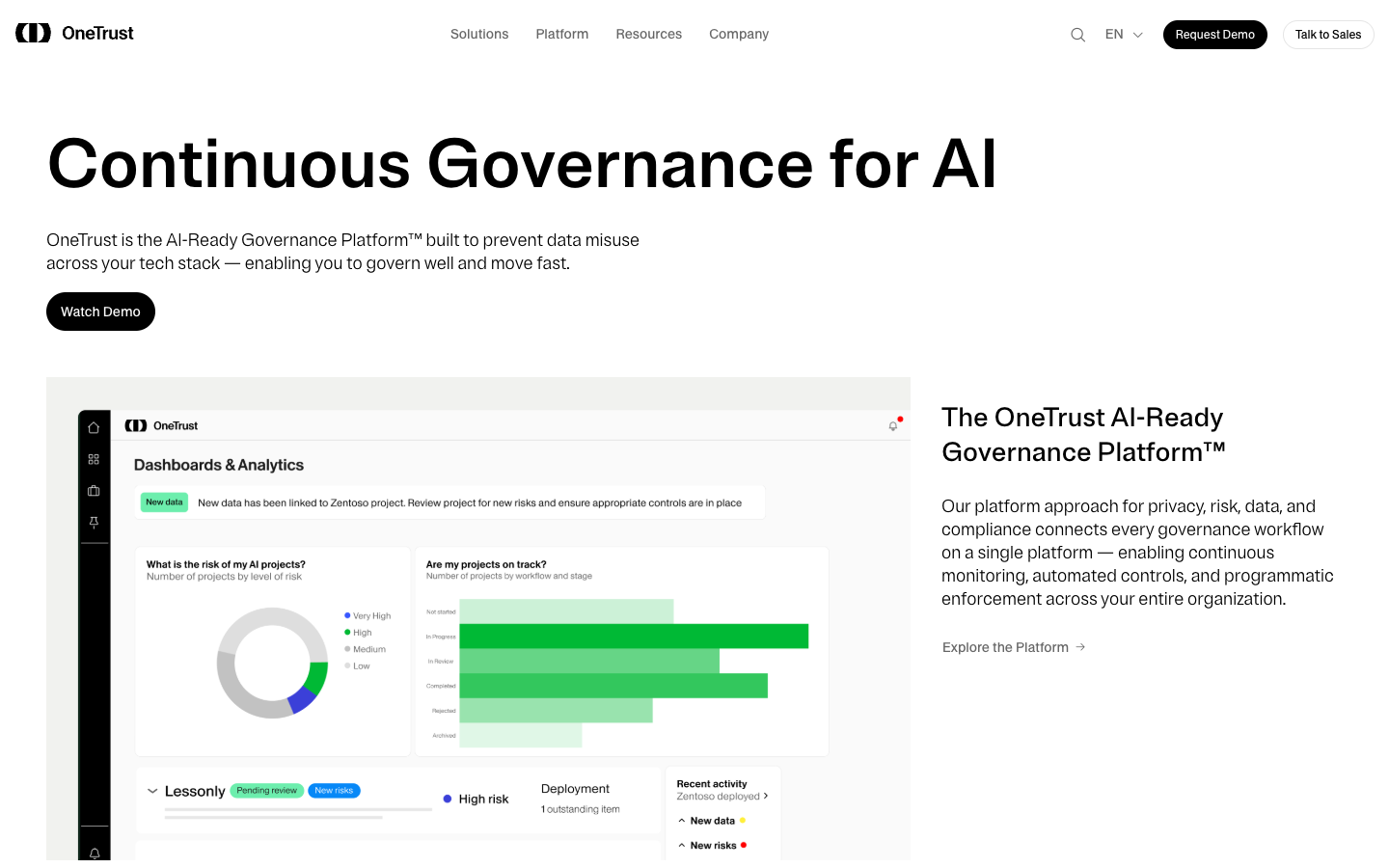
OneTrust is the market leader in privacy management. If you’ve looked at any CCPA vendor comparison, it’s the first name you’ve seen. That’s not an accident: OneTrust has the most complete CCPA feature set available, covering consumer rights automation, data mapping across IT systems and third parties, consent management, vendor risk, and California-specific breach notification workflows.
The platform handles the full consumer rights lifecycle: intake, identity verification, data discovery, deletion, and secure response delivery. It automates Do Not Sell opt-outs across web, mobile, and connected TV. It maps personal information using CCPA-specific attributes (browsing history, geolocation, psychological profiles). And it comes with regulatory guidance covering 300+ jurisdictions, so you’re not starting from scratch when a new state privacy law lands.
What OneTrust doesn’t do is make any of this simple. Onboarding is significant. Pricing is opaque and per-module. You’ll need a privacy team or a consultant to get real value out of it. For a startup founder implementing CCPA for the first time without a dedicated privacy officer, this is the wrong starting point.
“
OneTrust proves to be a fundamental platform for incorporating risk management and compliance into the flow of our daily operations, which translates into greater security, efficiency, and reliability.
★★★★★Christine H.· 10,001+ employees
Via Capterra ↗Key features:
- Consumer rights request automation (intake, identity verification, data discovery, deletion)
- Do Not Sell and Do Not Share opt-out management across web, mobile, and CTV
- Automated data mapping with CCPA-specific personal information attributes
- Breach notification with California 30-day cure period workflow
- Vendor risk management with third-party data flow mapping
- Regulatory guidance covering 300+ jurisdictions
Pros of OneTrust
- Most comprehensive CCPA feature set available
- Handles multi-jurisdiction compliance (300+ regulations)
- Strong breach notification and vendor risk workflows
Cons of OneTrust
- Pricing is not public; per-module structure and grows quickly at scale
- Steep learning curve: not self-service for small teams
- Support quality inconsistent at lower tiers
Pricing: Contact for pricing. Scalable packages; pricing not publicly disclosed.
Best for: Enterprise and mid-market organizations with dedicated privacy teams and complex multi-jurisdiction needs.
2. Vanta

Vanta is the most widely used compliance automation platform for startups, with 2,352+ reviews and leadership across 19 G2 categories. Most people know it for SOC 2, but its CCPA support is built around something genuinely useful: the US Data Privacy (USDP) framework, which covers 19 US state privacy laws including CCPA/CPRA in a single control set. If you’re in a state with its own privacy law and also doing SOC 2, you’re not running two parallel programs.
Vanta pulls evidence automatically from 400+ integrations, which at audit time translates to hours rather than weeks of evidence collection. Its policy builder comes with CCPA-ready templates so you’re not writing a privacy policy from scratch. Continuous monitoring alerts you when a control fails rather than letting you find out during audit prep.
The honest tradeoff: Vanta doesn’t publish pricing. You’ll need a demo to get a number. Contracts have been reported as rigid, particularly for early-stage teams that need flexibility. But for a company that needs SOC 2 and CCPA in one platform and wants the most recognized name in the market, Vanta is the default answer. Read my Vanta pricing guide if you want to know what to expect before the call.
“
Vanta enabled us to move our compliance (SOC 2, and next PCI) projects forward in an organized and monitored manner. We reached audit readiness in half a year after struggling with manual SOC 2 requirements.
★★★★★Barbara N.· Financial Services
Via Capterra ↗Key features:
- USDP framework covering CCPA/CPRA and 19 US state privacy laws
- Automated evidence collection from 400+ integrations
- Policy builder with CCPA-ready templates
- Continuous monitoring with real-time failing test alerts
- Automated access reviews for sensitive data controls
- Security awareness training built into the platform
Pros of Vanta
- Most recognized brand in startup compliance, making it an easy internal sell
- USDP framework handles 19 US state privacy laws in one control set
- 400+ integrations; evidence collection is largely automated
Cons of Vanta
- Pricing is not public; contracts can be rigid for early-stage teams
- CCPA coverage is framework-level, not deep privacy tooling (no consent banners or DSAR portal)
- Per-seat pricing model means cost scales as you hire
Pricing: Custom pricing across Essentials, Plus, Professional, and Enterprise tiers. No public price list.
Best for: Startups and scaleups wanting SOC 2 and CCPA in one platform with the most recognized compliance brand.
3. Drata

Drata has been a G2 Leader for 13 consecutive quarters. For CCPA specifically, what sets it apart is cross-framework control mapping: the controls you build for CCPA overlap significantly with SOC 2, ISO 27001, HIPAA, and GDPR, and Drata maps these automatically so you’re not configuring the same thing four times. For a startup that knows its compliance roadmap runs through multiple frameworks, that efficiency compounds quickly.
The customer success team is notably different from most competitors: former auditors, not just account managers. That matters more than it sounds at audit time, when you need someone who can tell you whether your evidence actually satisfies a control rather than just confirming the integration is connected.
The tradeoff: pricing grows with frameworks. The median buyer pays around $25,000/year, and each additional framework adds cost. For teams that need only CCPA to start, that’s expensive. For teams running CCPA alongside SOC 2 and ISO 27001, the cross-framework efficiency makes it reasonable. See our Drata review for a full breakdown.
“
Drata makes it easier to go through the SOC 2 checklist and get audit-ready with standard templates for policies, daily checks, and audit questionnaires. The cross-framework control mapping is a real time saver when you're running CCPA and SOC 2 simultaneously.
★★★★★Verified User· SMB · 51-200 employees
Via G2 ↗Key features:
- CCPA control library with pre-mapped policies and templated documentation
- Consumer data mapping with ownership accountability
- Cross-framework control mapping (CCPA controls reused for SOC 2, ISO 27001, GDPR)
- Continuous 24/7 monitoring for CCPA control health
- Vendor privacy assessments and third-party risk management
- Compliance advisor support from former auditors
Pros of Drata
- Cross-framework control mapping eliminates duplicate work across CCPA, SOC 2, ISO 27001
- Former-auditor CS team adds real value at audit time
- 13 consecutive G2 Leader quarters
Cons of Drata
- Pricing grows significantly with additional frameworks
- Fewer integrations than Vanta (75 vs. 400+)
- Enterprise-tier pricing can be out of reach for early-stage startups
Pricing: From ~$7,500/year (single framework); growth plans ~$15,000/year; enterprise $25,000–$50,000+/year.
Best for: Growing SaaS teams that need CCPA alongside SOC 2 or ISO 27001, with strong audit coordination.
4. ComplyJet
ComplyJet is built for one specific buyer: an early-stage startup pursuing compliance for the first time, without a dedicated privacy or security team, that needs the process to actually get done rather than handed to them as software to configure.
The model is different from Vanta or Drata. You get the automation platform (350+ integrations, continuous monitoring, evidence collection, CCPA and 25+ frameworks), and you also get a team that guides you through the work end to end, from scoping and controls to audit coordination with vetted auditors. The audit relationship is part of the product, not an add-on you source separately.
If you’ve looked at SOC 2 compliance and felt like the software vendors were leaving you with the hardest parts, that’s exactly the gap ComplyJet is designed to close.
Pricing is publicly listed and flat per company: $5,000/year for one framework, $8,000/year for two (for example, CCPA plus SOC 2 or CCPA plus HIPAA). That stays the same whether you have 10 employees or 50, which is a meaningful difference when you’re growing fast.
Key features:
- CCPA, SOC 2, ISO 27001, HIPAA, GDPR, and 25+ frameworks in one platform
- 350+ integrations with automated evidence collection and continuous monitoring
- End-to-end audit coordination with vetted auditors
- Branded Trust Center for sharing compliance posture with enterprise prospects
- Security questionnaire automation
- ComplyJet AI for intelligent compliance guidance
“
The platform makes it simple: it splits the work into four buckets with clear, bite-sized tasks we could fit into our routine. No sales gauntlet or upselling. The clearest, most sensible option.
Artur G.· CTO · Symmetre
Via complyjet.com ↗
Pros of ComplyJet
- Flat per-company pricing: cost doesn’t scale with headcount
- Covers CCPA alongside SOC 2, HIPAA, and 25+ other frameworks
- Team-guided process: audit coordination is included, not a separate contract
Cons of ComplyJet
- No free tier or trial
- Fewer integrations than Vanta (350 vs. 400+)
- Not the right fit for teams that want to self-implement without support
Pricing: $5,000/year (one framework), $8,000/year (two frameworks). Flat per-company, not per-seat.
Best for: Early-stage startups pursuing CCPA alongside SOC 2 or HIPAA for the first time, without a compliance team.
5. Osano
Osano is the strongest dedicated CCPA tool for teams that don’t need a full GRC platform. It focuses on consent management, DSAR automation, data mapping, and vendor privacy risk, covering the core CCPA obligations cleanly without the overhead of a compliance automation platform.
The implementation is fast: one line of JavaScript, and your site detects California visitors and displays the right consent experience. DSAR workflows are built around the 45-day response window. The vendor risk module runs a 163-item assessment on each vendor your organization uses, which is more thorough than anything else in this price range.
The No Fines, No Penalties pledge is worth calling out specifically: Osano covers regulatory fines up to $500,000 if you’re penalized while using the platform correctly. No other tool on this list offers anything comparable. If CCPA enforcement risk is a genuine concern, that’s a meaningful differentiator.
The free plan is limited to 5,000 monthly visitors and basic consent. Most startups will want at least the Plus plan at $199/month. Full DSAR management requires the custom Basic Privacy tier.
“
Very good! Solves all my compliance related concerns centrally. Privacy law automations and cookie consent management are the key strengths.
★★★★★Tarnika C.· Mid-size
Via Capterra ↗Key features:
- Cookie consent management with California geolocation detection
- DSAR automation with 45-day response workflows
- Automated data mapping for personal information discovery
- Vendor risk scoring (163-item proprietary assessment per vendor)
- Global Privacy Control (GPC) support
- No Fines, No Penalties pledge (up to $500,000 coverage)
Pros of Osano
- No Fines, No Penalties pledge is unique in the market
- Strong vendor risk scoring (163-item assessment)
- Free tier available; one-line JS implementation
Cons of Osano
- Full DSAR management requires custom pricing tier
- Not a GRC platform: if you need SOC 2 or ISO 27001, you’ll need a second tool
- Can get expensive at higher traffic volumes
Pricing: Free (1 domain, 5,000 visitors); Plus $199/month (3 domains, 30,000 visitors); Basic Privacy at custom pricing.
Best for: SMBs and startups focused on CCPA and GDPR compliance without a broader GRC program.
6. TrustArc

TrustArc (formerly TRUSTe) has been in the privacy compliance business since 1997, longer than most of the other tools on this list have existed. It combines AI-powered software with advisory services and trust certifications, and it has been ranked #1 in G2’s Data Privacy Management category for four consecutive quarters.
The platform covers the full CCPA stack: consent management, DSR automation, data mapping, vendor risk, and privacy impact assessments. Its standout feature is depth: 800+ operational templates, auto-law identification that adjusts behavior based on jurisdiction, and TRUSTe certifications that some enterprise customers specifically require. If you’re selling to large regulated companies and they want to see a TRUSTe certification, that carries weight that other tools can’t replicate.
The tradeoff is squarely in the enterprise direction. Enterprise clients like Abbott, ADP, GE, and Nike are in their customer list for a reason. The platform is built for organizations with a privacy officer managing the program. For a startup founder self-implementing CCPA, it’s the wrong level of complexity.
“
TrustArc's comprehensive tools and automation features help streamline complex processes, making it easier for organizations to maintain compliance. Its ability to automate cookie scanning and categorization has significantly streamlined our workflows.
★★★★☆Verified User· Mid-market
Via G2 ↗Key features:
- AI-powered compliance automation (Arc Intelligence)
- Cookie consent and tracker management
- DSR automation with auto-law identification
- 800+ operational compliance templates
- Privacy impact assessments (PIAs and DPIAs)
- TRUSTe certifications (Enterprise Privacy, Responsible AI, APEC CBPR)
Pros of TrustArc
- G2 #1 in Data Privacy Management, four consecutive quarters
- TRUSTe certifications carry weight with enterprise buyers
- Deep advisory services on top of the software
Cons of TrustArc
- Pricing is not public; enterprise-focused cost
- Not built for self-service implementation
- Complex for teams without a dedicated privacy function
Pricing: Contact for pricing. Enterprise-focused; demo required.
Best for: Mid-market companies with a privacy officer that also need advisory services and established trust certifications.
7. DataGrail
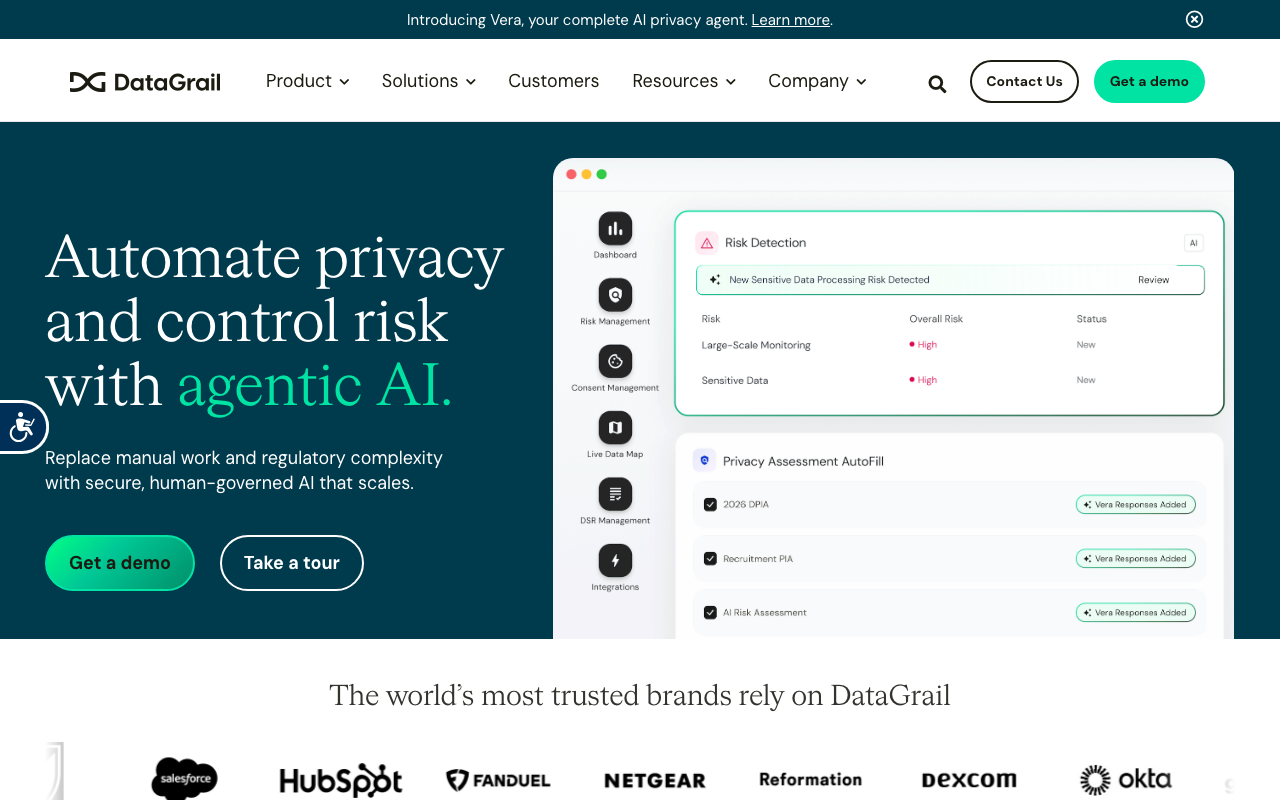
DataGrail is a specialist. It does one thing better than anyone else on this list: automating data subject requests across a complex SaaS stack. With 2,500+ pre-built connectors, it can execute a deletion or access request across your CRM, support desk, analytics tools, and data warehouse simultaneously, automatically, without someone manually tracking down where the data lives.
The Live Data Map gives you real-time visibility into every system that holds personal data, updated as your stack changes. The Vera AI agent surfaces compliance risks and recommends actions contextually. And it covers every US state privacy law, not just CCPA.
If you’re handling fewer than 20 DSARs per month, this is overkill. The complexity and cost are calibrated for organizations where DSAR processing has become a real operational burden. But if you’re at the scale where one person is spending days each month tracking down data across dozens of systems, DataGrail pays for itself quickly.
“
DataGrail has been a game changer for our DSAR process. The pre-built connectors to our SaaS tools mean we no longer have to manually search for data across systems — requests go out automatically and come back with what we need.
★★★★★Verified User· SMB
Via G2 ↗Key features:
- DSR automation across 2,500+ pre-built application connectors
- Live Data Map for real-time system visibility and PII discovery
- 24/7 consent enforcement and management
- Automated PIAs, DPIAs, and AI risk assessments
- PII discovery across structured and unstructured data
- Vera AI agent with context-aware privacy recommendations
Pros of DataGrail
- 2,500+ pre-built connectors: largest DSAR automation network in the market
- Live Data Map updates in real time as your stack changes
- Covers all US state privacy laws, not just CCPA
Cons of DataGrail
- Priced for mid-market and enterprise; not a fit for early-stage startups
- No public pricing
- Consent management is secondary to DSAR: not a full cookie banner solution
Pricing: Contact for pricing. Mid-market to enterprise focus.
Best for: Companies with complex SaaS environments where DSAR volume has become an operational problem.
8. Sprinto
Sprinto takes a GRC-first approach to CCPA. Rather than building privacy tooling around consent banners and DSAR portals, it approaches CCPA through the security lens: continuous monitoring, vendor risk management, and audit-ready evidence collection. CCPA controls are pre-mapped to SOC 2 Trust Services Criteria and ISO 27001 Annex A simultaneously, so the work you do for one framework carries over to the others.
The numbers support the track record: 4.8/5 across 1,400+ reviews, with startups consistently reporting SOC 2 Type I readiness in 25–30 days. The AI-powered gap analysis surfaces what’s missing before your auditor does, which is exactly when you want to find out.
If you’re coming in specifically for CCPA and have no need for SOC 2 or ISO 27001, you’re paying for capability you won’t use. If you need CCPA as part of a broader compliance program, the multi-framework efficiency is real. Our Sprinto review covers the full platform and pricing in detail.
“
Thanks to Sprinto, we were able to achieve both ISO27001 and SOC2 Type 2 certifications without the usual stress and delays. The platform makes the entire process smooth and manageable even for a small team.
★★★★★Vivek K.· 2-10 employees
Via Capterra ↗Key features:
- Continuous compliance monitoring for CCPA/CPRA and 30+ frameworks
- Reusable controls satisfying CCPA, SOC 2 TSC, and ISO 27001 simultaneously
- AI-powered risk assessments and gap analysis
- Automated evidence collection with 200+ integrations
- Centralized vendor inventory for California consumer data scoping
- Auditor-friendly dashboards and evidence packages
Pros of Sprinto
- 4.8/5 across 1,400+ reviews: one of the highest-rated compliance platforms
- CCPA controls reuse directly for SOC 2 and ISO 27001, with no duplicate work
- AI gap analysis surfaces issues before your auditor does
Cons of Sprinto
- Not a dedicated privacy tool: no consent banners or DSAR portal
- CCPA is typically an add-on framework; entry price is $6,000–$8,000/year for a single framework
- Less suited for teams focused purely on CCPA without broader GRC needs
Pricing: From $6,000–$8,000/year (single framework); multi-framework pricing is custom.
Best for: SaaS startups running CCPA alongside SOC 2 or ISO 27001 in a single GRC platform.
9. Ketch
Ketch does something no other tool on this list does: it offers a fully-featured consent management platform for free. Not a watered-down version. Full CMP functionality, up to 5,000 unique visitors per month, two integrations. If you’re a pre-revenue startup that needs CCPA-compliant cookie consent today, Ketch is where you should start.
The standout paid feature is Opt-Out Sync. When a California consumer clicks “Do Not Sell or Share My Personal Information,” Ketch doesn’t just update the banner. It propagates that choice across your entire data ecosystem: CDPs, CRMs, ad platforms, and marketing tools. Most consent tools stop at the banner. Ketch enforces the preference everywhere the data goes.
The upgrade path is clean: Starter at $150/month for 30,000 visitors, Plus from $499/month for 100,000. DSR automation and full data mapping require the Pro tier (custom pricing). So Ketch works as a long-term platform, not just a free starting point.
“
Ketch provides a very strong, enterprise-ready consent and preference management platform that integrates well with complex ecosystems like Salesforce. The interface is intuitive and support has been excellent throughout our implementation.
★★★★★Verified User· Mid-Market
Via G2 ↗Key features:
- Full CMP functionality on free tier (up to 5,000 unique visitors/month)
- Opt-Out Sync propagates Do Not Sell choices across CDPs, CRMs, and ad platforms
- DSR automation (paid tiers)
- AI-powered data mapping and discovery
- Sensitive data discovery (Data Sentry)
- 1,000+ pre-built integrations
Pros of Ketch
- Free tier with full CMP functionality, no feature gating
- Opt-Out Sync enforces Do Not Sell across your entire data stack
- Clean upgrade path from free to full privacy management
Cons of Ketch
- DSR automation and data mapping require paid Pro tier
- Not a GRC platform: no SOC 2 or ISO 27001 coverage
- Free tier capped at 5,000 visitors/month
Pricing: Free (5,000 visitors); Starter $150/month (30,000 visitors); Plus from $499/month (100,000 visitors); Pro custom.
Best for: Teams wanting a free CCPA consent management starting point with a clear path to full privacy program management.
10. Usercentrics
Usercentrics is the #1 ranked consent management platform in G2’s 2026 Best Software Awards, used by 2.4 million websites across 195 countries, processing 8.8 billion monthly consents. If you need a CMP that is deeply integrated with your ad stack, Usercentrics is the specialist.
The strength is ad tech. Google Consent Mode v2, Meta Signals Gateway, Microsoft UET, IAB TCF v2.3: these integrations are built and maintained with the ad tech ecosystem in mind, not bolted on. If your business runs paid acquisition at scale and consent rate directly impacts attribution data, Usercentrics is built for that use case in a way that general-purpose privacy tools aren’t.
What Usercentrics doesn’t do: DSAR management, data mapping, security controls, or any of the broader CCPA obligations. It’s a consent management platform, not a compliance platform. If you need a complete CCPA solution, you’ll need additional tooling on top.
“
The initial setup is quite easy and the interface is self-explaining. When needed I can contact support and get sufficient help pretty fast.
★★★★★Tobias K.· Marketing and Advertising
Via Capterra ↗Key features:
- Auto-blocking non-essential scripts with a cookie repository of thousands of vendors
- Customizable CCPA/GDPR consent banners with A/B testing
- Google Consent Mode v2 and Meta Signals Gateway integration
- Server-side tracking for improved site performance
- Privacy policy generation in 25+ languages
- IAB TCF v2.3 certified
Pros of Usercentrics
- #1 CMP on G2; 2.4M websites, 8.8B monthly consents
- Deep ad-tech integration (Google Consent Mode v2, Meta Signals Gateway, Microsoft UET)
- Strong A/B testing for consent rate optimization
Cons of Usercentrics
- Not a complete CCPA solution: no DSAR, data mapping, or security controls
- Pricing not publicly listed
- Overkill if you don’t run significant paid acquisition
Pricing: Contact for pricing. Starter, Business, and Enterprise tiers.
Best for: Marketing and ad-tech teams that need CCPA-compliant consent tightly integrated with their ad stack.
How to choose CCPA privacy management software
Do you need a dedicated privacy tool or a GRC platform?
The biggest decision in this category isn’t which tool to pick: it’s which type of tool you need. Dedicated privacy tools (Osano, Ketch, DataGrail, Usercentrics) handle consent management and DSAR workflows cleanly. GRC platforms (Vanta, Drata, ComplyJet, Sprinto) treat CCPA as one of many frameworks and give you security controls, vendor risk, and audit readiness alongside privacy.
If CCPA is your only compliance need right now, a dedicated privacy tool is the more efficient path. If you’re also heading toward SOC 2, ISO 27001, or HIPAA, a GRC platform avoids running two separate tools for work that overlaps significantly. The SOC 2 compliance guide covers exactly where that overlap is biggest.
When you need CCPA and GDPR compliance software in one tool
Most SaaS companies collecting data from US and EU users need ccpa gdpr compliance software that handles both privacy regimes without running two parallel programs. Every tool on this list covers both. The practical question is whether you want them managed in the same control set.
GRC platforms (Vanta, Drata, ComplyJet, Sprinto) map CCPA and GDPR controls together, so evidence you collect for one partially satisfies the other. Dedicated privacy tools (Osano, DataGrail, Ketch) handle both regulations as separate programs within the same interface. If you’re thinking about building out a global privacy program, the GRC approach scales better.
Do you have a dedicated privacy team?
Be honest about this one. OneTrust, TrustArc, and DataGrail are excellent platforms that assume someone on your team owns privacy as a function. If you don’t have that person, you’ll use 20% of the platform and pay for 100% of it.
For a small ops or engineering team managing compliance alongside everything else: Osano, Ketch, ComplyJet, and Vanta are designed to be manageable without a privacy specialist. Ketch is the right free starting point. Osano is the right dedicated-CCPA choice. ComplyJet or Vanta if you’re pairing CCPA with SOC 2.
How much DSAR volume do you handle?
Below 10 requests per month: any tool handles this; the manual overhead is trivial. Between 10 and 100 per month: Osano, Ketch, or the DSR module in any GRC platform. Above 100 per month: DataGrail’s 2,500 pre-built connectors are purpose-built for this scale, and the automation ROI becomes clear quickly.
The smart choice vs. the safe choice
The default answer for startup compliance is Vanta. It’s the recognized brand, it has the most reviews, and it’s the easiest internal sell. None of that makes it the wrong choice, but it’s worth asking whether you need everything it offers.
If your compliance roadmap is CCPA only, Osano or Ketch gets you there faster and cheaper. If you need CCPA alongside SOC 2 and want a team that guides you through the process rather than a platform you configure yourself, ComplyJet is worth a look. The right tool is the one that fits your actual program, not the one that appears most often in competitor articles.
Free Demo
Handle CCPA, SOC 2, and HIPAA in one platform
Flat pricing. 350+ integrations. A team that drives the work end to end.
FAQ: data privacy compliance software and CCPA
What is CCPA compliance?
The California Consumer Privacy Act grants California residents five rights over their personal data: the right to know what data is collected, the right to delete it, the right to opt out of sale or sharing, the right to non-discrimination for exercising these rights, and under the CPRA amendment, the right to correct inaccurate information. Compliance means building the processes and tooling to honor those rights on request within the required timeframes.
How do I comply with CCPA?
Five practical steps: conduct a data inventory to understand what personal data you hold and where it lives; update your privacy policy to disclose categories of data collected, used, and sold; add a “Do Not Sell or Share My Personal Information” link to your site and implement the opt-out mechanism; build a DSAR intake process with a 45-day response workflow; review vendor contracts to ensure any third party processing California consumer data has appropriate data processing terms.
What does CCPA compliance require?
The core requirements: notice at collection (tell users what you’re collecting when you collect it), right to delete (honor deletion requests within 45 days), right to know and access (provide copies of personal data on request), right to opt out of sale or share (Do Not Sell link and backend enforcement), right to non-discrimination (don’t penalize users who exercise their rights), and reasonable security measures protecting the data you hold.
Is CCPA compliance required for SaaS companies?
CCPA applies to any for-profit business that does business in California and meets at least one of three thresholds: $25 million or more in annual gross revenue; buying, selling, or sharing the personal data of 100,000 or more California consumers or households per year; or deriving 50% or more of annual revenue from selling consumer personal data.
Many SaaS startups hit the second threshold faster than they expect. If you run product analytics, the count adds up quickly. Even below threshold, enterprise customers often require CCPA compliance as part of their vendor assessment process.
What’s the best CCPA compliance software for startups?
It depends on your broader compliance roadmap. CCPA only: Osano or Ketch. CCPA plus SOC 2 or ISO 27001: ComplyJet, Vanta, or Drata. CCPA plus heavy DSAR volume at scale: DataGrail. If you’re not sure where to start, Ketch’s free tier costs nothing and gets you CCPA-compliant consent today while you figure out the rest.
Final thoughts
The tools on this list split into two distinct groups. Dedicated privacy platforms (Osano, Ketch, DataGrail, Usercentrics) are built around consent management and DSAR automation, the right choice if CCPA and GDPR are your primary compliance needs. GRC platforms (Vanta, Drata, ComplyJet, Sprinto) treat CCPA as one framework in a broader program, which is more efficient if you’re also headed toward SOC 2 or ISO 27001.
If you’re an early-stage startup working through CCPA alongside SOC 2 or HIPAA for the first time, ComplyJet was built for exactly that situation: flat pricing, 350+ integrations, and a team that guides you from controls to certification. Book a free demo to see how it works in practice.