An enterprise security questionnaire lands in your inbox with one line near the top: "Provide a link to your privacy policy." You open the page you would point to and realize it was pasted from another company's site two years ago. It names tools you never used and skips three you do.
That is the problem a privacy policy template exists to solve, and it only works if the template gets filled in from what your product actually does.
A privacy policy template is a fill-in outline of the public notice that tells people what personal data you collect, why you collect it, who receives it, how long you keep it, and what rights they have. GDPR and California law both require that information to be given, so the finished policy has to describe your real data practices, not a generic company's.
Quick answer
A SaaS privacy policy needs twelve clauses: who you are, the data you collect, how you use it and why, who you share it with, international transfers, retention, security, user rights, cookies and tracking, children, changes, and an effective date. GDPR Articles 13 and 14 and the California Consumer Privacy Act shape most of them. Give a buyer the link to the live policy, plus a one-line answer on sub-processors and rights requests.
A template is a starting point, not legal advice, and it is only as accurate as the data inventory behind it. Plan on a lawyer reading the final version before you publish.
By the end of this guide you will have a clause-by-clause checklist, filled sample wording you can adapt, a free ungated PDF, and a way to keep the policy true as your product changes.
Here's what I'll cover:
- What a privacy policy template is, and how it differs from your internal security policy
- Which laws shape the content: GDPR, CCPA and CalOPPA
- The twelve clauses every SaaS privacy policy template needs
- How a SaaS company splits website data from customer data it processes for others
- Sample clauses and a free PDF you can download
- How to customize, publish and update the policy, and what buyers and auditors ask about it
What Is a Privacy Policy Template, and What Is It Not?
A privacy policy template is a structured draft of the document you publish to explain your handling of personal data, with the clauses laid out and the company-specific facts left for you to fill in. The privacy policy is the promise to the public. The template is the scaffold that helps you write it.
Three related things get mixed up, and a good privacy policy template keeps them straight. A privacy policy is the full public document. A notice at collection is a short statement shown at the moment you collect data, such as beside a signup form. A summary layer is a plain-language overview on top of the full text. Most startups need all three, and the notice and summary link to the full policy.
Privacy Policy vs Privacy Notice: Does the Name Matter?
Not much. GDPR talks about information that must be provided to the people whose data you handle. Websites and US law mostly say "privacy policy," and many companies say "privacy notice" for the same document. What matters is that the document says what the law requires, in language people can follow.
One distinction does matter, and it trips up almost every SaaS team writing for SOC 2. This page is about the external, customer-facing document. ComplyJet's information security policy guide covers the internal policy that tells your own staff how to protect systems and data. They share some vocabulary and nothing else: one is read by your users, the other by your employees and your auditor.
Note
If your auditor asked for a "privacy policy" and you handed over your information security policy, you answered a different question. The security policy describes controls. The privacy policy tells users what happens to their data. Keep both, and make them agree.
Privacy Policy vs Terms of Service, Cookie Policy and DPA
Four documents sit near each other on most SaaS footers, and each has a different reader.
| Document | Who reads it | What it covers | Who it binds |
|---|---|---|---|
| Privacy policy | Users, visitors, regulators, buyers | What personal data you collect, why, who gets it, how long you keep it, and user rights | You, as a statement of your practices |
| Terms of service | Users and customers | Rules of using the product, payment, liability, termination | You and the user, as a contract |
| Cookie policy | Visitors | Which cookies and trackers run, and the choices people have | You, as a statement of your practices |
| Data processing agreement (DPA) | Customers' legal and security teams | How you process the personal data customers load into your product | You and the customer, as a contract |
Note
A cookie policy and a customer DPA are separate documents with their own templates. This page covers where the privacy policy ends and they begin, and gives the cookie and tracking clause a privacy policy needs. For internal rules on how staff may use company systems, see our acceptable use policy guide.
Why a Privacy Policy Is Not Optional for a SaaS Startup
Do you need a privacy policy for your SaaS? In practice, yes, and three different parties are the reason.
- The law. GDPR requires you to give people specific information about your processing, and it can reach a company outside the EU that offers services to people in the EU, under Article 3(2). California rules require a conspicuously posted policy for commercial sites and services that collect personal information from California residents.
- Platforms. Apple's App Store Review Guidelines state that all apps must link to a privacy policy in App Store Connect and inside the app. Google's analytics help pages say customers need to inform users about the information being stored.
- Enterprise buyers. Security and procurement teams ask for the link before they ask for anything else, and then check it against what your product does.
The third one is the one that stalls deals. A mismatch between the policy and the product is easy to spot and hard to explain.
Picture the gap. The policy says "we do not share your data with third parties." The signup page loads an analytics script, a session-replay tool and an ad pixel. Nobody lied on purpose. The policy was written once, and the product kept shipping.
Watch out
The exposure is rarely a missing policy. It is the distance between what the policy says and what the product does. A short, accurate policy beats a long, confident one that nobody has checked against the code.
Privacy notices also feed directly into a broader GDPR program. If you are building one, start with the GDPR framework page and see how the notice, the records, and the rights process fit together.
GDPR
Building toward GDPR compliance?
A privacy notice is one piece of the program. See how ComplyJet supports GDPR as a framework, from policies to evidence.
Privacy Policy Requirements Under GDPR, CCPA and CalOPPA
Three legal sources shape most startup privacy policies. They overlap heavily, which is why one well-built policy can serve all three.
| Law | Who it reaches | What the public notice must contain | What it does not require |
|---|---|---|---|
| GDPR (Articles 12 to 14) | Organizations that process personal data of people in the EU, including non-EU companies offering services to them | Controller identity, purposes and legal basis, recipients, transfers, retention, rights, complaint right | A specific format or a separate document, though the text must be concise and in plain language |
| CCPA (California) | For-profit businesses that do business in California and meet a size or data threshold | Categories of personal information and purposes, consumer rights and how to use them, links for sale or sharing where they apply | A policy for businesses below the thresholds |
| CalOPPA (California) | Operators of commercial sites and online services that collect personal information from California residents | Categories collected and shared, how changes are announced, effective date, do-not-track disclosure | A "do not track" feature, only the disclosure of how you respond |
Quick take
You do not need three policies. Write one policy that meets the strictest content list, which is usually GDPR's, and add a short California section for the items only California requires.
GDPR Privacy Policy Template Elements: What Articles 13 and 14 Require
When you collect personal data directly from a person, Article 13 lists what you must tell them. Reading it as a checklist for a template, these are the items to cover:
- Who you are: the identity and contact details of the controller, and of a data protection officer where you have one
- Why and on what basis: the purposes of processing and the legal basis for each, plus the legitimate interests you rely on where that is the basis
- Who receives the data: the recipients or categories of recipients
- Transfers: whether you transfer data outside the EU and the safeguards that apply
- How long: the storage period, or the criteria used to set it
- Rights: access, rectification, erasure, restriction, objection and portability
- Consent: the right to withdraw consent at any time, where consent is the basis
- Complaints: the right to complain to a supervisory authority
- Whether providing the data is required: by law or by contract, and what happens if someone declines
- Automated decision-making: its existence and the logic involved, where it applies
Article 12 adds the tone requirement: the information must be concise, transparent, intelligible and easily accessible, in clear and plain language. A 6,000-word wall of legal prose is a weak answer to that.
Article 14 covers data you did not collect from the person. For a SaaS, that usually means leads you enrich, contacts a customer's user invited, or referrals.
It asks for the same core items plus the categories of data and the source, and the information must arrive within a reasonable period and at the latest within one month. If your product only gathers data from the people who use it, Article 13 is the main list for your GDPR privacy policy template. For the full set of obligations behind these notices, see our GDPR compliance requirements guide.
CCPA Privacy Policy Template Elements: Rights, Categories and Notice at Collection
The California Attorney General's CCPA page is the clearest primary summary.
It says the law applies to for-profit businesses that do business in California and meet any one of three thresholds: annual gross revenue over a set amount, buying, selling or sharing the personal information of 100,000 or more California residents or households, or earning 50% or more of annual revenue from selling or sharing it. The revenue figure is adjusted for inflation, and the California Privacy Protection Agency lists $26,625,000 as the amount effective January 1, 2025.
For a CCPA privacy policy template, the Attorney General's page describes what to include:
- Consumer rights: the right to know, delete, correct, opt out of sale or sharing, limit use of sensitive personal information, and not be discriminated against for exercising these rights
- How to submit requests, including deletion requests
- A "Do Not Sell or Share" link, if you sell or share personal information
- Categories collected and purposes, which also appear in the notice at collection
The notice at collection must be provided at or before the point of collection, and it must contain a link to the business's privacy policy. In plain terms: a short notice by the signup form, a full policy one click away.
Our CCPA compliance guide covers the law's obligations in depth. For the template, the practical point is that the rights list and the category disclosures have to match what you actually do.
CalOPPA and Other US State Laws
California's Online Privacy Protection Act is older and narrower than CCPA, and it applies to a much wider set of sites because it has no revenue threshold. Under Business and Professions Code Section 22575, as amended by AB 370, an operator must conspicuously post its policy, and the policy must:
- identify the categories of personally identifiable information collected and the categories of third parties it may be shared with
- describe any process for users to review and request changes to their information, if you offer one
- describe how users are notified of material changes
- state its effective date
- disclose how you respond to browser "do not track" signals, or link to a description of a tracking-choice program, and whether third parties may collect information about users' activity across sites through your service
Several other US states have comprehensive privacy laws that follow similar patterns, and the thresholds and rights differ from state to state, so check the states where your users live. A single policy with a short section per jurisdiction is the common approach for startups, not a separate policy for each place.
Important
This section is general information, not legal advice. Privacy statutes change, and which ones apply to you depends on your users and your data. Have counsel review the final policy before you publish it.
What Should a Privacy Policy Include? A Website Privacy Policy Template Clause Checklist
Twelve clauses cover the privacy policy requirements in the three sources above. The sample wording later in this guide follows the same order, and the free PDF uses it as its structure.
| # | Clause | Why it exists |
|---|---|---|
| 1 | Who we are and how to contact us | GDPR requires controller identity and contact details |
| 2 | Data we collect | Every law asks for categories of data |
| 3 | How we use it and the legal basis | GDPR requires a purpose and a basis for each |
| 4 | Who we share it with | Recipients or categories of recipients must be named |
| 5 | International transfers | Required if data leaves the EU, with the safeguard stated |
| 6 | Retention | A storage period, or the criteria used to set it |
| 7 | Security | Tells users what you do, without overpromising |
| 8 | Your rights and how to use them | GDPR and CCPA both require the rights list and a way to use it |
| 9 | Cookies and tracking | CalOPPA do-not-track disclosure and the third-party collection disclosure |
| 10 | Children | Sets your position on minors' data |
| 11 | Changes to this policy | CalOPPA asks how users learn of material changes |
| 12 | Effective date | CalOPPA asks for the date, and it proves which version applied when |
Data You Collect in a Privacy Policy Template: Sorting What Your SaaS Actually Gathers
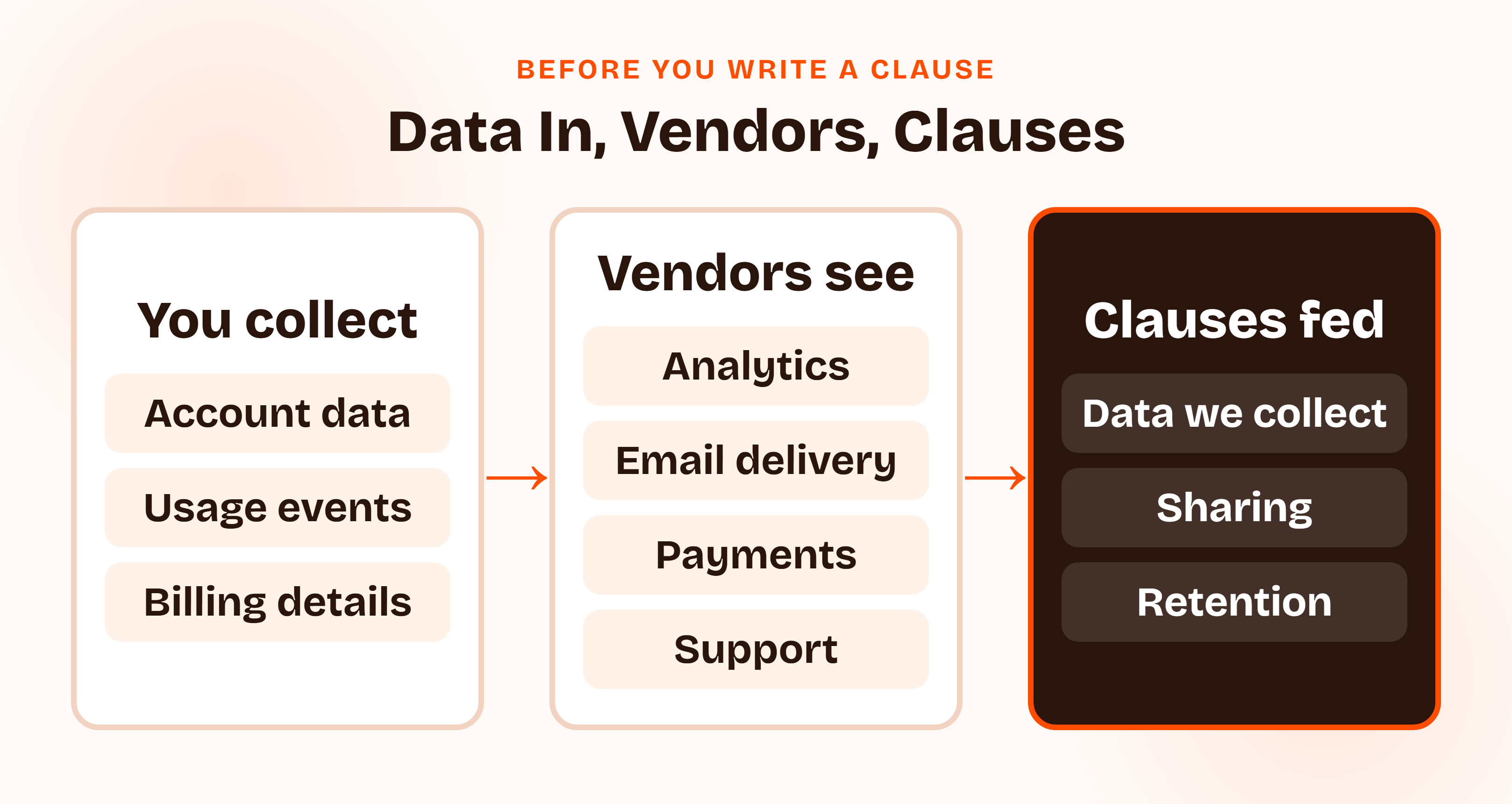
The data clause fails when it lists what the founder remembers instead of what the system collects. Sort it into three buckets before you write a word.
- Given by users: name, work email, password, billing details, support messages, and anything typed into a profile
- Collected automatically: IP address, device and browser data, usage events, logs, and cookie identifiers
- Received from others: single sign-on providers, data enrichment vendors, referrals, and customer admins who invite users
Then ask whether you hold any sensitive categories, such as health, biometric or precise location data. If the honest answer is no, say you do not collect them. Do not list them just because a generator did.
Try this yourself
Open your browser's developer tools on your own signup page, go to the Network tab, reload, and list every third-party request. Every domain on that list is either a recipient the policy must cover or a tag you did not know you were running. Do this before you write the data and sharing clauses.
Privacy Policy Template Purposes, Legal Basis and Sharing: Writing What You Do, Not What Sounds Safe
Pair each purpose with a legal basis. The table shows a typical SaaS pattern. Treat it as a starting position to test against your own processing, not a ruling on what basis applies to you.
| Purpose | Typical legal basis | What to say in plain words |
|---|---|---|
| Creating and running the account | Contract | We use your details to provide the service you signed up for |
| Billing and tax records | Contract and legal obligation | We keep records to charge you and meet accounting rules |
| Product analytics and security monitoring | Legitimate interests | We look at usage to fix bugs, prevent abuse and improve the product |
| Marketing emails | Consent, or legitimate interests where the local law allows it | We email you about updates, and you can opt out at any time |
| Advertising and retargeting tags | Consent | We run these only if you accept them |
Where you rely on legitimate interests, Article 13 says to state them, so write one sentence on what the interest is. Where you rely on consent, the policy must also say the person can withdraw it.
On sharing, name the categories at minimum: hosting, analytics, email delivery, payments, customer support tooling, error monitoring. Naming the vendors is better, and buyers often ask for it. A Hacker News commenter, in May 2018, put the standard simply: "disclose any third party that sees all or part of the data", along with the reason for using that service.
Decide how you will handle vendor changes. Either keep a sub-processor list on a separate page that you update, or list vendors in the policy and treat each change as a policy update. The first is easier to keep current.
Retention, Security and Rights Requests in a Privacy Policy Template: The Clauses Most Templates Leave Blank
These three are where generic templates go vague. "We keep data as long as necessary" does not meet Article 13, which asks for the period or the criteria used to set it.
State a period where you have one, and the criteria where you do not. The rows below are adjustable defaults, not legal periods. Your own tax, contract and regulatory obligations decide what is right for you.
| Data | Example retention statement | Adjust for |
|---|---|---|
| Account data | While the account is active, then deleted within [90 days] of closure | Your deletion process and backup cycle |
| Billing records | [7 years] after the transaction | Tax and accounting rules where you operate |
| Server and access logs | [12 months] | Your security monitoring needs |
| Marketing contacts | Until unsubscribe, or after [24 months] of no engagement | Local marketing and consent rules |
The internal schedule that backs these statements lives in your retention policy, covered in our data retention policy guide. The public statement should never promise more than the schedule delivers.
For security, describe what you actually do in terms a customer can check: encryption in transit and at rest, access controls, and independent audits if you hold them. Avoid "we use industry-leading security" and "your data is 100% safe." Neither is verifiable, and the second is a promise nobody can keep.
For rights requests, give a channel, say how you confirm identity, and state your response time as your own commitment. GDPR Article 12(3) requires action without undue delay and within one month of receipt, extendable by two further months for complex or numerous requests, with notice to the person. A promise tighter than the law is fine only if you can keep it.
Pro tip
Write every sentence in the retention and rights clauses so a support agent could follow it. If the sentence says you delete account data within 90 days and nobody on the team knows how, the sentence is a risk, not a clause.
Privacy Policy Template for SaaS: Controller, Processor and Customer Data
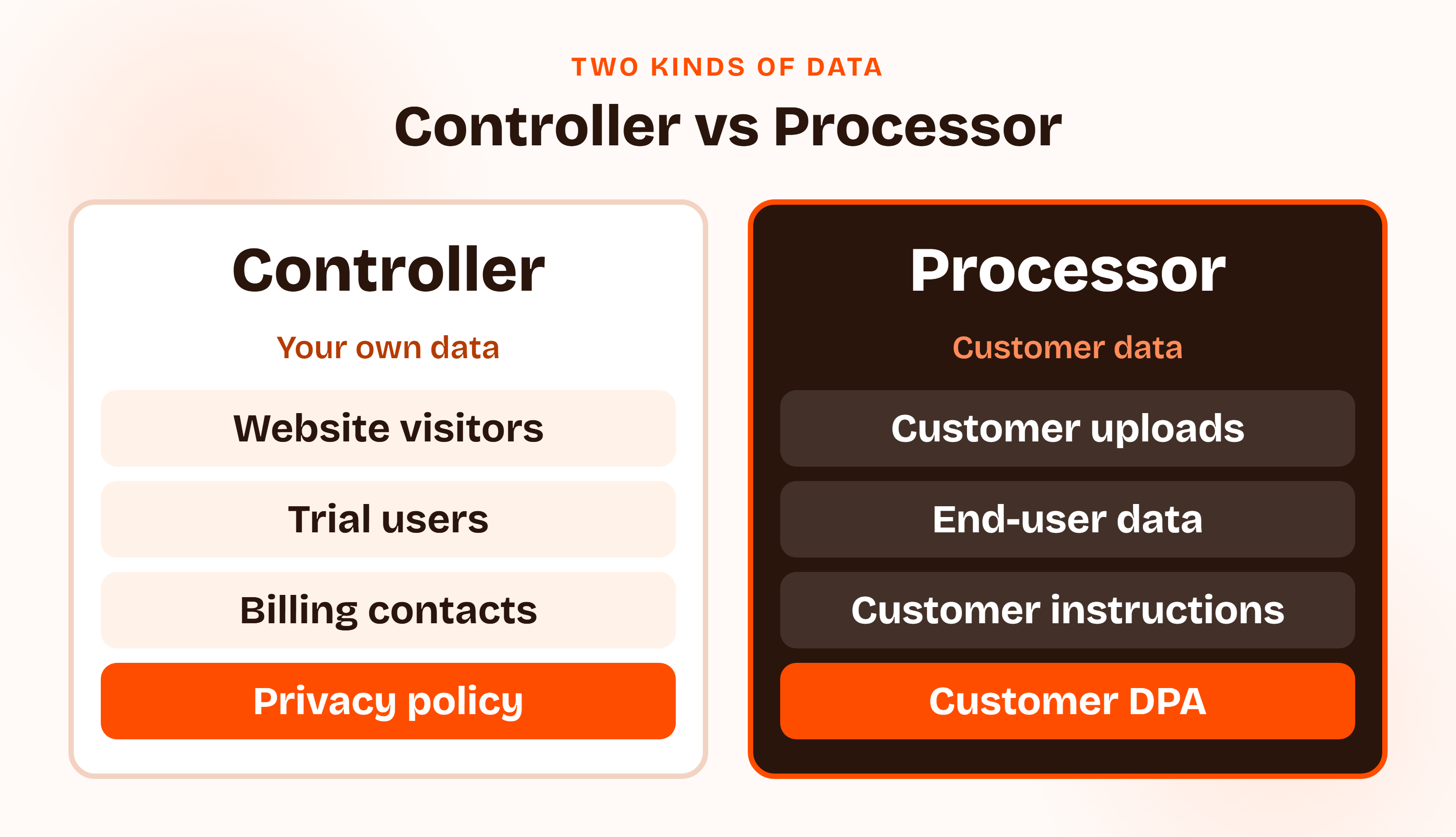
Here is the split that matters most for SaaS companies and that generic templates skip. You hold two different kinds of personal data, and your role is different for each.
For your own website visitors, trial users and account holders, you decide why and how the data is used. You are the controller. For the data your customers load into your product about their own users or employees, the customer decides the purpose and you act on their instructions. You are usually the processor.
GDPR Article 28 says processing by a processor is governed by a contract. That contract is the customer data processing agreement, not your public privacy policy.
| Data type | Your role | Which document covers it | Who answers a rights request |
|---|---|---|---|
| Website visitors and cookie data | Controller | Privacy policy and cookie policy | You |
| Trial sign-ups and account holders | Controller | Privacy policy | You |
| Billing contacts | Controller | Privacy policy | You |
| Data your customers upload or generate in the product | Usually processor | Customer DPA and your terms | The customer, with your help |
| Data of your customer's end users | Usually processor | Customer DPA | The customer, with your help |
Quick answer
Add one short paragraph to the policy: "We process the data our customers submit to the service on their instructions. If you are one of our customers' users, contact the customer first, and we will assist them with your request." That points people to the right place without making promises the DPA has to carry.
The same data flows that make you a controller or processor also make you a customer of other vendors. Your hosting provider, analytics tool and support platform each process data on your behalf, which is the vendor side of the picture. Our third-party risk management policy guide covers how to manage that side.
Customer Story
"It made SOC 2 and ISO 27001 readiness clear and manageable with automated workflows, evidence collection, and expert support."
David Orr, COO, Romina Day
Privacy Policy Template for Startups: A Free Example You Can Download
Here is what a privacy policy example looks like as clauses you can adapt. Square brackets mark the facts only you can supply. Everything else is written to be used as it stands once it matches your practices.
Privacy Policy Example: Sample Clauses You Can Adapt
Sample clause 1: Who we are
[Company legal name] ("we", "us") runs [product name]. We are the controller of the personal data described in this policy. You can reach us at [privacy email address] or at [postal address]. [If you have appointed a data protection officer: Our data protection officer can be contacted at [address].]
Sample clause 2: Data we collect
We collect data you give us, such as your name, work email address, password and billing details, and the messages you send our support team. We collect some data automatically when you use the service, such as your IP address, browser and device type, and the pages and features you use. We may receive data from others, for example when you sign in through a single sign-on provider or when a colleague invites you to an account. We do not knowingly collect [health, biometric or precise location] data.
Sample clause 3: How we use data and why
We use your data to provide the service and manage your account (to perform our contract with you), to bill you and keep records (contract and legal obligation), to secure the service and understand how it is used (our legitimate interests in keeping it safe and improving it), and to send product updates and marketing emails (your consent, or our legitimate interests where the law allows). You can withdraw consent at any time.
Sample clause 4: Who we share data with
We share data with service providers that help us run the service: [hosting, analytics, email delivery, payments, customer support, error monitoring]. They may use it only on our instructions. The current list is at [sub-processor page link]. We do not sell your personal data, and we [do / do not] share it for cross-context behavioral advertising. We may disclose data where the law requires it.
Sample clause 5: International transfers
We are based in [country] and our providers may process data in [countries]. Where data leaves the European Economic Area or the United Kingdom, we rely on [an adequacy decision / standard contractual clauses] and additional safeguards where needed. You can ask us for a copy of the safeguards at [privacy email address].
Sample clause 6: How long we keep data
We keep account data while your account is active and delete it within [90 days] after you close it. We keep billing records for [7 years] to meet tax and accounting rules, and server logs for [12 months]. Where we cannot give a fixed period, we keep data only as long as needed for the purpose it was collected for, or as the law requires.
Sample clause 7: Your rights and complaints
Depending on where you live, you may have the right to access, correct, delete, restrict or object to our use of your data, to receive it in a portable format, and to opt out of its sale or sharing. To use these rights, email [privacy email address]. We will confirm your identity and respond within [30 days]. If you are in the EU or UK, you may also complain to your local data protection authority. We do not penalize you for using your rights.
Sample clause 8: Cookies and do not track
We use cookies and similar technologies for [essential functions, analytics and, with your consent, advertising]. Third parties such as [analytics provider] may collect data about your activity on our site through these technologies. [Our site does not respond to browser "do not track" signals / We respond to browser "do not track" signals by ...]. You can manage cookies through [cookie settings link] and your browser.
Sample clause 9: Children and changes
Our service is not directed to children under [16], and we do not knowingly collect their data. If we make material changes to this policy, we will tell you by [email or in-app notice] before they take effect and update the date below. Earlier versions are available at [link]. Effective date: [date].
Clause 8 above is the boundary with your cookie policy. The privacy policy needs the tracking disclosure, and a separate cookie policy can carry the detailed cookie table.
Free Template
Download the Free Privacy Policy Template (PDF)
All twelve clauses with filled sample wording, a retention table, a sub-processor table, a changes log, and a one-page customization checklist. A starting point, not legal advice.
Layered Privacy Policy Example: A Short Summary on Top of the Full Text
A long policy is hard to read, and GDPR asks for concise, easily accessible information. A layered policy puts a short summary at the top and the full text below it.
Sample summary layer
The short version: we collect your account details and usage data to run [product name]. We share data only with the service providers that help us operate it. We do not sell your data. You can ask to see, correct or delete your data at any time at [privacy email address]. The full policy follows.
Put the link where people make decisions, not only in the footer:
- the footer of every page
- the signup form, next to the button
- in-app settings
- app store listings, where the store requires a privacy policy link
- checkout, where billing details are collected
How to Customize and Roll Out Your Privacy Policy Template
Can you use a free privacy policy template as is? No. A template cannot know which tools you run, which countries your users are in, or which clauses you can truthfully stand behind. Three things go wrong most often: it lists transfer mechanisms that no longer apply, it includes clauses for features you do not have, and it leaves out facts that only you know.
Customizing it is a sequence. Do it in this order, because each step feeds the next.
- Inventory the data and tools. List what you collect, where it is stored, and which vendors touch it.
- Map each item to a purpose and a legal basis. If you cannot name a purpose, stop collecting it.
- Fill the clauses from the inventory, not from memory.
- Delete what does not apply. A children's clause for a product with no child users still needs a position, but a Brazil section for a company with no Brazilian users does not.
- Get counsel review. One hour of a privacy lawyer's time on a finished draft is cheaper than a rewrite.
- Publish with an effective date and keep the old version.
- Link it from the footer, the signup form and your app listings.
- Brief the team, so support, sales and engineering know what the policy promises.
Action step
Before you publish, check each of these: every tool on your network-request list appears in the sharing clause, every retention period matches what your systems do, the rights email address is monitored, and the effective date is set. A policy that passes those four checks is already better than most.
If your product touches many systems, the inventory in step 1 is the hard part. Our best data mapping software guide covers tools for building and maintaining that inventory at scale.
Keeping Your Privacy Policy Template Accurate: Updates, Triggers and Version History
A privacy policy is accurate on the day you publish it and starts drifting the next sprint. How often should you update it? On a fixed review schedule you commit to, and immediately when something changes.
The triggers are specific enough to put in your engineering checklist.
| Change | Why the policy must change |
|---|---|
| New analytics, advertising or tracking tool | It creates a new recipient and often new cookies |
| New sub-processor | The sharing clause and the sub-processor list change |
| New data category | The data clause and the legal basis table change |
| New product feature, including AI features | A new purpose, and possibly a new recipient |
| New market or user region | New laws, rights and transfer rules may apply |
| Change in retention | The retention clause must match what you now do |
| Security incident | Security statements and any notices may need revisiting |
Keep a short version log with each change, its date, and a one-line summary. Show the effective date at the top of the policy, announce material changes the way the policy says you will, and keep prior versions available. Under CalOPPA the policy has to describe how users are told about material changes, so what you wrote in the changes clause becomes a promise you have to keep.
Note
Review the policy on a fixed cadence even when nothing seems to have changed, for example every six months, and record the review. That cadence is your own commitment. Some laws may set a minimum review frequency of their own, so ask your counsel whether one applies to you.
Privacy Policy Evidence for Buyers, SOC 2 and ISO 27701
A published policy is also evidence. Different readers use it for different decisions.
| Audience | What they ask | What you show |
|---|---|---|
| Enterprise buyer | Is there a public notice, and does it match what you do? | The live policy link and your sub-processor list |
| SOC 2 auditor | Is a privacy notice in scope, and is it current? | The policy, its version history, and review records |
| ISO 27701 assessor | How do you inform individuals and handle their rights? | The notice, the rights process, and records |
| Regulator | What did you tell people, and when? | The dated policy versions |
What Enterprise Security Reviews Ask About Your Privacy Policy
Questionnaires tend to ask the same short questions. Do you have a public privacy notice? What categories of data do you collect? Who are your sub-processors? How do you handle transfers outside the EU? How do individuals exercise their rights? Do you offer a DPA?
Sample answer: Customer questionnaire
Yes. [Company] publishes a privacy policy at [link], last updated [date]. It describes the categories of personal data we collect, our purposes and legal bases, our sub-processors (listed at [link]), international transfer safeguards, retention, and how individuals can exercise their rights at [privacy email address]. A data processing agreement is available on request.
Every statement in that answer has to be true on the day you send it. That is why the policy, the sub-processor page and the DPA should be updated together.
Where SOC 2 and ISO 27701 Look for Privacy Notice Evidence
Most startups start with the Security category of SOC 2 and add the optional Privacy category later, if a customer asks for it. Published mappings of the Trust Services Criteria place the first privacy criterion, P1.1, on providing notice to data subjects about the entity's privacy practices. The criteria themselves are published by the AICPA, so confirm the current wording with your auditor before you cite a specific point of focus.
ISO 27701 extends ISO 27001 to a privacy information management system, and it includes controls on determining and providing information to the individuals whose data you process. Control numbering changed between editions, so confirm which edition your assessor uses. Our ISO 27701 guide walks through the framework.
Neither framework calls for a specific "privacy policy template." What an auditor tests is whether the notice exists, is accurate, is easy to find, and is kept up to date, which is why the version log in the previous section matters.
Privacy Policy Template Mistakes to Avoid
These are the errors that show up again and again when a policy is read against the product.
- Copying a competitor's policy. It describes their tools, their regions and their promises, not yours. It also copies their mistakes.
- Listing tools you no longer use, or omitting ones you do. Both are inaccurate. Check the list against the network requests on your own pages every time you ship a new integration.
- Promising "we never share your data" while running ad pixels. An absolute claim is the easiest sentence to prove false.
- Stale transfer language. The EU-US Privacy Shield was invalidated by the Court of Justice in July 2020 in the Schrems II ruling, and the European Commission adopted a replacement adequacy decision for the EU-US Data Privacy Framework in July 2023. That framework faces a pending appeal at the Court of Justice, so name the transfer mechanism you actually rely on and check it periodically.
- Leaving retention as "as long as necessary." GDPR asks for a period or the criteria used to set one. A vague phrase gives neither.
- Publishing with no effective date or version history. You cannot show a buyer, an auditor or a regulator what you told people on a given day.
How ComplyJet Helps You Maintain Your Privacy Policy Template
The policy is a document. Keeping it true is a process, and that is the part we help with. ComplyJet supports GDPR as a framework, with AI-assisted policy drafting, policy distribution with employee acknowledgment tracking, and evidence collection for audits. Your privacy policy sits alongside your internal policies, with the review dates and acknowledgments an auditor looks for.
To be direct about scope: we do not generate your public privacy notice from a scan of your website, run a cookie banner, or operate a data subject request portal, and we are not a legal advisor. You still own the policy text and the legal review. What we do is help you keep the surrounding compliance program organized and ready for audit.
Compliance Automation
Keep your policies reviewed and audit-ready
See how ComplyJet handles policy drafting, distribution and acknowledgments alongside your GDPR and audit evidence.
FAQs
Do I Need a Privacy Policy for My SaaS?
Yes, in practice. GDPR can reach non-EU companies that offer services to people in the EU, California requires a posted policy for sites that collect personal information from its residents, and app stores and enterprise buyers ask for the link. Even a small product that collects only account emails needs one.
What Is the Difference Between a Privacy Policy and a Privacy Notice?
Mostly the label, so privacy policy vs privacy notice is a question of vocabulary. GDPR speaks of information that must be provided to individuals, and many companies call the public document a privacy notice. A privacy policy is the full document. A notice at collection is the short statement shown where you collect data, and it should link to the full policy.
What Is the Difference Between a Privacy Policy and Terms of Service?
A privacy policy describes what you do with personal data. Terms of service are the contract that sets the rules for using your product. The policy is a statement of your practices, while the terms are agreed to by the user, so keep them as two documents and link each from the other.
Is a Free Privacy Policy Template Enough?
It is a good start and not a finish. A template cannot know your tools, your regions or your retention periods, so it will include clauses that do not apply and miss facts that do. Fill it from your own data inventory and have a lawyer review it before you publish.
Does a Privacy Policy Need to Mention GDPR and CCPA?
Not by name, but it needs the content each law requires. For GDPR that means legal bases, transfers, retention and rights. For California it means the categories collected, the consumer rights, and the links for sale or sharing where they apply. Many companies add short sections labeled for each jurisdiction so readers can find theirs.
How Often Should I Update My Privacy Policy?
Update it whenever your practices change, such as a new tool, sub-processor, data category or feature, and review it on a fixed schedule you set, such as every six months. Ask your counsel whether a statute sets a minimum cadence for you.
Where Should I Put My Privacy Policy?
Link it from the footer of every page, the signup form, in-app settings, app store listings, and checkout. Make it a plain, readable page that does not sit behind a login, so a buyer or regulator can reach it without an account.
Related Reading
- Information Security Policy: the internal counterpart to this public document
- GDPR Compliance Requirements: the full obligations behind the notice
- CCPA Compliance Guide: what California law requires beyond the notice
- Data Retention Policy: the internal schedule behind your retention statement
- Best Data Privacy Software: tools for privacy programs
- GDPR Compliance: how to build a GDPR program