.svg)

A customer's security questionnaire lands with one line that stops you cold: "Attach your written password policy." What you actually have is a Slack thread from eighteen months ago and an unspoken agreement that everyone uses a password manager, probably.
A password policy template is a written, adoptable document that defines how a company creates, stores, changes, and enforces passwords, covering minimum length, multi-factor authentication, storage rules, and review cadence. A current template follows 2025-2026 NIST guidance (length over complexity, no forced rotation) and maps to whichever compliance frameworks actually apply, whether that's SOC 2, ISO 27001, HIPAA, PCI DSS, or GDPR.
Quick answer
A password policy template covers eight things: purpose and scope, password creation requirements, multi-factor authentication, storage and password-manager requirements, account lockout, an exceptions process, enforcement and ownership, and a review cadence. A current one is built on NIST SP 800-63B-4 (2025): longer minimum length instead of forced complexity, no periodic rotation, and mandatory breach screening.
By the end of this guide, you'll have a complete, current password policy template you can adapt in an afternoon, not a week of cross-referencing five different framework guides to figure out what your auditor actually wants to see.
Here's what I'll cover:
- What a password policy template actually is, and how it differs from general best-practices advice
- What current NIST guidance says for 2026, and what it replaced
- Everything a complete template needs to include, section by section
- How requirements differ (and mostly don't) across SOC 2, ISO 27001, HIPAA, PCI DSS, and GDPR
- A free, downloadable template with real sample clauses
- How to roll it out so it's actually enforced, not just written
- The mistakes that get password policies flagged in an audit
What Is a Password Policy Template?
A password policy template is a reusable, adaptable document, not a one-off memo. A company fills it in with its own scope, ownership, and specific requirements, then formally adopts it as an official policy.
That's a different thing from password policy best practices, which is the reasoning behind what goes into the document. Best practices are the "why." A template is the actual artifact you adopt, sign off on, and hand to an auditor.
Most companies write one for the first time under pressure: a customer security questionnaire asks for it directly, a SOC 2 or ISO 27001 audit is starting, or leadership simply decides that "everyone knows to use a strong password" isn't a policy anyone can point to. Whether the team calls it a password policy template or an IT password policy internally, the document a reviewer expects to see is the same one.
Quick take
A password policy template is the document you adopt. Password policy best practices are the reasoning behind it. Most teams eventually need both, but only one of them satisfies an auditor asking for evidence.
How This Differs From ComplyJet's SOC 2 and ISO 27001 Password Guides
This article is the generic, framework-agnostic template, not a substitute for ComplyJet's own SOC 2 password requirements guide, an eight-step walkthrough of building a SOC-2-specific policy mapped to CC6.1 through CC6.3, or its ISO 27001 password policy guide, built specifically around Annex A control 5.17.
If you already know you're pursuing SOC 2 or ISO 27001 specifically and want the deep implementation walkthrough for that one framework, including exactly what an auditor asks to see as evidence, those two guides go further than this template does. This one is the faster, framework-agnostic starting point, and it's the one with an actual downloadable document.
Note
These three pages work together, not in competition. Start here if you haven't picked a framework yet, or need one policy that covers several at once. Move to the SOC 2 or ISO 27001 guide once you're deep into that specific audit and need control-by-control evidence language.
Why Every Company Needs a Password Policy Template
Weak or undocumented password practices show up constantly in breach post-mortems, and they're one of the first things a SOC 2 or ISO 27001 auditor, or a customer's security reviewer, asks to see in writing.
"We have good password habits" and "we have a documented password policy" are not the same claim, and only one of them satisfies an auditor. Reviewers, questionnaires, and cyber-insurance underwriters all ask for the document itself, not a verbal assurance that people are careful.
A written policy also removes ambiguity internally. New hires and IT admins get one adopted standard instead of tribal knowledge that quietly erodes as the team grows past the size where everyone just knows how things are done.
Watch out
"Informal practice isn't a policy" is the same gap that trips up most unwritten controls, not just password rules. If a reviewer can't point to a document, it doesn't count, no matter how disciplined the team actually is.
Password Policy Best Practices: What NIST Recommends for 2026
A strong password policy in 2026 is built on one source: NIST Special Publication 800-63B, the U.S. government's digital identity guideline, and specifically its Revision 4, finalized August 26, 2025. This is the standard nearly every credible password guide, including SOC 2 and ISO 27001-aligned ones, is benchmarked against.
Four things changed the shape of a good policy:
- Length over complexity. Longer passphrases beat forced special-character and mixed-case rules.
- No mandatory periodic rotation. Password changes are tied to evidence of compromise or a role change, not a fixed calendar.
- Mandatory breach screening. New passwords get checked against known-breached and commonly-used password lists at creation time, not left to the user's judgment.
- MFA as a required companion control, with phishing-resistant methods and passkeys treated as stronger than SMS-based codes.
The length number is the one figure worth memorizing, since it's the single most common thing an outdated template still gets wrong.
Quick take
NIST SP 800-63B-4, Section 3.1.1.2, requires a minimum of 15 characters for passwords used as the sole authentication factor, and a minimum of 8 characters when the password is only one factor in an MFA setup. It explicitly prohibits forced composition rules, and requires screening every new password against known-breached and commonly-used password lists. Source: NIST SP 800-63B-4, Section 3.1.1.2.
NIST Password Guidelines: What Changed From Older Advice
I looked at a password policy template still being distributed today. It requires passwords to be changed every 90 days and to mix upper case, lower case, numbers, and symbols. Both of those are exactly what current guidance recommends against.
| Outdated advice (still common) | Current NIST SP 800-63B-4 guidance |
|---|---|
| 8-character minimum | 15-character minimum for password-only login (8-character minimum only when paired with MFA) |
| Mandatory mixed-case, numbers, and symbols | No forced composition rules |
| Forced periodic rotation (30, 60, or 90 days) | No periodic rotation; change only on evidence of compromise or a role change |
| No screening against breached passwords | Mandatory screening against breach corpuses and commonly-used passwords |
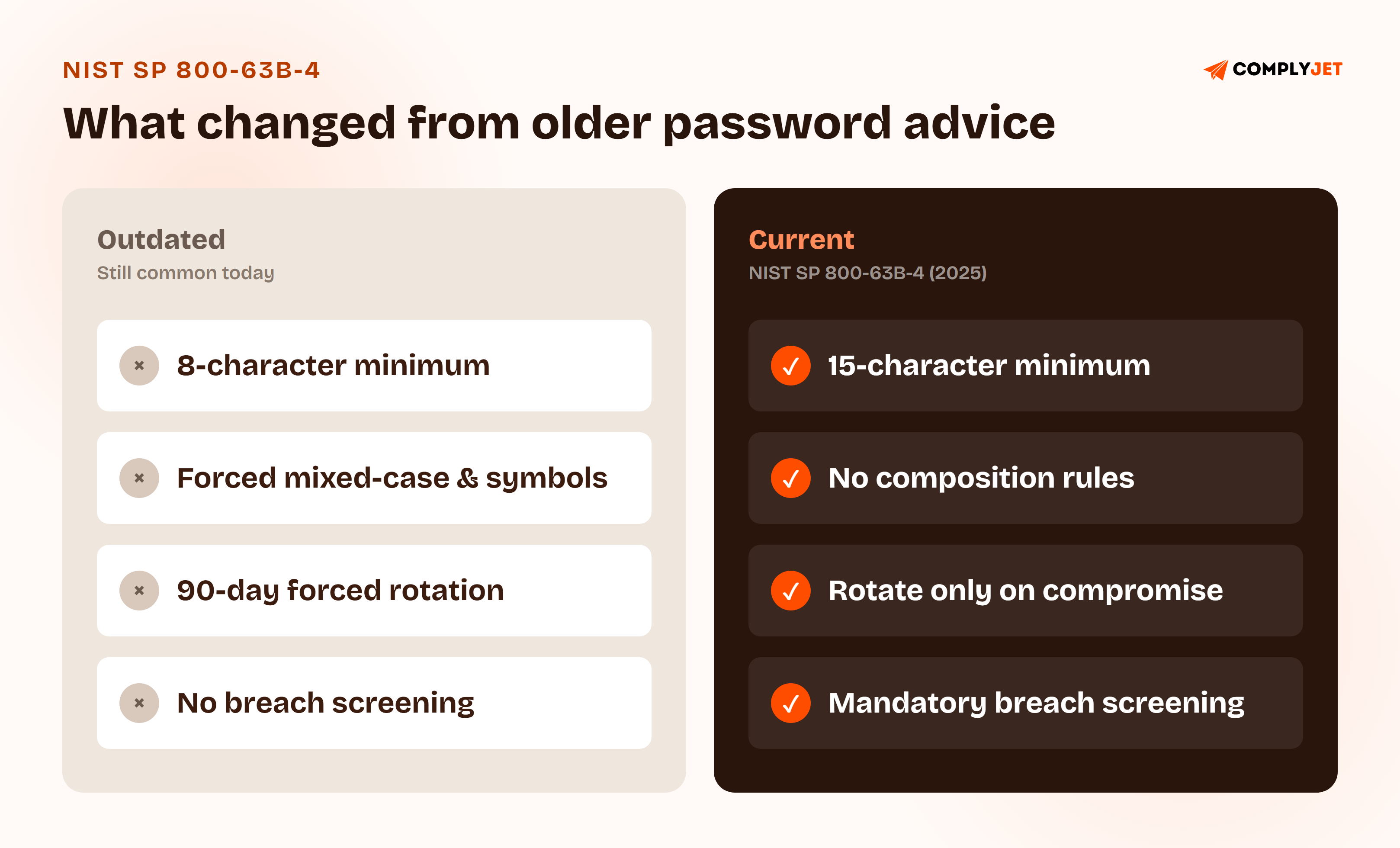
A practical self-check: if your current policy still requires quarterly password changes and a symbol, it's overdue for an update.
What to Include in a Password Policy Template
A complete password policy template has eight core sections. Here's what each one covers and why a reviewer actually checks it.
| Section | What It Covers | Why Auditors and Reviewers Check It |
|---|---|---|
| Purpose and scope | Who and what systems the policy applies to | Scope gaps (forgetting contractors or service accounts) are a common audit finding |
| Password creation requirements | Minimum length, passphrase guidance, no reuse across systems | Confirms the policy reflects current NIST guidance, not outdated rules |
| Multi-factor authentication | Which systems require MFA and in what form | MFA gaps are one of the fastest ways to fail a logical-access control test |
| Password storage and manager requirements | Mandatory approved password manager, no browser-saved or written-down passwords | Storage failures turn a strong password requirement into a weak one in practice |
| Account lockout and monitoring | Failed-attempt thresholds and what happens after lockout | Shows the policy is technically enforced, not just written |
| Exceptions process | How a documented deviation gets approved, and by whom | Legacy systems that can't meet current requirements need a logged exception, not silence |
| Enforcement and ownership | Who owns the policy and how it's technically enforced | A policy with no named owner is a document nobody's accountable for |
| Review cadence | How often the policy itself gets revisited | Frameworks and NIST guidance change; a policy that never gets reviewed goes stale |
Some teams call this document an IT password policy internally. Auditors, HR, and customer security reviewers all expect to see the same document, whatever it's called internally. One artifact, several audiences.
The Core Sections of a Password Policy Template
- Purpose and scope: name who it applies to explicitly, including all employees, contractors, and service accounts
- Password creation requirements: minimum length, passphrase guidance, and a no-reuse rule across systems
- Multi-factor authentication requirements: which systems require MFA and what form it takes (app-based, hardware key, or passkey)
- Password storage requirements: a mandatory approved password manager, with browser-saved or written-down passwords explicitly prohibited
- Account lockout and monitoring: failed-attempt thresholds and what happens once an account locks
- Exceptions process: how a documented deviation, like a legacy system that can't support current requirements, gets approved
- Enforcement and ownership: who owns the policy, and how it's enforced technically through identity-provider configuration, not just the written word
- Review cadence: how often the policy itself, not just individual passwords, gets revisited
Password Policy Template Requirements: Length, Storage, and Breach Screening
Translated into template-ready language, the NIST best practices above become three concrete requirements: a length-based minimum instead of a complexity rule, mandatory breach screening at creation time, and a required password manager for storage. Most competing templates get the length part right and stop there.
Note
Pairing a length requirement with an explicit breach-screening requirement matters more than either one alone. A 15-character password that's already circulating in a breach corpus isn't actually strong.
Password Policy Requirements by Framework: SOC 2, ISO 27001, HIPAA, PCI DSS, and GDPR
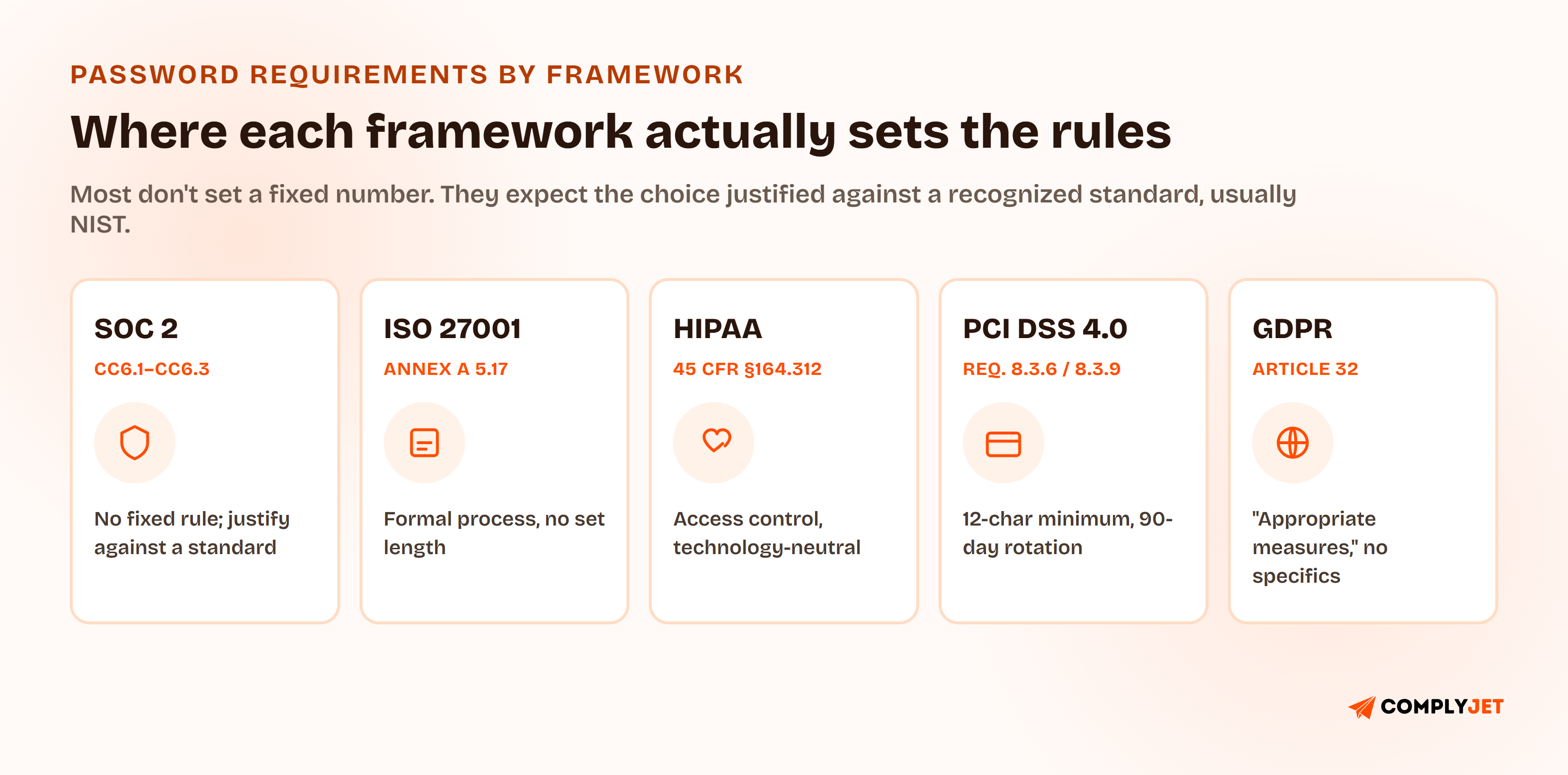
A strong password policy for employees needs to hold up against whichever framework a company is actually pursuing, and the honest answer is that most of them don't set fixed numeric password rules at all. They expect the company to justify its choices against a recognized standard, usually NIST.
| Framework | Where password requirements live | What it actually requires |
|---|---|---|
| SOC 2 | Trust Services Criteria CC6.1-CC6.3 (logical access security) | No fixed numeric rules; expects authentication strength (CC6.1), account provisioning and offboarding (CC6.2), and periodic access review (CC6.3) justified against a recognized standard |
| ISO 27001 | Annex A control 5.17, Authentication Information | Requires a formal process for allocating and managing authentication information; doesn't mandate a specific length, but expects a documented, enforced policy |
| HIPAA | Security Rule Technical Safeguards, 45 CFR §164.312(a) Access Control and §164.312(d) Person or Entity Authentication | Requires access-control and identity-verification procedures; sets no specific password length, complexity, or rotation parameters |
| PCI DSS 4.0 | Requirement 8.3, Strong Authentication | The most prescriptive of the five: Requirement 8.3.6 sets a 12-character minimum (8-character minimum if a system can't support 12); Requirement 8.3.9 requires passwords used as the sole authentication factor to be changed at least every 90 days, or account risk analyzed dynamically instead |
| GDPR | Article 32, Security of Processing | Requires "appropriate technical and organisational measures"; doesn't name passwords directly, but a documented password policy is commonly cited as evidence of meeting this requirement |
SOC 2 and ISO 27001 Password Policy Requirements
SOC 2 doesn't set a fixed numeric password rule. Password requirements sit under the CC6 series of Trust Services Criteria, and an auditor expects the company to justify its choices against a recognized standard like NIST rather than hitting a specific number. For the full step-by-step implementation, ComplyJet's SOC 2 password requirements guide maps CC6.1 through CC6.3 in detail.
ISO 27001's password requirements live under Annex A control 5.17, Authentication Information, which calls for a formal management process over how authentication information gets allocated and controlled. For the full breakdown, see ComplyJet's ISO 27001 password policy guide.
Note
Both frameworks point to a standard, not a number. That's exactly why a template built on current NIST guidance satisfies both, rather than needing a separate document for each.
HIPAA, PCI DSS, and GDPR Password Rules
HIPAA's Security Rule requires access controls and identity authentication under its Technical Safeguards, specifically 45 CFR §164.312(a) (Access Control) and §164.312(d) (Person or Entity Authentication), but the regulation text itself does not specify a password length, complexity rule, or rotation schedule. It's deliberately technology-neutral.
PCI DSS 4.0 is notably more prescriptive than the others. Requirement 8.3.6 sets a 12-character minimum password length (8 characters if a system genuinely can't support 12), and Requirement 8.3.9 requires that passwords used as the sole authentication factor be changed at least every 90 days, unless the account's risk posture is analyzed dynamically instead. These became mandatory for organizations handling cardholder data as of March 31, 2025.
GDPR doesn't set password rules directly. Article 32 requires "appropriate technical and organisational measures" for data security, and a documented password policy is commonly cited as one piece of evidence that requirement is being met.
Companies keep treating this as five separate problems because the frameworks are named differently. In practice, it's one password policy, mapped once against each framework's actual language, then reused everywhere a reviewer asks for it. — Upendra Varma, CTO at ComplyJet
Password Policy Template: A Free Example You Can Download
Here's a real password policy example: two sections of a current, NIST-aligned template, written out in full rather than just described.
Sample clause: Password Creation Requirements
All passwords must be a minimum of 15 characters when used as the sole authentication factor, or a minimum of 8 characters when combined with an approved multi-factor authentication method. Mandatory complexity rules (special characters, mixed case) are not required. New passwords are screened against a list of known-breached and commonly-used passwords at the time of creation; any match is rejected. Passwords may not be reused across company systems.
Sample clause: Enforcement
This policy is enforced primarily through identity provider (SSO) configuration, not individual memory or discretion. The IT/Security lead configures minimum-length and MFA requirements to match this document, monitors failed-login thresholds, and reviews logged exceptions quarterly. Any system that cannot technically enforce these settings must be recorded under the Exceptions process.
Free Template
Download the Free Password Policy Template (PDF)
All eight sections above, pre-filled with current NIST-aligned defaults, plus framework-specific notes for SOC 2, ISO 27001, HIPAA, PCI DSS, and GDPR readers to adapt.
Rolling Out a Company Password Policy for Employees
Writing the document is the easy half. A password policy for employees only works if it's actually enforced and lived, not filed away after the audit that prompted it.
- Assign an owner, usually the IT or security lead, who's accountable for keeping the document current.
- Get leadership to formally approve it, so it's an adopted policy, not a draft.
- Communicate it during onboarding, not as a standalone memo employees never open.
- Configure identity-provider settings so the written minimums are technically enforced, not just described.
- Require the approved password manager as part of account setup, not an optional recommendation.
- Set a review date on the calendar, so the policy doesn't quietly go stale as guidance changes.
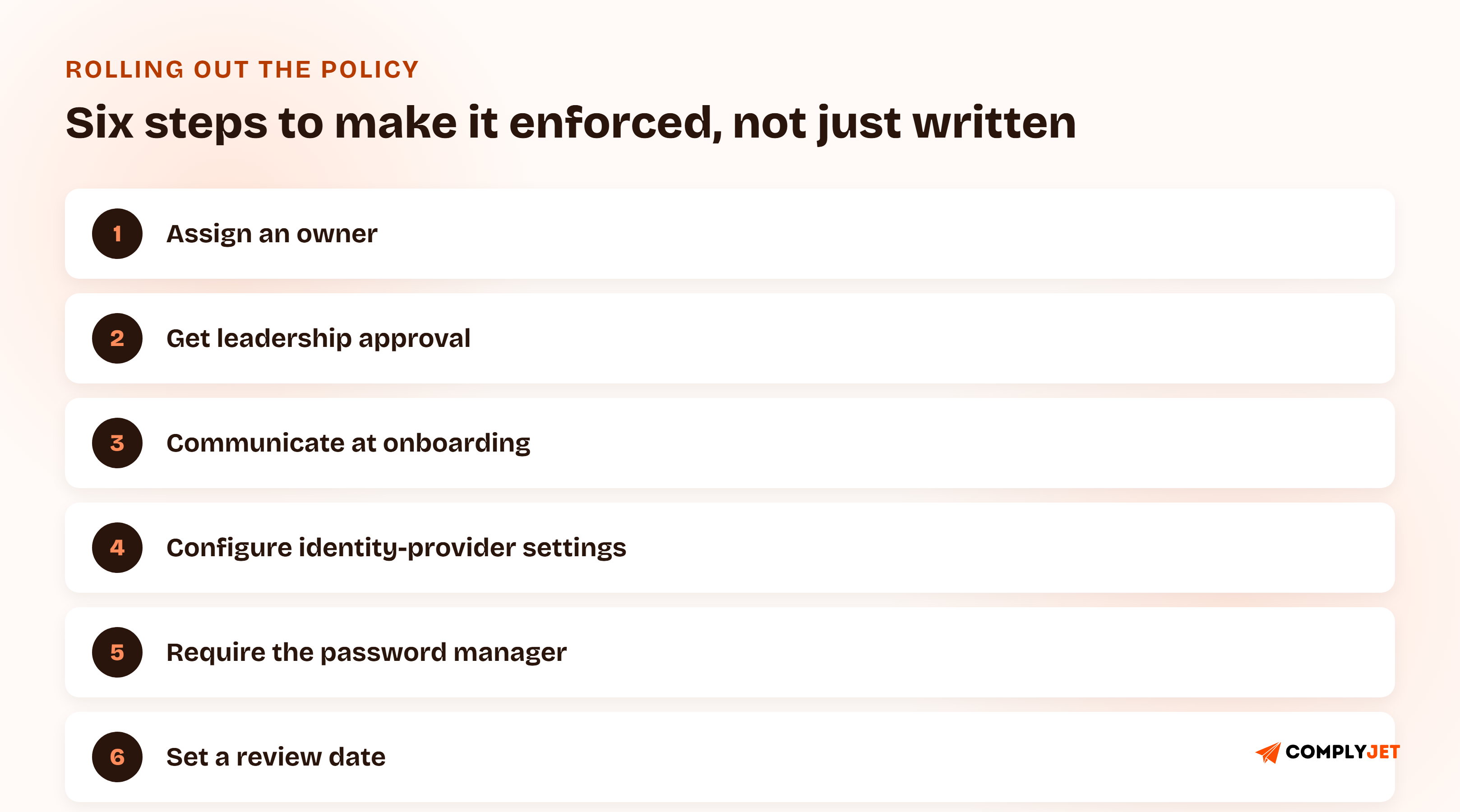
That sequence is the real distinction from the "what to include" section above: rollout is about making sure the policy is enforced and lived, not just written. A template alone doesn't pass an audit if nothing about it is technically backed.
Communicating and Enforcing Your Password Policy Template
The actual enforcement channel is identity provider (SSO) configuration, not employee memory. Set technical minimums that match the written policy exactly, so the two documents (the policy and the actual system configuration) can't quietly drift apart.
Action step
Name who revokes access and how fast in the rollout plan itself. Offboarding timing is one of the first things an auditor checks against a written policy, and a policy that never mentions it has an obvious gap.
Common Password Policy Template Mistakes That Fail Audits
- Copying an old template that still requires 90-day rotation and mandatory special characters. Current NIST guidance moved away from both, and auditors increasingly flag outdated requirements as readily as missing ones.
- Writing the policy but never configuring the identity provider to enforce it. A documented requirement with no technical backing is one of the most common audit findings.
- Leaving scope vague. Not naming which systems, contractors, or service accounts the policy applies to is an easy, avoidable gap.
- No documented exceptions process. Legacy systems that can't meet current requirements go unaddressed instead of being formally logged and approved.
- Treating the policy as a one-time document. No review cadence means it quietly goes stale as frameworks and NIST guidance evolve.
- Requiring MFA "where possible" instead of naming exactly which systems require it. Vague MFA language reads as a gap, not a control.
- Missing the offboarding link entirely. A password policy that never references how access gets revoked when someone leaves is an incomplete policy.
How ComplyJet Supports Your Company Password Policy
A written policy is the starting point. Turning it into enforced, evidence-backed controls is the part most companies underestimate, especially once an auditor starts asking for proof, not just the document.
We help teams do exactly that as part of a broader SOC 2, ISO 27001, HIPAA, or PCI DSS program: AI-assisted policy drafting to get the document itself right, plus integrations that pull the technical evidence an auditor actually asks for, like MFA status and identity-provider configuration, instead of leaving that to a manual screenshot hunt every audit cycle.
Compliance Automation
Turn your password policy into an enforced control
ComplyJet pairs AI-assisted policy drafting with integrations that pull the technical evidence auditors ask for, MFA status and identity-provider configuration included, across SOC 2, ISO 27001, HIPAA, and PCI DSS.
FAQs
What Should a Password Policy Include?
Purpose and scope, password creation requirements, MFA requirements, storage requirements, account lockout rules, an exceptions process, enforcement and ownership, and a review cadence. The full breakdown with explanations is in the "What to Include" section above.
How Often Should Passwords Be Changed?
Under current NIST guidance, not on a fixed schedule. Passwords should only be changed when there's evidence of compromise or a role or access change, which replaces the older 90-day-rotation standard most legacy policies still use.
What Is the NIST Password Policy?
NIST SP 800-63B-4 is the U.S. government's digital identity guideline that most modern password policies, including SOC 2 and ISO 27001-aligned ones, are benchmarked against. Its NIST password guidelines favor length over complexity, require breach screening, and discourage forced periodic rotation.
Does a Password Policy Need Multi-Factor Authentication?
Yes, for any policy meant to satisfy SOC 2, ISO 27001, or current NIST guidance. MFA is treated as a required companion control, not optional hardening, for any system handling sensitive or customer data.
How Long Should a Password Be?
Under NIST SP 800-63B-4, a minimum of 15 characters when the password is the sole login factor, or a minimum of 8 characters when it's combined with MFA. That's a meaningful jump from the 8-character minimums many older policies still specify.
What's the Difference Between a Password Policy and Password Policy Best Practices?
A password policy is the formally adopted, company-specific document. Password policy best practices, like NIST's guidance, are the general reasoning a well-built policy is based on. One is a document; the other is the thinking behind it.
How Do You Enforce a Password Policy?
Through technical controls, primarily identity-provider configuration, mandatory password managers, and MFA enforcement, not the written document alone. See the "Rolling Out" section above for the specific steps.
Is There a Free Password Policy Template PDF?
Yes. This article includes a downloadable password policy template PDF, pre-filled with current NIST-aligned defaults, a full password policy example for two of its sections, and framework-specific notes for SOC 2, ISO 27001, HIPAA, PCI DSS, and GDPR.
Related Reading
- SOC 2 Password Requirements Guide, the deep-dive, SOC-2-specific implementation walkthrough for readers who've already committed to that framework.
- ISO 27001 Password Policy, the Annex A 5.17-specific version for readers pursuing ISO 27001 certification.
- Access Control Policy, the broader access-management policy this password policy template sits under.
- Information Security Policy, the top-level policy this and other control-specific policies roll up into.
- Remote Access Policy, for readers whose password policy questions are really about remote or VPN access specifically.
Sources: NIST SP 800-63B-4, Digital Identity Guidelines: Authentication and Authenticator Management, Section 3.1.1.2, finalized August 26, 2025; 45 CFR §164.312, HIPAA Security Rule Technical Safeguards; PCI DSS 4.0 Requirements 8.3.6 and 8.3.9, effective March 31, 2025, per SecurityMetrics' summary of PCI DSS 4.0 password updates; GDPR Article 32, Security of Processing.