The pilot starts Monday. Then the customer's security contact sends one line: "Please countersign the attached BAA before we send any patient data." You have never signed one, you do not have a HIPAA BAA template of your own, and you cannot tell which terms are negotiable.
A HIPAA BAA template is an editable business associate agreement that carries every term 45 CFR 164.504(e)(2) requires: permitted uses, safeguards, reporting, subcontractor flow-down, support for individual rights, HHS access to records, return or destruction of PHI, and termination for material violation. Commercial terms sit around that fixed core, in brackets.
The real question is not which HIPAA BAA template to download. It is whose paper to use, which terms the regulation fixes, and which numbers (breach-notice hours, liability caps) are commercial choices.
This page is the agreement itself. For the concept (who counts as a business associate, when a BAA is required, how penalties work), ComplyJet's BAA explainer goes through it, and this page does not repeat it.
By the end, you will be able to pick the right paper for your role, fill the template in five steps, write a breach clause that matches the rule, and push back on a hospital's draft without guessing. You also get a free, ungated PDF.
Here's what I'll cover:
- What a BAA is, and which other contracts it is not
- Who signs what, depending on your role
- What 45 CFR 164.504(e) fixes by law
- Eleven clauses with sample wording written out
- The breach clock, and why 24 hours is a contract choice
- Flowing terms down to subcontractors
- Negotiating, signing and keeping BAAs current
This guide is practical information, not legal advice. Have healthcare counsel review the final agreement before it goes to a customer or vendor.
What a HIPAA BAA Template Is, and Which Contract It Is Not
A HIPAA BAA template is the fill-in version of the written contract HIPAA requires before protected health information (PHI, meaning individually identifiable health information) moves from a covered entity to a business associate, or from a business associate to its own subcontractor. It does not replace your master services agreement. It sits next to it, or inside it, and governs only the PHI.
What Is a BAA? One Sentence, Then the Document
A business associate agreement (BAA) is the written contract that HIPAA requires between a covered entity and a business associate, or between a business associate and a subcontractor, setting what the business associate may do with PHI and the safeguards it must keep (45 CFR 164.502(e) and 164.504(e)).
A covered entity is a health plan, clearinghouse or health care provider that transmits health information electronically. A business associate is a company that creates, receives, maintains or transmits PHI for a covered entity, or provides certain services to it that involve PHI, and is not part of the covered entity's workforce. That is the definition in 45 CFR 160.103. The same section counts a subcontractor that handles PHI for a business associate as a business associate too.
HIPAA BAA Template vs the BAA Explainer: Which Page You Need
| You need | Where to go |
|---|---|
| To know who is a business associate, when a BAA is required, and what the exclusions are | The BAA explainer |
| The agreement wording, the regulation behind each clause, the breach clock, negotiation positions and a PDF | This page |
If you already know a BAA is required and a customer is waiting on a draft, stay here.
BAA Agreement vs MSA, NDA and Security Addendum: How the Documents Stack
A BAA agreement is one of four documents a health-tech team usually signs with a customer. Each does a different job, and only one satisfies HIPAA's written-contract rule.
| Document | What it covers | Does it satisfy HIPAA? |
|---|---|---|
| Master services agreement (MSA) | Price, term, service levels, general liability | No, unless it also carries the BAA terms |
| NDA | Confidentiality of business information | No |
| Security addendum or questionnaire | Evidence of your controls | No, it supports the BAA but does not replace it |
| BAA | Permitted uses of PHI, safeguards, reporting, subcontractors, termination | Yes, if it meets 164.504(e) and 164.314(a) |
Quick take
A signed NDA or a vendor's security page does not satisfy the written-contract requirement. HHS says the BAA terms may sit inside the services agreement or in a separate document, so the test is whether the terms are there, not what the file is called.
Who Signs What: Picking the Right HIPAA BAA Template for Your Role
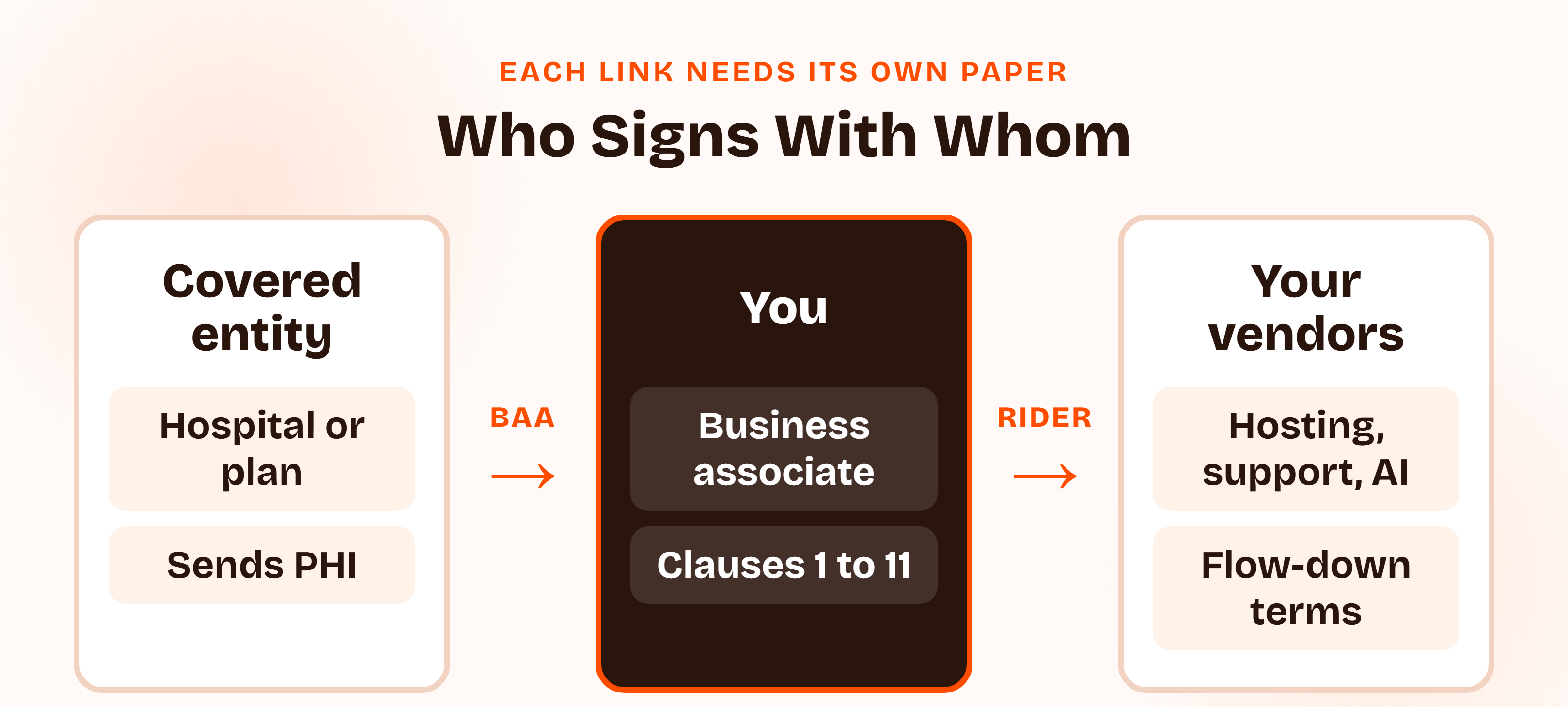
A SaaS company usually sits in the middle of a chain. The hospital is upstream, your hosting and support vendors are downstream, and each link needs its own paper.
| Your role in the deal | Who drafts first | Which part of this page to use |
|---|---|---|
| Covered entity engaging a vendor | You, or the vendor's standard BAA | Clauses 1 to 11 as a review checklist |
| Business associate serving a covered entity | The customer's paper, or your standard BAA | The full template, Clauses 1 to 11 |
| Business associate engaging a subcontractor | You | The subcontractor rider and Clause 5 |
HIPAA BAA Template for SaaS: You Are the Business Associate
This is the most common starting point for a startup. A hospital, clinic or health plan asks for a BAA, and you are the business associate. Prepare three things before the request arrives: a standard BAA of your own, a short list of where PHI actually flows in your product, and the security evidence a customer will ask for.
Three questions settle your role:
- Does your product create, receive, maintain or transmit PHI for a covered entity?
- Will a signed agreement be in place before the first record moves?
- Does anything downstream (hosting, logging, support tooling, AI services) touch that PHI?
If the answer to the first is yes, you are a business associate, and a HIPAA BAA template for SaaS is the document your sales team will need on the next deal.
Business Associate Agreement Template for Vendors You Hand PHI To
The same template works in reverse when you are the party handing PHI to a vendor. Hosting, logging and monitoring, support desks, e-signature, transcription and AI vendors all qualify when PHI passes through them. The BAA explainer covers the exclusions.
If you are unsure whether you are a covered entity at all, the covered entities guide walks through that test. If you handle health data outside the US, see HIPAA equivalent laws by country.
HIPAA
Selling into healthcare?
A BAA is one document inside a HIPAA program. See how ComplyJet supports HIPAA, from Privacy, Security and Breach Notification policies to a structured risk analysis and workforce training.
Why a Missing or Thin BAA Becomes the Finding
In March 2016, the HHS Office for Civil Rights (OCR) announced a $1.55 million settlement with North Memorial Health Care of Minnesota. Hunton's summary of the resolution says OCR found the hospital system had disclosed the PHI of about 290,000 people to a contractor, Accretive Health, without a business associate agreement, and had not completed an organization-wide risk analysis.
A month later OCR announced a $750,000 settlement with Raleigh Orthopaedic Clinic. Per Hunton's April 2016 post, the clinic had handed X-ray films to a vendor that converted them to electronic media in exchange for the silver, with no BAA in place.
| Case | Amount | What OCR found |
|---|---|---|
| North Memorial Health Care (March 2016) | $1.55 million | PHI disclosed to a billing contractor without a BAA, plus no organization-wide risk analysis |
| Raleigh Orthopaedic Clinic (April 2016) | $750,000 | PHI released to a film-conversion vendor without a BAA |
The regulation explains why. Under 164.504(e)(1), a covered entity is out of compliance if it knew of a business associate's pattern of activity that breached the contract and did not take reasonable steps to cure it or, failing that, end the contract where feasible. The same test applies between a business associate and its subcontractor. That is the reason Clause 9 below exists.
There is a commercial stake as well. A hospital's security review will not release data until the BAA is signed, so the template is a sales-cycle document as much as a compliance one. For the penalty framework, see ComplyJet's guide to the HIPAA enforcement rule.
Watch out
A BAA does not by itself make either party compliant. It records the assurances the Security Rule requires under 164.308(b). The business associate still has to run the safeguards the contract promises, and since HITECH it answers to OCR directly. HHS states plainly that a business associate is directly liable for uses and disclosures its contract does not allow and for failing to safeguard electronic PHI.
HIPAA BAA Template Requirements: What 45 CFR 164.504(e) Fixes by Law
The regulation is short. A fixed set of obligations goes into every BAA, and everything else is commercial. Knowing the line is what lets you concede a lot in negotiation without breaking the law.
Privacy Rule Terms Every HIPAA BAA Template Must Carry
The terms below come from 45 CFR 164.504(e). The last column shows where each one lives in the template on this page.
| Required term | Citation | Template clause |
|---|---|---|
| Establish permitted and required uses and disclosures, none of which the covered entity could not itself make | 164.504(e)(2)(i) | Clause 2 |
| No use or disclosure beyond the contract or as required by law | (e)(2)(ii)(A) | Clause 2 |
| Use safeguards and comply with Subpart C for electronic PHI | (e)(2)(ii)(B) | Clause 3 |
| Report unauthorized uses and disclosures, including breaches under 164.410 | (e)(2)(ii)(C) | Clause 4 |
| Subcontractors agree to the same restrictions | (e)(2)(ii)(D), (e)(5) | Clause 5 |
| Make PHI available for access (164.524) | (e)(2)(ii)(E) | Clause 6 |
| Make PHI available for amendment (164.526) | (e)(2)(ii)(F) | Clause 6 |
| Provide information for accountings of disclosures (164.528) | (e)(2)(ii)(G) | Clause 6 |
| Comply with Privacy Rule requirements that bind the covered entity when you carry out its obligations | (e)(2)(ii)(H) | Clause 7 |
| Make internal practices, books and records available to the HHS Secretary | (e)(2)(ii)(I) | Clause 7 |
| Return or destroy PHI at termination if feasible, otherwise extend protections and limit further use | (e)(2)(ii)(J) | Clause 8 |
| Allow the covered entity to terminate for a material violation | (e)(2)(iii) | Clause 9 |
Two optional extras come from 164.504(e)(4). The business associate may use PHI for its own proper management and administration or to carry out its legal responsibilities. It may disclose PHI for those purposes only if the disclosure is required by law, or if the recipient gives reasonable assurances of confidentiality and agrees to report known breaches. Data aggregation for the covered entity's health care operations is allowed only if the contract provides for it.
Security Rule Terms: 164.314(a) and 164.308(b)
The Security Rule adds its own layer for electronic PHI. Under 164.308(b), a covered entity may let a business associate handle ePHI only after getting satisfactory assurances, and a business associate may do the same with a subcontractor. Those assurances must be documented in a written contract or other arrangement that meets 164.314(a).
Under 164.314(a)(2)(i), that contract must require the business associate to:
- Comply with the applicable Security Rule requirements
- Make sure any subcontractor handling ePHI agrees to comply as well
- Report any security incident it becomes aware of, including breaches of unsecured PHI under 164.410
That last duty is wider than the breach duty, which matters for Clause 4.
Required, Needed to Work, or Commercial: Sorting Business Associate Agreement Clauses
Business associate agreement clauses fall into three buckets. Label them before you negotiate.
| Bucket | Examples in this template | Can you change it? |
|---|---|---|
| Required by regulation | Permitted uses, safeguards, reporting, flow-down, individual-rights support, HHS access, return or destruction, termination for material violation | No, only the wording |
| Needed to make it work | Definitions, order of precedence, notices, survival, amendment for changes in law | Yes, but keep them |
| Commercial | Breach-notice hours, forwarding windows, cure period, liability cap, indemnity, insurance, cost of breach response | Yes, this is what you negotiate |
Important
The only breach-reporting number in the rule is the 60-calendar-day outer limit in 164.410. Any hour count in a contract is a commercial choice, which is why the template shows every such number in brackets.
HIPAA BAA Template Clauses: What to Write, With Sample Wording
Each clause below gives the duty and its citation, the sample wording in full, and a verdict. The wording is adapted for a SaaS company acting as business associate. It follows the structure of HHS's own sample provisions, which HHS says are only sample language, not required for compliance, and may be changed to fit the business arrangement.
HHS adds that the sample alone may not be enough for a binding contract under state law and does not replace a lawyer. Treat everything here the same way. Brackets mark party details and commercial choices.
HIPAA BAA Template Clause 1: Definitions and Roles
Define terms by pointing at the regulation, then name the parties and the services. HHS's sample uses a catch-all: the listed terms "shall have the same meaning" as in the HIPAA Rules, including Breach, Designated Record Set, Minimum Necessary, Security Incident and Unsecured Protected Health Information.
Sample clause: Definitions and roles
"Business Associate" means [Company]. "Covered Entity" means [Customer]. "HIPAA Rules" means the Privacy, Security, Breach Notification and Enforcement Rules at 45 CFR Parts 160 and 164. Capitalized terms not defined in this Agreement, including Breach, Designated Record Set, Disclosure, Minimum Necessary, Protected Health Information, Required By Law, Secretary, Security Incident, Subcontractor, Unsecured Protected Health Information and Use, have the meanings given in the HIPAA Rules. This Agreement applies to Protected Health Information that Business Associate creates, receives, maintains or transmits for Covered Entity in providing the services described in Exhibit A.
One drafting choice is worth raising with counsel: whether to define reportable security incidents so that unsuccessful attempts such as pings and port scans do not each trigger a notice. The HIPAA Rules define the term, and a contract that leaves it undefined invites arguments later.
Verdict: needed to make it work. Short, by reference, and tied to Exhibit A.
HIPAA BAA Template Clause 2: Permitted and Required Uses and Disclosures
This is the heart of the agreement. The business associate may use or disclose PHI only as the contract permits or as required by law (164.502(a)(3) and 164.504(e)(2)(i) and (ii)(A)), and the contract may not authorize anything the covered entity could not do itself.
Sample clause: Permitted uses and disclosures
Business Associate may use and disclose Protected Health Information only as necessary to perform the services described in Exhibit A, as permitted by this Agreement, or as Required By Law. Business Associate will not use or disclose Protected Health Information in a manner that would violate Subpart E of 45 CFR Part 164 if done by Covered Entity, except as permitted in this Section. Business Associate may use Protected Health Information for its own proper management and administration and to carry out its legal responsibilities. Business Associate may disclose Protected Health Information for those purposes only if the disclosure is Required By Law, or Business Associate obtains reasonable assurances from the recipient that the information will stay confidential and be used or further disclosed only as Required By Law or for the purpose for which it was disclosed, and the recipient agrees to notify Business Associate of any known breach of confidentiality. Business Associate will request, use and disclose only the minimum necessary Protected Health Information to accomplish the intended purpose. [Optional: Business Associate may provide data aggregation services relating to the health care operations of Covered Entity.] Business Associate will not de-identify Protected Health Information, or use it to train or improve its own products, unless Exhibit A expressly permits it.
The last sentence matters for any SaaS product with analytics or AI features. HHS's sample says the parties should specify whether the business associate may use PHI to de-identify the information under 164.514(a) to (c), so silence is a gap, not a safe default. Minimum necessary comes from 164.502(b).
Verdict: required, with the commercial detail in Exhibit A. List purposes narrowly and delete the data-aggregation option unless you need it.
HIPAA BAA Template Clause 3: Safeguards and Security Rule Compliance
The business associate must use appropriate safeguards and comply with Subpart C for electronic PHI (164.504(e)(2)(ii)(B) and 164.314(a)(2)(i)(A)). Under HITECH section 13401, now codified at 42 U.S.C. 17931, the Security Rule's administrative, physical and technical safeguard sections and its documentation section apply to a business associate in the same way they apply to a covered entity.
Sample clause: Safeguards
Business Associate will use appropriate administrative, physical and technical safeguards, and will comply with Subpart C of 45 CFR Part 164 with respect to electronic Protected Health Information, to prevent use or disclosure of Protected Health Information other than as provided for by this Agreement. Business Associate's current safeguards are described in [its security addendum / its most recent SOC 2 report available on request]. Business Associate will conduct and document a risk analysis and keep its safeguards reasonable and appropriate for the risks identified, and will train its workforce members on these obligations.
Pro tip
Do not paste a customer's full control list into the BAA as a warranty. Point to a security addendum or an audit report instead, so a control you later improve does not become a breach of contract.
Verdict: required. Keep the "reasonable and appropriate" standard and promise only what you can evidence.
HIPAA BAA Template Clause 4: Reporting Unauthorized Uses, Security Incidents and Breaches
Three reporting duties sit here: any use or disclosure the contract does not allow (164.504(e)(2)(ii)(C)), any security incident (164.314(a)(2)(i)(C)), and any breach of unsecured PHI under 164.410. HHS's sample says the parties may add "a stricter timeframe" for reporting a potential breach, which is the bracket below.
Sample clause: Reporting
Business Associate will report to Covered Entity: (a) any use or disclosure of Protected Health Information not provided for by this Agreement of which it becomes aware; (b) any Security Incident of which it becomes aware; and (c) any Breach of Unsecured Protected Health Information. Business Associate will report a Breach without unreasonable delay and in no case later than [__] calendar days after discovery, as discovery is determined under 45 CFR 164.410(a)(2), and in any event within [24 to 72] hours after Business Associate confirms the Breach. The report will identify, to the extent known, each individual whose Unsecured Protected Health Information was or is reasonably believed to have been accessed, acquired, used or disclosed, and will give Covered Entity the other information it needs to notify individuals under 45 CFR 164.404(c), supplemented as more becomes known. Unsuccessful Security Incidents, such as pings and port scans that do not result in unauthorized access, are reported by this sentence and require no further notice. Business Associate will cooperate with Covered Entity's investigation and mitigation.
The next section breaks down BAA breach notification: what the rule sets and what the bracketed hours add.
Verdict: required, with a commercial number. Never promise an hour count you cannot meet.
HIPAA BAA Template Clause 5: Subcontractors
A business associate must make sure any subcontractor that handles PHI for it agrees to the same restrictions, conditions and requirements (164.504(e)(2)(ii)(D) and (e)(5)). The full flow-down, including a rider you can attach, is covered in the subcontractor section below.
Sample clause: Subcontractors
In accordance with 45 CFR 164.502(e)(1)(ii) and 164.308(b)(2), Business Associate will ensure that any Subcontractor that creates, receives, maintains or transmits Protected Health Information on its behalf agrees in writing to the same restrictions, conditions and requirements that apply to Business Associate with respect to that information. Business Associate will give Covered Entity a current list of such Subcontractors on request. [Optional: Business Associate will notify Covered Entity at least [15 to 30] days before engaging a new Subcontractor for the services in Exhibit A.]
Verdict: required. The notice period for new subcontractors is commercial.
HIPAA BAA Template Clause 6: Individual Rights: Access, Amendment and Accounting
The business associate must support the covered entity's duties to give individuals access to PHI (164.524), amend it (164.526) and account for disclosures (164.528). The covered entity has 30 days to act on an access request, with one 30-day extension in limited cases. Your window to the covered entity has to fit well inside that.
Sample clause: Individual rights
Within [10 to 15] days after Covered Entity's written request, Business Associate will make available Protected Health Information in a Designated Record Set as necessary to satisfy Covered Entity's obligations under 45 CFR 164.524, make any amendment to Protected Health Information that Covered Entity directs or agrees to under 45 CFR 164.526, and make available the information required to provide an accounting of disclosures under 45 CFR 164.528. If an individual sends Business Associate a request directly, Business Associate will forward it to Covered Entity within [5 to 10] business days and will not respond to the individual except as Covered Entity directs.
HIPAA Journal points out that long chains of subcontractors stretch this clock. Its example is a chain of five downstream parties that each allow ten days, which uses up the 30 days before the covered entity ever sees the data (see its business associate agreement guide).
Verdict: required, with commercial windows. Set each window from the covered entity's 30 days backward.
HIPAA BAA Template Clause 7: HHS Access to Books and Records and Carrying Out the Covered Entity's Duties
Two short required terms share this clause. The business associate makes its internal practices, books and records available to the HHS Secretary so HHS can determine compliance (164.504(e)(2)(ii)(I)). And to the extent it carries out a covered entity obligation under the Privacy Rule, it complies with the requirements that apply to that obligation (164.504(e)(2)(ii)(H)).
Sample clause: HHS access and delegated duties
Business Associate will make its internal practices, books and records relating to the use and disclosure of Protected Health Information available to the Secretary for purposes of determining compliance with the HIPAA Rules. To the extent Business Associate is to carry out one or more of Covered Entity's obligations under Subpart E of 45 CFR Part 164, Business Associate will comply with the requirements of Subpart E that apply to Covered Entity in the performance of those obligations. [Optional: Business Associate will cooperate with a reasonable audit by Covered Entity, no more than [once per year] unless a Breach has occurred, on [30] days' notice.]
Verdict: required. Audit cooperation for the customer is commercial, so offer a report before an on-site visit.
HIPAA BAA Template Clause 8: Return or Destruction of PHI at Termination
At termination, the business associate returns or destroys all PHI if feasible. If that is not feasible, it extends the contract's protections to the PHI it keeps and limits further use to the purposes that make return or destruction infeasible (164.504(e)(2)(ii)(J)). Backups and logs are where "not feasible" usually applies.
Sample clause: Return or destruction
Within [30 to 60] days after this Agreement ends for any reason, Business Associate will return to Covered Entity, or, if Covered Entity agrees, destroy, all Protected Health Information it still maintains in any form, and will certify destruction in writing on request. If return or destruction is not feasible, including for encrypted backups and logs that are overwritten on a fixed cycle, Business Associate will notify Covered Entity of the reasons, extend the protections of this Agreement to the retained information, and limit further use and disclosure to the purposes that make return or destruction infeasible, for as long as it retains the information. These obligations survive termination.
Verdict: required, with a commercial window. Write the backup case out so it is not a surprise at the end of the contract.
HIPAA BAA Template Clause 9: Term and Termination for Material Violation
The covered entity must be able to terminate if the business associate violates a material term (164.504(e)(2)(iii)). A cure period is optional, and HHS's sample shows it in brackets for that reason. Tie termination of the BAA to the service agreement so you do not strand a customer mid-contract.
Sample clause: Term and termination
This Agreement takes effect on [effective date] and continues until the services agreement ends or this Agreement is terminated under this Section, whichever is earlier. Covered Entity may terminate this Agreement, and the services agreement to the extent it depends on Protected Health Information, if Covered Entity determines that Business Associate has violated a material term of this Agreement and Business Associate has not cured the violation within [30] days after written notice. If cure is not possible, Covered Entity may terminate immediately.
Verdict: required, with a commercial cure period. A cure window protects you and costs the customer nothing.
HIPAA BAA Template Clause 10: Liability, Indemnification and Insurance
The regulation requires none of this. It is purely commercial, and it is where most negotiation time goes. Offer these as bracketed options, never as "standard".
Sample clause: Liability (options)
[Option A: Each party's liability under this Agreement is subject to the limitations in the services agreement.] [Option B: Business Associate's aggregate liability under this Agreement is capped at [amounts paid in the 12 months before the claim], except for liability arising from Business Associate's own gross negligence or willful misconduct.] [Option C: Business Associate will reimburse Covered Entity's reasonable, documented costs of notifying affected individuals, up to [cap], where a Breach results from Business Associate's failure to comply with this Agreement.] Business Associate will maintain [cyber liability] insurance of at least [amount] during the term.
Verdict: commercial. Counsel should draft this one, and the cap should mirror your services agreement.
HIPAA BAA Template Clause 11: Order of Precedence, Amendment and Governing Law
The last clause keeps the document working. The BAA prevails over the services agreement on anything touching PHI. The parties agree to amend for changes in law. HHS's optional miscellaneous provisions offer the same three moves: references to the HIPAA Rules mean the rules as amended, the parties amend as needed for compliance, and any ambiguity is read to permit compliance.
Sample clause: Precedence, amendment and governing law
If this Agreement conflicts with the services agreement on the handling of Protected Health Information, this Agreement controls. A reference to a section of the HIPAA Rules means that section as in effect or as amended. The parties will amend this Agreement as necessary to comply with the HIPAA Rules and other applicable law, and any ambiguity will be read to permit compliance with the HIPAA Rules. This Agreement is governed by the laws of [State], except where federal law controls. Nothing in this Agreement gives a third party any right.
State health-privacy laws can add duties beyond HIPAA. That is a reason to have counsel read the final version, not a reason to attempt a state survey in the contract.
Verdict: needed to make it work. Short, and it protects the other ten clauses.
BAA Breach Notification: What the Rule Sets and What Contracts Add
Two clocks run in a breach, and neither is 24 hours. This section covers BAA breach notification in terms of what the rule sets and what a contract can add. The covered entity and the business associate each have their own, starting from their own discovery.
| Who notifies whom | What the rule says | Source |
|---|---|---|
| Business associate to covered entity | Without unreasonable delay and in no case later than 60 calendar days after discovery | 164.410(b) |
| Covered entity to affected individuals | Without unreasonable delay and in no case later than 60 calendar days after discovery | 164.404(b) |
| What counts as "discovery" | The first day the breach is known, or would have been known with reasonable diligence | 164.410(a)(2), 164.404(a)(2) |
| Whose knowledge counts | Any workforce member or agent, other than the person who committed the breach | 164.410(a)(2) |
| Law-enforcement hold | The deadline can be delayed where 164.412 applies | 164.412 |
Both rules say the 60 days is an outer limit, and "without unreasonable delay" is the standard that comes first. The 60-day figure is also not a safe harbor. Notice that waits until day 59 for a breach you could have understood on day 5 is still late.
Security Incident vs Breach: Why Both Need a Definition
A breach is an impermissible acquisition, access, use or disclosure of PHI that compromises its security or privacy, and under 164.402 it is presumed to be one unless a risk assessment shows a low probability of compromise.
A security incident is a wider idea, and 164.314(a)(2)(i)(C) requires the business associate to report any it becomes aware of. A BAA that mentions only breaches leaves the incident duty undefined. A BAA that defines incidents too broadly buries both parties in notices about port scans.
That is the reason Clause 4 includes a sentence on unsuccessful attempts.
HIPAA BAA Template Reporting Clock: Rule Limit vs Contract Hours
Take one incident and run it on two timelines. The rule's limit is the outer edge. The contract's hours, if any, sit inside it.
| Timeline | Starts | Ends | Where the number comes from |
|---|---|---|---|
| Rule limit for business associate notice | Discovery, as defined in 164.410(a)(2) | No later than 60 calendar days after, and without unreasonable delay | The regulation |
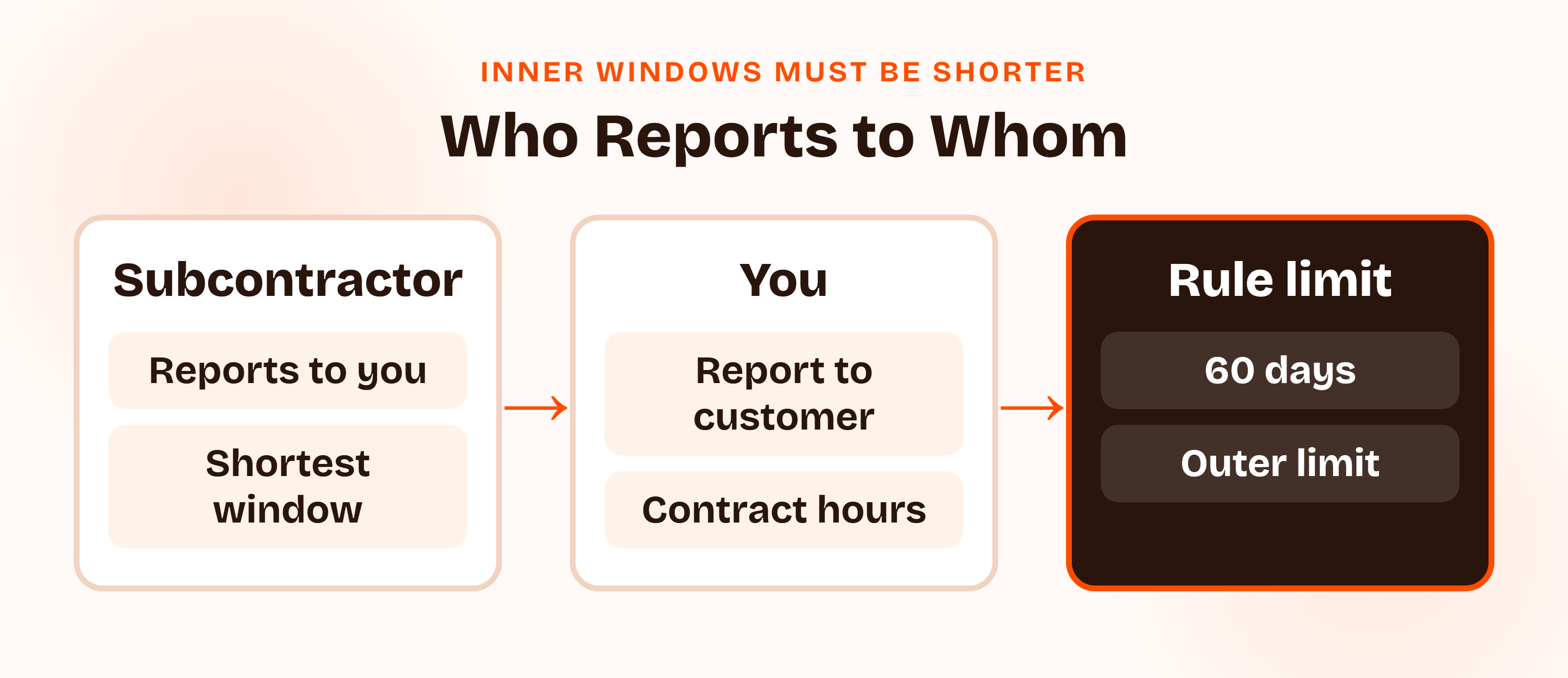
| Contract window for business associate notice | Discovery, or confirmation of the breach, as the contract defines it | [24 to 72] hours, or a bracketed number of days | The negotiation |
| Subcontractor's window to you | Its own discovery | Shorter than your window to the customer | Your flow-down terms |
On real positions: a Scrut guide to negotiating a SaaS BAA lists "within 24 hours of discovery" as a common covered-entity ask, and suggests a counter built around a window you can meet after triage, with a defined start point. Spendflo's template page labels its own day counts as illustrative, not as legal requirements. I would treat both as commercial positions to bargain from, not as a standard.
Try this yourself
Pick your last three security alerts. For each one, mark the moment it would have counted as "discovered" under the rule: when anyone on your team knew, or would have known with reasonable diligence. Then ask whether a 24-hour promise would have held. If not, bargain for a window that starts at confirmation.
For what happens after a report reaches HHS, see ComplyJet's HIPAA violation report guide.
Subcontractor Business Associate Agreement: Flowing the Terms Down
A business associate's own vendors are business associates too when they touch PHI, and the upstream BAA does not cover them automatically.
The rule is direct. 164.504(e)(5) applies the same contract requirements to a contract between a business associate and a subcontractor. 164.308(b)(2) lets a business associate permit a subcontractor to handle ePHI only after satisfactory assurances. 164.314(a)(2)(iii) applies the Security Rule terms down the chain the same way. HHS adds in its sample provisions that its language, written for covered entity and business associate contracts, may be adapted for a subcontractor.
A subcontractor business associate agreement can be short, because it only has to carry the same restrictions down. Attach this rider to your vendor's paper or sign it as a stand-alone document.
Sample rider: Subcontractor flow-down
[Subcontractor] agrees to the same restrictions, conditions and requirements that apply to [Company] under its business associate agreement with [Customer] with respect to Protected Health Information, including the safeguards required by Subpart C of 45 CFR Part 164. [Subcontractor] will report to [Company] any use or disclosure not provided for, any Security Incident and any Breach of Unsecured Protected Health Information without unreasonable delay and in any event within [__] hours of discovery, so that [Company] can meet its own reporting obligations. [Subcontractor] will return or destroy Protected Health Information on termination as provided in Clause 8, and will ensure that any further subcontractor it engages agrees to these terms in writing.
The squeeze to watch is timing. Your window to your customer has to be longer than your subcontractor's window to you. If your hosting provider gets 72 hours and you promised your customer 48, you have breached your own clause before you have even heard of the incident.
Which of Your Vendors Need a Subcontractor BAA
| Vendor type | Touches PHI? | Usual action |
|---|---|---|
| Cloud hosting and storage | Yes, if PHI is stored or processed there | Sign a BAA |
| Logging and monitoring | Yes, if logs can contain PHI | Sign a BAA, or scrub PHI from logs |
| Support desk and email | Yes, if customers paste PHI into tickets | Sign a BAA, or block PHI in tickets |
| E-signature and e-fax | Yes, if documents carry PHI | Sign a BAA |
| Transcription | Yes | Sign a BAA |
| AI and LLM services | Yes, if prompts or files include PHI | Sign a BAA, or keep PHI out |
On cloud storage, HHS's cloud computing guidance, issued October 2016, addresses the "we only hold encrypted data" argument head on. As Mintz's summary of the guidance quotes OCR: "Lacking an encryption key does not exempt a CSP from business associate status and obligations under the HIPAA Rules." Encryption lowers the risk. It does not remove the BAA.
Watch out
If a vendor will not sign a BAA, you have two honest options: keep PHI out of that tool, or replace it. A vendor's security page is not a substitute for the written contract.
Free HIPAA BAA Template: The PDF You Can Download and Edit
The free HIPAA BAA template below is an ungated PDF, a complete HIPAA business associate agreement template you can edit. No form, no email, no account.
The HIPAA business associate agreement template PDF carries the eleven clauses written out above, Exhibit A (services and PHI covered), Exhibit B (current subcontractors), the subcontractor flow-down rider, a one-page vendor-side checklist, a changes log and a customization checklist. Every commercial number is a bracketed range, and the PDF says plainly that the regulation sets only the 60-day outer limit.
Free Template
Download the Free HIPAA BAA Template (PDF)
Eleven clauses with sample wording, Exhibits A and B, a subcontractor rider, a vendor-side checklist, a changes log and a customization checklist. No email required.
Business Associate Agreement Sample: The Clauses at a Glance
This business associate agreement sample summary shows what each clause does and how to treat it.
| # | Clause | Citation | Treat it as |
|---|---|---|---|
| 1 | Definitions and roles | 45 CFR 160.103 | Needed to make it work |
| 2 | Permitted and required uses and disclosures | 164.504(e)(2)(i), (ii)(A), (e)(4) | Required |
| 3 | Safeguards and Security Rule compliance | 164.504(e)(2)(ii)(B), 164.314(a) | Required |
| 4 | Reporting incidents and breaches | 164.504(e)(2)(ii)(C), 164.410 | Required, commercial number |
| 5 | Subcontractors | 164.504(e)(2)(ii)(D), (e)(5) | Required |
| 6 | Individual rights | 164.524, 164.526, 164.528 | Required, commercial windows |
| 7 | HHS access and delegated duties | 164.504(e)(2)(ii)(H), (I) | Required |
| 8 | Return or destruction | 164.504(e)(2)(ii)(J) | Required, commercial window |
| 9 | Term and termination | 164.504(e)(2)(iii) | Required, commercial cure period |
| 10 | Liability, indemnification, insurance | None | Commercial |
| 11 | Precedence, amendment, governing law | None | Needed to make it work |
How to Fill In the HIPAA BAA Template: Five Steps
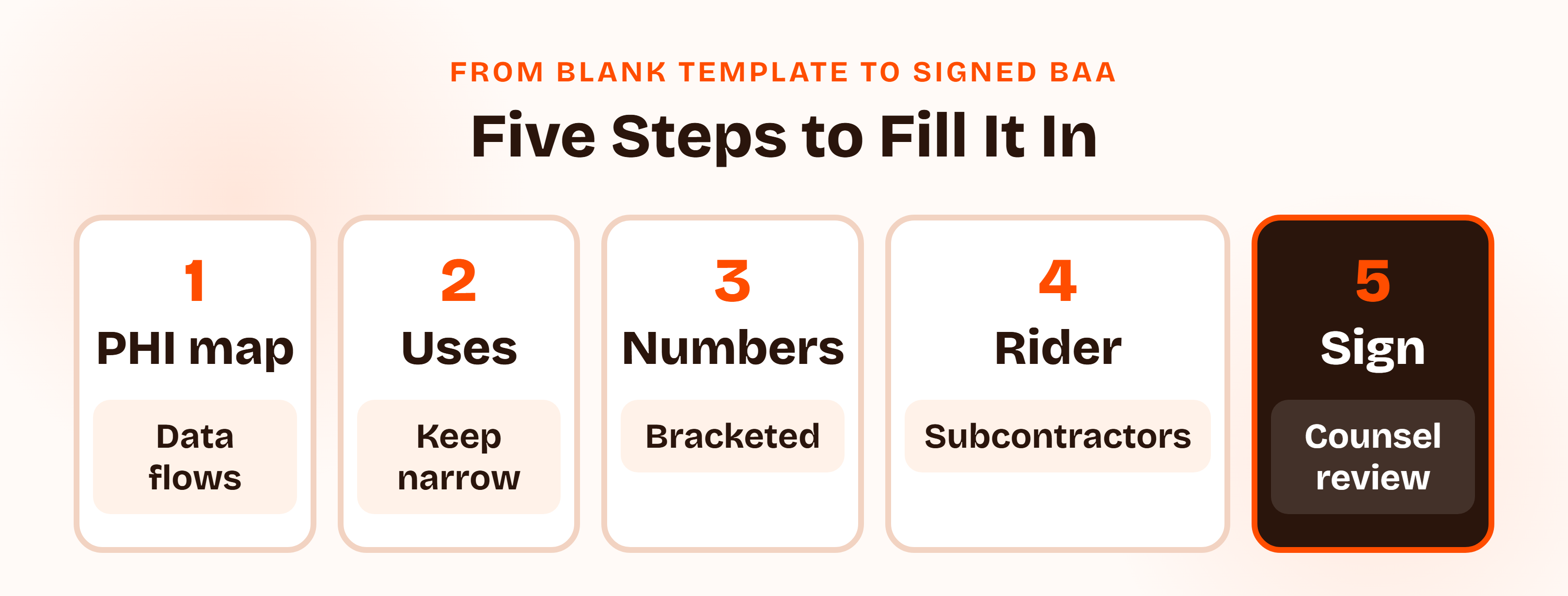
- List your PHI data flows. Name the parties, the services, and every system where PHI is created, received, stored or sent. Put it in Exhibit A.
- Set permitted uses. Keep them narrow and delete the data-aggregation option unless you need it.
- Choose your commercial numbers. Breach-notice hours, forwarding window, return or destruction window and cure period are all yours to bracket and bargain.
- Add the subcontractor rider. List your current subcontractors in Exhibit B and attach the rider to each vendor's paper.
- Get counsel review, sign, and file. Put the executed copy in your BAA inventory the same day.
Business Associate Agreement Checklist Before You Sign
Run this business associate agreement checklist on every BAA, yours or theirs:
- ☐ Parties and effective date are correct
- ☐ Exhibit A describes the real services and PHI
- ☐ Permitted uses are listed, not "any lawful purpose"
- ☐ Every term in the Privacy Rule table above is present
- ☐ Security incident and breach are both defined
- ☐ Breach window starts at a defined point and your team can meet it
- ☐ Subcontractor flow-down is present and your own vendors have signed
- ☐ Return or destruction covers backups and logs
- ☐ Termination for material violation is present, with a cure period if agreed
- ☐ Liability matches your services agreement
- ☐ The BAA wins on PHI if it conflicts with the services agreement
- ☐ Counsel has read it
Customer Story
When a customer contract requires HIPAA
Latitude Health, a healthcare AI company that sells to health plans, completed SOC 2 Type 2 and then reached HIPAA compliance, driven by a customer contract that required it.
Negotiating a HIPAA BAA Template With a Hospital, Health Plan or Vendor
Start with whose paper. A covered entity will often send its own draft. Offering yours first is reasonable, and it saves time if the customer accepts it. Large vendors, in turn, usually insist on their own standard BAA, so expect to review rather than redraft.
Whichever paper wins, check it against the Privacy Rule table above first. If every required term is there, everything else is commercial, and you can negotiate it calmly.
| Clause | A common ask | A reasonable counter | The regulatory floor |
|---|---|---|---|
| Breach notice | Within 24 hours of discovery | [48 to 72] hours from confirmation of a breach, with a defined start | Without unreasonable delay, 60 calendar days outer limit |
| Liability | Uncapped indemnity | A cap tied to fees paid, with a carve-out for your own gross negligence | None |
| Audit rights | On-site audit on demand | A current audit report first, then a limited audit after a breach | Books and records open to HHS only |
| New subcontractors | Prior written approval | Notice of [15 to 30] days with a right to object | Written flow-down terms |
| Return or destruction | Within [10] days | [30 to 60] days, with a backup carve-out | If feasible, otherwise extend protections |
Each number in the middle two columns is a commercial position, not a market statistic. Use it as a starting point and adjust for your size and your customer.
What to concede: extra reporting detail, cooperation with the covered entity's investigation, and a breach clock you can truly meet. What to hold: indemnity tied to fees and a notice period that starts at a defined point.
Try this yourself
Before signing a vendor's BAA, ask in writing two questions: does it flow down to the vendor's own hosting provider, and which breach window does the vendor itself get from that provider? The answers show whether the chain holds.
Signing, Storing and Reviewing Your BAAs Over Time
A signed BAA that nobody reads again is a liability. Treat it as a living record.
Keep an inventory of every BAA with the party, direction, PHI covered, subcontractors, dates and a named owner. ComplyJet's HIPAA compliance plan guide shows where that tracker fits in a full program. Review each BAA at onboarding, after go-live, and at least annually, more often for high-risk vendors. Re-open it after a material change or an incident.
Retention. The Security Rule's documentation standard, 164.316(b), requires required documentation to be kept for six years from the date it was created or last in effect, whichever is later. The written contract that records satisfactory assurances under 164.308(b) is that kind of record.
The practical rule is simple: keep each BAA and its amendments for six years after it was last in effect. OCR's corrective action plan for Raleigh Orthopaedic also required the clinic to keep BAA records for six years after termination.
The vendor side of this work belongs in the vendor management policy template and the third-party risk management policy. Staff who mishandle PHI under a BAA fall under your HIPAA sanction policy.
One dated note on the regulatory horizon. HHS has proposed amendments to the Security Rule, and in July 2026 Davis Wright Tremaine reported that final action had moved from May 2026 to July 2027, with the rulemaking now listed as a long-term action. Until a final rule is published, the current rule is what this template is written against.
If you also handle personal data from the EU or UK, the same structure applies to a data processing agreement template, the GDPR counterpart contract.
HIPAA BAA Template Mistakes to Avoid
These are easy to get wrong, and each one breaks a specific clause.
- A blank breach window, or a copied 24 hours. Clause 4. Either leaves you with a number you did not choose or one you cannot meet.
- No PHI data-flow list. Clause 2. Without Exhibit A, "permitted uses" is fiction.
- No subcontractor BAAs behind the vendors that touch PHI. Clause 5. The chain is only as strong as its weakest link.
- Treating encryption as a reason no BAA is needed for hosting. Clause 3 and the subcontractor section. OCR's guidance says lacking a key does not remove business associate status.
- One template for every direction. Clauses 1 and 5. A customer-facing BAA and a vendor rider need different wording.
- No return or destruction mechanics for backups and logs. Clause 8. "If feasible" needs to be written out.
- Signing and filing without ever reviewing. The inventory, not the PDF, is what keeps a BAA true.
How ComplyJet Helps You Run Your HIPAA Agreements
A BAA is a promise. The program behind it is what keeps the promise true.
ComplyJet supports HIPAA as a framework, with policies covering the Privacy, Security and Breach Notification rules, a structured risk analysis workflow, workforce training with acknowledgement tracking, access reviews and a pre-populated audit workspace.
Its vendor risk management product builds a vendor inventory from your connected tools, tiers vendors by data access and criticality, runs questionnaires, and sends annual re-assessment reminders for high-risk vendors. We guide you through the process, so your team does not have to turn software into outcomes alone.
To be precise about scope: ComplyJet is not a law firm, and it does not draft, negotiate or sign contracts. Counsel handles the agreement. We handle the program around it.
Free Demo
Keep the commitments in your BAAs true
See how ComplyJet helps a startup run HIPAA policies, risk analysis, training and vendor risk without building it from spreadsheets.
FAQs
What Is a BAA in HIPAA?
A business associate agreement is the written contract HIPAA requires before a covered entity shares PHI with a business associate, or a business associate shares it with a subcontractor. It sets what the recipient may do with the PHI, the safeguards it must keep, and what happens on a breach or at the end of the relationship.
Does HIPAA Require a Business Associate Agreement With Every Vendor?
No. It requires one with every vendor that creates, receives, maintains or transmits PHI for you, or provides certain services that involve PHI. A vendor that never touches PHI does not need one. The exclusions in 45 CFR 160.103 include a health care provider receiving PHI for an individual's treatment.
Who Needs a Business Associate Agreement?
Covered entities need one with each business associate, and business associates need one with each subcontractor that handles PHI. A SaaS company serving a hospital is usually the business associate. Check the role table earlier on this page, and the covered entities guide, if you are unsure.
How Fast Must a Business Associate Report a Breach?
Without unreasonable delay, and no later than 60 calendar days after discovery, under 45 CFR 164.410. Many contracts set a shorter window, and any hour count is a commercial choice. The covered entity then has its own 60-day clock to notify individuals under 164.404.
Do Subcontractors Need a Business Associate Agreement?
Yes, when they create, receive, maintain or transmit PHI for a business associate. 164.504(e)(5) applies the same contract requirements, and 164.308(b)(2) requires satisfactory assurances before a subcontractor handles ePHI.
Is a Business Associate Agreement Required for Cloud Storage if the Data Is Encrypted?
Yes. OCR's cloud guidance, as quoted by Mintz, says lacking an encryption key does not exempt a cloud provider from business associate status. Encryption lowers risk, but the provider that maintains the encrypted PHI for you still needs a BAA.
Can I Use the Vendor's Own BAA Instead of Mine?
Often, yes. HIPAA does not require a particular form. Check any vendor paper against the Privacy Rule table in this guide, and negotiate only the commercial terms. If a vendor will not sign any BAA, keep PHI out of its tool.
What Happens to PHI When a Business Associate Agreement Ends?
The business associate returns or destroys it if feasible. If not, it extends the contract's protections to the retained PHI and limits further use to the purposes that make return or destruction infeasible (164.504(e)(2)(ii)(J)). Clause 8 shows the wording.
Is a Free BAA Template Enough?
It is a starting point. HHS says its own sample provisions alone may not result in a binding contract under state law and do not replace a lawyer. Use the template to get to a good draft fast, then have healthcare counsel read it.
How Long Should I Keep a Signed Business Associate Agreement?
Keep it, with amendments, for six years after it was last in effect. The Security Rule's documentation standard in 164.316(b) uses six years from creation or last effective date, whichever is later.
Related Reading
- BAA Explainer: What Is a BAA in HIPAA?: who is a business associate and when a BAA is required
- HIPAA Compliance Plan: where the BAA inventory sits in a HIPAA program
- HIPAA Covered Entities Guide: the covered entity versus business associate test
- HIPAA Violation Report Guide: where breach and violation reports go
- HIPAA Enforcement Rule: who enforces HIPAA and how penalties work
- HIPAA Sanction Policy: staff discipline for mishandling PHI
- Vendor Management Policy Template: the policy behind the vendor program
- Third-Party Risk Management Policy: due diligence on the vendors you share PHI with
- HIPAA Equivalent Laws by Country: health data rules outside the US
- Data Processing Agreement Template: the GDPR counterpart contract