An enterprise buyer sends your security questionnaire back with one new line at the bottom: "Is your agent AIUC-1 certified?" You know SOC 2. You have never had to answer this one.
AIUC-1 certification is a technical certification for AI agents. The Artificial Intelligence Underwriting Company (AIUC) runs adversarial tests against your agent, an accredited third-party auditor reviews your policy, operational and technical controls, and AIUC issues a certificate that stays valid for 12 months. The agent is then retested at least every quarter, and the certificate is renewed through an annual re-audit.
On October 19, 2026, the AICPA and AIUC announced a joint offering that pairs a SOC 2 report with AIUC-1 certification in one CPA-led engagement. That announcement is why this question is landing on more desks this month.
By the end of this guide you will know how the process works, who is allowed to audit you today, what the published timeline and cost evidence actually says, and how to prepare. Here is what I'll cover:
- What AIUC-1 certification is, and what it is not
- The four-step process and who does what
- What certified companies like Cursor, Fin, ElevenLabs and KPMG actually had tested
- The accredited auditor roster, with full and provisional status
- Timeline and cost, using only attributed evidence
- A readiness checklist you can start on this week
- How SOC 2 and AIUC-1 fit together, and who needs AIUC-1 at all
What AIUC-1 Certification Is (and Is Not)
AIUC-1 is a security, safety and reliability standard for AI agents, maintained by AIUC. Certification means an agent has passed AIUC's technical evaluations and an independent controls audit against that standard. It certifies how an agent behaves under attack and pressure, not only whether your company has the right policies.
That distinction is the whole point. A SOC 2 report tells a buyer your organization's controls were designed well and operated effectively. AIUC-1 adds a live test of whether the agent leaks data, follows a prompt injection, hallucinates, or takes an action it should not.
Note: This guide covers how to get certified. If you want the six risk domains and what each control demands, read AIUC-1 requirements. If you want a side-by-side with SOC 2, read AIUC-1 vs SOC 2.
Is AIUC-1 a Certification or an Attestation?
It is a certification. SOC 2 is an attestation: a licensed CPA examines your controls under AICPA Attestation Standards and issues a report with an opinion. AIUC-1 is different. AIUC runs the technical evaluations and issues the certificate, while an accredited audit firm collects evidence and reports on controls.
Schellman's February 3, 2026 announcement describes that split directly: AIUC performs the technical evaluations and issues certification, and Schellman handles independent evidence collection, detailed reporting and certification guidance.
Who Needs AIUC-1 (and Who Doesn't)
Who needs AIUC-1? Companies that build or operate AI agents and sell to enterprise buyers who ask for independent proof. That is the honest filter.
Lenny Zeltser, a security leader and SANS Faculty Fellow, put the decision plainly in an April 2026 post:
"If you're building an AI agent product, the clearest reason to pursue AIUC-1 would be buyers asking for it."Lenny Zeltser, zeltser.com, April 22, 2026
If you do not ship or operate an agent, there is nothing to certify. If no buyer is asking yet, certification is an early-mover bet, not a deal-closing requirement. Zeltser's own framing is that early adoption "lets a vendor frame the security conversation," which is a real benefit but a different one from unblocking a deal this quarter.
The AIUC-1 Certification Process in Four Steps
The AIUC-1 certification process runs in four steps, then repeats on a schedule. AIUC's own site lays them out as scoping, evals, audit and certification.
| Step | Who runs it | What happens | What you get |
|---|---|---|---|
| 1. Scoping | You, with AIUC and your auditor | Define the agent, its deployment context and the control domains in scope, plus a gap assessment | A defined scope and a list of gaps |
| 2. Evals | AIUC | Red-team style testing of the agent. AIUC's site cites 1,000+ evals, and the AICPA release says a typical evaluation covers thousands of scenarios | Test results and failures to fix |
| 3. Audit | An accredited third-party auditor | Review of policy, operational and technical controls, with evidence | Audit report |
| 4. Certification | AIUC | Report and certificate issued, valid for one year | The AIUC-1 certificate |
After step 4, AIUC retests the agent at least every three months. The certificate is renewed each year.
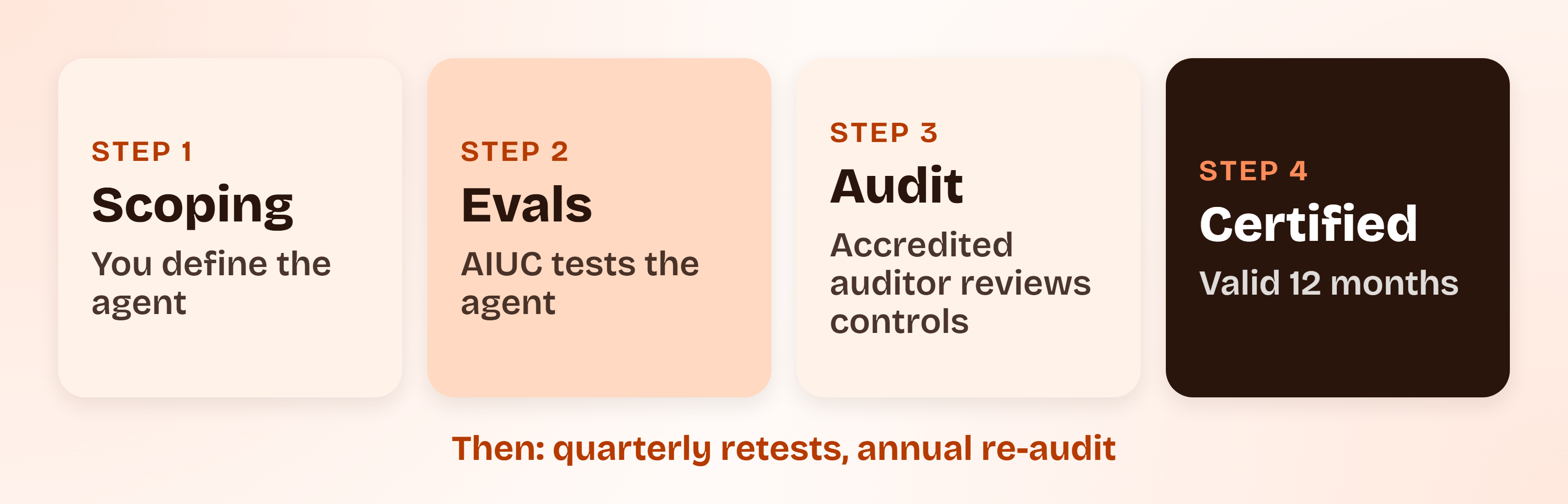
Quick takeCertification is not a one-time audit. The quarterly technical retests mean the thing a buyer is trusting is a pass rate that keeps getting re-measured, which is also why it keeps costing effort after the certificate is issued.
What Happens at Each Step in Practice
Scoping is where most of the real work hides. You decide which agent is being certified, what data and tools it can reach, and what actions it can take. Elevate Consult, a firm selling AIUC-1 readiness, flags the agent inventory as the step organizations most often get wrong, and it is easy to see why: a "customer support agent" may quietly have refund permissions and CRM write access.
Evals are adversarial by design. Think prompt injection hidden in a document the agent reads, attempts to pull secrets or personal data out of context, and inputs designed to make the agent confidently invent facts.
The audit looks at the human side: access controls, incident response, human oversight, vendor and subprocessor governance, logging. If you have been through a SOC 2 audit, it will feel familiar. The SOC 2 audit process is a useful warm-up for how evidence requests and sampling work.
Issuance closes it out. The certificate is yours to show buyers, and your next quarterly retest is already on the calendar.
Which Version of the Standard Applies
AIUC-1 changes every quarter. The standard has had releases on July 22, 2025 (launch), October 1, 2025, January 15, 2026, April 15, 2026, July 15, 2026 and October 15, 2026. The Q4 release added controls for open-weight models and new third-party testing requirements for data and privacy risk and for accountability risk.
Because the standard moves, confirm the current version with your auditor before scoping. Preparing against last quarter's controls is an avoidable way to fail a gap assessment.
What an AIUC-1 Certification Actually Covers: Lessons From Cursor, Fin, ElevenLabs and KPMG
Four companies have published detailed accounts of what their AIUC-1 certification covered. Each one answers the question buyers ask next: certified, but certified for what?
All four come from AIUC's own published research pages, so treat them as vendor-published accounts, not independent audits of the process.
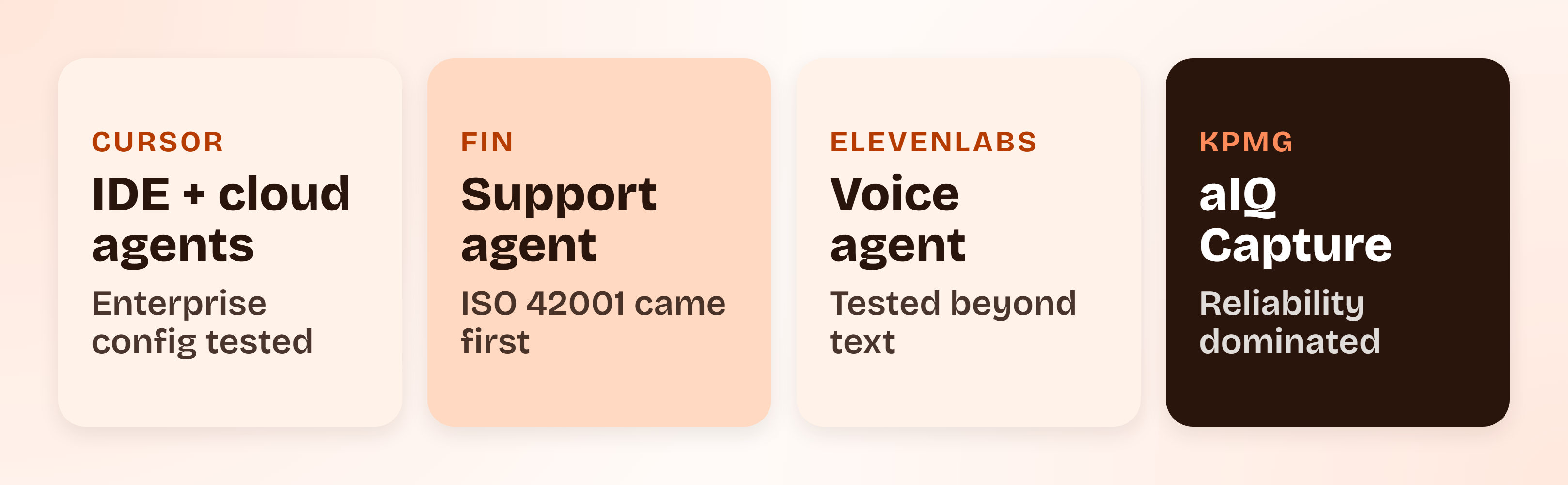
Cursor (announced August 12, 2026). The certified scope was the agent in the IDE and its cloud agents, tested in a representative enterprise configuration with rules, hooks, .cursorignore and auto-review enabled. Testing ran thousands of evals across two rounds in 12 risk categories, including secrets leakage, hidden prompt injection and insecure code defaults. Schellman reviewed operational, governance and security controls. Verdict: a precise, configuration-specific scope, not "all of Cursor."
Fin (case study December 11, 2025). Fin, the customer-service agent, had already earned ISO 42001 certification for its AI governance before pursuing AIUC-1. The audit covered more than 50 controls, and Fin now undergoes quarterly retesting across 1,000+ scenarios. Fin's CISO Thibault Candebat says that "certifying against AIUC-1 gives our customers confidence." Verdict: the ISO 42001 groundwork came first, and AIUC-1 added technical testing on top.
ElevenLabs (announced February 18, 2026). The certified agent was ElevenLabs' own voice agent, tested with 5,835 evals across 14 risk categories, including multilingual prompts in English, Spanish and Hindi and speech robustness against accents, muffled voices and background noise. Verdict: testing was shaped around how the agent is actually used, which for a voice agent means audio, not just text.
KPMG (announced August 27, 2026). The certified product was aIQ Capture, an agentic platform that interviews people to capture organizational knowledge. Testing covered hallucinations, content safety and prompt injection, and no critical or major vulnerabilities were identified. Reliability risks, including hallucinations, made up 55% of evaluation runs. Verdict: for a knowledge-capture agent, the dominant risk was reliability, not security.
Does AIUC-1 Certify a Company or a Product?
In every published example above, the certification attaches to a named agent or product, not to the whole company. Third-party commentary says the same: soc2auditors.org describes AIUC-1 as certifying "named agents or products." AIUC's methodology page does not state this explicitly, so ask your auditor to confirm how scope will be written for your agent.
Watch outA certificate that names one product does not cover your other agents. If you sell three, ask whether scoping will be done once or three times, and whether evidence can be shared across them.
Sierra, which announced its AIUC-1 certification on September 17, 2026 after an audit by Schellman, describes it as sitting alongside its existing SOC 2 Type II attestation and its ISO 27001 and ISO 42001 certifications. That is the right mental model: AIUC-1 is an addition to your assurance stack, not a replacement for it.
AIUC-1 Accredited Auditors: Who Can Audit You Today
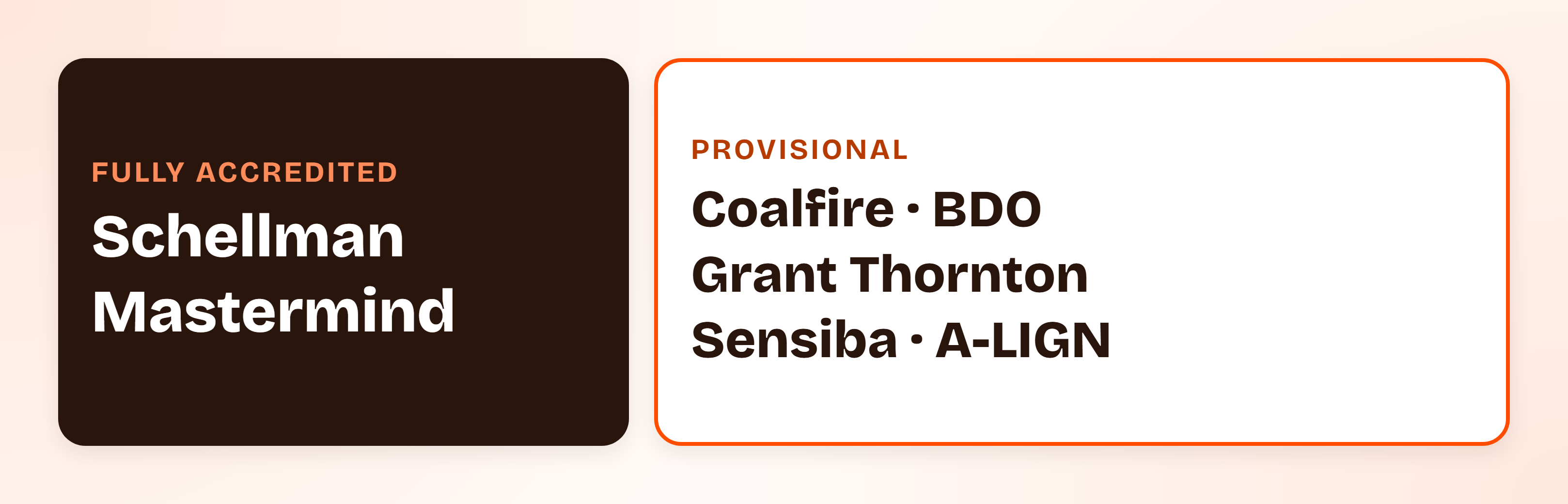
The AIUC-1 accredited auditors list is short and changing. AIUC is the only body that can accredit auditors, and accreditation is earned through a witness audit that checks consistency (controls applied uniformly) and technical capability (controls tested appropriately). As of November 2, 2026, AIUC's accredited-auditors page shows:
| Auditor | Status | Accreditation period |
|---|---|---|
| Schellman | Fully accredited | November 1, 2025 to current |
| Mastermind | Fully accredited | July 20, 2026 to current |
| Coalfire | Provisional | May 1, 2026 to current |
| BDO | Provisional | July 15, 2026 to current |
| Grant Thornton | Provisional | July 15, 2026 to current |
| Sensiba | Provisional | August 1, 2026 to current |
| A-LIGN | Provisional | August 1, 2026 to current |
Provisional means a witness audit is under way, with full accreditation subject to satisfactory completion. AIUC says it accredits gradually and prioritizes trusted auditors with AI capabilities, such as ISO 42001 accreditation.
Quick takeProvisional does not mean unqualified, but it does mean the firm has not finished AIUC's witness audit. If a provisional firm quotes you, ask when full accreditation is expected and what happens to your engagement if it is delayed.
Why the Auditor List Matters More Than It Looks
Some firms are announcing AIUC-1 services without appearing on this list. Check any firm against AIUC's page itself, not against its own marketing. The roster will keep moving, so the date on the page matters.
There is also a structural point worth knowing. AIUC accredits its own auditors, and there is no external accreditation body of the kind that sits above ISO 42001 certification bodies. Zeltser makes the broader point in his post:
"New certifications start as claims and earn credibility through cycles of scrutiny."Lenny Zeltser, zeltser.com, April 22, 2026
That is not a reason to skip AIUC-1. It is a reason to read the certificate scope carefully and not assume a buyer will treat it like a decades-old standard.
How Long the AIUC-1 Audit Timeline Really Runs
There is no official AIUC-1 audit timeline, and the third-party numbers disagree. Here is every figure I could attribute to a named source:
| Source | Estimate | What it is |
|---|---|---|
| Axipro (certification guide) | 4 to 8 weeks, with its FAQ saying 5 to 10 | A compliance vendor's estimate, not reconciled with its own phase breakdown |
| soc2auditors.org | 4 to 12 weeks, and 6 to 10 weeks for a joint SOC 2 + AIUC-1 engagement | A directory site that also runs sponsored placements |
| Rune Kvist, AIUC CEO | "Somewhere between like three to 10 weeks, depending on how up to snuff they already are" | A podcast comment (Latent Space, September 2026), reported by FourWeekMBA, not in AIUC's written announcement |
Treat all three as unverified. Each comes from a party with a commercial interest, and none is an audited average.
The useful part is the last clause of the AIUC CEO's own quote: the range depends on how prepared you already are. That is the variable you control.
Pro tipAxipro breaks its estimate into phases: roughly 1 to 2 weeks of readiness scoping, 3 to 5 weeks of evidence collection, an audit, and 1 to 3 weeks for certificate issuance. Those phases add up to more than its headline range, which is a good reminder to ask any provider to show the arithmetic behind a timeline.
What Stretches an AIUC-1 Audit Timeline
Three things move the date more than anything else. First, scope: an agent with broad tool access and many integrations takes longer to inventory and test than a narrow one. Second, evidence: teams that already have access reviews, incident response records and vendor assessments from SOC 2 or ISO 42001 reuse them. Third, fixes: if the evals surface failures, remediation and a retest add time that nobody can estimate for you in advance.
What AIUC-1 Certification Cost Looks Like When Nobody Publishes a Price
AIUC-1 certification cost is not published anywhere I can find. AIUC does not list a price, and soc2auditors.org notes that AIUC and each audit firm set their own fees separately. Axipro's guide says quotes depend on scope, control count, agent complexity and the auditor chosen.
So I won't give you a number. Third-party figures floating around are not tied to a named, verifiable source, and a number you repeat to your CFO should be one you can trace.
One warning on a figure you may see: an auditor's published fee range for ISO 42001 is a different engagement and should not be used as a stand-in for AIUC-1. For the ISO side, see ISO 42001 certification cost.
What Drives AIUC-1 Certification Cost
- Scope: how many agents, and how many tools and data sources each can reach
- Control count: AIUC-1 has roughly 50 requirements, and the number of applicable controls depends on your agent
- Agent complexity: a voice agent, a coding agent and a knowledge-capture agent each need different evals
- Auditor choice: firms price their own work
- Existing evidence: work you have already done for SOC 2 or ISO 42001 reduces new effort
- Remediation: fixing eval failures is real engineering time, and it recurs with quarterly retests
Try this yourselfSend every auditor you are considering the same five questions so quotes are comparable: (1) What is included in your fee and what does AIUC charge separately? (2) What does the quarterly retest cost after year one? (3) How is scope written for an agent with several integrations? (4) What is your accreditation status today, and when is it expected to change? (5) Can the engagement be combined with our SOC 2 and what is the combined timeline? Put the answers in one table before you decide.
A Practical AIUC-1 Readiness Checklist
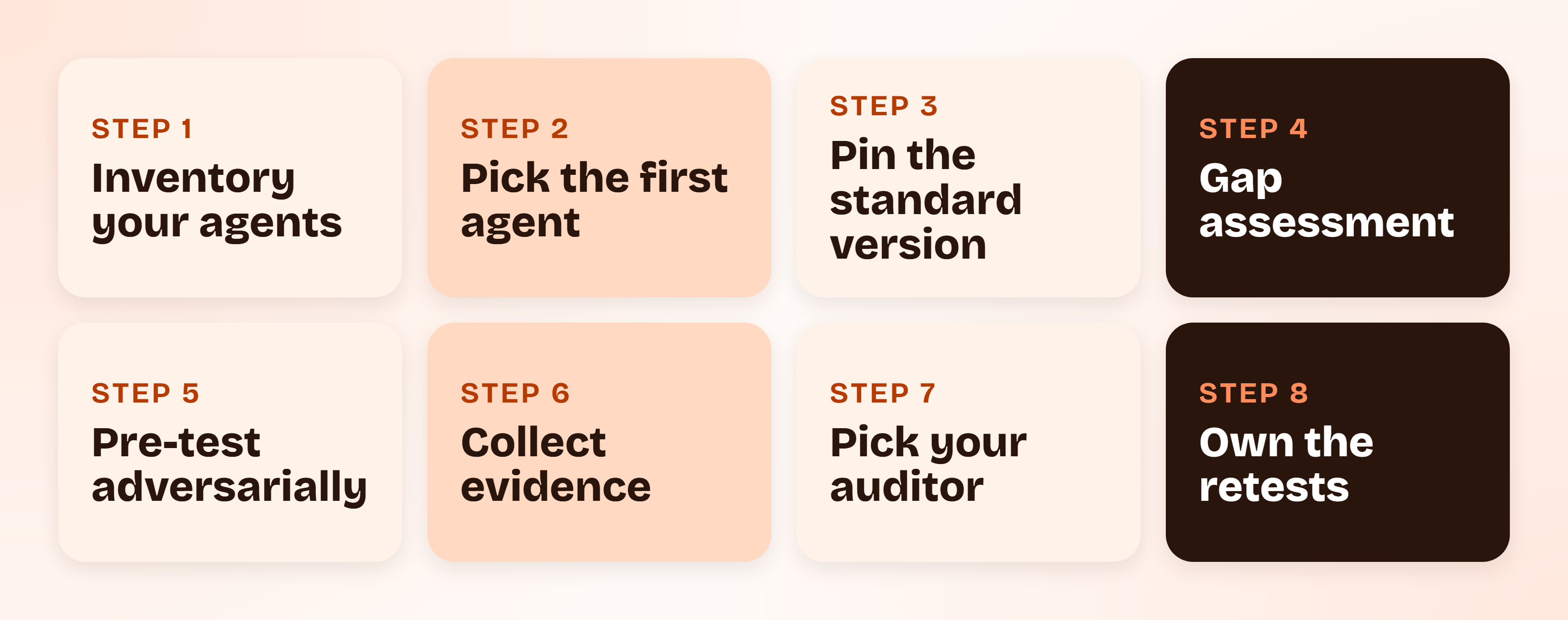
An AIUC-1 readiness checklist is mostly about shrinking surprises before the evals begin. Work through these eight steps in order.
- Inventory your agents. List every agent, what it can read, what it can write and which actions it can take on its own. Include the quiet permissions.
- Pick the first agent to certify. Start with the one buyers ask about, not the most complex one.
- Pin the current standard version. Confirm with your auditor which quarterly release applies to your engagement.
- Run a gap assessment across all six domains. Data and privacy, security, safety, reliability, accountability and society. Compare each against what you actually do, not what your policy says.
- Pre-test adversarially. Try prompt injection, jailbreaks and data-leakage attempts yourself before AIUC does.
- Collect evidence as you go. Access reviews, incident response records, human oversight procedures, vendor and subprocessor assessments, logging.
- Pick your auditor. Check the roster above and run the five-question comparison.
- Name owners and a retest calendar. Quarterly retests are permanent. Someone has to own them.
Pro tipElevate Consult describes reusing evidence from ISO 42001, the NIST AI RMF or SOC 2 where crosswalks allow. AIUC publishes crosswalks to SOC 2, ISO 42001, the NIST AI RMF and the EU AI Act, so start by checking which of your existing controls already map. For ISO 42001 groundwork, see our ISO 42001 guide.
How to Get AIUC-1 Certified Alongside SOC 2
How to get AIUC-1 certified and keep your SOC 2 on track is now a single question, because of the October 19, 2026 announcement. The AICPA and AIUC described a joint SOC 2 plus AIUC-1 certification delivered as one report from one CPA-led engagement, meant to replace repeated security questionnaires.
AICPA President and CEO Mark Koziel said stakeholders deserve "a fuller, objective picture of whether the technology is safe, reliable" and properly governed. AIUC's own page for the combined path says both engagements run in parallel under one auditor.
What we know and don't know is worth separating:
- Known: one engagement, both SOC 2 and AIUC-1 renew annually, AIUC-1 adds quarterly technical retests, and several CPA firms are already delivering it to clients.
- Stated: a full launch is expected in early 2027, after initial engagements conclude.
- Not published: pricing, the names of the participating CPA firms, and whether the AIUC-1 portion falls under the CPA's opinion or remains a separately issued AIUC certificate. Schneider Downs flagged that last point as an open question.
SOC 2 foundation
Get the SOC 2 half of the joint offering ready first
ComplyJet automates SOC 2 and ISO 42001 readiness with 350+ integrations, AI-assisted policy drafting and a team that guides you through the audit, so the evidence an AIUC-1 engagement builds on is already in place.
Joint Engagement or Sequential Certification?
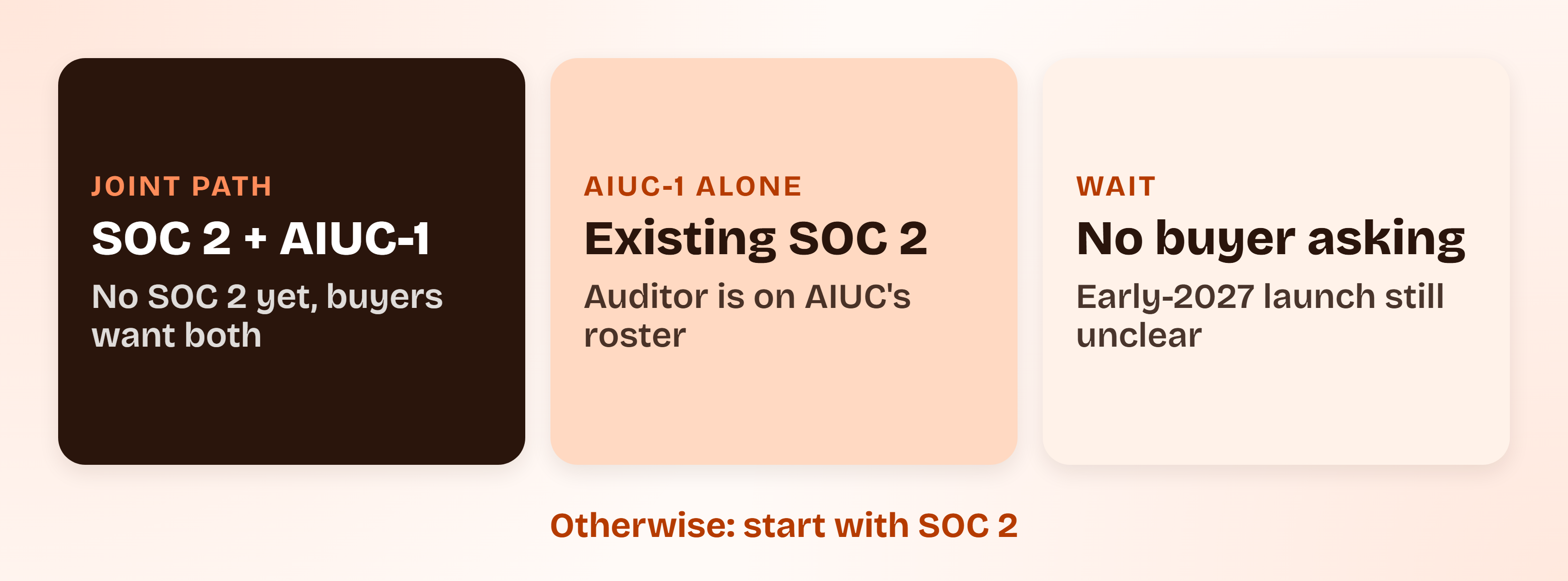
- Choose the joint SOC 2 and AIUC-1 path if you do not have SOC 2 yet, buyers are asking for both, and you want one auditor and one evidence set.
- Choose AIUC-1 on its own if you already hold a current SOC 2 Type II and your auditor is on AIUC's roster.
- Wait and watch if no buyer has asked and the early-2027 launch details, including who issues what, are still unclear.
- Otherwise, start with SOC 2. It is the foundation every AIUC-1 route assumes, and the combined route cannot start without it. For a deeper walk-through of the decision, see SOC 2 and AIUC-1 for AI startups.
Common Mistakes Teams Make Pursuing AIUC-1 Certification
These are the mistakes that waste the most time, in rough order of how early they show up:
- Scoping to the product name, not the agent's real permissions. The agent's tool access defines the risk, not the logo on it.
- Preparing against an old version of the standard. Quarterly releases mean last quarter's checklist can already be out of date.
- Treating policies as proof. Zeltser notes that some AIUC-1 controls cover judgment-based categories where documentation alone can satisfy the requirement, but the technical evals will not accept a policy as a substitute for behavior.
- Choosing an auditor without checking the roster. A firm marketing AIUC-1 services is not automatically accredited.
- Quoting a timeline to your sales team before scoping is done. Every published range is conditional on readiness.
- Forgetting the retests. The quarterly cycle is the ongoing cost, and it needs an owner.
Where ComplyJet Fits Before AIUC-1 Certification
We do not offer AIUC-1 certification, and we do not audit anyone. What we do is get the SOC 2 and ISO 42001 groundwork in place, because every AIUC-1 route builds on controls like access management, vendor risk, incident response and evidence collection.
For early-stage teams under 50 people, that foundation is what makes an AIUC-1 engagement faster and less painful. A team that guides you through the process, a Trust Center to share evidence with buyers, and a flat per-company price that does not change as your headcount grows are the parts that matter most before an AI-specific audit begins.
AIUC-1 Certification FAQs
How Do You Get AIUC-1 Certification?
Define the agent you want certified, run a gap assessment against the current version of the standard, have AIUC run its technical evals, pass an audit by an accredited auditor, and receive a certificate valid for 12 months. Quarterly retests and an annual re-audit follow. Start by contacting AIUC or an accredited auditor from the roster above.
How Much Does AIUC-1 Certification Cost?
No price is published. AIUC and each audit firm set their own fees, and quotes depend on scope, control count, agent complexity and auditor choice. Use the five-question comparison above to get quotes you can line up side by side.
How Long Does AIUC-1 Certification Take?
There is no official figure. Third-party estimates range from about 3 to 12 weeks, and AIUC's CEO has said it depends on "how up to snuff they already are." Those numbers are unverified, so plan around your own readiness instead.
Who Can Audit You for AIUC-1 Certification?
Only auditors accredited by AIUC. As of November 2, 2026, Schellman and Mastermind are fully accredited, and Coalfire, BDO, Grant Thornton, Sensiba and A-LIGN are provisional. Check AIUC's accredited-auditors page for the current list.
Is AIUC-1 a Certification or an Attestation?
A certification. AIUC runs the technical evaluations and issues the certificate, and an accredited audit firm reviews controls. SOC 2 is an attestation issued by a CPA under AICPA standards.
Does AIUC-1 Certify a Company or a Product?
In published examples, it certifies a named agent or product, such as Cursor's IDE and cloud agents or KPMG's aIQ Capture. Ask your auditor how scope will be written for your agent.
How Long Is an AIUC-1 Certificate Valid?
Twelve months. During that year AIUC retests the agent at least every three months, and the certificate is renewed by an annual re-audit.
Do You Need SOC 2 Before AIUC-1?
It is not stated as a formal prerequisite for AIUC-1 on its own. The joint AICPA and AIUC offering, though, is built on a SOC 2 examination. In practice, a SOC 2 report is the baseline most buyers already expect, so most AI vendors pursue it first or alongside.
Related Reading
- AIUC-1: What It Is and What the AICPA Announcement Changes: the pillar overview of the standard and the news.
- AIUC-1 vs SOC 2: where the two overlap and where they do not.
- AIUC-1 Requirements: the six domains explained.
- SOC 2 and AIUC-1 for AI Startups: which to get first.
- ISO 42001 Certification Cost: what the ISO route costs.
- SOC 2 Audit Process: how a SOC 2 audit actually runs.
Sources: