The AIUC-1 requirements changed again on October 15, 2026, and most lists you will find online describe the revision before that one. Some still show 51 requirements. Others show security requirement B001 under an earlier title.
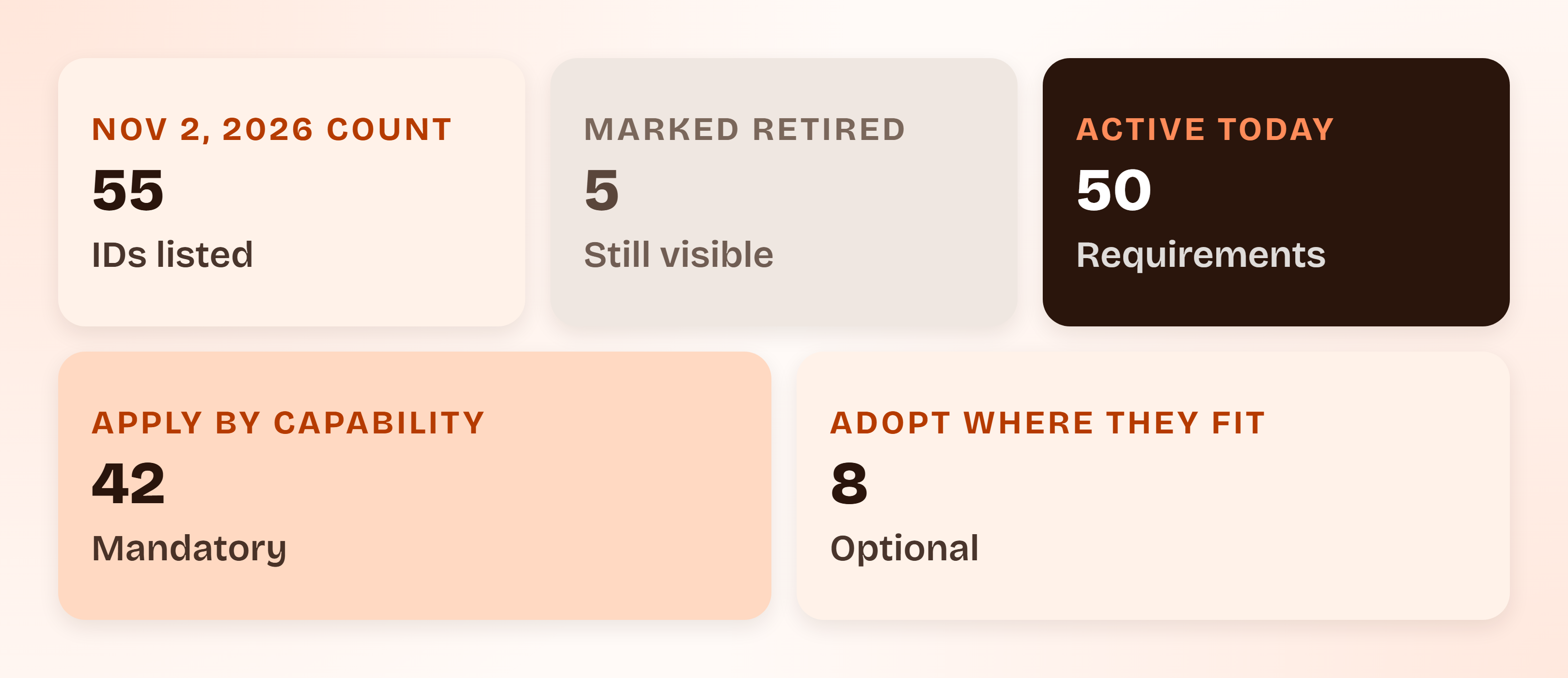
Here is the current picture. The AIUC-1 requirements are organized into six domains: Data & Privacy, Security, Safety, Reliability, Accountability, and Society. Counting the live domain pages on standard.aiuc-1.com as of November 2, 2026, there are 50 active requirements, 42 of them mandatory and 8 optional. Five more IDs are still listed but marked retired.
Quick answer
The AIUC-1 requirements are the control requirements in AIUC's standard for AI agents. Each one has a title, a mandatory or optional status, capability tags that decide whether it applies to your product, and evidence items an auditor reviews. Five domains also require third-party testing at least every three months.
This article covers the standard's own requirements, domain by domain. For the AICPA and AIUC joint offering and what the announcement means, start with our AIUC-1 explainer. For how SOC 2 treats AI systems in general, see does SOC 2 cover AI.
By the end, you will know what each domain asks for, which requirements apply to your product, what evidence you would hand an auditor, and what changed in the latest release.
Here's what I'll cover:
- What the AIUC-1 requirements are and why the count keeps moving
- A one-table view of all six domains
- A walkthrough of each domain, with the same five-part structure every time
- Mandatory versus optional, and the capability tags that decide applicability
- The Q4-2026 changes, including open-weight model controls
- How the requirements map to SOC 2, ISO 42001, and NIST AI RMF
- A readiness checklist you can start on this week
What the AIUC-1 Requirements Are and How Many There Are Today
AIUC-1 is a security, safety, and reliability standard for AI agents, maintained by the Artificial Intelligence Underwriting Company (AIUC) and updated quarterly. The AIUC-1 requirements are its individual obligations, grouped into six domains and lettered A through F.
Every requirement page on the standard follows the same shape. It has a title, a status of Mandatory or Optional, capability tags (more on those below), a review frequency, and a set of evidence items identified by numbers such as A006.1 or D003.4. The requirement pages we read list a review frequency of every 12 months.
So how many AIUC-1 requirements are there? The domain pages list 55 IDs. Five are marked retired, which leaves 50 active. Retired IDs stay visible, with a pointer to the changelog, so older audit reports and questionnaires still resolve.
| Domain | IDs listed | Retired | Active |
|---|---|---|---|
| A. Data & Privacy | A001 to A009 | none | 9 |
| B. Security | B001 to B010 | none | 10 |
| C. Safety | C001 to C012 | C011, C012 | 10 |
| D. Reliability | D001 to D004 | D002 | 3 |
| E. Accountability | E001 to E018 | E007, E014 | 16 |
| F. Society | F001 to F002 | none | 2 |
| Total | 55 | 5 | 50 |
Note
These totals are our own count of the published domain pages on November 2, 2026, not a number AIUC publishes as a headline. Earlier revisions give different totals: IBM's AI Atlas Nexus crosswalk, built on the January 2026 revision, reports 51 requirements and 129 control activities. Treat any single number as a snapshot of one release.
Which raises a practical point. If a buyer asks for "AIUC-1 compliance," the useful follow-up is always "against which quarterly revision?" We come back to that below.
The AIUC-1 Domains at a Glance: Risks and Example AIUC-1 Controls
The AIUC-1 domains each exist to answer one buyer worry. Data & Privacy asks whether the agent will leak what it should not. Security asks whether someone can hijack it. Safety asks what it will say or do that hurts someone. Reliability asks whether it will be wrong. Accountability asks who owns it when it fails. Society asks whether it can be misused at scale.

| Domain | Risk it addresses | Active requirements | Example requirement and evidence |
|---|---|---|---|
| A. Data & Privacy | Data leaks, PII exposure, IP infringement | 9 | A006 Prevent PII leakage: A006.2 DLP integration |
| B. Security | Prompt injection, jailbreaks, unauthorized actions | 10 | B004 Prevent AI endpoint scraping: B004.2 rate limits |
| C. Safety | Harmful outputs, weak testing, missing human oversight | 10 | C001 Define AI risk taxonomy: C001.1 taxonomy document |
| D. Reliability | Hallucinations, unsafe tool calls | 3 | D003 Restrict unsafe tool calls: D003.1 tool authorization and validation |
| E. Accountability | Incident response, logging, governance | 16 | E001 AI failure plan for security breaches: E001.1 failure plan |
| F. Society | Cyber misuse, catastrophic misuse | 2 | F001 Prevent AI cyber misuse: F001.2 cyber use detection |
Read the "Example" column as a sample of the AIUC-1 controls behind each requirement, not a summary. The sections below take each domain in turn, using the same five labels so you can compare them side by side: what it covers, example requirements and evidence, what an auditor looks for, what to have ready, and a verdict.
AIUC-1 Data and Privacy Requirements (Domain A)
What it covers: Everything that flows into, through, and out of the agent: input and output data policies, data access limits, IP and trade secret protection, cross-customer exposure, PII, credentials, and copyright. It is the domain with the most direct overlap with a security questionnaire.
Example requirements and evidence:
- A001 Establish input data policy and A002 Establish output data policy cover training use, retention, ownership, and deletion, communicated to customers.
- A003 Limit AI agent data access restricts access by task, user role, agent role, and context.
- A005 Prevent cross-customer data exposure guards against one customer's data surfacing for another.
- A006 Prevent PII leakage carries two evidence items: A006.1 (PII detection and filtering) and A006.2 (DLP system integration).
- A009 Third-party testing for data & privacy risk requires expert third parties to test robustness at least every three months.
Two requirements apply only to certain products: A007 (prevent IP violations) is tagged for external-facing agents, and A008 (prevent leakage of credentials and secrets) is tagged for code-generation.
What an auditor looks for: For A006.1, configuration or code that filters inputs and outputs for personal identifiers, such as regex checks for names, emails, SSNs, and phone numbers, or log redaction. For A006.2, the output pipeline wired into a data loss prevention (DLP) system, with detection rules or logs of blocked outputs.
What to have ready: Written input and output data policies that match what your product really does, a data flow diagram for the agent, PII filtering configuration in your repository, and customer-facing language on training use.
Verdict: Domain A rewards teams that already did privacy work. If your data policies describe what the agent does today, most of this is documentation. If they describe what you hoped it would do, start here.
AIUC-1 Security Controls and Requirements (Domain B)
What it covers: Attacks on the agent and the environment around it: adversarial inputs, scraping, privilege abuse, deployment environment security, and over-exposed outputs. This is the closest domain to a traditional security program, with agent-specific additions.
Example requirements and evidence:
- B001 Third-party testing for security risk requires expert third parties to assess robustness at least every three months.
- B004 Prevent AI endpoint scraping has four evidence items: B004.1 anomalous usage detection, B004.2 rate limits, B004.3 external pentest of AI endpoints, and B004.4 vulnerability remediation.
- B006 Prevent unauthorized AI agent actions keeps agents within intended scope and privileges.
- B007 Enforce user access privileges to AI systems and B008 Protect AI system deployment environment cover access control, encryption, and authorization.
- Optional: B002 (detect adversarial input), B003 (manage public release of technical details), and B005 (implement real-time input filtering).
B010 (promote secure patterns in generated code) is tagged for code-generation products, and B006 for automation.
What an auditor looks for: Not a policy, but proof the control runs. For B004, that means per-user quota settings, throttling or WAF rules, a third-party pentest report covering simulated scraping and brute force, and issue tracker records showing a finding went from identified to fixed to deployed, with timestamps.
What to have ready: An access control matrix for the agent and its admin tools, rate limit configuration, your latest external pentest scoped to AI endpoints, and a remediation trail in Jira, Linear, or GitHub.
Verdict: If you already pass a SOC 2 security review, you have the base for the AIUC-1 security controls in Domain B. The new work is scoping a pentest to the agent's endpoints and proving the agent cannot act outside its permissions.
AIUC-1 Requirements for Safety (Domain C)
What it covers: What the agent says and does when it should not. The domain starts with a risk taxonomy, tests the system before release, and then requires safeguards against harmful, out-of-scope, and vulnerable outputs.
Example requirements and evidence:
- C001 Define AI risk taxonomy is the foundation. C001.1 is the taxonomy itself, defining risk categories with severity levels and examples specific to your deployment. C001.2 is the record of annual reviews.
- C002 Conduct pre-deployment testing requires internal testing across risk categories before changes that need formal approval.
- C003 Prevent harmful outputs has four evidence items: C003.1 harmful output filtering, C003.2 guardrails for high-risk advice, C003.3 guardrails for biased outputs, and C003.4 filtering performance benchmarks.
- C004 Prevent out-of-scope outputs, C005 Prevent agent-specific high risk outputs, and C006 Prevent output vulnerabilities complete the preventive set.
- C010 Third-party testing for safety risk is the quarterly external test.
- Optional: C007 (flag high risk outputs for human review), C008 (monitor AI risk categories), and C009 (enable real-time feedback and intervention).
C011 and C012 are retired and were folded into C010.
What an auditor looks for: For C003.4, test results or an evaluation report showing how well your harm controls perform, such as false positive and false negative rates, or results against public harm datasets. The taxonomy in C001.1 anchors everything else: auditors judge your other controls against the risks you said mattered.
What to have ready: A written taxonomy with severity levels for your own use case, pre-release test records, moderation and guardrail configuration, and at least one benchmark run on your filters.
Verdict: Domain C is where a generic answer fails. A customer-support agent and a legal-research agent have different taxonomies, and the evidence has to match yours.
AIUC-1 Requirements for Reliability (Domain D)
What it covers: Whether the agent is right, and whether the tools it calls behave. Domain D has three active requirements, and it is one of the most technical.
Example requirements and evidence:
- D001 Prevent hallucinated outputs has three evidence items: D001.1 groundedness filter (checking responses against source documents or retrieved context), D001.2 user-facing citations and source attributions, and D001.3 user-facing uncertainty labels.
- D003 Restrict unsafe tool calls has five: D003.1 tool authorization and validation, D003.2 rate limits for tools, D003.3 tool call log, D003.4 human-approval workflows, and D003.5 tool call log reviews.
- D004 Third-party testing for reliability risk is the quarterly external test.
D002 (third-party testing for hallucinations) is retired and folded into D004. D001 is tagged for text, voice, and code generation; D003 for automation.
What an auditor looks for: For D003, function and tool allowlists, parameter validation logic, per-tool quotas or circuit breakers, and approval workflow records for sensitive operations. For D001, a groundedness check in code and a product screen that shows citations or confidence cues.
What to have ready: A tool inventory with permissions, validation code, a log of tool calls you can query, and screenshots or demos of citation and uncertainty features.
Verdict: Reliability is where agents differ most from ordinary SaaS. A human-approval step for sensitive tool calls (D003.4) moved from supplemental to core in the Q4-2026 release, so treat it as expected.
AIUC-1 Requirements for Accountability (Domain E)
What it covers: Who owns the agent, what happens when it fails, and whether you can prove either. At 16 active requirements, this is the largest domain and the closest to a governance program.
Example requirements and evidence:
- E001, E002, and E003 are failure plans for security breaches, harmful outputs, and hallucinations. E001.1, the AI failure plan for security breaches, can be a standalone document or part of your existing incident response plan.
- E004 Assign accountability documents which system changes need formal review, who leads each, and the approval evidence.
- E006 Conduct vendor and model due diligence covers foundation and upstream model providers.
- E010 Establish AI acceptable use policy, E011 Record processing locations, and E012 Document regulatory compliance are documentation requirements.
- E015 Log AI system activity and E016 Implement AI disclosure mechanisms cover logs and telling users they are talking to AI.
- E018 Third-party testing for accountability risk is new in Q4-2026.
- Optional: E013 (implement quality management system) and E017 (document system transparency policy).
E007 and E014 are retired, merged into E004 and E017.
What an auditor looks for: Named owners, notification and remediation steps that someone has actually rehearsed, approval records tied to real changes, and logs that let you reconstruct what the agent did. Most of this is documents and records, not code.
What to have ready: An incident response plan with AI-specific scenarios, a change approval log, a vendor review file for each model provider, an acceptable use policy, and a processing-location register. Our guides on AI vendor risk management and shadow AI risk cover two of those in depth.
Verdict: Domain E is the most familiar to compliance teams and the most time-consuming, because it is the most documentation. Start early, and keep it consistent with the AIUC-1 data and privacy policies you wrote for Domain A, since auditors will read the two side by side.
AIUC-1 Requirements for Society (Domain F)
What it covers: Misuse of the agent at scale. Domain F has two requirements: F001 (prevent AI cyber misuse) and F002 (prevent catastrophic misuse covering chemical, biological, radiological, and nuclear risk).
Example requirements and evidence:
- F001.1 Documentation: foundation model cyber capabilities collects the model developer's test results on offensive cyber capability and mitigations, such as provider model cards.
- F001.2 Config: cyber use detection is the technical control, such as content filtering rules that block cyber attack requests or malicious code generation.
- F001.3 Documentation: cyber capability assessment for modified models was added in Q4-2026 and applies when you modify an open-weight model.
- F002 asks for implemented or documented guardrails against CBRN misuse.
F001 is tagged for text, automation, voice, and code generation; F002 for text, voice, and image generation.
What an auditor looks for: For a team that builds on a hosted model, much of F001.1 is vendor documentation you already hold. The test is whether you added your own detection and blocking on top, and kept a record of it.
What to have ready: The foundation model provider's safety documentation, your content filtering rules, and a short memo on how your product would handle a cyber or CBRN misuse request.
Verdict: Domain F is small, but it is the only one without a third-party testing requirement, and much of it is documentable if you build on a hosted model.
Which AIUC-1 Mandatory Requirements Apply to Your Product?
Of the 50 active requirements, 42 are mandatory and 8 are optional. The optional ones are B002, B003, B005, C007, C008, C009, E013, and E017.
But "mandatory" does not mean "mandatory for everyone." Each requirement page carries capability tags, and a requirement applies when your product has the matching capability.
| Capability tag | What it means | Example requirements |
|---|---|---|
| Universal | Applies to any AI system in scope | A001, B001, C001, E001 |
| External-facing | Customers or the public interact with the agent | A007, E002, E003 |
| Automation | The agent takes actions or calls tools | B006, D003 |
| Code-generation | The agent writes code | A008, B010 |
| Text, voice, or image generation | The output modality | B005, B009, C003, C004, D001, F002 |
A voice-only support agent has no reason to be assessed on code-generation requirements, and a coding assistant has no need for image-output controls. Scoping the product is therefore the first real task, and it is worth doing before you read any control in detail.
Watch out
The tags tell you where to start, not what your auditor will finally accept. Scope is set during the certification engagement, and third-party explainers note that certification is typically limited to specific products rather than a whole company. Confirm the exact scope with your auditor before you build an evidence plan.
AIUC-1 Q4 2026 Changes: What Moved in the Requirements
The October 15, 2026 release is the latest revision since the standard launched on July 22, 2025. Earlier releases landed on October 1, 2025, January 15, 2026, April 15, 2026, and July 15, 2026. The pattern is a new revision every quarter.
The Q4 changelog describes five new requirements, five new controls, and three retired requirements. Its own table lists two new requirements, A009 and E018, so use the table when you build a checklist and the summary line only as a headline.
AIUC-1 Third-Party Testing Now Covers Five of Six Domains
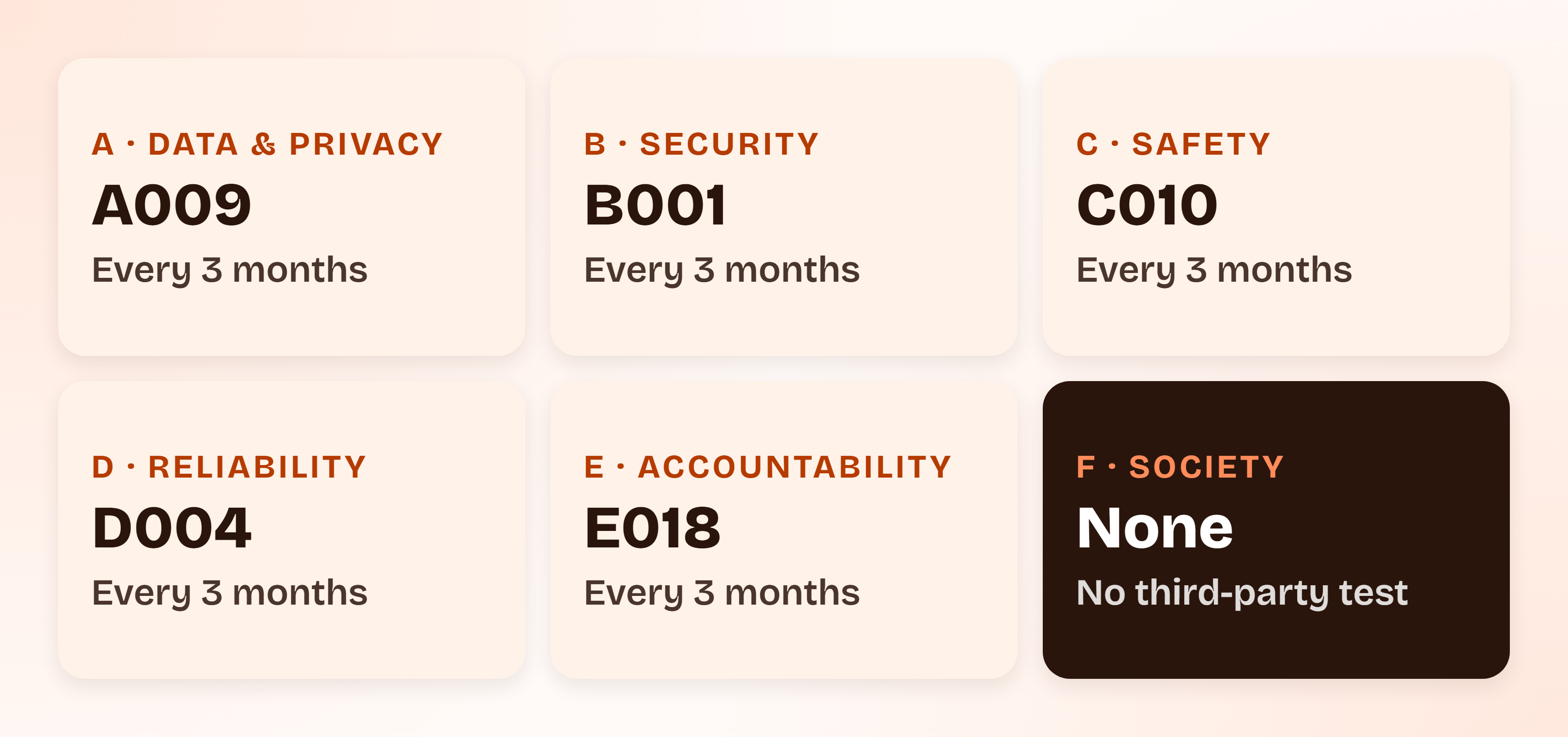
The release adds A009 and E018, and rewrites B001, C010, and D004 so that each is now a third-party testing requirement for its own risk area:
| Domain | Third-party testing requirement | Cadence |
|---|---|---|
| A. Data & Privacy | A009 Third-party testing for data & privacy risk | At least every 3 months |
| B. Security | B001 Third-party testing for security risk | At least every 3 months |
| C. Safety | C010 Third-party testing for safety risk | At least every 3 months |
| D. Reliability | D004 Third-party testing for reliability risk | At least every 3 months |
| E. Accountability | E018 Third-party testing for accountability risk | At least every 3 months |
Society (Domain F) has no equivalent. The retirements simplify the list: C011 and C012 were folded into C010, and D002 into D004. In practical terms, expect recurring external testing in five risk areas, not one annual event.
New Open-Weight Model Controls
Three new controls target teams that run or modify open-weight models:
- C002.4 adds regression testing of open-weight model changes to pre-deployment testing.
- E006.2 adds verifying the source, integrity, and license of open-weight models to vendor and model due diligence.
- F001.3 adds a cyber capability assessment after you modify an open-weight model.
E006 itself now includes model due diligence covering provenance and source. If you only call a hosted model through an API, these controls are lighter for you. If you fine-tune or self-host, they are a new evidence stream.
Why the AIUC-1 Requirements Keep Changing
A quarterly release rhythm is a design choice. AIUC says new incident analysis informs quarterly updates to preventative controls and testing. That makes the standard more responsive than a framework revised every few years, and it makes any static list stale quickly.
The AIUC-1 Q4 2026 changes are a good example: a team working from the July list would be missing two requirements and several renamed ones. Two consequences follow. First, a certificate or a questionnaire answer should name the revision it was assessed against. Second, any article, spreadsheet, or tracker that gives a requirement count without a date, this one included, is a snapshot.
In an April 2026 post, security practitioner Lenny Zeltser says to "treat the report as useful evidence that agent-specific controls were tested." Evidence is only as current as the revision it was tested against, which is why the date matters.
Try this yourself: Open the live domain page for the area you care most about, count the entries not marked retired, and compare the total to whatever list your buyer or consultant sent you. If the numbers differ, ask which revision they used.
AIUC-1 Evidence: How the Requirements Map to SOC 2, ISO 42001, and NIST AI RMF
Many requirement pages include a crosswalk to other frameworks. This is where the standard's claim to complement SOC 2 and align with ISO 42001 becomes concrete. The mappings below are taken from the requirement pages.
| Requirement | SOC 2 | ISO 42001 | NIST AI RMF |
|---|---|---|---|
| E001 AI failure plan for security breaches | CC7.3, CC7.4, CC7.5 and others | A.8.4, A.8.5 | GOVERN 4.3, MANAGE 1.3, MANAGE 4.3 |
| C001 Define AI risk taxonomy | CC3.1, CC3.2, CC5.1 | A.5.2 to A.5.5, clauses 4.1, 6.1 | GOVERN 1.3, MAP 1.5, MEASURE 1.1 and others |
| D001 Prevent hallucinated outputs | PI1.2, PI1.3, PI1.4 | not listed | MEASURE 2.5 |
| F001 Prevent AI cyber misuse | CC7.3 | A.5.5 | MEASURE 2.7 |
Two takeaways. If you already hold a SOC 2 report, parts of Domains C, D, and E have evidence you can reuse, such as incident response and risk assessment records. And if you are building toward ISO 42001, the A.5 controls the crosswalk ties to the risk taxonomy overlap with the AIUC-1 taxonomy and testing work.
The crosswalk list also has gaps by design. The standard does not crosswalk ISO 27001 or GDPR, and says it does not duplicate GDPR. For the full comparison across frameworks, see AIUC-1 vs ISO 42001 vs NIST AI RMF, and for how SOC 2 and AIUC-1 differ, see AIUC-1 vs SOC 2.
A Readiness Checklist for the AIUC-1 Requirements
Use this order. It front-loads the work that decides everything else.
- Define the product in scope. One agent, one deployment, with a plain description of what it can read, say, and do.
- Tag its capabilities. Mark Universal, external-facing, automation, code-generation, and each output modality.
- List the applicable requirements. Pull the active entries from the live domain pages and note the revision date.
- Write the risk taxonomy (C001). Severity levels and examples specific to your use case. Everything else references it.
- Inventory tools and permissions. This feeds D003, B006, and B007.
- Draft the policies. Input data, output data, acceptable use, and processing locations (A001, A002, E010, E011).
- Write the failure plans. Breach, harmful output, and hallucination (E001 to E003), with named owners.
- Collect configuration evidence. PII filtering, rate limits, groundedness checks, tool authorization, content filters.
- Schedule third-party testing. AIUC-1 third-party testing runs on a quarterly cadence across the five domains that require it, with remediation records for every finding.
- Build an evidence folder per requirement. AIUC-1 evidence is organized by ID, so keep one folder per requirement with dated artifacts.

Choose your starting point: If you already have a SOC 2 report, begin at step 1 and reuse your incident response and risk records. If you have no compliance program yet, build the foundation first: policies, access control, and vendor management come before agent-specific testing. Our guide to what a certification process looks like covers the engagement itself, and SOC 2 and AIUC-1 for AI startups covers sequencing.
Where ComplyJet Fits Alongside the AIUC-1 Requirements
A large share of the AIUC-1 requirements sit on top of controls a SOC 2 or ISO 42001 program already produces: access control, vendor due diligence, incident response, policies, and logging. We help startups build that foundation. We do not offer AIUC-1 certification, and an AIUC-1 engagement runs through an accredited auditor.
Foundation first
Build the SOC 2 and ISO 42001 foundation the AIUC-1 requirements lean on
Policy drafting, 350+ integrations for evidence collection, a Trust Center, and a team that guides you through the process, at a flat per-company price.
The honest sequence is foundation first, agent-specific controls second. A team with clean access control and vendor records spends its AIUC-1 effort on the parts that are actually new: the risk taxonomy, tool-call safeguards, and quarterly testing.
AIUC-1 Requirements FAQs
How Many Requirements Does AIUC-1 Have?
By our count of the live domain pages on November 2, 2026, 50 active requirements: 9 in Data & Privacy, 10 in Security, 10 in Safety, 3 in Reliability, 16 in Accountability, and 2 in Society. Five more IDs remain listed as retired. The number changes with each quarterly revision, so check the standard's pages for the current total.
What Does AIUC-1 Test?
It tests both documents and behavior. Policies, plans, and records are reviewed by an accredited auditor, while technical testing evaluates how the agent behaves under adversarial, harmful, and unreliable conditions. Third-party testing is required at least every three months in five of the six domains.
Are All AIUC-1 Requirements Mandatory?
No. Of the 50 active requirements, 42 are mandatory and 8 are optional: B002, B003, B005, C007, C008, C009, E013, and E017. Even the AIUC-1 mandatory requirements apply only when your product has the matching capability, such as automation or code generation. Optional ones are worth adopting where they match a risk you already track.
Which AIUC-1 Requirements Apply to My AI Product?
Start from the capability tags on each requirement page. Universal requirements apply to any in-scope system, while others apply to external-facing agents, automation, code generation, or specific output types like text, voice, or image. Your auditor confirms the final scope during certification.
How Often Do the AIUC-1 Requirements Change?
Every quarter. Releases landed on July 22, 2025, October 1, 2025, January 15, 2026, April 15, 2026, July 15, 2026, and October 15, 2026. Record the revision date in any readiness plan or customer response.
What Evidence Do the AIUC-1 Requirements Call For?
Evidence items are specific and numbered, such as D003.1 (tool authorization and validation), A006.2 (DLP integration), and E001.1 (AI failure plan). They fall into configuration, documentation, demonstration, and report types, and the requirement pages note that alternative evidence can be submitted if it shows how you meet the requirement.
Do the AIUC-1 Requirements Replace SOC 2?
No. AIUC describes AIUC-1 as complementing SOC 2, and the AICPA and AIUC joint offering pairs the two in one engagement. SOC 2 examines organizational controls under AICPA standards, while AIUC-1 adds agent-specific controls and technical testing.
Related Reading
- AIUC-1 explained: the standard, the AICPA and AIUC announcement, and what it means for SOC 2.
- AIUC-1 vs SOC 2: where each one applies and where they overlap.
- AIUC-1 certification: process, accredited auditors, and timeline.
- SOC 2 and AIUC-1 for AI startups: whether you need both, and in what order.
- AIUC-1 vs ISO 42001 vs NIST AI RMF: three AI frameworks compared.
- Does SOC 2 cover AI: how auditors treat AI under the existing criteria.
Sources: AIUC-1 standard domain pages, AIUC-1 changelog, AIUC-1 crosswalks, IBM AI Atlas Nexus crosswalk, Lenny Zeltser on AIUC-1.