.svg)

Someone on the team just said it in standup: "why don't we just build this ourselves?" It's a fair question. Most engineers can build a script that pulls access logs, flags stale permissions, and dumps evidence into a folder. The build vs buy compliance tooling question isn't whether your team can build something. It's what stops happening while they do, and what an auditor thinks of it eighteen months later.
For nearly every team under 50 engineers, the honest answer is: buy the platform, and build only the one integration that's genuinely unique to your stack. The exceptions are narrow, specific, and rarer than most teams assume.
Quick answer
Building in-house compliance tooling makes sense only at real scale, roughly 500+ engineers, or when your requirements are genuinely non-standard. Below that, the engineering time it costs almost always outweighs what a platform costs in dollars.
We're a compliance platform, so this is naturally the "buy" side of the argument. That's stated plainly here, not hidden in the fine print, because a topic this practical deserves an honest answer regardless of who's writing it.
By the end of this, you'll have a real cost breakdown for both sides, know exactly which two signals should flip the answer toward building, know whether an AI coding agent actually changes the math, and have a framework to run before committing either way. Here's what's ahead:
- What the build vs buy compliance tooling decision actually means for an engineering team
- Why the smaller your team is, the worse in-house tooling costs
- The hidden costs of building it yourself, broken down by category
- What buying a platform actually gets you instead
- Whether an AI coding agent changes any of this
- When building your own really does make sense
- A decision framework you can run this week
- The mistakes teams keep making on both sides
What Build vs Buy Compliance Tooling Actually Means for Engineering Teams
The build vs buy compliance tooling decision is whether your engineering team writes and maintains its own evidence-collection, control-mapping, and audit-reporting tooling, or adopts a vendor platform that already does it.
This is a different question from what compliance automation is in the first place. If that's the question, ComplyJet's Compliance Automation guide covers the category broadly, what it does and why it exists. This article assumes you already know that, and are deciding whether your own team should build it or buy it.
Quick take
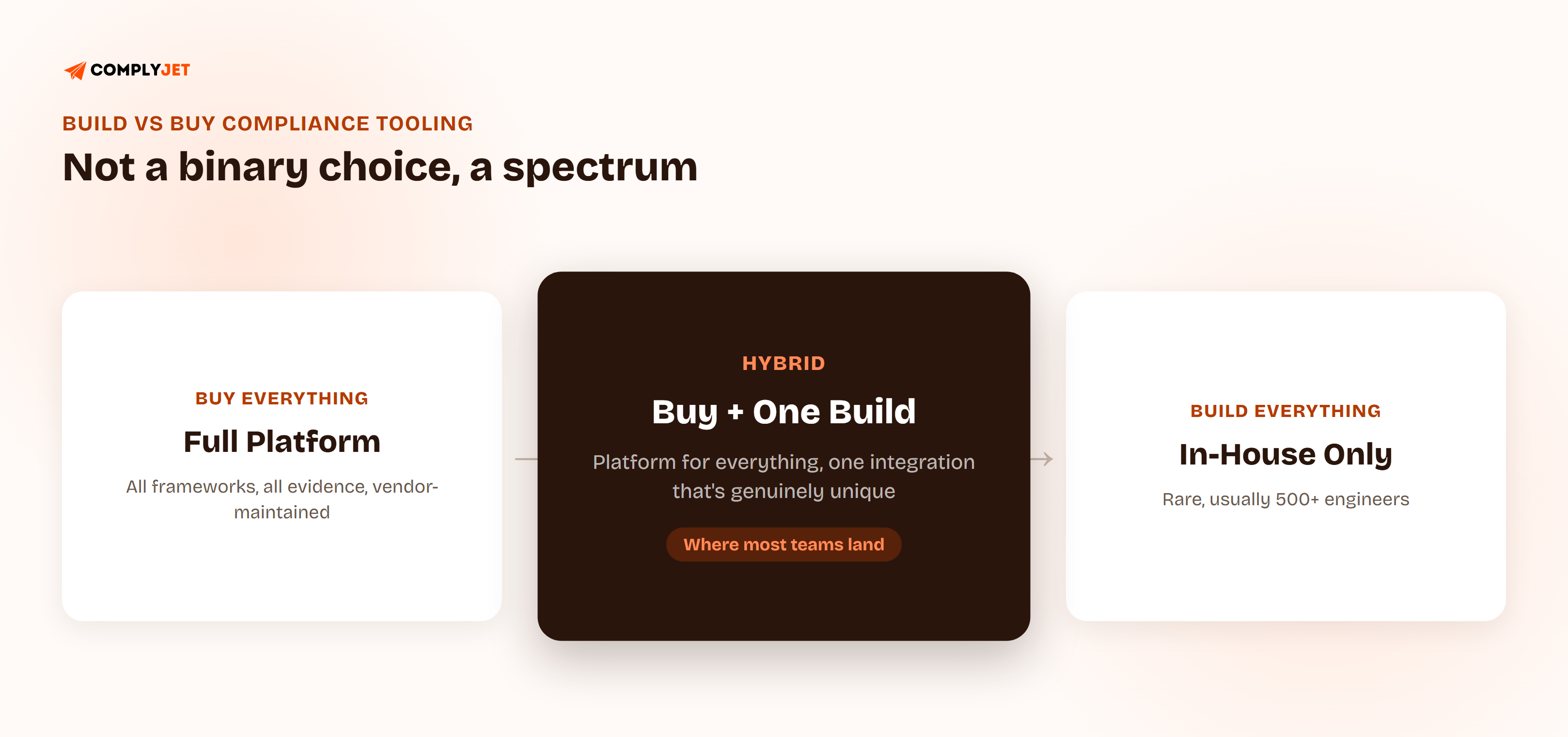
This is really a compliance automation build or buy question, not a clean binary. Most teams that "build" still end up buying a point tool or two around whatever they built themselves, so the honest framing is a spectrum, not two boxes on a whiteboard.
Why Build vs Buy Compliance Tooling Isn't Actually a Binary Decision
Most teams that build end up with a hybrid anyway: a homegrown script for the one workflow that's genuinely unique to their stack, and a purchased tool or platform for everything else. The real decision usually isn't "build everything" versus "buy everything." It's which two or three pieces are worth building yourself, and which aren't.
However you frame it, compliance automation build or buy comes down to the same underlying tradeoff: whether the engineering hours it takes to build and maintain something in-house buy more value than a subscription would. That answer changes with team size, and it changes again as the team grows.
Why In-House Compliance Tooling Costs More the Smaller Your Team Is
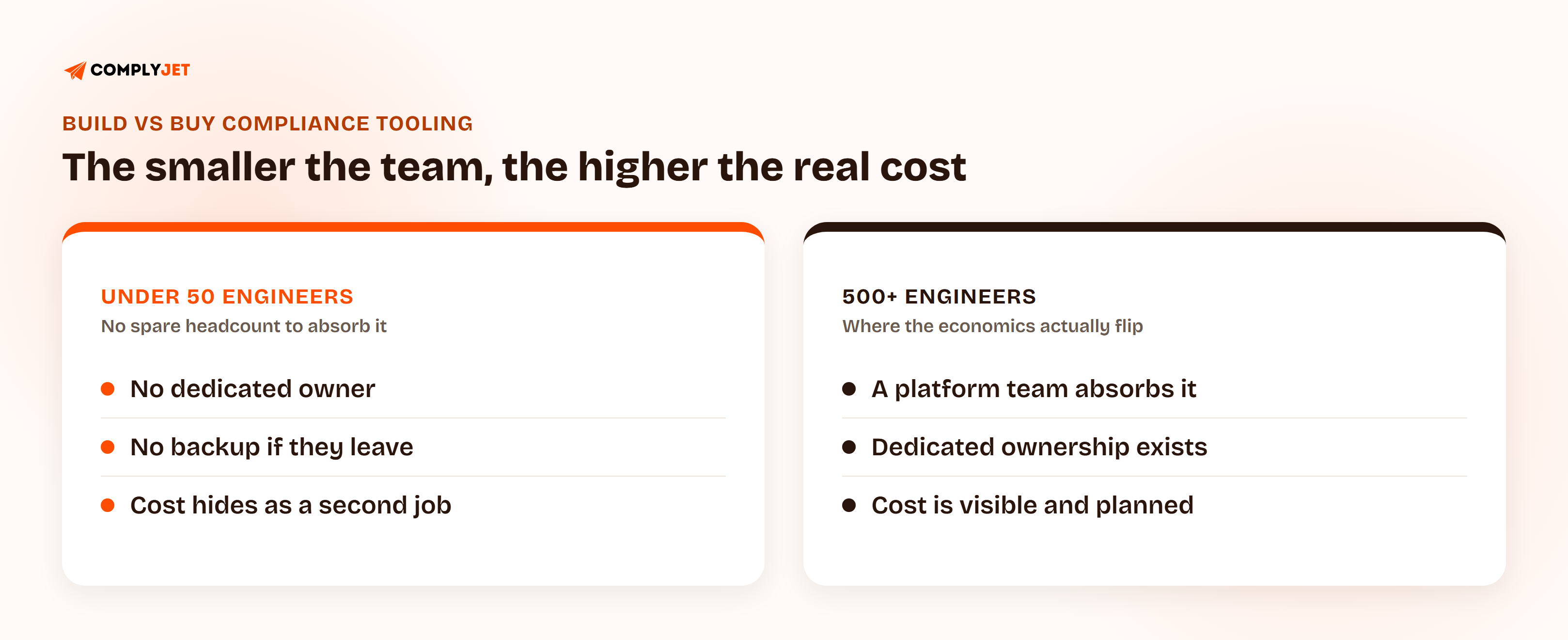
Getting this decision wrong is expensive, and the size of that expense scales inversely with headcount. The Cloud Playbook puts the cost of the wrong call at six to eighteen months of engineering time, and names roughly 500 engineers as the point where building starts to make economic sense. Below that line, in-house compliance tooling doesn't get cheaper. It just gets less visible, because there's no dedicated person to own it.
At a 15 to 40-person engineering org, there's no spare headcount for a compliance-tooling specialist. Whoever builds the evidence-collection script becomes its permanent owner, on top of their actual job, indefinitely.
Two things quietly compound the smaller the team is:
- No dedicated owner. At real scale, a platform team can absorb one person's time on internal tooling without anyone noticing. Below 50 engineers, that time is visibly missing from something else.
- No backup. One engineer usually understands the whole system. If they leave or move teams, the tooling's institutional knowledge leaves with them.
Picture this: the engineer who wrote the internal evidence script six months ago is now the only person who understands it, still shipping the product roadmap, and now also responsible for keeping it working through every new integration and every framework update. Nobody planned for that. It just happened, because nobody planned for anything else either.
The teams that get burned by in-house compliance tooling almost never budgeted for it as a decision. They backed into it, one script at a time, until the person who wrote the first one owned a second job nobody hired them for. — Upendra Varma, CTO at ComplyJet
The Hidden Costs of Building Compliance Software In-House
The real compliance tooling engineering cost has three separate lines, not one, and most teams only price the first.
| Cost category | What it looks like at month one | What it looks like at month twelve |
|---|---|---|
| Initial build | A sprint or two, a working script or dashboard | Already outdated against the framework's latest revision |
| Ongoing maintenance | Nothing yet, everything still works | A new integration breaks the script every time a tool gets swapped |
| Opportunity cost | One engineer's sprint, absorbed quietly | That same engineer's part-time, indefinite second job |
The Maintenance Cost Nobody Budgets For
A compliance framework isn't static. SOC 2's Trust Services Criteria get clarified, ISO 27001's Annex A gets restructured, PCI DSS moves between major versions. In-house tooling has to be updated by hand every time, by someone who remembers it needs updating, which is exactly the kind of manual dependency compliance automation is supposed to remove in the first place.
The Audit-Credibility Gap
Auditors are used to evaluating evidence from established platforms with a track record. Homegrown tooling shifts the burden: now the company has to prove the tool itself is reliable, on top of proving the controls it tracks are working. That's an extra conversation with the auditor that a bought platform doesn't require.
Add up all three lines and the hidden costs of building compliance software rarely stay hidden for long. They just show up later than expected, usually a few weeks before an audit, when there's no time left to absorb them gracefully.
Watch out
The compliance tooling engineering cost that gets missed most often isn't the build. It's the maintenance tax that shows up every time a framework gets revised or a tool in the stack changes, quietly, for as long as the tooling exists.
Custom Compliance Software vs Vendor: What Buying Actually Gets You
The other half of the ledger deserves the same honesty as the cost side. A custom compliance software vs vendor comparison isn't just a price tag. It's what's already built, multi-framework control mapping, continuous evidence checks, an audit track record, against what your team would have to build and validate from nothing.
For a sense of what "buy" actually takes to set up, not just what it costs on paper, ComplyJet's help center walks through the real onboarding flow:
From the Help Center
Onboarding to ComplyJet
Setup is OAuth-based for most tools, connected in a few clicks, not custom integration code your team has to write and maintain.
| What you're paying for | The in-house equivalent it replaces |
|---|---|
| Multi-framework control mapping, already built | Researching and encoding every control for every framework you need, yourself |
| Continuous evidence validation | A script that has to be re-triggered and re-checked as your stack changes |
| Pre-built integrations across your tools | Custom integration code, broken every time a vendor changes an API |
| A track record auditors already trust | Convincing an auditor your homegrown tool is reliable, from scratch |
ComplyJet
Flat pricing instead of a maintenance tax
ComplyJet charges per company, not per seat: $5,000/year for one framework, $8,000/year for two, with 350+ pre-built integrations maintained on our side, not yours.
Can an AI Coding Agent Handle Your Build vs Buy Compliance Tooling Decision?
This is the version of "why don't we just build it" that's specific to 2026: an engineering team with a capable AI coding agent can prototype something that looks like a compliance tool in an afternoon. That changes the build side of the math, but not as much as it seems to.
Myth debunking
Can't we just have an AI agent build this? No. A coding agent can scaffold the surface-level app fast. The other 90 percent, multi-framework control mapping, continuous evidence validation, regulatory change tracking, cross-functional workflow orchestration, and audit-ready reporting a CPA firm will actually accept, is exactly what an auditor is going to test.
A generated prototype can pull a list of IAM users or flag an open S3 bucket. It doesn't know that SOC 2's CC6 criterion and ISO 27001's Annex A access-control clause overlap but aren't identical, or that an auditor expects evidence to be continuous across the whole review period, not a one-time export run the week before the audit. That's domain knowledge encoded over years, not something a prompt shortcuts.
None of this means AI has no role. Several platforms, ComplyJet included, use AI to speed up policy drafting and evidence review. That's a narrower, different thing than an engineering team generating an entire compliance platform from scratch and trusting it with an audit.
Should We Build Our Own Compliance Tool? When It Actually Makes Sense
The honest version of this article doesn't pretend the exceptions don't exist. They do. They're just narrower than most teams assume before they've priced it out.
Real reasons to build:
- Genuinely non-standard requirements. A proprietary industry standard with no public framework equivalent, so no platform has anything to map to.
- Real scale. The Cloud Playbook names roughly 500+ engineers as the point where the economics flip in building's favor.
- Compliance tooling is the product. Not a support function for some other product, the thing itself being sold.
The Two Signals Worth Taking Seriously
Two things genuinely change the answer. First, a dedicated compliance or security engineering function already exists and isn't a side project bolted onto someone's other job. Second, the specific requirement in question has no vendor-supported framework mapping anywhere, not "we didn't check," but confirmed after actually looking.
"Should we build our own compliance tool" is worth asking again every time headcount or scope changes meaningfully, not just once at the start. The right answer at 10 engineers and the right answer at 300 aren't the same question with different numbers plugged in, they're genuinely different questions.
Note
Most teams that think they're the exception aren't. Before building, check whether the requirement is genuinely unique or just unfamiliar. Those are different problems with different solutions.
A Build vs Buy GRC Platform Decision Framework You Can Actually Use
Run these five steps before committing either way. This is a build vs buy GRC platform decision framework, not a gut call made in a Slack thread.
- Count the frameworks you actually need mapped, and flag whether any of them are genuinely non-standard rather than assumed to be.
- Name who specifically would own the tooling long-term, not just who would build version one. If no name comes to mind, that's the answer.
- Price the engineering time at fully-loaded cost across year one and year two, not just the length of the initial build sprint.
- Check whether the requirement is actually unique or just unfamiliar before treating it as a reason to build.
- Decide the hybrid split. Most real answers involve buying the platform and building the one integration or workflow that's genuinely specific to your stack, not an all-or-nothing call.
| Decision factor | Leans build | Leans buy |
|---|---|---|
| Team size | 500+ engineers | Under 50 engineers |
| Requirements | Genuinely non-standard, no framework mapping exists | Standard frameworks (SOC 2, ISO 27001, HIPAA, GDPR, PCI DSS) |
| Ownership | Dedicated compliance/security engineering function already exists | No one specific would own it long-term |
| Time horizon | Multi-year investment the org has already committed to | Need to be audit-ready in months, not years |
The GRC Build vs Buy Decision: Mistakes Engineering Teams Keep Making
The GRC build vs buy decision goes wrong in the same handful of ways, on both sides of the call.
- Pricing only the initial build sprint. Year two's maintenance tax never makes it into the original estimate, so the true cost only shows up after the decision is already made.
- Assuming "we have the engineering talent" answers the opportunity-cost question. Having the skill to build something isn't the same as having the spare capacity to own it forever.
- Treating a generated AI prototype as production-ready evidence tooling. A working demo and an auditor-accepted evidence system are not the same artifact.
- Building before checking whether the requirement is actually non-standard. Most "we're different" cases turn out to be unfamiliar, not unique, once someone actually checks.
- Skipping the audit-credibility question until the auditor raises it. By then, it's a finding, not a design decision.
- Not naming a long-term owner before starting the build. Whoever wrote version one becomes the permanent owner by default, whether or not that was ever agreed to.
How ComplyJet Fits Into the Build vs Buy Compliance Tooling Decision
We're a compliance automation platform, so we're naturally the "buy" side of this argument, worth saying plainly rather than pretending otherwise.
What ComplyJet specifically answers from the cost breakdown above: flat per-company pricing, not per-seat, so the bill doesn't climb every time the team grows. 350+ pre-built integrations maintained on our side, not the maintenance tax described earlier landing on yours. AI-assisted policy drafting to speed up the parts that are genuinely faster with AI. White-glove support instead of one engineer quietly owning the tooling alone.
Here's what that looked like for one early-stage team that chose not to build any of this themselves:
ComplyJet
See what buying actually looks like
Flat per-company pricing, 350+ integrations, and a team that guides you through the outcome, not just software you're left alone with.
FAQs
When should you build your own compliance software?
When your requirements are genuinely non-standard and no platform maps to them, when you're at real scale (roughly 500+ engineers), or when compliance tooling is itself the product you're selling. Below that, a dedicated compliance/security function already needs to exist before building makes sense.
How much does it cost to build compliance tooling in-house?
There's no single number, but the real cost has three parts: the initial build (typically a sprint or two), ongoing maintenance as frameworks and integrations change, and the opportunity cost of the engineer who ends up owning it indefinitely. Most teams only budget for the first one.
What are the risks of building your own GRC tool?
The tool becomes a single-owner dependency, maintenance gets skipped when that person is busy with other priorities, framework updates don't get reflected automatically, and auditors may ask you to prove the tool itself is reliable, on top of proving your controls work.
Is compliance automation worth buying vs building?
For most teams under 50 engineers, yes. The engineering time it costs to build and maintain in-house tooling usually exceeds what a platform costs, and a bought platform already has the audit track record and framework mapping a homegrown tool has to earn from zero.
Can AI coding tools replace compliance software?
Not on their own. An AI coding agent can scaffold a surface-level app quickly, but real compliance tooling needs continuous evidence validation, multi-framework control mapping, and regulatory change tracking that a generated prototype doesn't provide out of the box.
What does a compliance platform do that a script can't?
It maintains itself. A platform tracks framework revisions, keeps integrations working as your tool stack changes, and carries an audit track record. A script does what it was written to do, until something around it changes and nobody remembers to update it.
When does building compliance tooling make sense at scale?
Roughly past 500 engineers, per industry estimates, once a dedicated compliance/security engineering function already exists as a permanent role rather than a side project, and the opportunity cost of that team's time is genuinely lower than a platform's cost at that scale.
Related Reading
- Compliance Automation: What It Is, How It Works, for the category-level definition before deciding whether to build or buy it
- GRC vs IRM, for how GRC tooling fits into the broader risk-management category
- Compliance as Code: Baking SOC 2 Controls Into Your CI/CD Pipeline, for wiring a platform's controls into your pipeline once you've decided to buy