.svg)

Your CFO wants a number before next year's budget gets locked. "What does ISO 42001 certification cost?" isn't a question you can answer with a shrug and a "it depends," even though, honestly, it does depend.
Here's the direct answer: for a small organization, under roughly 50 employees, realistic first-year all-in ISO 42001 certification cost runs $15,000 to $75,000+, depending on scope, whether you bring in outside consultants, and how much of the work an existing ISO 27001 or SOC 2 program already covers.
Audit fees alone, the certification body's own charge for Stage 1 and Stage 2, typically start around $5,000 to $20,000 on the low end. Everything above that line is implementation, consulting, and internal effort, and it's the part most guides skip.
Quick answer
ISO 42001 certification cost isn't one number. It's audit fees ($5,000-$20,000+) plus implementation and consulting (which can range from near-zero if built in-house to $50,000+), plus ongoing annual surveillance audits (roughly 30-40% of the initial audit fee each year). A company that already holds ISO 27001 pays meaningfully less than one starting from zero, because the underlying management-system work already exists.
This guide is written for readers past the "what is ISO 42001" question and into the "what does this actually take" one: founders budgeting for next year, compliance leads building an internal business case, or teams comparing certification bodies.
Here's what I'll cover:
- What ISO 42001 certification actually is and what a certification body checks
- The real requirements checklist: what you need in place before you apply
- The full certification process, from readiness assessment through Stage 1 and Stage 2 audits
- ISO 42001 certification cost broken down by company size and by cost component, not one blended figure
- What actually moves the price up or down
- How to lower cost if you already hold ISO 27001
- Common, avoidable mistakes that inflate the number
One scope note before the rest of this guide: this article assumes you already know what ISO 42001 is. If you need the standard itself explained first, ComplyJet's ISO 42001 guide covers the AI Management System (AIMS), the 10 clauses, and Annex A controls in full. This piece picks up from there.
What Is ISO 42001 Certification? The AI Management System Certification, Explained
ISO 42001 certification is third-party confirmation, issued by an accredited certification body after a two-stage external audit, that an organization's AI Management System (AIMS) meets ISO/IEC 42001:2023 and is actually operating, not just written down. That's the whole point of certification versus just having a policy: an auditor who doesn't work for you checks the system, not the paperwork alone.
Certification is the outcome. The AIMS, the ongoing system of policies, risk assessments, impact assessments, and controls, is what's actually being certified. If that distinction is new to you, or you're not sure your organization has a real AIMS yet versus a policy sitting in a shared drive, the hub article covers that in full before you get here.
An AI Management System certification isn't awarded for having written a good policy. It's awarded for proving, to an outside auditor, that the system behind the policy actually runs.
Note
This article is scoped to requirements, process, and cost specifically. It doesn't re-explain the AI Management System certification's underlying clause structure or Annex A controls; those are covered in the hub guide linked above.
ISO 42001 Certification Requirements: What You Need Before You Apply
Clauses 4 through 10 of ISO 42001 are mandatory for every certifying organization. Context of the organization, leadership, planning, support, operation, performance evaluation, and improvement, that's the auditable core a certification body checks against, and there's no version of certification that skips any of it.
What that means in practice, not just as clause names:
- A defined AIMS scope and a clear statement of the organization's role (AI provider, producer, or user, since a developer building AI models has a meaningfully larger scope than a company using one third-party model)
- A documented AI policy, owned and approved at the leadership level, not delegated entirely to engineering
- A completed AI risk assessment covering the systems actually in scope
- A completed AI impact assessment, covering things like bias, fairness, and transparency
- A Statement of Applicability documenting which Annex A controls apply and why, not a blanket "all 38" answer
- Evidence the system has actually been running: management review minutes, internal audit records, corrective actions, not a system that was stood up the week before the audit
Sourced across three independently converging references (Hicomply, Advisera, and ISMS.online's own ISO 42001 documentation breakdowns): ISO 42001 has 20+ required documents and records, spanning four categories, required documents, required records, policies and procedures, and AI-system-level documentation. The exact count scales with organization size, the number of AI systems in scope, and risk profile, not a fixed list every certified company produces identically.
The ISO 42001 Certification Documentation Checklist (20+ Documents)
| Category | What it includes |
|---|---|
| Required documents | AIMS Scope Statement, AI Policy, AI Objectives, Statement of Applicability |
| Required records | AI risk assessment, AI impact assessment, internal audit records, management review minutes, corrective action records |
| Policies and procedures | Roles and responsibilities, competence and training procedures, incident-handling procedures for AI systems |
| AI system-level documentation | AI system inventory, data governance records for each system in scope, monitoring and performance records |
A lean startup doesn't need 20+ standalone Word documents scattered across a shared drive. Several of these are better built as structured records inside a compliance platform than as separate files nobody maintains, and that's exactly where the cost-reduction section further down connects.
The ISO 42001 Certification Process: From Readiness Assessment to Stage 2
Quick answer
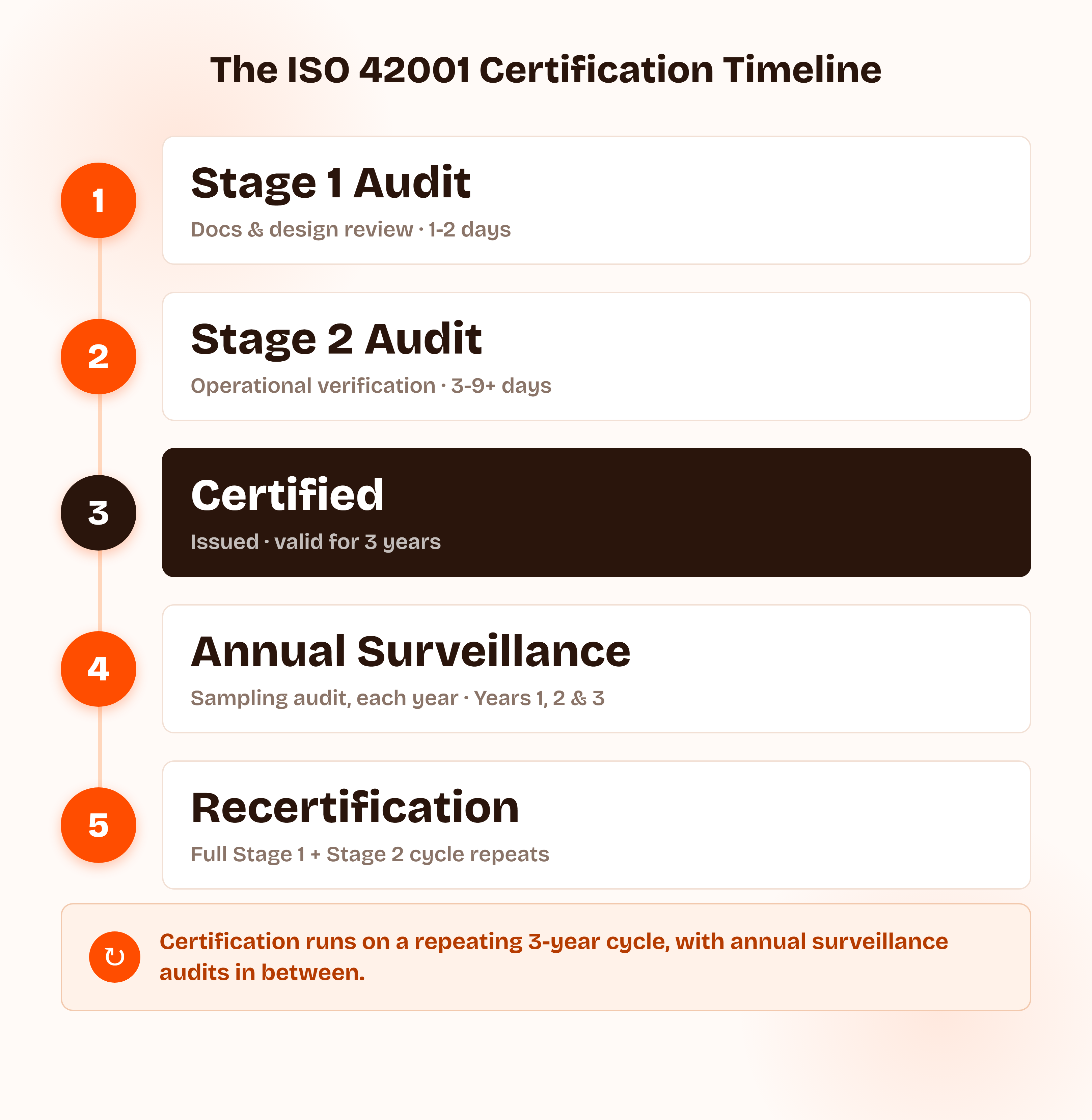
Readiness assessment, build the AIMS, internal audit, external Stage 1 audit, external Stage 2 audit, certification, then annual surveillance audits across a three-year cycle.
The ISO 42001 certification process, sourced from an accredited certification body's own published methodology (Schellman) and cross-checked against Cloud Security Alliance and InfosecTrain guidance with no contradictions found, runs in this order:
| Stage | What happens |
|---|---|
| 1. Readiness or gap assessment | Optional but common; evaluates preparedness and flags gaps ahead of the real audit |
| 2. AIMS implementation | Build the policies, risk assessment, impact assessments, and Annex A controls the risk assessment selects |
| 3. Internal audit | Confirm the AIMS is operating as designed before an external body ever looks at it |
| 4. External Stage 1 audit | Documentation and design review: does the AIMS's scope, policy, and records exist and cover what they need to |
| 5. External Stage 2 audit | Operational verification: is the AIMS genuinely running, not just documented |
| 6. Certification | Issued after a successful Stage 2, valid for three years |
| 7. Surveillance audits | Annual, sampling-based, confirming the AIMS is still operating between full recertification cycles |
ISO 42001 Stage 1 and Stage 2 Audit: What Each One Actually Checks
Every ISO 42001 audit splits into these same two stages, run by the certification body you've chosen. Budget both the ISO 42001 Stage 1 and Stage 2 audit into your timeline separately; they're rarely scheduled back to back.
Stage 1 (typically 1-2 days) is a documentation and design review. The auditor checks that your AIMS scope, AI policy, risk assessment methodology, and Statement of Applicability exist and actually cover what they claim to. It outputs "Areas of Concern," gaps that have to be resolved before Stage 2 can proceed. This isn't a formality; a Stage 1 that surfaces real gaps delays the whole timeline.
Stage 2 (typically 3-9+ days, and up to roughly 30 days for larger organizations) is operational verification. This is where the auditor checks whether the AIMS is genuinely running: are risk assessments actually being performed, are impact assessments documented for real systems, did management review actually happen on a real cadence, do internal audit records show the system being checked and corrected. Stage 2 outputs a certification recommendation, not the certificate itself.
Watch out
The gap between Stage 1 and Stage 2 typically runs 4-12 weeks and shouldn't exceed six months. If it does, some certification bodies require re-verifying the Stage 1 findings before Stage 2 can proceed, which adds real time and cost that a tighter schedule avoids.
ISO 42001 Certification Timeline: How Long Does an ISO 42001 Audit Take?
| Starting point | Realistic overall timeline |
|---|---|
| No existing management system | Roughly 3-12 months, depending on team size and how much of the AIMS has to be built from scratch |
| Already running an ISO 27001 ISMS | Meaningfully shorter, since scope definition, internal audit process, and management review cadence can extend rather than start over |
Budget the full ISO 42001 certification timeline into your planning, not just the audit days themselves. Most of that time sits in the AIMS implementation stage before any external auditor is even involved.
Once certified, the certificate is valid for a three-year period, with annual surveillance audits in between. Each ISO 42001 surveillance audit runs roughly one-third the length of the initial certification audit and uses a sampling approach rather than a full re-review, checking that the AIMS is still genuinely operating, not re-litigating every control from scratch.
Budgeting for that ongoing ISO 42001 surveillance audit cost matters just as much as the first-year number, since it repeats every year of the three-year cycle.
What Does ISO 42001 Certification Cost? A Full Breakdown
Every credible source on this gives a range, not a fixed number, and that's not evasiveness. ISO 42001 certification cost genuinely depends on organization size, AI system scope, whether consultants are involved, and how much of the underlying management-system work already exists. Anyone quoting a single number without knowing those four things is estimating, not quoting.
Note
Organizations already building SOC 2 or ISO 27001 evidence with ComplyJet start this process with meaningfully less to build from scratch. Documented scope, risk assessment methodology, and internal audit process are all reusable, not one-time sunk cost.
ISO 42001 Certification Cost by Company Size
| Company size | Realistic first-year, all-in range |
|---|---|
| 1-20 employees | Roughly $15,000-$35,000 all-in; audit fees alone can start around $5,000 |
| 21-50 employees | Roughly $20,000-$45,000 all-in; audit fees alone typically $7,000-$15,000 |
| 50+ employees | $40,000-$75,000+, scaling with the number of AI systems and business units in scope |
A real distinction worth naming directly: several vendor cost pages state per-headcount figures (for example, "$5,000 for a 1-20-employee organization") that describe audit fees only, not the true all-in cost once implementation and internal effort are included. Treat any figure that low as one line item, not the whole budget.
ISO 42001 Certification Cost by Component: Readiness, Implementation, Audit, and Surveillance
| Cost component | Typical range | What drives it |
|---|---|---|
| Readiness or gap assessment | $3,000-$10,000+ | Whether it's done at all, and by an outside consultant vs. internally |
| AIMS implementation and internal resources | $10,000-$40,000+ | Usually the largest single line: policy drafting, risk/impact assessments, staff time, tooling |
| Certification audit fees | $5,000-$20,000 | Certification body chosen, organization size, number of audit days quoted |
| Annual surveillance audits | Roughly 30-40% of the initial audit fee per year | Sampling scope, whether findings from the prior audit need re-checking |
One concrete, named comparison worth more than an abstract percentage: a company that already held ISO 27001 and ISO 9001 added ISO 42001 certification for roughly $35,000 total. A similar-sized company with no existing ISO certification, starting from zero, spent $70,000-$90,000 for the same scope. That's the real financial size of the head start an existing management system provides.
What Actually Drives ISO 42001 Certification Cost Up or Down
- Number and complexity of AI systems in scope. A single, well-understood LLM-powered feature costs far less to certify than a portfolio of AI systems across multiple products
- The organization's role. An AI developer building and training models has an inherently larger scope, and higher cost, than an organization that only uses a third-party AI system
- Consultant use. Hiring a consultant for the full build instead of just the gap analysis is usually the single biggest cost lever, in either direction
- Existing framework overlap. An organization already ISO 27001 or SOC 2 certified reuses real work; one starting from zero pays for all of it
- Certification body chosen. Audit-day rates and quoted scope vary meaningfully between accredited bodies, worth comparing rather than accepting the first quote
How to Lower ISO 42001 Certification Cost If You Already Hold ISO 27001
The shared Annex SL management-system structure between ISO 27001 and ISO 42001 is the single biggest cost lever available, more concrete than a general "these overlap" statement. Scope definition, the internal audit process, and management review cadence can all be extended from an existing ISMS rather than built from nothing. That's the mechanism behind the $35,000-versus-$70,000-$90,000 comparison above, not a coincidence.
The teams that get through ISO 42001 fastest and cheapest aren't the ones with the biggest budgets. They're the ones who already run ISO 27001 well and treat this as extending a system they already trust, not starting a second, separate compliance project from scratch. — Upendra Varma, CTO at ComplyJet
What actually carries over in practice: the organizational context and interested-parties analysis, the internal audit program and its cadence, the management review process, and (often) the certification body relationship itself, since the same auditor can frequently extend an existing certification rather than starting a new vendor relationship.
For the fuller ISO 27001-and-ISO 42001 relationship, see ComplyJet's ISO 42001 guide. If you're weighing both certifications' budgets side by side, ComplyJet's ISO 27001 certification cost guide breaks down that framework's cost the same way this one does.
Common Mistakes That Drive Up ISO 42001 Certification Cost
- Scoping the AIMS across the entire company instead of the actual AI systems in play. Every downstream cost, documentation, risk assessment, audit days, scales with scope. A five-person company with one AI feature doesn't need company-wide scope.
- Booking Stage 2 before the AIMS has real operating history. An AIMS that's two weeks old won't have the review minutes, risk assessments, or audit records Stage 2 actually looks for, and a failed Stage 2 means paying for a second one.
- Treating the readiness assessment as optional with no prior ISO experience. It's the cheapest place to catch a gap; finding the same gap during Stage 1 costs more in delay and re-work.
- Hiring a consultant for the entire build instead of just the gap analysis. Consultant day rates add up fast; many organizations only need consulting help at the specific points where in-house expertise runs out.
- Not reusing an existing ISO 27001 or SOC 2 evidence base. Rebuilding scope definition, risk methodology, or internal audit process from scratch when a working version already exists is pure avoidable cost.
- Accepting the first certification-body quote without comparing audit-day pricing. Audit-day rates vary meaningfully across accredited bodies for equivalent scope.
- Letting the Stage 1-to-Stage 2 gap exceed six months. Past that point, some certification bodies require re-verifying Stage 1 findings, adding real time and fees that a tighter schedule avoids entirely.
Where ComplyJet Fits Into ISO 42001 Certification Cost
ComplyJet's role connects directly to the cost lines broken out above, not as an adjacent mention but as real capability against each one. Automated evidence collection across 350+ integrations reduces the AIMS implementation and internal-resources line, usually the single largest cost component. AI risk and impact assessment templates reduce the readiness and documentation line. A vetted network of independent ISO 42001 auditors gives a real comparison point on audit-body fees, instead of a cold search with no benchmark.
Pricing is flat and per-company, not per-seat, which matters specifically here: it removes one more cost-scaling variable as a team grows from 20 to 40 people during the certification process itself, rather than the price moving with headcount the way some audit and consulting fees do.
If you're earlier in the decision, still working out whether ISO 42001 applies to you at all, ComplyJet's ISO 42001 guide is the right starting point instead of this one.
AI Management System
Budgeting for ISO 42001 certification?
See how ComplyJet reduces the implementation and readiness lines of ISO 42001 certification cost: automated evidence collection, risk and impact assessment templates, and a vetted auditor network, at flat, per-company pricing.
FAQs
How Much Does ISO 42001 Certification Cost, Really?
For a small organization, realistic first-year all-in ISO 42001 certification cost runs $15,000 to $75,000+, depending on scope, consultant use, and existing framework overlap. Audit fees alone can start around $5,000-$20,000. See the cost breakdown sections above for the full picture by company size and cost component.
What Are the ISO 42001 Certification Requirements?
Clauses 4 through 10 are mandatory for every certifying organization, plus a defined AIMS scope, a documented AI policy, completed risk and impact assessments, a Statement of Applicability, and evidence the system has actually been operating. See the requirements section above for the full documentation checklist.
What Is the ISO 42001 Certification Process?
Readiness assessment, AIMS implementation, internal audit, external Stage 1 audit, external Stage 2 audit, certification, then annual surveillance audits across a three-year cycle. See the process section above for what happens at each stage.
Who Is the ISO 42001 Certification Body, and Who Issues It?
An accredited, independent ISO 42001 certification body issues the certificate after conducting Stage 1 and Stage 2 audits, not ISO itself. Certification bodies vary in audit-day pricing and industry focus, so comparing quotes from a few accredited bodies is worth the time before committing.
How Much Do ISO 42001 Surveillance Audits Cost?
An ISO 42001 surveillance audit typically costs roughly 30-40% of the initial certification audit fee each year, or in the low thousands of dollars for a small organization. It's shorter and narrower than the original audit, using a sampling approach rather than a full re-review.
What Documents Do You Need for ISO 42001 Certification?
Roughly 20+ required documents and records across four categories: required documents (AIMS Scope Statement, AI Policy, Statement of Applicability), required records (risk and impact assessments, audit and review records), policies and procedures, and AI-system-level documentation. See the documentation checklist above for the full table.
Does Already Holding ISO 27001 Lower ISO 42001 Certification Cost?
Yes, meaningfully. The shared management-system structure means scope, internal audit process, and management review can extend rather than rebuild. One sourced example: a company with existing ISO 27001 and ISO 9001 added ISO 42001 for about $35,000, versus $70,000-$90,000 for a similar company starting from zero.
How Long Does ISO 42001 Certification Take?
Roughly 3-12 months for an organization with no existing management system, and meaningfully shorter for one already running ISO 27001. See the timeline section above for the full breakdown by starting point.
Related Reading
- What Is ISO 42001? The Complete AI Management System Guide, the hub this article is a direct spoke off, for readers who need the standard itself explained first
- ISO 27001 Certification Cost: Breakdown, Factors & Hidden Costs, the same requirements/process/cost breakdown for ISO 27001, for readers evaluating both frameworks together
- ISO 27001 and AI Compliance: The Complete Comparison, for the fuller ISO 27001-vs-ISO 42001 breakdown
- How to Write an AI Governance Policy, for readers whose immediate next step is the policy document itself
- ISO 22301 Guide: Business Continuity Management, Certification & Cost, a sibling framework's own requirements/process/cost guide, for readers building a multi-framework roadmap
- ComplyJet's ISO 42001 Framework Page, for readers ready to evaluate certification support directly
Sources: Certification process sourced to Schellman's ISO 42001 certification process guide, cross-checked against Cloud Security Alliance's ISO 42001 certification process overview and InfosecTrain's Stage 1 vs. Stage 2 audit breakdown. Cost breakdown sourced to Vanta's ISO 42001 certification cost structural breakdown, CertPro's and Compyl's 2026 cost guides, and the $35,000-vs-$70,000-$90,000 comparison to Elevate Consult's 2026 ISO 42001 cost breakdown. Documentation requirements cross-checked against Hicomply's, Advisera's, and ISMS.online's ISO 42001 documentation guides, independently converging on 20+ required documents and records.