.svg)

Let's cut to the chase. You aren't reading this because you want to think about SOC 2 controls on a Friday afternoon. You're here because a massive enterprise deal - the one that could define your quarter - just slammed on the brakes. The procurement team sent over a 200-question security spreadsheet, and suddenly, "getting compliant" isn't a roadmap item for next year. It's a "hair on fire" problem for today.
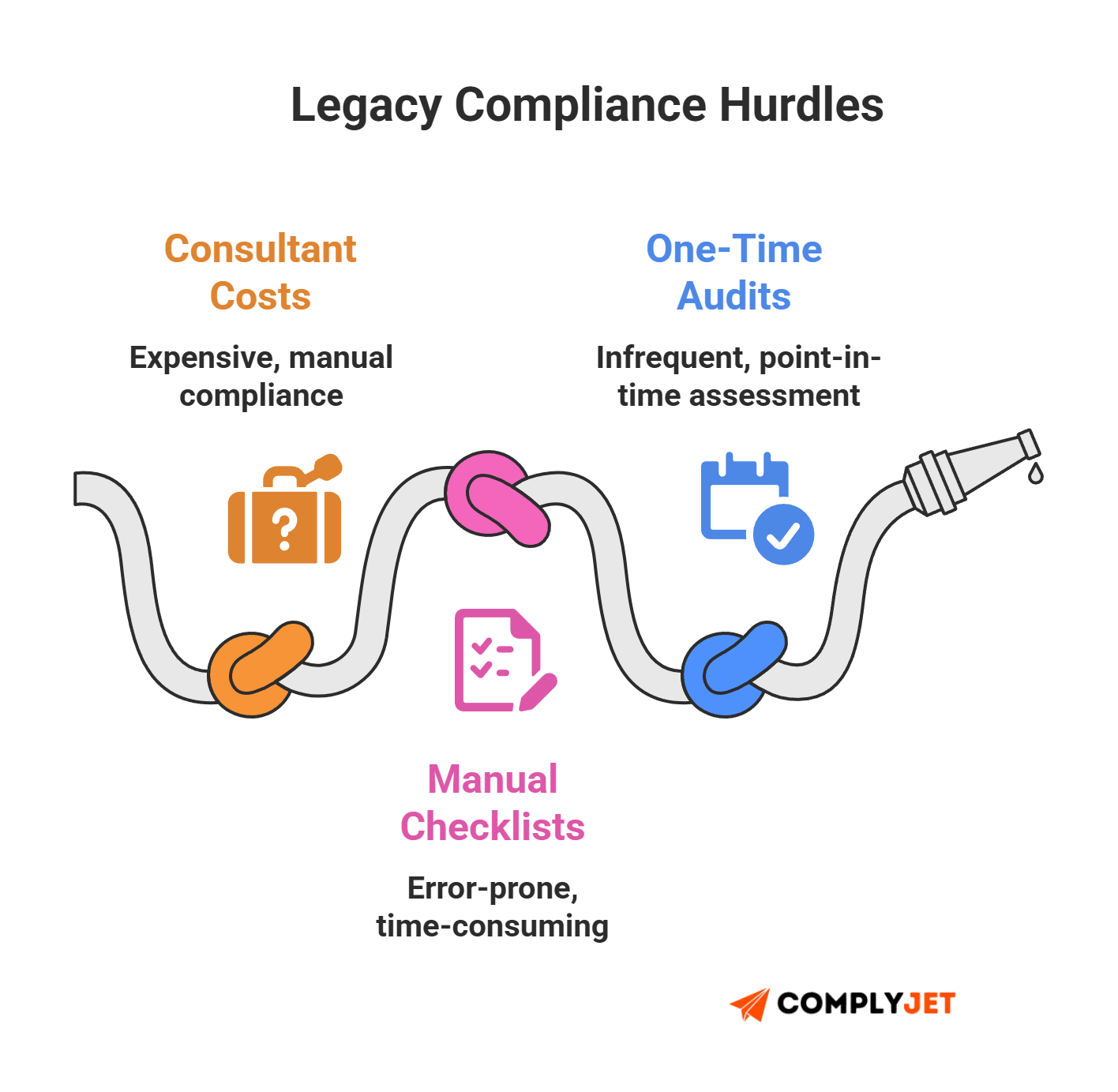
The "Compliance Tax" is real. It's the friction that stands between you and closed revenue.
A few years ago, your only option was to hire a consultant with a clipboard for $50k. Today, the market has shifted to API-driven automation. But now you have a new problem: paralysis by analysis. Most compliance software reviews you find online are either thinly veiled ads or outdated Reddit threads. It's incredibly hard to find the truth amidst the noise.
Drowning in feature bloat? ComplyJet cuts through the noise. We get lean startups audit-ready without the complex dashboards or the enterprise price tag. Get compliant simply.
This guide is your unbiased roadmap. We are going to compare Vanta vs Secureframe - the two 800-pound gorillas of the space - without the sales fluff. We will dissect their pricing models, expose hidden costs triggers, and help you decide which is the best compliance tool for startups like yours.
We aren't here to declare a winner. We're here to stop you from buying a Ferrari when you need a minivan (or vice versa).
The Strategic Divide
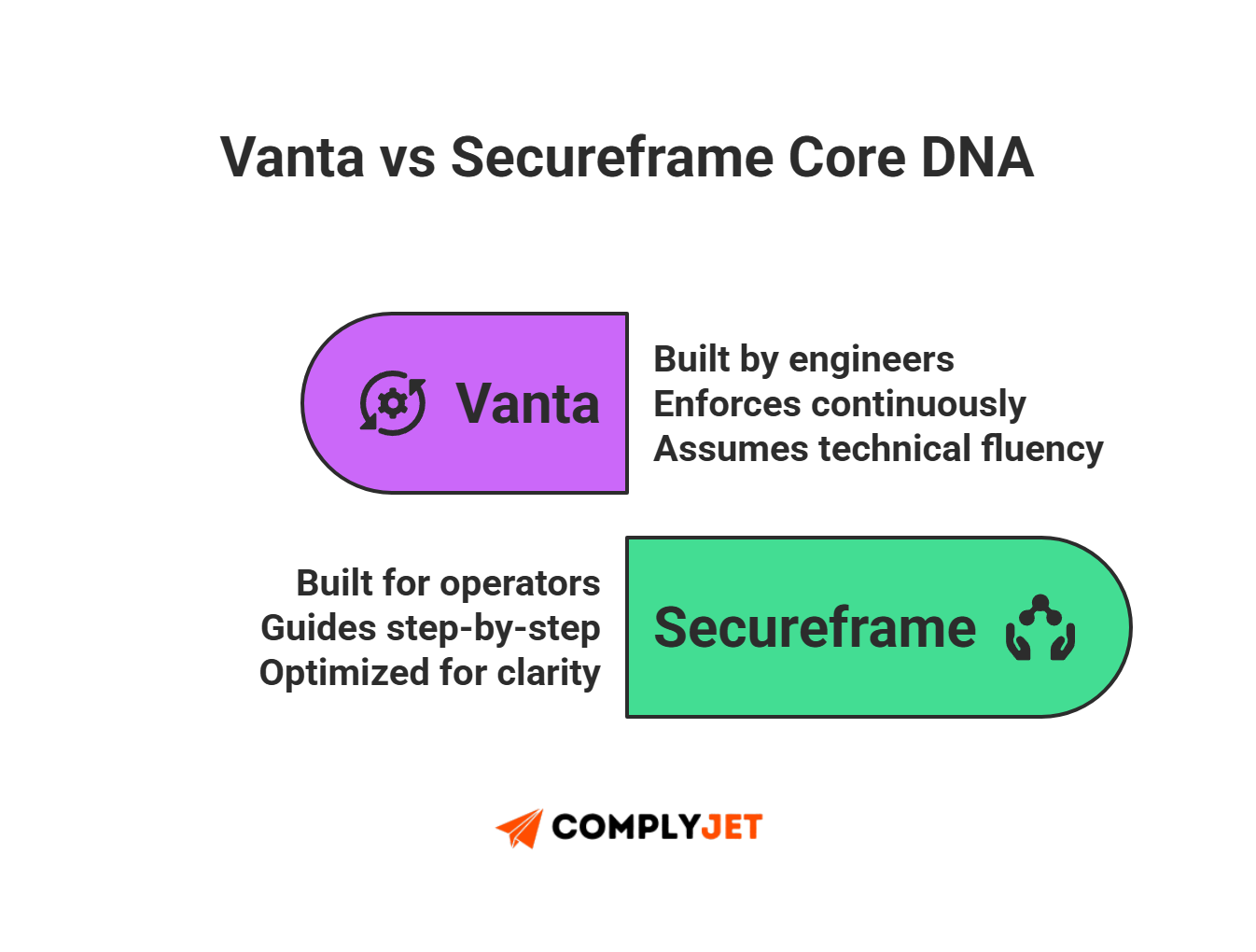
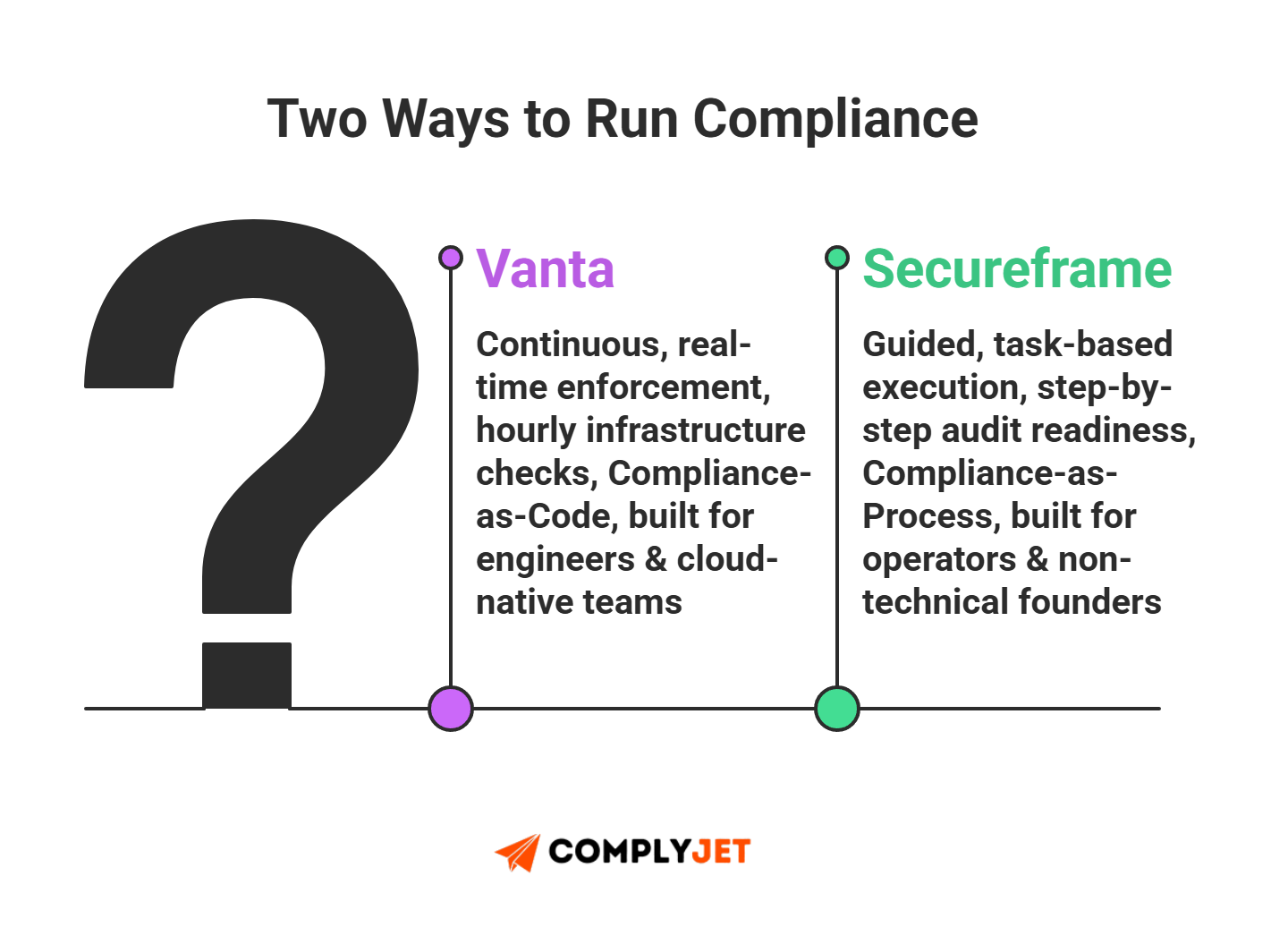
If you strip away the branding, Vanta vs Secureframe isn't just a feature battle; it's a philosophical one. These two platforms were built by different types of people for different types of customers. Understanding this DNA is the single most important factor in your decision.
Vanta: The "Cron Job" (Engineer's Choice)
Vanta is the incumbent for a reason. It was built by engineers, for engineers, and it shows. The platform operates on a philosophy of "continuous enforcement." It doesn't just want to know if you had a policy yesterday; it wants to know if your production database is encrypted right now.
This is where Vanta's Real-Time Risk Monitoring shines. The platform runs hourly tests against your infrastructure, functioning almost like a unit test for your security posture. If an engineer accidentally opens a port on a firewall at 2:00 AM, Vanta's Risk Monitoring will likely flag it by 3:00 AM.
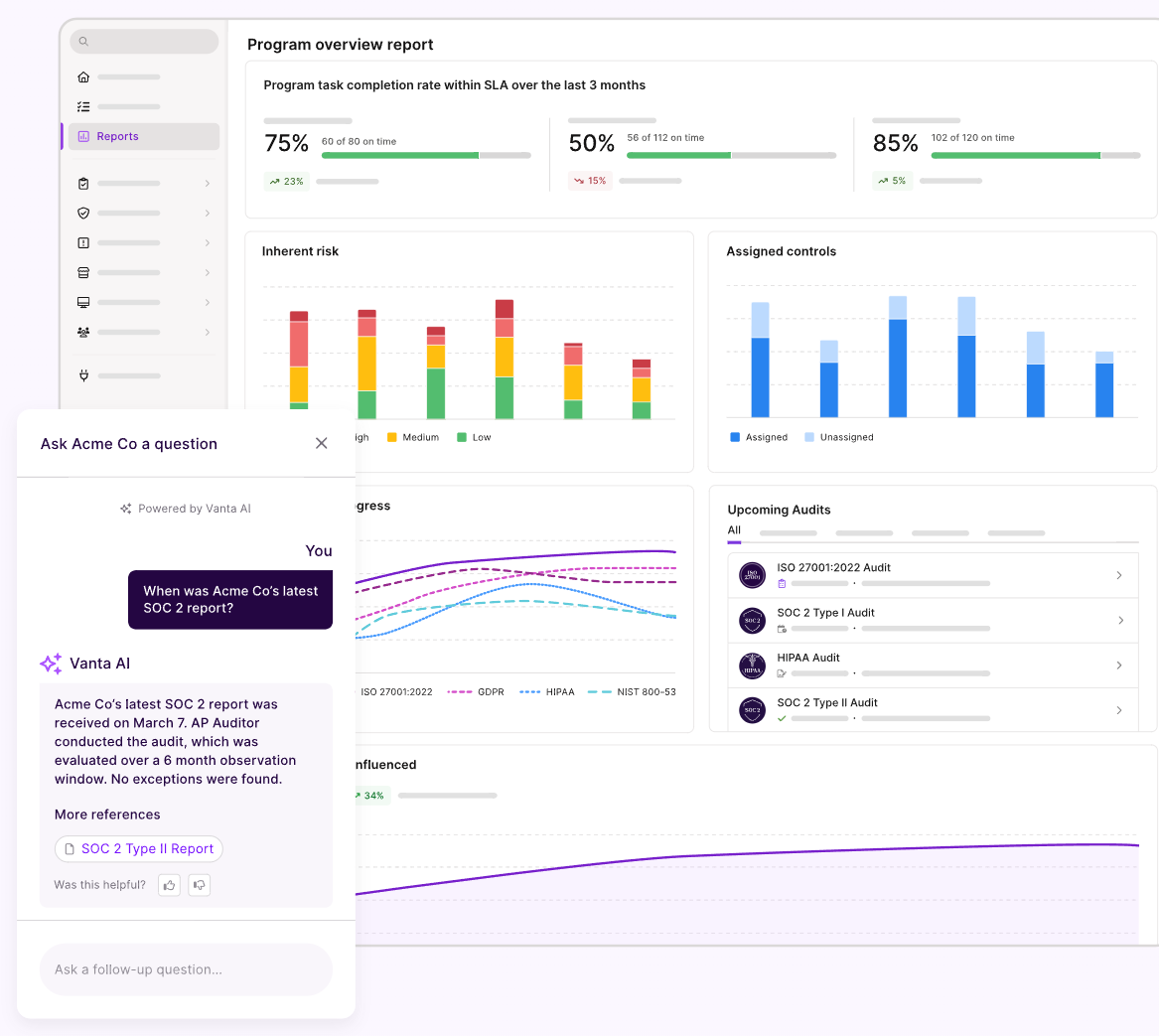
For a CTO or a technical founder, this is comforting. It feels like "Compliance-as-Code." You aren't relying on a human to check a box; you are relying on a script to query an API. This makes Vanta the best compliance tool for startups that are cloud-native and live in GitHub.
However, this relentless Real-Time Risk Monitoring has a downside: noise. If you are a non-technical founder, logging into Vanta can feel like staring into the Matrix. You see 400 failing tests, cryptic AWS error codes, and a "security score" that fluctuates wildly. It assumes you know how to fix the issues it finds, although Vanta's AI agents have lessened the friction considerably. Click here to learn more about Vanta's compliance offerings.
Secureframe: The Project Manager (Operator's Choice)
If Vanta is a high-performance gaming PC, Secureframe is a Mac Studio - polished, intuitive, and designed to just work. Secureframe entered the market slightly later and realized that for 90% of founders, compliance isn't a technical problem; it's a process problem.
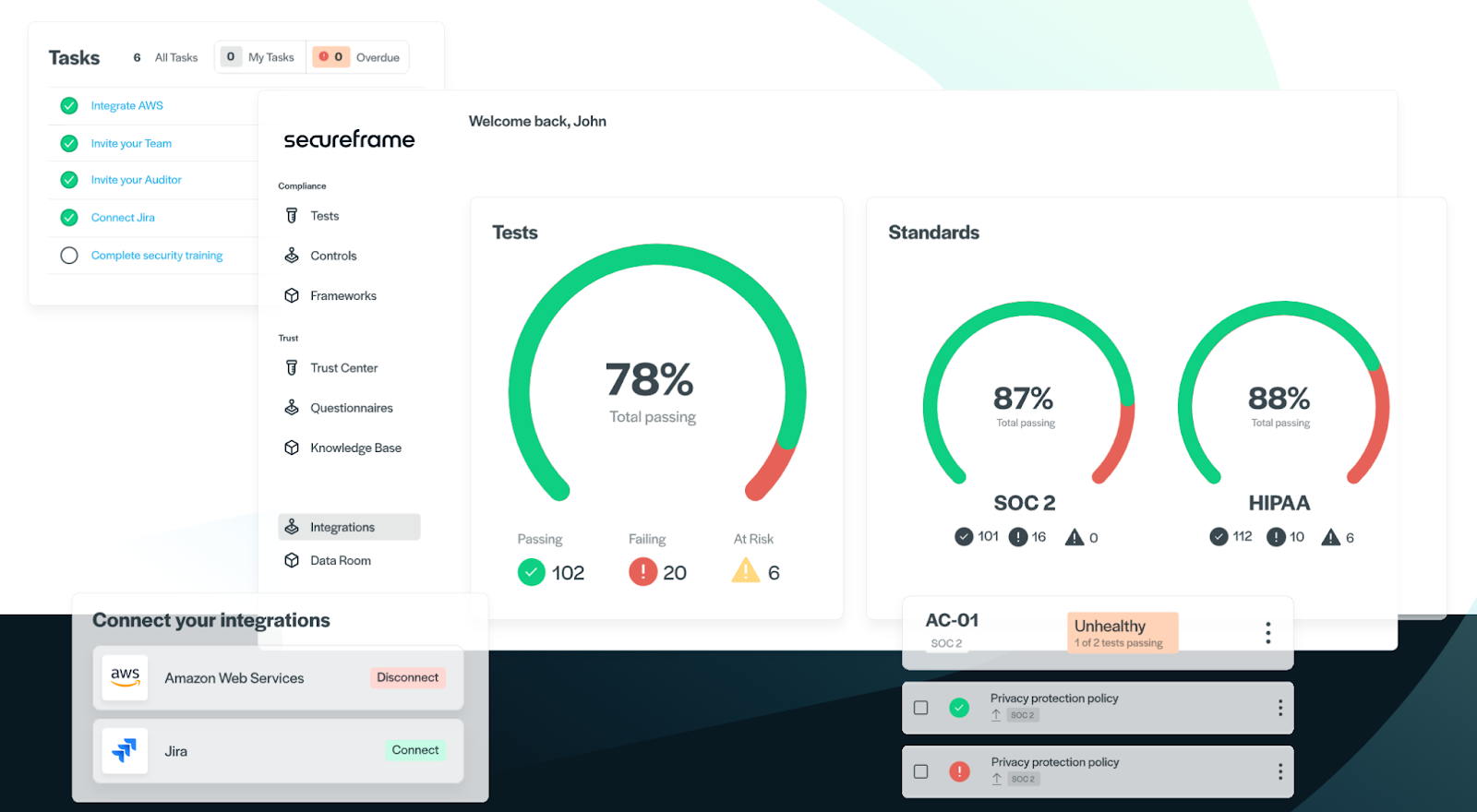
Secureframe's DNA is built around "Guidance." The platform feels less like a monitoring tool and more like a turbo-charged checklist. It excels at taking the nebulous nightmare of "SOC 2 Type 2" and breaking it down into linear, bite-sized tasks: Review this policy. Assign this owner. Fix this setting.
For operations-focused founders or companies without a dedicated CISO, this approach is a lifesaver. You don't need to speak fluent Terraform to use Secureframe. Their focus is on getting you "audit-ready" with the least amount of friction possible.
While they do offer automated monitoring, their "pulse" is often described as slightly less aggressive than Vanta's, focusing more on the state of compliance rather than the second-by-second fluctuation. For a thorough breakdown of Secureframe's compliance solutions, go through our in-depth review.
Vanta vs Secureframe Feature Deep Dive
When you get past the dashboard, the Secureframe vs Vanta debate comes down to three specific battlegrounds: Automation, AI, and Trust Centers. This is where your daily workflow will actually live. We've dug into the docs to see what's actually under the hood.
Automation: Depth vs. Breadth
Vanta's 300+ integrations are impressive. They connect to everything from your HR system (Rippling, Gusto) to your code repository (GitHub, GitLab). Because of this depth, Vanta is exceptional at "discovering" things you didn't know existed - like that one contractor who still has admin access to a repo they haven't touched in six months.
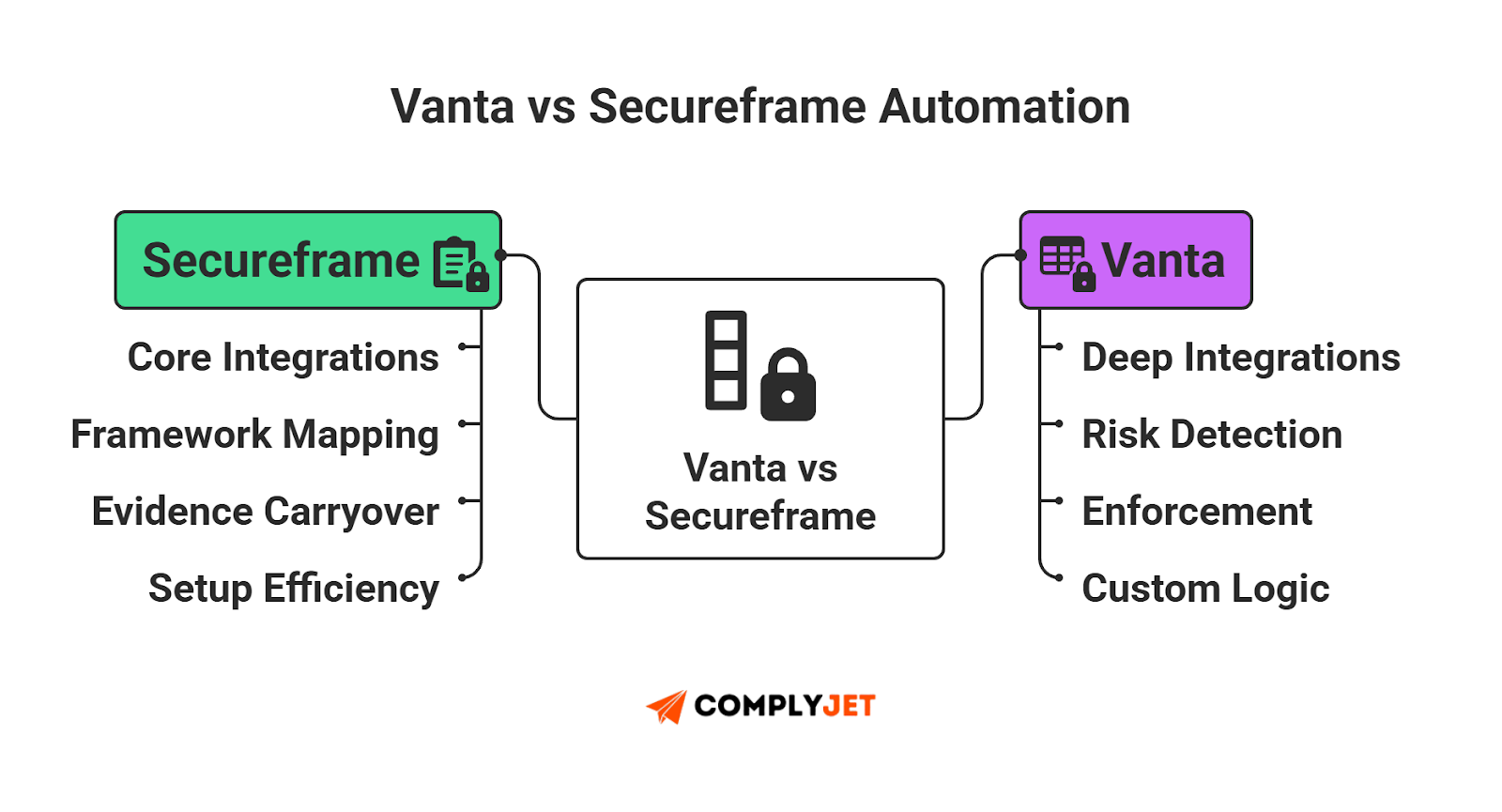
- The Vanta Agent: Unlike many competitors, Vanta offers a lightweight agent for employee laptops. This allows it to query granular details like disk encryption status and screen lock timers, even on BYOD devices.
- Custom Logic: Vanta allows mature teams to write custom tests. If you have a specific internal policy that isn't standard SOC 2, you can code a test for it.
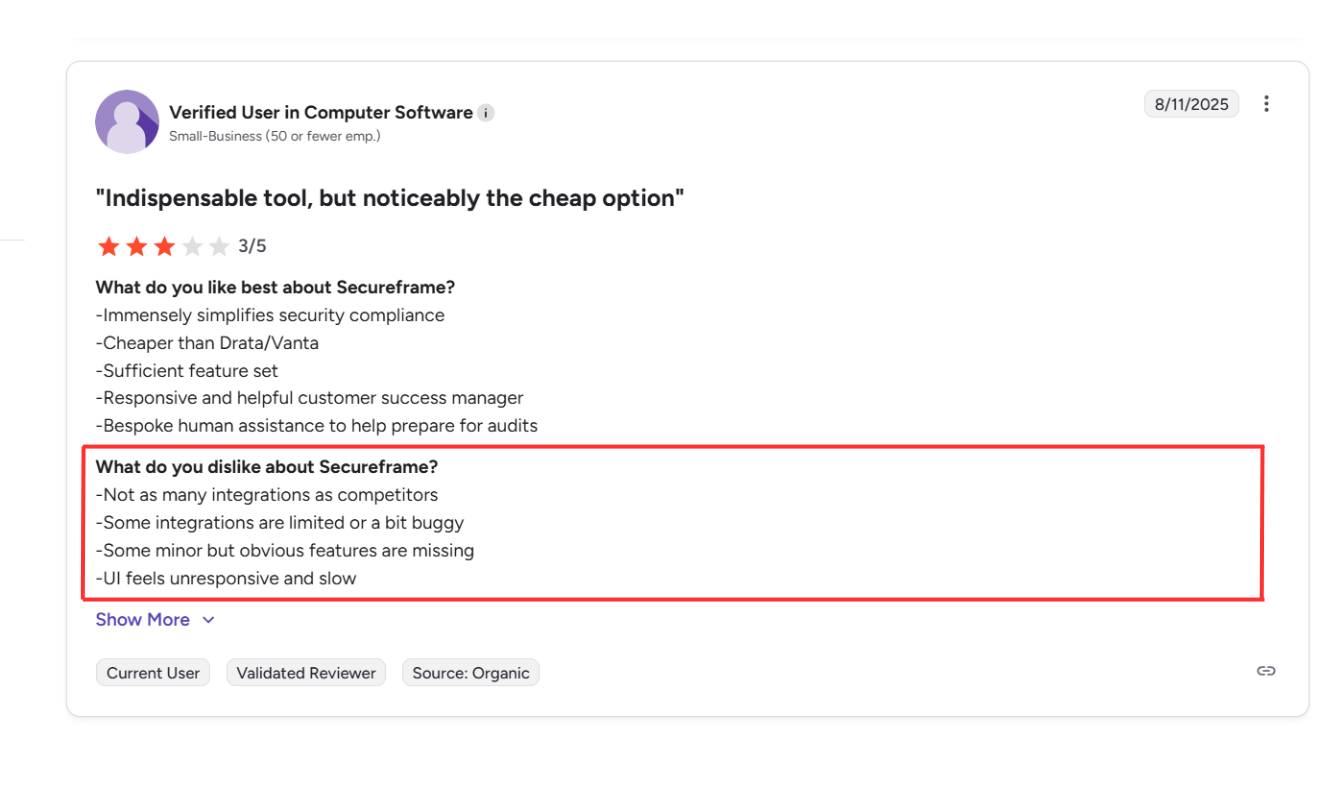
Secureframe matches most of these core integrations (200+) but plays a different ace card: Secureframe Comply.
Secureframe Comply is their cross-framework mapping engine, and it is a massive time-saver for growing startups. Let's say you spend weeks getting SOC 2 ready. Six months later, a big European client demands ISO 27001.
With Secureframe Comply, the platform looks at the evidence you already collected for SOC 2 and automatically "maps" it to the relevant ISO controls. You aren't starting from scratch; you're starting at 60% completion. Vanta does this too, but Secureframe's visualization of this overlap is often cited as more intuitive for non-experts. However, if your operational niche requires a wider integration support, Vanta may be a better fit.
The AI Arms Race
Both companies are aggressively jamming AI into their products, but they are solving different problems.
Vanta is betting big on Vanta AI agents to solve the "Questionnaire Hell" problem. You know the drill: a prospect sends you a 300-row Excel sheet asking if you encrypt data at rest. Vanta AI agents (leveraging their acquisition of Trustpage) ingest your previous security docs and auto-fill these questionnaires for you with high accuracy.
It's a legitimate productivity hack for sales teams. However, be warned: these advanced Vanta AI agents often live behind the "Scale" tier or expensive add-ons.
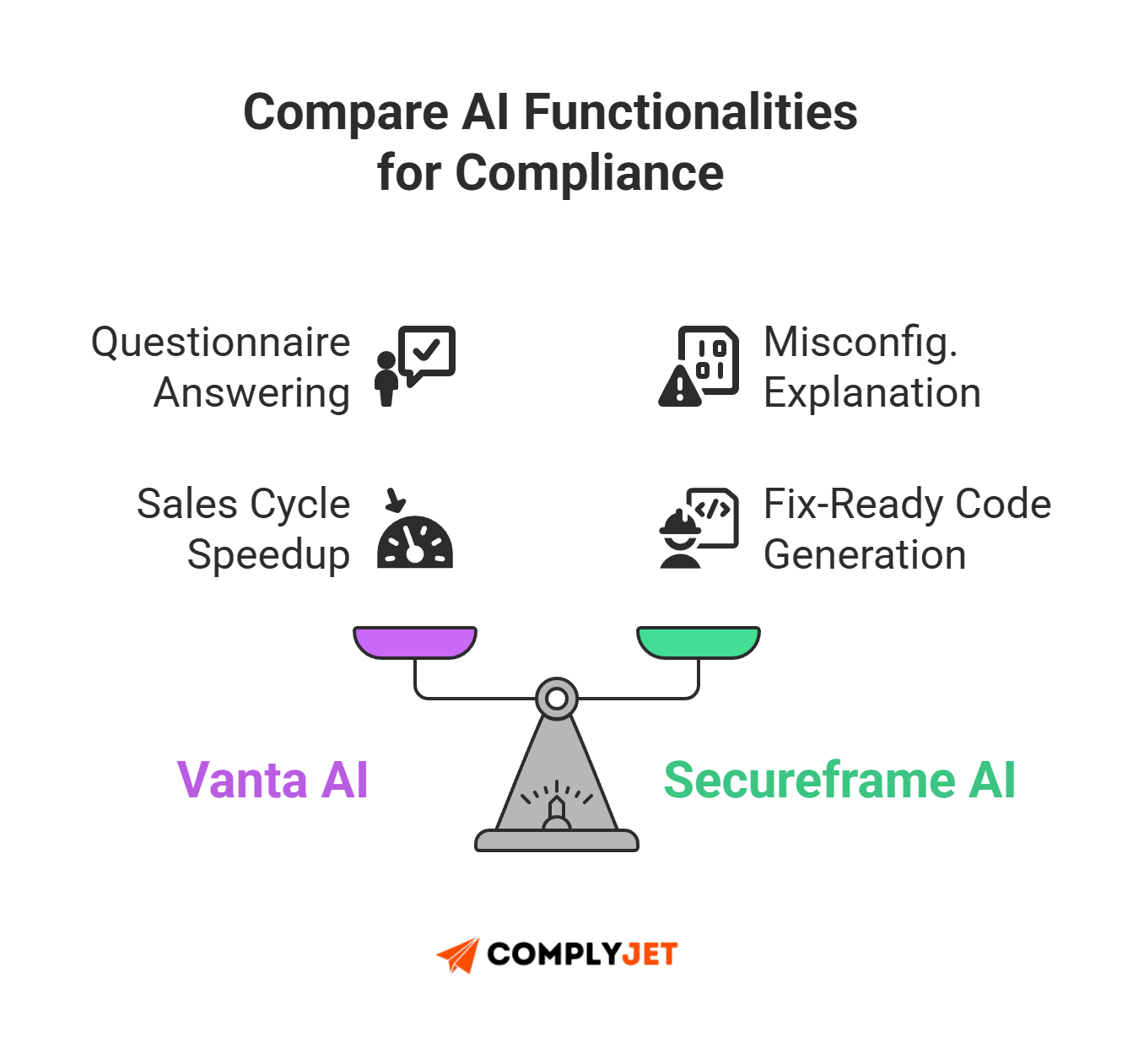
Secureframe AI, on the other hand, focuses on the "fix it" phase. When the platform detects a cloud misconfiguration - like an S3 bucket open to the public - Secureframe AI doesn't just alert you. It generates the specific Infrastructure-as-Code (Terraform or CloudFormation) snippet you need to patch the hole. For a stretched DevOps engineer, copying and pasting a fix from Secureframe AI is infinitely faster than researching the solution manually.
Trust Centers: The Sales Accelerator
The "Trust Center" is a public-facing webpage where you display your security posture. The goal is to send a link instead of filling out a questionnaire.
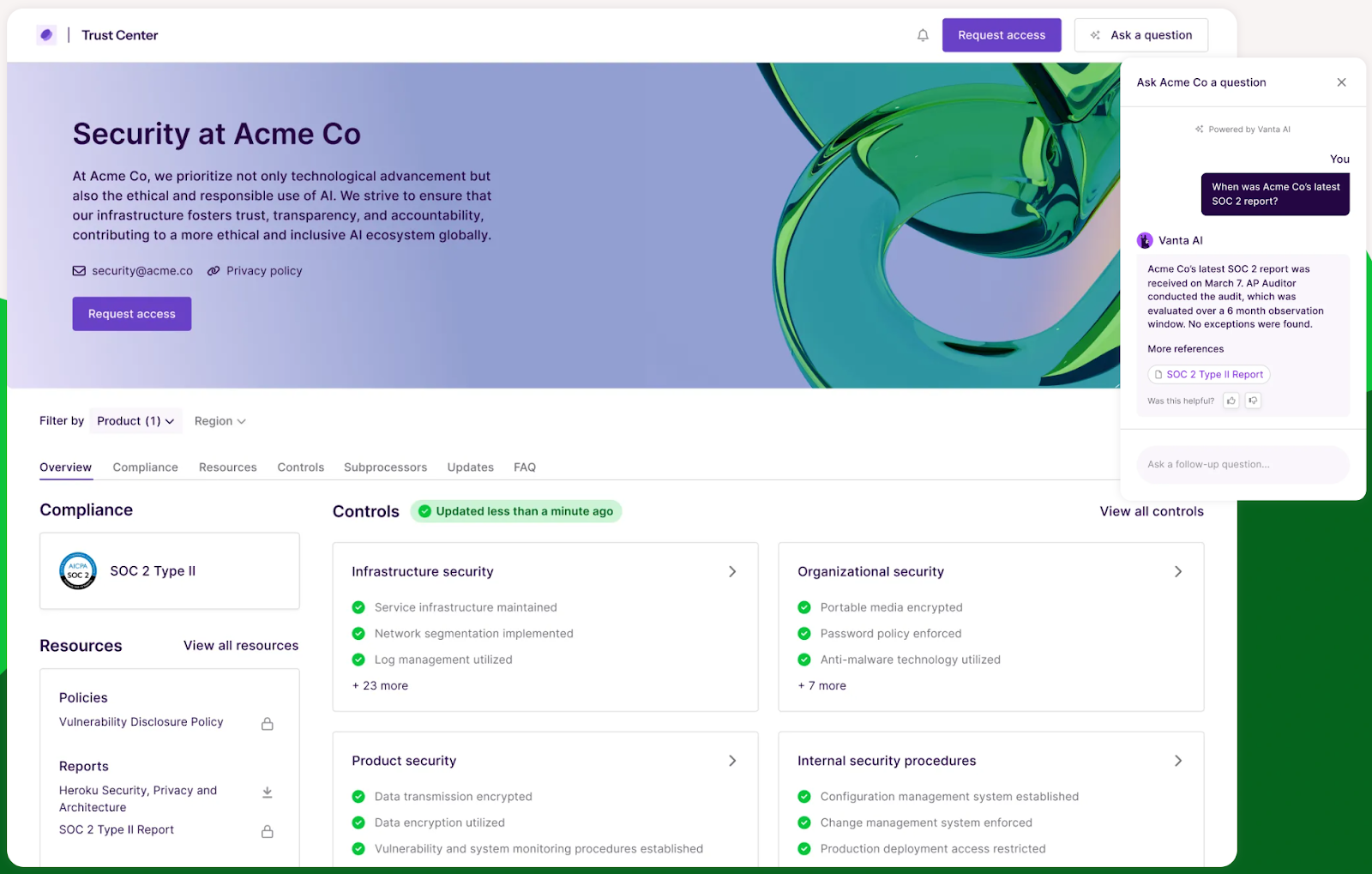
Vanta's Trust Center is the gold standard in terms of polish and customization. It looks professional and integrates deeply with Salesforce to auto-approve access requests. The catch? Vanta's Trust Center features, especially the advanced ones, are notoriously gated behind add-on fees that can exceed $6,000/year.
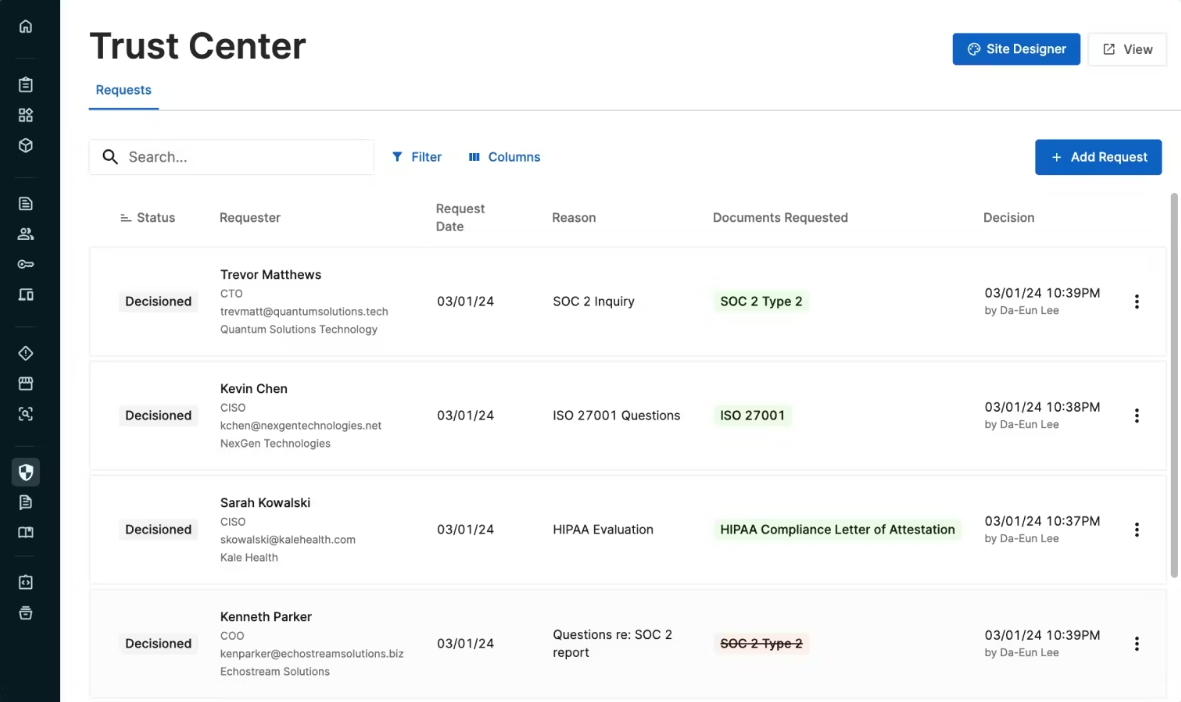
Secureframe takes a more bundled approach. Secureframe Trust is often included in lower-tier plans or available at a much more reasonable price point. While Secureframe Trust might lack some of the extreme configurability of Vanta's enterprise version, it gets the job done for 99% of startups without blowing the budget.
Founder Tip: If you are targeting US Government contracts, Secureframe has a massive edge. Their automation for FedRAMP (managing SSPs and POA&Ms) is significantly more mature than Vanta's generalist approach.
The Economics: Vanta vs Secureframe Pricing & Hidden Costs
This is the most critical part of the Vanta vs Secureframe decision, and naturally, it is the part sales teams try hardest to hide. Pricing in the GRC space is notoriously opaque. It relies on the "Call for Quote" button because vendors want to gauge your funding round before giving you a number.
However, based on procurement data and user reports from late 2024, we can crack the box open.
Vanta Pricing Structure
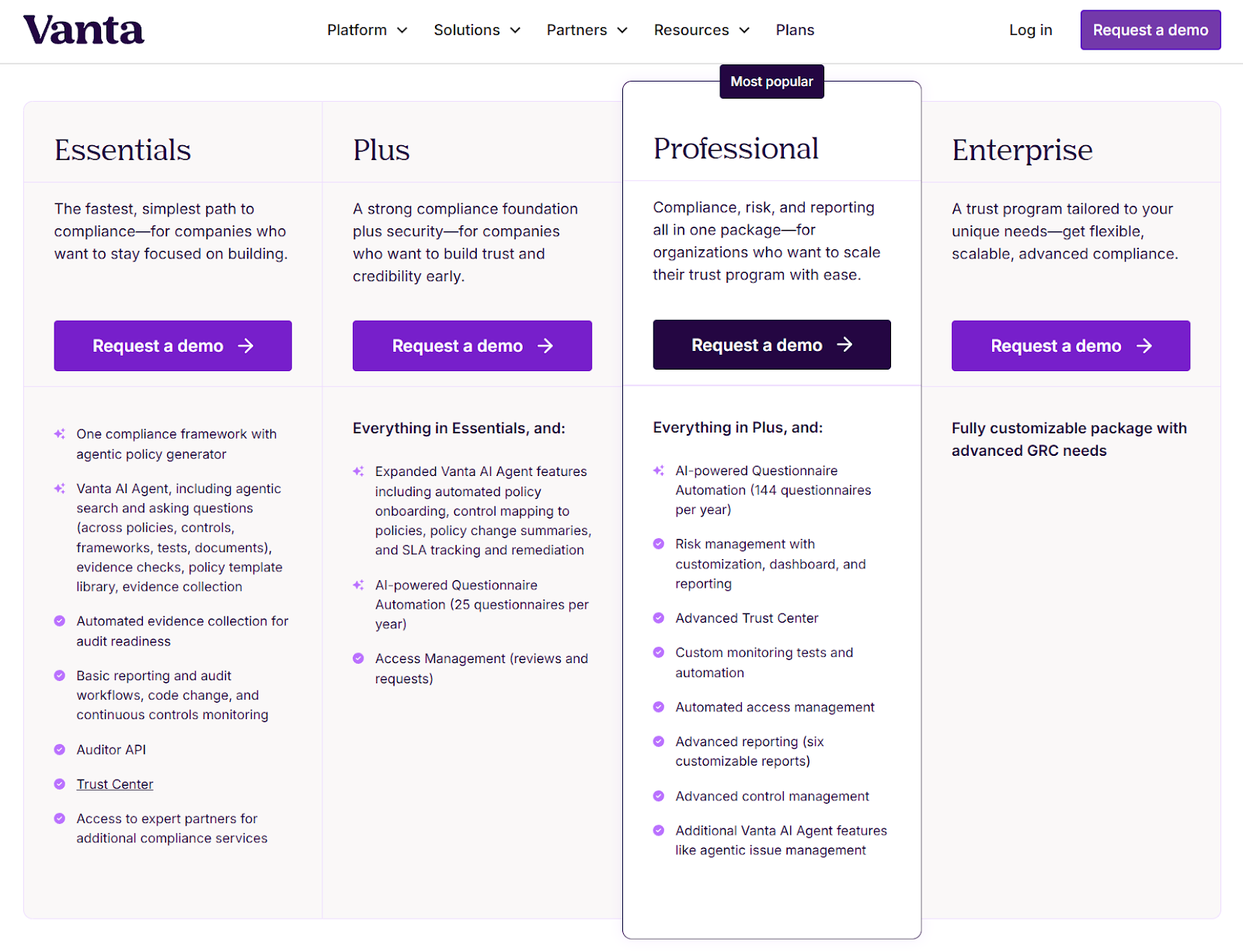
Vanta's pricing is built on a tiered model that scales aggressively with your headcount.
- Essentials (<20 employees)
$7,500-$12,000/year
Single framework (e.g., SOC 2), automated evidence collection, basic reporting, and core AI Agent features. Enough to get audit-ready, limited depth. - Plus (20-100 employees)
$20,000-$40,000/year
Everything in Essentials, plus expanded AI Agent capabilities, access management workflows, deeper integrations, and limited questionnaire automation (≈25/year). - Professional (100+ employees)
$45,000-$80,000+/year
Adds risk management, advanced and customizable reporting, automated access management, custom monitoring tests, advanced Trust Center, and higher questionnaire automation limits (up to 144/year). - Enterprise
Custom pricing
Fully customizable compliance and GRC setup for large or complex organizations.
Bottom line: Vanta starts reasonably but becomes expensive fast as headcount, frameworks, and automation needs increase.
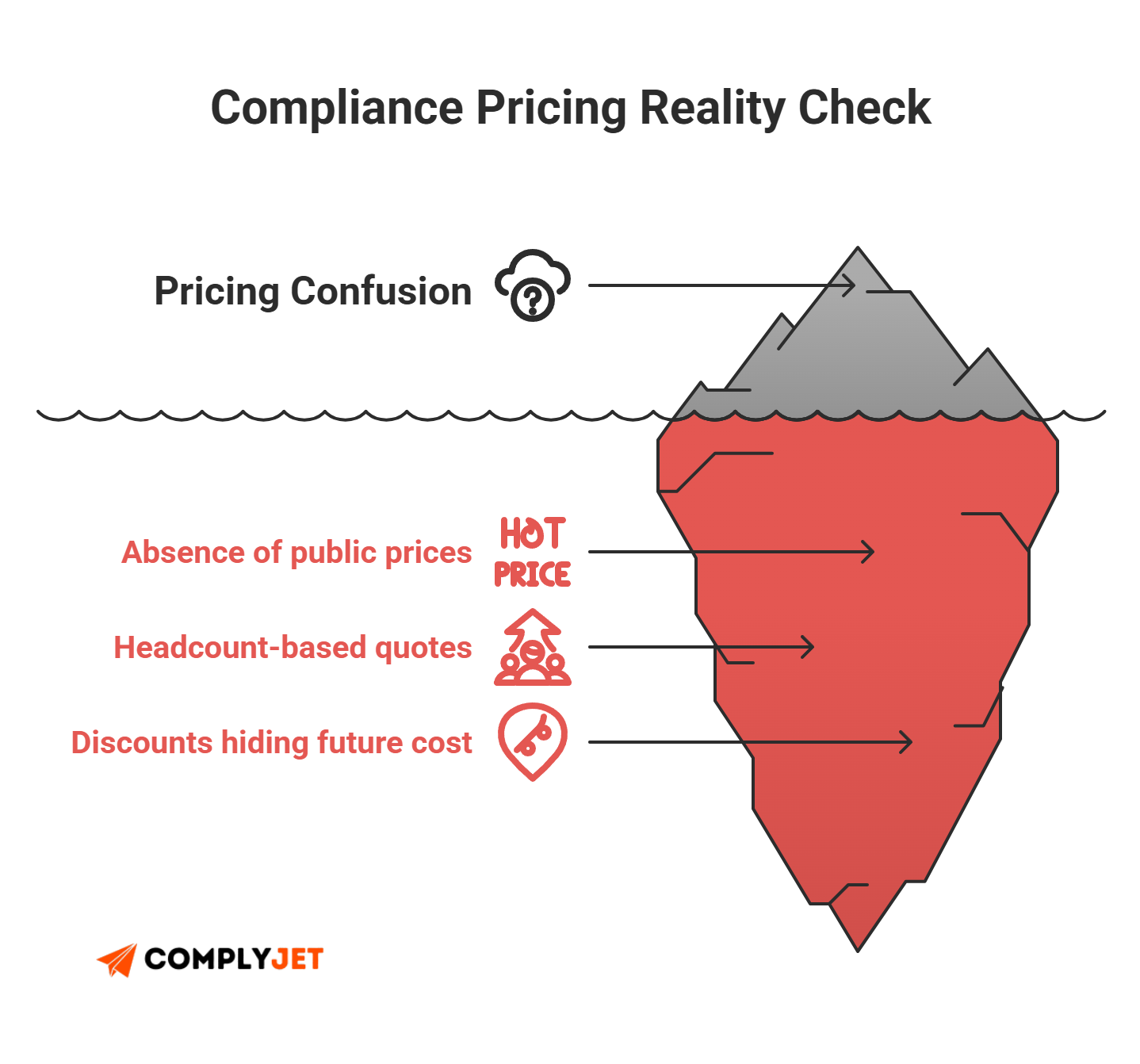
Vanta pricing is famous for the "Growth" trap. Vanta is the market leader, and they know it. To get early-stage startups on board, they often offer massive first-year discounts - sometimes 50-70% off the list price. It feels like a steal until Year 2.
The Trap: Beware the renewal price hike. When that discount expires, your contract reverts to the list price. We have seen founders face a renewal price hike of 100% overnight. Even if you aren't on a discount, standard contract uplifts of 5-15% are common.
Founder Tip: Check your Vanta contract for the 'Auto-Renewal' clause. Many require a 60-day notice to cancel or renegotiate. If you miss that window by one day, you are locked in at a higher rate.
Secureframe Pricing Structure
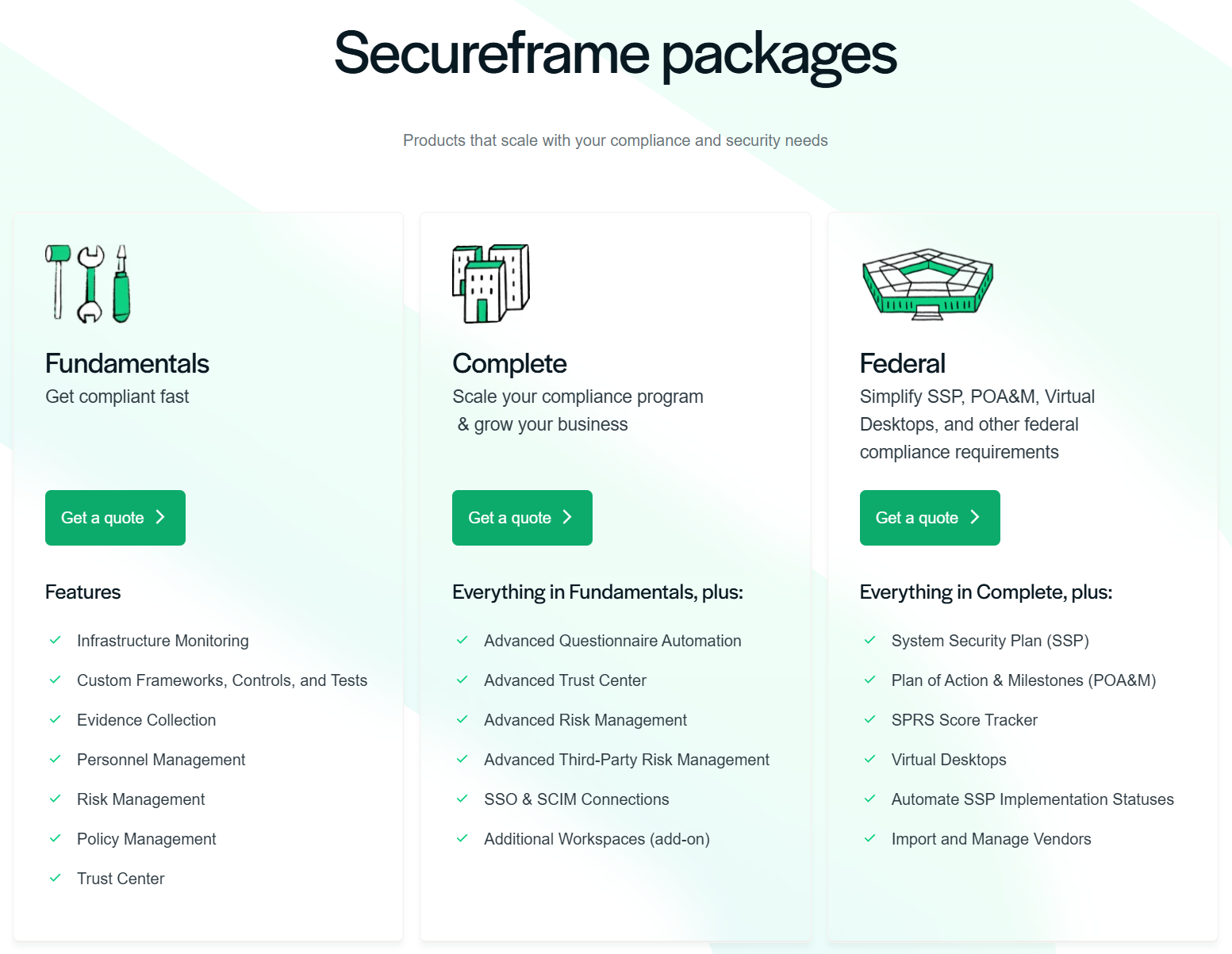
Secureframe pricing operates differently. Instead of strict feature tiers, they often use employee "bands" (e.g., 1-25, 26-50, 51-100) to determine your license fee.
- Fundamentals (<20 employees)
$7,500-$15,000/year
Core compliance coverage: infrastructure monitoring, evidence collection, policy and risk management, and a basic Trust Center. - Complete (~50-100 employees)
$20,000-$45,000/year
Everything in Fundamentals, plus advanced questionnaire automation, expanded risk and third-party risk management, SSO/SCIM, and an advanced Trust Center.
Because of this band model, Secureframe's pricing is generally more predictable for small teams planning headcount growth. You know exactly when you will trigger the next price jump. While they also have renewal uplifts (typically 5-10%), users generally report them as less jarring than the "discount cliff" associated with Vanta.
No hidden fees. No renewal cliffs. ComplyJet offers 100% transparent, flat-rate pricing designed to scale with you, not punish you. See Our Pricing here.
Head-to-Head Comparison
Analyzing Vanta and Secureframe's pricing reveals a distinct pattern. For very small startups (Seed stage), Vanta can be cheaper if you negotiate a massive first-year discount. However, Vanta is usually more expensive for small startups in the long run due to the renewal aggression.
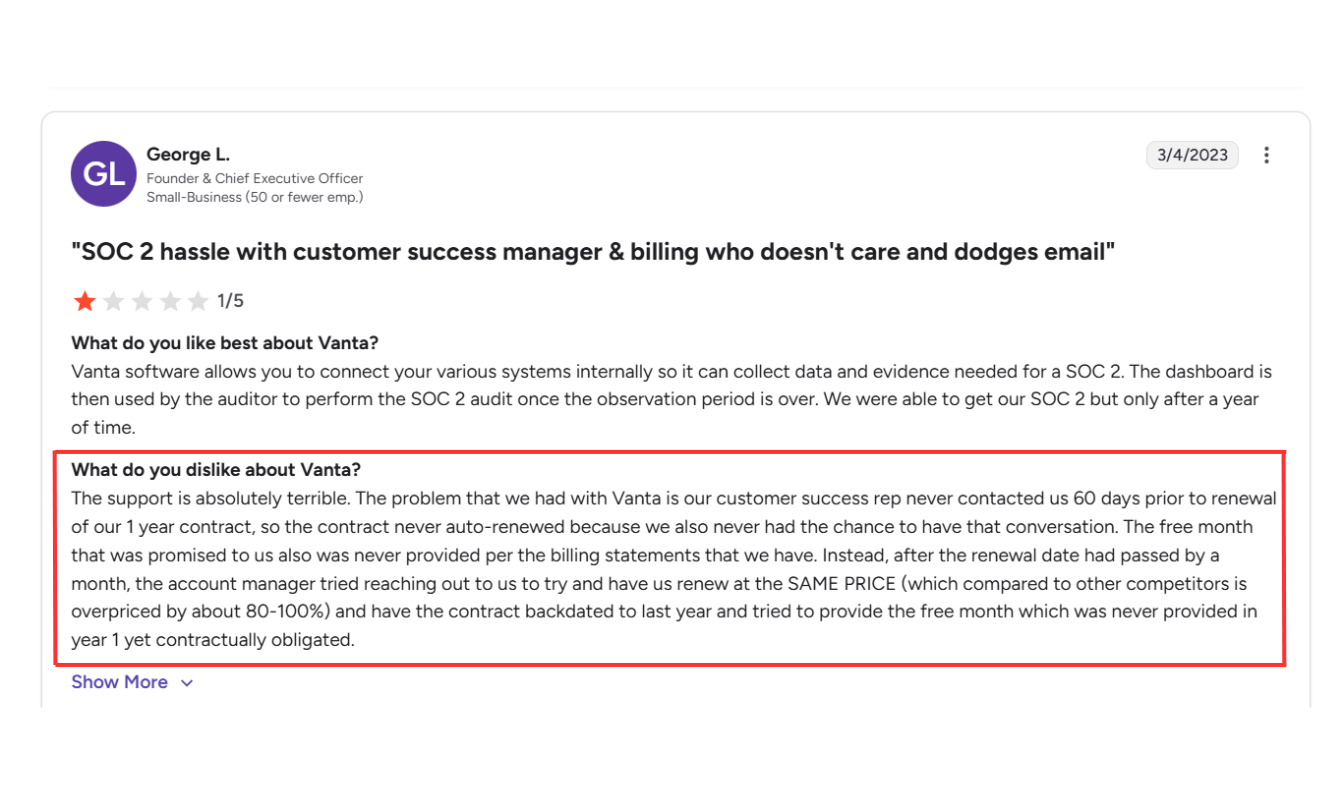
Debates surrounding the Vanta vs Secureframe pricing to value proposition converge as you scale to enterprise levels, where both vendors will fight tooth and nail for the contract.
Sleeper Costs: The platform fee is only ~30% of your total spend. When calculating the true differences between Vanta and Secureframe's pricing, don't forget to account for the hidden costs triggers:
- Audit Fees: You still have to pay a CPA firm to do the audit. Budget $15,000 - $25,000 for this.
- Add-Ons: Vanta's advanced Vendor Risk Management (VRM) can be an $11,200 add-on. Secureframe charges ~$7,500 for each additional framework like ISO 27001.
- Pen Tests: A real manual pentest (required for SOC 2 Type 2) costs $5,000+.
- Automated Questionnaires: If you blow through your allotted quote of automated questionnaire; be ready to loosen your wallet to buy add-ons or be prepared to move up a tier entirely.
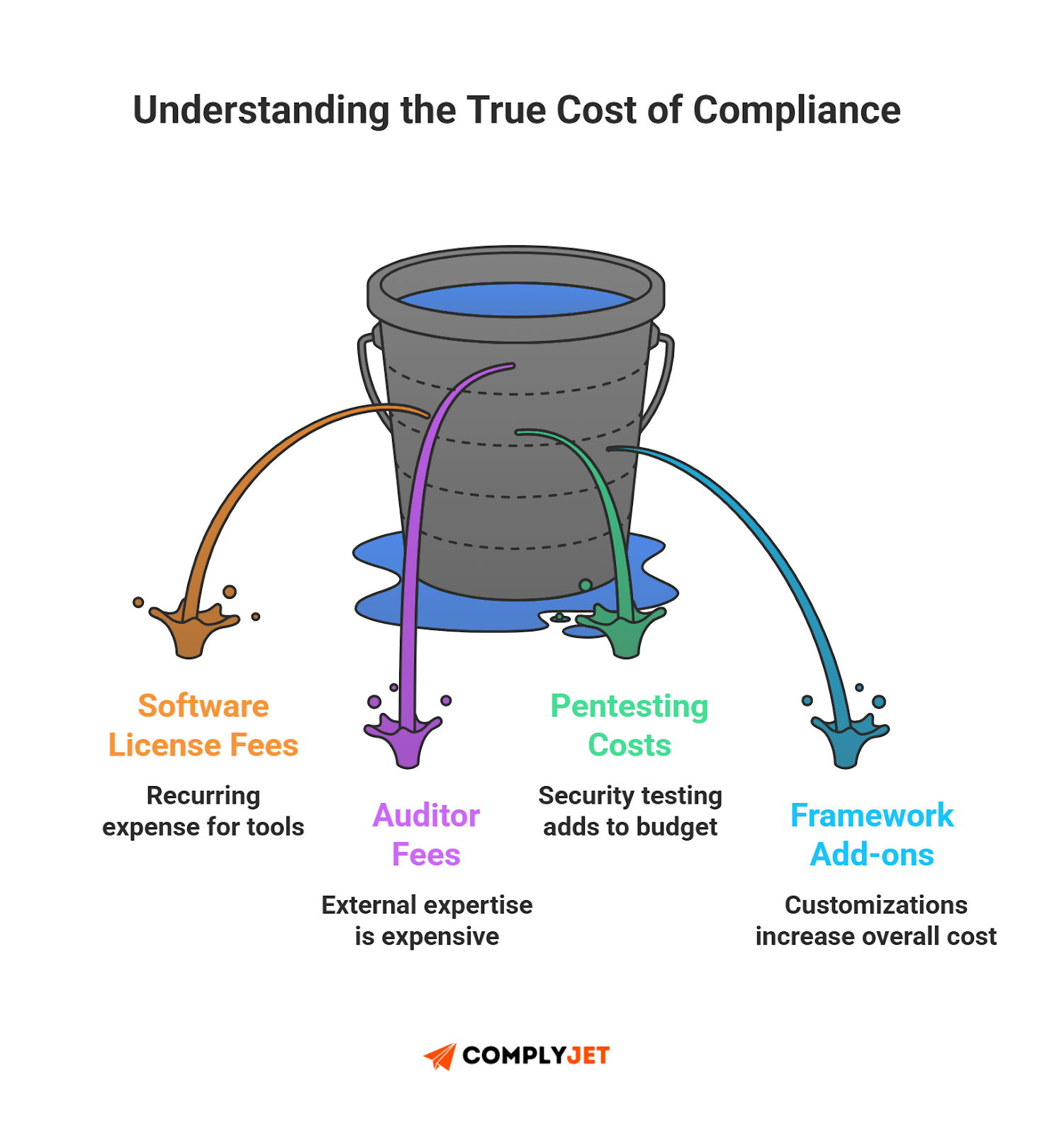
If you aren't careful, hidden cost triggers such as these can easily double your year-one budget.
The Vanta vs Secureframe Audit Ecosystem
Here is the thing: Vanta and Secureframe are the prep school, not the examiner.
You do not get your diploma from them. You get it from an auditor - a licensed CPA firm that is legally required to be independent. The software's job is to organize your homework so the teacher (auditor) gives you an A.
Both platforms maintain extensive networks of partner firms. They will introduce you to a friendly auditor who knows the software, which theoretically makes the process faster. But remember: The software's "Green Checkmark" validates existence (did you upload a file?). The auditor validates adequacy (is the file actually a policy?).
The Pen Test Trap
One of the most common ways founders get burned is falling for the "bundled" penetration test.
Sales reps love to say that pen testing services are included or heavily discounted. Be very careful here. Often, these "free" pen testing services are just lightweight vulnerability scans - automated scripts that look for low-hanging fruit.
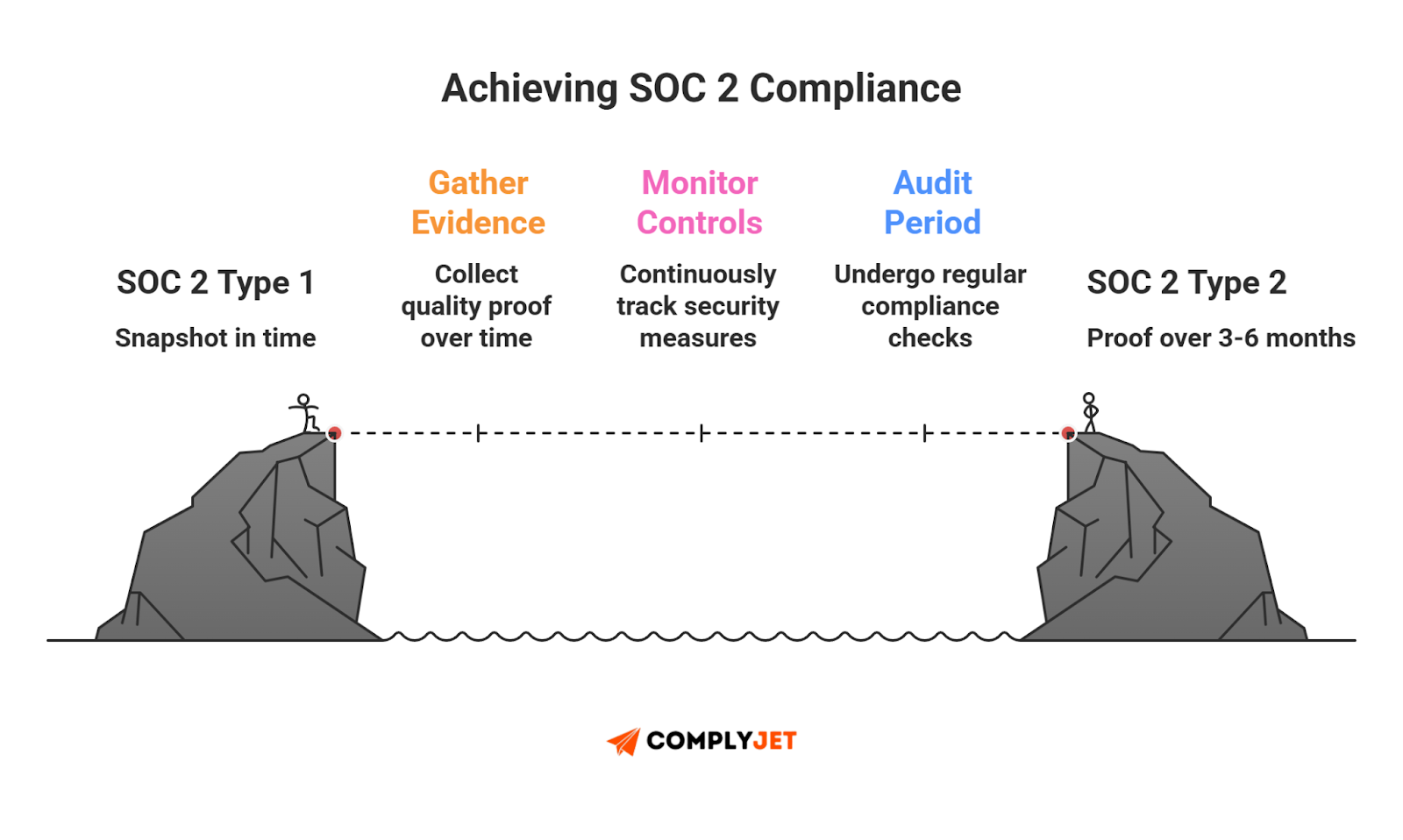
For a SOC 2 Type 1, you might get away with a scan. But for a SOC 2 Type 2, auditors typically demand a rigorous, manual penetration test where a human ethical hacker actually tries to break into your app. If you try to pass off a $500 scan as a real test, the auditor will reject it.
This is a disaster. If you fail the audit control because of a bad pen test, your entire SOC 2 timeline is ruined. You have to hire an additional firm, schedule a new test, fix the findings, and then re-submit to the auditor.
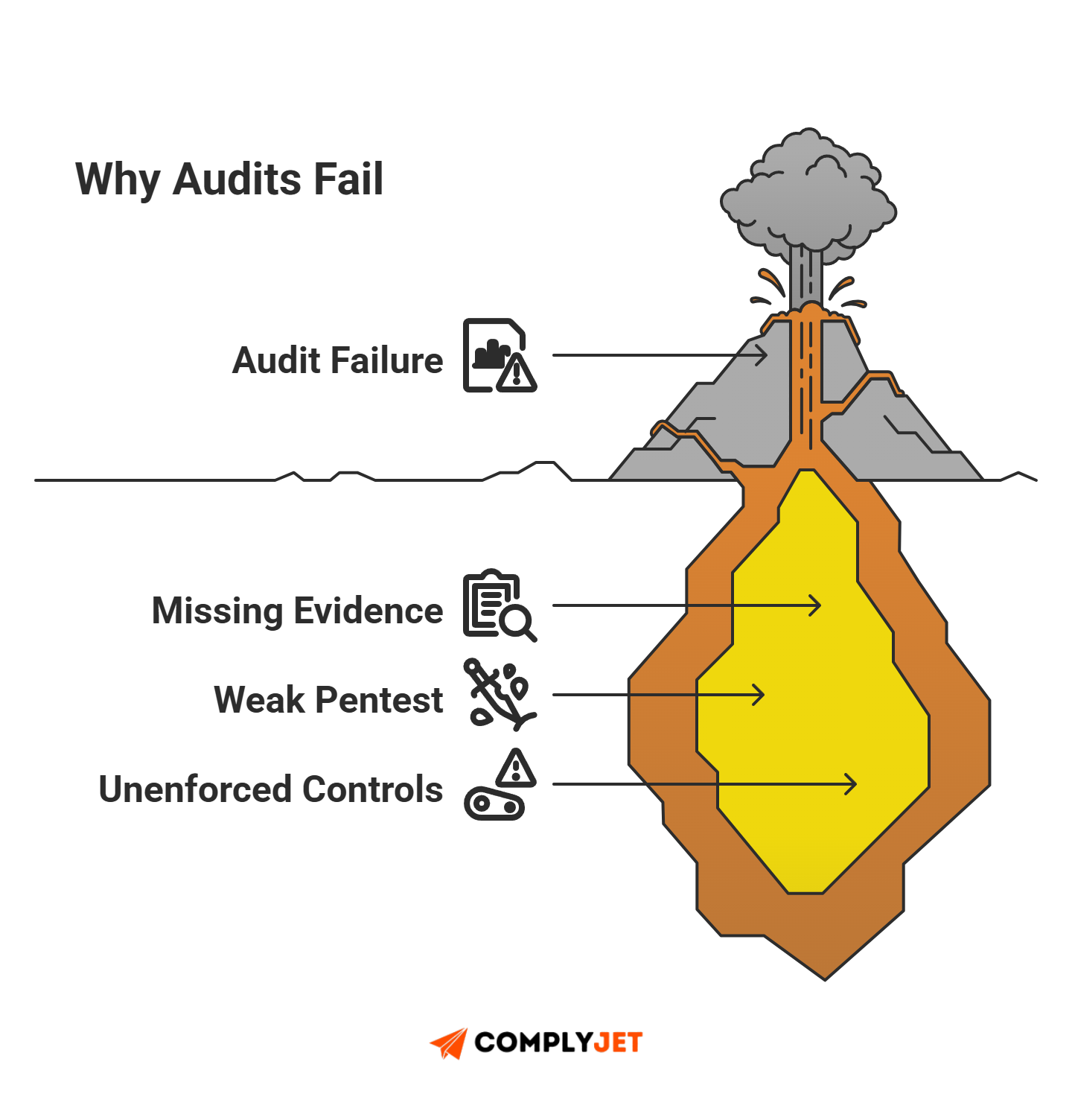
Real, manual pen testing services may cost $3,000+. Budget for this independently. Do not rely on the "check-the-box" freebie. Delays in your SOC 2 timeline can kill your sales cycle because you cannot close that enterprise deal while you are stuck in remediation purgatory.
Founder Tip: Ask the sales rep explicitly: 'Is the included pentest a manual exploitation test or just a vulnerability scan?' If they hesitate, assume it's a scan and budget $5k for a third-party vendor like Cobalt.
Founder FAQs
Perhaps the core gist of the Vanta vs Secureframe discussion can be surmised by the reviews left by their respective users. We scoured relevant review forums and subreddits and analyzed reviews left for both Secureframe and Vanta so you don't have to. Here is the raw truth.
Can I switch from Vanta to Secureframe (or vice versa) later?
Yes, but it hurts. Technically, you can export your policies, but you lose your "continuous monitoring" history. If you switch in the middle of an audit observation period, you effectively reset the clock. You also lose the specific mapping of your evidence to controls. Our advice: Pick the tool you can live with for 3 years, not just for the next 6 months.
How do I avoid the renewal price hike?
The "Year 2 Cliff" is real, especially with Vanta's aggressive year 1 discount strategy. The single best way to avoid the renewal price hike is to negotiate a multi-year contract (2-3 years) upfront. If you can't commit to that, insist on a "Renewal Cap" clause (e.g., "Renewals cannot exceed a 5% increase") before you sign. If you wait until 30 days before renewal, you have zero leverage.
What is the realistic Secureframe vs Vanta audit-ready timeline for SOC 2?
Ignore the "Get SOC 2 in 2 Weeks" ads. That refers to Type 1 (a snapshot). For a Type 2 (what enterprises actually care about), you need an observation window of 3 to 6 months.
- Weeks 1-4: Implementation & Policy Writing.
- Weeks 5-8: Remediation (fixing the 500 things the tool found wrong).
- Months 3-6: Observation Period (Don't break anything!).
- Month 7: The Audit. Realistically, the Secureframe vs Vanta comparison doesn't matter here; your SOC 2 timeline is 4-6 months minimum for a Type 2 report.
What do Secureframe reviews say about support?
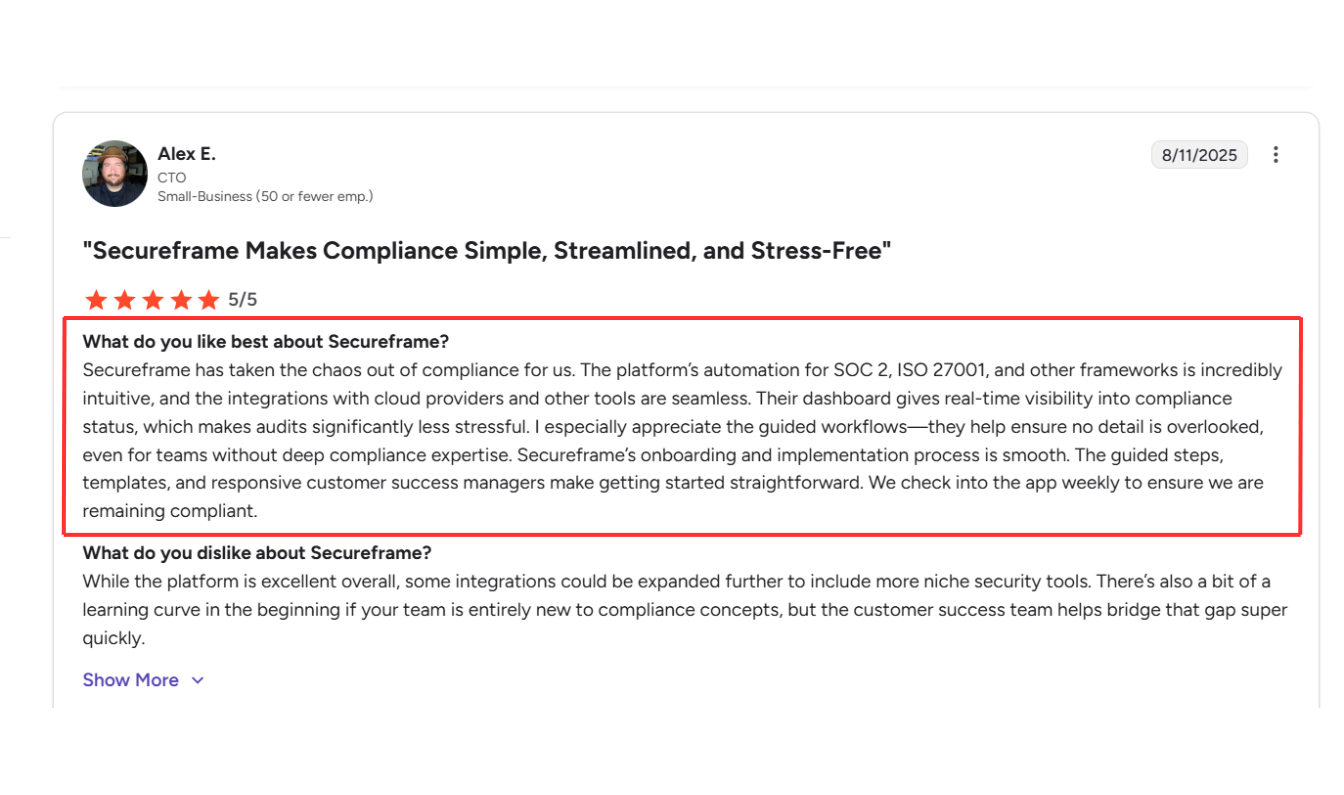
Secureframe reviews generally praise the "human" element. Users often highlight the access to "Compliance Experts" - former auditors who can answer qualitative questions like "Does this policy actually make sense for a 10-person startup?". It's a major selling point for teams without a CISO, which is why Secureframe reviews concerning customer support are positive.
What do Vanta reviews say?
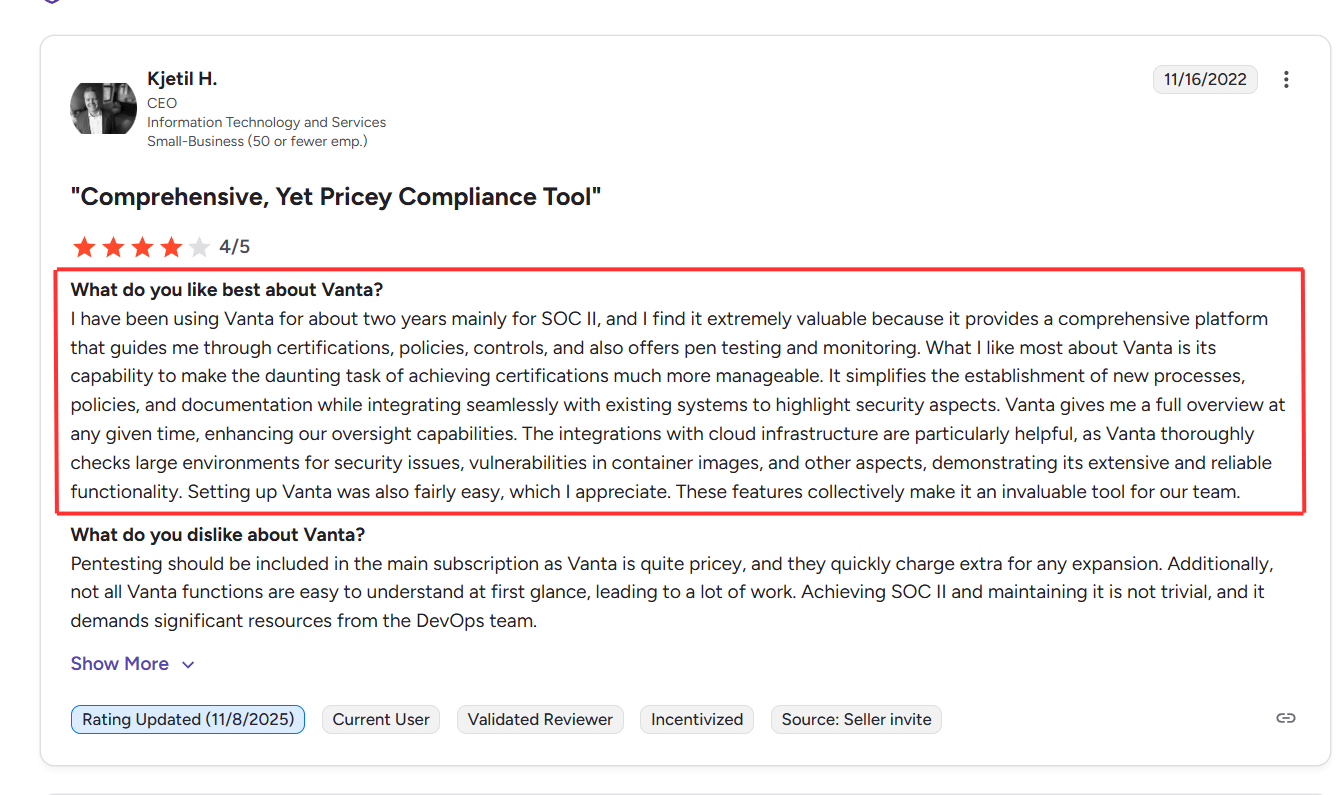
Vanta reviews are as consistent as the product itself. The product is the gold standard for automation and integrations. However, negative Vanta reviews frequently cite the support experience for smaller customers. If you are on the "Essentials" tier, expect email-based support rather than a dedicated Slack channel or Success Manager.
Need a partner, not just a platform? At ComplyJet, you aren't a ticket number. We provide the dedicated, human hand holding early-stage founders crave. Talk to an Expert.
Is Vanta pricing negotiable?
Highly. Vanta is known to offer steep discounts (up to 70%) to win market share, especially at the end of the quarter. Vanta's pricing is rarely fixed; it's a function of your negotiation leverage and willingness to walk away.
Is Secureframe pricing negotiable?
Yes, though they often stick closer to their employee bands. Secureframe pricing is generally viewed as more transparent, but there is always room to negotiate on implementation fees or bundled add-ons like the Trust Center.
The Verdict: Which Should You Choose?
We have analyzed Vanta vs Secureframe pricing, features, and core DNA. Here is the bottom line.
Get Vanta if...
- You are an engineering-led company (DevTools, AI, API products).
- You want "Compliance-as-Code" and deep integrations.
- You have the budget for Vanta AI agents and the robust Vanta's Trust Center.
- You are okay with Vanta pricing being higher if it means getting the "market standard."
Get Secureframe if...
- You are an early-stage startup or non-technical founder.
- You are targeting Government contracts (FedRAMP/CMMC is their moat).
- You want Secureframe Comply and Secureframe Trust included without massive upsells.
- You value Secureframe pricing predictability and human guidance.
- You want Secureframe AI to help fix your infrastructure bugs, not just answer questionnaires.
The Final Takeaway
Ultimately, the Vanta vs Secureframe pricing war is a distraction. The software is just the vehicle; the auditor is the driver.
To identify the best compliance tool for your operational niche, look at your internal DNA. If you want a tool that runs silently in the background like a cron job, pick Vanta. If you want a project manager who holds your hand, pick Secureframe.
Before you sign, check the latest Secureframe vs. Vanta reviews for service updates, and remember:
The goal isn't just a badge on your website. It's closing the deal.
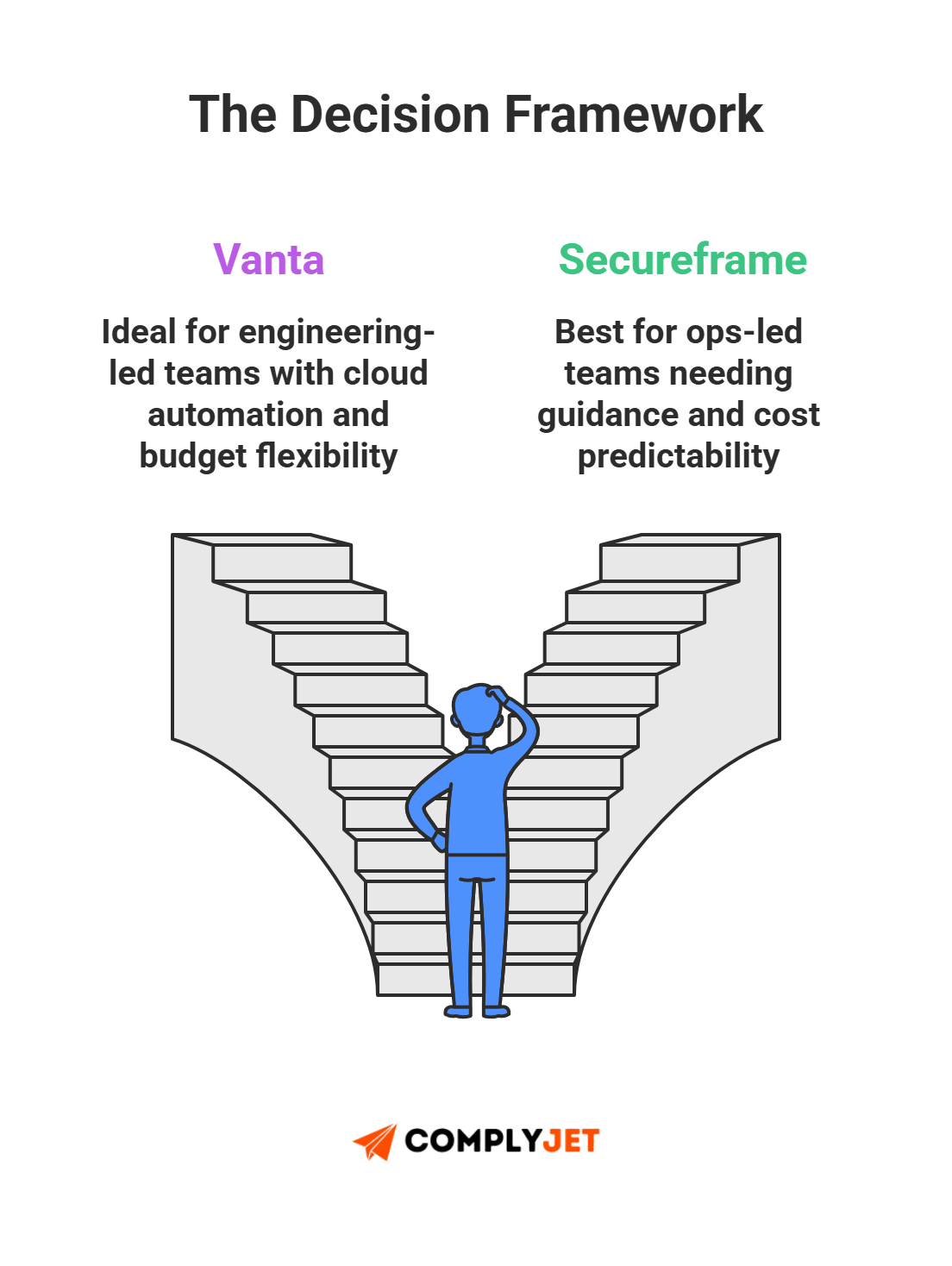
Both Vanta's and Secureframe's pricing will change, but the need for trust won't. Choose the partner that helps you build it fastest, while avoiding paying for features that you just won't need.
Founder's checklist before signing:
- Get a quote for the audit (CPA firm), not just the software.
- Confirm if the "included" pentest is sufficient for Type 2.
- Negotiate a renewal cap (max 5%).
- Ask for a "Proof of Concept" (POC) to test the integrations.
Skip the expensive overkill. ComplyJet combines the efficiency you need with the hands-on support lean teams deserve - at a fraction of the cost. Book a demo and get audit-ready now.