A customer success rep forwards an email titled "Request for a copy of my data" to the founder. It is day nine. The one-month GDPR clock started on day one, nobody has checked who actually sent it, and nobody is sure whose job it is.
A DSAR policy template exists for exactly this moment. It is also the answer to a line that keeps appearing in enterprise security questionnaires: "Do you have a documented process for data subject requests?"
A data subject access request (DSAR) policy is the internal document that says how your company recognizes, verifies, searches for, and answers a request from a person who wants to see, correct, or delete the personal data you hold about them, who owns each step, and which deadline applies.
Quick answer
A DSAR policy needs ten sections: purpose and scope, definitions, roles and owners, how to submit, identity verification, deadlines, fees and refusals, search and redaction, response content, and records and review. Two clocks matter. GDPR gives you one month, extendable by up to two more. California gives you 10 business days to confirm receipt and 45 calendar days to respond, extendable by up to 45 more. Our recommended defaults for a startup: acknowledge within two business days, answer within 21 days, and log every request from the moment it lands.
By the end of this guide you will have a free, ungated PDF with real sample clauses, a deadline table for both laws, an identity verification matrix, four response letters, and a request log you can start using today.
Here's what I'll cover:
- What a data subject access request policy is, and what it is not
- Which law your DSAR policy template follows, GDPR or CCPA
- The ten sections every policy needs
- DSAR deadlines side by side
- Intake to closure, including the request form and identity checks
- Fees, refusals, search, and redaction
- Response letters, the request log, and sample clauses
- What SOC 2 and ISO 27701 say, and the evidence auditors sample
This guide is practical information, not legal advice. Have counsel review the final policy before you adopt it.
What Is a Data Subject Access Request Policy, and What Does It Not Cover?
A data subject access request policy is a short internal procedure. It tells your team what to do in the first ten minutes after someone asks for their data, and what to do on every day after that until the request is closed.
It helps to separate four things people mix up. The policy sets the rules and owners. The request form is an optional convenience for the requester. The procedure is the step list your team follows. The log is the record that proves you followed it.
DSAR Policy Template vs Privacy Policy, Breach Procedure, and DSAR Software
Three neighbors sit close to this document. The privacy policy is the public notice that tells people their rights exist and where to send a request. This policy is the internal procedure for answering. A breach procedure is a separate obligation, covered in our GDPR breach notification guide and incident response plan template. DSAR software is a tool, not a policy. For the full list of data subject rights, see GDPR compliance requirements.
| Document | The question it answers | Who reads it | Who owns it |
|---|---|---|---|
| Privacy policy (notice) | What rights do people have and where do they send a request? | The public | Legal or the privacy owner |
| DSAR policy | How do we recognize, verify, and answer a request? | Your team | Privacy owner plus a backup |
| Breach procedure | What do we do when personal data is exposed? | Security and incident responders | Security lead |
| DSAR software | How do we track and package requests at volume? | Whoever runs requests | The tool owner |
Note
The notice says what people can ask for. This policy says what happens in the first ten minutes after they do. Adopt them together and let each point to the other.
GDPR DSAR Policy vs CCPA DSAR Rules: Which Law Your DSAR Policy Template Follows
Does a small company actually receive these requests? Sometimes, and rarely on a schedule. A Hacker News commenter writing in January 2026 noted that for California requests it was "mostly big companies with A LOT of users that got more DSARs". A startup may go a year without one, then receive three in a month after a layoff or a support dispute. The policy has to be ready before the first one lands.
One DSAR policy for startups can serve both laws, as long as it names which clock applies to which requester.
| Regime | Who it protects | What the request is called | Where the clock comes from |
|---|---|---|---|
| GDPR (EU) | People in the EU whose data you process | Access, rectification, erasure, and other data subject rights | Article 12(3) |
| UK GDPR | People in the UK | Subject access request and related rights | UK data protection law |
| CCPA (California) | California consumers | Request to know, request to delete, request to correct | 11 CCR 7021 |
| Other US states | Residents of states with comprehensive privacy laws | Varies by state | Each state's own statute |
A GDPR DSAR and a CCPA DSAR are not the same thing. The GDPR right of access is one of several rights. California calls the whole family "requests to know, delete, and correct." Your policy should cover the family, not only access, because the first request you receive may be "please delete everything."
The UK sits under its own version of the rules, and the Data (Use and Access) Act 2025 amended UK subject access law, so check the ICO's current guidance for UK requesters. Other US states have their own request rules and deadlines. Confirm the ones that apply to your customers rather than assuming they match California.
Does a DSAR Apply to Employee, Contractor, and Applicant Data?
Yes. People inside the company ask too. Their data sits in your HRIS, email, Slack, and recruiting tool, which are the places startups forget to search. California privacy law now treats employee and job applicant data the same way it treats customer data, as our CCPA compliance guide explains.
Quick take
For most early-stage startups, the first request does not come from a privacy activist. It comes from an ex-employee, a customer's employee, or a person who just lost a support dispute. Write the policy for them.
GDPR
Selling to EU customers?
Data subject requests are one part of GDPR readiness. See how ComplyJet helps a startup build the full program.
What a DSAR Policy Template Must Include
Ten sections cover what a regulator, a customer, or an auditor will look for. Brackets in the PDF mark the values you set for your own company.
| # | Section | What it settles |
|---|---|---|
| 1 | Purpose and scope | Why the policy exists and whose data it covers |
| 2 | Definitions | Personal data, requester, controller, and the request types |
| 3 | Roles and owners | One owner, one backup, and who supports them |
| 4 | How to submit | Every channel a request can arrive through |
| 5 | Identity verification | How much proof you ask for, and when |
| 6 | Deadlines | The clock for each law, and your internal target |
| 7 | Fees and refusals | When you can decline or charge, and what you must still send |
| 8 | Search and redaction | Which systems you search and what you remove |
| 9 | Response content | What a complete answer contains |
| 10 | Records and review | The log, the retention date, and the annual review |
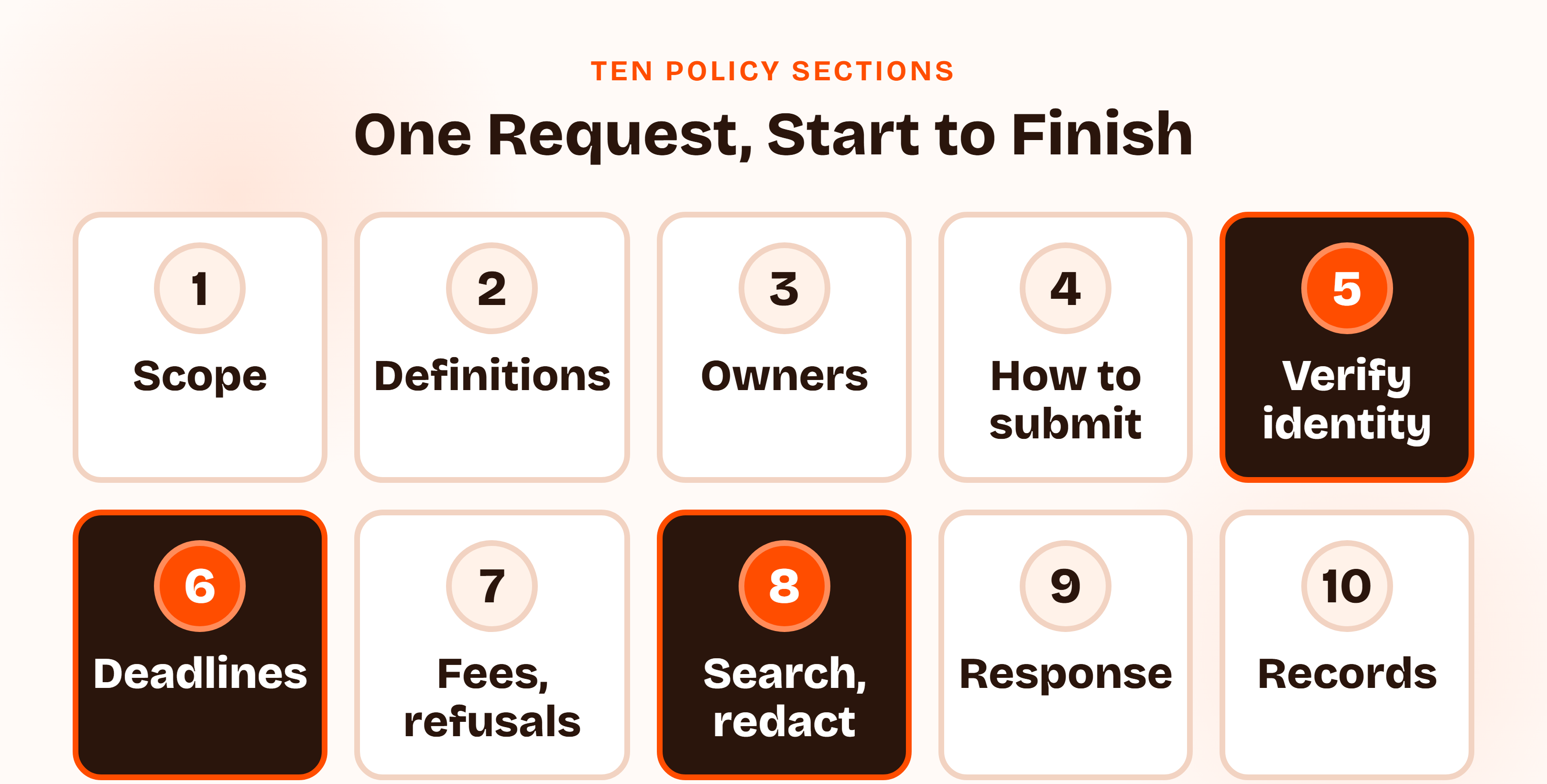
The sections work as one lifecycle. A request arrives, the clock starts, you verify, search, redact, answer, and record. Each section answers one question in that chain, and the rest of this guide takes them in order.
DSAR Deadline Rules: GDPR One Month vs CCPA 45 Days
The deadline is the first thing most readers want, so here it is side by side.
| GDPR (Article 12) | CCPA (11 CCR 7021) | |
|---|---|---|
| Trigger | Receipt of the request | Receipt of the request |
| Acknowledge | No fixed day count | Within 10 business days |
| Respond | Without undue delay, within one month | Within 45 calendar days |
| Extension | Up to two further months for complex or numerous requests | Up to 45 additional calendar days |
| Extension notice | Within the first month, with reasons | Notice to the consumer with the reason |
| Maximum | Three months in total | 90 calendar days in total |
| Verification pauses the clock? | Not stated as a pause in the Article | No. The clock runs regardless of verification time |
| Refusal | Reasons plus the right to complain and seek a judicial remedy, within one month | Confirm current denial rules with counsel |
| Fee | Free, except manifestly unfounded or excessive requests | Confirm current rule with counsel |
Two details catch people. The GDPR period is one month, not a fixed 30 days. And California's 45 days is counted from receipt even if you are still verifying the person, so a slow identity check eats your own time.
Watch out
The clock starts when the request reaches anyone in the company, not when your privacy owner sees it. A request sent to a sales rep on Monday is a request received on Monday.
Newer California rules on automated decisionmaking technology add a further access right with a later compliance date. If your product makes significant decisions about people with automated tools, review those rules with counsel.
Quick tip
Set an internal target that beats both laws: acknowledge within two business days and answer within 21 days. That makes the statutory date a ceiling, not the plan, and it leaves room for an extension notice if a request turns out to be large.
Try this yourself: forward a dummy request to your support inbox from a personal email address and time how long it takes to reach the person who owns it. If the answer is more than a day, your real clock is already running while nobody is looking.
DSAR Procedure in Your DSAR Policy Template: Intake to Closure
This procedure is written for a DSAR policy for startups: one owner, one backup, no committee. Nine steps cover the whole lifecycle.
- Receive and recognize. Anyone who gets a request forwards it to the owner the same day.
- Log it. Assign a case ID and record the date received, which is the start of the clock.
- Acknowledge. Send the acknowledgment letter and say which deadline applies.
- Verify identity. Use the lightest check that fits the risk.
- Clarify scope. Ask only what you need to find the data, and only if it is genuinely unclear.
- Search. Ask each system owner for the requester's data by a set date.
- Review and redact. Remove other people's data and anything you may withhold.
- Respond. Send the data and the required information in a commonly used electronic format.
- Close and retain. Record the outcome, the date sent, and the date the case file is deleted.

Requests do not arrive on a form. They arrive in Slack, a support ticket, a LinkedIn message, or a phone call. The policy should say that any written or spoken request counts, and that your form is a convenience, not a gate.
DSAR Request Form: What to Ask For and What to Leave Out
A DSAR request form helps the requester and speeds up your search. It must never be mandatory, because a valid request does not stop being valid because it arrived in an email.
Fields worth collecting: full name, contact email, relationship to the company (customer, employee, applicant, other), what they want (copy of data, correction, deletion), a date range if they have one, and the format they prefer. Leave out government ID numbers, dates of birth you do not need, and any free-text field that invites medical or financial detail.
Sample request form (short version)
Your name: [ ]. Email we should reply to: [ ]. Your relationship to [Company]: customer / employee / applicant / other. What are you asking for: a copy of your data / a correction / deletion / something else. Anything that helps us find your data, such as a date range or a product name: [ ]. Preferred format: [ ]. You do not have to use this form. A request in any written or spoken form is valid.
DSAR Identity Verification Rules for Your DSAR Policy Template
Verification is where startups either over-collect or under-check. GDPR Article 12(6) allows you to ask for additional information to confirm identity when you have reasonable doubts about who is asking. California's rules (11 CCR 7060) require a documented, reasonable verification method, and tell businesses to avoid collecting extra sensitive information unless it is necessary to verify.
A risk-based matrix keeps the checks proportionate:
| Requester | Lightest check that fits | Step up when |
|---|---|---|
| Logged-in account holder | Session plus confirmation sent to the email on file | The request is for a large export or a deletion |
| Email requester with no account | Reply to the address on file; ask one account-specific question | The answers do not match your records |
| Request for sensitive data, or from a third party | Stronger evidence plus written authority for any third party | Always |
| Authorized agent (California) | Signed permission from the consumer, and confirmation with the consumer directly | Always |
The rule behind the matrix is data minimization. Collect the least you need, and delete any ID copy as soon as it has served its purpose. California's regulation says the same thing: new information collected only for verification must be deleted as soon as practical after processing the request.
Watch out
Asking for extra ID in a way that delays the response is a common way to blow a deadline. Ask once, ask for the minimum, and note the date you asked in the log.
Sample clause: Identity verification
Before releasing personal data, [Company] will take reasonable steps to confirm that the requester is the data subject. Where the requester is logged in to an account, we will confirm the request to the email address on file. In other cases we may ask for the minimum information needed to confirm identity. We will not request more than we need, and we will delete any identity document once it has served its purpose.
Fees, Refusals, and Exemptions in Your DSAR Policy Template
Can you charge a fee for a DSAR? Under GDPR Article 12(5), the default answer is no. Information and actions are free of charge. You may charge a reasonable fee or refuse to act only when a request is manifestly unfounded or excessive, and the burden of proving that sits with you, not the requester.
Can you refuse a DSAR? Sometimes. If you decide not to act, Article 12(4) requires you to explain why within one month and to tell the requester they can complain to a supervisory authority and seek a judicial remedy. A refusal letter that skips that sentence is incomplete.
"Excessive" usually means repetitive, not merely large. A big request from someone who has never asked before is still an answerable request.
| Situation | Can you refuse? | Can you charge? | What you must still send |
|---|---|---|---|
| Large first-time request | No | No | Full response, or an extension notice within the first month |
| Repeated, identical request | Possibly, if manifestly excessive | A reasonable fee, if so | Reasons, plus the complaint and judicial remedy sentence |
| Request made to cause disruption, not to see data | Possibly, if manifestly unfounded | A reasonable fee, if so | Reasons, plus the complaint and judicial remedy sentence |
| Request where a copy would expose other people's data | Not wholesale | No | The requester's own data, with others' data redacted |
For California requests, confirm the current denial and fee rules with counsel before you write them into the policy.
Sample clause: Fees and refusals
[Company] does not charge for responding to requests. Where a request is manifestly unfounded or excessive, we may charge a reasonable fee or decline to act, and we will document the reason. If we decline, we will tell the requester why within one month, and that they may complain to their supervisory authority and seek a judicial remedy.
Customer Story
"The support team at ComplyJet is, without question, the best I've experienced with any software vendor."
Raghuram Vadapally, Managing Director and Head of Software Engineering at Synexar AI
Searching and Redacting Personal Data Under Your DSAR Policy Template
Searching is where a DSAR policy for startups earns its keep. The data is rarely in one place. Walk the list before the first request arrives, not during it.
Where a SaaS startup's personal data typically sits:
- Production database: account, profile, and usage records
- Analytics and product tools: events tied to a user ID
- Support tool: tickets, chat transcripts, attachments
- CRM and marketing tools: contact records, email history
- Email and Slack: messages that mention or involve the person
- Logs and backups: often the hardest to search and the easiest to forget
- Vendors and sub-processors: anything they hold on your behalf
A data inventory makes this faster. Our guide to data mapping software covers tools for building one, and the data classification policy helps you decide which systems hold the most sensitive records. For each system, name the person who can search it and the number of working days they have to answer.
Redaction comes next. A copy of the data must not adversely affect the rights and freedoms of others, which is the wording of GDPR Article 15(4). In practice that means removing other people's personal data, and checking whether privileged material or trade secrets need to be withheld.
A Hacker News commenter who says they handled DSARs at one of the big 4 wrote in May 2026 that "we'd redact the names of other people on joint accounts". Practitioners differ on where the legal line sits for third-party names, so treat it as a case-by-case judgment, with counsel for the hard ones, not as a blanket rule.
Pro tip
Keep a short search checklist in the case file: system, owner, date asked, date answered, and whether anything was found. It doubles as evidence that your search was reasonable.
One more rule belongs in the policy. Do not delete data after a request arrives to avoid answering it. Your data retention policy sets normal deletion schedules, and the DSAR policy should say that a pending request freezes deletion of that person's data until the case is closed.
DSAR Response Letter Wording for Your DSAR Policy Template
A complete response is more than a data export. Article 15 lists the information the requester is entitled to alongside the copy: the purposes of the processing, the categories of data, the recipients, the storage period or the criteria for setting it, the right to request rectification or erasure, the right to complain to a supervisory authority, the source of the data where it was not collected from the person, and the existence of automated decision-making.
If data is transferred to a third country, the requester can also be told which safeguards apply. Electronic requests are answered in a commonly used electronic form unless the requester asks otherwise.
A good approach is to prepare these answers once, in a standard paragraph, and update it when your processing changes.
DSAR Template Letters: Acknowledgment, Extension, Refusal, Fulfilment
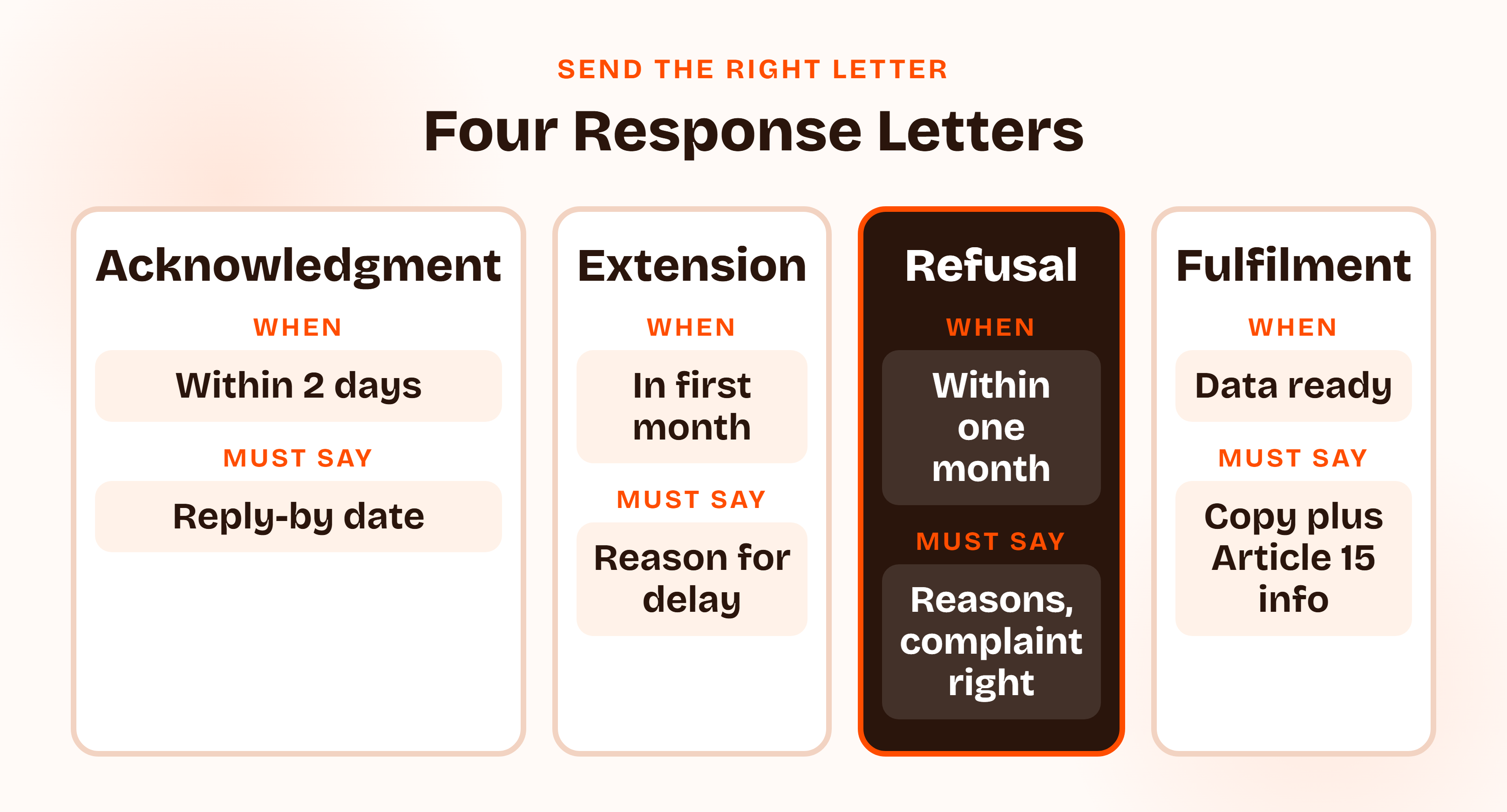
Four letters cover almost every case. The full text is in the PDF. Each shell below shows the sentence that cannot be left out.
| Letter | When it is sent | The sentence it must contain |
|---|---|---|
| Acknowledgment | Within your internal target, and no later than the legal one | The date you received the request and the date you will respond by |
| Extension | Within the first month under GDPR, or before the California 45 days runs out | The reason the extra time is needed |
| Refusal | Within one month under GDPR | The reasons, plus the right to complain and seek a judicial remedy |
| Fulfilment | When the response is ready | The data copy plus the Article 15 information |
Sample letter: Acknowledgment
Hello [Name], we received your request on [date]. We will respond by [date]. To protect your data, we may need to confirm your identity first, and we will tell you if we do. If you have questions in the meantime, reply to this email and quote case [ID].
Sample letter: Extension
Hello [Name], we received your request on [date] and need more time to respond because [reason, such as the number or complexity of requests]. We will respond by [new date]. We are sorry for the delay.
DSAR Log for Your DSAR Policy Template: Fields That Prove You Met the Deadline
The log is the document that turns a policy into proof. If an auditor, a customer, or a regulator ever asks whether you met a deadline, the log is the answer.
| Field | Why it matters |
|---|---|
| Case ID | One reference for every letter and file |
| Date received | Starts the clock |
| Channel | Shows whether intake works |
| Requester type | Customer, employee, applicant, other |
| Regime | GDPR, CCPA, or other |
| Verification status | Pending, confirmed, or declined |
| Extension | Yes or no, with the date notified |
| Systems searched | Evidence that the search was reasonable |
| Outcome | Fulfilled, partly fulfilled, refused |
| Date sent | Proves the deadline was met |
| Retention date | When the case file is deleted |
An illustrative row, with fictional data, looks like this: case DSAR-0001, received 3 March, channel support email, requester type ex-employee, regime GDPR, verification confirmed 5 March, no extension, five systems searched, fulfilled, sent 19 March, case file deleted after 24 months.
Four numbers are worth watching: days to acknowledge, the share answered inside your internal target, the number of extensions, and the number of refusals. A rising extension count tells you your search process is too slow. A rising refusal count tells you to check your reasoning.
Quick tip
Once a quarter, pick a closed case and rebuild its timeline from the log alone. If you cannot show when the clock started and when you answered, add the missing field.
DSAR Policy Example: Sample Clauses You Can Adapt
Here is what a DSAR policy example looks like as clauses. Brackets mark the values to set for your own company.
Sample clause: Purpose and scope
[Company] respects the rights of people whose personal data we hold. This policy explains how we recognize, verify, search for, and respond to requests to access, correct, or delete personal data. It applies to customers, employees, contractors, applicants, and anyone else whose personal data we process.
Sample clause: Recognizing a request and owners
A request may be made in any form, by any channel, to any person at [Company]. Anyone who receives one must forward it to [Privacy Owner] at [address] on the same day. [Backup Owner] acts when [Privacy Owner] is unavailable.
Sample clause: Deadlines
The clock starts on the day any person at [Company] receives the request. We acknowledge requests within [two business days] and aim to respond within [21 days]. We will respond within one month for requests under the GDPR, and within 45 calendar days for California consumer requests. Where we need more time, we will notify the requester within the first month, or before the 45 days end, with our reasons.
Sample clause: Searching, redaction, and records
We search the systems listed in the DSAR search checklist. We remove personal data about other people and any material we are entitled to withhold. We do not delete data to avoid answering a request. We log every request, keep the case file for [24 months], and review this policy at least once a year.
Free Template
Download the Free DSAR Policy Template (PDF)
The full policy, a one-page request form, an identity verification matrix, four response letters, a log field list, and a search and redaction checklist. No email required.
DSAR Template Wording for the Support Team Playbook
Front-line staff need a short version they can paste into a help center macro. Treat this as the DSAR template wording for the support team.
Sample wording: Support macro
Thank you for your request. We have passed it to our privacy team and logged it today. You will hear from us within [two business days] to confirm what we need next. You do not need to fill in a form.
DSAR Policy Template Requirements by Framework: SOC 2, ISO 27701, and Privacy Laws
Neither SOC 2 nor ISO 27001 requires a DSAR policy as a standalone document for a startup. The two places where this topic does show up are optional or specialized: the SOC 2 Privacy category and the ISO 27701 privacy extension. Both apply only when they are in scope for your audit.
| Framework | Where it lives | What it asks | How it is tested |
|---|---|---|---|
| SOC 2 (Privacy category) | Criteria P5.1 and P5.2 | Data subjects can access their stored personal information and have it corrected, with identity checked and denials communicated | Policy, procedure, and a sample of handled requests |
| ISO 27701 (controller controls) | Clause 7.3, including 7.3.6 and 7.3.9 | Procedures for access, correction, or erasure, and for handling requests | Documented procedure plus records of handled requests |
| GDPR | Articles 12 and 15 | Respond within one month, free of charge, with defined content | Regulators on complaint; customers on questionnaires |
| CCPA | 11 CCR 7021, 7060 | Confirm within 10 business days, respond within 45 days, verify reasonably | Attorney General and CPPA enforcement |
The SOC 2 and ISO 27701 control wording above is paraphrased from published mappings of those frameworks. Check the exact text in the official criteria or standard before you cite a control in an audit response. If you pursue SOC 2 without the Privacy category, a DSAR policy still helps with customer questionnaires, but your auditor will not test it. See our SOC 2 framework page for how scope is decided.
Important
Do not tell a customer that SOC 2 requires a DSAR policy. It does not, unless you added the Privacy category. A precise answer builds more trust than a convenient one.
Do You Need DSAR Software, or Is a Spreadsheet Enough?
A few requests a quarter run fine on a log and a checklist. Volume, many systems, or an enterprise questionnaire that asks for automation is when tooling starts to pay.
What a tool does not replace is the policy, the owner, and the verification rule. Software speeds the search. It cannot decide whether you should answer.
If you are weighing vendors, our best data privacy software and best CCPA compliance software guides compare the options. Start with the policy either way.
Rolling Out Your DSAR Policy Template and Proving It Works
A policy nobody has read is not a control. Rollout is a short sequence:
- Approve the policy with a version number and a date.
- Name the owner and the backup.
- Publish the request channel in your privacy notice and your site footer.
- Train support, HR, and anyone who reads a shared inbox.
- Run a test request and record how long it takes.
- Review annually, and after any incident or change in systems.
DSAR Policy Template Evidence: What Auditors and Customers Sample
| Evidence | What it shows |
|---|---|
| Approved policy with version and date | The policy exists and is current |
| Acknowledgment records | Staff have read it |
| Training record | Front-line staff know how to recognize a request |
| Test-request record | The process works end to end |
| Log export | Requests are tracked with dates |
| Closed-request sample with letters | A real case followed the policy |
| Privacy notice showing the request channel | People can actually find the way in |
Quick tip
If you have never received a real request, a test request is your evidence. Run one each year, keep the record, and describe it honestly as a test.
Answering Customer Questionnaires About Your DSAR Process
Sample answer: Customer questionnaire
Yes. We maintain a documented data subject request policy with a named owner and backup. Requests are logged on receipt, acknowledged promptly, identity-verified proportionately, and answered within the applicable legal deadline. We keep a request log and review the policy annually.
DSAR Policy Template Mistakes to Avoid
These are easy to get wrong, and each one has caused a missed deadline somewhere.
- Counting the clock from when the privacy owner sees the request. It starts on receipt by anyone in the company.
- Requiring a form. A request is valid in any form.
- Asking for ID by default. Verify in proportion to the risk, and collect the minimum.
- Deleting data after a request arrives. It looks like evasion and can be treated as such.
- Keeping a spreadsheet nobody owns. A log without an owner is a list of missed deadlines.
- Handling only access requests. California also covers requests to delete and correct, and your first request may be one of those.
How ComplyJet Helps With Your DSAR Policy Evidence
A DSAR policy is quick to write and tedious to prove. The rules fit on three pages. The proof is a year of consistent behavior.
ComplyJet's policy management drafts policies with AI, lets you edit them before publishing, distributes them to your team, and tracks acknowledgments with a timestamp and a version history. Our security awareness training assigns courses to your team and keeps per-person completion records, and our audit evidence collection keeps those records beside everything else an auditor asks for.
The request itself, the search, and the response live in your own tools. ComplyJet holds the policy, the acknowledgments, and the training evidence.
Compliance Automation
Turn your DSAR policy into audit-ready evidence
See how ComplyJet distributes policies, tracks acknowledgments, and records security training for your audit.
FAQs
What Should a DSAR Policy Template Include?
Ten sections: purpose and scope, definitions, roles and owners, how to submit, identity verification, deadlines, fees and refusals, search and redaction, response content, and records and review. Add a request form, four response letters, and a log so the policy can be run on day one.
How Long Do You Have to Respond to a DSAR?
Under GDPR Article 12(3), one month from receipt, extendable by up to two further months for complex or numerous requests, with notice and reasons inside the first month. Under California's 11 CCR 7021, confirm receipt within 10 business days and respond within 45 calendar days, with one extension of up to 45 more days and notice to the consumer.
How Do You Verify Identity for a DSAR?
Use the lightest check that fits the risk. For a logged-in user, confirm to the email on file. For others, ask an account-specific question. Collect the minimum, and delete any ID copy once it has served its purpose.
Can You Charge a Fee or Refuse a DSAR?
Under GDPR, requests are free. You may charge a reasonable fee or refuse only when a request is manifestly unfounded or excessive, and you must be able to prove it. A refusal needs reasons and notice of the right to complain and seek a judicial remedy. Confirm California's current rules with counsel.
What Is the Difference Between a GDPR DSAR and a CCPA Consumer Request?
A GDPR DSAR is a request under the right of access, one of several data subject rights. A CCPA consumer request covers three types: know, delete, and correct. The clocks differ: one month for GDPR, 45 calendar days for CCPA.
Who Should Handle DSARs at a Startup?
One named owner and one backup, usually whoever leads security, legal, or operations. Give them authority to ask system owners for data, and make sure every employee knows to forward a request the same day.
Does a DSAR Apply to Employee Data?
Yes. Employees, contractors, and applicants can ask too. Their data sits in HR tools, email, and Slack, which your search checklist should include. California privacy law also treats employee and applicant data as in scope.
Is There a Free DSAR Policy Template?
Yes. The PDF above is free and ungated: a policy, a request form, an identity verification matrix, four response letters, a log, and a search and redaction checklist. Adapt the bracketed values to your company and have counsel review the final version.
Related Reading
- GDPR Compliance Requirements, for the eight data subject rights.
- CCPA Compliance Guide, for California consumer rights.
- GDPR Breach Notification, for the separate breach clock.
- Data Retention Policy, for deletion schedules.
- Incident Response Plan Template, for security incidents.
- Best Data Privacy Software, for the tooling question.
- Best Data Mapping Software, for building a data inventory.
Sources: