.svg)

Why Some Founders Still Get Compliance Tools Wrong
The most common myth surrounding compliance is that it's hard because of frameworks. On the contrary, it's hard because most founders buy tools before they understand the audit.
For start-ups, buying compliance software without context is like buying a gym membership and expecting abs. Swiping the card feels productive, but results don't show up unless you do the work.
When a deal stalls and security questionnaires pile up, founders often rush to compare Delve vs. Vanta's compliance solutions. They look for green checkmarks and slick dashboards, assuming automation equals approval. It doesn't. Auditors don't care about your UI - they care about evidence and consistency.
Tip for founders: If you understand the audit, the tools make sense. If you don't, even the best software will just help you move faster in the wrong direction.
Let's skip the vanity metrics and look at the real trade-offs.
ComplyJet helps founders decode SOC 2, security questionnaires, and tool trade-offs before money changes hands.
Delve vs. Vanta: Two Very Different Compliance Philosophies
This isn't Coke vs Pepsi.
It's not even Mac vs PC.
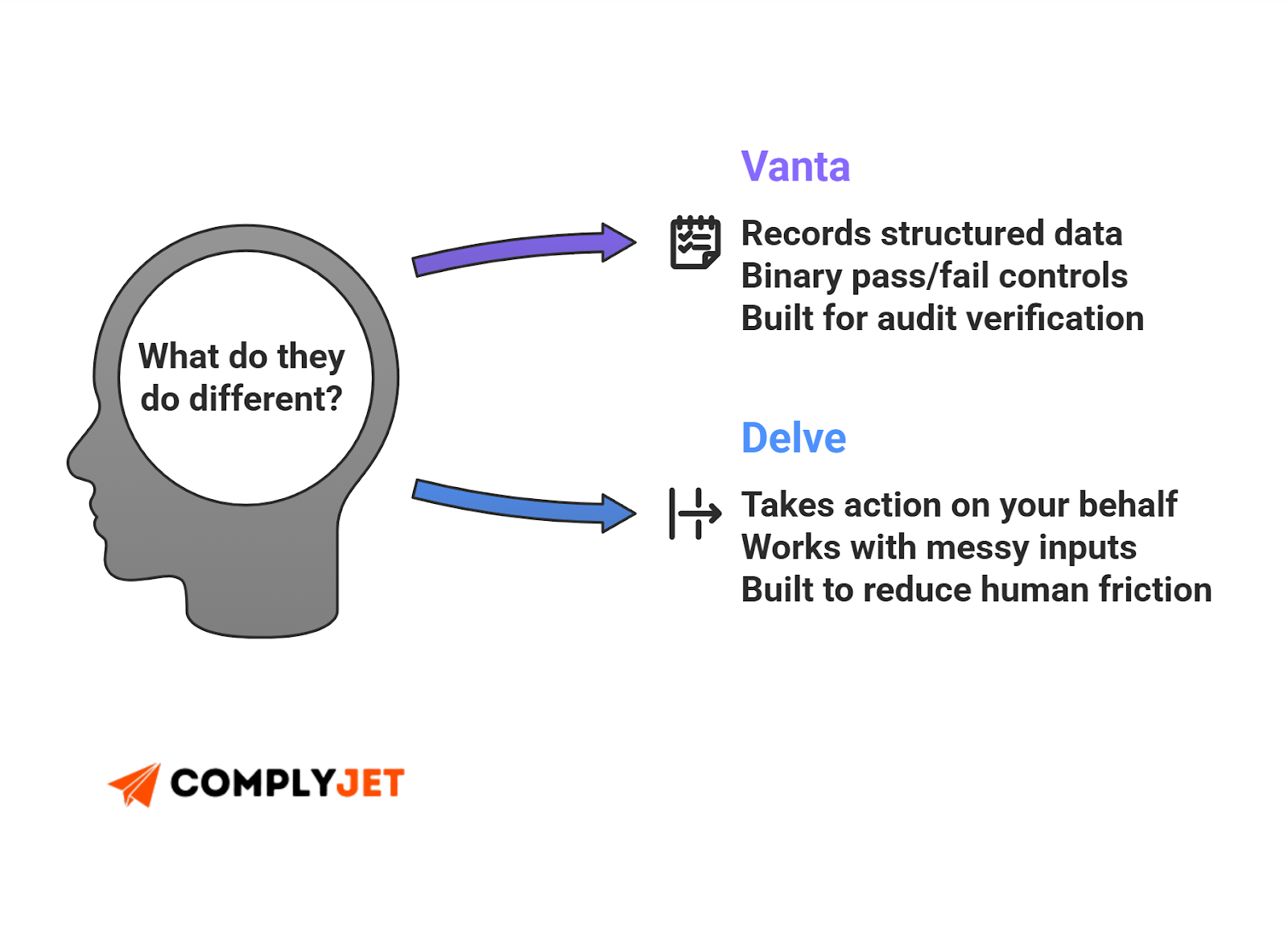
The real difference is simpler - and more consequential: a system of record vs a system of action. Once you grasp that, the rest of the comparison snaps into place, allowing you to scrutinize the real-world nuances when comparing Vanta and Delve's reviews.
Vanta: Structural, Audit-first
Vanta is designed as a system of record. Think of it as the ledger your auditor trusts.
It pulls structured data from your stack, checks it against fixed rules, and stores an evidence trail that's easy to verify months later. A control is either passing or failing. There's very little gray area.
That determinism is the point. Auditors like certainty. Security teams like repeatability. Over time, this structure compounds into something valuable: boring audits. And boring audits are a win.
Vanta also emphasizes real-time Risk Monitoring, but in a strict sense. Signals are measured, logged, and flagged against defined thresholds. If something drifts, you see it. If it stays fixed, the record proves it stayed fixed.
For teams that want compliance to behave like infrastructure, this model works. It's steady. It's predictable. It doesn't try to think for you. For a more thorough breakdown of Vanta's compliance offerings click here.
Delve: Velocity-first, AI-assisted
Delve is closer to a system of action.
Instead of waiting for perfect inputs, it focuses on reducing friction where humans usually slow things down. This is where Delve's AI compliance comes in - not as magic, but as leverage.
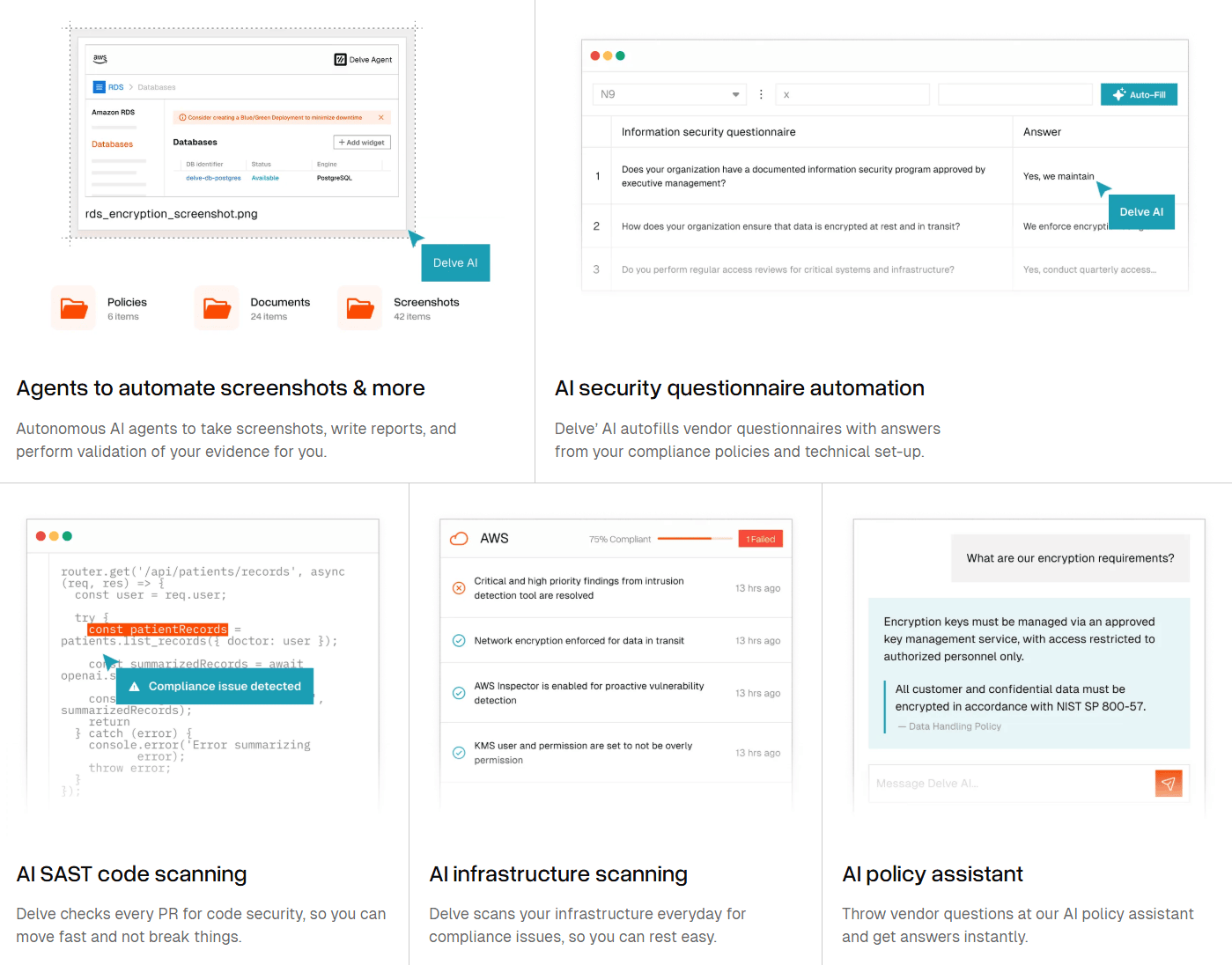
Delve uses what's often called agentic AI. Strip away the jargon, and it's simple: software that can take steps on your behalf. Click through settings. Gather evidence. Interpret messy inputs that don't fit clean APIs. This is key to why Delve's AI compliance feels fast early on, especially when compared to structural compliance that veterans like Vanta offer. Check out the intricacies of Delve's compliance solutions here.
This probabilistic approach trades rigidity for speed. It works especially well when your stack isn't neat, or when you don't yet have a dedicated compliance owner. For many early teams, this is what compliance automation for startups actually needs to look like: less ceremony, more momentum.
The Philosophy Gap That Matters
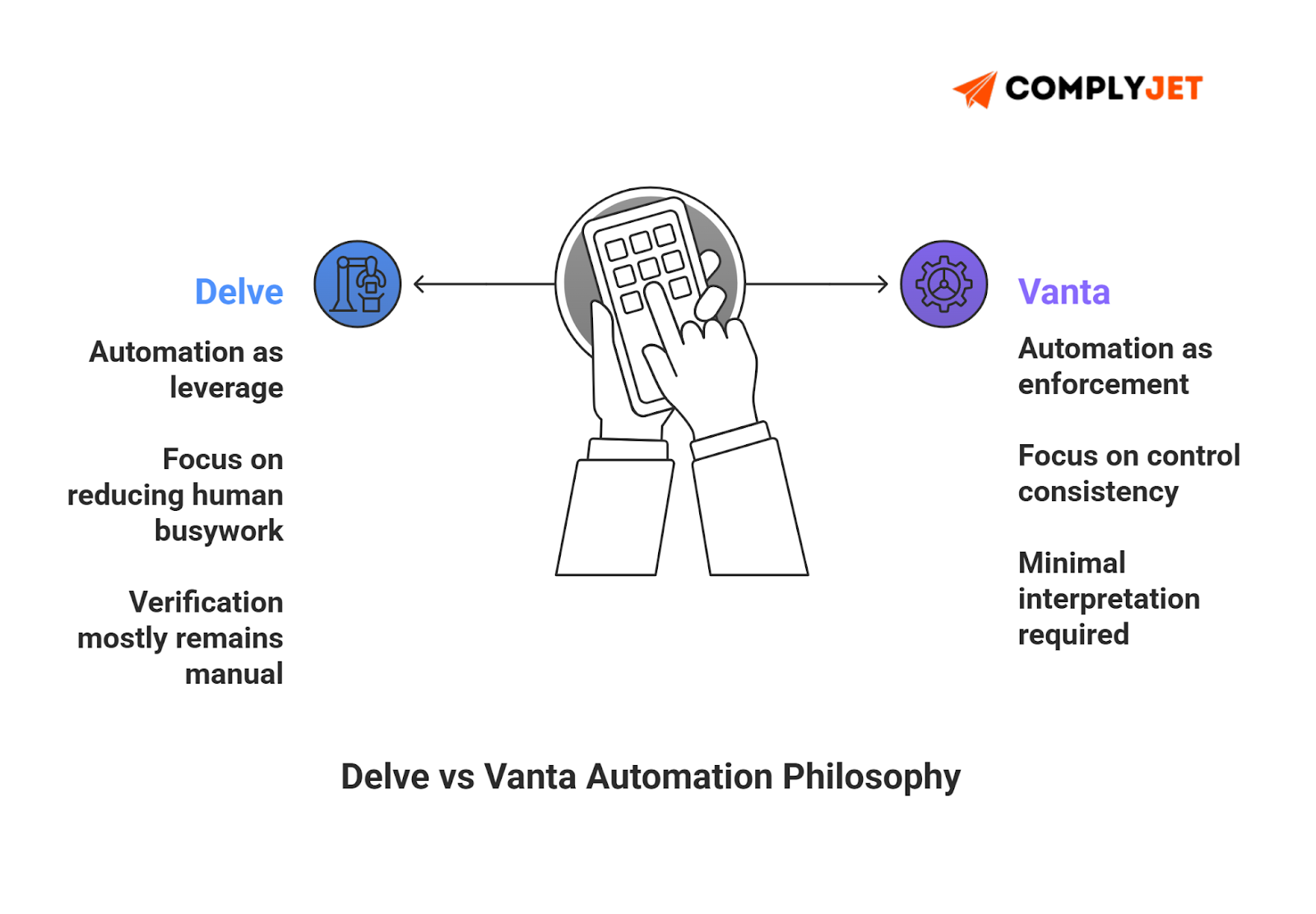
- Vanta assumes the world should be made orderly.
- Delve assumes the world already isn't.
Neither assumption is wrong. They just optimize for different realities. One builds a durable record. The other helps you take action sooner.
Once you understand that split, the rest of the debate becomes much easier to navigate.
How Delve AI Compliance Actually Works (And Where It Breaks)
Automated compliance is powerful. But auditors don't care.
That tension sits at the center of how Delve operates. Delve AI compliance isn't about replacing auditors or inventing shortcuts. It's about reducing the human grind that usually slows teams down before an audit even starts.
The easiest way to understand it is to imagine a very fast, very literal human assistant.
What Delve's AI actually does
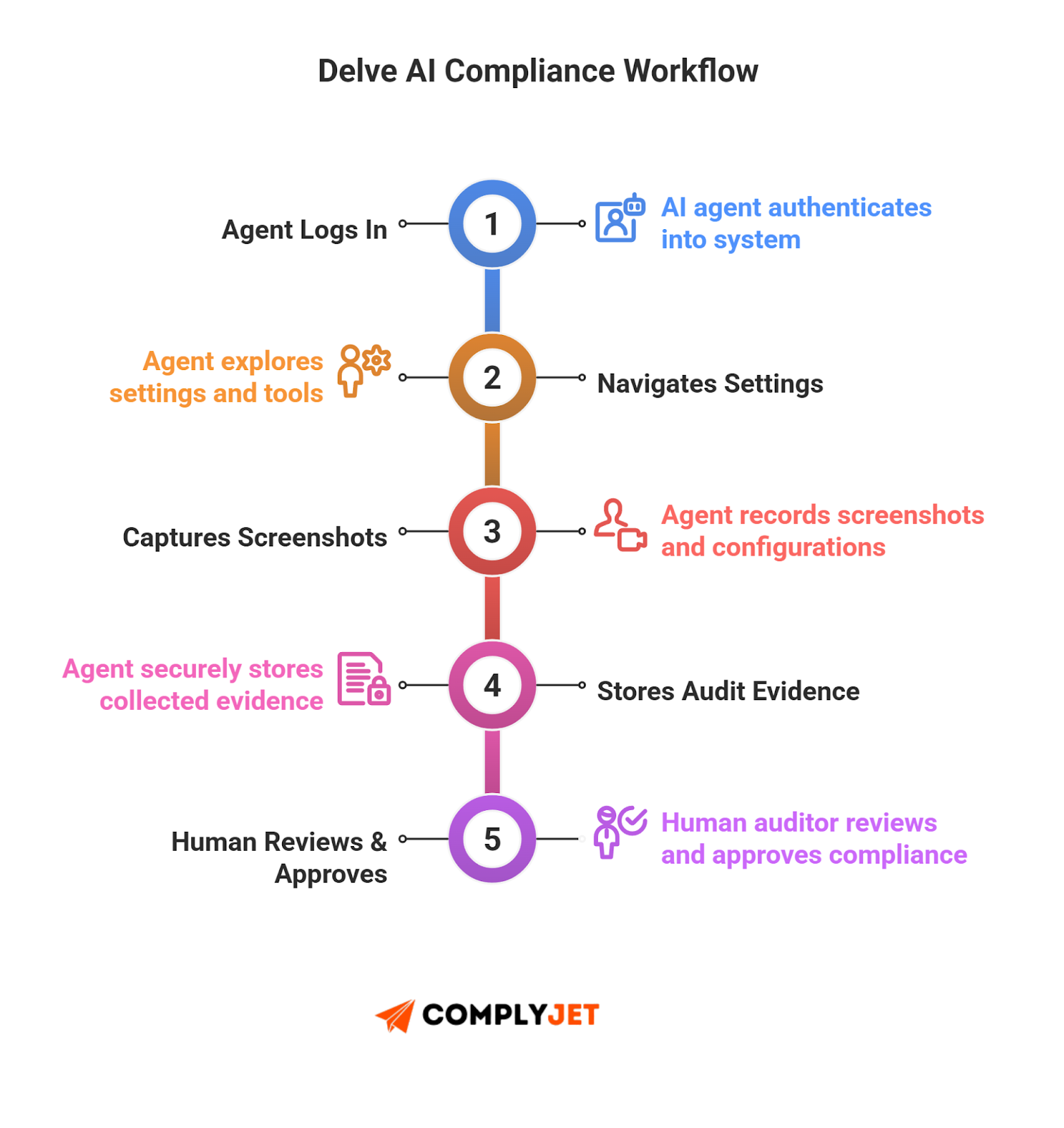
At its core, Delve AI compliance relies on browser-based agents. When an integration doesn't exist, the agent logs in like a human would. It clicks through settings, captures screenshots, and pulls evidence that APIs can't reach.
Think of it as delegating busywork to someone who never gets tired. You still decide what to look for. The agent just moves faster and doesn't complain.
Key features of Delve's compliance solutions:
- AI Compliance Agents - Virtual compliance assistants that track controls, collect proof, and prepare audit-ready evidence automatically.
- AI Evidence Collection - Continuously pulls verified evidence from connected tools, eliminating manual screenshots and follow-ups.
- Security Questionnaire Automation - Auto-fills vendor security questionnaires using your existing controls and policies.
- AI SAST & Infrastructure Scanning - Scans code and cloud infrastructure continuously to detect security and compliance risks early.
- AI Policy Assistant - Instantly answers auditor and policy questions using verified internal documentation.
- Computer Use Agent - Automatically verifies device-level security settings and generates audit proof for company laptops.
Key Insight: By now, you're starting to see why Delve AI compliance feels genuinely useful for early teams. Messy stacks? Legacy tools? Half-documented processes? Not a problem. Instead of blocking progress, the agent can still collect usable evidence and keep things moving.
Where Automation Stops and Verification Starts
Here's the critical line: the agent doesn't decide whether something is compliant. It collects inputs. Humans verify outputs.
This matters for real-time Risk Monitoring. Delve can surface signals quickly, but risk assessment isn't binary. A screenshot might show MFA enabled, but an auditor will still ask whether it stayed enabled over time.
Delve doesn't hide this limitation. Review is assumed to be part of the workflow, not a failure of automation.
What Auditors Care About (And Where Cracks Appear)
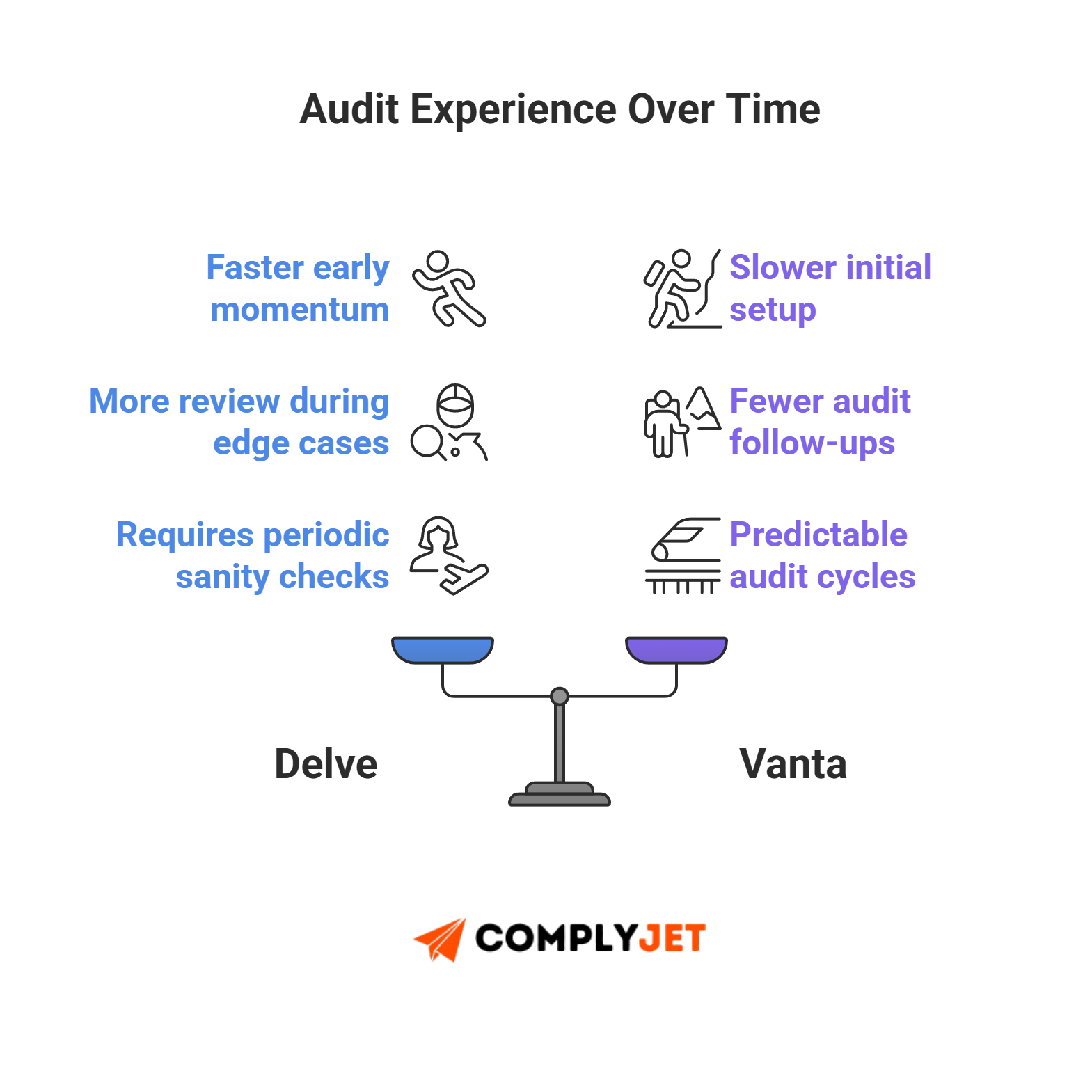
If you're considering Delve's compliance platform, understanding this distinction is non-negotiable. Auditors don't audit AI. They audit evidence.
If the agent misreads a UI change or captures outdated context, someone has to catch it. That's the trade-off. Speed increases. So does the need for spot checks.
This shows up clearly in Delve reviews left all over the web. Founders consistently praise the reduction in manual effort. Other reviews of Delve also point to the need to sanity-check edge cases themselves. The AI accelerates the process, but it doesn't absolve responsibility.
The Honest Takeaway
Delve's AI works best when treated as leverage, not authority. It's a multiplier for effort, not a substitute for judgment.
Used as intended, Delve's AI compliance does exactly what it promises: it moves you forward faster, as long as you're still paying attention.
Vanta's Approach: Structured, Rigid, and Audit-Friendly
Vanta is boring on purpose. That's not a criticism; it's the design.
At its core, Vanta treats compliance like a bank of switches. On or off. Passing or failing. A laptop is encrypted, or it isn't. MFA is enabled, or it's not. This deterministic mindset is exactly why auditors are often more comfortable with Vanta's SOC 2 compliance solutions.
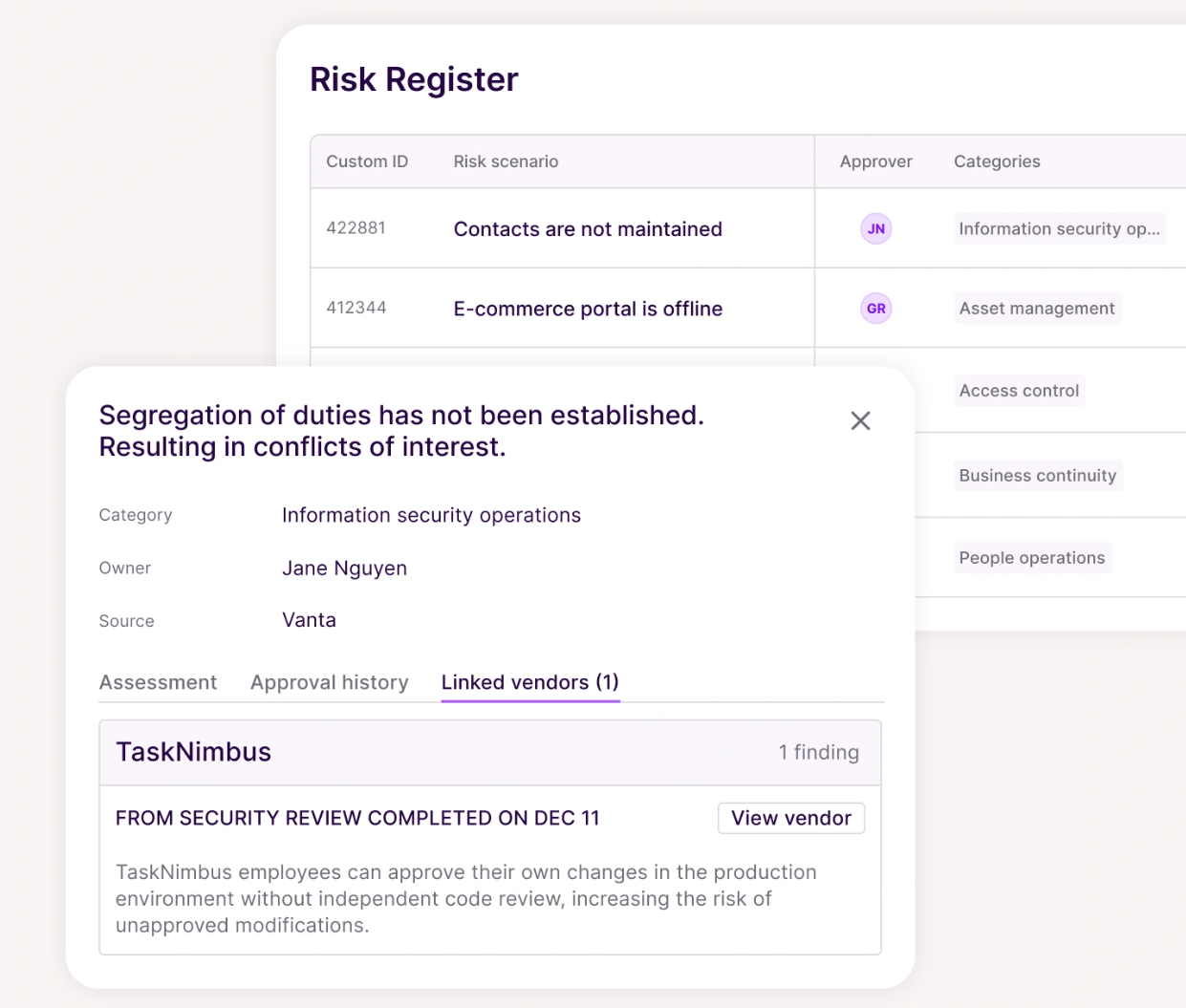
Key features that are often praised in Vanta reviews:
- Continuous Monitoring (AWS, identity, devices) - Ongoing checks that verify security controls are operating continuously, not just at audit time.
- Policies with Control Mapping - Policies automatically linked to controls to show how written intent maps to real operations.
- Questionnaire Automation & Exports - Standardized, reusable security answers that reduce errors and speed up responses.
- Access Reviews & Certifications - Periodic reviews that confirm users have only the access they need.
- Vendor Risk Management - A structured process to assess, rate, and remediate third-party security risks.
- Trust Center & RFP Support - A centralized public page that shares verified security documentation with customers and prospects.
There's very little ambiguity. Evidence is pulled from known systems, checked against fixed rules, and logged continuously. The result is a clean, durable trail that's easy to review months later, even by auditors who weren't involved in setup.
Why Auditors Trust Vanta's Rigidity
Auditors don't care about interpretation as much as they do about consistency.
Vanta excels at real-time Risk Monitoring in the strictest sense. Configurations are checked continuously. Drift is flagged. Historical proof is preserved. Nothing is inferred. Nothing is guessed.
This is why many Vanta reviews describe audits as "uneventful" or even "boring." In audit terms, that's a win. Fewer follow-ups. Fewer judgment calls. Less back-and-forth during the observation window. Less chance of pushing a rushed security fix.
For teams running on Vanta's SOC 2 compliance solutions, this predictability compounds. Each clean month of evidence makes the next audit cycle easier than the last.
Where the Structure Starts to Feel Heavy
That same rigidity comes with a cost.
If a tool doesn't integrate cleanly, Vanta may not improvise. You'll upload evidence manually or change how you work. If a control doesn't fit neatly into the framework, it may not partially pass. It either passes or it doesn't.
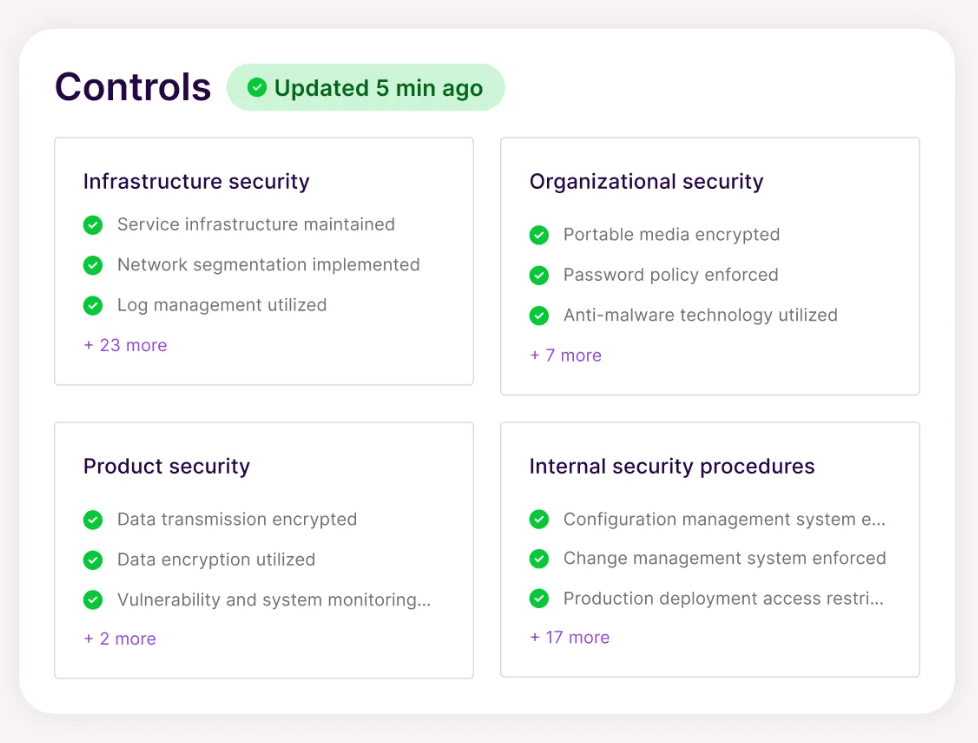
This trade-off clearly shows up in Vanta reviews left by smaller teams on G2 and Capterra. Founders value the audit defensibility but sometimes feel the platform expects them to adapt to it, not the other way around.
Governance Over Guidance
Vanta extends this philosophy into sales as well. Vanta's Trust Center turns compliance into a polished artifact buyers recognize and trust.
The takeaway is simple: Vanta prioritizes governance over guidance. That rigidity is a strength when you're scaling. It's also a tax when you're still figuring things out.
Whether it's the right trade depends on where you are today.
For lean teams that value thoroughness over shortcuts - ComplyJet keeps compliance efficient and audit-sound.
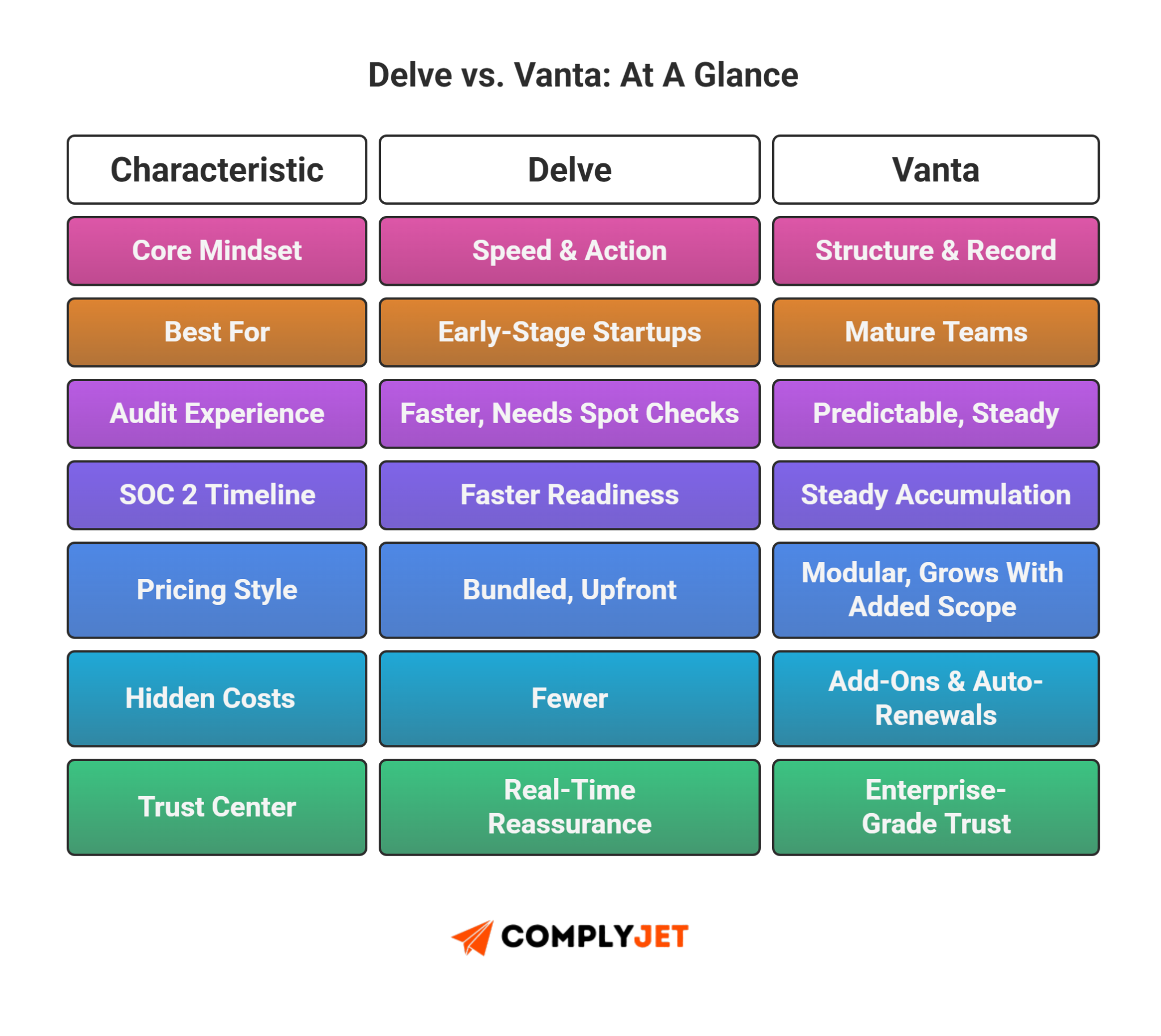
Delve vs Vanta SOC 2 Timeline: "Fast" Means Different Things
It's important to note that no compliance tool can cheat time. It can only reduce wasted effort.
That distinction is where founders get tripped up when comparing speed claims - especially when comparing Delve and Vanta's advertised timelines regarding SOC 2.
SOC 2 isn't a sprint. It's a takeoff.
You can line up faster.
You can remove friction on the runway.
But you still need enough distance to get airborne.
That's the core misunderstanding behind "SOC 2 in days," and it's why comparisons of Delve and Vanta's SOC 2 timeline need context.
SOC 2 Type 1 vs Type 2: What Actually Changes the Timeline
Type 1 answers a simple question:
Are your controls designed correctly right now?
This phase can move quickly with focus. Policies are drafted. Controls are mapped. Evidence is gathered. This is where Delve's SOC 2 solutions often feel fast. Onboarding is guided, early manual work is reduced, and founders trying to unblock sales feel immediate momentum.
Type 2 answers a harder question:
Do those controls actually work over time?
That requires an observation window - usually months. No software compresses that clock. This is true regardless of how Delve or Vanta market their compliance timelines.
Where Delve and Vanta Diverge in Practice
Here's how the Delve vs Vanta SOC 2 timeline typically plays out:
- Delve's SOC 2 timeline: Faster setup, lower early friction, optimized for getting audit-ready quickly
- Vanta's SOC 2 timeline: Immediate monitoring, steady evidence accumulation, fewer audit surprises
Reality: Same destination, different timing.
Interpreting "SOC 2 in days"
Tip for founders: When you hear it, translate carefully. It usually means "ready to start the clock," not "audit completed." Framed honestly, that's fine. Framed loosely, it erodes trust - which is exactly why the delineation of Delve vs Vanta's SOC 2 timeline deserves precision.
Vanta vs Delve Pricing: What Founders Actually End Up Paying
You'd be hard-pressed to find a founder who bought compliance software for fun. They buy it when a deal stalls, procurement demands it, or SOC 2 becomes non-negotiable.
Hence, Vanta and Delve's pricing comparison needs straight talk, not marketing fluff.
Vanta Pricing: Structured Tiers that Expand
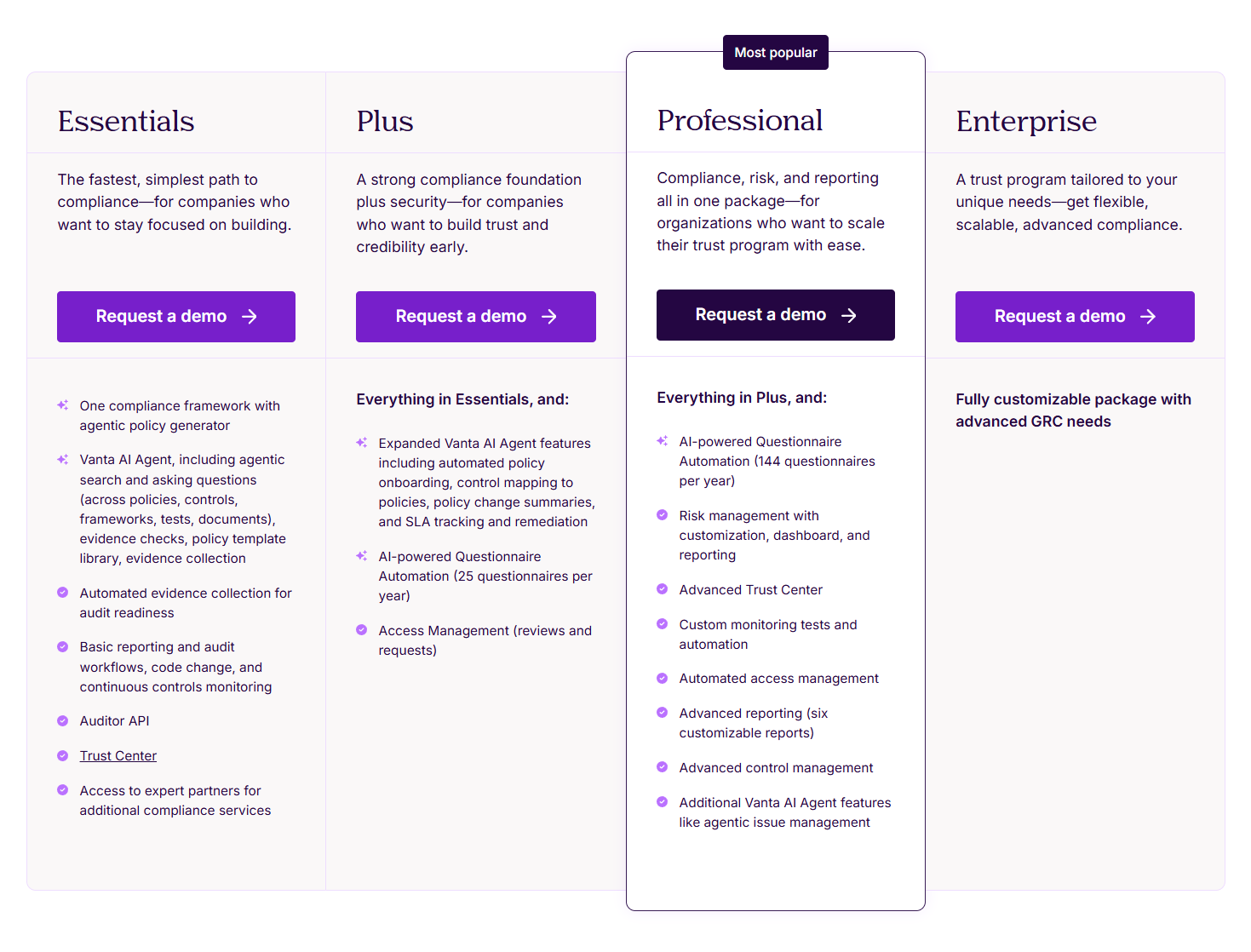
Vanta pricing follows familiar SaaS logic. Entry plans typically start around $7.5k to $10k annually - covering Vanta’s Core SOC 2 compliance, basic integrations, and evidence collection.
The hidden costs in Vanta's pricing appear as you scale. Extra frameworks. Advanced questionnaires. Vendor risk tools. Device management upgrades. Each makes sense individually, but they stack fast. Additional costs across Vanta's pricing tiers aren't surprises - they're scope creep.
This is where Vanta and Delve's pricing diverges. Vanta scales with your org: more people, more tools, higher spend. But renewals are the next pressure point. Once compliance is revenue-critical, teams sometimes hit a late-stage price hike during renewal. Switching feels riskier than paying, so most absorb it.
Delve Pricing: Bundled Packages, Less Configurability
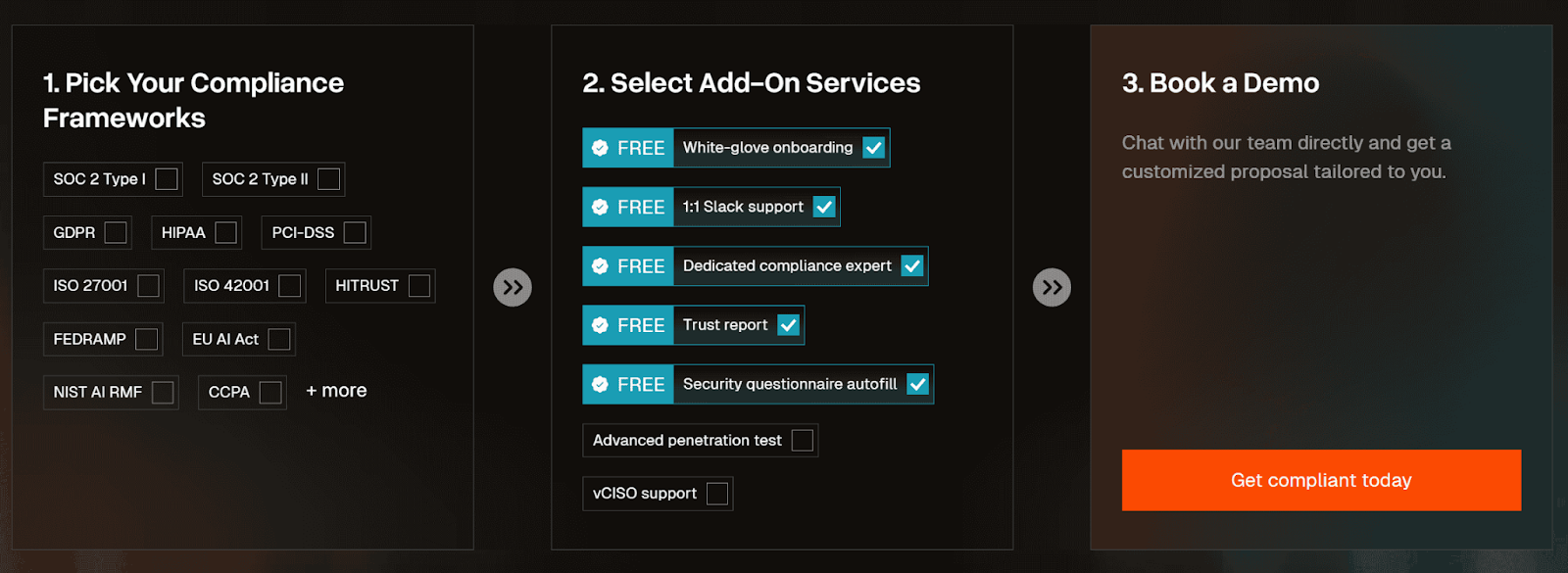
Delve's pricing works differently. No public tiers. Everything starts with a conversation.
Based on founder reports, Delve's pricing structure typically lands between ~$10k-$20k annually. The pitch is bundling: tooling, guidance, and sometimes pen testing services in one package instead of à la carte add-ons.
When comparing Vanta and Delve's pricing, keep in mind that Delve optimizes for speed and fewer decisions. Vanta optimizes for control and extensibility.
The real cost question: The listed price doesn't quite tell the story. The real cost is time and attention. Comparing Vanta and Delve's pricing isn't about cheaper versus expensive - it's about when you pay. Vanta spreads cost as you grow. Delve concentrates it upfront for certainty.
The Trust Center, Buyer Trust, and Sales Reality
Compliance doesn't exist to impress auditors. It exists to close deals.
Most founders learn this the hard way. They pass SOC 2 and still watch security questionnaires pile up. The audit is done, but buyer trust isn't automatic. That's where Trust Centers come in.
Think of a Trust Center as a security resume.
Not the full audit report. Not internal dashboards. Just the evidence buyers actually want, in a format they recognize.
Vanta's Trust Center: Built for Self-Serve Buyer Trust
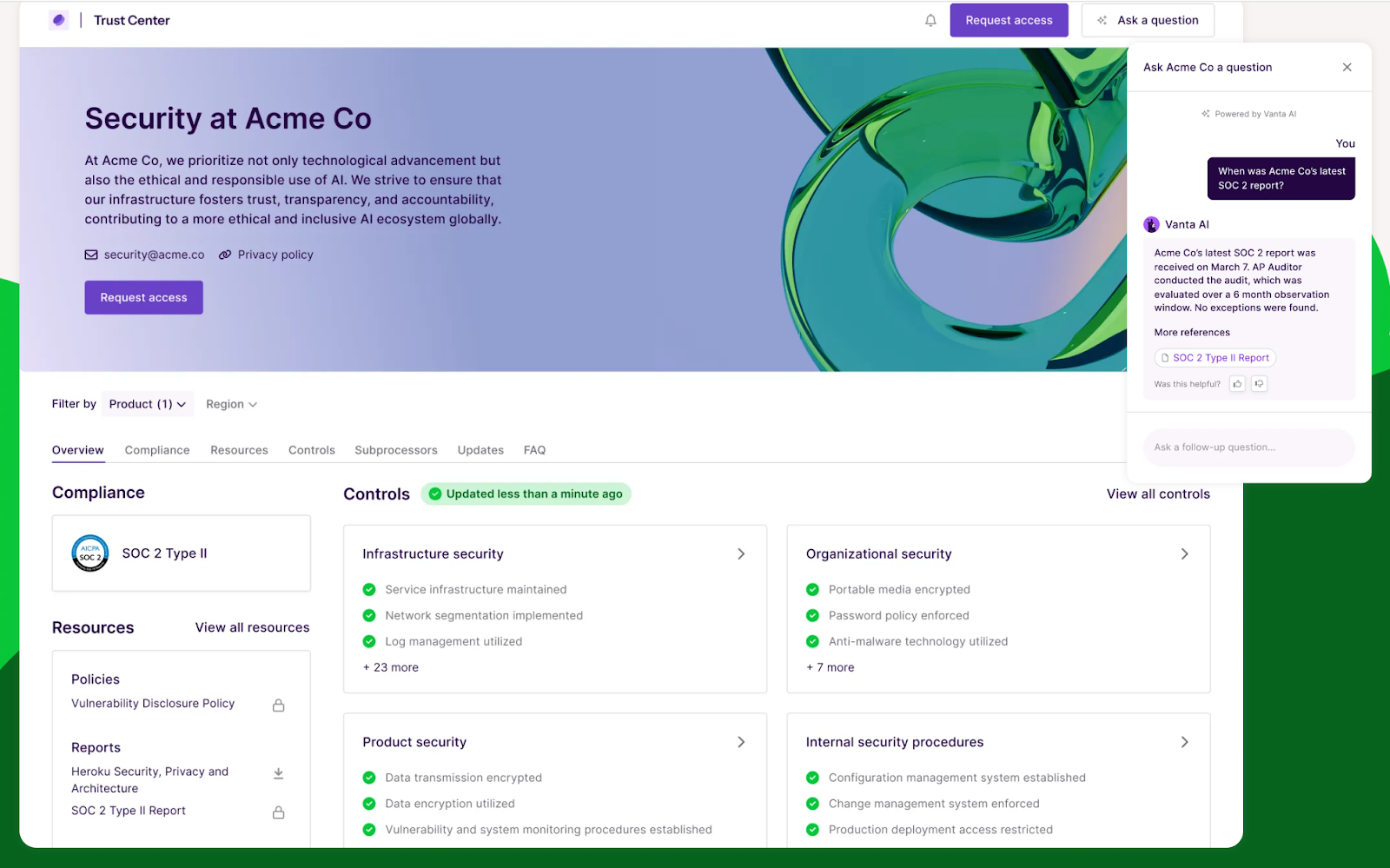
Vanta's Trust Center is designed as a first-class sales artifact. It's a public-facing page where buyers can review certifications, controls, and security posture without waiting on your team.
Because it's tightly connected to the rest of the platform, updates stay current as controls change. Sales sends a link. Procurement reviews it asynchronously. Fewer calls. Fewer follow-ups.
This is why you'd find many Vanta reviews focusing less on audits, and more on deal velocity. For teams selling into enterprise or regulated markets, Vanta's Trust Center often becomes the quiet closer running in the background.
Delve's Trust Center: Real-Time Trust, Lighter Infrastructure
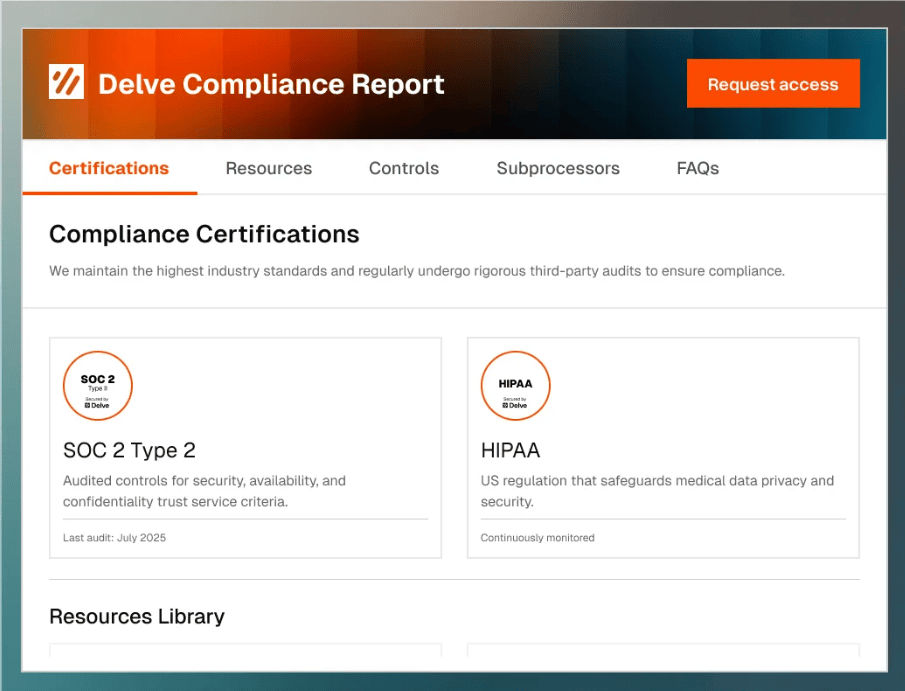
Delve approaches buyer trust differently, but it does have a Trust Center-style feature. Delve's Trust Center emphasizes real-time visibility. Buyers can see current security status and compliance progress, backed by AI-collected evidence rather than static snapshots.
The focus is immediacy. Questions get answered quickly. Founders stay out of long email threads. When it comes to compliance automation for startups, this can be a strong early-stage fit.
The trade-off is depth versus permanence. Vanta leans toward durable infrastructure. Delve leans toward timely reassurance.
Bottom Line
Both Trust Centers aim to shorten sales cycles.
One does it with structured governance.
The other does it with real-time clarity.
Which works better depends on how and to whom you sell.
Pen Testing Services: Where Most Founders Get Burned
Not all pen testing services are created equal. Auditors know the difference between manual pen tests and glorified vulnerability scans - and so should you.
The Pen Testing Basics
At the heart of a SOC 2 audit isn't paperwork. It's proof that your controls actually work. An automated vulnerability scan is like a blood-pressure check: quick, cheap, and only a surface signal. A manual penetration test is closer to an MRI - slow, thorough, and designed to expose real weaknesses. For companies handling ssensitive data, most auditors and enterprise buyers expect the latter as part of credible SOC 2 evidence.
Naturally, pen testing services matter for both Delve and Vanta's compliance approaches - but they're handled differently.
How Delve Handles It
With Delve's SOC 2 bundles, penetration testing/vulnerability scan is usually framed as part of audit readiness. Delve may help coordinate or prepare for testing, but the manual test itself is often still a third-party engagement. The platform accelerates prep, not the tester's work.
How Vanta Handles It
Vanta takes a more explicit stance. Monitoring and control automation live in the platform, but manual penetration testing is a separate external engagement you're expected to budget and plan for. Vanta won't generate human-tested evidence on your behalf, but it does have a shiny list of third-party partners who do provide similar services.
The Founder Gotcha
Many tools include automated scans under the hood and label them as pen testing services. Your high-profile client may not accept that substitution.
So, judge testing by two questions:
- Who ran it - automation or a human expert?
- Will the clientele accept the report as evidence?
Ignore the difference, and you may find yourself rebooking tests mid-audit - a delay no founder wants.
What Real Users Say: Delve Reviews vs Vanta Reviews
This is where marketing dies.
Sales pages talk about "automation" and "speed." Real users talk about friction, support, and what breaks at 11 p.m. the night before an audit. When you read Delve vs. Vanta reviews side by side, a clear pattern shows up fast.
Delve Reviews
Most Delve reviews come from early-stage founders and lean teams. The tone is consistent: relief mixed with realism.
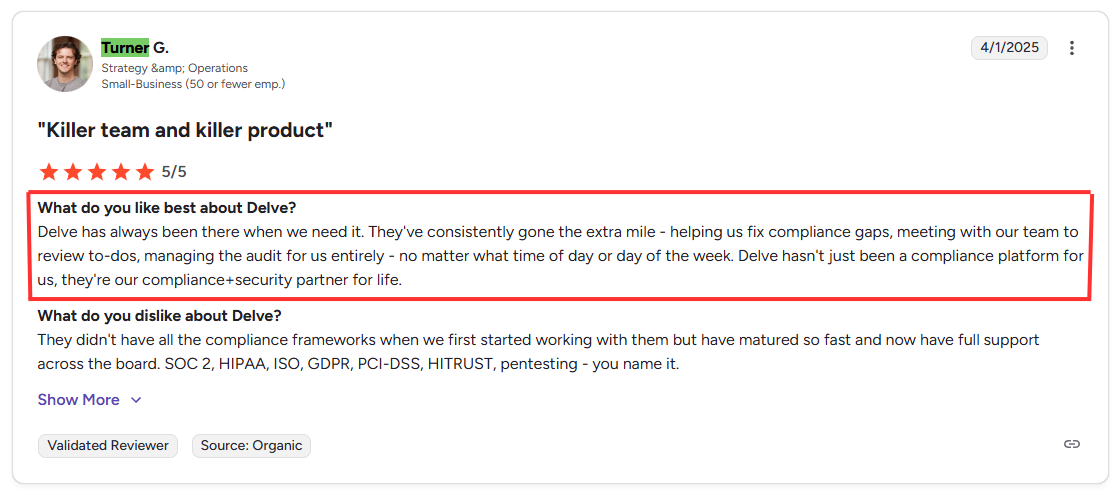
Users often praise how hands-on the experience feels. Slack-based support comes up repeatedly. Founders talk about getting answers quickly, usually from someone who understands audits - not just the product. For teams new to the SOC 2 compliance theatre, that matters more than another dashboard.
Speed is the other recurring theme in Delve reviews. Setup feels guided. Evidence collection feels less manual. Several founders describe Delve as having a "fractional compliance lead" rather than a tool they need to babysit.
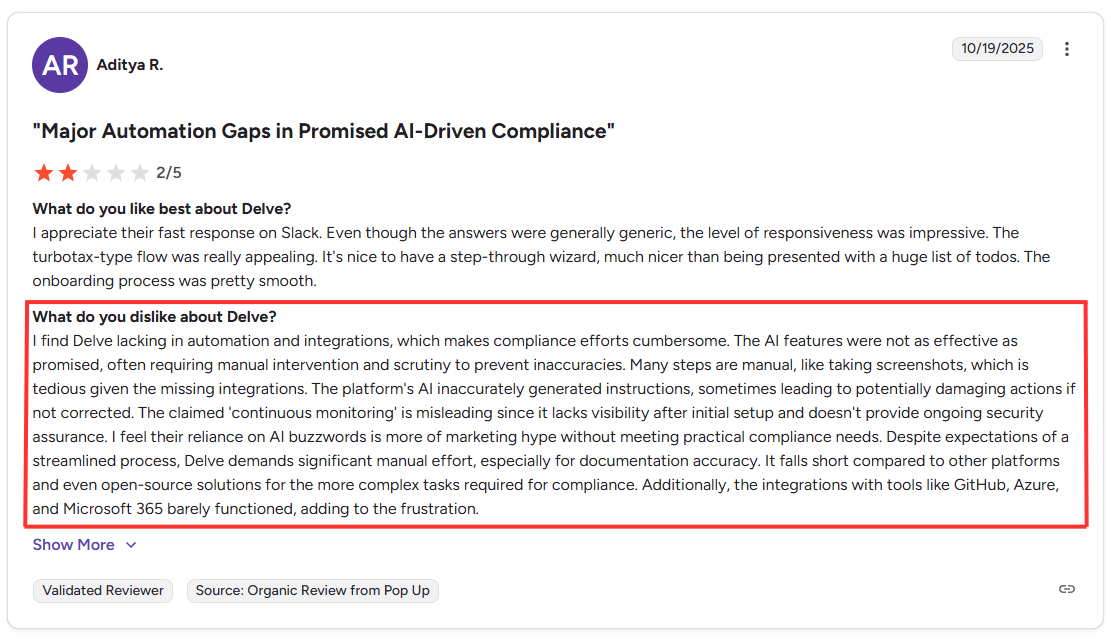
The criticism is predictable, too. Some reviewers say the AI feels overhyped in edge cases. Others note that for complex environments, they still had to double-check evidence themselves. In authentic reviews of Delve, the takeaway isn't "magic." It's "less painful than doing it alone."
This is where Delve's reviews vs. Vanta's begins to split, clearly spurred by varying company stages.
Vanta Reviews
Vanta reviews skew toward teams that are further along. The word "standard" comes up a lot - as in, "our customers expect it."
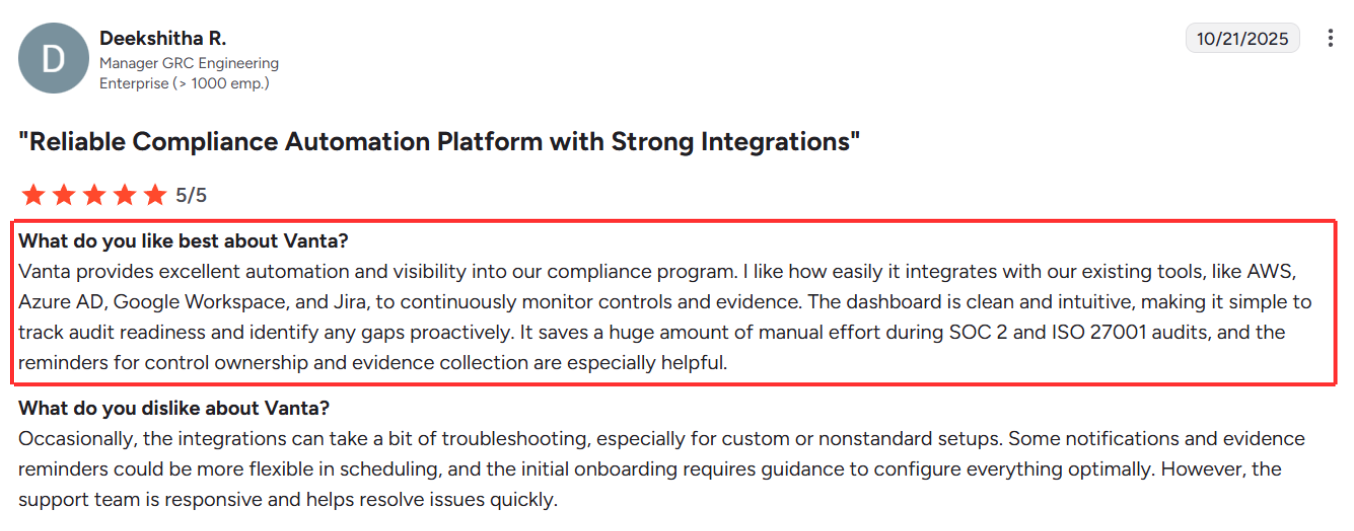
Users consistently describe Vanta as reliable and audit-friendly. Auditors know it. Security teams trust it. For growing companies, that predictability is a feature, not a bug.
The downsides show up just as consistently in Vanta reviews. Founders mention alert fatigue, setup overhead, and pricing friction as teams scale. Support is often described as solid, but less personal unless you're a larger customer.
Get end-to-end audit support with one dedicated team from start to sign-off. At ComplyJet, our founders stay hands-on through the entire compliance journey - no handoffs, no rotating reps, no dropped context.
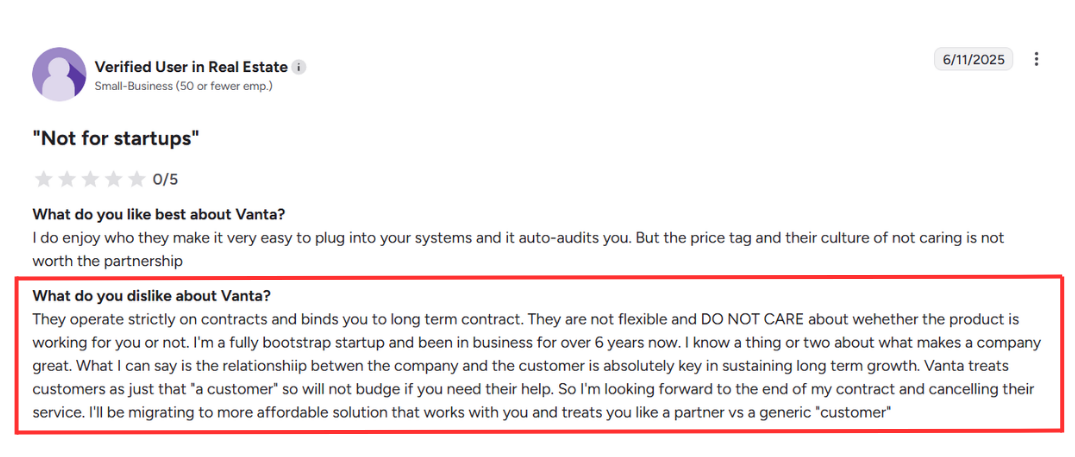
So, when going through Delve vs. Vanta's reviews, the contrast is simple: Delve feels more like a partner, while Vanta feels like infrastructure. Neither is wrong. They just solve different problems at different stages.
Vanta vs Delve: Which One Fits Your Stage?
There's no universally "best" compliance tool.
There's only the tool that fits where you are right now.
Not good versus bad, but early versus late, speed versus structure. Let's break it down by stage.
Seed/Series A
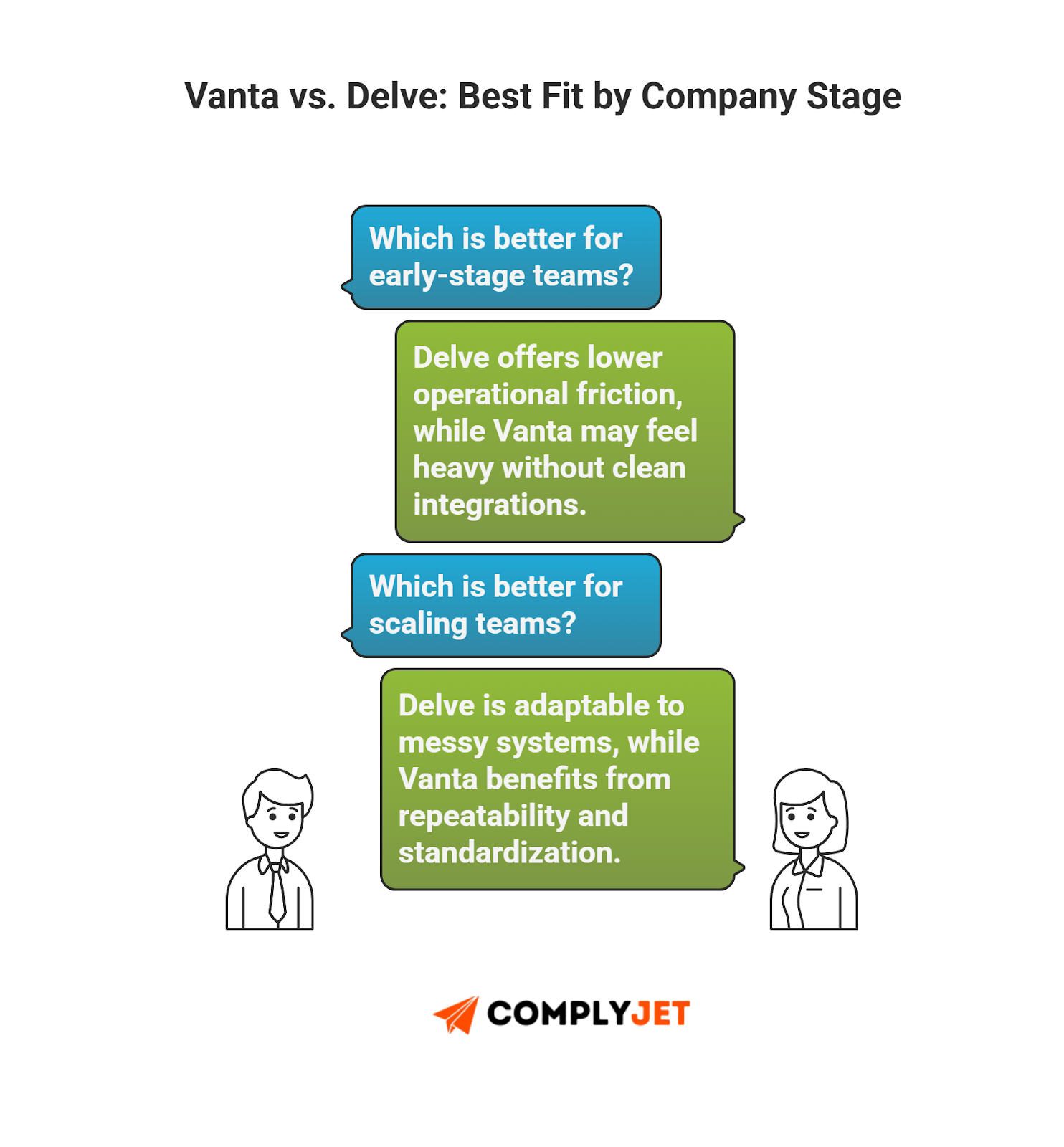
At this stage, compliance is usually reactive. A deal gets blocked. A security review lands in your inbox. You don't have a dedicated security hire, and you don't want one yet.
This is when compliance automation for startups tends to be lightweight. Delve's pricing is often easier to swallow early because it's scoped around outcomes, not long-term infrastructure. You're paying to get unblocked fast, not to build a perfect system.
If your goal is momentum - closing deals, buying time, and learning the audit ropes - Delve tends to fit better here.
Series B+
Once you're scaling, the math changes. More customers. More employees. More scrutiny.
Compliance stops being a one-off project and becomes an ongoing operation. This is where Vanta's pricing starts to make sense, even if it's higher over time. You're paying for durability: continuous monitoring, standardized workflows, and fewer surprises when auditors show up.
At this stage, teams often accept that Vanta pricing grows with headcount and scope because the alternative is internal chaos.
Custom Stack Teams
If your infrastructure is non-standard - self-hosted tools, custom internal systems, unconventional workflows - rigid automation can become friction.
Here, Delve's pricing often feels more flexible because the product is designed to adapt to messy environments. The trade-off is less long-term rigidity, but more short-term progress.
The takeaway: Pick the tool that matches your current constraints, not your future aspirations. You can always switch tools. You can't get back lost time.
FAQs: Founders' Most Asked Questions
Which is more cost-effective for a Seed-stage startup: Vanta or Delve?
The trade-off: entry price vs cost certainty
Vanta often looks cheaper upfront, with base licenses commonly quoted in the $8k-$15k range. The catch is expansion. Features like MDM, additional frameworks, or more seats are usually add-ons, and the audit itself is a separate cost, often $10k+.
Delve typically charges a higher flat fee, often cited at around $10k-$20k. The benefit is predictability. That price frequently bundles services that founders forget to budget for, like penetration testing and sometimes audit coordination. Fewer surprises later.
Is the "SOC 2 in Days" claim legitimate?
The trade-off: faster readiness vs fixed timelines
Delve can dramatically shorten prep work by automating policy drafts, cloud fixes, and control mapping. That part really can happen in days.
What can't be compressed is the audit clock. A SOC 2 Type 2 still requires a multi-month observation window. No tool changes that.
My stack is messy and custom. Which tool handles this better?
The trade-off: standardization vs adaptability
Choose Vanta if your stack is clean and mainstream. It performs best when tools are API-supported and predictable.
Choose Delve if you rely on custom or legacy systems. Its browser-based agents can log in like a human and capture evidence without forcing architectural changes.
Will big auditors trust AI-generated evidence?
The trade-off: defensibility vs convenience
Vanta produces deterministic evidence pulled directly from APIs. This is binary, audit-friendly data preferred by conservative auditors.
Delve relies more on automated evidence collection and OCR. This is faster, but probabilistic. It's usually acceptable for standard startups, but can draw scrutiny in highly regulated industries.
How involved do I need to be in the audit?
The trade-off: visibility vs delegation
Vanta is a glass box. You see what the auditor sees and manage the relationship yourself.
Delve provides expert support and helps prepare audit evidence, which can streamline communication with auditors and reduce back-and-forth during an audit.
Which platform scales better for ISO 27001 or other frameworks?
The trade-off: maturity vs flexibility
Vanta scales more cleanly. Its cross-mapping allows most SOC 2 evidence to be reused for ISO 27001 and other frameworks, with strong HRIS and MDM depth.
Delve supports multiple frameworks, but expansion usually requires more manual configuration as complexity increases.
The Final Verdict
Most founders frame this decision as tooling. It isn't.
Compliance is a reflection of how your company operates under pressure. That's why scrutinizing Delve vs. Vanta reviews is more useful than scanning feature tables. What founders praise - or complain about - usually mirrors how their teams actually work.
If you move fast, hate overhead, and want compliance to stay out of your headspace, Delve will feel natural. It optimizes for momentum. The difference between Delve and Vanta's SOC 2 timeline makes sense here: quick readiness, fewer decisions, and a strong bias toward getting you unblocked when time matters.
If you value repeatability, defensibility, and long-term audit confidence, Vanta fits better. Compared to Delve’s compliance timeline - Vanta isn't flashy, but it's steady. Controls accumulate. Evidence compounds. Over time, audits become boring - and boring is good.
Pricing follows the same philosophy. Vanta vs Delve pricing isn't about cheaper versus more expensive. It's about when you want to pay. Vanta spreads cost across scale and structure. Delve concentrates it around speed and support.
So don't ask which tool is "better." Ask which operating mindset matches how your company actually runs today:
Structure vs speed. Governance vs guidance.
Pick the one that sounds like you.
If you're still unsure, that's usually a signal - not a failure. ComplyJet helps founders pressure-test their compliance mindset before they pick a tool, and stays hands-on through audit sign-off. Book a demo now to start your compliance journey.