.svg)

You’ve decided you need to get PCI DSS compliant. Maybe a payment processor asked for it, maybe an enterprise prospect flagged it in a security review. Either way, you’re now looking at a list of tools that all claim to handle it, none of them willing to show pricing without a demo call, and most of them built primarily for SOC 2 with PCI DSS bolted on as an afterthought.
I’ve reviewed 11 of the best PCI compliance software tools available in 2026, covering both GRC automation platforms and dedicated PCI-specialist tools. The list includes everything from broad multi-framework platforms to niche pci dss compliance software built specifically for merchants, acquirers, and payment processors. By the end, you’ll know exactly which type of tool fits your situation, and which specific platforms are worth your time.
What PCI DSS actually demands from your software stack (and why pci compliance automation matters)
Key insight
Most people think PCI compliance is just running a quarterly vulnerability scan. It’s not. PCI DSS v4.0 has 12 requireme
Most people think PCI compliance is just running a quarterly vulnerability scan. It’s not. PCI DSS v4.0 has 12 requirement domains and over 300 individual controls, and the 2024 deadline for v4.0 brought several requirements that older GRC tools weren’t built for, including client-side script security on payment pages (requirements 6.4.3 and 11.6.1) that demands active monitoring of every script running on your checkout pages.
Without software, you’re tracking all of this in spreadsheets, manually collecting screenshots, chasing engineers for access log exports, and rebuilding the same evidence package every year. It doesn’t work at scale, and it doesn’t hold up under a real audit.
What PCI compliance software does is collapse that manual work: it pulls evidence automatically from your cloud infrastructure, identity providers, and dev tools; maps that evidence to specific PCI DSS controls; and flags gaps before your QSA does. Some platforms also include or integrate ASV-certified vulnerability scanning, which you need for quarterly external scans regardless of your merchant level.
The two categories in this article solve different problems. GRC platforms are your choice if you’re also pursuing SOC 2 or ISO 27001 alongside PCI, and you want one tool managing all of it. PCI-specialist tools are your choice if PCI is your primary need and you want purpose-built SAQ wizards, ASV scanning, and dedicated QSA relationships.
How we evaluated the best PCI DSS compliance software and tools
I evaluated these tools against criteria that matter specifically for PCI DSS, not just general compliance:
- PCI DSS v4.0 framework coverage: Does the platform support the full v4.0 requirement set, not just the legacy v3.2.1 controls that most tools mapped years ago?
- Evidence automation depth: How much of your evidence collection is actually automated versus manually uploaded? The difference between 60% and 90% automation is weeks of work per audit cycle.
- ASV and scanning integration: Does the platform include ASV-certified scanning, or do you need to bolt one on separately?
- SAQ support: Can it identify the right Self-Assessment Questionnaire type for your environment and guide you through it?
- Continuous monitoring: Is monitoring truly real-time, or does it run periodic checks? What happens when a control drifts out of compliance?
- Pricing model: Per-seat pricing, flat pricing, or bundled audit pricing each have very different cost trajectories as your company grows.
Quick comparison: top PCI compliance software
| Tool | Best for | Pricing | Standout feature |
|---|---|---|---|
| Vanta | Broad multi-framework compliance | Contact for pricing | 400+ integrations, 16,000+ customers |
| Drata | SOC 2 + PCI dual programs | Contact for pricing | Agentic AI evidence automation |
| Secureframe | SMBs needing cross-framework mapping | Contact for pricing | One control covers SOC 2 + PCI simultaneously |
| ComplyJet | Early-stage startups, flat pricing | From $5,000/yr | 350+ integrations, team-guided compliance |
| Thoropass | Guided audit-as-a-service | Contact for pricing | Embedded auditor in platform |
| Sprinto | Speed-to-compliance, startups | From ~$4,000/yr | 300+ integrations, expert sessions |
| SecurityMetrics | Merchant ASV + SAQ | From ~$300/yr | ASV + QSA certified, 300K+ merchants |
| VikingCloud | Payment processors, acquirers | Contact for pricing | 4M+ merchant locations, 100+ QSAs |
| Scrut Automation | Security-first GRC | Contact for pricing | 4.9/5 rating, AI remediation guidance |
| Hyperproof | Mid-market, 140+ frameworks | Contact for pricing | FedRAMP authorized environment |
| Strike Graph | Audit-anchored bundled pricing | Contact for pricing | Bundled pentesting + compliance |
Free Demo
Get compliant faster with ComplyJet.
Flat pricing, 350+ integrations, and a team that guides you to certification.
The 11 best PCI compliance tools and pci dss software in 2026
1. Vanta

Vanta is the category default for a reason. With 400+ integrations, 16,000+ customers, and coverage across 35+ frameworks including PCI DSS, SOC 2, and ISO 27001, it has the broadest integration library of any platform on this list. Companies like Ramp, Snowflake, Cursor, and GitHub use it, which tells you it scales well. If you’re evaluating GRC tools and haven’t looked at Vanta yet, you’re not really evaluating the category.
For PCI DSS specifically, Vanta automates evidence collection across your cloud infrastructure, identity providers, and dev stack. Its AI-powered policy drafting and questionnaire automation reduce the back-and-forth with your QSA. The Trust Center lets you share your security posture directly with customers or prospects, which matters if you’re also using compliance as a sales asset. Worth checking out our Vanta pricing guide before your sales call.
“
It's very easy to use, and it guides you through the steps in a natural way. The best part is the automations and integrations, because they save a lot of time and make the whole compliance process much more efficient.
★★★★★Verified User· SMB
Via G2 ↗Key features:
- 400+ integrations for automated evidence collection across cloud, identity, HR, and endpoint tools
- Supports 35+ frameworks including PCI DSS, SOC 2, ISO 27001, HIPAA, GDPR, FedRAMP, CMMC
- AI-powered questionnaire automation and policy drafting
- Trust Center for sharing real-time security posture with customers
- Continuous control monitoring with real-time alerts
Pricing: Contact for pricing (no public tiers)
Best for: Companies that want the broadest integration library and multi-framework compliance under one roof, especially if they’re already in the Vanta ecosystem or pursuing PCI DSS alongside SOC 2 or ISO 27001.
Pros of Vanta
- Largest integration library in the category (400+)
- Well-established with a large customer base and auditor familiarity
- Strong AI features for policy drafting and questionnaire automation
- Trust Center is one of the best in class
Cons of Vanta
- Pricing is not public and is reported to be significant, especially for smaller teams
- Per-seat model means costs scale with headcount
- PCI DSS is one of many frameworks, not a primary focus
2. Drata

Drata has built its identity around automation depth. Where some platforms automate 60–70% of evidence collection, Drata pushes that number higher through its agentic AI, which continuously monitors and collects evidence without manual triggers. It’s a strong pick for companies running SOC 2 and PCI DSS simultaneously, since the control overlap is significant and Drata handles cross-mapping well. Read our full Drata review if you want the detailed breakdown.
The 8,000+ customer base and 4.7/5 rating across 1,153 reviews reflects genuine satisfaction, particularly for teams that value automation and support responsiveness. The main complaint I hear: pricing is on the higher end, and for startups with one framework to pursue, it can feel like paying for features you won’t use for another two years.
“
Drata's automation of internal controls is invaluable — it significantly eased our audit management. The customer support team is responsive, especially the live chat and our dedicated CSM.
★★★★★Verified User· Mid-Market
Via G2 ↗Key features:
- Agentic AI for autonomous evidence collection and control mapping
- Deep native integrations with AWS, Okta, GitHub, and Jira
- Continuous monitoring across all PCI DSS domains
- AI-powered security questionnaire automation
- Trust Center and vendor risk management
Pricing: Contact for pricing
Best for: Teams running dual compliance programs (PCI DSS + SOC 2 or ISO 27001) who want the highest automation depth and are willing to pay for it.
Pros of Drata
- Highest automation depth in the category, especially for evidence collection
- Strong AI features and improving rapidly
- 8,000+ customers means auditor familiarity is high
- Excellent support reputation
Cons of Drata
- No public pricing; reported to be expensive for small teams
- Can feel heavy if you only need one compliance framework
- Some users report the UI has a learning curve
3. Secureframe
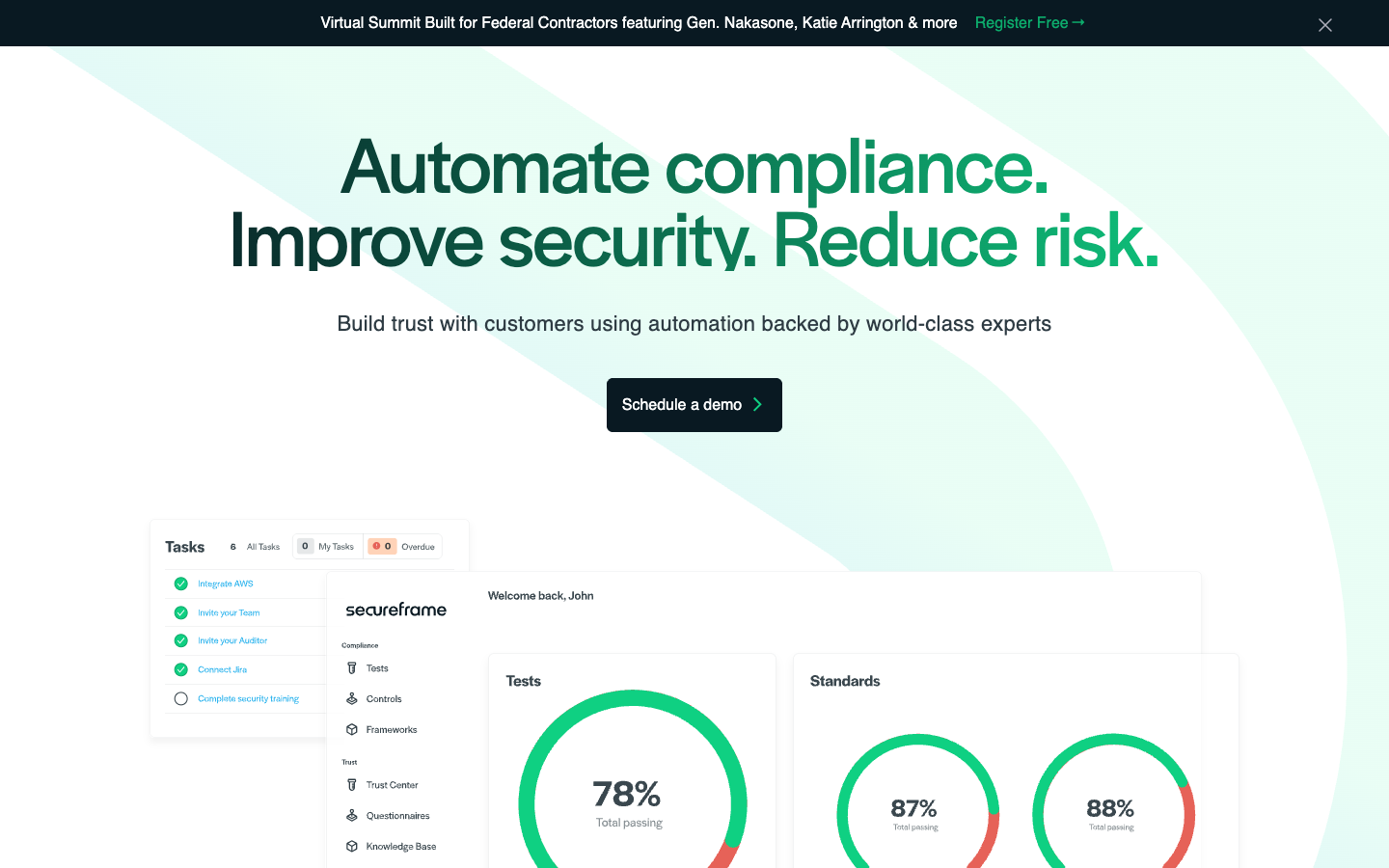
Secureframe has a specific strength that matters for PCI DSS: cross-framework control mapping. A single control can satisfy both a SOC 2 criterion and a PCI DSS requirement simultaneously, which cuts redundant work significantly if you’re pursuing both. The platform is built and supported by former auditors, which shows in how the compliance workflows are structured and what gets flagged.
With 6,000+ customers and a 4.7/5 rating, it’s a proven pick. The bundled employee security training is also a differentiator since most platforms make you source that separately. One user put it well: “Secureframe saved us an immense amount of time on our PCI and SOC audits. What could have been months of manual evidence collection became a much smoother, automated process.”
“
Secureframe saved us an immense amount of time on our PCI and SOC audits. What could have been months of manual evidence collection and coordination became a much smoother, automated process.
★★★★★Verified User· SMB
Via G2 ↗Key features:
- Cross-framework control mapping: one control covers SOC 2 + PCI DSS simultaneously
- Continuous monitoring across 175+ cloud services
- Bundled employee security awareness training
- Expert guidance from former auditors and compliance professionals
- Vendor risk reporting and automated access reviews
Pricing: Contact for pricing
Best for: SMBs pursuing PCI DSS and SOC 2 together who want cross-framework efficiency and bundled employee training.
Pros of Secureframe
- Cross-framework control mapping reduces duplicated effort significantly
- Former auditor team means the workflows reflect real audit expectations
- Bundled training is a genuine differentiator
- 6,000+ customers and strong support
Cons of Secureframe
- Integration library (175+) is smaller than Vanta or Drata
- Pricing not public; can be expensive at smaller company sizes
- Less AI automation depth than Drata
4. ComplyJet
ComplyJet is built for one scenario: an early-stage startup that needs to get compliant without derailing the engineering team or blowing through runway on software licenses. The model is team-guided rather than self-serve: a compliance team guides you through the process end-to-end, from scoping your cardholder data environment to collecting evidence to getting audit-ready. You’re not handed software and wished luck.
The pricing is flat per company, not per seat. At $5,000/yr for a single framework (PCI DSS, SOC 2, ISO 27001, or HIPAA), the cost stays the same whether you have 10 employees or 50. That matters when you’re hiring fast and most per-seat tools would double your compliance bill alongside your headcount.
With 350+ integrations and a pre-built PCI DSS control library, the automation coverage is deep. The Trust Center lets you share your certifications with enterprise prospects, which is usually the business reason you started this process in the first place.
The honest caveat: if you need FedRAMP, HITRUST, or other heavyweight government frameworks, ComplyJet isn’t the right fit. It’s built for the startup compliance stack, not the enterprise compliance stack.
Key features:
- Flat pricing per company, not per seat: cost stays predictable as you grow
- 350+ integrations for automated evidence collection
- AI-assisted policy drafting
- Trust Center for sharing compliance certifications with prospects and customers
- Team-guided compliance process: the outcome is the deliverable, not just the software access
- Pre-built PCI DSS control library mapped to v4.0 requirements
Pricing: $5,000/yr for one framework, $8,000/yr for two frameworks (e.g. PCI DSS + SOC 2)
Best for: Early-stage startups (1-50 employees) pursuing PCI DSS for the first time, especially those also pursuing SOC 2 and wanting a single team to guide the process.
Pros of ComplyJet
- Flat pricing: no per-seat scaling, which is a meaningful advantage as you hire
- Guided compliance model: a team drives the outcome, not just the tooling
- Strong integration coverage (350+) for the startup tech stack
- Competitive pricing compared to per-seat platforms at equivalent coverage
Cons of ComplyJet
- Less suited to enterprise frameworks (FedRAMP, HITRUST) or very complex multi-framework programs
- Smaller brand recognition than Vanta or Drata, which matters if auditor familiarity is a concern
- Best fit is clearly the startup segment: not the right call for 500-person companies
5. Thoropass
Thoropass solves a specific friction point: the gap between compliance software and the auditor relationship. Most GRC platforms help you prepare for an audit; Thoropass embeds the auditor directly into the platform. You collaborate with your auditor in the same tool where you collect evidence, which eliminates a significant amount of email, version confusion, and back-and-forth. For PCI DSS, which typically involves more complex scoping conversations than SOC 2, that embedded relationship has real value.
The CREST-accredited penetration testing included in Thoropass packages is another differentiator since PCI DSS requires pentesting and most platforms don’t include it. With 1,000+ customers and a 4.7/5 rating across 551 reviews, the model clearly works. The main trade-off: bundling audit and software means less flexibility on choosing your own QSA.
“
The ease of uploading documents and sharing comments directly with our CSM and auditors in one place was a game-changer. Customer support was swift and queries were clarified in no time.
★★★★★Verified User· SMB
Via G2 ↗Key features:
- Embedded auditor collaboration directly inside the platform
- AI-powered evidence collection and validation
- CREST-accredited penetration testing included in packages
- Real-time compliance monitoring with automated alerts
- Access review automation and questionnaire handling
- Supports 30+ frameworks including PCI DSS, SOC 2, ISO 27001, HIPAA, HITRUST
Pricing: Contact for pricing (custom; bundles software + audit delivery)
Best for: Companies that want a single vendor for both compliance software and the audit itself, particularly those tackling PCI DSS for the first time and wanting guided end-to-end support.
Pros of Thoropass
- Embedded auditor in the platform eliminates a major coordination friction point
- Bundled pentesting is a real differentiator for PCI DSS
- Strong support reputation and guided process
- Good fit for teams without an internal compliance function
Cons of Thoropass
- Bundling audit and software means less flexibility to choose your own QSA
- Not the right pick if you want to bring your own auditor
- Pricing requires a sales conversation with no public reference point
6. Sprinto
Sprinto is built for speed. The pitch is that you can get through PCI DSS, SOC 2, or ISO 27001 faster with Sprinto than with most alternatives, and based on the 4.8/5 rating across 1,620 reviews, users agree.
The 300+ native integrations and opinionated onboarding process are designed to compress the time between “we need compliance” and “we’re audit-ready.” For PCI DSS specifically, Sprinto offers session-based expert guidance on scoping your cardholder data environment, which is one of the harder parts of the process for first-timers.
Pricing starts at around $4,000/yr for smaller setups, with median contracts around $15,000/yr for teams with more complexity. More transparent than most. If you want a detailed breakdown, our Sprinto review covers the pricing model in full. For startups on a timeline, this is one of the top picks.
“
Sprinto simplifies PCI-DSS compliance end-to-end. The dashboard shows live audit status with every control, document, and integration tracked in real time.
★★★★★Verified User· SMB · 11–50 employees
Via G2 ↗Key features:
- 300+ native integrations across cloud, identity, HR, and business tools
- Session-based expert guidance for cardholder data environment (CDE) scoping
- Real-time compliance dashboard with live audit status per control
- Automated vulnerability assessment integration
- PCI DSS compliance cost calculator available on their site
Pricing: From ~$4,000/yr; median contract around $15,000/yr
Best for: Startups on a tight timeline that want expert-guided PCI DSS compliance with high integration coverage and transparent-ish pricing.
Pros of Sprinto
- Highest user rating of any GRC platform on this list (4.8/5 across 1,620 reviews)
- Speed-to-compliance is a genuine differentiator
- Expert guidance sessions included for PCI DSS scoping
- More pricing transparency than most competitors
Cons of Sprinto
- Pricing can escalate quickly for larger, more complex tech stacks
- Less suited to enterprise or government frameworks
- Some users report the onboarding is opinionated to the point of being inflexible
7. SecurityMetrics

SecurityMetrics is the specialist pick. It has been doing PCI DSS for over 20 years, holds both ASV (Approved Scanning Vendor) and QSA (Qualified Security Assessor) certifications, and serves 300,000+ businesses including Stripe, Authorize.net, TD Bank, GoFundMe, and Chick-fil-A. It is not a GRC platform. It does not help with SOC 2 or ISO 27001. It does PCI DSS, deeply and specifically.
The FastPass SAQ wizard auto-fills your Self-Assessment Questionnaire in plain language, which cuts the time most merchants spend interpreting compliance-speak. The Shopping Cart Inspect and Monitor feature addresses PCI DSS requirements 6.4.3 and 11.6.1, which mandate active monitoring of client-side scripts on payment pages. Most GRC platforms haven’t built this yet. If your primary concern is meeting the new PCI v4.0 client-side requirements, SecurityMetrics is the most direct answer.
“
Our assigned QSA was knowledgeable and took time to explain each requirement clearly. The PCI audit process was far less stressful than we expected — personalized support made all the difference.
★★★★★Verified User· SMB
Via G2 ↗Key features:
- ASV-certified quarterly external vulnerability scanning
- FastPass SAQ wizard: auto-fills SAQs in non-technical language for merchants
- Shopping Cart Inspect and Monitor for payment page script security (PCI DSS 6.4.3 and 11.6.1)
- Full PCI DSS audit services as a Qualified Security Assessor (QSA)
- P2PE audits, PA-DSS audits, and PIN security assessments
- PCI compliance training and policy templates
Pricing: From ~$300/yr for basic ASV scanning; full compliance packages $1,000–$10,000+/yr depending on merchant level and services
Best for: Merchants and payment processors that need dedicated PCI DSS tooling: ASV scans, SAQ completion, and QSA audit services from a single specialist vendor.
Pros of SecurityMetrics
- 20+ years of PCI-specific expertise with ASV and QSA credentials
- FastPass SAQ wizard is genuinely useful for non-technical teams
- Payment page script monitoring (reqs 6.4.3 and 11.6.1) is a differentiator most GRC tools lack
- Transparent entry-level pricing starting from ~$300/yr
Cons of SecurityMetrics
- Not a GRC platform: no help with SOC 2, ISO 27001, or other frameworks
- Weaker in the modern integrations and automation that GRC platforms excel at
- Some reviews mention aggressive upselling for services some merchants don’t need
8. VikingCloud
VikingCloud (formerly ControlScan) operates at a scale most platforms don’t reach. With 4M+ merchant locations served, 100+ in-house QSAs, and ASV certification, it manages PCI compliance programs for payment processors, acquirers, and ISOs at enterprise scale.
The CCS Advantage platform, which won the 2026 Global InfoSec Market Disruptor Compliance Award, combines PCI DSS compliance with cybersecurity monitoring in a self-service platform built for SMBs navigating the increasing complexity of v4.0. SecureTrust PCI Manager (via securetrust.com) handles the small merchant end of the portfolio.
This is not the tool for a single startup getting their first PCI certification. It’s the tool for an acquiring bank that needs to manage compliance programs across thousands of merchant relationships, or a payment processor with a large and varied merchant portfolio.
Key features:
- CCS Advantage: self-service PCI DSS compliance and cybersecurity monitoring for SMBs
- SecureTrust PCI Manager for small merchants
- ASV-certified vulnerability scanning
- 100+ in-house QSAs for audit and assessment services
- Compliance programs tailored for processors, acquirers, and ISOs
- C-VEP: PCI Compliance Exemption Program for acquirers
Pricing: Contact for pricing
Best for: Payment processors, acquirers, and ISOs managing PCI compliance programs across large merchant portfolios.
Pros of VikingCloud
- Unmatched scale: 4M+ merchant locations and 100+ in-house QSAs
- Specialized programs for processors and acquirers that general GRC platforms don’t offer
- 2026 compliance award for the CCS Advantage platform
- Full ASV and QSA capabilities in-house
Cons of VikingCloud
- Overkill (and likely not available) for a single startup pursuing PCI DSS
- Less polished GRC automation experience compared to modern platforms like Vanta or Drata
- Limited integration ecosystem for tech startups
9. Scrut Automation

Scrut Automation has quietly built one of the highest-rated platforms in the compliance space: 4.9/5 across 1,000+ reviews. The security-first positioning is genuine. Where most GRC tools focus on evidence collection as the primary job, Scrut treats security posture as the underlying goal and builds compliance evidence from that. The Scrut Teammates AI provides active remediation guidance, not just alerts, which cuts the time between “gap identified” and “gap closed.”
For PCI DSS, the pre-built control templates and continuous 24/7 monitoring are solid. The configurability is deep enough for teams that want to customize their risk formulas and workflows rather than accepting an off-the-shelf setup. 2,500+ customers use it, ranging from mid-market startups to growing enterprises. Our Scrut competitors analysis covers how it stacks up against similar platforms if you want a side-by-side look.
“
Scrut's continuous monitoring is genuinely real-time — it flags control drift immediately so we're never surprised in an audit. The AI guidance for remediation has cut our response time in half.
★★★★★Verified User· SMB · 51–200 employees
Via G2 ↗Key features:
- Scrut Teammates: AI-powered remediation guidance (not just alerts)
- Continuous 24/7 control monitoring and drift detection
- Highly configurable frameworks, risk scoring formulas, and workflows
- Pre-built PCI DSS control library
- Expert Assist: live InfoSec team support during setup and audits
- Third-party and vendor risk assessments
Pricing: Contact for pricing
Best for: Growing companies that want a security-first GRC approach with strong configurability and active AI remediation support, not just evidence collection.
Pros of Scrut Automation
- Highest rating on this list (4.9/5 across 1,000+ reviews)
- AI remediation guidance is more actionable than typical alert-based monitoring
- Deep configurability for teams that want custom frameworks and risk formulas
- Strong support model through Expert Assist
Cons of Scrut Automation
- Pricing is fully opaque; requires a sales conversation
- Less brand recognition than Vanta or Drata, which can matter for auditor familiarity
- Integration ecosystem is smaller than the top tier
10. Hyperproof
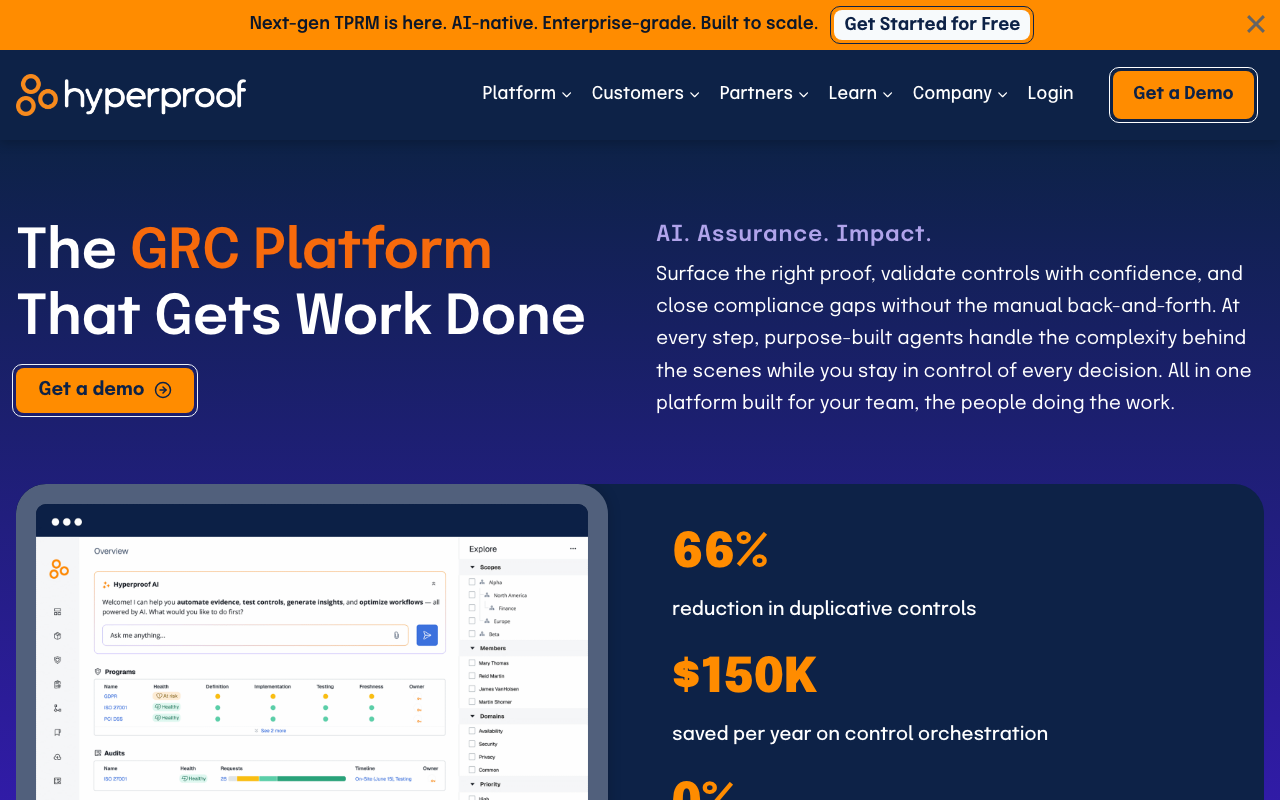
Hyperproof is the platform for compliance teams managing PCI DSS alongside five other frameworks simultaneously. With 140+ pre-built frameworks and 200+ integrations, it handles genuinely complex multi-framework environments that would overwhelm more opinionated platforms. The customer list, Reddit, Nutanix, Fortinet, Appian, and Thales, signals the mid-market and enterprise positioning clearly. Read our Hyperproof review for a detailed breakdown of its GRC workflow.
The FedRAMP Moderate authorized environment (Hyperproof Gov) is relevant if you’re working with government customers. For PCI DSS specifically, the control mapping across 140+ frameworks means evidence collected for one framework often satisfies requirements in others automatically. The trade-off: the platform is designed for dedicated compliance teams, not for a founder doing their first audit.
Key features:
- 140+ pre-built frameworks with automatic cross-framework control mapping
- 200+ integrations including AWS, Okta, CrowdStrike, Jira, Datadog, and Cloudflare
- AI-powered compliance automation and control orchestration
- FedRAMP Moderate authorized environment for government use cases
- Third-party vendor risk management and audit evidence management
Pricing: Contact for pricing
Best for: Mid-market and enterprise compliance teams managing PCI DSS alongside multiple other frameworks in complex environments.
Pros of Hyperproof
- 140+ pre-built frameworks is the broadest coverage on this list
- Cross-framework control mapping reduces redundant evidence collection at scale
- FedRAMP authorized for government-adjacent use cases
- Strong enterprise customer base with proven scalability
Cons of Hyperproof
- Designed for dedicated compliance teams, not solo founders or small startups
- Steeper learning curve than more opinionated platforms
- Less optimized for speed-to-compliance on a single framework
11. Strike Graph
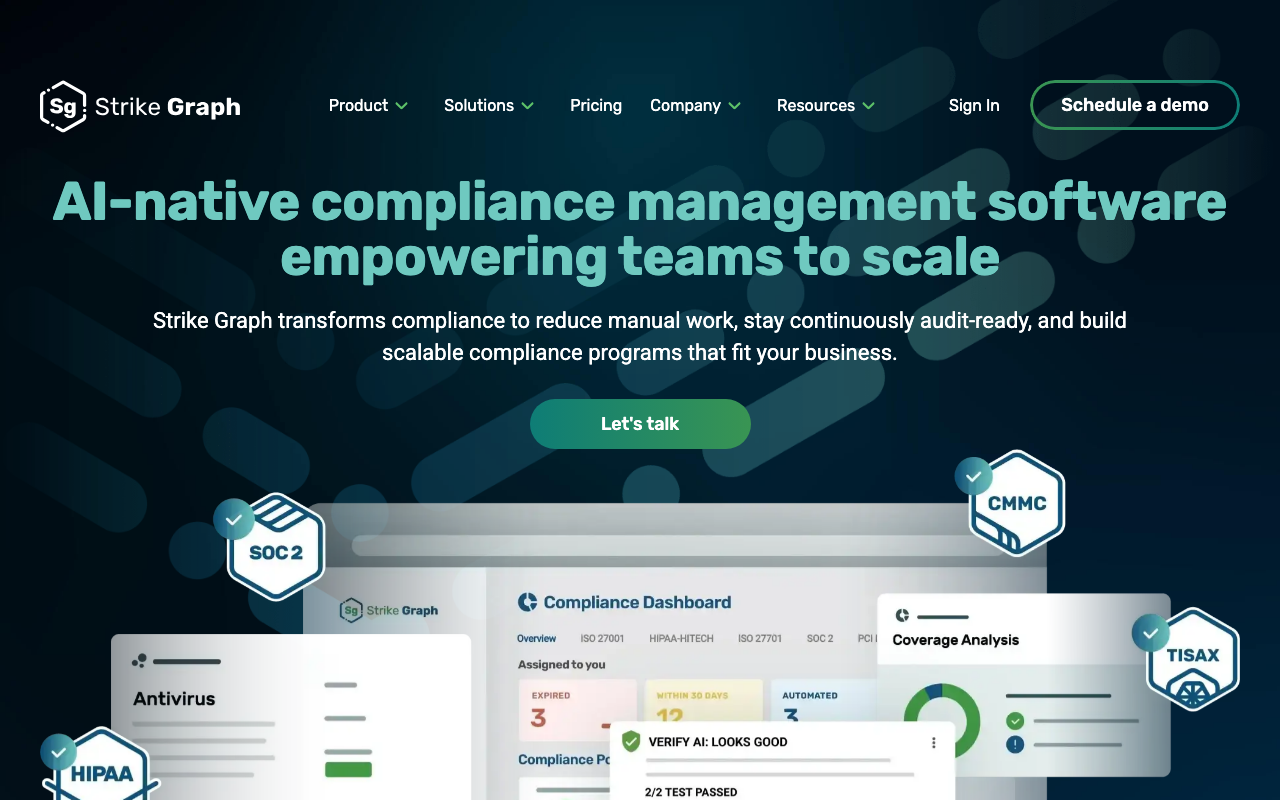
Strike Graph takes a different approach to pricing: instead of software and audit as separate line items, it bundles them into one predictable cost. The audit-anchored model includes penetration testing and vulnerability scanning, which PCI DSS requires and which most platforms make you source separately. For a startup that wants to avoid the coordination cost of managing software vendors, auditors, and pen testers separately, this is genuinely appealing. Our Strike Graph review covers the pricing model in detail.
The AI Security Assistant provides compliance guidance throughout the process, and the platform supports 14+ frameworks including PCI DSS, SOC 2, ISO 27001, and CMMC. The trade-off: the integration ecosystem is thinner than Vanta or Sprinto, and the platform has less market presence, which can mean less auditor familiarity.
Key features:
- Bundled penetration testing and vulnerability scanning (included in packages)
- AI Security Assistant for compliance guidance throughout the process
- Real-time compliance tracking and reporting dashboards
- SBOM management and System Security Plan (SSP) tracking
- Plan of Action and Milestones (POA&M) management
- Vendor risk assessment
Pricing: Contact for pricing (audit-anchored, bundled model)
Best for: SMBs that want compliance software, audit readiness, and penetration testing bundled into one predictable price rather than managed separately.
Pros of Strike Graph
- Bundled pentesting is a real differentiator: PCI DSS requires it and most platforms don’t include it
- Predictable pricing model avoids the coordination cost of multiple vendors
- AI guidance throughout the compliance process
- 14+ frameworks including CMMC, TISAX, and DORA
Cons of Strike Graph
- Thinner integration ecosystem than Vanta, Drata, or Sprinto
- Less auditor familiarity due to smaller market presence
- Limited public information on review counts and ratings
How to choose PCI compliance management software: a practical checklist
The list above covers 11 platforms. Here’s how to narrow it to one.
Know your merchant level first
PCI DSS has four merchant levels based on annual transaction volume. Your level determines what compliance looks like:
- Level 1 (6M+ card transactions/year): requires an annual Report on Compliance (ROC) from a Qualified Security Assessor (QSA) and quarterly ASV scans. Look at Thoropass, SecurityMetrics, or VikingCloud.
- Level 2 (1M–6M transactions): annual self-assessment with an ISA or QSA, plus quarterly ASV scans. Most GRC platforms handle this well.
- Level 3 and 4 (fewer than 1M transactions): SAQ self-assessment plus quarterly ASV scans. Sprinto, ComplyJet, Secureframe, and Vanta all work here.
Most SaaS startups processing payments through Stripe or a similar processor fall into Level 3 or 4. If you’re not sure, ask your acquiring bank.
GRC platform vs. PCI-specialist tool
GRC platforms like Vanta, Drata, Sprinto, and ComplyJet are the right call if you’re pursuing SOC 2 or ISO 27001 alongside PCI DSS. The control overlap is significant, and having one platform manage all of it avoids duplicated evidence collection. If you ever read our ISO 27001 vs SOC 2 breakdown, you’ll see how much the control sets overlap with PCI DSS too.
PCI-specialist tools like SecurityMetrics and VikingCloud are the right call if PCI DSS is your only compliance need, or if you’re a payment processor managing compliance programs for many merchants. Many companies use both: a GRC platform for continuous evidence management and a specialist tool for ASV scanning.
Automation depth and pci compliance checker capabilities
The practical question is: how many of your cloud services, identity providers, and dev tools does the platform integrate with natively? Integration depth determines how much evidence you can automate versus manually upload.
Check the integration counts: Vanta (400+), ComplyJet (350+), Sprinto (300+), Drata and Hyperproof (200+). If your stack is AWS-heavy with Okta, GitHub, and Jira, all the top platforms handle this well. If you’re running a more unusual stack, verify integrations before committing.
Pricing model matters at scale
Per-seat pricing (the default for most tools) means your compliance bill scales with headcount. For a startup growing from 20 to 60 people in a year, that’s a meaningful cost increase for the same compliance coverage.
Flat pricing like ComplyJet’s means costs stay predictable regardless of how fast you hire. Bundled audit pricing like Thoropass and Strike Graph offer eliminates the separate auditor cost, which can look expensive upfront but is often cheaper than managing software plus QSA separately.
Startup, scaling, or enterprise: which fits you
- Startup (under 50 employees, first PCI certification): Sprinto, ComplyJet, or Secureframe. Speed, guidance, and cost predictability matter most.
- Scaling (50–200 employees, pursuing multiple frameworks): Vanta, Drata, Thoropass, or Scrut. Automation depth and cross-framework mapping pay off at this stage.
- Enterprise or complex environments: Hyperproof, Thoropass, or VikingCloud. Configurability, FedRAMP support, and large-scale QSA capacity are the differentiators.
If you’re an early-stage startup pursuing PCI DSS (or combining it with SOC 2 or ISO 27001 for the first time), ComplyJet is built for exactly this: flat pricing, 350+ integrations, and a team that guides you through the process from scoping to certification.
Frequently asked questions about PCI compliance software
What is PCI compliance software?
PCI compliance software helps businesses meet PCI DSS requirements by automating evidence collection, monitoring security controls, running or integrating ASV vulnerability scans, and guiding teams through Self-Assessment Questionnaires. It replaces the spreadsheet-and-screenshot approach most teams start with, which breaks down quickly when audit time arrives.
What is PCI DSS and who needs to comply?
PCI DSS (Payment Card Industry Data Security Standard) is a set of security requirements maintained by the PCI Security Standards Council. Any business that processes, stores, or transmits cardholder data is in scope. That includes SaaS companies accepting credit card payments directly, even if you use Stripe or another processor as the intermediary. Your processor may absorb some requirements, but it does not make you fully exempt.
How much does PCI compliance cost?
It depends heavily on your merchant level. Level 4 SMBs using a SAQ and quarterly ASV scans can pay as little as $300–$1,500/yr for the scanning component, plus the cost of a GRC platform ($5,000–$30,000+/yr depending on the tool). Level 1 merchants requiring a full QSA Report on Compliance can face total costs of $50,000–$200,000+ annually, including audit fees, remediation work, and ongoing software. For most startups, the realistic all-in cost lands between $10,000 and $40,000 in year one.
How do I achieve PCI compliance?
The process has six steps. First, determine your merchant level and which SAQ type applies to your environment. Second, scope your cardholder data environment (CDE): everything that stores, processes, or transmits card data, plus anything that could affect its security.
Third, implement the required controls: network segmentation, access controls, encryption at rest and in transit, logging, and monitoring. Fourth, run ASV-certified quarterly external vulnerability scans. Fifth, complete your SAQ or engage a QSA for a Report on Compliance if your level requires it. Sixth, maintain continuous monitoring year-round so you stay compliant between assessments, not just at audit time.
Can I use a GRC platform instead of a dedicated PCI tool?
Yes, for most startups. GRC platforms like Vanta, ComplyJet, and Sprinto include pre-built PCI DSS control libraries and handle the evidence collection and continuous monitoring. You may still need to integrate a separate ASV scanning vendor for quarterly scans. Some platforms include ASV scanning or direct integrations with certified scanners; others require you to source it separately. Check this before committing to a platform.
Final thoughts
The right PCI compliance software depends on where you sit. If you’re a startup handling card data and pursuing PCI DSS for the first time, probably alongside SOC 2, a GRC platform with strong startup support is the smart call. If you’re a payment processor managing compliance across thousands of merchant relationships, that’s a different problem requiring a different tool.
PCI DSS compliance isn’t something you do once and forget. The goal isn’t just passing the audit; it’s building the controls that protect your customers’ payment data year-round. The best software accelerates that process. The wrong software just adds to the spreadsheet count.
If you’re an early-stage company looking for a starting point, ComplyJet is worth a look: flat pricing, strong integrations, and a team that drives the outcome, not just the tooling.