.svg)

You’ve decided you need ISO 9001. Maybe a potential customer asked for it, maybe your operations team is drowning in spreadsheets, or maybe you’re pursuing it alongside SOC 2 or ISO 27001 as part of a broader compliance program. Either way, you’re now looking at software, and the options split into two completely different worlds.
On one side: modern compliance automation platforms that handle ISO 9001 as part of a multi-framework stack. On the other: purpose-built quality management systems designed from the ground up for CAPA workflows, document control, and supplier audits. Both are legitimate. Picking the wrong category is the mistake worth avoiding.
I’ve reviewed 11 ISO 9001 software tools across both categories, looking at real pricing, honest review data, and what each tool is actually built for. Whether you’re evaluating ISO 9001 QMS software for a manufacturing operation or ISO 9001 compliance software for a SaaS company, this is what I found.
Two types of ISO 9001 compliance software — and how to know which one you need
Key insight
The category splits cleanly in two. Knowing which side you’re on before you start demoing will save you three weeks of w
The category splits cleanly in two. Knowing which side you’re on before you start demoing will save you three weeks of wasted calls.
Compliance automation platforms (Vanta, Thoropass, ComplyJet, Secureframe) are built for tech and SaaS companies. They handle ISO 9001 as one framework among many, alongside SOC 2, ISO 27001, HIPAA, and others. If you’re a software company that also wants ISO 9001, this is your lane. These tools automate evidence collection, map controls across standards, and are designed to be run by a compliance lead or an engineering team without a dedicated quality manager.
Traditional QMS software (QT9, ETQ Reliance, MasterControl, Qualio, ComplianceQuest, Ideagen, SimplerQMS) is built for manufacturing, life sciences, aerospace, and regulated industries where quality management is the core of the business. CAPA workflows, document control, nonconformance tracking, and supplier quality are first-class features. If ISO 9001 is your primary certification and your team runs audit cycles and corrective action processes as part of daily operations, these tools are built for you.
Ask yourself three questions before shortlisting:
- Is ISO 9001 my only certification, or do I also need SOC 2 or ISO 27001?
- Is my team primarily technical (engineers, developers) or quality-focused (quality managers, regulatory affairs)?
- Am I in manufacturing, life sciences, or aerospace, or am I a SaaS or services company?
If you answered “multiple certifications,” “technical team,” and “SaaS or services,” start at Vanta and work down through ComplianceQuest. If you answered “ISO 9001 only,” “quality-focused,” and “manufacturing or regulated,” start at QT9 QMS.
How we evaluated the 11 best ISO 9001 software tools
I only included ISO 9001 software tools that explicitly name ISO 9001 on their website or in their framework documentation. No “probably supports it through custom frameworks.”
Criteria I applied:
- Explicit ISO 9001 support: named on the product page or framework list, not just mentioned in a blog post
- Review volume and rating: G2 and Capterra scores, with weight given to review count (a 4.9 from 12 reviews means less than a 4.6 from 2,352)
- Pricing transparency: tools with public pricing ranked higher on accessibility; contact-only pricing is noted clearly
- Fit for purpose: compliance automation tools assessed on multi-framework depth; QMS tools on module completeness and workflow configurability
- Implementation ease: how long it actually takes to go live, and what support looks like during setup
Quick comparison: best ISO 9001 QMS software in 2026
| Tool | Best for | Pricing | Standout feature |
|---|---|---|---|
| Vanta | SaaS startups and mid-market | Contact for pricing | 400+ integrations, 35+ frameworks |
| Thoropass | Startups wanting built-in audit support | Contact for pricing | Auditors embedded in the platform |
| ComplyJet | Early-stage startups, flat pricing | From $5,000/year | Flat per-company rate, not per-seat |
| Secureframe | SMBs with dedicated ISO 9001 workflows | Contact for pricing | Dedicated ISO 9001 page and templates |
| QT9 QMS | SMB manufacturers and regulated industries | From $10,000/year | 4.9/5 rating, 25+ modules included |
| ETQ Reliance | Enterprise manufacturers | Contact for pricing | 40+ QMS apps, drag-and-drop workflows |
| MasterControl | Pharma, life sciences, regulated industries | From $25,000/year | FDA and CDC use it; Validation on Demand |
| Qualio | Life sciences SMBs | From $12,000/year + $3,000/user/year | Built for GxP plus ISO 9001 |
| ComplianceQuest | Salesforce shops and enterprise QMS | From $30/user/month | Native Salesforce platform QMS |
| Ideagen Q-Pulse | European enterprise and regulated sectors | From $25,000/year | 11,400+ customers, aviation and banking focus |
| SimplerQMS | Small life sciences teams | From $1,200/month | Pre-validated, no extra fees for support |
Free Demo
Get compliant faster with ComplyJet.
Flat pricing, 350+ integrations, and a team that guides you to certification.
The 11 best ISO 9001 software tools in 2026
1. Vanta

Vanta is the category default in compliance automation. If someone at your company says “let’s get compliant,” Vanta is usually the first name in the room. It serves 16,000+ customers, has a 4.6/5 rating across 2,352 reviews, and supports 35+ frameworks including ISO 9001 as an available framework.
For ISO 9001 specifically, Vanta handles it as an add-on to its primary compliance stack. If you’re a SaaS company that needs ISO 9001 alongside SOC 2 or ISO 27001, that model works well. You automate evidence collection, map controls across frameworks, and get a Trust Center to show prospects. The 400+ integration library covers practically every tool your engineering team already uses.
Where Vanta earns its reputation is breadth: AI-powered questionnaire automation, risk management, vendor risk, personnel management, and continuous monitoring in one place. Where it earns its criticism is pricing. Contracts are quote-based, reportedly steep for early-stage companies, and some users flag two-year lock-ins as a friction point. If you want to see how Vanta’s pricing stacks up in detail, I’ve covered it in our Vanta pricing guide.
ISO 9001 is not Vanta’s primary focus. If you need it as part of a multi-framework program and you have the budget, Vanta delivers. If ISO 9001 is your only certification need, it may be more platform than you need.
“
Vanta helped us automate several time-consuming security compliance processes on our journey to achieving SOC2 compliance. Its intuitive UI and checklist-driven workflow made setup much faster and helped ensure we were prioritizing the right things.
★★★★★Verified User· Small Business
Via G2 ↗Key features:
- Automated compliance monitoring and evidence collection across 35+ frameworks
- AI-powered Vanta Agent for questionnaire drafting and policy creation
- 400+ native integrations
- Third-party vendor risk management
- Trust Center for customer-facing security posture
- Personnel and access control management
Pros of Vanta
- Largest integration library in compliance automation
- Strong brand credibility with 16,000+ customers including Ramp, GitHub, and Atlassian
- Broad framework coverage means you can expand beyond ISO 9001 later without switching tools
- AI questionnaire automation is genuinely time-saving
Cons of Vanta
- Pricing is opaque and reported to scale steeply as you add frameworks or users
- Some users report difficult contract terms and two-year lock-ins
- ISO 9001 is an additional framework, not a primary focus
- Automation depth varies by integration, per some user reviews
Pricing: Contact for pricing (Essentials, Plus, Professional, Enterprise tiers) Best for: SaaS startups and mid-market companies that want ISO 9001 as part of a broader multi-framework compliance program
2. Thoropass
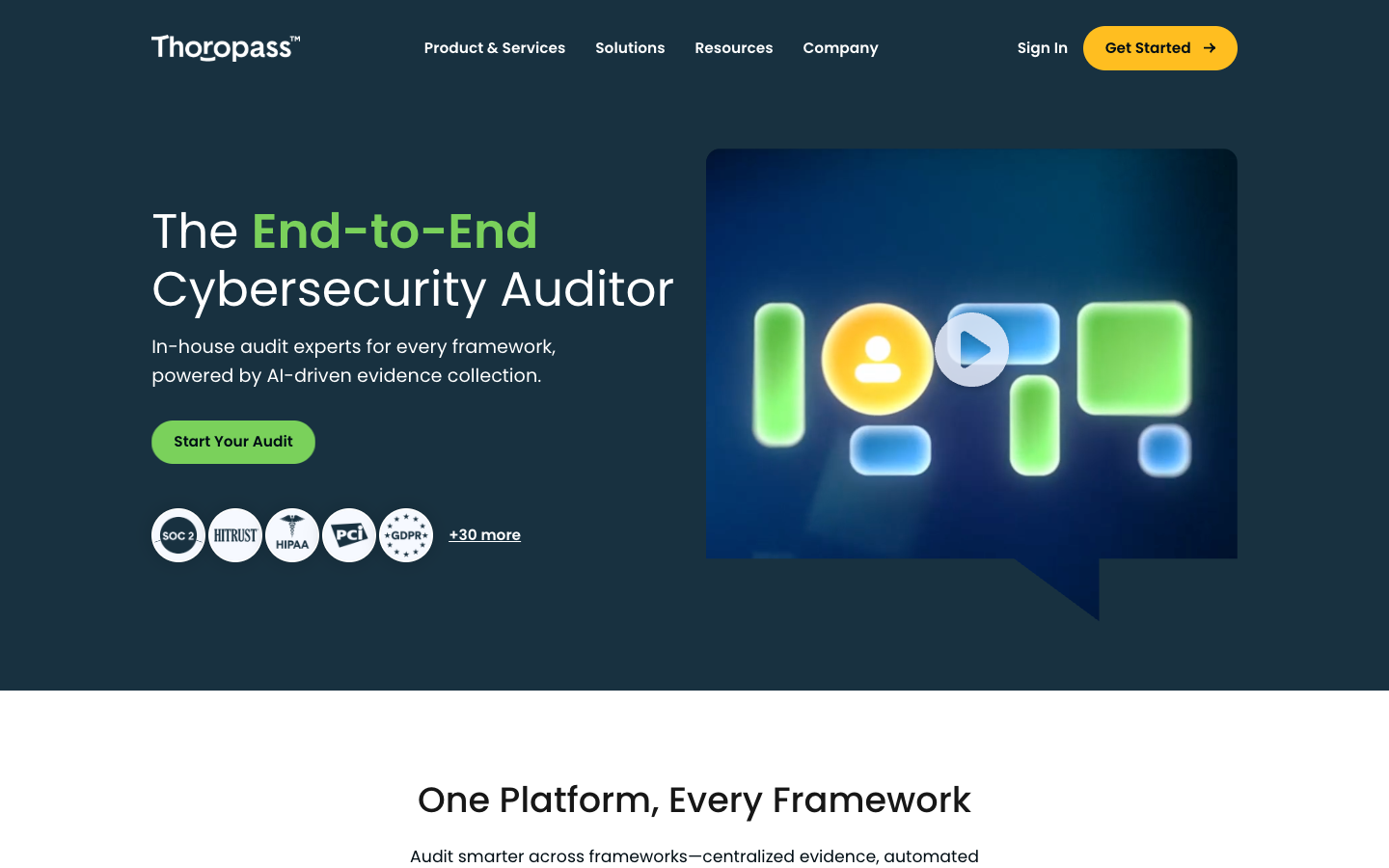
Thoropass takes a different approach to the compliance platform category: it bundles licensed auditors into the platform, so you’re not buying software and then separately finding an audit firm. The platform handles compliance automation, evidence collection, and risk management. The audit itself is run by Thoropass’s in-house team.
ISO 9001 is explicitly supported, added alongside CMMC Level 2, NIS 2, and ISO 42001 as newer framework additions. With a 4.7/5 rating across 568 reviews, Thoropass user satisfaction is strong, and reviews consistently cite the responsiveness of their support and audit teams as the standout.
The embedded auditor model is genuinely useful for teams pursuing compliance for the first time. You’re not coordinating between a SaaS tool and a separate audit firm. One vendor handles the whole lifecycle.
The tradeoff: pricing is entirely quote-based, and Thoropass tends to appeal to infosec-oriented compliance programs rather than traditional quality management. If you need ISO 9001 because a customer asked for it alongside SOC 2 or ISO 27001, Thoropass is a strong fit. If ISO 9001 is your primary certification and you need deep QMS workflows like CAPA or document lifecycle management, the traditional QMS tools later in this list are more purpose-built.
“
The platform's excellent customer support and expert guidance stand out — the responsive and practical support team makes typically overwhelming compliance work more manageable. Setup was quick and straightforward compared to other tools we evaluated.
★★★★★Verified User· Small Business
Via G2 ↗Key features:
- Compliance automation with real-time monitoring
- In-house licensed auditors conducting assessments (no separate audit firm needed)
- CREST-accredited penetration testing
- AI-powered control mapping and gap identification
- Access review automation
- ISO 9001 framework support alongside 30+ other standards
Pros of Thoropass
- One vendor for software and audit, no coordination overhead
- ISO 9001 is natively supported, not just an add-on
- 4.7/5 across 568 reviews with consistently strong support ratings
- Supports newer frameworks like CMMC Level 2 and ISO 42001
Cons of Thoropass
- Pricing is entirely quote-based, requires sales engagement
- Better suited for infosec compliance than deep manufacturing QMS workflows
- Very limited Capterra presence limits independent review signal
- Notable customer details not publicly listed
Pricing: Contact for pricing (audit services bundled with platform) Best for: SaaS companies that want compliance automation and audit services from a single vendor, including ISO 9001
3. ComplyJet
ComplyJet is built for early-stage SaaS startups pursuing compliance for the first time. ISO 9001 is natively supported, alongside SOC 2, ISO 27001, HIPAA, GDPR, PCI DSS, and 20+ other frameworks, all in a single platform.
The differentiator is the pricing model and the support approach. Pricing is flat per company, not per seat: $5,000/year for a single framework, $8,000/year for two. That means your cost stays predictable whether you’re at 10 people or 50. It’s a meaningful distinction for a growing startup where per-seat tools quietly compound as headcount rises.
On support: ComplyJet’s team guides you through the compliance process end to end. That means the work gets done, not just the software gets configured. If you’re pursuing ISO 9001 alongside ISO 27001 and want both handled without managing two tools, two audit firms, and two sets of evidence collections, that’s exactly what ComplyJet is built for. The 350+ integration library covers the standard SaaS stack, and AI-assisted policy drafting handles the documentation-heavy parts.
ComplyJet is not the right fit for traditional manufacturers or life sciences companies that need deep QMS workflows like CAPA tracking or supplier audit management. It’s built for tech companies, and it’s good at that specific problem.
Key features:
- Native ISO 9001 support alongside 25+ frameworks
- 350+ integrations
- AI-assisted policy drafting
- Automated evidence collection and continuous monitoring
- Trust Center for sharing compliance posture with customers
- Flat per-company pricing (not per-seat)
Pros of ComplyJet
- Flat pricing stays predictable as the team grows
- 350+ integrations, covering the full SaaS stack
- A team that guides you through the process, not just the software
- Multi-framework support means ISO 9001 + SOC 2 or ISO 27001 in one program
Cons of ComplyJet
- Not built for manufacturing or regulated industry QMS workflows
- Newer brand with less third-party review volume than Vanta or Drata
“
The platform makes it simple: it splits the work into four buckets with clear, bite-sized tasks we could fit into our routine. No sales gauntlet or upselling. The clearest, most sensible option.
Artur G· CTO · Symmetre
Via complyjet.com ↗
Pricing: From $5,000/year (single framework); $8,000/year (two frameworks). Flat, not per-seat. Best for: Early-stage SaaS startups pursuing ISO 9001 alongside SOC 2 or ISO 27001 for the first time
4. Secureframe
Secureframe serves 6,000+ customers and is one of the few compliance automation platforms with a dedicated ISO 9001 page, policy templates, and a QMS manual template built in. When they added ISO 9001 support, they built it out properly: control mapping to framework requirements, policy management templates, and Risk Management tooling aligned to ISO 9001 requirements.
Secureframe’s ratings are strong across both platforms: 4.7/5 across 795 reviews, with a 4.8/5 on Capterra across 57 reviews. The Fundamentals tier covers infrastructure monitoring, evidence collection, personnel management, risk management, policy management, and Trust Center. The Complete tier adds advanced third-party risk, access reviews, and questionnaire automation.
The main limitation noted in user reviews is pricing. Independent sources estimate starting costs around $7,000/year, which is not cheap for a micro-startup. The integration library is smaller than Vanta’s. But if you specifically want ISO 9001 structured automation, not just “it’s in our framework list,” Secureframe has done the work to map it properly.
“
Secureframe provides a smooth onboarding experience with support teams that are responsive to user needs. The automation features and integration library make continuous compliance much less painful than doing it manually.
★★★★★Verified User· Small Business
Via G2 ↗Key features:
- Automated evidence collection and continuous monitoring
- Dedicated ISO 9001 framework automation with policy templates
- AI-powered compliance task automation
- Controls management mapped across multiple frameworks
- Risk and vendor management
- Questionnaire automation (Complete tier)
Pros of Secureframe
- 4.8/5 on Capterra — highest rating among compliance automation platforms in this list
- ISO 9001 built out with dedicated templates and control mapping, not just listed as a supported framework
- Controls overlap between ISO 9001 and ISO 27001 reduces duplication work
- Strong customer success responsiveness cited in reviews
Cons of Secureframe
- Pricing reported at ~$7,000+/year, not cheap for early-stage companies
- Smaller integration library compared to Vanta
- AI features still developing per some user feedback
- External auditor coordination still required during the audit process
Pricing: Contact for pricing (Fundamentals, Complete, Defense tiers) Best for: SMBs that want structured ISO 9001 compliance automation with proper control mapping and templates out of the box
5. QT9 QMS
QT9 QMS is the highest-rated pure quality management system in this list: 4.9/5 across 123 reviews on G2, and 4.8/5 across 114 reviews on Capterra. Bootstrapped since 2005, it has built a reputation in regulated manufacturing, aerospace, medical devices, and food and beverage.
Where it stands apart from the compliance automation platforms above is depth. QT9 includes 25+ integrated modules out of the box: document control, CAPA, audit management, employee training, risk management, supplier quality, inspection management, and real-time dashboards. No add-on fees for the module library. It also supports cloud-based or on-premise deployment, which matters for organizations with specific data residency requirements.
The starting price is $10,000/year on a concurrent license model (concurrent users, not named users), which makes it more cost-effective for teams where not everyone uses the system simultaneously. Customer support consistently scores near-perfect in reviews, which is unusual for a QMS tool at this price point.
QT9 is not built for SaaS companies. It does not handle SOC 2 or ISO 27001. If ISO 9001 is your primary certification and your team runs quality management workflows daily, this is the strongest SMB-to-mid-market QMS in the list.
“
Implementation of the Document Control Module was a game-changer for our organization as we were still operating under a paper-based system. Document creation and changes are so much more efficient now that we are utilizing QT9 QMS.
★★★★★Clayton F.· Medical Devices (51–200)
Via Capterra ↗Key features:
- 25+ integrated QMS modules with no add-on fees
- Document control with version management and approvals
- CAPA (Corrective and Preventive Actions) management
- Audit management
- Employee training management and tracking
- Supplier, customer, and employee web portals
- Cloud-based or on-premise deployment
Pros of QT9 QMS
- 4.9/5 rating, highest user satisfaction among all QMS tools in this list
- 25+ modules included with no add-on fees
- Customer support rated 9.5/10 in reviews, consistently cited as exceptional
- Transparent starting price with concurrent license model
Cons of QT9 QMS
- Customer document portal notifications only go to internal staff, requiring manual alerts for external customers
- Mobile accessibility could be improved per user feedback
- Report customization has some limits for advanced use cases
- Not built for SaaS or tech companies, and does not support security compliance frameworks
Pricing: From $10,000/year (concurrent license model, custom quote required) Best for: Small to mid-sized manufacturers, aerospace, medical device, and food and beverage companies pursuing ISO 9001, AS9100, or FDA compliance
6. ETQ Reliance
ETQ Reliance, now rebranded as Octave Reliance following Hexagon’s $1.2B acquisition in 2022, is one of the most established enterprise QMS platforms in the market. Founded in 1992, it serves 600+ global customers across pharmaceuticals, electronics, food and beverage, and manufacturing.
The headline feature is breadth: 40+ ready-to-use QMS applications, all configurable through drag-and-drop workflow design and point-and-click form builders, without custom code. That flexibility matters for enterprise organizations with complex, multi-site quality programs where no two workflows are identical. The cloud-native architecture supports unlimited sites, languages, and user roles.
At 4.3/5 across 605 reviews, ETQ Reliance scores lower than QT9 on satisfaction. User feedback highlights the learning curve and some reports of slow support responsiveness. The pricing structure is also more complex than most: yearly subscriptions, support costs, concurrent user licensing, add-on modules, and consulting hours are all separate line items. Not ideal for small teams.
If you’re running a global quality program with multi-site coordination and need a configurable, enterprise-grade QMS that supports ISO 9001, IATF 16949, and ISO 13485, ETQ Reliance (Octave Reliance) has the depth. For smaller teams, QT9 is the better starting point.
“
I have reviewed and used many QMS software programs and ETQ Reliance is very flexible and easy to customize. Many of the out-of-the-box modules are very well designed and integrated, which helps create a holistic quality experience that complies with ISO 9001 requirements.
★★★★☆John R.· Electrical/Electronic Manufacturing
Via Capterra ↗Key features:
- 40+ ready-to-use QMS applications
- Document control, CAPA, audit, training, and supplier quality management
- Drag-and-drop workflow design (no custom code required)
- Point-and-click form builders
- Cloud-native architecture with unlimited sites and languages
- Configurable for complex multi-site programs
Pros of ETQ Reliance
- 40+ out-of-the-box applications, broadest module set in this list
- Highly configurable without custom development
- Cloud-native supports unlimited sites and global teams
- 30+ years of enterprise QMS expertise
Cons of ETQ Reliance
- Complex pricing structure with multiple cost components
- Some users report poor customer support responsiveness
- Steeper learning curve and less intuitive UI than QT9 or Qualio
- Lower satisfaction rating (4.3/5) than peers in the traditional QMS category
Pricing: Contact for pricing (enterprise, multi-component pricing structure) Best for: Mid-market to enterprise manufacturers with complex multi-site ISO 9001 programs needing highly configurable QMS without custom code
7. MasterControl
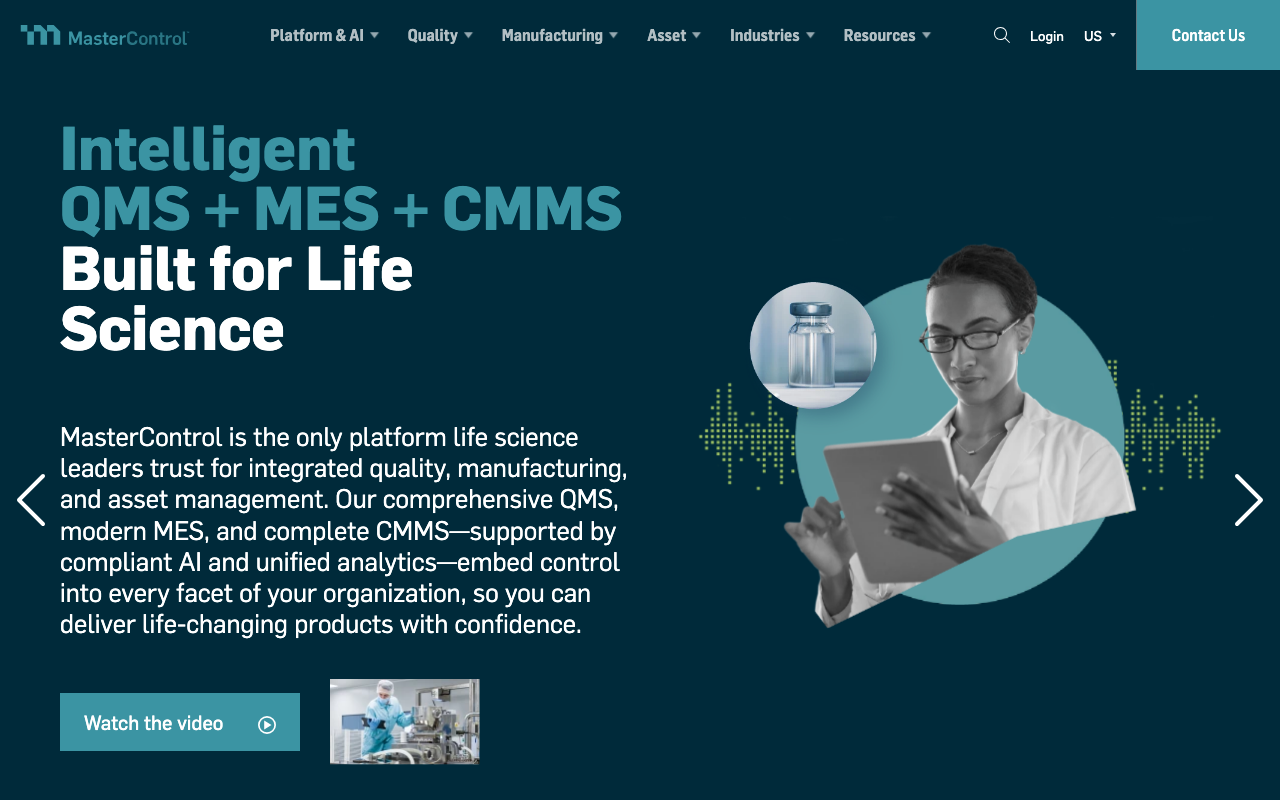
MasterControl has a specific reputation: it is the number one QMS in life sciences. Founded in 1993, used by 1,250+ companies worldwide, including the FDA and CDC. If your environment is pharmaceutical, biotech, or medical devices, MasterControl is a name you already know.
The core strength is document control and training management in heavily regulated environments. The patented Validation on Demand (VoD) feature reduces software validation time significantly, which matters in FDA-regulated contexts where validation is a formal, documented process. Audit trails, role-based access, and version archiving are built for the scrutiny of an FDA inspection or ISO 9001 audit.
At $25,000/year starting (with enterprise implementations reported above $50,000 per month), MasterControl is not a small-team tool. The UI is functional but not modern, and the learning curve is real: most reviews cite the need for extensive training before teams are productive. That said, for organizations where the FDA or a notified body is looking at your QMS documentation, MasterControl’s track record is hard to argue with.
It is over-engineered for a general ISO 9001 implementation at a services company or manufacturer without FDA overlap. For life sciences specifically, it earns its place.
“
As a Quality Director in the medical devices industry, MasterControl's platform has revolutionized how we manage our extensive library of SOPs, work instructions, and batch records. It's more than a storage solution — it's a dynamic system that integrates document workflows into our broader QMS, streamlining operations and bolstering audit readiness.
★★★★★Quality Director· Medical Devices (201–500)
Via Capterra ↗Key features:
- Role-based document control with full audit trails and version archiving
- Automated training management with training matrix
- CAPA management
- Patented Validation on Demand (VoD) for rapid software validation
- Audit and inspection management
- Change management and risk management
Pros of MasterControl
- 30+ years of life sciences QMS experience, deep domain expertise
- FDA and CDC use it, providing strong regulatory credibility
- Validation on Demand reduces validation time significantly
- Active user community and excellent customer support
Cons of MasterControl
- Starts at $25,000/year, enterprise implementations can exceed $50,000/month
- Non-intuitive UI with a steep learning curve requiring extensive training
- Complex workflow management can be difficult to maintain
- Overkill for general ISO 9001 implementations outside life sciences
Pricing: From $25,000/year (enterprise, quote-based) Best for: Pharmaceutical, biotech, and medical device companies requiring FDA 21 CFR Part 11 compliance alongside ISO 9001 or ISO 13485
8. Qualio
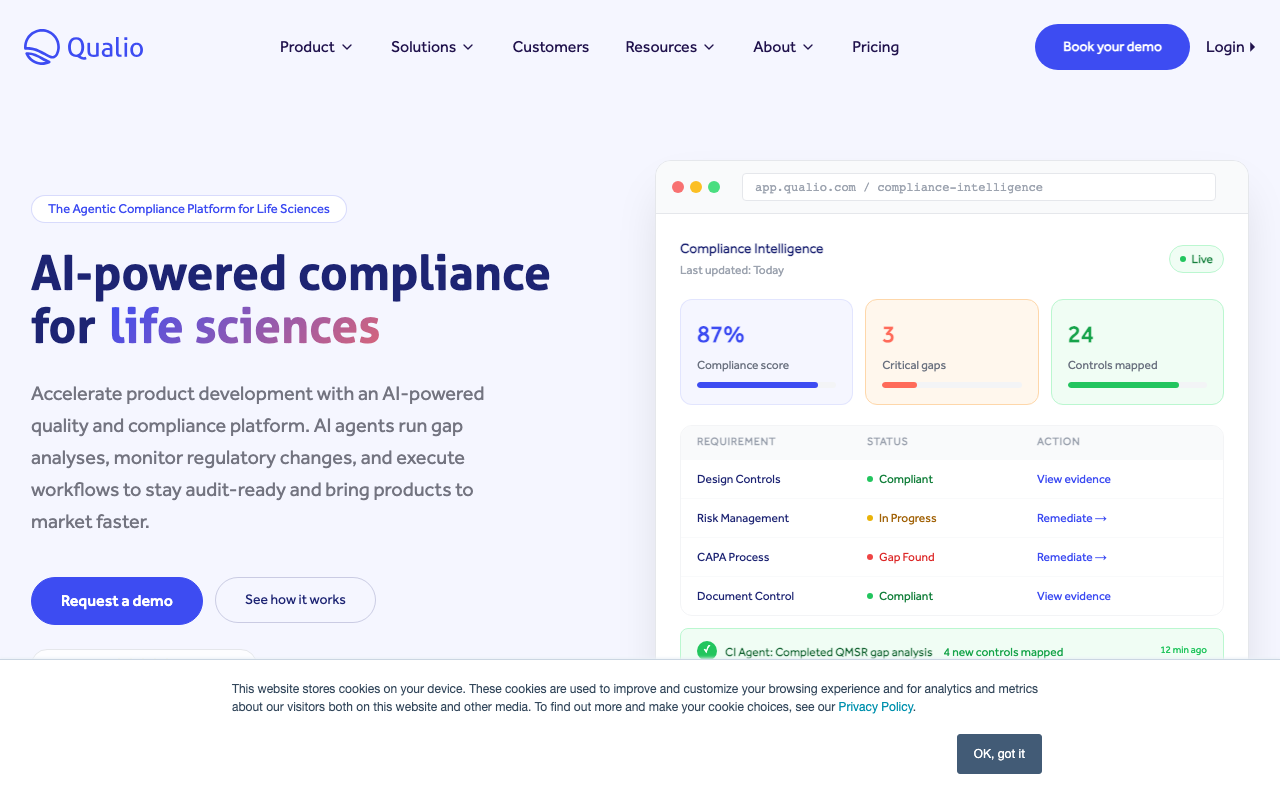
Qualio is a cloud-based electronic QMS built specifically for regulated life sciences: biotech, medtech, pharma, and diagnostics. Founded in 2012 and serving 500+ companies across 80 countries, Qualio bridges ISO 9001 and GxP requirements in a modern interface that smaller teams can actually use without a three-month implementation project.
The difference between Qualio and MasterControl is the user experience and the target team size. Qualio’s UI is rated as intuitive and fast to learn. Reviews from quality managers moving from legacy systems consistently note that training new staff is much easier than with older QMS tools. At 4.4/5 across 682 reviews with a 4.6/5 on Capterra, user satisfaction is strong.
The pricing model is per-user: starting at $12,000/year plus $3,000 per user annually. That keeps costs low for tiny teams but compounds quickly at 10+ users. For a life sciences startup with 5 quality team members, Qualio is accessible. At 20 users, you’re approaching MasterControl pricing territory.
If your company is in life sciences and ISO 9001 is one of several standards you need (including GxP or ISO 13485), Qualio handles that overlap well and does it in an interface your team will actually use daily.
“
Fantastic — coming from older clunky more expensive QMS at other pharma companies, Qualio was a breath of fresh air. The user interface is very good and easy to train new people on.
★★★★★Verified User· Pharmaceutical (11–50)
Via Capterra ↗Key features:
- Document control with in-app editor (SOPs, technical drawings, batch records)
- Training management
- CAPA management
- Audit management
- Change and risk management
- AI-driven change summary generation
- Supplier and complaints management
Pros of Qualio
- Modern, intuitive UI with a low learning curve compared to legacy QMS tools
- Built for life sciences with ISO 9001, GxP, and ISO 13485 overlap handled natively
- 500+ customers across 80 countries, strong global adoption
- AI-powered change summaries reduce review time
Cons of Qualio
- Per-user pricing ($3,000/user/year) gets expensive quickly as teams grow
- Some users report limitations in change control history
- More expensive than general-purpose QMS tools for equivalent functionality
- Smaller teams may find some features limited as compliance needs mature
Pricing: From $12,000/year + $3,000/user/year Best for: Life sciences startups and SMBs (biotech, medtech, pharma) pursuing ISO 9001 and GxP or ISO 13485 compliance together
9. ComplianceQuest
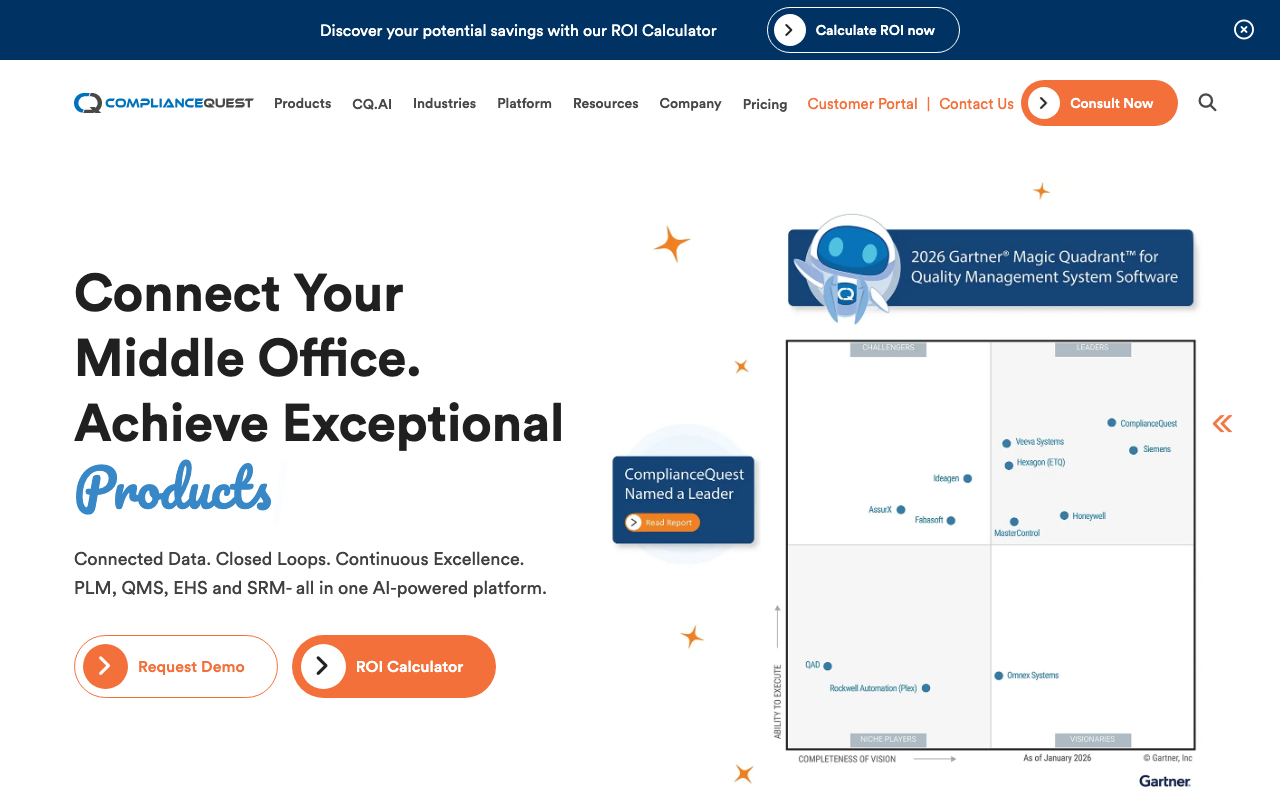
ComplianceQuest is built natively on Salesforce. If your organization already runs Salesforce, that is either a strong reason to look at it or a reason to look elsewhere, depending on how much you want your QMS tied to your CRM infrastructure.
The native Salesforce build means your quality data lives in the same platform as your customer data, sales pipeline, and service records. For manufacturing and life sciences companies already deeply invested in Salesforce, that eliminates a separate QMS system and its integration overhead. ComplianceQuest covers document control, CAPA, audits, risk, supplier quality, inspections, and change management, all within the Salesforce environment.
At $30/user/month, the pricing is among the most transparent in the traditional QMS category. The catch is that Salesforce admin experience is a real prerequisite. Users without Salesforce familiarity report a steeper learning curve than the pricing implies. Some components are locked as managed packages, limiting deep customization.
With 4.6/5 across 109 Capterra reviews, user satisfaction is solid. G2 reviews (79 total) are thinner, so Capterra is the more reliable signal here.
“
As a Life-Sciences manufacturing services startup, our company decided early on that a flexible, agile QMS was a must. Only ComplianceQuest met our needs.
★★★★★Verified User· Life Sciences Manufacturing (51–200)
Via Capterra ↗Key features:
- AI-powered quality management natively on Salesforce
- Document control and CAPA management
- Audit, inspection, and change management
- Non-conformance handling
- Supplier quality management and risk scoring
- Electronic signatures (21 CFR Part 11 compliant)
- Predictive analytics and AI risk scoring
Pros of ComplianceQuest
- Native Salesforce build eliminates a separate system for Salesforce users
- Unified QMS, PLM, EHS, and SRM in one platform
- Transparent per-user pricing at $30/user/month
- AI-powered predictive analytics and risk scoring
Cons of ComplianceQuest
- Requires Salesforce admin experience, not beginner-friendly
- Some components are locked managed packages, limiting deep customization
- Relatively few G2 reviews (79) compared to QT9 and MasterControl
- Implementation complexity scales with Salesforce org complexity
Pricing: From $30/user/month (enterprise requirements vary by users, modules, and sites) Best for: Mid-market to enterprise manufacturing and life sciences companies already on Salesforce that want an integrated QMS without a separate system
10. Ideagen Q-Pulse (now Ideagen Quality Management)
Ideagen is a UK-headquartered technology company with 1,800 employees and 11,400+ customers. Q-Pulse, their flagship QMS product, has been rebranded as Ideagen Quality Management, though the Q-Pulse name still appears widely in documentation and user reviews. Founded in 1993, with customers including British Airways, Heineken, and the US Navy, Ideagen is deeply embedded in aviation, defense, banking, and regulated industries, particularly in Europe.
The platform covers dynamic document management, CAPA, nonconformance workflows, end-to-end audit management, inspection management, training and competency tracking, supplier quality, and regulatory intelligence. It has been named a G2 Leader in QMS for 12+ consecutive quarters, though its 4.2/5 rating across 405 reviews is lower than QT9 and Qualio, reflecting some user feedback about admin-heavy workflows and module connectivity.
Pricing starts at $25,000+ with additional onboarding and module costs. This is not a tool for small teams. For enterprises operating in heavily regulated European markets with aviation, defense, or financial services compliance requirements alongside ISO 9001, Ideagen’s established presence and regulatory intelligence capabilities are hard to match.
Key features:
- Dynamic document management with version control and approvals
- CAPA and nonconformance workflows
- End-to-end audit management with real-time dashboards
- Inspection and training management
- Supplier quality management
- Regulatory intelligence across multiple standards
Pros:
- 11,400+ customers, deeply embedded in aviation, defense, and banking
- Named G2 Leader in QMS for 12+ consecutive quarters
- Comprehensive audit management with real-time dashboards
- Strong European and global regulated industry coverage
Cons:
- Entry cost $25,000+, not accessible for small teams
- Some users report admin-heavy workflows and limited connectivity between modules
- Lower G2 rating (4.2/5) compared to QT9 and Qualio
- Steeper learning curve with some users reporting insufficient support training
Pricing: From $25,000+/year (enterprise, quote-based, additional module and onboarding costs) Best for: Mid-market to enterprise organizations in aviation, aerospace, life sciences, and European regulated sectors
11. SimplerQMS

SimplerQMS is a life sciences-focused electronic QMS built by professionals with deep regulatory experience. Founded in 2017 in Denmark, it targets small to mid-sized biotech, medtech, and pharma teams that need ISO 9001 and ISO 13485 compliance but do not need the full enterprise complexity of MasterControl or Ideagen.
The key selling point is the all-in pricing model: starting at approximately $1,200/month, with no extra fees for implementation, hosting, validation, training, or support. For a team of five to ten quality professionals, that is an unusually transparent cost structure. The system is pre-validated, which reduces the documentation burden for FDA-regulated teams. 24/7 expert support is included.
With only 5 G2 reviews, SimplerQMS has very limited presence on that platform. Capterra is more representative: 4.6/5 across 32 reviews, with customer service rated as a standout. The small team size (under 50 employees) and modest funding (~€4M) are worth factoring in for teams evaluating long-term vendor stability. For a small life sciences company where the price point and low setup friction are the priorities, SimplerQMS is the strongest budget-accessible option in this category.
“
Highly recommendable system, good price-performance ratio, best customer service ever experienced for any software application in 15 years of business life. Ease of speed to find documents is very useful during audits.
★★★★★Head of Regulatory & Quality Affairs· Medical Devices (11–50)
Via Capterra ↗Key features:
- Document control and lifecycle management
- CAPA management
- Training and competency management
- Supplier management and audit management
- Change management and risk management
- Pre-validated cloud system included
- 24/7 expert support at no extra cost
Pros of SimplerQMS
- Pre-validated system reduces validation burden for FDA-regulated teams
- No extra fees for implementation, training, hosting, or support
- Customer service rated 5.0/5 on Capterra, exceptional for this category
- Purpose-built for life sciences with deep regulatory expertise baked in
Cons of SimplerQMS
- Very few G2 reviews (5), limited social proof on that platform
- Small company with limited funding, scalability may be a concern for larger teams
- Pricing requires a sales call for full details
- Limited applicability outside life sciences industries
Pricing: From $1,200/month (no extra fees for implementation, training, hosting, or support) Best for: Small to mid-sized life sciences teams (biotech, medtech, pharma) needing a pre-validated, affordable ISO 9001 and ISO 13485-compliant QMS
How to choose ISO 9001 quality management system software: a practical guide
The comparison table gives you a quick reference. This section is for when you’ve narrowed down to two or three options and need to make the actual call.
Are you a tech company or a regulated industry business?
This is the most important question in the list. Compliance automation platforms (Vanta, Thoropass, ComplyJet, Secureframe) are built for SaaS and services companies. They assume your team is technical, that you use cloud-based tools, and that ISO 9001 is one of several certifications you need. They are not built for CAPA-driven quality programs, and they do not replicate the module depth of a proper QMS.
Traditional QMS tools (QT9, ETQ, MasterControl, Qualio, ComplianceQuest, Ideagen, SimplerQMS) are built for manufacturing, life sciences, aerospace, and regulated industries where quality management is daily work. Document control, corrective action workflows, supplier audits, and inspection management are first-class features, not afterthoughts.
If you are a software company pursuing ISO 9001 because a customer asked for it, start with the compliance automation platforms, which treat ISO 9001 software as part of a broader quality management system software stack. If you run a factory floor, a biotech lab, or an aerospace maintenance operation, start with the dedicated ISO 9001 QMS software tools.
Does pricing need to stay predictable as your team grows?
Per-seat pricing sounds reasonable at five users. At thirty, it compounds fast. This catches a lot of teams off guard.
The compliance automation platforms are all quote-based at this point, which makes direct comparison hard. The traditional QMS tools have more pricing diversity: QT9 uses concurrent licensing (not named users), ComplianceQuest charges $30/user/month, Qualio charges $3,000/user/year, and SimplerQMS includes everything in a flat monthly fee.
If growth trajectory is a concern, ask every vendor: “What happens to our annual cost if we double our team?” The answer tells you more than the starting price.
How much of the process do you want guided vs. self-serve?
Some platforms hand you the software and expect you to bring the compliance knowledge. Others actively guide you through the process. The distinction matters most for first-time compliance programs.
Thoropass embeds licensed auditors into the platform. ComplyJet’s team guides you through the compliance program end to end. Vanta is largely self-serve with good documentation. Most traditional QMS tools assume you already have a quality manager who knows what they’re doing.
If your team has never run a compliance program before, factor in the support model as seriously as the feature list.
Do you need ISO 9001 document control software or a full multi-framework platform?
If ISO 9001 document control software is your primary need, the traditional QMS tools do this better than any compliance automation platform. Document lifecycle management, version control, approval workflows, and audit trails are core features in QT9, ETQ, MasterControl, and Qualio. In compliance automation platforms, document management is usually thinner.
If you need ISO 9001 evidence collection alongside SOC 2 or ISO 27001 evidence collection, and you want it all in one platform, compliance automation is the right model. The control mapping overlaps between ISO 9001 and ISO 27001 are real: a single piece of evidence can satisfy requirements in both standards, reducing overall work.
For a deeper look at how ISO 27001 compares to SOC 2 if you’re considering both, I’ve covered it in our ISO 27001 vs SOC 2 guide.
Buying guidance by stage
Startup (under 30 people, first certification): ComplyJet, Secureframe, SimplerQMS, QT9 QMS. Keep the implementation lightweight. Avoid enterprise QMS tools that require months to configure.
Scaling (30 to 150 people, multiple frameworks or growing quality program): Vanta, Thoropass, ETQ Reliance, Qualio. At this stage, you need a platform that can grow with you and handle expanding framework coverage or a more formal quality team.
Enterprise (150+ people, multi-site or complex compliance programs): ETQ Reliance, MasterControl, Ideagen Q-Pulse, ComplianceQuest. These platforms are built for complexity. The pricing and implementation time reflect that.
Free Demo
Get compliant faster with ComplyJet.
Flat pricing, 350+ integrations, and a team that guides you to certification.
Frequently asked questions about ISO 9001 software
What is ISO 9001 software?
ISO 9001 software is a platform that helps organizations implement, document, and maintain a quality management system (QMS) that meets the requirements of the ISO 9001:2015 standard. Depending on the tool, it covers document control, CAPA workflows, audit management, training tracking, risk management, and evidence collection for the certification audit. Modern compliance automation platforms extend this to include automated evidence collection and multi-framework support for companies that need ISO 9001 alongside SOC 2 or ISO 27001.
What software is used for ISO 9001?
It depends on what type of organization you are. For SaaS and tech companies, compliance automation platforms like Vanta, ComplyJet, Thoropass, and Secureframe support ISO 9001 as part of a broader compliance stack. For manufacturers, life sciences companies, and regulated industries, purpose-built QMS tools like QT9 QMS, ETQ Reliance, MasterControl, Qualio, and Ideagen Q-Pulse are the standard choices.
What software complies with ISO 9001?
Any software that helps you implement and maintain the ISO 9001 requirements can be used for compliance. The key is whether the tool explicitly maps to ISO 9001:2015 clauses and generates the documentation evidence your auditor will need. Tools in this list that confirm explicit ISO 9001 support include Vanta, ComplyJet, Thoropass, Secureframe, QT9 QMS, ETQ Reliance, MasterControl, Qualio, ComplianceQuest, Ideagen Q-Pulse, and SimplerQMS.
Which software is used for ISO 9001 management?
For day-to-day quality management workflows (CAPA, document control, supplier audits, nonconformance tracking), QT9 QMS and ETQ Reliance are the most commonly used platforms in manufacturing and regulated industries. For tech companies managing ISO 9001 alongside other security and compliance frameworks, compliance automation platforms like Vanta and ComplyJet are the more natural fit.
Is ISO 9001 only for manufacturers?
No. ISO 9001 applies to any organization that wants to demonstrate consistent quality in its products or services. SaaS companies, consulting firms, healthcare providers, and financial services organizations all pursue ISO 9001 certification. Enterprise customers increasingly ask for it as part of vendor qualification, even from software vendors. The compliance automation platforms in this list (Vanta, ComplyJet, Thoropass, Secureframe) exist precisely because the demand from non-manufacturing organizations has grown significantly.
How long does ISO 9001 certification take with software?
With a compliance automation platform and a well-supported implementation, a typical first-time ISO 9001 certification takes three to six months. With a traditional QMS tool and a more complex quality program, implementation can take six to twelve months before you’re audit-ready. The support model matters: platforms that guide you through the process tend to get organizations to audit-readiness faster than pure self-serve tools.
Can ISO 9001 and ISO 27001 be done on the same platform?
Yes, with the right tool. Compliance automation platforms like ComplyJet, Vanta, Thoropass, and Secureframe support both frameworks in a single platform. There is meaningful overlap in control requirements between ISO 9001 and ISO 27001, particularly around documentation, internal audits, risk management, and continual improvement.
Running both on one platform means shared evidence collection, shared controls, and one program to manage instead of two. If you’re considering ISO 27001 as well, our ISO 27001 for startups guide covers the process in detail.
Final thoughts
The right ISO 9001 software depends on one thing more than anything else: whether you’re a tech company treating ISO 9001 as one compliance program among several, or a quality-focused business where ISO 9001 is the operational spine.
For tech companies: start with ComplyJet, Vanta, or Thoropass. You’ll get ISO 9001 handled as part of a broader compliance program, without building out a separate QMS infrastructure.
For manufacturers and regulated industries: QT9 QMS is the best-rated SMB option by a meaningful margin. ETQ Reliance and Ideagen handle enterprise complexity. Qualio and MasterControl own life sciences.
If you’re a startup pursuing ISO 9001 as part of your first compliance program, book a demo with ComplyJet to see how it fits alongside any other certifications you’re planning.