.svg)

A hospital customer just told you they need HITRUST before they’ll sign. You looked it up, found HITRUST CSF (the Common Security Framework), read about three assessment types, hundreds of controls, and a mandatory external assessor, and realized this is a different beast from the SOC 2 you did last year.
The question isn’t whether to get HITRUST compliance software. You need it. The question is which tool actually supports your assessment level, integrates with HITRUST’s MyCSF portal, and doesn’t burn your team in the process.
I reviewed 8 tools that explicitly support HITRUST, checked their product pages, dug into G2 reviews, and looked at how each handles the three assessment types: e1, i1, and r2. Here’s what I found.
HITRUST, MyCSF, and Your Compliance Software: How They Actually Fit Together
Key insight
MyCSF is mandatory — no HITRUST certification is possible without it. Compliance software handles preparation and evidence collection before the formal assessment begins in MyCSF.
Before comparing tools, one thing is worth understanding: HITRUST compliance software and HITRUST MyCSF are not the same thing, and you need both.
MyCSF is the official HITRUST assessment portal. Every HITRUST certification runs through it: your assessor logs in, reviews evidence, and submits findings there. You cannot get certified without it. But MyCSF is not a compliance automation tool. It doesn’t collect evidence for you, map your controls, or tell you where your gaps are.
That’s what the tools in this article do. They sit upstream of MyCSF, doing the preparation work: automated evidence collection, cross-framework control mapping (so your existing SOC 2 or HIPAA work carries over), and gap tracking against HITRUST requirements. When assessment time comes, the best tools sync directly into MyCSF, so your evidence doesn’t have to be re-entered manually.
One more thing worth knowing: HITRUST has three assessment levels. The e1 assessment covers 44 essential controls, suitable for entry-level assurance. The i1 covers 182 leading-practice controls. The r2 is the full risk-tailored assessment with 800-plus controls, required by most large healthcare organizations and federal agencies. Not all tools support all three, and that matters when you’re choosing.
How I Evaluated These 8 Tools
Why it matters
A listing in the HITRUST Alliance product directory confirms verified HITRUST support — a glossary entry or marketing page is not the same thing.
I kept this list to tools that explicitly support HITRUST as a product feature, not just an educational blog post. Every tool here either has a dedicated HITRUST product page, is listed in the HITRUST Alliance product directory, or both.
The other criteria I used:
- Assessment level coverage: Does it support e1, i1, r2, or only some? I flagged any gaps.
- MyCSF integration: Two-way sync saves significant manual work during the actual assessment.
- Cross-framework control mapping: Most teams pursuing HITRUST already have SOC 2 or HIPAA in place. Reusing that evidence matters.
- Pricing transparency: Some tools publish pricing; most don’t. I noted which ones require a demo call just to get a number.
- Real user reviews: I pulled from G2, Capterra, and AWS Marketplace. No marketing quotes.
Quick Comparison: 8 HITRUST Compliance Software Tools at a Glance
| Tool | Best for | HITRUST levels | Pricing |
|---|---|---|---|
| Vanta | Mid-market teams with existing SOC 2 or HIPAA | e1, i1, r2 | Contact |
| Drata | Multi-framework compliance at scale | e1, i1, r2 | Contact |
| Thoropass | Teams wanting software and auditor in one | All levels | ~$30K/yr median |
| ComplyJet | Early-stage startups, first HITRUST | e1, i1, r2 | Flat pricing |
| Hyperproof | Complex GRC, FedRAMP alongside HITRUST | r2, i1, e1 | Contact |
| Sprinto | SaaS startups, multi-framework | HITRUST + 200 frameworks | ~$8K–$30K+/yr |
| AuditBoard | Enterprise, mature compliance teams | HITRUST CSF | Contact |
| OneTrust | Large enterprise, HITRUST plus privacy | HITRUST CSF r2 | From ~$10K/yr |
If you’re an early-stage startup looking to get HITRUST certified alongside HIPAA or SOC 2, ComplyJet is built for exactly this: flat pricing, 350+ integrations, and a team that guides you through the process from start to certification. Book a free demo to see how it works.
The 8 Best HITRUST Compliance Software Tools in 2026
Free Demo
See how ComplyJet handles HITRUST
Flat pricing, 350+ integrations, guided process from gap to certified.
1. Vanta

Vanta is the category default for HITRUST compliance automation. It supports all three assessment levels (e1, i1, and r2) with two-way MyCSF synchronization, 400-plus integrations, and direct connections to six-plus HITRUST-accredited assessors. If you’re already using Vanta for SOC 2, your existing evidence can be cross-mapped to HITRUST controls without starting from scratch. That’s a meaningful time saving at r2 scope.
Vanta serves 16,000-plus customers, from startups to large enterprises. The platform is well-documented, well-supported, and recognized by every major assessor. For most healthcare SaaS teams with an existing Vanta deployment, it’s the most natural path to HITRUST.
The tradeoff is pricing. Vanta doesn’t publish rates, and the cost scales steeply when you add frameworks. Teams that outgrow the base tier find themselves in enterprise pricing territory quickly. That’s fine if you’re at the right stage. It’s a harder pill if you’re a 20-person startup.
You can read more in our Vanta pricing guide if you want a clearer picture before the sales call.
“
Platform works technically well — automation and integrations are solid. But as a small startup, the experience was disappointing due to lack of flexibility and an inflexible support team.
★☆☆☆☆Michael L.· 2–10 employees
Via Capterra ↗Key features:
- Two-way MyCSF sync for scoping requirements and pushing evidence
- Cross-framework control mapping from SOC 2, ISO 27001, and HIPAA to HITRUST
- 400+ integrations for automated evidence collection
- Six-plus HITRUST assessor partnerships built in
- Continuous automated monitoring across connected tools
- AI-assisted questionnaire automation (up to 93% automated)
Pros of Vanta
- Broadest HITRUST integrations in the category
- All three assessment levels (e1, i1, r2) supported
- MyCSF two-way sync reduces manual data entry during assessment
Cons of Vanta
- No public pricing; cost scales steeply when adding frameworks
- Better suited to mid-market and above than early-stage startups
Pricing: Contact for pricing (four tiers: Essentials, Plus, Professional, Enterprise) Best for: Mid-market and enterprise healthcare SaaS teams with existing compliance programmes pursuing HITRUST e1, i1, or r2
2. Drata

Drata has the highest G2 rating in this category: 4.8/5 across 1,153 reviews. Its HITRUST support natively covers e1 and i1, with an extensible path to r2. The platform’s strength is evidence consolidation: controls mapped once can be reused across HITRUST, SOC 2, HIPAA, and ISO 27001, which matters if you’re running multiple frameworks simultaneously.
Drata’s AI-powered analysis is genuinely useful at HITRUST scale. When a control test fails, the platform explains why and surfaces what to fix, rather than leaving you to interpret raw data. The Audit Hub brings assessors into the platform directly, reducing the back-and-forth that typically slows HITRUST assessments.
Pricing is not public. Third-party sources put the range at roughly $7,500 to $100,000-plus per year depending on headcount and frameworks. You’ll need to go through a demo call to get an actual number. For a more detailed breakdown, our Drata review covers what to expect.
“
Drata works smoothly and has been incredibly helpful for preparing for our HITRUST audit by mapping controls to policies. The evidence consolidation across frameworks saves our team significant manual effort.
★★★★★Verified User· Mid-Market
Via G2 ↗Key features:
- Native e1 and i1 support; extensible to r2
- Evidence consolidation across multiple frameworks and assessment cycles
- AI-powered control test analysis with remediation guidance
- Autonomous agents for third-party assessment evaluation
- User access reviews conducted within the platform
- 300-plus integrations (AWS, Azure, Okta, GitHub, Jira, Workday, and more)
Pros of Drata
- Highest G2 rating in the category (4.8/5)
- Strong multi-framework control reuse
- Audit Hub streamlines assessor collaboration
Cons of Drata
- Pricing not transparent; scales by headcount bands
- r2 support is extensible rather than native
Pricing: Contact for pricing; estimated $7,500–$100,000+/year depending on headcount and frameworks Best for: Teams managing HITRUST alongside SOC 2 and HIPAA at mid-market scale
3. Thoropass
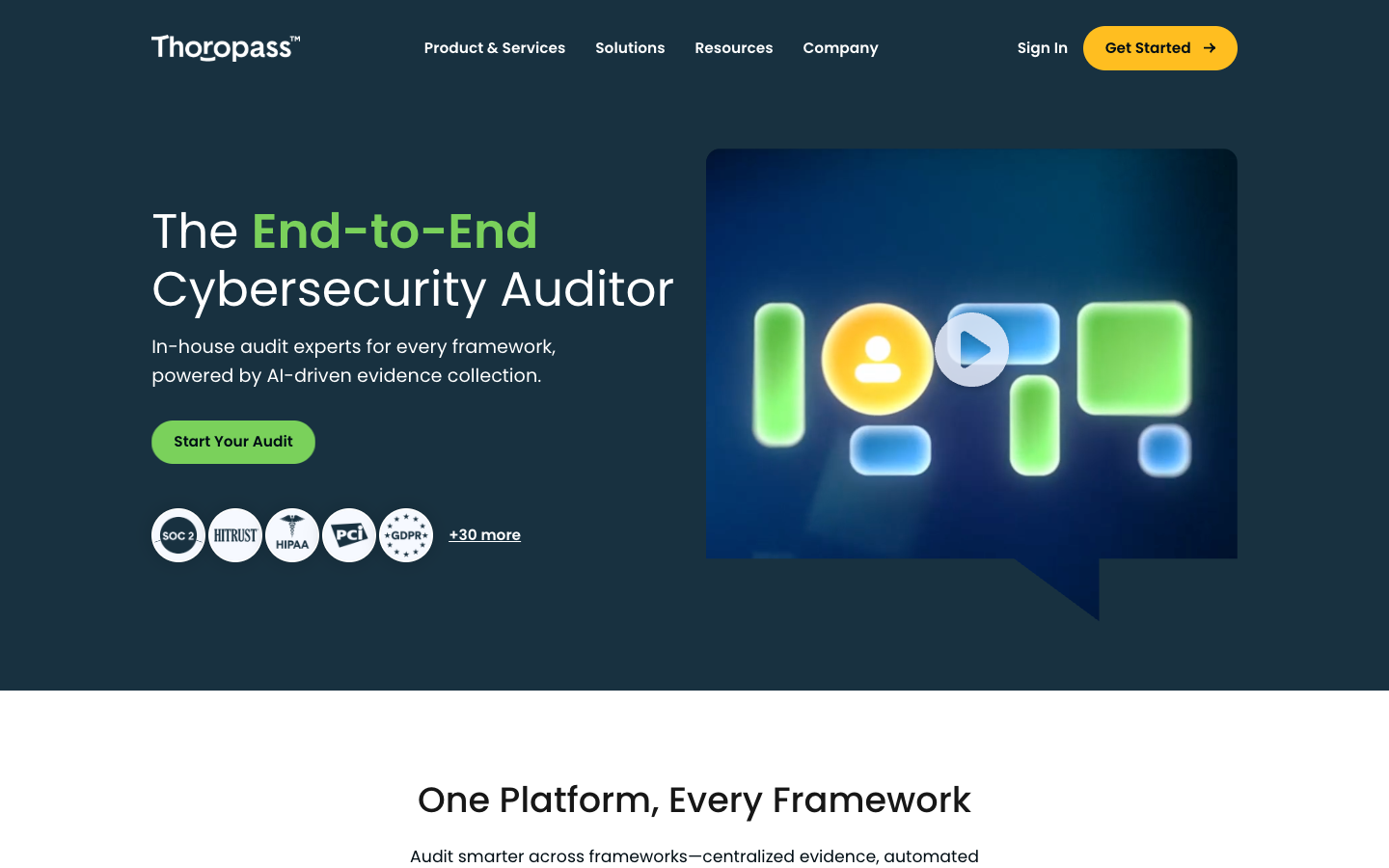
Thoropass has a positioning that no other tool in this list can match: it is simultaneously a compliance automation platform, a HITRUST-accredited assessor, and a HITRUST reseller. You can go through the entire certification process under one contract, with one team, without engaging a separate audit firm.
That’s a genuine differentiator. Hiring a HITRUST-accredited assessor separately typically adds $10,000 to $30,000-plus to your project cost and introduces a second vendor relationship to manage. Thoropass bundles both. They claim clients get certified in half the time and save up to 50% compared to using separate vendors, and the two-way MyCSF integration is included.
The catch is price. The median Thoropass contract runs around $30,000 per year (per Vendr data). There are AWS Marketplace entry points at $5,800–$8,700/year, but those represent stripped-down access. If you’re early-stage and budget-sensitive, that cost profile deserves careful consideration relative to alternatives.
“
Thoropass held our hands throughout the entire process for SOC 2 Type 1 and Type 2 audits. The platform makes it easy to track documents and evidence, and the team was always available to answer questions.
★★★★★Todd L.
Via G2 ↗Key features:
- Two-way HITRUST MyCSF integration
- In-house HITRUST-accredited assessor services (no separate firm needed)
- HITRUST reseller status
- Automated evidence collection and validation
- Continuous monitoring with real-time alerts
- AI-powered policy and procedure drafting
- Multi-framework support (SOC 2, ISO 27001, HIPAA, PCI DSS, GDPR, and more)
Pros of Thoropass
- Only platform that bundles software plus HITRUST-accredited auditor in one contract
- MyCSF integration included
- Strong G2 rating (4.7/5 across 568 reviews)
Cons of Thoropass
- Median contract ~$30,000/year; not built for early-stage budgets
- Integration count not publicly listed
Pricing: ~$30,000/year median; AWS Marketplace entry at $5,800–$8,700/year Best for: Mid-market and enterprise teams in healthcare, FinTech, and SaaS who want software and accredited auditor services under one contract
4. ComplyJet
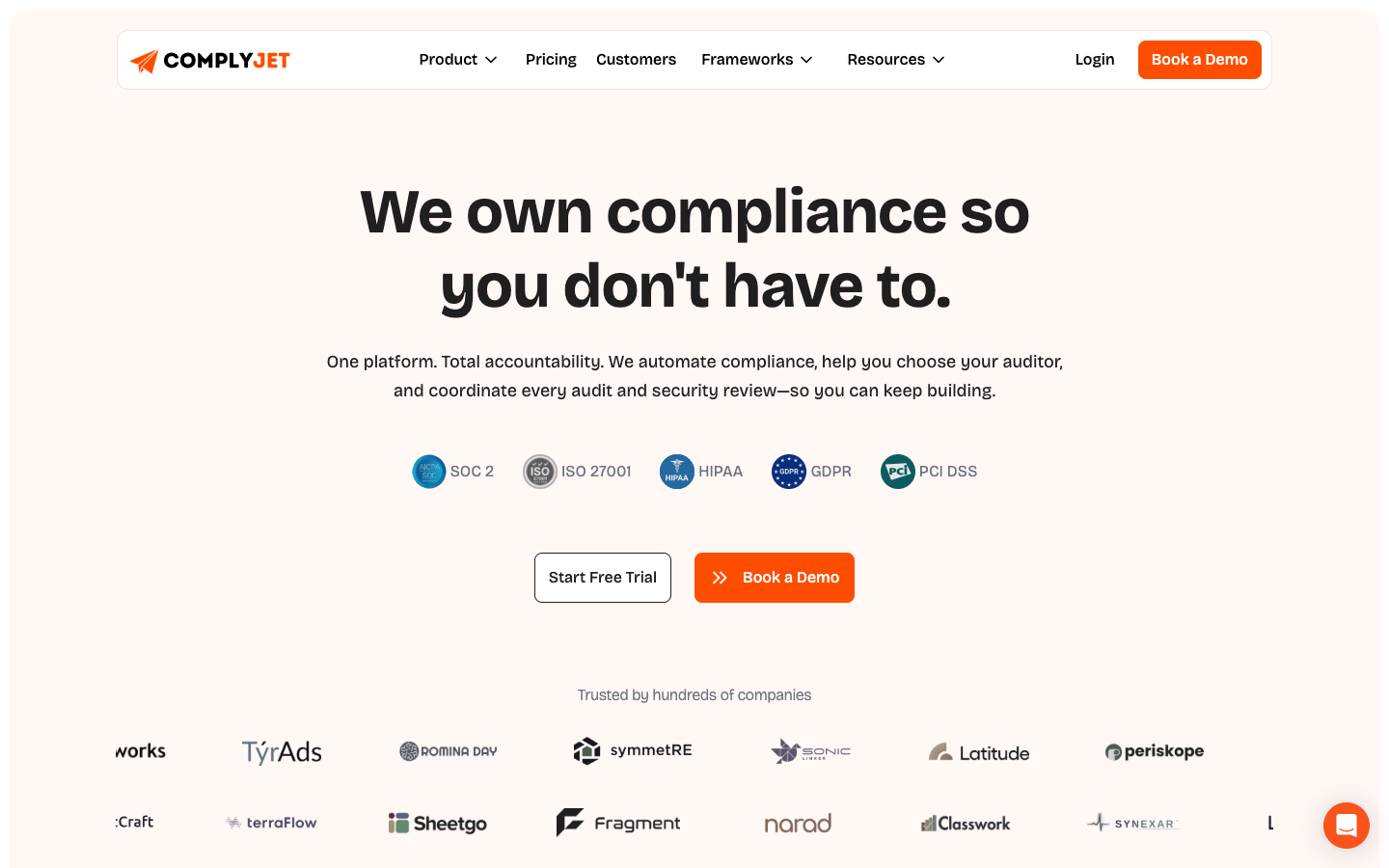
ComplyJet is built for early-stage SaaS companies doing HITRUST for the first time. The platform covers e1, i1, and r2 across 25-plus frameworks, with 350-plus integrations for automated evidence collection. What sets it apart isn’t the feature list: it’s the model. A team guides you through the compliance process from onboarding to certification, so you’re not left to convert software into outcomes on your own.
The pricing is publicly listed and flat: $5,000 per year for a single framework, $8,000 per year for two (for example, HITRUST plus HIPAA). Not per seat. Whether you’re a team of 10 or 50, the cost stays the same. That predictability matters when you’re sizing up a certification project that already comes with its own external assessor fees.
For healthcare SaaS companies pursuing HITRUST alongside HIPAA, the two-framework bundle is particularly relevant. HITRUST e1 overlaps significantly with HIPAA, so the evidence collected for one feeds directly into the other. The platform’s HITRUST certification cost breakdown blog and HITRUST certification guide are also worth reading if you’re still sizing up what you’re getting into.
ComplyJet is newer and has a smaller review footprint than Vanta or Drata. It doesn’t have an in-house assessor, but it connects you to a vetted partner network. If you’re a 20-person team that wants to get HITRUST-certified without enterprise pricing or a six-month procurement process, this is worth a hard look.
Key features:
- HITRUST CSF support across e1, i1, and r2
- 350+ integrations for automated evidence collection
- AI-assisted policy drafting
- Multi-framework coverage (HITRUST, HIPAA, SOC 2, ISO 27001, GDPR, PCI DSS, 25+ frameworks)
- Trust Center for sharing certifications with prospects
- Flat, publicly listed pricing (not per seat)
Pros of ComplyJet
- Flat pricing: $5,000/year single framework, $8,000/year two frameworks
- 350+ integrations; multi-framework control reuse
- Team-guided process from onboarding through certification
- Free 14-day trial
Cons of ComplyJet
- Smaller review base than category leaders
- No in-house accredited assessor; works with partner network
“
ComplyJet helped us feel secure and prepared for our SOC 2 audit. The platform is intuitive and AI-driven, and the team was responsive every step of the way.
Chuck Feerick· CEO · Latitude Health
Via complyjet.com ↗
Pricing: $5,000/year (single framework), $8,000/year (two frameworks); flat, not per seat Best for: Early-stage SaaS startups (under 50 employees) pursuing HITRUST for the first time, especially alongside HIPAA or SOC 2
5. Hyperproof
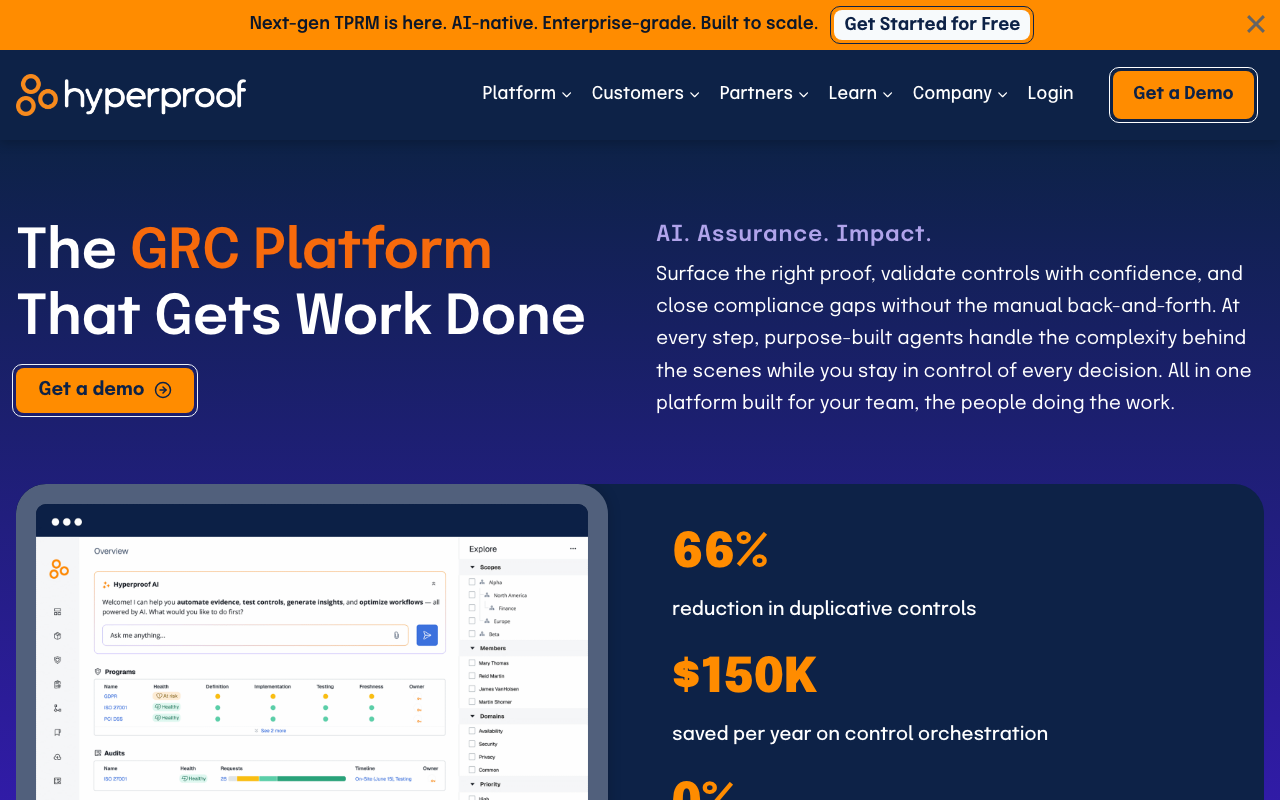
Hyperproof is the right pick if you’re running a complex compliance programme: HITRUST alongside FedRAMP, NIST SP 800-53, or multiple other frameworks simultaneously. The platform supports 140-plus pre-built frameworks, all three HITRUST assessment levels (r2, i1, e1), and has a FedRAMP Moderate-authorized environment called Hyperproof Gov, which is rare in this category.
Healthcare organizations make up a meaningful chunk of Hyperproof’s customer base: Artemis Health, CareFirst, and Nomi Health are all named customers. That domain familiarity shows up in the platform’s evidence organization and workflow design. Our Hyperproof review goes deeper if you want more.
The G2 rating is strong (4.5/5 across 213 reviews; Capterra gives it 4.8/5 across 114). The consistent criticism in reviews is a learning curve: the platform is deep, and initial configuration can be complex for teams without a dedicated GRC person. If you have a compliance engineer, this is a very capable tool. If you don’t, that complexity is worth pricing in.
“
Hyperproof features an intuitive, modern UI with strong automation, flexible framework coverage, and robust integrations at competitive pricing. Initial configuration can feel complex for non-technical users, and some integrations could be more flexible.
★★★★★Giorgi L.· Accounting, <6 months use
Via Capterra ↗Key features:
- 140+ pre-built frameworks including all three HITRUST assessment levels
- Automated evidence collection via Hypersyncs
- Integrated risk register and risk assessment workflows
- FedRAMP Moderate-authorized environment (Hyperproof Gov)
- Task automation via Jira, Asana, and ServiceNow integrations
- 200+ integrations
Pros of Hyperproof
- Deepest multi-framework coverage in this list (140+ frameworks)
- All three HITRUST levels supported natively
- FedRAMP Moderate authorization (rare differentiator)
- Strong healthcare customer base
Cons of Hyperproof
- Steep learning curve flagged consistently in reviews
- No public pricing; demo required
- Better suited to teams with a dedicated GRC function
Pricing: Contact for pricing Best for: Mid-market and enterprise teams running HITRUST alongside FedRAMP, NIST, or other complex multi-framework programmes
6. Sprinto
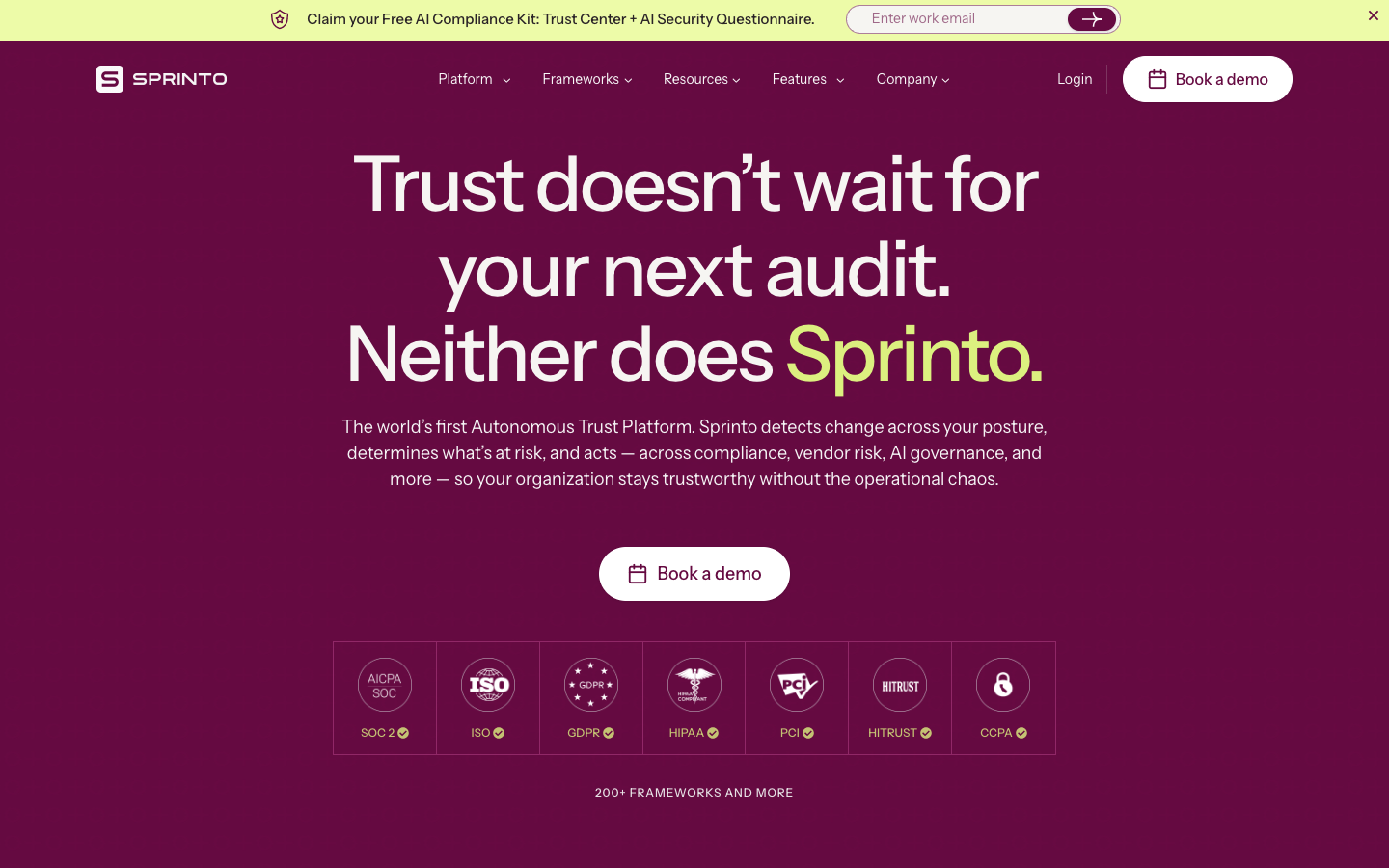
Sprinto is a startup-friendly compliance automation platform listed in the official HITRUST Alliance product directory. That listing matters: it’s the HITRUST Alliance’s own verification that Sprinto works within the HITRUST ecosystem. The platform supports HITRUST as one of 200-plus frameworks, with cross-framework control sharing so your SOC 2 or ISO 27001 work feeds into your HITRUST programme automatically.
Sprinto’s G2 rating is the highest in this list tied with Drata at 4.8/5, across 1,563 reviews. The platform’s sweet spot is SaaS companies doing multi-framework compliance for the first time: the workflows are opinionated and guided, which speeds up onboarding. The tradeoff is that those same predefined workflows can feel rigid when your programme needs customization.
Pricing is not public but is generally more startup-accessible than Vanta or Drata. Third-party estimates put the entry tier at around $8,000–$10,000 per year for small teams. Our Sprinto review covers the specifics in more detail.
“
Sprinto streamlines compliance with automated monitoring and evidence collection. The platform automates the compliance lifecycle and integrates monitoring, evidence collection, and control management seamlessly. The platform can be 'too opinionated' with predefined workflows that sometimes require customization workarounds.
Girish C.
Via AWS Marketplace ↗Key features:
- Listed in the official HITRUST Alliance product directory
- Cross-framework control sharing (map once, reuse across frameworks)
- AI-driven autonomous compliance engine
- Continuous controls monitoring via API integrations
- 200+ native integrations
- Vendor risk management module
Pros of Sprinto
- Listed in HITRUST Alliance product directory (confirmed ecosystem fit)
- High G2 rating (4.8/5 across 1,563 reviews)
- Startup-friendly pricing and guided workflows
- Strong multi-framework control reuse
Cons of Sprinto
- Predefined workflows can feel rigid; customization requires workarounds
- Not a HITRUST-accredited assessor
Pricing: Contact for pricing; estimated $8,000–$30,000+/year Best for: SaaS startups and scaling companies pursuing HITRUST alongside SOC 2 or ISO 27001 for the first time
7. AuditBoard
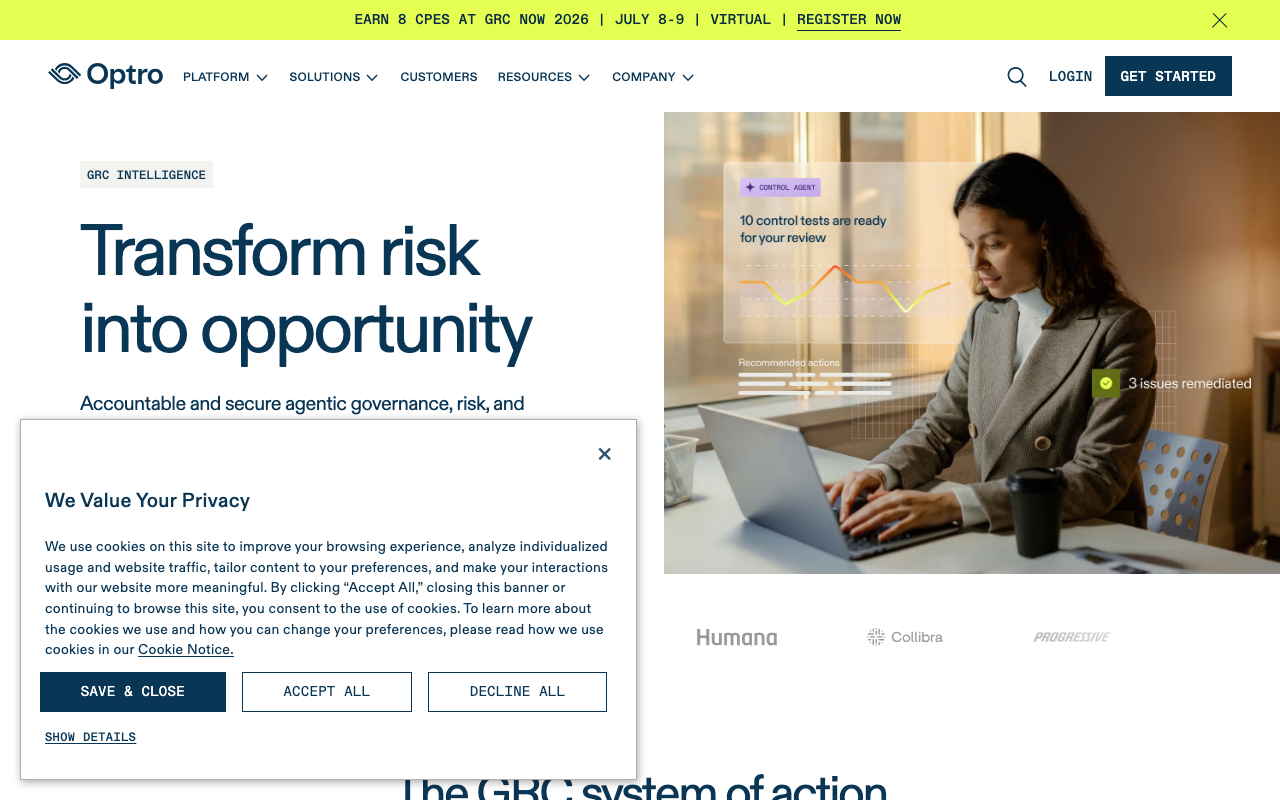
A quick note: AuditBoard rebranded to Optro in March 2026. The platform, G2 listing, and customer base are continuous, but you may see both names in the market. I’m using AuditBoard here since it’s still the dominant search term.
AuditBoard is an enterprise GRC platform that serves over 2,000 companies, including nearly half of the Fortune 500. It’s a Gartner Magic Quadrant Leader for GRC Tools (2025) and carries 1,585 G2 reviews at 4.6/5. HITRUST CSF is one of 30-plus preloaded frameworks with ready-to-use templates. The platform unifies audit management, risk management, and compliance in a single system, with 200-plus integrations and AI-powered evidence analysis.
If you’re running a mature compliance programme with internal audit, SOX controls, and HITRUST all in scope, AuditBoard is designed for that complexity. If you’re a 30-person startup doing your first HITRUST, it’s significant overkill, and the pricing ($30,000–$50,000-plus per year estimated) reflects that.
“
The support is top-notch. We work closely with our Customer Success Manager to meet our strategic goals. The main downside is that permissions management is challenging across multiple coordinating groups, though customer service provides excellent assistance.
★★★★★Tracy G.
Via Capterra ↗Key features:
- HITRUST CSF with preloaded templates (HIPAA and HITRUST ready on day one)
- Unified audit, risk, compliance, and AI governance modules
- AI-powered evidence analysis and autonomous control testing
- 200+ integrations for evidence collection
- Third-party risk management
- Gartner Magic Quadrant Leader, GRC Tools (2025)
Pros of AuditBoard
- Enterprise depth: unified audit, risk, and compliance in one system
- Preloaded HITRUST and HIPAA templates
- Strong analyst recognition (Gartner, G2)
Cons of AuditBoard
- Enterprise pricing; not suited to startups or first-time HITRUST teams
- Recent rebrand to Optro may cause confusion during evaluation
- Module-based pricing adds up
Pricing: Contact for pricing; estimated $30,000–$50,000+/year for mid-market Best for: Large enterprises with mature GRC programmes managing HITRUST alongside SOX, internal audit, and multi-framework compliance
8. OneTrust
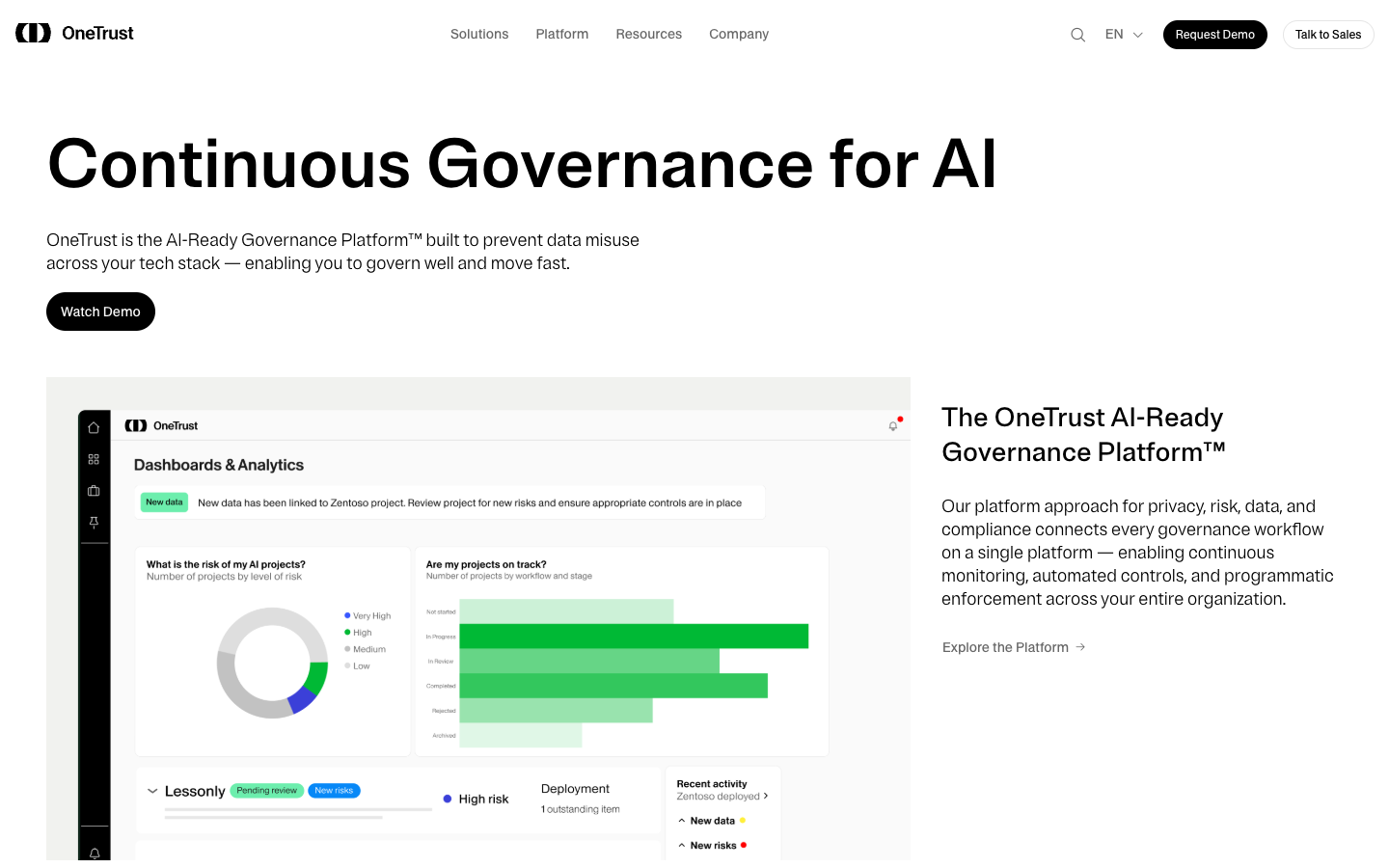
OneTrust is the largest enterprise GRC platform in this list. It covers 50-plus frameworks with a “collect once, comply many” shared evidence model, 500-plus integrations, and modules spanning compliance automation, privacy management, third-party risk, and enterprise risk. Notably, OneTrust itself holds HITRUST r2 certification, which signals real depth of implementation rather than a checkbox feature.
G2 gives OneTrust’s compliance automation module 4.6/5 across 109 reviews. The consistent user feedback is that the platform is powerful but heavy: flexible for large organizations, complex for smaller ones. Pricing starts at roughly $10,000 per year for small businesses, but mid-market contracts typically run $40,000–$120,000-plus depending on modules selected.
If your compliance programme spans HITRUST, GDPR, CCPA, and a complex vendor risk management function, OneTrust is built for that. If HITRUST is your primary certification goal and you’re under 100 people, the platform’s breadth becomes a burden.
“
Its flexibility is a real strength — you can build out your program using only the modules you need. The integrations are solid too. Being able to hook it into Microsoft 365, ServiceNow, and Jira saved a lot of time. That said, it's not exactly beginner-friendly. The platform has a lot going on and it can feel quite heavy. Pricing also adds up with advanced features costing extra.
★★★★★Stuart H.· 1,001–5,000 employees
Via Capterra ↗Key features:
- HITRUST CSF support; OneTrust itself holds HITRUST r2 certification
- 50+ frameworks with “collect once, comply many” shared evidence approach
- 500+ integrations
- Privacy management, TPRM, and enterprise risk modules
- Pre-architected collectors for automated real-time evidence capture
- Implementation guidance that maps requirements to actionable tasks
Pros of OneTrust
- Broadest framework coverage (50+) and integration count (500+) in this list
- “Collect once, comply many” reduces cross-framework duplication
- OneTrust’s own HITRUST r2 certification signals genuine depth
Cons of OneTrust
- Heavy and complex for smaller teams and first-time compliance programmes
- Pricing adds up quickly with advanced modules
- Not suited for startups or early-stage HITRUST
Pricing: From ~$10,000/year (small business); $40,000–$120,000+/year for mid-market Best for: Large enterprises managing HITRUST alongside GDPR, CCPA, HIPAA, and complex privacy and vendor risk programmes
How to Choose HITRUST Compliance Software for Your Team
Key insight
The assessment level you're pursuing (e1, i1, or r2) determines more about your tool selection than any other factor — it affects scope, timeline, and total cost.
Which HITRUST Assessment Level Do You Need? (e1, i1, or r2)
Start here. The assessment level determines how much your tool needs to do, and it affects timeline and cost more than anything else.
The e1 covers 44 essential controls and takes four to six months with good tooling. Most of the platforms in this list handle it well. The i1 covers 182 controls and adds leading practices on top of the e1 foundation.
The r2 is the full risk-tailored assessment: 800-plus controls, required by most large hospital systems and federal agencies. Not every tool handles r2 natively. Vanta and Hyperproof explicitly do. Drata offers an extensible path. Ask any vendor directly which levels they support in their standard product before committing.
If you’re unsure which level a customer actually requires, our HITRUST certification guide breaks down when each level is typically required and by whom.
Do You Need a Built-In Assessor or Will You Hire Separately?
Every HITRUST certification requires a HITRUST-accredited external assessor. The software tools in this list prepare you for that assessment, but only Thoropass includes the assessor in the same contract.
If you hire an assessor separately, add $10,000 to $30,000-plus to your project budget. Factor that into your total cost comparison when evaluating platforms. For a full picture of what HITRUST actually costs end to end, see our HITRUST certification cost breakdown.
Best HITRUST Compliance Software for Healthcare Providers
Choosing hitrust compliance software healthcare providers actually use means looking beyond control libraries. Healthcare SaaS companies face specific requirements: HIPAA overlap with HITRUST controls, Business Associate Agreement (BAA) considerations, and PHI handling requirements throughout the evidence collection process.
Look for tools with a native HIPAA-plus-HITRUST cross-framework mapping capability, so you’re not collecting the same evidence twice. Vanta (with Healthie, Kaia Health, and Garner as named customers), Hyperproof (Artemis Health, CareFirst, Nomi Health), and ComplyJet (which bundles HITRUST and HIPAA under a single flat-rate contract) are the strongest options in this segment.
Best HITRUST Compliance Software for SaaS Companies
Most SaaS teams come to HITRUST from a SOC 2 or ISO 27001 foundation. The key is cross-framework control mapping: the evidence you already have should carry into HITRUST rather than being recollected from scratch.
Sprinto and Drata are both strong here, with explicit cross-framework control sharing and startup-accessible pricing tiers. ComplyJet’s two-framework bundle (HITRUST plus HIPAA or SOC 2 for $8,000/year) is worth evaluating if you’re early-stage and want predictable cost alongside that control reuse.
Startup vs. Scaling vs. Enterprise: Which HITRUST Tool Fits?
The honest answer depends more on budget and complexity than on company size.
Starting out (under 50 people, first HITRUST certification): ComplyJet and Sprinto are the clearest fits. Flat or startup-friendly pricing, guided onboarding, and cross-framework reuse without enterprise contracts.
Scaling (50–300 people, multi-framework): Vanta, Drata, and Thoropass. Deeper automation, broader assessor networks, and the MyCSF integration depth you’ll need for i1 and r2.
Enterprise (mature GRC programme, complex needs): Hyperproof, AuditBoard, and OneTrust. Unified GRC across audit, risk, and compliance; FedRAMP support; SOX integration.
The Smart Choice vs. the Safe Choice in HITRUST Software
Vanta is the safe choice. Every HITRUST assessor knows it, most healthcare enterprise teams have heard of it, and picking it requires no explanation to anyone in the room. That’s worth something.
But safe isn’t always the right choice. The teams that do the most thorough evaluation tend to ask a different set of questions: Does this tool actually support the assessment level I need? Does the pricing model stay predictable as my team grows? Will I get outcomes or just access to software?
Matching the tool to those specific answers is where the considered choice happens.
Frequently Asked Questions
What is HITRUST compliance software?
HITRUST compliance software helps organizations prepare for and manage HITRUST CSF certification. It automates evidence collection, maps controls to HITRUST requirements, tracks gaps, and (in the best cases) syncs directly with HITRUST’s official assessment portal, MyCSF. It does not replace the requirement for a HITRUST-accredited external assessor, but it significantly reduces the manual work involved.
Do I need HITRUST compliance software or just MyCSF?
You need both. MyCSF is the mandatory assessment portal: your assessor uses it to review evidence and submit findings, and HITRUST issues your certification through it. But MyCSF does not collect evidence, map controls, or track your readiness. Compliance software handles that preparation work and then syncs into MyCSF when assessment time comes.
What’s the difference between HITRUST e1, i1, and r2?
The e1 (Essential, 1-year) covers 44 foundational controls and is the fastest path to HITRUST certification. The i1 (Implemented, 1-year) covers 182 controls and adds leading security practices. The r2 (Risk-based, 2-year) is the full assessment with 800-plus controls and is what most large healthcare organizations and federal agencies require. The right level depends on what your customers ask for. Our HITRUST certification guide explains when each level is typically needed.
How long does HITRUST certification take?
HITRUST e1 typically takes four to six months with good tooling. i1 takes six to nine months. r2 can take nine to eighteen months depending on your current control maturity and how much remediation is needed. Software that automates evidence collection and does cross-framework mapping from an existing SOC 2 or HIPAA programme meaningfully shortens those timelines.
Is HITRUST certification worth it for SaaS companies?
Only if a customer or prospect requires it. HITRUST is not a general-purpose certification like SOC 2. It’s primarily required by large healthcare organizations, hospital systems, payers, and federal agencies handling protected health information. If a healthcare enterprise customer is blocking you on HITRUST, it’s worth pursuing. If no one in your pipeline is asking for it, SOC 2 covers more ground at lower cost.
How much does HITRUST compliance software cost?
Ranges vary significantly. ComplyJet starts at $5,000/year (flat, single framework). Sprinto entry-tier is estimated at $8,000–$10,000/year. Drata and Vanta are contact-for-pricing but typically range from $15,000 to well over $100,000/year depending on headcount and frameworks. Thoropass median is around $30,000/year. AuditBoard and OneTrust start at $30,000-plus for mid-market. Factor in the external assessor fee separately: typically $10,000–$30,000-plus on top of the software cost. Our HITRUST certification cost breakdown covers the full picture.
Can HITRUST compliance software replace a HITRUST assessor?
No. Every HITRUST validated assessment requires a HITRUST-accredited external assessor. The software prepares you for that assessment; it does not conduct it. Thoropass is the only platform in this list that includes an accredited assessor service in its contract. All others require you to engage an assessor separately.
Where can I find HITRUST compliance software healthcare reviews?
G2 and Capterra are the most reliable sources for verified user reviews. For healthcare-specific reviews, filter G2 by industry. The HITRUST Alliance product directory also lists platforms that have been recognized within the HITRUST ecosystem. The reviews in this article are drawn from G2, Capterra, and AWS Marketplace.
Final Thoughts
Free Demo
Get your first HITRUST certification done right
Flat pricing, 350+ integrations, guided from gap assessment to certification.
HITRUST is a serious undertaking. The right software doesn’t make it easy, but it makes it manageable: automated evidence collection, cross-framework reuse from your existing compliance work, and a direct line into MyCSF when your assessor shows up.
For enterprise teams with complex GRC programmes, Vanta, Drata, and Thoropass are the strongest options. For early-stage SaaS companies doing HITRUST for the first time, especially alongside HIPAA, ComplyJet’s flat pricing and guided approach are worth a close look.
ComplyJet handles HITRUST, HIPAA, SOC 2, and 25-plus other frameworks under one flat-rate contract. If you’re an early-stage startup getting ready for your first HITRUST certification, book a free demo and we’ll walk you through exactly what it involves.