.svg)

You’re looking at a dozen HIPAA compliance software options. Most of them have identical feature lists. None of them will show you a price without a 30-minute demo call. One is built for hospital systems, one is built for dental offices, and three are general compliance platforms that added HIPAA as a checkbox after the fact.
I’ve reviewed 10 hipaa compliance tools across two distinct categories: dedicated HIPAA platforms built for healthcare practices, and compliance automation platforms that cover HIPAA alongside SOC 2, ISO 27001, and other frameworks.
Here’s the short version: if you’re a healthcare practice, look at Compliancy Group, Accountable HQ, or Medcurity. If you’re a SaaS or health tech company that handles PHI, look at ComplyJet, Vanta, or Drata. If budget is the primary filter, Medcurity starts at $499/year and Accountable HQ publishes its pricing upfront.
Whether you’re a dental practice that just got an HHS inquiry, a health tech startup closing your first enterprise deal, or a SaaS company that handles PHI and needs hipaa compliant software alongside your SOC 2 program, there’s a different right answer for each of you. Here’s what I’ll cover:
- What hipaa compliance management software actually handles
- How I selected these tools
- A side-by-side comparison of all 10
- Full reviews of each platform
- How to choose based on org type and budget
- Answers to the questions I get asked most often
What HIPAA compliance management software actually does — and why it matters
You signed the BAA. You told yourself you were done. Six months later, HHS asks for your Security Risk Analysis documentation. That’s the moment most teams realise what HIPAA compliance actually involves.
Why it matters
Doing this manually in spreadsheets works when you're two people. It falls apart around ten and collapses under the pressure of a real audit.
HIPAA is four rules running simultaneously: the Privacy Rule, the Security Rule, the Breach Notification Rule, and the Omnibus Rule covering business associates. Together, they require a formal Security Risk Analysis (SRA) that documents where PHI lives, what threats exist, and what controls you have in place.
Then you remediate the gaps. Update your policies. Train your entire workforce and track that training. Manage every vendor relationship with signed BAAs. Document everything in a way that holds up under audit.
Doing this manually in spreadsheets works when you’re two people. It falls apart around ten and collapses under the pressure of a real audit. The SRA alone is a multi-day exercise done properly.
HIPAA compliance management software automates the parts that consume the most time: risk assessment, policy generation, training assignments, BAA tracking, and ongoing monitoring. The better platforms also produce audit-ready reports: evidence that’s organised and defensible rather than a folder of screenshots assembled the night before.
How we chose these HIPAA compliance tools
I evaluated 10 platforms against six criteria:
Watch out
Pricing transparency: is the price publicly listed, or do you have to sit through three demos to find out?
- HIPAA coverage depth: does the platform cover the full scope (SRA, policies, training, BAA management, incident response), or just one piece?
- Ease of use for non-compliance teams: can a practice manager or startup founder run this without a dedicated compliance hire?
- Pricing transparency: is the price publicly listed, or do you have to sit through three demos to find out?
- Multi-framework support: for SaaS and health tech companies, can HIPAA sit alongside SOC 2 or ISO 27001 in the same platform?
- Healthcare-specific features: workforce training formats, OSHA coverage, covered entity versus business associate modes
- Support model: are you getting a chat widget, a customer success manager, or an actual compliance expert assigned to your account?
Quick comparison: top HIPAA compliance platforms in 2026
| Tool | Best for | Pricing | Standout feature |
|---|---|---|---|
| Vanta | Enterprise SaaS, multi-framework | Contact | 400+ integrations, 16,000+ customers |
| Drata | Cloud SaaS with SOC 2 + HIPAA | Contact | Agentic automation, 4.8/5 G2 |
| ComplyJet | Startups, flat per-company pricing | $5K–$8K/yr (flat) | 350+ integrations, white-glove support |
| ComplyAssistant | Hospitals, health systems, and healthcare organizations managing complex HIPAA programs | Contact for pricing | Healthcare-focused GRC platform with risk analysis, documentation, vendor management, and compliance task tracking |
| Compliancy Group | Healthcare practices (HIPAA + OSHA) | Contact | Dedicated Compliance Coach on every account |
| Abyde | Small medical and dental practices | Contact | 3,000+ practices, 94% renewal rate |
| Secureframe | First-time compliance teams | Contact | Guided workflows, 700+ G2 reviews |
| Sprinto | Cloud SaaS, global teams | Contact | 300+ integrations, 4.8/5 G2 across 1,500+ reviews |
| Accountable HQ | Any healthcare org, transparent pricing | $199–$799/mo | Public pricing, 7-day free trial |
| Medcurity | Healthcare startups on a budget | From $499/yr | Most affordable dedicated HIPAA tool |
| Scytale | SMBs needing 80+ frameworks | Contact | 2026 G2 Best GRC Award, 4.8/5 |
The 11 best HIPAA compliance software tools in 2026
1. Vanta

Vanta is the category default. With 16,000+ customers, 400+ integrations, and names like GitHub, Snowflake, and Atlassian on its customer list, it has become the go-to answer for companies that need compliance and want the safest vendor choice. That brand gravity is real, and it comes at a price.
For HIPAA specifically, Vanta maps your existing cloud infrastructure to HIPAA controls automatically, collects evidence continuously, and surfaces control failures in real time. If you’re already running SOC 2 or ISO 27001 through Vanta, adding HIPAA is relatively low-friction: you’re not starting a new tool, you’re extending what you already have.
That multi-framework angle is where Vanta earns its position. If your compliance roadmap involves three or four frameworks over the next two years, keeping them all in one hipaa compliance platform is worth something.
The tradeoffs are pricing and contract flexibility. Vanta doesn’t publish numbers, but companies with complex stacks frequently report figures in the $15,000 to $25,000 range annually. For early-stage startups, that’s a meaningful line item, and the rigid multi-year contract terms have drawn consistent criticism (more in our full Vanta review).
It’s also worth noting that Vanta’s roots are in SOC 2 for SaaS companies: the HIPAA experience is solid, but it wasn’t built around the specific workflows of a healthcare practice.
“
We needed a clear structure to follow for SOC 2 and HIPAA compliance, and Vanta provided that framework right out of the box. It turned what could have been a very overwhelming, ambiguous process into something actionable and trackable.
★★★★★Verified User· SMB
Via G2 ↗Key features:
- Automated compliance management and continuous monitoring
- 400+ integrations across cloud, identity, and business tools
- AI-powered questionnaire automation and policy drafting
- Audit preparation with automated evidence collection
- Trust Center for sharing your security posture with customers
- Risk assessment and third-party vendor risk management
Pros of Vanta
- Largest integration library in the category
- Strong brand recognition in enterprise deal rooms
- Covers HIPAA, SOC 2, ISO 27001, HITRUST, FedRAMP, and 10+ other frameworks in one platform
Cons of Vanta
- No public pricing; contracts are typically multi-year and inflexible
- Not tailored for healthcare practices: no OSHA coverage, no healthcare-specific training
- Expensive relative to purpose-built HIPAA tools for teams that need only HIPAA
Pricing: Contact for pricing (estimated $10,000–$25,000+/year depending on frameworks and team size)
Best for: Mid-market and enterprise SaaS companies needing HIPAA alongside SOC 2, ISO 27001, or HITRUST under one roof
2. Drata
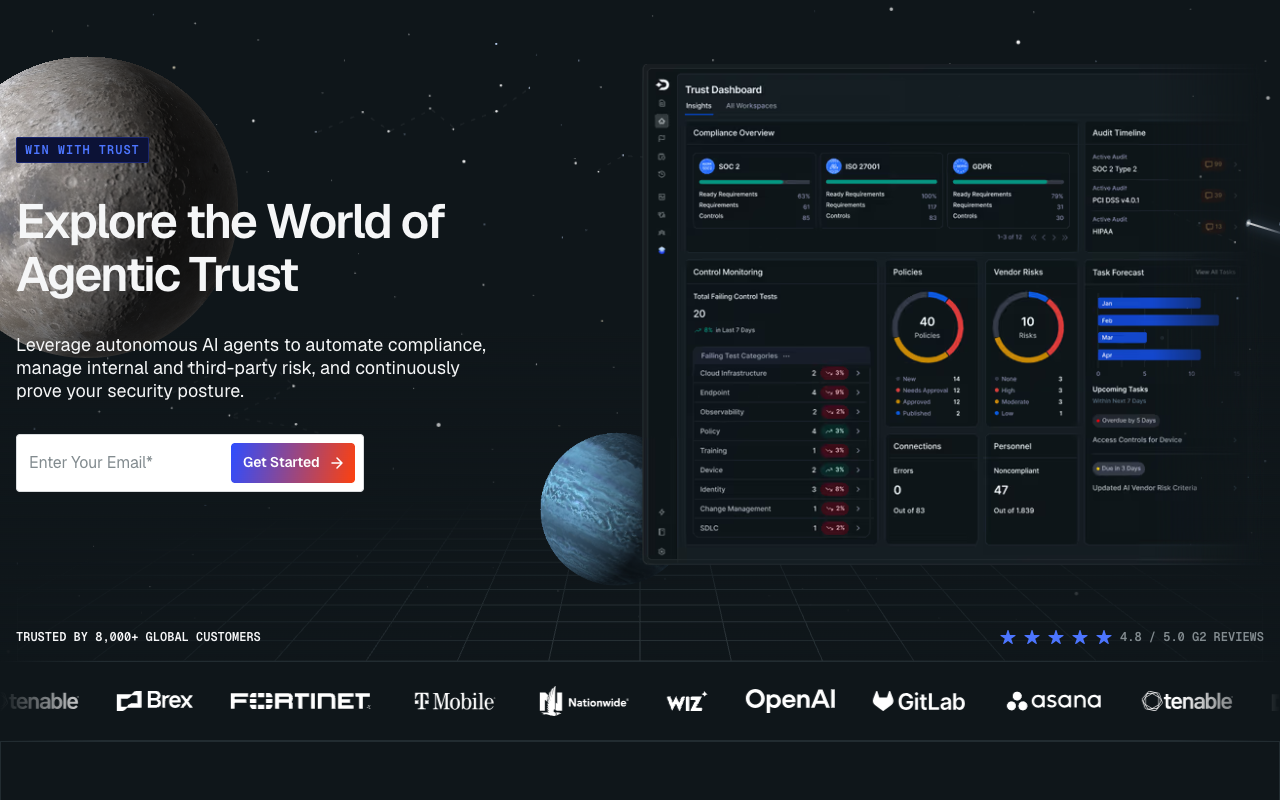
Drata has emerged as Vanta’s most credible challenger in compliance automation, with a 4.8/5 G2 rating across 1,153 reviews and a reputation for genuinely impressive support (see our Drata review for a full breakdown). Where Vanta owns the top of the market through brand recognition, Drata has earned its position through product quality and customer satisfaction scores that consistently outrank the competition.
For HIPAA, Drata’s approach is built around autonomous agents: software components that continuously scan your infrastructure, collect evidence against pre-mapped HIPAA controls, flag drift, and surface remediation tasks without waiting for you to ask. If you’re already doing SOC 2 with Drata, layering HIPAA on top adds controls you’re likely already meeting. The audit evidence is mostly already there. That’s the scenario where Drata is genuinely hard to beat.
Where it gets complicated is pricing. Drata operates sales-led, and multi-framework plans add up quickly. Users consistently note that starting on the Foundation tier and then adding a second framework pushes costs higher than anticipated — our Drata pricing breakdown goes into what to expect before the sales call.
For startups in the early stages of compliance, navigating that pricing conversation adds friction. But for teams at the growth or mid-market stage where HIPAA is one piece of a broader compliance program, Drata is one of the strongest options available.
“
For a small team managing a serious compliance program, having one place for controls monitoring, evidence collection, and audit readiness has been worth it. We layered HIPAA on top of SOC 2 and it was already embedded in our operations.
★★★★★Verified User· SMB · 11–50 employees
Via Capterra ↗Key features:
- Autonomous agents for continuous evidence collection and control monitoring
- Pre-built HIPAA control mapping with unified cross-framework view
- AI-powered questionnaire automation and Trust Center
- Third-party vendor risk assessment
- Real-time control monitoring with automated risk flagging
- Hundreds of integrations
Pros of Drata
- Best-in-class support ratings (9.7/10 quality of support score on G2)
- Strong multi-framework coverage: HIPAA, SOC 2, ISO 27001, PCI DSS, FedRAMP, and more
- Trusted by Brex and Okta; carries weight in enterprise deal rooms
Cons of Drata
- No public pricing; costs scale up quickly when adding frameworks
- Less healthcare-specific than dedicated HIPAA tools (no OSHA, no healthcare training modules)
- Can feel heavy for a team that only needs HIPAA
Pricing: Contact for pricing (estimated $12,000+/year for multi-framework; Foundation tier for single framework)
Best for: Cloud-native SaaS companies that need HIPAA as part of a broader compliance program alongside SOC 2 or ISO 27001
3. ComplyJet
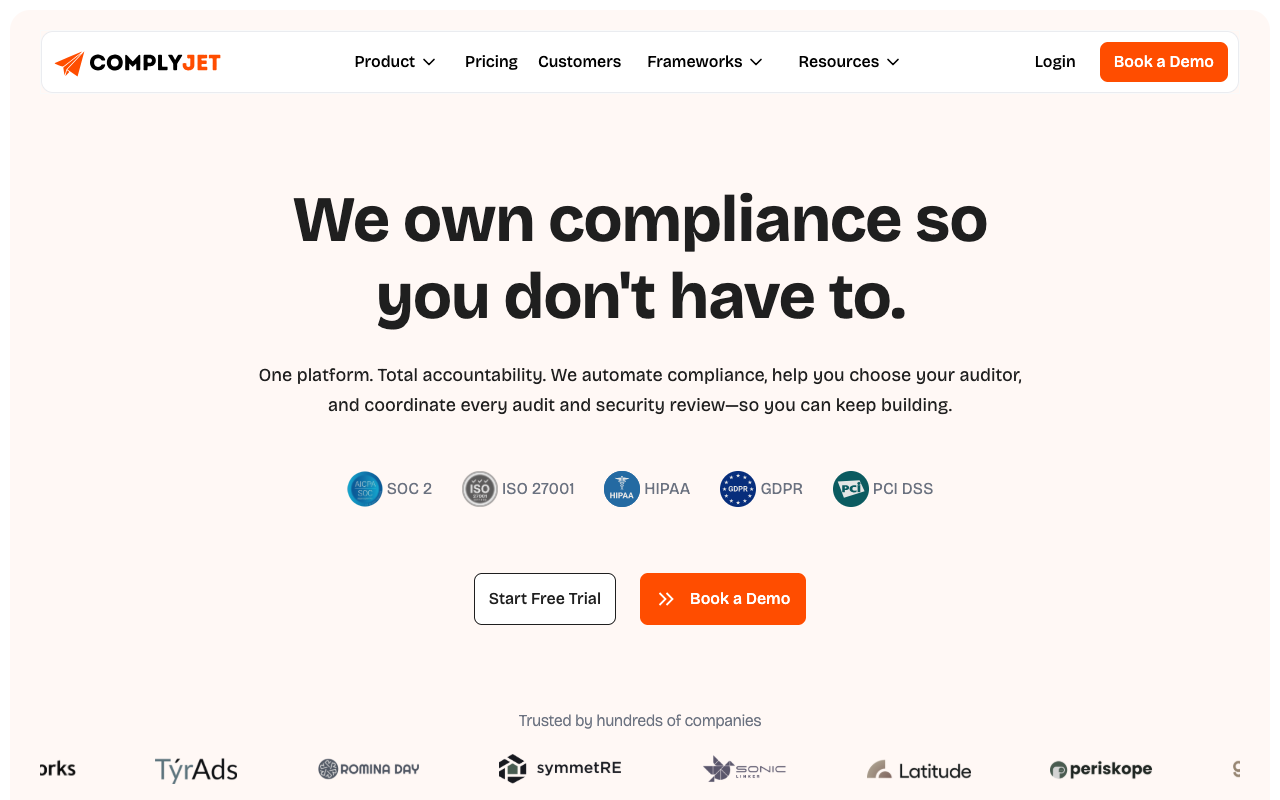
ComplyJet is built around a different premise from most platforms on this list: compliance as a managed outcome, not a software subscription. You get a team that guides you through the process end to end, not just access to a tool with a ticketing system bolted on. The team drives the process, coordinates with auditors, and ensures your HIPAA program is actually complete, not just started.
The platform covers the full compliance stack: automated monitoring across 350+ integrations, AI-assisted policy drafting, a custom-branded Trust Center, and end-to-end audit management with vetted auditors included. HIPAA, SOC 2, ISO 27001, and 25+ other frameworks are all in one plan, not parceled out as separate add-ons. The pricing is flat per company rather than per seat, which means the cost stays predictable as your team grows, a meaningful distinction when you’re scaling from 10 to 40 people mid-audit.
The honest limitation is brand recognition. In an enterprise deal where a prospect security reviewer is checking your compliance vendor, Vanta or Drata will be more familiar names. ComplyJet is the right call when the decision is being made by someone who thinks carefully about vendor fit over brand gravity, specifically early-stage founders who want the outcome (the certification, the audit, the Trust Center) rather than just the software license.
Key features:
- Automated compliance monitoring across 350+ integrations (AWS, Azure, GCP, GitHub, and more)
- ComplyJet AI for policy drafting and security questionnaire automation
- End-to-end audit management with vetted auditors included
- Custom-branded Trust Center for sharing certifications with enterprise prospects
- Outcome-driven support: a team that guides you through compliance, not just software and a help desk
- 25+ frameworks including HIPAA, SOC 2, ISO 27001, GDPR, PCI DSS, HITRUST
Pros of ComplyJet
- Flat per-company pricing: cost doesn’t scale with headcount
- Outcome-driven model: compliance gets done, not just enabled — a team guides you through the whole process
- Multi-framework support without per-framework add-on fees
- Built for startups and growing companies, not retrofitted for them
Cons of ComplyJet
- Smaller brand footprint than Vanta or Drata in enterprise deal rooms
- Best fit for early to mid-stage teams; not the primary choice for large enterprise procurement
Pricing: $5,000/year (single framework); $8,000/year (two frameworks, e.g. HIPAA + SOC 2). Flat per-company, not per-seat — cost stays the same whether you have 10 or 50 people.
Best for: SaaS startups (under 50 employees) pursuing HIPAA for the first time, particularly those who also need SOC 2 or ISO 27001 and want one platform handling it all
4. ComplyAssistant
ComplyAssistant is a healthcare-focused HIPAA risk management software platform that helps organizations manage HIPAA requirements, risk assessments, documentation, vendors, and compliance tasks from one place.
Key features:
- HIPAA risk assessments and risk management
- Compliance documentation and policy management
- Vendor and business associate management
- Contract management
- Incident and event tracking
- Compliance task management and reporting
Pros of ComplyAssistant
- Built specifically for healthcare organizations
- Centralizes HIPAA compliance activities
- Supports vendor and risk management
- Includes compliance consulting services
Cons of ComplyAssistant
- Pricing isn't publicly available
- May offer more functionality than smaller practices need
User Review: A CIO at Cape Regional Health System highlighted ComplyAssistant's ability to help manage HIPAA and security assessments, including follow-up actions and reporting.
Pricing: Contact ComplyAssistant for pricing and a demo.
Best for: Hospitals, health systems, and healthcare organizations looking for HIPAA risk management software and centralized compliance management.
5. Compliancy Group
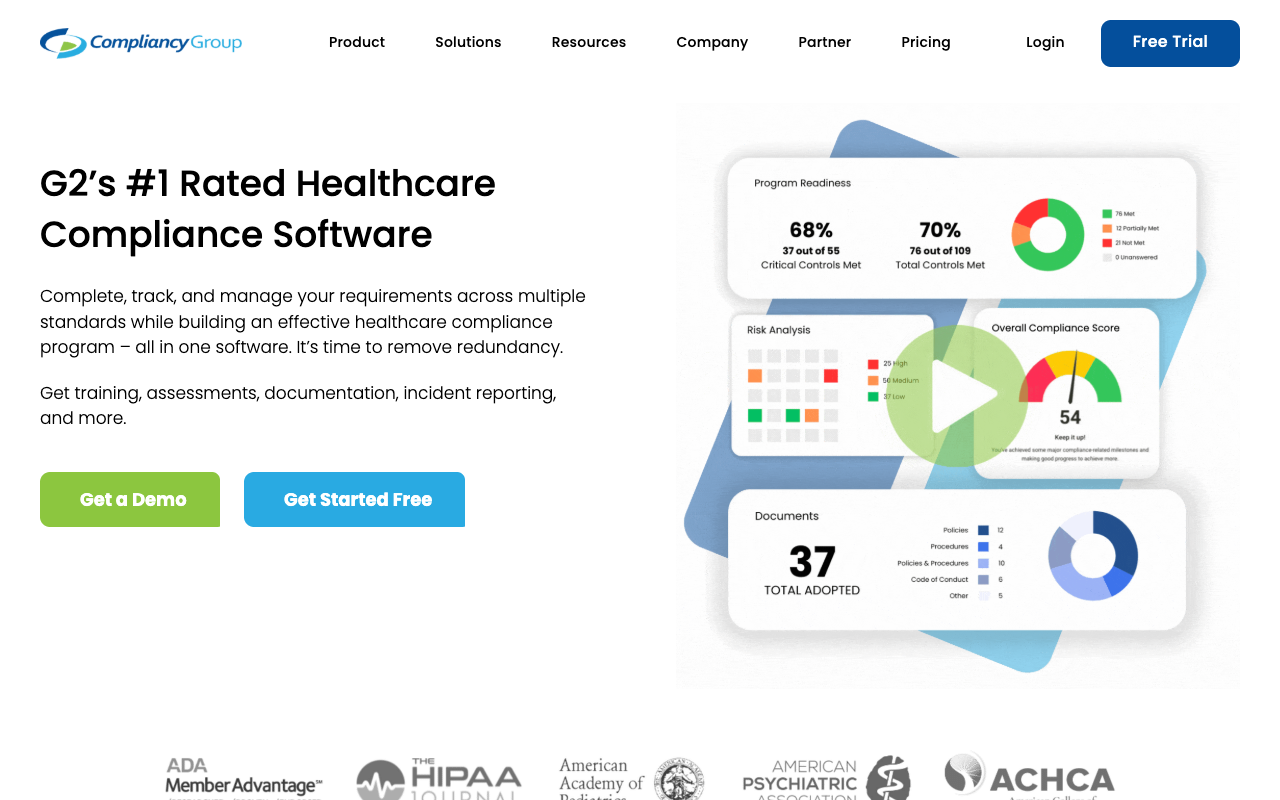
Compliancy Group has been building HIPAA compliance software since 2005, which makes it old by SaaS standards. Their platform, The Guard, was built by former healthcare auditors and compliance specialists, and it shows in the depth of healthcare-specific features that general GRC platforms simply don’t have.
The most notable differentiator is the Compliance Coach model: every account gets a dedicated compliance coach, not a shared support queue. Your coach guides you through the full HIPAA program, reviews your SRA, flags gaps, and is available when things come up. For practices with no in-house compliance expertise, that’s not a nice-to-have. It’s the difference between getting this done and staying stuck.
Compliancy Group also gives customers its HIPAA Seal of Compliance, a visual credential that carries real weight with patients and partners, and an OCR Audit Response Program that prepares you for a government audit if one ever lands.
The tradeoffs are scope and transparency. Compliancy Group covers HIPAA and OSHA, with some SOC 2 coverage added recently, but it’s not a multi-framework GRC platform. If you’re a health tech startup that also needs SOC 2, you’d be managing two tools. Pricing is not published and requires a sales conversation.
“
We were scared to death after going to the HHS website to see all the requirements. The Guard took all the complication out of it. Without the Guard we would still be floundering. Thanks for making a truly great product!
★★★★★Verified User· SMB · 1–10 employees
Via TrustRadius ↗Key features:
- Policy Manager with 100+ ready-to-use HIPAA templates
- Compliance training covering HIPAA, OSHA, and Fraud, Waste, and Abuse
- Incident reporting with anonymous reporting, ticketing, and tracking
- Security Risk Analysis and remediation planning
- Vendor due diligence and BAA management
- Exclusion List Verification across 55 government and private lists
- Dedicated Compliance Coach on every account
- HIPAA Seal of Compliance and OCR Audit Response Program
Pros of Compliancy Group
- Dedicated compliance coach on every account, not just support tickets
- Deep healthcare expertise: built by former auditors, designed for covered entities
- HIPAA and OSHA in one platform, which most practices need anyway
- HIPAA Seal of Compliance adds visible credibility with patients and partners
Cons of Compliancy Group
- No public pricing; requires a sales conversation
- Not a multi-framework GRC platform: not suited for companies that also need SOC 2 as a standalone
- Some users have noted the interface can be disorienting after product updates
Pricing: Contact for pricing (tiered by organisation size)
Best for: Healthcare covered entities (medical practices, dental offices, mental health providers, business associates) that need guided HIPAA and OSHA compliance with expert support baked in
6. Abyde
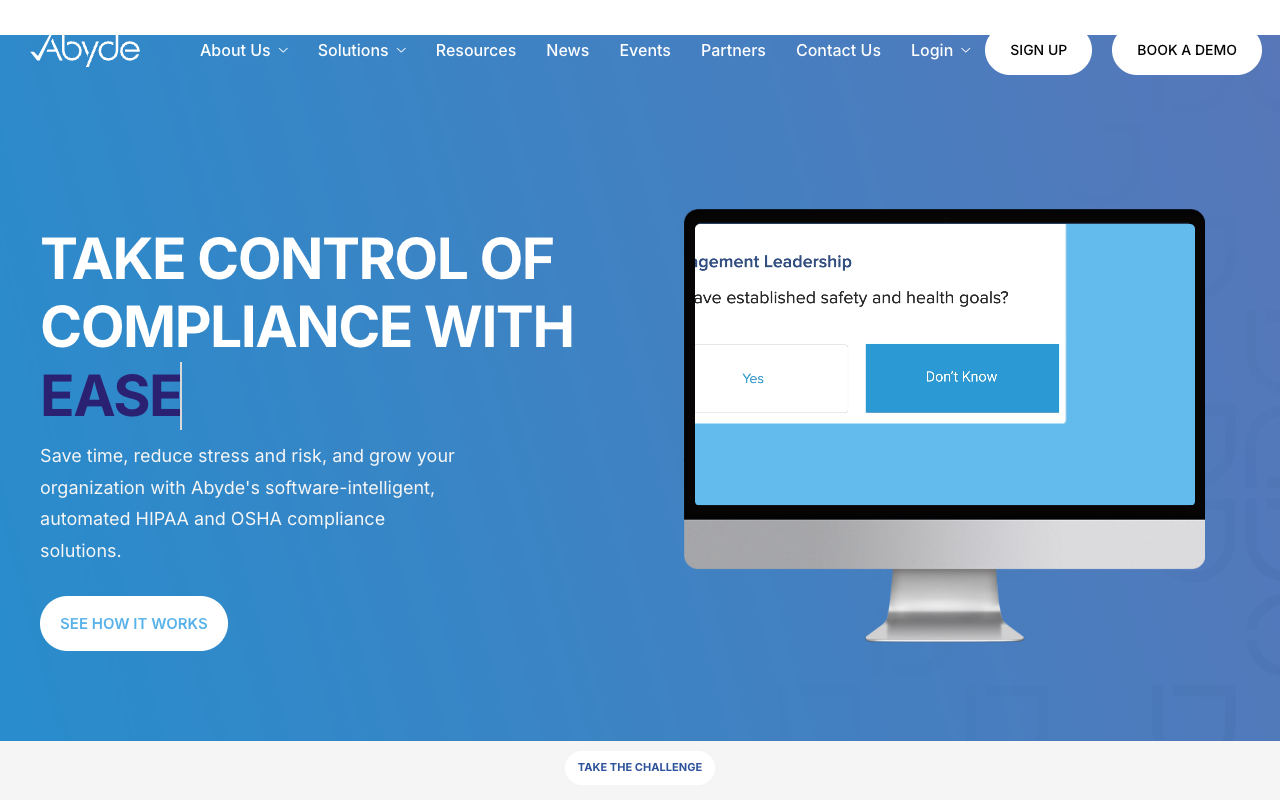
Abyde has one job: make HIPAA and OSHA compliance manageable for healthcare practices that don’t have a compliance team. It does that job well enough that 94% of its customers renew every year, which is a harder metric to fake than G2 stars.
The platform is built around three things healthcare practices actually need: automated risk assessments that don’t require you to speak compliance fluently, policy generation that adapts to your specific practice type, and workforce training that actually gets completed. Abyde’s training modules are PACE and COPE accredited, meaning they count toward continuing education requirements for clinical staff in many states. That’s a real differentiator for practices where training compliance and clinical CE hours overlap.
What Abyde is not is a multi-framework platform. It’s HIPAA and OSHA, full stop. If you’re a health tech SaaS company that also needs SOC 2, Abyde won’t serve that need. And pricing requires a demo conversation, which adds friction for practices that just want the number before getting on a call.
“
The software makes HIPAA compliance easy. User friendly and saves me time! It is so user-friendly — it keeps us compliant, the training videos are great, and the staff are fantastic.
★★★★★Verified User· SMB · 1–10 employees
Via G2 ↗Key features:
- Automated risk assessments with plain-language guidance
- Dynamic policy generation using intelligent algorithms
- Employee and vendor compliance management
- Real-time updates for state and federal regulatory changes
- Unlimited access to compliance experts
- PACE and COPE accredited training modules with quizzes
- Electronic agreement signing and BAA management
- Dedicated module for HIPAA for Business Associates
Pros of Abyde
- 94% renewal rate across 3,000+ practices: the retention data backs up the reviews
- PACE and COPE accredited training: counts toward CE credits for clinical staff in many states
- Real-time regulatory update alerts: you’re notified when HIPAA guidance changes, not months later
- Dedicated module for business associates, not just covered entities
Cons of Abyde
- Pricing not publicly listed; requires a demo call to get a quote
- HIPAA and OSHA only: not suited for SaaS companies needing SOC 2 or ISO 27001
- Limited integrations compared to general GRC platforms
Pricing: Contact for pricing (demo-led; pricing not publicly disclosed)
Best for: Small and mid-size healthcare practices (dental, optometry, chiropractic, mental health) needing straightforward HIPAA and OSHA compliance
7. Secureframe

Secureframe’s pitch is simple: guided compliance, end to end. For teams that have never run a SOC 2 or HIPAA program before and need someone to tell them what to do and in what order, that guided experience is genuinely valuable. The platform holds your hand through the process in a way that feels less like software and more like an onboarding checklist that actually works.
The HIPAA offering is solid: pre-mapped controls, automated evidence collection, policy templates, and user access reviews that flag issues before an auditor does. Secureframe AI automates a meaningful chunk of the manual work, from drafting policies to answering questionnaires. The support team consistently earns high marks in user reviews, which matters for teams that aren’t compliance experts.
The limitation that comes up most often is that Secureframe’s HIPAA experience can feel like a layer built on top of a SOC 2 product rather than a first-class implementation. Healthcare practices will find it doesn’t have the OSHA coverage, healthcare-specific training formats, or practice management context that dedicated HIPAA tools offer. For SaaS companies handling PHI alongside a SOC 2 program, it’s a strong choice. For a dental office, it probably isn’t.
“
Secureframe provided an easy guide on exactly what is required for HIPAA compliance, with examples and templates that helped us gather evidence quicker than expected. We got SOC 2 and HIPAA certified in parallel.
★★★★★Verified User· SMB · 11–50 employees
Via G2 ↗Key features:
- Automated evidence collection and continuous monitoring
- Secureframe AI for compliance task automation and policy drafting
- Controls and policy management
- User access reviews and personnel management
- Third-party and vendor risk management
- Questionnaire automation
- Readiness reporting and Trust Center
Pros of Secureframe
- Excellent guided experience for first-time compliance teams
- 4.7/5 on G2 across 700+ reviews: consistent across a large sample
- Strong multi-framework support: SOC 2, HIPAA, ISO 27001, PCI DSS, FedRAMP, GDPR, CMMC
Cons of Secureframe
- No public pricing
- HIPAA features feel secondary to SOC 2 in some areas of the platform
- Not suited for healthcare practices needing OSHA coverage or clinical-specific training
Pricing: Contact for pricing
Best for: SMB SaaS companies running SOC 2 and HIPAA for the first time and wanting a guided, structured compliance experience
8. Sprinto
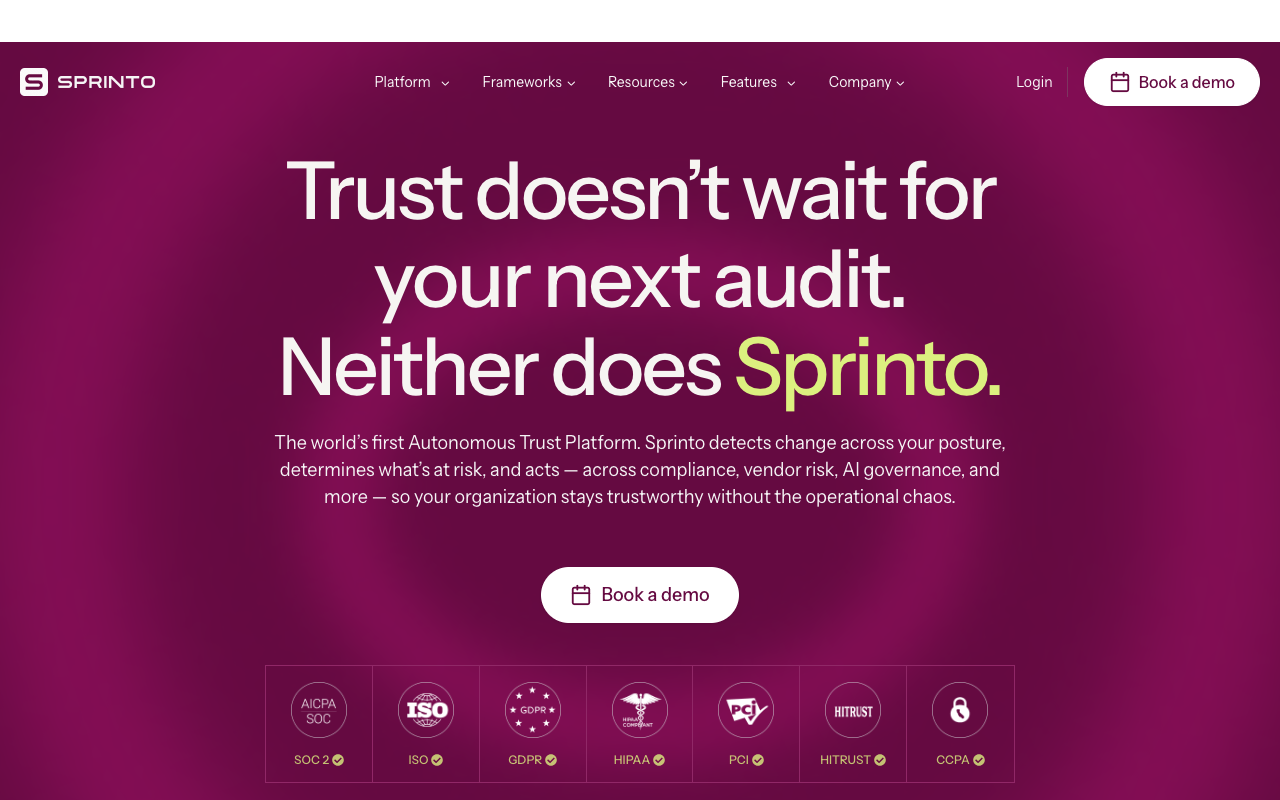
Sprinto has earned a reputation for getting teams to compliance fast. A 4.8/5 G2 rating across 1,500+ reviews is impressive on volume alone, and the teams that use it consistently report hitting compliance in weeks rather than months (see our Sprinto review for a full picture).
The platform is built around continuous monitoring and workflow automation. It connects to your cloud infrastructure, identity providers, and business tools, maps your environment to HIPAA controls, and surfaces the exact gaps you need to close. The 300+ native integrations cover most of what a cloud-native startup runs, and the workflow-based task management is genuinely useful for distributing compliance work across a small team without dropping anything.
Where Sprinto is weaker is healthcare specificity. It’s a SaaS compliance platform that includes HIPAA, not a HIPAA platform that also covers SaaS companies. Healthcare practices that need OSHA training, covered entity workflows, or clinical-specific features should look at Compliancy Group or Abyde instead.
“
For companies with small risk management and IT security teams, Sprinto has been valuable in helping manage risks and allowing quick policy drafting and enforcement. We hit HIPAA compliance in under six weeks.
★★★★★Verified User· SMB · 11–50 employees
Via Capterra ↗Key features:
- Automated security control monitoring across cloud infrastructure
- Workflow-based compliance task management
- 300+ native integrations across cloud, identity, and business tools
- Continuous compliance monitoring and real-time alerts
- Risk intelligence and remediation tracking
- Audit readiness dashboard and evidence locker
- HIPAA-specific control mapping
Pros of Sprinto
- Fast path to compliance: teams consistently report hitting HIPAA in weeks, not months
- 4.8/5 on G2 across 1,500+ reviews: the largest review base here after Vanta
Cons of Sprinto
- Not built for healthcare practices: no OSHA, no clinical training, no covered entity workflows
- Pricing increases meaningfully when adding a second or third framework
- Less white-glove than ComplyJet or Compliancy Group
Pricing: Contact for pricing
Best for: Cloud-native SaaS startups needing HIPAA with strong automation and a fast path to compliance
9. Accountable HQ
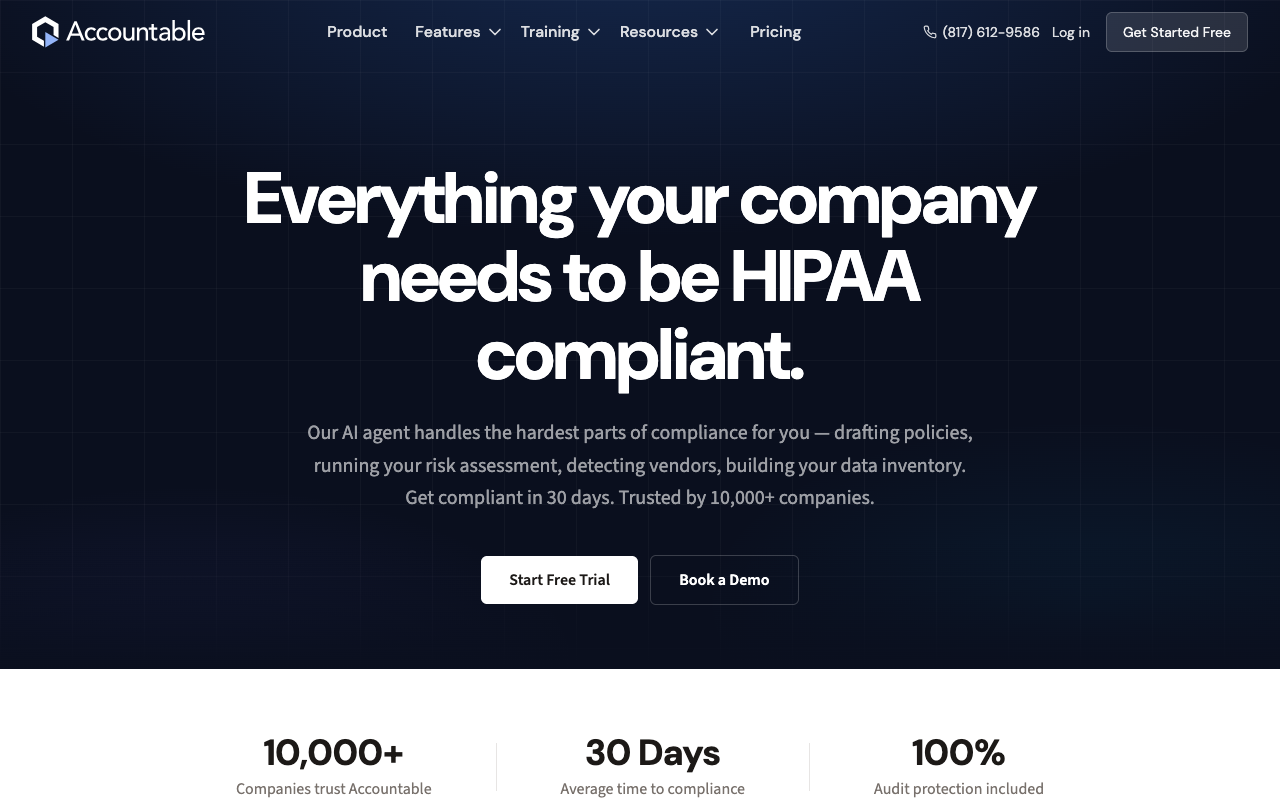
Accountable HQ does something most HIPAA compliance platforms refuse to do: it tells you the price upfront. Starting at $199 per month (or $169 per month billed annually) with a 7-day free trial and no credit card required, it’s one of the most accessible options in the dedicated HIPAA category. For small healthcare organisations that are tired of sitting through sales calls just to find out whether they can afford the tool, that alone is worth something.
The platform covers the full HIPAA compliance workflow: SRA, policy drafting, data flow mapping, workforce training (including Security Awareness, FWA, and Bloodborne Pathogens, not just HIPAA basics), vendor management, BAA tracking, and breach monitoring. The Pro tier adds phishing simulation and penetration testing, bringing it surprisingly close to what enterprise security programs include.
The AI Compliance Copilot handles a lot of the initial setup work, and the Trust Center gives you a shareable proof of compliance for partners and enterprise buyers.
The limitation is scope: Accountable HQ is HIPAA-focused. If you’re a health tech startup that also needs SOC 2, you’ll need a second platform. And while the per-employee pricing works well at small scale, it adds up for larger organisations.
“
Accountable makes HIPAA compliance simple, streamlined, and easy to follow. Their client support is lightning fast and incredibly helpful. I feel like we have a full-time cybersecurity director on staff.
★★★★★Verified User· SMB · 11–50 employees
Via G2 ↗Key features:
- AI-powered Compliance Copilot
- Security Risk Assessment and remediation planning
- Policy management and data inventory and flow mapping
- Employee training across HIPAA, Security Awareness, FWA, and Bloodborne Pathogens
- Vendor management and BAA tracking
- Incident reporting and data breach monitoring
- Phishing simulation and MFA review
- HIPAA Seal of Compliance and Trust Center
Pros of Accountable HQ
- Public pricing with a 7-day free trial: no sales call required to evaluate
- 10,000+ customers: the largest customer base of any dedicated HIPAA tool on this list
- Surprisingly comprehensive at higher tiers: phishing simulation and pen testing in the Pro plan
Cons of Accountable HQ
- HIPAA only: no SOC 2, ISO 27001, or multi-framework support
- Per-employee pricing model gets expensive for larger teams
- No dedicated compliance coach; support is responsive but not assigned
Pricing: Basic HIPAA: $199/mo ($169/mo annual). Plus: $299/mo ($254/mo annual). Pro: $799/mo ($679/mo annual). 7-day free trial on all plans.
Best for: Healthcare organisations of all sizes that want transparent pricing, a self-service evaluation path, and a complete HIPAA program without a sales conversation
10. Medcurity
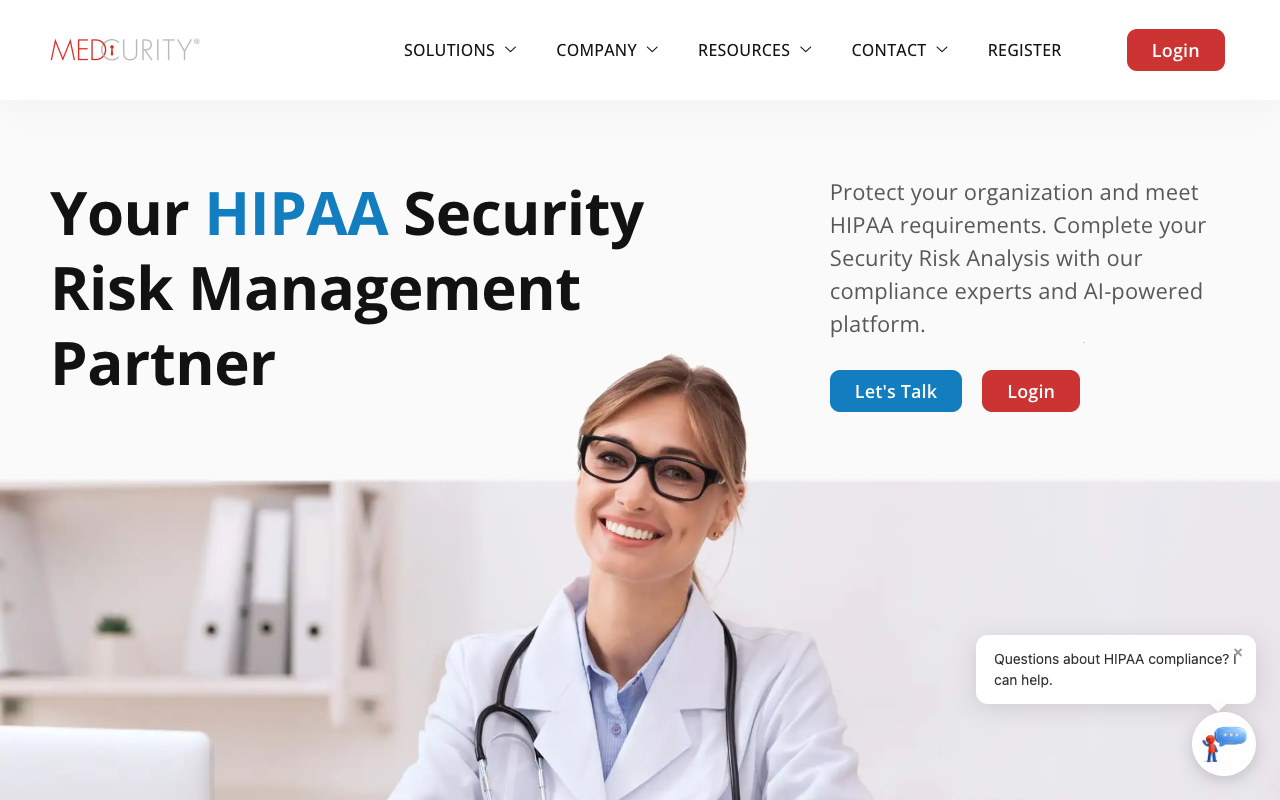
The first thing you notice about Medcurity is the price: $499 per year. That’s not a stripped-down trial tier. It’s a full-featured, self-service HIPAA Security Risk Analysis platform, and for healthcare startups or small practices on tight budgets, it’s the most significant cost advantage in the category.
Medcurity specialises in what matters most for OCR compliance: the Security Risk Analysis. The SRA is the document HHS asks for first in any audit, and Medcurity’s platform generates a customised, audit-ready report that’s been validated across 1,000+ healthcare facilities including FQHCs, rural hospitals, and multi-site practices. Beyond the SRA, the platform covers BAA management, HIPAA training, policy creation, network vulnerability assessments, and a centralised risk dashboard.
The tradeoff for the price is depth of automation. Medcurity does not offer the continuous cloud monitoring or multi-framework GRC coverage that platforms like Vanta or Drata do. It’s a HIPAA-specific tool, and its automation is focused on the SRA and risk management workflow rather than real-time controls monitoring. For healthcare practices that need to get their HIPAA program in order without spending thousands per month, it’s hard to beat.
“
Their process is more robust than previous HIPAA SRA providers and identified gaps we didn't know existed, while providing solutions and resources including a helpful dashboard to track progress.
★★★★★Rebekah D.· SMB
Via Medcurity website ↗Key features:
- Security Risk Analysis with customised, audit-ready reports
- Network vulnerability assessments
- HIPAA training and policy creation tools
- Business Associate Agreement management and tracking
- Centralised risk management dashboard
- Vendor management and due diligence
Pros of Medcurity
- From $499/year: the most affordable entry point of any dedicated HIPAA tool on this list
- 4.92/5 customer satisfaction across 1,000+ facilities: exceptional retention
- Healthcare-native SRA focus: reports are built to satisfy OCR requirements directly
- Advisor-assisted option available for teams that want expert guidance on top of the software
Cons of Medcurity
- Primarily SRA-focused: less automation depth than enterprise GRC platforms
- No multi-framework support: HIPAA only
- Smaller brand footprint than Compliancy Group or Accountable HQ
Pricing: From $499/year (self-service). Advisor-assisted plans available on request.
Best for: Healthcare startups, FQHCs, rural hospitals, and small practices that need a credible, audit-ready HIPAA program without a large software budget
11. Scytale
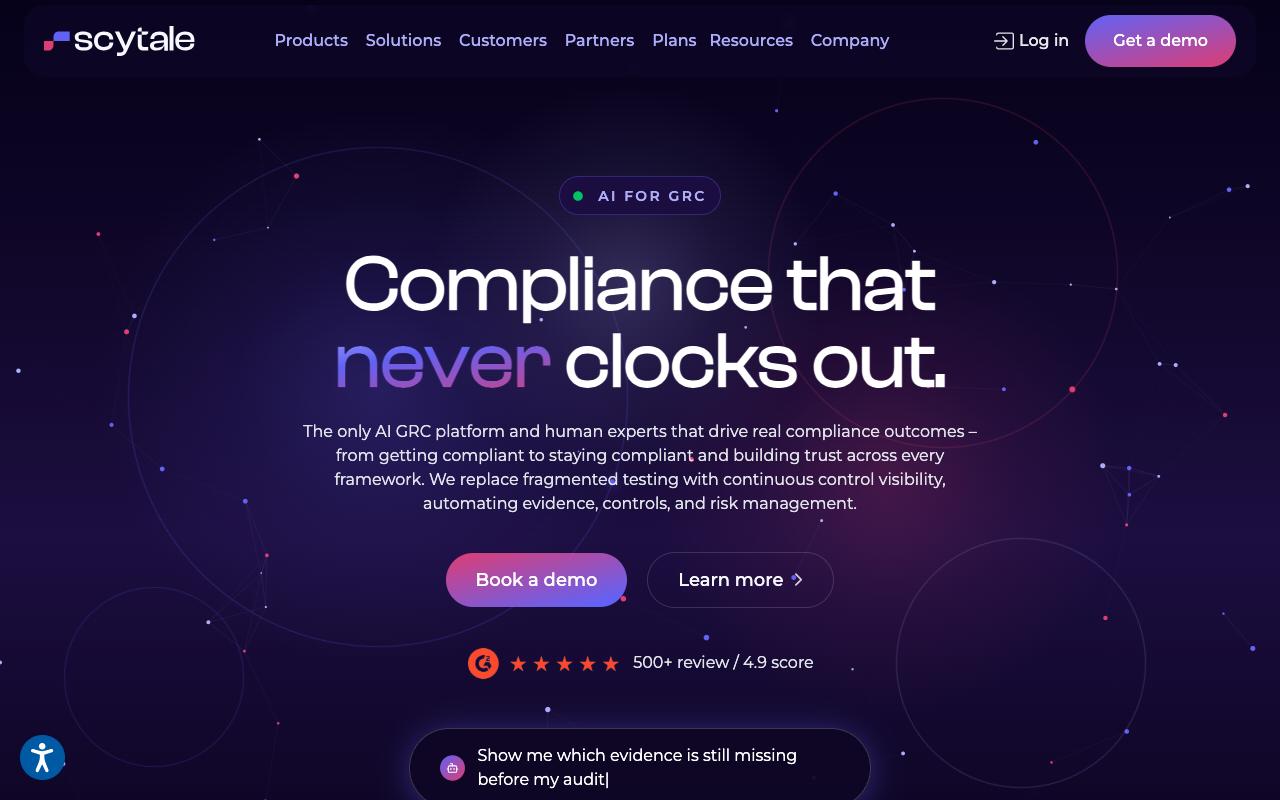
Scytale won the 2026 G2 Best Software Award in GRC, and its 4.8/5 rating across 578 reviews reflects consistent quality. What differentiates Scytale from most platforms on this list is the combination of AI-native multi-agent automation with genuine human expert support: you’re not just getting software, you’re getting a team that knows compliance and is actively watching your environment.
The multi-agent architecture is legitimately interesting. Instead of one monitoring system, Scytale runs dedicated agents: a Gap Scanner that identifies control failures, an Evidence Reviewer that validates what’s been collected, a Governance Engine that tracks policy currency, a Security Responder for incidents, and a Vendor Intel Agent for third-party risk. Across 80+ frameworks including HIPAA, SOC 2, ISO 27001, PCI DSS, and ISO 42001, that continuous coverage is meaningful for companies building out a serious compliance program.
The tradeoff relative to the top three is integrations: 150+ versus 400+ for Vanta. For most startups, 150 integrations will cover everything in their stack. For complex enterprise environments, that gap matters more.
“
The system is easy to use and integrations save plenty of time. But the best feature is the team — they're incredibly responsive and know compliance inside-out.
★★★★★Verified User· SMB · 11–50 employees
Via G2 ↗Key features:
- Multi-agent compliance automation: Gap Scanner, Evidence Reviewer, Governance Engine, Security Responder, Vendor Intel Agent
- Custom Trust Center for customer-facing compliance transparency
- AI-integrated penetration testing capabilities
- 150+ integrations across cloud, identity, HR, and development tools
- Continuous compliance monitoring and regulatory change tracking
- AI security questionnaire automation
Pros of Scytale
- 2026 G2 Best Software Award in GRC; 4.8/5 across 578 reviews
- Genuine expert support model: human experts, not just a support queue
- 80+ frameworks: one of the broadest coverage sets on this list
Cons of Scytale
- No public pricing
- 150 integrations is fewer than Vanta, Drata, or Sprinto
- Less well-known than the top three outside GRC practitioner communities
Pricing: Contact for pricing
Best for: SMB and mid-market SaaS companies needing HIPAA as part of a broader multi-framework compliance program, with expert-guided support
How to choose HIPAA compliance software
You’ve read the list. Now you’re deciding. Here’s how to cut through it.
Free Demo
Not sure which HIPAA compliance tool fits your org?
ComplyJet covers HIPAA, SOC 2, and 25+ other frameworks at flat per-company pricing. A compliance expert guides you through the whole process.
There are two types of decisions here. The safe decision is picking the most recognisable name: Vanta or Drata. Nobody will question it. The smart decision is matching the tool to what you actually need. For most healthcare practices and early-stage startups, that’s a different answer.
Are you a healthcare practice or a tech company?
This is the first question, and it matters more than any feature comparison.
If you’re a covered entity (a medical practice, dental office, mental health provider, pharmacy, or any organisation that provides healthcare services directly), you need tools designed around your workflows: SRA documentation, OSHA training, BAA management, workforce attestation, and OCR audit readiness. Compliancy Group, Abyde, Accountable HQ, and Medcurity are all built for you.
General GRC platforms like Vanta and Drata will get you HIPAA compliant, but they won’t have the clinical training formats, the OSHA modules, or the practice management context you actually need.
If you’re a technology company handling PHI (a health tech startup, a SaaS platform with healthcare customers, a digital health company), your compliance needs look different. You probably need HIPAA alongside SOC 2 or ISO 27001. You need cloud infrastructure monitoring, not workforce compliance training. ComplyJet, Vanta, Drata, Secureframe, Sprinto, and Scytale are the right category for you.
If you’re both (a health tech startup that also runs clinical operations), start with a GRC platform that has strong HIPAA coverage. Running two separate tools adds overhead you don’t need at early stage.
HIPAA compliant software vs. full GRC platform: which do you actually need?
The honest answer depends on where HIPAA sits in your compliance roadmap.
If HIPAA is the only framework you need, dedicated tools like Compliancy Group, Abyde, Accountable HQ, and Medcurity will serve you better. They’re built around HIPAA’s specific requirements, cost less, and don’t ask you to pay for SOC 2 infrastructure you’re not using.
If you need HIPAA alongside SOC 2, ISO 27001, GDPR, or PCI DSS, a general GRC platform makes more sense. Maintaining two separate tools adds overhead and creates evidence silos. ComplyJet, Vanta, Drata, Sprinto, and Scytale all handle HIPAA as one framework within a broader compliance program.
A useful rule of thumb: if you’re a Series A company or later, you’ll almost certainly need SOC 2 within the next 12 to 24 months if you don’t have it already. Pick a platform that handles both now so you’re not migrating later.
What’s your budget?
Budget is the fastest filter.
- Under $1,000/year: Medcurity, starting at $499. The only serious option at this price point.
- $2,000–$5,000/year: Accountable HQ Basic or Plus. Public pricing, no sales call required.
- $5,000–$8,000/year: ComplyJet ($5K single framework, $8K for two like HIPAA + SOC 2), flat per-company with no per-seat scaling.
- Contact-only: Vanta, Drata, Compliancy Group, Abyde, Secureframe, and Scytale all require a sales conversation.
How much hand-holding do you need?
Some teams want to pick up a tool, follow the prompts, and figure it out themselves. Others need someone to tell them what to do and make sure it actually gets done.
Self-serve options: Medcurity and Accountable HQ both let you start without a sales call. The platform guides you through the process.
Guided onboarding with ongoing support: Secureframe and Sprinto both have strong customer success teams that walk you through setup and stay engaged through your first audit cycle.
Guided outcome delivery: Compliancy Group gives you a named compliance coach assigned to your account. ComplyJet gives you a team that actively drives the process from day one, with world-class support focused on getting you to the outcome, not just keeping the software running.
Best HIPAA compliance software for small business and growing teams
For small healthcare practices (1–10 employees), Abyde and Medcurity are the strongest fits: built for your context, priced appropriately, and not asking you to manage cloud infrastructure monitoring that isn’t relevant.
For small health tech startups (11–50 employees) building SaaS products that handle PHI, ComplyJet and Sprinto are the most practical: multi-framework support, reasonable pricing for early-stage companies, and enough automation to run compliance without a dedicated compliance hire.
For practices and companies at 50+ employees, the choice expands to Vanta, Drata, Secureframe, and Scytale, depending on whether your primary need is healthcare workflows or multi-framework GRC.
If you’re a startup pursuing HIPAA or SOC 2 for the first time, ComplyJet is built for you: flat pricing, 350+ integrations, and a dedicated compliance expert on every account.
Frequently asked questions
What is HIPAA compliance software?
HIPAA compliance software helps covered entities and business associates meet the requirements of the HIPAA Security Rule, Privacy Rule, and Breach Notification Rule. It typically includes a Security Risk Analysis tool, policy management, workforce training tracking, Business Associate Agreement management, and incident response. The goal is to replace manual spreadsheets and document folders with a system that’s auditable, organised, and defensible when HHS comes knocking.
What is the best HIPAA compliance software?
It depends on who you are. For healthcare practices, Compliancy Group and Accountable HQ are consistently top-rated. For SaaS and health tech companies, ComplyJet, Vanta, and Drata combine HIPAA with broader compliance automation so you’re not running two tools. For the tightest budgets, Medcurity starts at $499 per year. There’s no universal best: the right tool is the one that matches your org type, your framework needs, and your budget.
How do I choose HIPAA compliance software?
Start with two questions: are you a healthcare practice or a tech company handling PHI, and do you need HIPAA only or HIPAA alongside SOC 2 and ISO 27001? Healthcare practices should look at Compliancy Group, Abyde, or Accountable HQ. Tech companies should look at ComplyJet, Vanta, Drata, or Sprinto. Then filter by budget: Accountable HQ publishes prices upfront; the rest require a sales call.
How do I conduct a HIPAA compliance audit?
A HIPAA compliance audit starts with a Security Risk Analysis (SRA): document where PHI lives in your environment, what threats exist, what controls are in place, and what gaps need remediation. From there: update your policies, complete workforce training, get BAAs signed with all vendors who touch PHI, and document everything. Most HIPAA compliance platforms automate much of this. Tools like Medcurity and Compliancy Group are specifically designed around the SRA workflow and produce audit-ready reports that satisfy OCR requirements.
How much does HIPAA compliance software cost?
Prices range from $499 per year (Medcurity, self-service) to $25,000 or more per year for enterprise GRC platforms. For small healthcare practices, expect $1,000 to $5,000 per year from dedicated HIPAA tools.
For SaaS companies needing HIPAA alongside SOC 2, ComplyJet starts at $8,000/year for two frameworks. Vanta, Drata, and Sprinto don’t publish prices but typically land in the $10,000 to $20,000+ range depending on team size and framework count.
Final thoughts
HIPAA compliance software is not one-size-fits-all. Healthcare practices and tech companies handling PHI have different workflows, different budgets, and different compliance footprints. The right tool for a dental practice is not the right tool for a health tech startup that also needs SOC 2.
Free Demo
Ready to get HIPAA compliant without the overhead?
ComplyJet gives you flat pricing, 350+ integrations, and a dedicated compliance team — so compliance gets done, not just started.
If you’re a SaaS company or digital health startup pursuing HIPAA for the first time, and you know SOC 2 is coming in the next year or two, the most efficient path is a platform that handles both without forcing you to migrate later. ComplyJet covers HIPAA alongside 25+ other frameworks at flat, predictable pricing, with a team that guides you through the process from day one rather than leaving you to figure it out from software alone.
If you’re a startup pursuing HIPAA, SOC 2, or ISO 27001 for the first time, ComplyJet gives you a team that guides you to the outcome, 350+ integrations, and flat per-company pricing that stays predictable as your team grows.