.svg)

You’re looking for GLBA compliance software, which means you already know the stakes. The FTC’s updated Safeguards Rule landed in June 2023 and turned what was once a loose, principles-based obligation into something with teeth: documented risk assessments, MFA, annual penetration testing, access controls, incident response plans, and a named qualified individual overseeing the whole program. Spreadsheets and good intentions don’t cut it anymore.
The problem is that most tools claiming GLBA support don’t actually have a dedicated GLBA framework. They just say “25+ frameworks” and hope you don’t look too closely. I did look closely. Every tool in this list has explicit, verified GLBA support: a dedicated product page, a named GLBA framework, or a published GLBA requirements mapping.
I’ve reviewed 7 GLBA compliance software tools covering the full range: purpose-built GRC platforms for financial institutions, IT audit tools for generating evidence, and enterprise data security platforms for NPI discovery at scale. This covers banks, credit unions, fintechs, mortgage companies, insurance firms, and universities subject to Gramm-Leach-Bliley Act compliance. If you’re also evaluating broader financial data compliance software beyond GLBA, check our compliance reporting guide for context on what good evidence looks like across frameworks.
The GLBA Safeguards Rule Now Has Teeth: What Changed in 2023
Key insight
Before 2023, GLBA compliance was largely self-directed. The original Safeguards Rule said you needed “an information sec
Before 2023, GLBA compliance was largely self-directed. The original Safeguards Rule said you needed “an information security program” but left the specifics vague. Financial institutions largely wrote their own interpretation.
The 2021 FTC amendments, fully effective June 2023, closed that gap. Now the GLBA Safeguards Rule requires specific controls: multifactor authentication for anyone accessing customer information, encryption of NPI in transit and at rest, annual penetration testing, vulnerability assessments at least every six months, and access controls based on least privilege.
It also mandates documented risk assessments, a formal incident response plan, annual board-level reporting, and a designated qualified individual overseeing the security program. That last one matters: you now need a named person accountable for GLBA, not just a general security posture.
GLBA has three rules total. The Privacy Rule requires you to disclose how you use and share customer NPI. The Safeguards Rule (the one with the 2023 updates) requires the security program. The Pretexting provisions prevent data access through false pretenses. Gramm Leach Bliley Act compliance, taken as a whole, means satisfying all three.
The practical implication for software: different tools solve different parts of this. GRC platforms manage the program itself (risk assessments, vendor oversight, control tracking). IT audit tools generate the evidence trail auditors actually look at. Data security platforms handle NPI discovery and classification, which you need before you can protect what you don’t know you have. Some tools do multiple jobs; most do one well.
How I Picked These 7 GLBA Compliance Tools
Key insight
I applied five filters to arrive at this list. These apply whether you’re evaluating purpose-built GLBA tools or broader
I applied five filters to arrive at this list. These apply whether you’re evaluating purpose-built GLBA tools or broader financial data compliance software with GLBA support:
- Confirmed GLBA support: Only tools with an explicit GLBA page, a named GLBA framework, or a published GLBA requirements mapping. I excluded platforms that imply GLBA support through broad “25+ frameworks” claims without naming GLBA specifically.
- Safeguards Rule coverage: Tools must address the security program requirements from the 2023 amendments, not just the Privacy Rule’s disclosure obligations.
- Review credibility: G2 rating and review volume as a signal of real-world adoption. Flagged where review counts are thin.
- Pricing transparency: I’ve noted where pricing is public vs. contact-only, since most tools in this category hide pricing.
- Fit across buyer sizes: The list covers community banks and credit unions through large enterprise financial institutions, because GLBA applies to both and the right tool depends heavily on your scale.
Quick Comparison Table
| Tool | Best for | Pricing | Standout feature |
|---|---|---|---|
| Apptega | MSSPs and multi-framework financial teams | Contact (14-day free trial) | Dedicated GLBA Safeguards Rule framework + task pack |
| Isora GRC | Financial institutions and universities | Contact | Purpose-built GLBA assessment + audit-ready reports |
| LogicManager | Mid-market ERM teams | Contact | AI-assisted GLBA control mapping |
| Netwrix | IT and security ops teams | Contact (SMB self-serve available) | Complete audit trail with GLBA requirements mapping |
| OneTrust | Enterprise compliance and privacy teams | Contact | 55+ frameworks including GLBA + CPRA crosswalk |
| Securiti | Multi-regulation financial institutions | Contact | GLBA + GDPR/CPRA compliance from one platform |
| BigID | Large enterprises with complex data estates | From $175,000/year | AI-driven NPI discovery across 100s of data sources |
The 7 Best GLBA Compliance Software Tools in 2026
1. Apptega
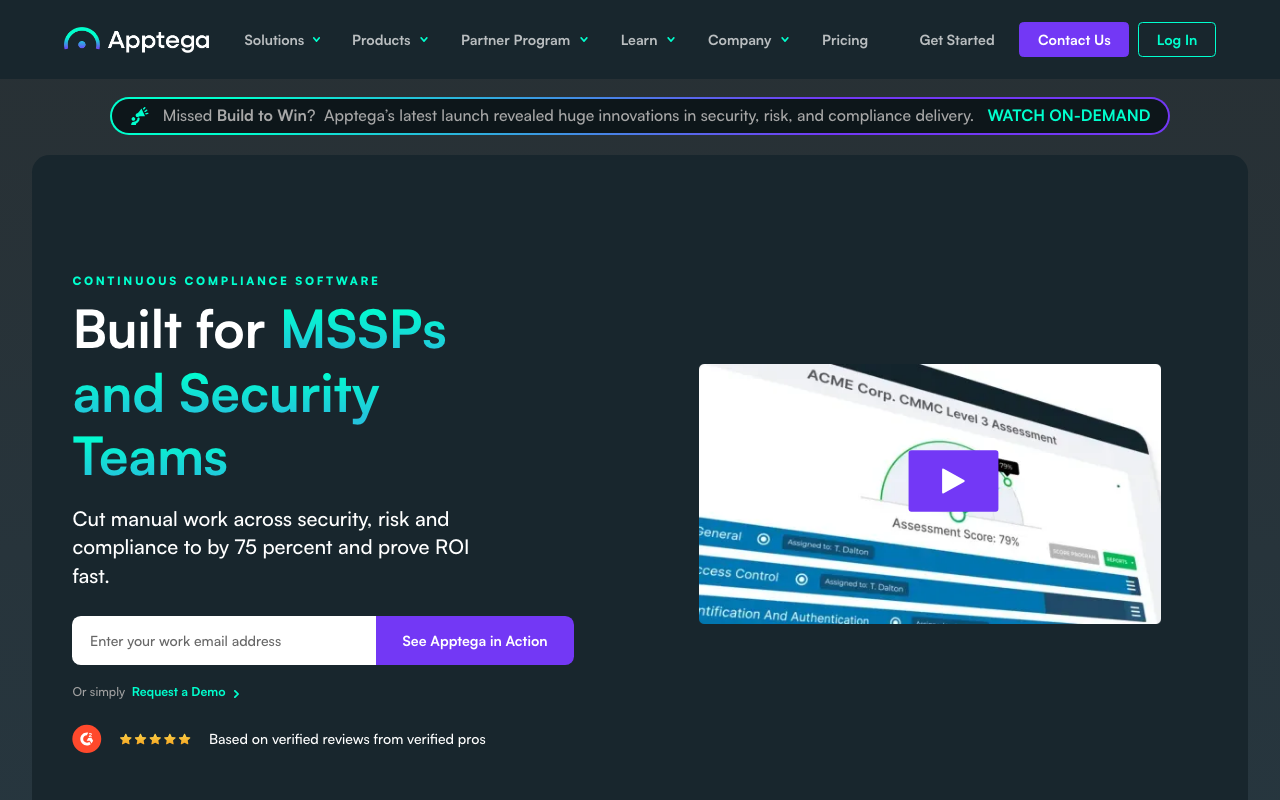
Apptega has the most complete GLBA implementation of any tool in this list. It doesn’t just include a GLBA checkbox in a framework library; it ships a dedicated GLBA Safeguards Rule assessment and task pack that was updated specifically for the 2023 FTC amendments, aligned directly to 16 C.F.R. § 314. That matters because a lot of platforms built their GLBA framework before June 2023 and haven’t kept pace with the new requirements.
The framework covers all three GLBA rules: Privacy, Safeguards, and Pretexting. What makes Apptega particularly useful for teams managing multiple frameworks is its Harmony crosswalk feature, which maps common controls across frameworks so you’re not duplicating work. If you’re handling GLBA alongside NIST CSF, CMMC, or PCI DSS, Apptega eliminates the redundancy.
The Audit Manager is genuinely useful: auditors can submit requests directly into the platform and Apptega transfers the relevant evidence, rather than you building a manual evidence folder for every audit cycle. The Third-Party Risk Manager handles vendor assessments, which the 2023 Safeguards Rule now explicitly requires.
The main limitation is the lack of published pricing. You need a sales call to get a number, which is annoying when you’re still in early evaluation mode. The 14-day free trial helps. It’s a full-platform trial, so you can actually stress-test the GLBA framework before committing.
“
The ability to manage multiple compliance frameworks like NIST, CMMC, GLBA, etc. and map common controls allows organizations to crosswalk programs and gain a holistic view of compliance status.
★★★★★Verified User
Via G2 ↗Key features:
- Pre-built GLBA Safeguards Rule assessment and task pack (updated June 2023)
- Automated questionnaire-based compliance evaluations
- Audit Manager for importing auditor requests and transferring evidence
- Third-Party Risk Manager for vendor cybersecurity assessment
- Framework Harmonization (Harmony) to eliminate duplicate controls across GLBA, NIST, SOC 2, and CMMC
- Risk gap identification with prioritized remediation tracking
Pros of Apptega
- Highest G2 rating in this list at 4.8/5 across 152 reviews
- Free 14-day trial lets you evaluate the GLBA framework before buying
- Harmony crosswalk is genuinely useful if you’re managing more than one framework
Cons of Apptega
- No published pricing; requires a sales call
- Multi-framework features add overhead if GLBA is your only requirement
- Smaller community than enterprise GRC platforms
Pricing: Contact sales. 14-day free trial available.
Best for: Financial services firms, MSSPs, and security teams managing GLBA alongside other frameworks like NIST, CMMC, or PCI DSS.
2. Isora GRC
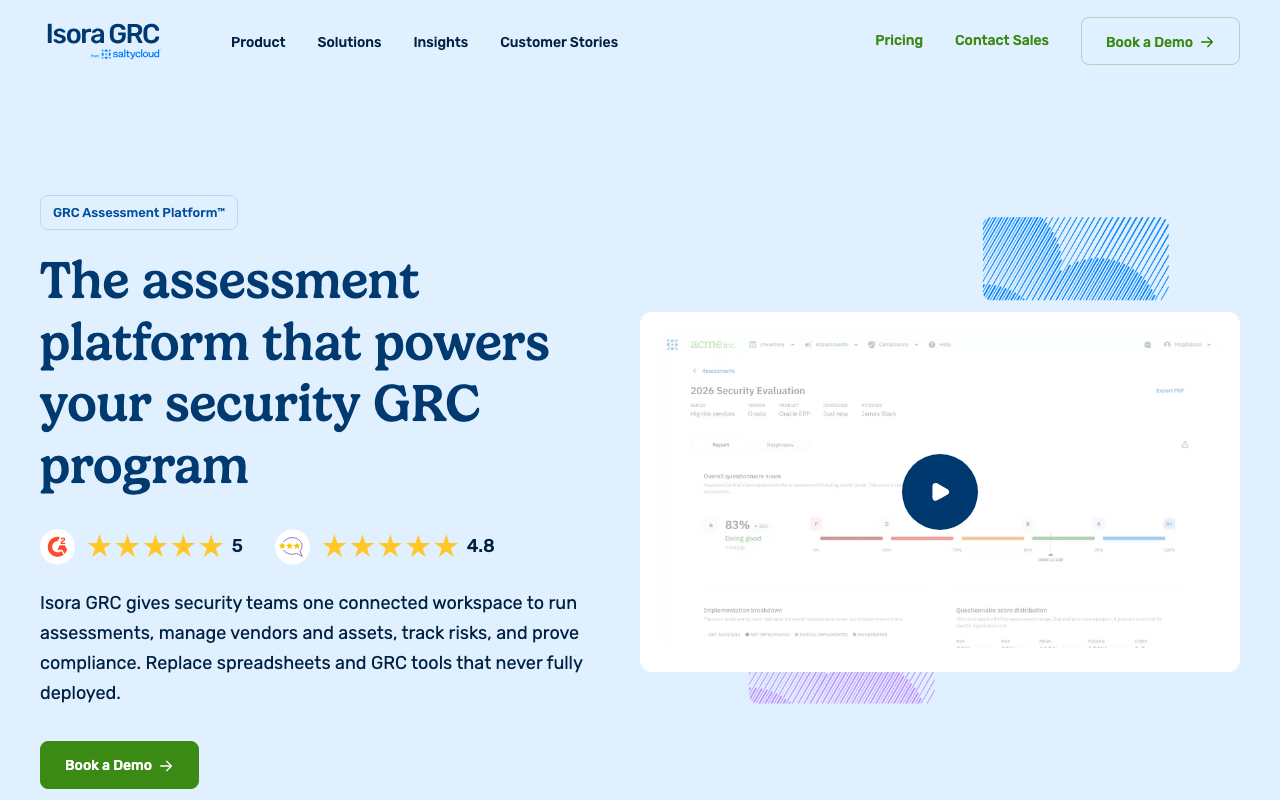
Isora GRC is the most purpose-built tool in this list. It wasn’t designed as a general GRC platform with GLBA tacked on; GLBA is a first-class use case with dedicated assessment templates, vendor management workflows, and audit-ready report generation built specifically for financial institutions and higher education.
The platform gives security teams a single workspace to run structured GLBA assessments across systems, teams, and vendors. The risk register is “living” in the useful sense: findings from assessments automatically populate it with owners, remediation plans, and full audit lineage, so you’re not manually translating assessment outputs into a separate tracking spreadsheet. That chain of evidence from assessment to finding to remediation is exactly what GLBA auditors look for.
The higher education focus is notable. Over 30 institutions use Isora GRC, including Virginia Tech, UC Berkeley, Yale, and Ohio State. Universities are a significant GLBA constituency that most compliance software ignores (student financial aid programs create GLBA obligations), so if you’re in higher ed, this is probably the most relevant tool in the list.
The trade-off is breadth. If you need GLBA alongside GDPR, SOC 2, or CMMC, Isora GRC is less equipped than Apptega or OneTrust. It does support other frameworks (NIST CSF 2.0, NIST 800-53, CIS Controls v8), but multi-framework crosswalks aren’t its strength.
“
The support we get is the best part of Isora GRC. Everyone is always quick to respond and help with training or any type of issue.
★★★★★Verified User
Via G2 ↗Key features:
- Structured GLBA assessment management across systems, teams, and vendors
- Centralized vendor inventory with security questionnaires and documentation storage
- Living risk register with owners, remediation plans, and full audit lineage
- IT asset inventory linked to assessments
- Exception tracking and policy exception resolution for audit readiness
- Audit-ready structured GLBA reports
Pros of Isora GRC
- GLBA is a first-class use case, not an afterthought
- Strong track record in higher education GLBA compliance
- Responsive support, which matters during audit season
Cons of Isora GRC
- No published pricing, no free trial
- Thin G2 review volume relative to larger platforms
- Less suited for multi-framework programs that go beyond GRC into data discovery
Pricing: Contact sales.
Best for: Financial institutions and universities that want a purpose-built GLBA GRC platform and don’t need to manage a large stack of additional frameworks simultaneously.
3. LogicManager
LogicManager has been building enterprise risk management software since 2006, which gives it a pedigree that newer GRC platforms can’t match. Its GLBA compliance module goes beyond a framework checklist: the Readiness Assessment feature breaks GLBA requirements into individual tasks, distributes them to the right activity owners, and links them to your existing controls automatically.
The AI-powered control library search is legitimately useful for GLBA specifically. When you’re implementing the Safeguards Rule, you often have existing controls (from SOC 2, PCI DSS, or internal security policies) that partially satisfy GLBA requirements. LogicManager scans your control library and surfaces which existing controls map to which GLBA requirements, which cuts down the implementation work significantly. Most teams don’t realize how much of GLBA they’re already covered for.
The Integration Hub is a practical advantage for mid-market teams: no-code connections to NetSuite, DocuSign, Office 365, BitSight, and RiskRecon mean GLBA compliance data flows automatically from the systems you already use, rather than being entered manually.
The pricing model is worth understanding before you sign up. LogicManager uses “Job-to-be-Done” pricing: a fixed price per compliance use case, with unlimited licenses for each job. That sounds clean, but it means you pay separately for each module. If your GRC needs grow beyond GLBA compliance, costs can escalate quickly.
“
I appreciate that LogicManager houses all our risks in one system, which makes it very helpful and centralizes risk management across our organization.
★★★★☆Verified User
Via G2 ↗Key features:
- GLBA Readiness Assessment that distributes requirements to activity owners and links to existing controls
- AI-powered control library search that surfaces existing controls satisfying GLBA requirements
- Centralized GLBA compliance plan and checklist
- Visualization of control deficiencies, compliance results, and testing calendars
- Integration Hub with no-code connections to NetSuite, DocuSign, Office 365, BitSight, and RiskRecon
- AI risk ripple analytics that reveal hidden connections between risks across departments
Pros of LogicManager
- 18+ years in ERM gives it a depth of methodology that newer platforms lack
- AI control mapping saves real time identifying what GLBA requirements you already satisfy
- Clean integration ecosystem for mid-market tech stacks
Cons of LogicManager
- No published pricing; per-module model can escalate as GRC needs expand
- Heavier to configure than purpose-built GLBA tools
- G2 rating of 4.2 is solid but lower than several alternatives in this list
Pricing: Contact sales. Job-to-be-Done model: fixed price per use case, unlimited licenses per job.
Best for: Mid-market financial institutions that want a mature ERM platform and have existing control libraries they want to leverage for GLBA compliance.
4. Netwrix: GLBA Audit Software for IT Teams
Netwrix plays a different role than the GRC platforms above. It’s an IT auditing tool, and its GLBA compliance functionality is built around one thing: generating the audit evidence trail that proves your controls are working.
The 2023 Safeguards Rule requires audit trails as part of the security program. Netwrix provides a complete record of who did what, when, and where across your entire IT infrastructure: Active Directory, file servers, Exchange, SharePoint, SQL Server, VMware, and more. That audit trail is searchable and retained for 10+ years, which covers you for long auditor lookback periods.
What I find genuinely useful about Netwrix is the published GLBA requirements-to-functionality mapping document. It’s a public document that shows exactly which Netwrix feature satisfies which GLBA Safeguards Rule requirement. That level of transparency is unusual in this space and makes vendor evaluation significantly faster.
One Netwrix customer, Forreston State Bank, reports saving 8 hours a week on auditing processes after implementing it, with continuous compliance across FFIEC and GLBA requirements. That’s a realistic number; manual audit trail generation is genuinely that time-consuming.
The important caveat: Netwrix is not a GRC program manager. It doesn’t run risk assessments, manage vendor questionnaires, or track your GLBA compliance plan. You’ll likely need it alongside a GRC platform like Apptega or Isora GRC, not instead of one.
Key features:
- Complete who/what/when/where audit trail across the full IT infrastructure
- Out-of-the-box GLBA compliance reports aligned to Safeguards Rule requirements
- Published GLBA requirements-to-Netwrix-functionality mapping document
- 10+ year searchable audit trail for auditor inquiries
- Access rights monitoring aligned with the Safeguards Rule’s access control requirements
- Anomaly detection and automated alerts for suspicious user behavior
- Continuous FFIEC compliance monitoring used alongside GLBA
Pros:
- Most credible review volume in this list: 4.5/5 across 266 reviews
- Published GLBA requirements mapping makes vendor evaluation fast
- SMB self-service checkout available without a sales call
- 10+ year audit trail retention is industry-leading
Cons:
- IT audit tool only: no risk register, no vendor management, no compliance program tracking
- Primarily Windows and Active Directory focused; cloud-native environments may need additional modules
- You’ll need a GRC platform alongside it to cover the full Safeguards Rule program
Pricing: Contact sales. Self-service checkout available for organizations up to 150 employees.
Best for: Financial institution IT and security teams that need a detailed audit evidence trail to satisfy GLBA Safeguards Rule reporting requirements.
5. OneTrust Tech Risk & Compliance
OneTrust is the broadest platform in this list. It covers 55+ compliance frameworks and approaches GLBA across two modules: the Privacy Automation module handles the Privacy Rule (NPI disclosures, consent, data mapping), while the Tech Risk & Compliance module handles the Safeguards Rule (security program management, risk assessments, incident response).
The GLBA + CPRA crosswalk is worth calling out specifically. Financial institutions operating in California are subject to both GLBA and CPRA, and managing them as two separate programs is wasteful. OneTrust has built a dedicated crosswalk between the two, so overlapping requirements (which are substantial) are addressed once rather than twice. If you’re a fintech with California customers, this is a meaningful differentiator.
The integration footprint is significant: 200+ pre-built integrations and 500+ system connectors. For large financial institutions with complex tech stacks, that matters. The platform pulls compliance data from the systems you already run, rather than requiring manual evidence entry.
The honest limitation: OneTrust is built for enterprises, and it shows. The platform is comprehensive and powerful, but it has a learning curve. For a community bank or small credit union that needs GLBA compliance without a dedicated GRC team, OneTrust is probably more platform than you need. For a large bank or fintech managing GLBA alongside GDPR, DORA, and NIST, it makes more sense.
Key features:
- 55+ ready-to-use compliance frameworks including GLBA
- GLBA Privacy Rule and CPRA crosswalk for dual-regulation management
- Centralized policy management with approval workflows and attestation tracking
- Incident and breach response workflows from intake through remediation
- 200+ pre-built integrations and 500+ system connectors
- Real-time risk dashboards with dynamic compliance scoring
Pros:
- Best option for managing GLBA alongside GDPR, DORA, CPRA, or other global regulations
- Strong G2 rating: 4.6/5 across 109 reviews
- GLBA + CPRA crosswalk is a genuine differentiator for California-based financial institutions
Cons:
- Enterprise-grade complexity: significant learning curve for smaller teams
- Modular pricing means combining Privacy and Tech Risk modules increases cost substantially
- Overkill for organizations whose compliance footprint is limited to GLBA
Pricing: Contact sales. Modular pricing by product.
Best for: Enterprise financial institutions and fintechs managing GLBA alongside multiple global regulations, particularly those subject to both GLBA and CPRA.
6. Securiti

Securiti calls itself a “Data Command Center” and that framing is accurate: it covers data security, privacy, governance, and compliance from a single platform, with multiple dedicated GLBA product pages covering the Safeguards Rule, Privacy Rule, and risk assessment requirements separately.
The core capability is automated data discovery and classification. Before you can protect NPI, you need to know where it lives. Securiti uses AI to discover and classify sensitive financial data across your environment, which is particularly valuable for institutions with data spread across cloud services, SaaS tools, and legacy on-premises systems. The 2023 Safeguards Rule’s access control requirements are hard to satisfy if you don’t have a complete data inventory.
Where Securiti stands out is the multi-regulation angle. If you’re subject to GLBA in the US while also handling GDPR for European customers, LGPD for Brazilian customers, and CPRA for Californians, Securiti manages all of them from one platform with a unified data map. That’s a significant operational advantage over running separate tools for each regulation.
The trade-off is complexity. Securiti is a powerful platform, and the breadth of its features can create a learning curve for teams that just want to check the GLBA box quickly. It’s also not a GRC program manager in the traditional sense: strong on data discovery and privacy, less focused on the security program management and vendor oversight components of the Safeguards Rule.
“
Securiti keeps us compliant with privacy regulations. It offers one central location to manage compliance for multiple domains, manage website scans, cookie categorization, and provides exactly what our developers need.
★★★★★Verified User
Via G2 ↗Key features:
- Automated data discovery and classification for NPI and sensitive financial data
- GLBA Safeguards Rule compliance lifecycle management
- GLBA risk assessment automation
- Data breach investigation and automated notification workflows
- Access intelligence with least-privilege monitoring
- Multi-regulation crosswalk: GLBA alongside GDPR, CPRA, PCI DSS from one platform
Pros of Securiti
- Highest G2 rating in this list: 4.7/5
- Best option for managing GLBA alongside global privacy regulations simultaneously
- Strong automated NPI discovery and classification, critical for Safeguards Rule access controls
Cons of Securiti
- Complex platform with a significant learning curve
- No published pricing; enterprise-oriented cost structure
- Less focused on GRC program management (risk registers, vendor questionnaires) than on data-centric compliance
Pricing: Contact sales.
Best for: Financial institutions operating under multiple privacy regulations simultaneously, particularly those handling GLBA alongside GDPR, CPRA, or other global frameworks.
7. BigID
BigID is the most enterprise-focused tool in this list by a significant margin. It’s a Forrester Wave Leader for Sensitive Data Discovery and Classification (2026) and one of only three vendors in the Leaders category. The pricing reflects that position: paid plans start at $175,000 per year, which immediately removes community banks, credit unions, and most fintechs from the evaluation.
For the organizations it’s built for, the NPI discovery capability is industry-leading. BigID uses AI-powered classification with over 1,000 pre-trained classifiers covering 100+ languages, deployed across cloud, SaaS, on-premises, and development environments. The GLBA Safeguards Rule requires a data inventory as the foundation of your information security program, and BigID builds that inventory at a scale and coverage depth that no other tool in this list can match.
The GLBA compliance automation includes continuous data posture monitoring: the platform doesn’t just build a one-time inventory, it monitors it continuously so that new NPI sources are caught automatically. When a data breach occurs, the automated investigation and notification workflows cover the GLBA’s incident response requirements directly.
The important caveat, beyond pricing: BigID is a data discovery and classification tool, not a GRC program manager. It won’t run your GLBA risk assessments, manage vendor questionnaires, or track your Safeguards Rule compliance plan. Large financial institutions will typically run BigID alongside a GRC platform, not instead of one.
“
BigID is very good for data security, privacy and compliance. Really nice platform, easy to use and a great way to protect your data without worrying about leaks.
★★★★☆Verified User
Via G2 ↗Key features:
- AI-powered discovery and classification of NPI across cloud, SaaS, and on-premises sources
- 1,000+ pre-trained classifiers covering 100+ languages
- GLBA Safeguards Rule compliance automation with continuous data posture monitoring
- Audit-ready GLBA compliance reports
- Data breach investigation and automated notification workflows
- Access intelligence with least-privilege enforcement
- AI-augmented remediation: labeling, masking, redaction, retention, and deletion
Pros of BigID
- Deepest NPI discovery capability of any tool in this list
- Forrester Wave Leader recognition in Sensitive Data Discovery and Classification
- Continuous posture monitoring catches new NPI sources automatically
Cons of BigID
- $175,000/year minimum eliminates most small and mid-size financial institutions
- Data discovery tool only: no GRC program management, no risk register, no vendor oversight
- Overkill unless you have a genuinely complex, distributed data environment
Pricing: Free tier available. Paid plans from $175,000 per year.
Best for: Large financial institutions with complex, distributed data estates that need enterprise-grade NPI discovery and classification as part of a broader GLBA compliance program.
GLBA Compliance Checklist: How to Choose the Right Software
The seven tools above don’t compete directly with each other. They solve different problems within the GLBA compliance landscape, and the right choice depends on what your specific gap is.
Are you managing GLBA as a standalone requirement or alongside other frameworks?
If GLBA is your primary obligation and you don’t have significant overlap with GDPR, CMMC, or SOC 2, purpose-built tools are the faster path: Isora GRC deploys quickly and generates audit-ready reports, and Apptega’s 14-day trial lets you evaluate without a sales commitment.
If you’re managing GLBA alongside other frameworks, crosswalk capability matters more than GLBA depth. Apptega’s Harmony feature handles NIST, CMMC, and SOC 2 overlap well. OneTrust and Securiti are the right calls when global privacy regulations like GDPR or CPRA are also in scope.
Do you need a GRC program manager or a technical audit tool?
These are different tools solving different problems. If you’re unsure of the distinction, our GRC vs IRM guide covers how these categories relate.
A GRC program manager (Apptega, Isora GRC, LogicManager, OneTrust) helps you build and track the compliance program itself: risk assessments, vendor management, control tracking, and board reporting. A technical audit tool (Netwrix) generates the evidence trail that proves the program is working. A data discovery platform (Securiti, BigID) finds and maps the NPI that the security program needs to protect.
Most organizations need at least two of these. Ask yourself which gap is most urgent before choosing a single platform.
What is your organization’s size and budget?
For community banks, credit unions, and small fintechs: start with Apptega (free trial, GLBA-specific framework), Isora GRC (purpose-built for your context), or Netwrix (SMB self-service checkout available). These three have the lowest barrier to entry.
Mid-market financial institutions with a GRC team: LogicManager and OneTrust are the right tier. More configuration required, but stronger long-term program management.
Large enterprises with complex data environments: BigID for NPI discovery, OneTrust or Securiti for multi-regulation program management.
Do you handle customer data across multiple jurisdictions?
If your compliance footprint is US-only GLBA, any tool in this list works. If you’re also subject to GDPR, CPRA, LGPD, or other global privacy regulations, choose Securiti or OneTrust. Both are built for multi-regulation management and have explicit crosswalk features for GLBA plus other frameworks.
How fast do you need to be audit-ready?
If you’re approaching a GLBA audit and need structured, auditor-ready reports quickly, Isora GRC and Netwrix are the fastest paths. Isora GRC generates structured GLBA reports from assessment data. Netwrix has preconfigured GLBA compliance reports that pull from your existing audit trail.
If you’re building a long-term GLBA compliance program from scratch, LogicManager, Apptega, and OneTrust are designed for that horizon.
Frequently Asked Questions
What is GLBA compliance?
GLBA compliance means meeting the requirements of the Gramm-Leach-Bliley Act, which requires financial institutions to protect customers’ nonpublic personal information (NPI). The law has three components: the Privacy Rule (requires disclosure of how NPI is collected, used, and shared), the Safeguards Rule (requires a written information security program protecting NPI), and the Pretexting provisions (prohibit accessing NPI under false pretenses).
The 2023 FTC amendments significantly expanded the Safeguards Rule’s technical requirements, adding MFA, penetration testing, formal risk assessments, and incident response plan requirements.
Who does GLBA apply to?
GLBA applies to “financial institutions” as broadly defined by the FTC: banks, credit unions, insurance companies, mortgage lenders and brokers, investment advisors, tax preparers, real estate appraisers, auto dealers offering financing, and any business “significantly engaged” in financial activities.
Many fintechs fall under GLBA. Universities that participate in federal student loan programs are also subject to GLBA through the FTC Safeguards Rule. If you collect, store, or process nonpublic personal information as part of a financial service, GLBA likely applies.
What are the main GLBA requirements?
Under the updated Safeguards Rule, financial institutions must: designate a qualified individual to oversee the information security program; conduct and document a risk assessment; implement specific safeguards including MFA, encryption, access controls, and audit trails; conduct annual penetration testing and vulnerability assessments at least every six months; develop a formal incident response plan; oversee service providers through due diligence and contract provisions; and report to the board of directors at least annually on the status of the security program.
How do you achieve Gramm-Leach-Bliley Act compliance?
Six steps: first, identify all NPI your organization collects, processes, and stores (the data inventory the Safeguards Rule requires as its foundation). Second, designate a qualified individual to own the security program. Third, conduct a formal, documented risk assessment.
Fourth, implement a written information security plan covering all Safeguards Rule requirements: MFA, encryption, access controls, penetration testing, and an incident response plan. Fifth, assess and monitor third-party service providers who handle NPI on your behalf. Sixth, test and update the program at least annually. GLBA compliance software automates most of this, particularly risk assessments, vendor management, audit trail generation, and board reporting.
Final Thoughts
GLBA compliance is a serious regulatory obligation, and the 2023 Safeguards Rule amendments made that clearer than ever. The right software depends on what your specific gap is. If you need a purpose-built GRC program, Apptega and Isora GRC are the strongest dedicated options. If you’re generating audit evidence for an IT infrastructure, Netwrix is purpose-built for that. If you’re managing GLBA alongside global privacy regulations at enterprise scale, Securiti and OneTrust are the right tier.
Every tool in this list has confirmed, explicit GLBA support. That distinction matters more than it might seem. Start with a free trial where available (Apptega offers one), and book demos with your shortlist before committing. GLBA software is a multi-year decision; a week of proper evaluation is worth the time.