.svg)

Most compliance tools avoid showing prices upfront. Oneleet does the same. You book a demo, then get a quote that suits your organisation's stage. That used to be accepted.
In 2026, it is not. Founders now share real quotes publicly on Reddit & LinkedIn. YC teams compare notes. The market is no longer opaque unless vendors choose it to be.
Vague pricing is often justified by saying every company is different. That sounds fair at first.
But in practice, it creates doubt and leaves buyers without context. You do not know what is normal. That gap often costs a fortune and weakens your negotiating position.
This blog bridges that gap and brings clarity. It outlines realistic Oneleet pricing ranges and points out where value is bundled, including audits and penetration testing.
If you want a reference point before sales calls, many founders start with ComplyJet to anchor expectations.
Book a quick demo to know what you're paying for!
Now, let us look at why Oneleet keeps pricing opaque and how that affects your decision.
How Oneleet Prices Its Platform in 2026
If you're hoping for a clean pricing table, you won't find one. Oneleet doesn't list plans or tiers. You book a demo, answer some questions, and wait for a quote. That's the only way.
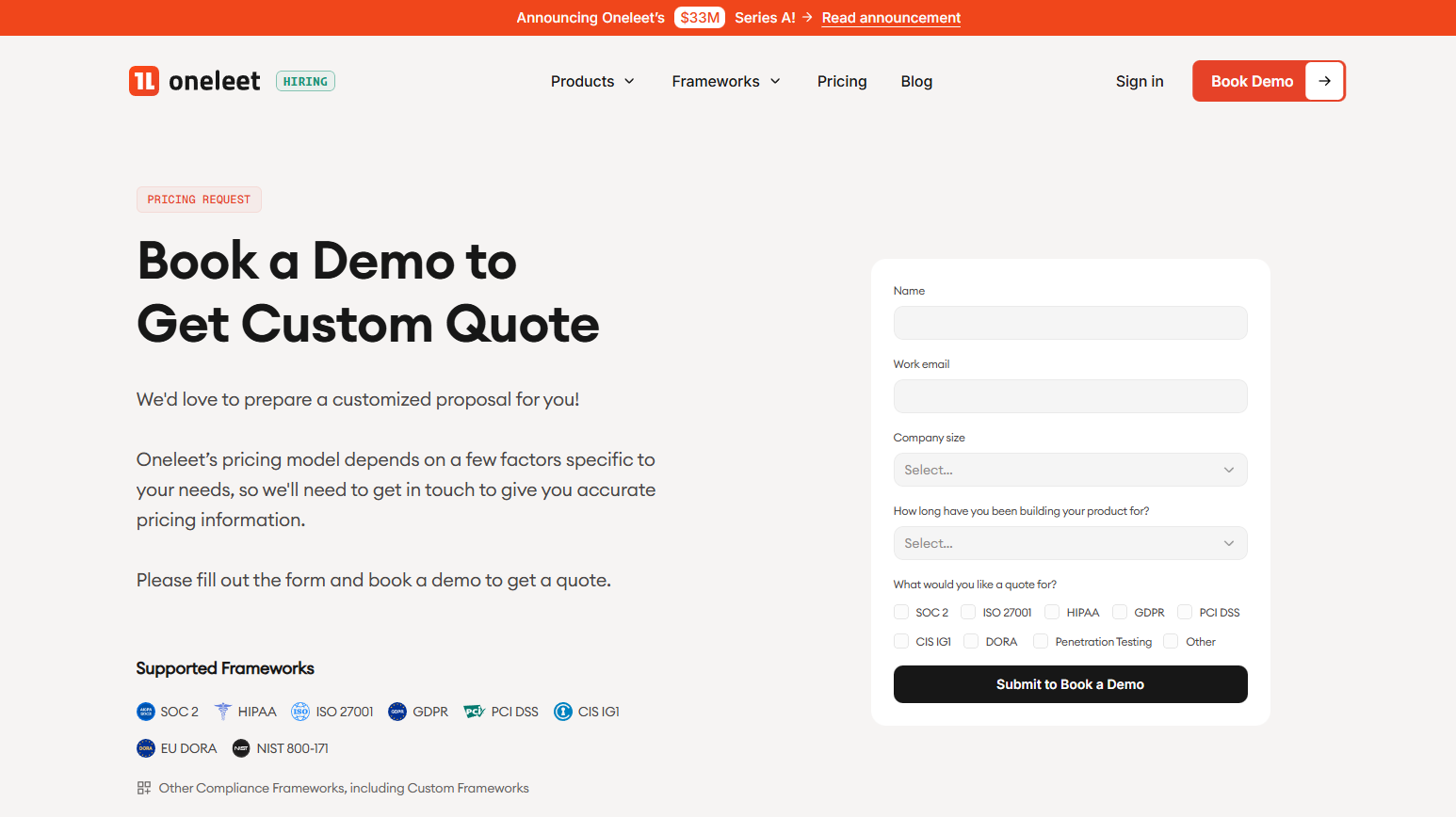
This approach lets them shape the offer to your setup. But it also means you have zero frame of reference going in.
Some founders say they paid around $17K. Others mention quotes north of $40K. Most land somewhere between $15K and $50K a year.
The lack of pricing upfront creates guesswork. If you haven't done this before, it's hard to know what's normal.
Key Factors That Drive Oneleet Cost
Your team size affects everything. A five-person startup won't be quoted the same as a fifty-person one. More people usually means more accounts to track and more systems to monitor.
The frameworks you need also matter. If you're going for SOC 2 Type I, that's one price. Add ISO 27001 or HIPAA later, and the cost climbs. Oneleet only runs one framework at a time, so that stretches things out.
Support level changes the bill, too. If you prefer a hands-on approach with someone guiding you through every step, keep that in mind. While automation-only setups tend to be cheaper, they lack the human element.
Penetration testing is included in most plans, which can cost anywhere from five to ten thousand dollars elsewhere. The same goes for audits; they are often bundled together, but it's important to ask for clarification to ensure you have all the details.
Your technology stack also plays a significant role in this process. Standard setups like AWS and GitHub are generally easier to manage. If you're using a custom setup or niche tools, it might take more work, which means more cost.
What's Actually Included
Oneleet sells itself as more than just compliance. The pricing includes real security tools. That's what sets it apart.
You get manual penetration testing. Not the automated kind. Real humans looking for real issues. For most startups, that's worth thousands right there.
They also give you access to a security advisor, often someone acting like a part-time CISO. If your team has never done a risk review or set up offboarding processes, this person helps with that.
There's also cloud scanning, code analysis, and attack surface monitoring. All the stuff you'd normally buy from three different vendors. They handle audit coordination, too, so you don't spend time going back and forth with external firms.
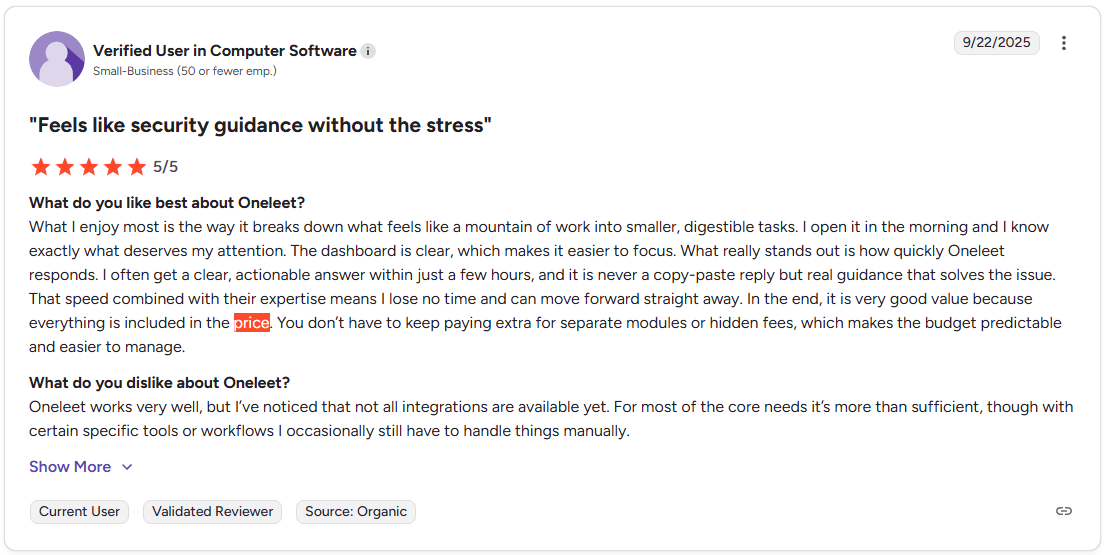
Customers usually praise this approach and are relieved that most of the services are included in the quote, as highlighted by this verified Oneleet user.
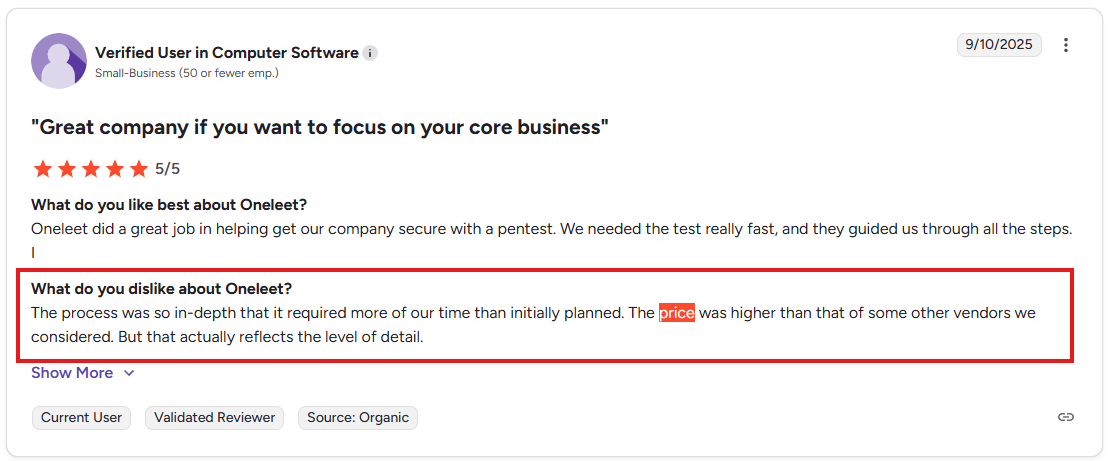
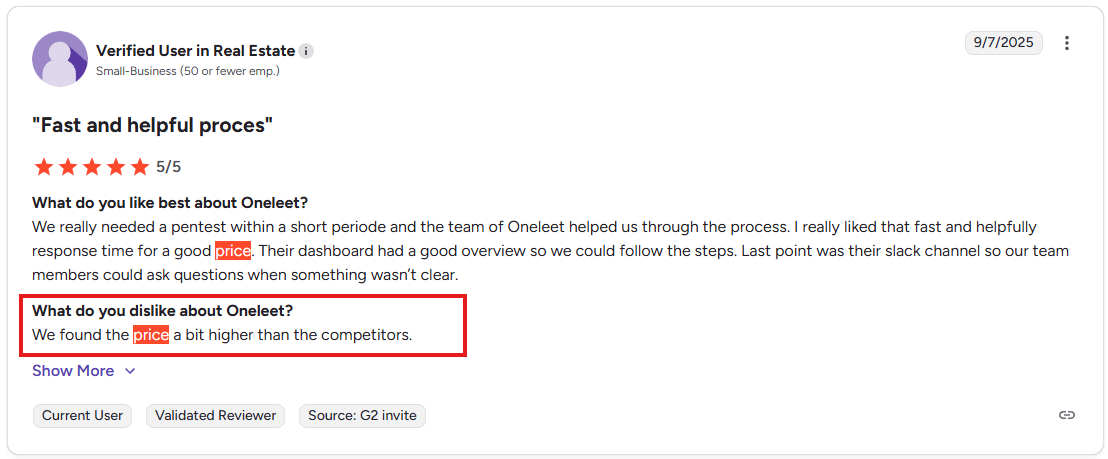
But major Oneleet users feel otherwise. They state the pricing is very high compared to the competitors' offering the same services. A few of them are highlighted here.
Next up: let's walk through what actual customers are getting at each pricing level.
Oneleet Pricing Plans Decoded: Real-World Customer Packages
Oneleet won't hand you a pricing sheet. But when you dig through founder posts and customer quotes, patterns start to show. Most teams fall into one of three buckets. The plan you're offered depends on how much help you need and how far along you are.
Some teams want to pass a security review. Others need to get audit-ready fast with guidance from someone who's done this before. Then there are teams juggling multiple frameworks at once. The pricing shifts with each use case.
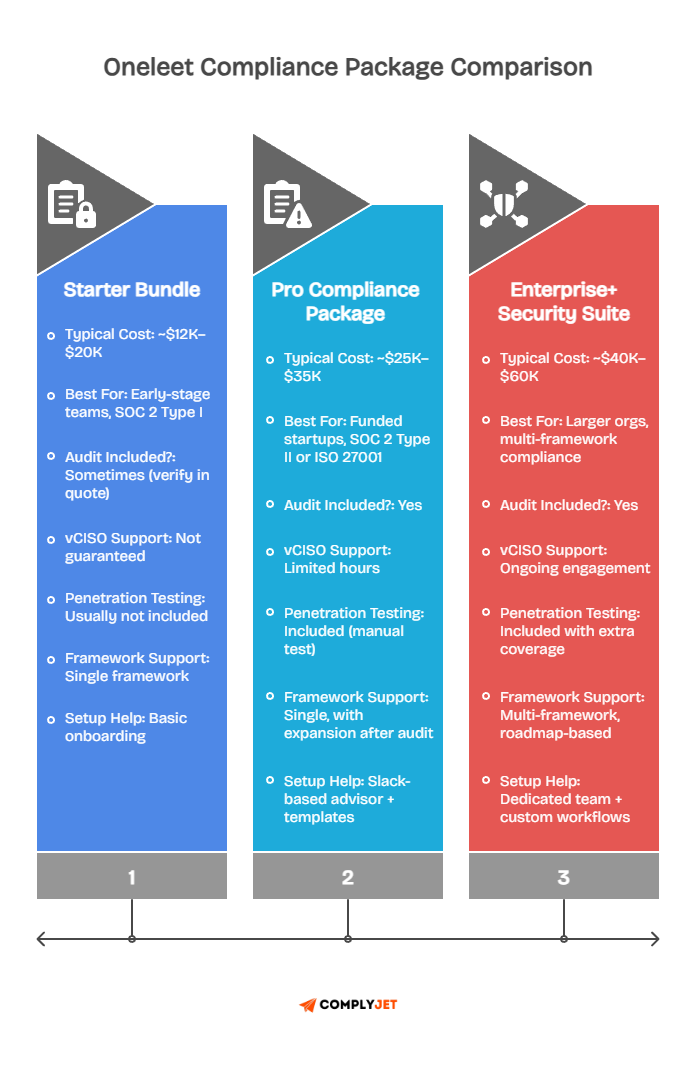
Starter Bundle (~$12K - $20K)
This one usually covers the basics. If you're trying to get SOC 2 Type 1 done, this is the tier you're in. This is generally suitable for early-stage teams. It includes automation, policy templates, and some basic onboarding support. However, do not expect extensive assistance compared to higher tiers.
There is no clear information on virtual Chief Information Security Officer (vCISO) support, and you will need to manage some aspects on your own.
One important thing to verify is whether the audit is included in this tier, as some users have reported that it is not. Clarifying this early can help you avoid any surprises later on.
Pro Compliance Package (~$25K - $35K)
This is where most funded teams land. You're either going for SOC 2 Type II or ISO 27001, and need a bit more help getting there.
The audit is part of the deal here. You also get someone to walk you through setup, often over Slack. If your team has never gone through a compliance process before, this saves a lot of time.
You'll also get limited hours with a vCISO, which is enough to get guidance on risky areas or clean up workflows. And there's a real penetration test included, not just a scan.
Enterprise+ Security Suite ($40K - $60K)
This tier is for larger or more regulated teams. If you've got enterprise deals in flight or have multiple frameworks lined up, this is what you'll probably be quoted.
You get a full compliance roadmap across frameworks, with hands-on help from a vCISO. One team mentioned they had weekly calls and custom risk registers created for them.
There's more depth, too. Cloud security reviews, attack surface scanning, Jira and GitHub integration, and direct help with monitoring. This plan is less about getting a certificate and more about running a real security program.
Next up: let's see how much these packages are actually worth and whether the price lines up with the ROI.
Oneleet Cost by Framework: SOC 2, ISO 27001, HIPAA, and More
Most teams shopping for a compliance tool ask the same thing first: how much will it cost us for SOC 2 or ISO 27001? But with Oneleet, that answer shifts depending on the framework you choose and how deep you need to go.
Their model is custom-quoted, and that makes pricing harder to predict unless you've seen other quotes before.
You're not just paying for automation here. You're paying for security services and expert-led audits built into each framework rollout. That sounds solid, but it also means you can't always scale frameworks in parallel.
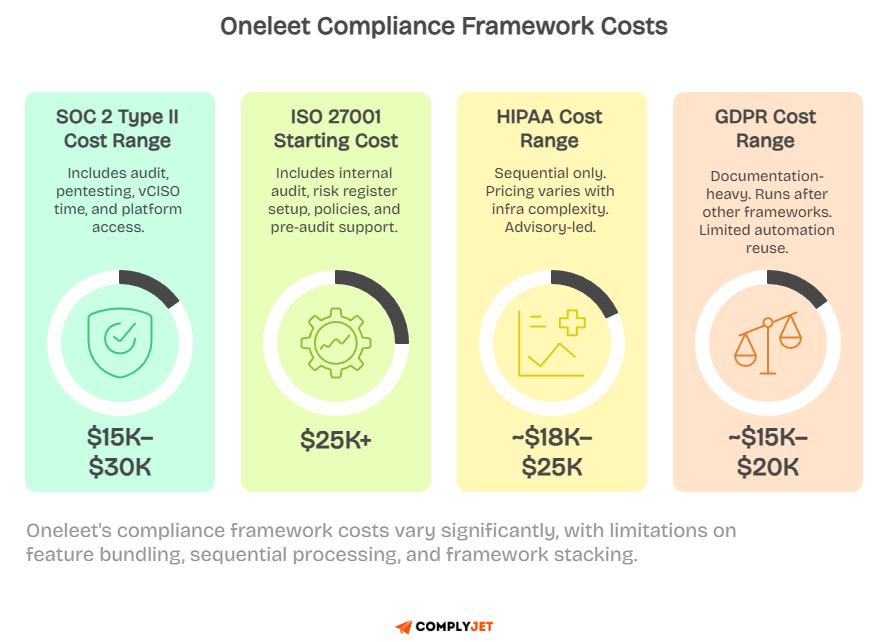
Let's break down the actual costs, one framework at a time.
SOC 2 Type II ($15K - $30K)
For SOC 2 Type II, most startups using Oneleet report quotes between $15,000 and $30,000. That range includes platform access, monitoring, vCISO time, and the audit itself.
Oneleet usually bundles in penetration testing, which would normally cost another $5,000 to $10,000. The higher price can still land you a decent ROI if you plan to go deep on security posture.
One drawback? You can't unbundle features you don't need. If you've already got pentesting handled or don't want advisory time, you're still likely paying for it in the package. And SOC 2 Type I isn't usually offered as a standalone option unless you specifically ask.
ISO 27001: ($25K+)
ISO 27001 with Oneleet usually starts around $25,000 for startups, and can easily go higher with support hours and custom integrations.
This includes help with risk register mapping, policy templates, and pre-audit review from their security experts. Oneleet also handles internal audits as part of their package, which cuts out an extra vendor cost.
But again, you'll be able to activate this only after your SOC 2 cycle is completed.
That means your timeline extends if you need both certifications at the same time.
If your buyer requires ISO 27001 fast, you might need to switch platforms or delay deals.
HIPAA and GDPR: Available, But Sequential
HIPAA and GDPR are supported, but not as bundled framework modules. You'll go through them one after another, just like SOC 2 and ISO.
The cost for HIPAA usually sits near $18K to $25K, depending on advisory hours and infrastructure complexity. GDPR runs slightly lower, often because it's driven by documentation more than technical checks.
What this means is you'll pay per framework, and you'll also wait per framework. That might work fine if you've got staggered client requirements. But if you're aiming for multiple logos at once, this delay could slow down revenue.
Why You Can't Stack Frameworks on Oneleet
Oneleet's compliance automation system focuses on one framework at a time, which means its internal audits, risk workflows, and policy checks are scoped accordingly. This approach aims to reduce confusion and prevent overlapping control testing. However, the downside is that you must wait for the completion of one framework before starting the next.
In contrast, tools like ComplyJet enable teams to run SOC 2, ISO 27001, or HIPAA audits in parallel with shared control mapping.
This can save months of work and reduce overall costs because evidence is reused, and audit cycles can be synchronized. For some teams, this difference is a crucial deciding factor.
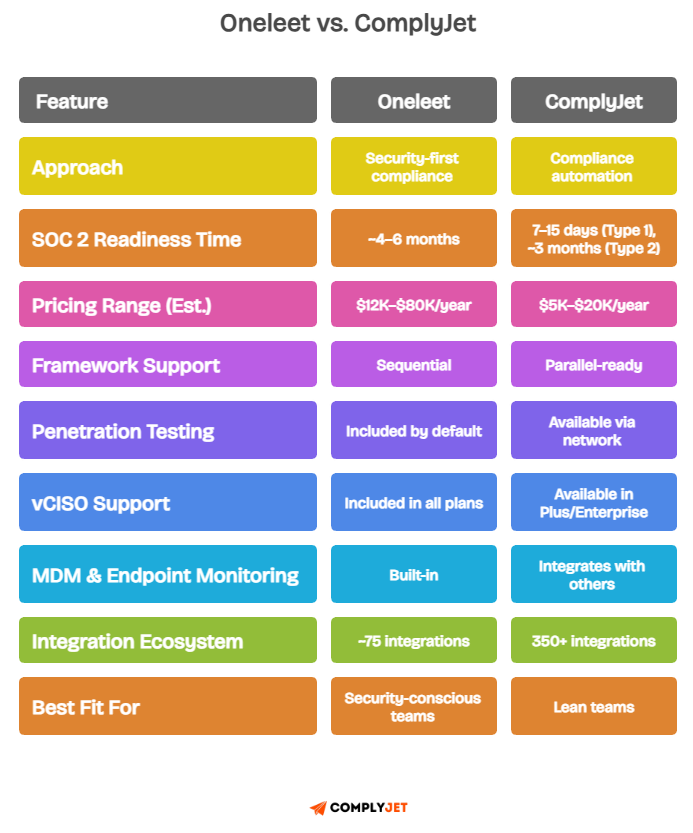
Framework costs are not solely about price; they influence how quickly you can close deals and how much time your team spends on compliance tasks. This is why platform design is more significant than just a quote.
Now that you've seen what Oneleet costs per framework and how it handles timelines, let's look at how its pricing stacks up against other platforms in total. That context will make your negotiation smarter.
Is Oneleet's Price Really Worth It?
You've probably seen the quote. Maybe it felt high. Or maybe it just wasn't clear what you were paying for. That's common. Most buyers don't realize Oneleet bundles more into the base price than other platforms do.
It's not just about automation or dashboards. You're paying for real security work, expert help, and faster outcomes. That changes the math, especially if you're tight on time or running lean.
Pentesting Included
Pen tests are usually extra. With most compliance tools, you have to hire a separate vendor. That can cost you anywhere from $5,000 to $10,000 per test.
Oneleet includes manual penetration testing in the platform. These aren't auto-scans. Real security pros do them. They look for actual vulnerabilities, not just missing configs.
That pen test report can also be reused as SOC 2 evidence. You save on both security and audit prep. That's a big win for lean teams trying to move fast.
vCISO Support Saves Security Consultant Costs
Hiring a virtual CISO on your own is expensive. Market rate is $150 to $250 an hour. Some founders spend over $10K just on expert help before their audit.
With Oneleet, you get built-in vCISO access. That includes help with risk register reviews, asset scoping, and filling control gaps. You're not guessing what auditors expect.
Multiple Oneleet users say they skipped hiring external consultants altogether. The in-platform guidance helped them finish prep in weeks, and not months.
Faster Time to Audit Leads to Faster Revenue
A slow audit timeline can kill your sales momentum, and deals can stall. Bigger customers wait until your SOC 2 is in hand.
Oneleet claims startups can become audit-ready in 4 to 6 weeks. Most competitors take 3 to 6 months. The difference? Done-for-you security testing and expert-led onboarding.
Some YC teams got SOC 2 Type I in a month and closed enterprise deals right after. That speed often pays for itself in the first contract.
Oneleet's pricing may seem high at first glance. However, when you consider the built-in value of pentests, vCISO assistance, and the time saved, the calculations begin to shift.
To know more about Oneleet features, read: Oneleet Review 2026: Features, User Feedback, Pros & Cons
Next, we'll look at how Oneleet stacks up against competitors on total cost of ownership.
Oneleet vs Vanta vs Drata: Total Cost of Ownership Compared
You can't judge compliance tools by their website pricing, because none of them tell the full story. The number they quote is just the starting point. The real cost shows up once you factor in audits, pentesting, support, and time lost to delays.
That's why the total cost of ownership matters more than sticker price. Oneleet pricing looks high upfront, but the bundle includes services that Vanta and Drata often charge extra for.
What the Platforms Actually Include (and What They Don't)
Let's break it down: Oneleet bundles penetration testing and includes access to vCISO support as part of the core package. That saves you from hiring outside experts.
Vanta and Drata charge extra for most of these services. So while their platform quote might be lower, the total bill ends up close to or higher than.
On the flip side, both Vanta and Drata allow multiple frameworks to run in parallel. Oneleet doesn't. So if you're handling SOC 2 and ISO 27001 at once, Oneleet makes you wait.
Read: Vanta vs Drata: Which one is right for you?
Where Oneleet Wins: Transparency and Security Built In
Oneleet includes things other tools treat as extras. The audit is part of the package. So is security testing. You don't need to coordinate with an outside firm just to get certified. That matters when you've got deals depending on compliance timing.
Their model also gives you vCISO-level support without needing to ask for it.
For first-time founders, that makes a difference. The learning curve is not so scary when someone guides you through what matters and what doesn't.
Where ComplyJet Edges Them All: Speed and Flexibility
ComplyJet stands out in two ways that matter most: price and speed.
Most teams using ComplyJet get fully audit-ready for SOC 2 or ISO 27001 in 7 to 14 days.
That's with real-time support, AI-generated policies, and automatic evidence mapping baked in.
The pricing is flat, starting at $8K per year for both the platform and audit support. No surprise charges, no upsells halfway through.
Unlike Oneleet, ComplyJet lets you run SOC 2, ISO, HIPAA, and GDPR in parallel from day one. That's how startups like Precognition Labs and Latitude Health closed deals faster.
They didn't have to wait for one framework to finish before starting the next. One early-stage AI team got SOC 2 Type II in under 90 days while prepping ISO at the same time. They cut their expected timeline in half.
Teams also get a free trial access before buying, which means no pressure. You can connect to GitHub or GCP, preview automated checks, and see policy drafts before you ever sign.
If you're looking for a leaner alternative with faster outcomes, ComplyJet's track record speaks louder than any pitch.
Next, we'll list out the negotiation tactics you can use to lower your overall quote.
How to Negotiate Oneleet Pricing Like a Pro
When you get a quote from Oneleet, it might look final. It's not. Like most compliance platforms, they don't show pricing upfront because every quote is meant to be flexible. You're expected to negotiate. And they expect you to try.
That's where most founders lose money. They accept the first offer, then find out later what others paid. If you know which levers matter, you can trim thousands off your Oneleet pricing without losing what you actually need.
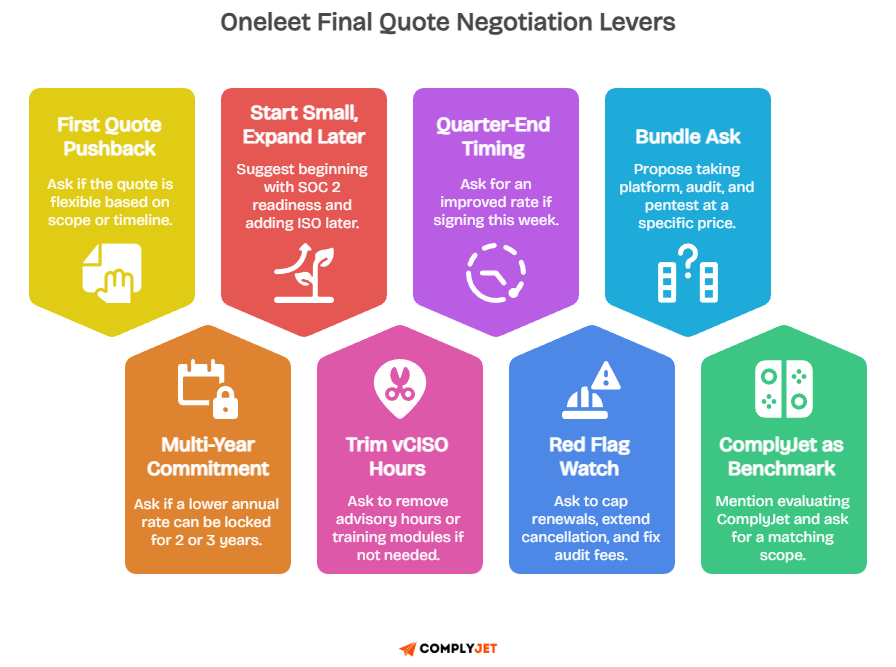
The First Quote Is a Starting Point
Oneleet will quote based on company size, frameworks, and how much help you ask for. But the first number they show you is just a guess. It's padded.
You're meant to come back with questions. Ask what's negotiable. Most teams get at least one price cut, often just by pushing back once or twice.
Multi-Year Contracts Can Drop Pricing
If you are willing to commit, signing multi-year contracts can give you an advantage. Such agreements demonstrate stability to vendors and enable you to negotiate meaningful discounts. Most SaaS providers are open to sacrificing some profit in exchange for long-term customer loyalty.
For instance, those who entered into two-year contracts typically received a 20% discount annually. If you extend this to a three-year deal, you can achieve discounts of up to 30%. Just be sure to establish a limit on renewal increases.
Start Small, Then Add On
Instead of buying everything up front, ask for a scoped-down first phase. Start with SOC 2 Type I or just readiness. Once that's in place, expand into audits, ISO, or HIPAA.
This helps lower Year 1 cost. You also get time to prove ROI internally, which helps justify any expansion later.
Drop What You Won't Use
Not every company requires extensive involvement from a virtual Chief Information Security Officer (vCISO). If your team already possesses basic cybersecurity skills, consider reducing the number of advisory hours. The same applies to additional services like training modules or device management if you're handling those tasks through other means.
Request a detailed, line-item quote from the vCISO service. This way, you can negotiate to eliminate any services you don't need. Remember, every service you remove will decrease your total cost.
Time the Deal Close Around Quarter-End
Sales teams work on quotas. If your deal lands near the end of their quarter, your odds of a better price go up. If you're flexible, ask, "Does it help if we sign this week?"
It's a soft nudge. But paired with a prepped list of asks, it works more often than not.
Avoid These Red Flags in the Contract
Be cautious with terms that may seem harmless initially, as issues can arise in the second year. Pay attention to auto-renewal clauses with short cancellation windows. Verify whether unused advisory hours expire and inquire about any potential audit costs that may be split or delayed.
Challenge any vague language in contracts. Ensure you get clear limits, definitive expiry terms, and exit clauses in case your business circumstances change.
Bundling Your Way to a Better Deal
Here's a script you can borrow. "We're ready to move forward if we can get the SOC 2 platform + audit + pentest at $X. We'll commit for two years, skip vCISO hours, and add ISO after the first audit."
This bundle works because it focuses on what you need now. And it shows you're serious about staying long term without paying all up front.
Use ComplyJet as a Benchmark to Create Pressure
Even if you're leaning toward Oneleet, it's a good idea to get a second quote. ComplyJet offers audit bundles, support for parallel frameworks, and faster setup at a lower price. You can use that information as a pricing benchmark.
There's no need to bluff; present what's available. This approach will help shift the conversation.
If you treat the quote as a discussion rather than just a bill, you'll be less likely to leave money on the table.
In the next section, we'll detail what you actually receive in the Oneleet quote and whether it justifies the price you paid.
Is Oneleet a good choice in 2026?
You're not wrong to pause at the price. It's not low. But pricing doesn't tell the full story. What really matters is whether it fits your stage, your team, and the kind of pressure you're under.
Some startups want a quick certificate. Others are trying to show real security maturity. Oneleet is built for the latter.
When is Oneleet a Smart Investment?
If you're facing a situation where a deal is stalled because you don't have SOC 2 compliance, and the buyer is becoming anxious, Oneleet is a great solution. They offer live assistance, quick turnaround times, and bundled penetration tests, helping to remove obstacles efficiently.
For teams that don't have a dedicated security hire, Oneleet can provide much-needed support. Instead of spending hours on Google or rewriting templates at 2 a.m., their team guides you through the process. You'll still be involved in the work, but you won't have to do it alone.
YC startups like Oneleet for that reason. There's trust in the support. If you'd rather have humans who've done this before instead of a Slackbot telling you what's next, the extra cost can be worth it.
When to Consider Alternatives
But let's be honest. If you're trying to do SOC 2 and ISO 27001 at the same time, Oneleet might slow you down. They do one framework at a time. You'll be waiting to start the second.
Their integration list also isn't the deepest. If you've got 250+ services across cloud, code, and workflows, you'll run into gaps. Other tools handle those cases better.
Some founders want the basics. They want to plug in, run some checks, book an audit, and be done. Oneleet can feel too hands-on for that. You might not need the extras if you already know what you're doing.
Oneleet isn't for every team. But if you're short on time, short on expertise, or blocked on a deal, it can save you weeks and real money. Next, let's compare what you're paying for across Oneleet, Drata, and Vanta.
Read: Top 10 Oneleet Alternatives & Competitors Compared [2025]
Frequently Asked Questions about Oneleet Pricing
Does Oneleet offer a free trial before signing up?
No, Oneleet does not offer a free trial. All prospective customers must schedule a demo to receive a tailored quote. Without a Oneleet free trial, you will need to evaluate based on the walkthrough and proposal shared during the sales process.
Can you negotiate Oneleet pricing if you're a startup?
Yes, Oneleet pricing discounts are possible for early-stage startups. Many YC companies and founders on Reddit have reported negotiating lower rates, especially when sharing competing quotes from platforms like Vanta or Drata.
What is included in Oneleet's audit bundle?
The typical Oneleet audit bundle includes the audit itself, platform access, vCISO guidance, evidence automation, and penetration testing. The Oneleet pentest pricing is usually bundled, which saves $5,000 to $10,000 compared to hiring a third-party vendor.
How long does it take to get SOC 2 with Oneleet?
SOC 2 Type I can be completed in 4 to 6 weeks if your setup is ready. Type II takes around 3 to 4 months, including the monitoring period. How much SOC 2 costs with Oneleet will depend on the level of support and timeline urgency you choose.
Can Oneleet help with HIPAA or ISO 27001, too?
Yes, Oneleet supports HIPAA and ISO 27001 frameworks, but not at the same time. It processes only one framework at a time. If you need SOC 2 and ISO 27001 together, you may want to consider platforms that allow multi-framework audits in parallel.
Is Oneleet cheaper than Vanta or Drata?
In several Oneleet vs Vanta Reddit discussions, founders have stated that Oneleet gave them a better quote. While it may look premium at first, once you factor in audit and pentest, Oneleet often turns out to be more cost-effective than Vanta or Drata.
What happens after the first year of using Oneleet?
Your access continues with ongoing monitoring, audit support, and platform updates. Oneleet contract terms vary, so make sure your renewal includes pricing caps, clear deliverables, and flexibility if your compliance needs change.
Is penetration testing optional or included in all plans?
Penetration testing is included in most Oneleet packages. This is one of the strongest parts of Oneleet pricing plans, as it eliminates the need for a separate security vendor and keeps your compliance costs predictable.
Final Thoughts
Oneleet isn't cheap. You probably noticed that already. But once you look closer, you're not just paying for a tool.
You will receive an entire setup that includes compliance preparation, penetration testing, virtual Chief Information Security Officer (vCISO) support, and assistance with audits, all in one location.
For teams under pressure to finalize deals requiring SOC 2 or ISO certification, the time saved could cover the cost of the platform itself, especially if you're doing this for the first time and don't want to piece it together yourself.
Not everyone requires an extensive package. If you have a good grasp of your security program or are simply trying to navigate an audit without overspending, Oneleet might be more than you need.
This is where platforms like ComplyJet can be beneficial. They offer automation, audit support, and evidence tracking without the hefty price tag. ComplyJet is designed for startups that want quicker results.
Book a ComplyJet demo for transparent pricing, fast onboarding, and audit-ready SOC 2 in less than 7 days.