.svg)

You've narrowed your compliance shortlist to two names that suddenly feel very different up close: Comp AI and Drata. Comp AI vs Drata comes down to one structural choice before anything else. Comp AI is roughly 99% open-source and AGPLv3-licensed, so you can self-host it for free or run it managed. Drata is a fully closed-source SaaS platform, full stop, no source you can inspect or run yourself.
Here's the direct answer. Comp AI is the open-source, self-hostable challenger built for engineering-heavy teams that want to own their compliance stack and bundle audit and pen test costs into one line item. Drata is the closed-source, continuous-monitoring-focused incumbent built for teams that want a fully managed platform with control statuses refreshed daily and a considerably broader framework catalog, and don't mind paying for that convenience. Everything else, pricing, audit bundling, framework coverage, follows from that one decision.
Quick answer
Comp AI vs Drata comes down to one structural choice: Comp AI is ~99% open-source and AGPLv3-licensed, so you can self-host it for free or run it managed, while Drata is a fully closed-source SaaS platform built around continuous control monitoring. The rest (pricing, audit bundling, framework coverage) follows from that one decision.
Comp AI just closed a $34M Series A, announced September 17, 2026, led by Roo Capital and Grand Ventures, per TechCrunch's coverage and Comp AI's own press release, which is why this comparison is suddenly a live buyer question and not just a niche open-source curiosity. The funding is a reason this pairing is being searched right now, not a reason by itself to pick either platform.
By the end of this, you'll know exactly which of the two fits your team, not just what each one claims about itself. Here's what's ahead:
- What actually separates Comp AI and Drata at a structural level
- A side-by-side table covering deployment, licensing, frameworks, and pricing signals
- The open-source vs. closed-SaaS tradeoff, explained in plain English
- What each platform actually costs, with every inconsistency named
- A decision framework for teams still stuck between the two
Comp AI vs Drata: What Actually Sets Them Apart
A feature checklist is the wrong place to start here, because Comp AI and Drata automate roughly the same basic work: evidence collection, control monitoring, policy management, audit prep. What actually separates comp ai vs drata is the business model underneath the software, not any single feature.
Comp AI was founded in January 2025 by Lewis Carhart, Claudio Fuentes, and Mariano Fuentes, and grew up open-source from day one, on GitHub as trycompai/comp. Drata was founded in 2020 in San Diego by Adam Markowitz, Daniel Marashlian, and Troy Markowitz, per general web coverage, and grew up as a closed-source SaaS platform built around continuous, automated control monitoring.
That five-year gap in founding dates, and the license choice each company made at the start, explains almost every difference you'll find further down this page.
Comp AI — Open-Source Compliance Automation, Built Fast
Roughly 99% of Comp AI's platform is AGPLv3-licensed and publicly on GitHub. It markets itself explicitly as "the open-source Vanta & Drata alternative," and supports SOC 2, ISO 27001, HIPAA, and GDPR, the four frameworks independently verifiable from ComplyJet's own competitor research. Comp AI's own marketing claims 580+ integrations.
Pros
- ~99% of the platform is open-source (AGPLv3) and publicly viewable on GitHub, a genuine rarity in this category.
- Free to self-host, with a managed option if you'd rather not run it yourself.
- Bundles audit and pen test into its pricing, per its own marketing, rather than billing them as separate line items.
Cons
- Founded January 2025, so it has a fraction of Drata's market tenure and reference-customer base.
- Its own integration-count claims are inconsistent across sources (more on this below), which makes the real number hard to pin down.
- Self-hosting shifts real operational and security work, patching, uptime, access control, onto your own team.
Verdict: the platform to shortlist if you want to see and control the code your audit evidence runs on, or want a free self-hosted path.
Drata — The Closed-Source Continuous-Monitoring Incumbent
Drata is the closed-source incumbent with a five-year head start on Comp AI, and its product story centers on automated, continuous control testing rather than point-in-time checks, with control statuses generally refreshed daily so drift gets caught before an auditor finds it. Per third-party coverage (Sprinto, guptadeepak.com's GRC Compass), Drata's own site claims a considerably broader catalog of 30+ frameworks.
Pros
- Continuous, near-daily control monitoring rather than point-in-time evidence snapshots, per this repo's own coverage of Drata's product positioning.
- A considerably broader framework catalog, 30+ frameworks claimed on Drata's own site per third-party coverage, versus Comp AI's 4 verified.
- Five years of market tenure and reference-customer base versus Comp AI's roughly one.
Cons
- No self-host option at all. Closed-source, SaaS-only, full stop.
- Audit and pen test are typically arranged separately rather than bundled into the base platform fee.
- No fixed public pricing exists; observed contract figures vary widely by source, which makes a real dollar comparison harder to pin down than Comp AI's more visible pricing signals.
Verdict: the platform to shortlist if continuous, near-real-time control monitoring and a broad framework catalog matter more to your team than transparency into the underlying code.
Interesting Finding The interesting thing about Comp AI vs Drata isn't the feature list, it's that Comp AI's own marketing page for this comparison is nearly a copy-paste of its Vanta comparison page, same pricing figures, same structure, Drata's name swapped in. That's not necessarily dishonesty, but it means a buyer has to read the underlying source, not just the sales page, before trusting either vendor's stated figures.
Comp AI vs Drata at a Glance
Here's the side-by-side, one table, dimension by dimension. Every figure below is sourced from ComplyJet's own Comp AI competitor research, a live web search on Drata's own facts, or explicitly attributed to Comp AI's own marketing claim about Drata, not invented or averaged.
| Dimension | Comp AI | Drata |
|---|---|---|
| Deployment model | Self-hosted (free) or managed SaaS | Closed SaaS only, no self-host option |
| License | ~99% AGPLv3, open-source on GitHub | Proprietary, closed source |
| Founded | January 2025 | 2020, San Diego |
| Frameworks (verified) | SOC 2, ISO 27001, HIPAA, GDPR | 30+ frameworks claimed on Drata's own site (SOC 2, ISO 27001, ISO 42001, GDPR, HIPAA, PCI DSS, DORA, CMMC, FedRAMP, HITRUST, and others), per third-party coverage |
| Integrations claimed | 580+ (Comp AI's own figure), though Comp AI's own drata-alternative page elsewhere cites 11 native + custom agent | No independently confirmed figure found in this research; described only as "limited, often requires professional services" per Comp AI's own marketing claim about Drata |
| Audit / pen test | Bundled into pricing, per Comp AI's own marketing | Typically arranged separately, per Comp AI's marketing claim about Drata |
| Pricing signal | $199/mo entry, free self-hosted, $20K–$80K/yr scaled (third-party estimates); an older Comp AI-sourced claim elsewhere cites $5K–$10K | $20K–$80K/yr per Comp AI's own marketing page (the identical figure Comp AI uses for Vanta); a more independently sourced range from Sprinto's pricing research puts observed contracts at $9,494–$67,350 with a $25,000 median, and this repo's own oneleet-vs-vanta-vs-drata cites a $7.5K–$20K platform fee with audit/pen-test billed separately |
| Funding stage | $34M Series A, announced 2026-09-17 (Roo Capital, Grand Ventures); $37.5M total raised | Not covered in this comparison's scope |
Comp AI's own trycomp.ai/drata-alternative page is one-sided marketing, not a neutral table, and its pricing figure for Drata is identical to the one it uses for Vanta, a real tell that it's a templated claim rather than Drata-specific research.
Note
No Drata figure in this table comes from Drata's own published pricing. The $20-80K/year figure traces back to Comp AI's own marketing page about Drata (trycomp.ai/drata-alternative), a direct competitor's characterization, not a neutral source, and it's the exact same number Comp AI uses on its Vanta comparison page. The $9,494-$67,350 range and $7.5K-$20K platform-fee figure are more independently sourced (Sprinto's pricing research and this repo's own oneleet-vs-vanta-vs-drata comparison, respectively), but still not a confirmed published Drata price list. Treat all three accordingly.
Treat this as the starting map, not the whole decision. The next few sections go a level deeper on the axis that actually decides this comparison: open source versus closed SaaS.
Comp AI vs Drata: Open Source vs Closed SaaS, the Real Structural Difference
This is the core of the comp ai vs drata decision. Comp AI's open-source, self-host model is the one structural difference closed-source Drata cannot match, no matter how the rest of the feature list shakes out.
What does "~99% AGPLv3-licensed" actually mean in plain English? Nearly the entire platform's source code is publicly viewable on GitHub, and AGPLv3 specifically is a stronger copyleft license than a standard MIT or Apache open-source license. It requires that anyone who modifies the software and runs it as a network service also release those modifications publicly.
Watch out
AGPLv3's copyleft requirement cuts both ways. If your team modifies Comp AI's code and runs that modified version as a network service, even internally, you're obligated to publish those modifications too. Confirm your own legal team is comfortable with that requirement before treating self-hosting as a purely technical decision.
In practice, that means you can read exactly how your audit evidence gets collected and processed. You can also run the whole thing on your own infrastructure for free, if you'd rather not hand that to a vendor at all.
Drata offers none of that. It's fully closed-source SaaS, so you're trusting the platform's internal workings without being able to inspect them, and there's no self-hosted path even if your team wanted one. That's the core answer for a comp ai open source drata alternative: Comp AI gives you the option Drata structurally cannot offer.
Cover both sides honestly, though. Self-hosting is not a free lunch just because the license is free. Choosing to run Comp AI yourself shifts real operational and security burden onto your own team: patching the instance, maintaining uptime, managing access control for the deployment itself. None of that disappears because the software license did.
Try this yourself
Ask a Comp AI sales rep directly whether your specific self-hosted deployment plan still qualifies for their audit-partner network and money-back guarantee. Those commercial guarantees may attach only to the managed offering, not a fully self-hosted install, and neither vendor's marketing page makes that distinction explicit.
Verdict: if code-level transparency and the option to self-host for free is a real requirement for your team, common with security-engineering-heavy buyers, this is Comp AI's single strongest argument. If it isn't a requirement at all, it's a neutral feature, not a reason to switch.
Comp AI Pricing vs Drata Pricing: What Each Actually Costs
Neither vendor publishes a fixed public price list, so this section is a range with sources, not a clean side-by-side total. Start with what's actually verifiable.
Comp AI's own site is quote-gated, but third-party estimates put its managed tiers at a $199/mo entry point, free if self-hosted, and $20K-$80K/year depending on company size and framework scope. An older claim found elsewhere in Comp AI's own marketing puts the figure at $5K-$10K, a real inconsistency worth naming plainly rather than picking whichever number is most flattering to Comp AI.
Watch out
Comp AI's own materials don't agree on price. The $199/mo entry point, the older $5K-$10K figure, and the $20-80K/year estimate all trace back to Comp AI's own marketing surfaces at different points, not three independent sources, worth remembering before treating any single number as a firm quote.
Comp AI bundles audit and pen test into its pricing with no separate line-item fees, and its own site claims a 100% money-back guarantee on audit outcomes plus "SOC 2 Type I audit-ready in as little as 24 hours." Both of those are Comp AI's own claims about itself, not independently verified, and the 24-hour claim in particular describes platform readiness, not a completed audit, which typically still takes an auditor weeks to schedule and execute regardless of platform speed.
Drata pricing is where this gets a little more interesting than the Vanta comparison. Comp AI's own trycomp.ai/drata-alternative page claims Drata runs $20-80K/year, with audit at $10-30K and pen test at $5-15K billed as separate line items. That's worth flagging plainly: it's the exact same dollar range Comp AI's site uses on its Vanta-alternative page, which reads less like Drata-specific research and more like a reused pricing template.
A more independently sourced picture on comp ai drata pricing exists elsewhere. Per Sprinto's own Drata pricing research, observed annual Drata contracts across 233 purchases ranged $9,494-$67,350, with a $25,000 median, and Drata's Foundation tier is estimated to start around $15,000/year, though AWS Marketplace listings put the Foundation level closer to $7,500-$10,000/year.
Separately, this repo's own oneleet-vs-vanta-vs-drata comparison cites a Drata platform fee of $7.5K-$20K, with audit and pen test billed apart and a 6-10 week onboarding timeline, landing at roughly $20K-$45K+ all-in for year one. None of these three figures agree exactly, but the Sprinto and oneleet-vs-vanta-vs-drata numbers are the closer thing to independent verification, since they don't come from a direct competitor's sales page.
Important
Comp AI's $20-80K/year Drata figure is the identical number it uses for Vanta on a separate marketing page, worth treating as a templated claim rather than Drata-specific research. If a real Drata price point matters to your decision, the Sprinto-sourced $9,494-$67,350 range (233 observed purchases, $25,000 median) is closer to independent, but still not Drata's own confirmed published pricing, so verify directly with Drata regardless.
Verdict: Comp AI's headline pricing signals skew lower and bundle more in, but with pricing this unverified and inconsistent, even within Comp AI's own materials and across third-party Drata sources, treat any dollar comparison here as directional, not a quote you can act on.
Comp AI vs Drata Frameworks: SOC 2, ISO 27001, HIPAA, and GDPR
Comp AI's verified framework coverage, per ComplyJet's own competitor research, is SOC 2, ISO 27001, HIPAA, and GDPR. Comp AI's own trycomp.ai/drata-alternative page separately claims 8 frameworks, adding PCI DSS, ISO 42001, ISO 9001, and NEN 7510, a wider claim that conflicts with the 4-framework set independently verified.
Note
Comp AI's own marketing claims 8 supported frameworks; ComplyJet's independent competitor research verifies 4. Until the other 4 are independently confirmed, treat Comp AI's wider framework claim the same way as its Drata pricing claim: a vendor's own assertion, not a neutral fact.
Drata is the one place in this comparison where the breadth claim actually checks out against multiple sources rather than just Comp AI's own marketing. Per Sprinto's and guptadeepak.com's GRC Compass third-party coverage, Drata's own site lists a considerably broader catalog: 30+ frameworks, including SOC 2, ISO 27001, ISO 42001, GDPR, HIPAA, PCI DSS, DORA, CMMC, FedRAMP, HITRUST, NIST CSF 2.0, COBIT, and SOX ITGC, plus custom frameworks.
On comp ai drata frameworks, this is a real, sourced breadth advantage for Drata, not an invented one, though it's still Drata's own claimed catalog as reported by third parties rather than something independently re-verified framework by framework here.
SOC 2 specifically is both vendors' primary wedge framework. Comp AI's own marketing claims a roughly 10-day path to SOC 2 Type I readiness, a figure that should be read as platform-readiness speed, attributed to Comp AI's own site, rather than a guaranteed audit timeline. Comp AI's own drata-alternative page separately claims Drata averages 3 months for SOC 2 Type I and 6 months for Type II, again a vendor's own characterization of a competitor, not independently confirmed.
Realistic SOC 2 audit readiness, across the market generally, typically runs closer to weeks or months once you account for evidence maturity and auditor scheduling, not just how fast the software itself can be configured.
| Framework | Comp AI (verified) | Drata |
|---|---|---|
| SOC 2 | Yes, primary wedge framework | Yes, primary wedge framework |
| ISO 27001 | Yes | Yes, per third-party coverage |
| HIPAA | Yes | Yes, per third-party coverage |
| GDPR | Yes | Yes, per third-party coverage |
| PCI DSS, DORA, CMMC, FedRAMP, and others | Claimed in Comp AI's own marketing (8 total, unverified here) | Claimed on Drata's own site (30+ total, per Sprinto/GRC Compass third-party coverage) |
Verdict: for the four frameworks Comp AI has verified support for, framework depth is roughly comparable to Drata's. For a multi-framework program that needs coverage outside that set, Drata's considerably broader, third-party-confirmed catalog is the safer starting assumption until Comp AI's own wider claims are independently confirmed.
Audit and Pen Test Bundling: Comp AI vs Drata
This is a genuinely distinct axis from the pricing comparison above, not just a pricing sub-point. Comp AI bundles audit and pen test into its base pricing, per its own marketing, with no separate procurement conversation required for either.
Drata's audit and pen test are typically arranged separately and billed as add-ons rather than folded into the base platform fee, per Comp AI's own characterization of Drata, and that pattern is consistent with the more independently sourced Drata figures above, where the platform fee and audit/pen-test costs are reported as distinct line items rather than one bundled number.
Frame this as the typical pattern for a closed-SaaS platform generally, not something unique to Drata specifically; most pure-play compliance-automation platforms in this category price the same way.
Quick take
Audit and pen-test bundling is a real, separate axis from platform pricing, not just a rounding difference. Comp AI folds both into one line item; Drata, like most closed-SaaS platforms, prices them apart. Weigh this alongside, not instead of, the raw platform-fee comparison above.
Verdict: if avoiding a second procurement conversation for audit and pen test matters to your team, Comp AI's bundled model is a real operational simplification. If you already have a preferred auditor relationship, that's less of a differentiator either way.
Drata vs Comp AI: The Buyer's Shortlist Question
This pairing gets searched both ways, comp ai vs drata and drata vs comp ai, same comparison, same answer, restated briefly here for readers who landed on the reverse-order query.
The core tradeoff doesn't change direction: open-source, self-host flexibility and bundled audit economics on Comp AI's side, against established closed-source breadth, continuous monitoring, and a considerably wider framework catalog on Drata's side. Whichever name you searched first, the decision still comes down to which of those two things your team actually needs more.
The Comp AI Drata Comparison Chart: Who Wins Each Category
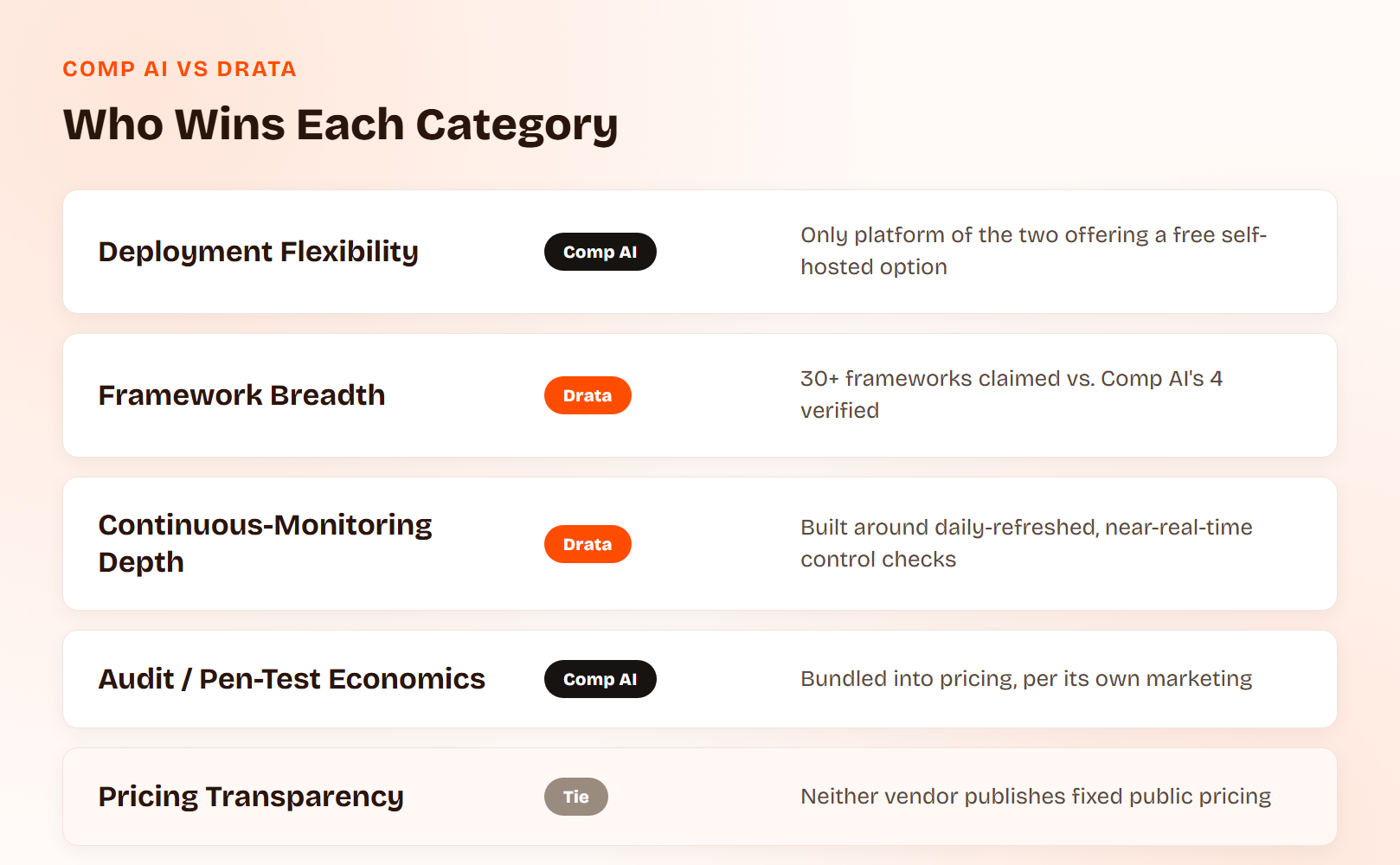
Rather than naming one overall winner, here's a scored breakdown by category, since the right answer genuinely depends on what your team values most:
| Category | Winner | Why |
|---|---|---|
| Deployment flexibility | Comp AI | Only platform of the two offering a free self-hosted option |
| Framework breadth | Drata | 30+ frameworks claimed on Drata's own site, per third-party coverage, versus Comp AI's 4 verified |
| Continuous-monitoring depth | Drata | Product built around daily-refreshed, near-real-time control monitoring |
| Audit / pen-test economics | Comp AI | Bundles both into pricing, per its own marketing, instead of billing separately |
| Pricing transparency | Tie | Neither vendor publishes fixed public pricing |
How to Decide: Comp AI or Drata for Your Compliance Program
Skip the generic "it depends" advice. Here's the actual decision:
- Choose Comp AI if: your team has the engineering capacity to self-host, or you want audit and pen test bundled into one line item instead of a separate procurement conversation.
- Choose Drata if: you want continuous, near-real-time control monitoring and the broadest framework catalog of the two, and full audit/pen-test line-item control matters less to you than deployment simplicity and monitoring depth.
- If neither fits, for example, if a flat per-company price that doesn't scale with headcount matters more to you than either open-source flexibility or Drata's monitoring depth, see the ComplyJet section below.
Pro tip
Ask each vendor for a reference customer at roughly your current headcount and stage, not their flagship logo. How Comp AI or Drata performed for a 200-person company tells you very little about how the same platform will feel for a 12-person team going through its first audit.
Common Comp AI vs Drata Mistakes to Avoid
- Treating Comp AI's self-hosted "free" tier as cost-free. It's free of license fees, not free of engineering time: patching, uptime, and access control for the instance are now your team's job.
- Comparing sticker price without checking whether audit and pen test are bundled. A lower platform number on either side can flip once you add back what the other vendor includes.
- Assuming Comp AI's broader 8-framework marketing claim without confirming it. Only 4 frameworks, SOC 2, ISO 27001, HIPAA, and GDPR, are independently verified; the rest is Comp AI's own marketing claim.
- Not confirming whether a self-hosted Comp AI deployment still carries the audit-partner guarantee. That commercial guarantee may attach only to the managed offering.
- Treating "580+ integrations claimed" at face value. Comp AI's own integration-count claims are inconsistent across its own sources, worth checking depth per integration, not just the headline number.
- Taking Comp AI's $20-80K/year Drata pricing claim at face value. It's the identical figure Comp AI uses for Vanta on a separate marketing page, a real sign it's a reused template rather than Drata-specific research; the Sprinto-sourced $9,494-$67,350 range is a closer approximation.
- Skipping the actual audit-experience question until after signing. Ask who runs the audit, on what timeline, and what happens if a control fails, before you're locked into either contract.
Most of these mistakes share a root cause: taking either vendor's own marketing page as the neutral source of truth instead of checking it against independently verifiable facts first.
Comp AI vs Drata: Where ComplyJet Fits If Neither Is Right
For early-stage teams that don't want to weigh self-hosting's operational overhead against Drata's platform-plus-add-on economics, ComplyJet's flat per-company pricing is worth a look as a third option. It's $5,000/year for one framework, $8,000/year for two (HIPAA plus SOC 2, for example), priced per company rather than per seat, for startups up to 50 employees.
That price doesn't move as you grow from a 5-person team to 30 or 40, which is the reassurance most early-stage teams actually want from a pricing model. It's not a claim that ComplyJet is cheaper than either Comp AI or Drata, just a different, flatter way of pricing the growth journey.
Watch out
Don't let bundled audit economics or open-source appeal on Comp AI's side, or continuous-monitoring depth on Drata's, overshadow the fact that neither platform guides you through the actual audit process the way a white-glove service does. That gap is what ComplyJet's flat-fee model is built to close.
That's a genuinely different lane from either platform above: not the open-source self-host route, not the closed-SaaS continuous-monitoring route, but a guided, white-glove compliance automation process with 350+ integrations built in, at a price that stays flat as your headcount and framework count grow. You can see the full breakdown on ComplyJet's pricing page.
Two honest limitations worth naming here. ComplyJet doesn't offer a self-hosted or open-source deployment option the way Comp AI does; it's SaaS-only. And ComplyJet doesn't yet match Drata's continuous-monitoring depth or its considerably broader 30+ framework catalog. If either of those specifically matters most to your team, that's a real reason to stay with Comp AI or Drata instead.
ComplyJet
Flat per-company pricing, not per seat or per framework tier
If neither an open-source self-host commitment nor a fully closed managed platform feels like the right fit, ComplyJet's guided process and flat pricing might.
FAQs
Is Comp AI Better Than Drata?
Neither is universally better. Comp AI is the better fit for teams that want open-source transparency, a self-host option, and bundled audit economics. Drata is the better fit for teams that want continuous, near-real-time control monitoring and the broadest framework catalog of the two. The "better" one depends on which of those two things your team actually needs.
Is Comp AI Cheaper Than Drata?
Neither publishes fixed pricing, so there's no clean answer. Comp AI's self-hosted tier is free excluding engineering time, and its managed tiers range from a $199/mo entry point up through a $20-80K/yr estimate. Drata's own independently sourced range, per Sprinto's pricing research, runs $9,494-$67,350 with a $25,000 median across observed purchases. Both figures come from estimates rather than confirmed published pricing, so a precise apples-to-apples comparison isn't possible.
Is Comp AI Open Source?
Yes. Roughly 99% of the platform is AGPLv3-licensed and publicly on GitHub, one of the very few genuinely open-source options in the compliance-automation category.
Can Comp AI Replace Drata?
For teams whose framework needs sit within Comp AI's four verified frameworks, SOC 2, ISO 27001, HIPAA, and GDPR, and who are comfortable with either self-hosting or a newer, less-established vendor, yes. It's less clear-cut for teams that need Drata's continuous-monitoring depth or its considerably broader 30+ framework catalog.
Is Comp AI Good for SOC 2 Compliance?
SOC 2 is Comp AI's primary wedge framework, with a claimed, attributed but not independently verified, fast timeline to audit-readiness. It's genuinely worth evaluating for SOC 2-first buyers, with the same self-hosting tradeoff noted throughout this article.
What Frameworks Does Comp AI Support vs Drata?
Comp AI's verified set is SOC 2, ISO 27001, HIPAA, and GDPR. Drata's own site claims a considerably broader catalog, 30+ frameworks per third-party coverage. Comp AI's own marketing claims 8 frameworks total, but that figure is flagged as unverified here rather than stated as fact.
How Fast Is Comp AI vs Drata for SOC 2?
Comp AI's own marketing claims roughly a 10-day path to SOC 2 Type I readiness, attributed to its own site rather than stated as guaranteed fact. Comp AI's own drata-alternative page separately claims Drata averages 3 months for SOC 2 Type I, also a vendor's own claim rather than independently verified. Treat any single-vendor speed claim as something to verify directly rather than a guaranteed outcome for your specific company.
Is Self-Hosted Compliance Software Safe for an Audit?
Yes, in principle. Auditors evaluate control evidence and operating effectiveness, not the hosting model itself. But self-hosting shifts responsibility for patching, access control, and uptime of the compliance platform onto your own team, a real operational tradeoff worth weighing before choosing it.
Related Reading
- Oneleet vs Vanta vs Drata, for readers also weighing a third, services-bundled compliance platform.
- Comp AI vs Vanta, the parallel two-way comparison against Comp AI's other primary competitor.