Executive Summary: Cross Border Data Transfer Requirements in Short
Most teams ask which countries are allowed to receive their data. The question that actually decides whether a transfer is lawful is sharper: which legal mechanism covers this specific transfer, and who has to sign, file or approve it?
A cross border data transfer is lawful when the sending country's rule is met through a recognised mechanism: an adequacy finding, signed standard contractual clauses, binding corporate rules, a certification or regulator filing, or a narrow exception such as explicit consent. The mechanism differs by country, and several countries add an assessment, a filing or a notice on top.
Quick answer
Nearly every regime works in the same order. Check for an adequacy-style free pass first, then use contract clauses or an approved scheme, then fall back on narrow exceptions. Countries differ on who approves the scheme and on whether data volume or sensitivity changes the route.
This guide maps cross border data transfer requirements across 15 jurisdictions, with the mechanism toolkit up front and country rules after it. It ends with a path for SaaS vendors: which mechanism to put in the contract for which customer. Facts are current as of October 2026.
Three boundaries up front. This is not the list of EU and EEA member states, which sits in our guide to GDPR countries. It is not a data processing agreement template either, and it does not explain how to draft one. And it is not a data residency guide: rules that force data to stay in a country appear only where they collide with transfer rules.
Here's what's ahead:
- What counts as a transfer, including remote access
- The mechanism toolkit: adequacy, standard contractual clauses, binding corporate rules, derogations
- The EU US Data Privacy Framework and what happens if it falls
- A comparison table of 15 jurisdictions
- Country rules for the UK, Switzerland, China, India, the Americas, the Gulf and Russia
- Which mechanism a SaaS vendor should use for which customer
GDPR
Selling to EU customers? Start with the framework behind the transfer rules
GDPR is one of the 25+ frameworks ComplyJet supports, alongside ISO 27701. See how compliance automation covers it for an early-stage team.
What Counts as a Cross Border Data Transfer? Definitions That Shape Every Rule
A cross border data transfer is personal data sent to, or made accessible from, a recipient in another country, including storage, cloud hosting and remote support access. The sending country's law decides whether it needs a mechanism, which is why the same vendor can face different rules for different customers.
Cross border data transfer laws share a core idea but not a definition. International data transfer requirements attach to the exporter's country, and a GDPR cross border data transfer is the version most SaaS vendors meet first. Under GDPR Chapter V, the rules apply when an exporter subject to GDPR makes personal data available to an importer in a third country. The importer is a legal entity located there, not the country itself.
Cross Border Data Transfer Requirements Reach Remote Access: The TikTok Decision
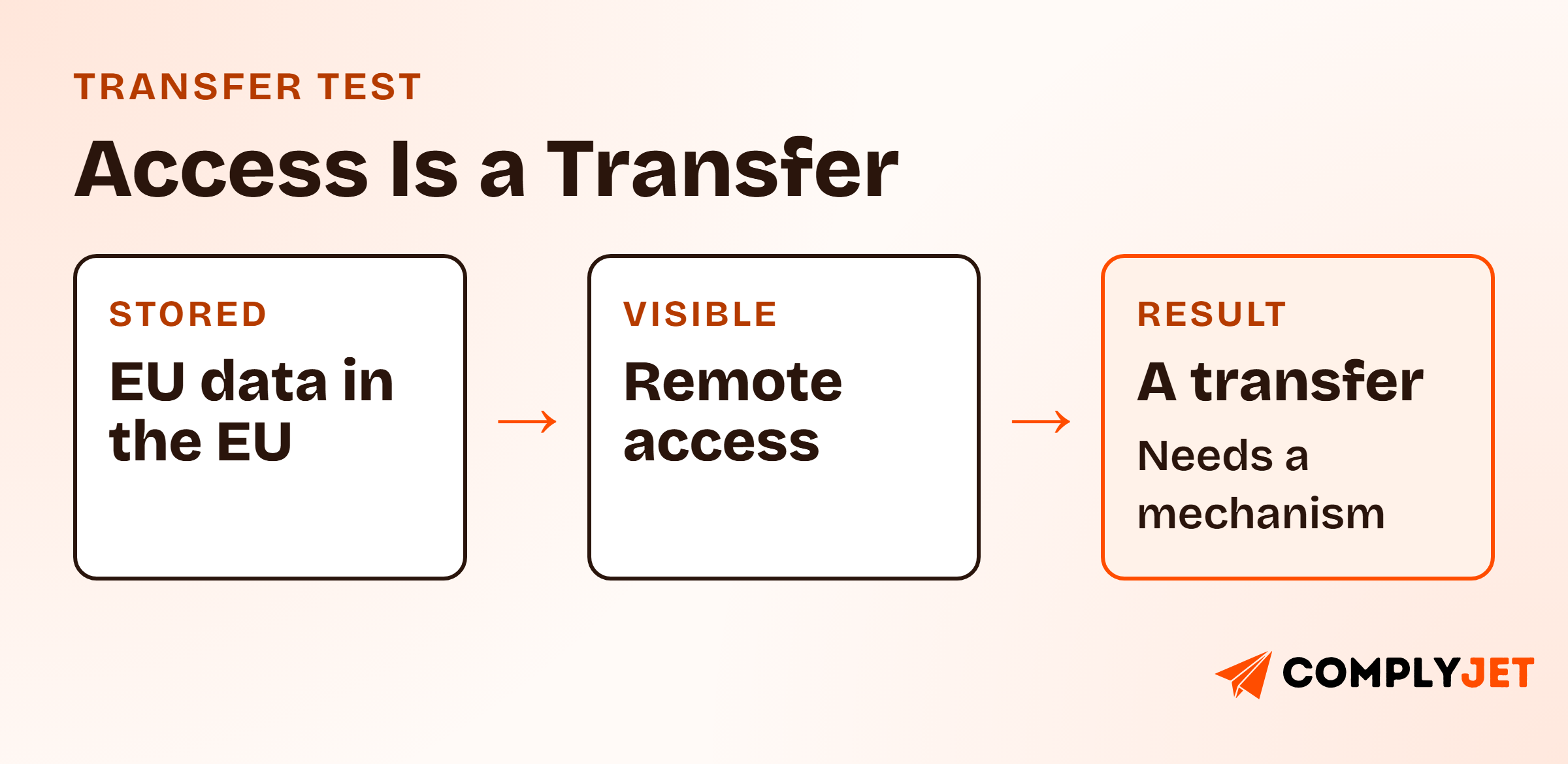
Nothing has to be "sent" for a transfer to happen. On 2 May 2025, Ireland's Data Protection Commission fined TikTok EUR 530 million after finding that staff in China could remotely access data of users in the EEA.
The regulator treated that access as a transfer and found Article 46(1) GDPR infringed, because TikTok's assessment of Chinese law did not address the laws it had itself flagged as diverging from EU standards. TikTok was given six months to bring its processing into line or have transfers to China suspended. Source: Simmons & Simmons.
Watch out
A US support engineer who can open an EU customer's tenant is a transfer, even if no file ever leaves the EU. Map who can see customer data from where, not only where it is stored.
Exporter, Importer and Onward Transfer: Who Carries Which Duty
Three roles recur in every regime:
- Exporter: the party subject to the sending country's law, usually your customer if you are a processor.
- Importer: the recipient in the other country, usually you.
- Onward transfer: the importer passes the data to someone else, such as a sub-processor in a third country.
Duties start with the exporter and flow down by contract. The written place for that flow-down is the data processing agreement, and our data processing agreement template covers the document itself. This article stays on the legal mechanism the document sits inside.
Cross Border Data Transfer Mechanisms: The Toolkit Behind Every Regime
Almost every national regime copies the same ladder, so learn it once and the country rules read faster.

The table compares the five cross border data transfer mechanisms in the same order.
| Mechanism | Who it binds | Who approves it | Speed and cost | Best for | SaaS vendor verdict |
|---|---|---|---|---|---|
| Adequacy decision | Nobody extra; the destination is recognised | The European Commission (or the national equivalent) | Immediate, no cost to you | Customers in recognised countries | Rely on it where it exists, and check its scope. |
| Standard contractual clauses (SCCs) | Exporter and importer, by contract | Pre-approved text; no one signs off | Days; low cost | Any vendor with non-adequate recipients | The default workhorse for EU customer data. |
| Binding corporate rules (BCRs) | One corporate group | A supervisory authority | Slow and costly | Multinational groups moving data internally | Rarely realistic for a startup. |
| Certification (the EU US Data Privacy Framework) | Self-certified US organisations | Self-certification, enforced by US agencies | Weeks; annual renewal | US vendors serving EU customers | Convenient, but exposed to a court ruling. |
| Derogations (Article 49) | The single transfer in question | Nobody; you justify it | Immediate | Occasional, narrow transfers | Not a basis for platform-scale flows. |
Adequacy Decisions: The Free Pass and Its Limits
An adequacy decision is the European Commission's finding that a country, territory or sector protects personal data to a standard essentially equivalent to the EU's. Data then flows to it without extra safeguards. The decision covers the destination, not what you do with the data once it arrives.
The Commission's adequacy page lists 16 jurisdictions, plus the European Patent Organisation. Source: European Commission, adequacy decisions.
| Jurisdiction | Scope caveat |
|---|---|
| Andorra, Argentina, Faroe Islands, Guernsey, Isle of Man, Israel, Jersey, New Zealand, Uruguay | No scope limit listed |
| Brazil | Decision of 26 January 2026; mutual with Brazil's own decision for the EU; excludes public security and law enforcement transfers |
| Canada | Commercial organisations only |
| Japan | Decision of 2019, reviewed in 2023; does not cover law enforcement data exchange |
| Republic of Korea | Decision of 2021; first review concluded 23 July 2026 |
| Switzerland | No scope limit listed |
| United Kingdom | Renewed 19 December 2025 until 27 December 2031 |
| United States | Only organisations certified under the EU US Data Privacy Framework |
Three recent movements matter. Brazil joined the list in January 2026. The UK's decisions were renewed in December 2025, with a six-year sunset and a review after four years. And the Commission concluded its first review of Korea's decision on 23 July 2026, finding protection still adequate while recommending tighter safeguards for onward transfers. For the EU and EEA member lists and the wider adequacy explainer, see our guide to GDPR countries.
Quick take
Adequacy covers the destination, not your use of it. Canada's decision applies only to commercial organisations, and the US decision applies only to organisations certified under the framework. A US vendor that is not certified gets no free pass.
Standard Contractual Clauses: Four Modules, One Contract
Standard contractual clauses are pre-approved contract terms that exporter and importer sign, so the importer promises GDPR-level protection. The Commission issued the current set on 4 June 2021. They come in four modules by role: controller to controller, controller to processor, processor to processor, and processor to controller. Source: European Commission, standard contractual clauses.
A SaaS vendor usually sits in the processor seat. The customer (controller) to vendor (processor) leg is the controller to processor module, and the vendor to its own sub-processor leg is the processor to processor module. The Commission is also developing additional clauses for importers whose processing is directly subject to GDPR, with no timeline published.
Transfer Impact Assessments: The Step Most Teams Skip
Signing clauses is not enough. When SCCs are the mechanism, the exporter must check whether the destination country's laws, including government access to data, undermine the promises in the contract, and add safeguards where they do. That check is called a transfer impact assessment.
The TikTok decision shows the cost of doing it badly. A good record covers the destination's relevant laws, how authorities can access data, what technical measures reduce that access (encryption with customer-held keys, for example), and the date of the assessment.
Try this yourself
Ask your cloud provider and your three most data-heavy sub-processors two questions: which transfer mechanism covers EU customer data today, and when was the latest transfer impact assessment done? A good answer names the mechanism and a date. "We are GDPR compliant" is not an answer.
Binding Corporate Rules and the Derogations
Binding corporate rules are internal data protection policies for a corporate group, approved by a supervisory authority, that let personal data move between the group's entities worldwide. Approval is slow and expensive, so BCRs make sense for multinationals moving employee and customer data between their own subsidiaries, not for a 30-person SaaS company.
Article 49 sets out the derogations, the narrow exceptions for when no adequacy decision or safeguard applies:
- Explicit consent, given after being told of the risks
- Necessity for a contract with the data subject, or in their interest
- Important reasons of public interest recognised in EU or Member State law
- Establishing, exercising or defending legal claims
- Protecting vital interests when the person cannot consent
- Transfers from a public register
A last-resort fallback also exists for compelling legitimate interests, but only if the transfer is not repetitive, involves a limited number of people, and the authority and the data subject are told. Source: GDPR Article 49. Regulators read these exceptions narrowly.
Myth debunking
"The customer accepted our terms, so consent covers the transfer." NO. Article 49 consent must be explicit and informed of the specific risks, and it is not a basis for the systematic, everyday flows a SaaS platform runs.
EU US Data Privacy Framework: Status, Scope and Your Fallback
The EU US Data Privacy Framework is the simplest route for a US vendor, and it is the one most exposed to a court. The Commission adopted its adequacy decision on 10 July 2023. It covers only organisations that self-certify to the framework, and US eligibility is limited to organisations under the jurisdiction of the Federal Trade Commission or the Department of Transportation.
Is the EU US Data Privacy Framework Still Valid?
Yes, today, and under appeal. On 3 September 2025 the EU General Court dismissed Philippe Latombe's challenge (case T-553/23), rejecting each of his arguments and limiting its review to the facts as they stood in July 2023. Latombe appealed on 31 October 2025, and the appeal is pending before the Court of Justice. Source: WilmerHale.
The United States and Ireland have intervened in support of the Commission, and the Court admitted Microsoft as a further intervener on 4 June 2026. No hearing date or Advocate General opinion has been announced as of mid-October 2026. A ruling is not imminent, and the framework stays in force while the appeal runs.
My read: treat it as valid but not permanent. Its two predecessors, Safe Harbor and the Privacy Shield, were both struck down by the Court of Justice, and no vendor should build a customer promise that depends on a third one surviving forever.
Swiss-US DPF and the UK Extension
The framework has two siblings with the same test: certification.
| Route | In force | Who it covers |
|---|---|---|
| Swiss-US Data Privacy Framework | Federal Council decision 14 August 2024; in force 15 September 2024 | Certified US companies only |
| UK-US data bridge (UK Extension to the DPF) | 12 October 2023 | US organisations certified to the UK Extension |
Certification to the main framework does not cover Swiss or UK data automatically. A vendor serving all three regions needs each extension listed.
Meeting Cross Border Data Transfer Requirements as a SaaS Vendor: DPF or SCCs?
The practical answer is both:
- If you are certified, EU customers can rely on the framework for data sent to you.
- Keep SCCs signed as a fallback, so a court ruling does not leave every customer's data without a legal basis overnight.
- If you are not certified, use SCCs plus a transfer impact assessment, and consider certification if you are in FTC or DoT jurisdiction.
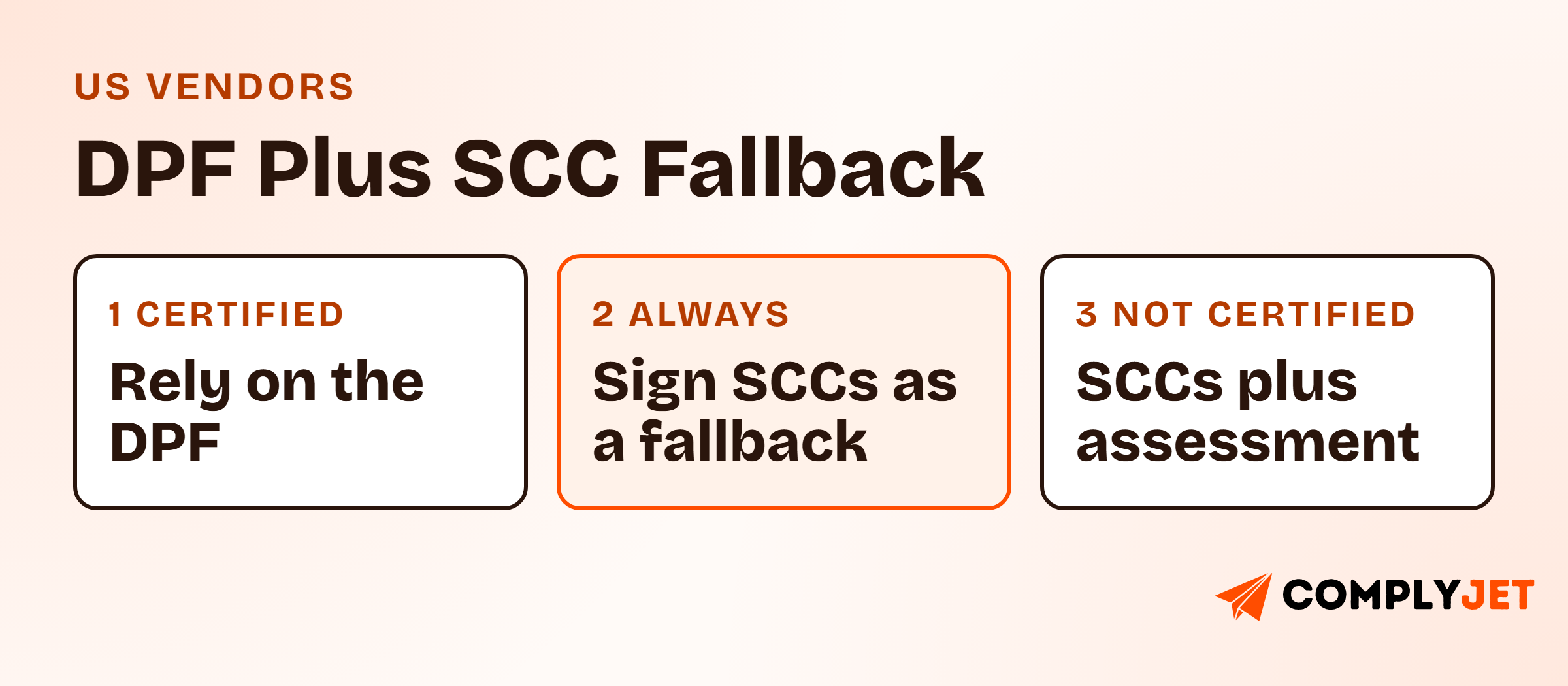
Certification does not replace the contract. It only changes which of the two carries the weight on a given day.
Pro tip
DPF certification status is public, and enterprise buyers check it. Look yourself up before a customer does, and confirm the entry covers the data categories you actually process.
ComplyJet customers
How an early-stage company runs compliance day to day
Raghuram Vadapally, Managing Director and Head of Software Engineering at Synexar AI, calls ComplyJet "an indispensable part of our compliance workflow." Their story is about everyday compliance rather than data transfers, but it shows how a small team runs it.
Cross Border Data Transfer Requirements by Country: The Comparison Table
Cross border data transfer requirements by country follow one pattern: a default rule, a short list of mechanisms, and a trap that catches vendors who assume the EU model applies everywhere. The table gives the starting point for each of 15 jurisdictions. Cross border data transfer laws differ most at the edges: filings, volume thresholds and sector overlays. Detail follows in the country sections.
| Jurisdiction | Default rule | Mechanisms | Regulator filing or approval | Consent role | Main trap |
|---|---|---|---|---|---|
| EU and EEA | Transfer needs a Chapter V basis | Adequacy, SCCs, BCRs, DPF, Art. 49 | None for SCCs; BCRs need authority approval | Art. 49 only, narrow | Remote access counts as a transfer |
| United Kingdom | Same structure under UK GDPR | UK adequacy regulations, IDTA or Addendum, BCRs, data bridge | None for IDTA or Addendum | Art. 49 only | Separate UK mechanism, plus a transfer risk assessment |
| Switzerland | Free to adequate countries | Federal Council list, recognised SCCs, BCRs, Swiss-US DPF | Notification for specific contract clauses | Narrow exceptions (Art. 17 FADP) | Own list, own notification duty |
| United States | No general restriction | Not needed for most data | DOJ rule restricts access by countries of concern | Not the basis | Bulk sensitive data and countries of concern |
| Canada | No adequacy regime; accountability | Contract or other means | None federally; Quebec assessment | Notice, not consent | Quebec's pre-transfer privacy assessment |
| Brazil | Transfers need a listed basis | Adequacy, ANPD SCCs, global corporate norms, certificates | ANPD approval for specific clauses and BCR-style norms | Specific, informed consent is one basis | Use ANPD clauses, not EU SCCs alone |
| China | Route set by volume and sensitivity | Security assessment, standard contract, certification | CAC assessment or provincial CAC filing | Separate consent required | Individual counts since 1 January change the route |
| India | Free except to restricted countries | Government blacklist model | None announced | Not the basis | Sector localization applies today |
| Japan | Prior consent naming the country, or an exception | Whitelisted countries, equivalent-standard recipients | None | Central | Consent must describe the destination's system |
| South Korea | Consent by default | Law or treaty, disclosed delegation, PIPC-required measures such as ISMS-P, PIPC adequacy | None for the listed exceptions | Central, with a detailed notice | Penalty ceiling rises from September 2026 |
| Singapore | Comparable protection | Contracts, notified consent, prescribed circumstances | Exemption by application | One basis among several | Recipient must give comparable protection |
| Australia | Reasonable steps and accountability | Contract, substantially similar law, consent after warning | None | One exception | You answer for the overseas recipient's breaches |
| UAE | Federal rule awaits regulations; sector rules bite | Contractual safeguards, express consent, necessity | Central Bank approval for financial data | Express consent is one route | Health and financial data localization |
| Saudi Arabia | Allowed within Transfer Regulations | Adequate countries, appropriate safeguards, limited exceptions | Sector approvals such as SAMA for banking | One basis | Minimum data and national security conditions |
| Russia | Notify the regulator first | Adequate-country list, regulator approval otherwise | Notification to Roskomnadzor before every transfer | Not the basis | Notice precedes transfer; localization applies separately |
Note
Read a row as a starting point, not legal advice. The transfer rule attaches to the exporter's country, not to the vendor's. A vendor in Austin sending EU customer data is under the EU rule for that transfer.
What does that change in practice? It means a single contract template rarely covers a global customer base, and the sections below show where it stops working.
Cross Border Data Transfer Requirements in Europe: UK and Switzerland
Each jurisdiction block below follows the same order: the default rule, mechanisms, any filing or approval, penalty exposure, and a one-line verdict.
UK Cross Border Data Transfer Requirements: UK International Data Transfer Agreement, Addendum and New Test
Default rule: the UK GDPR restricts transfers outside the UK unless a mechanism applies, the same ladder as the EU. Mechanisms: UK adequacy regulations (including the UK-US data bridge), the ICO's UK International Data Transfer Agreement (IDTA), the Addendum that lets organisations use the EU SCCs for UK transfers, BCRs and the Article 49 derogations. The EU SCCs are not valid on their own for UK restricted transfers.
What changed in 2026: the Data (Use and Access) Act 2025 replaces "essentially equivalent" with a test that protection must be "not materially lower" than under the UK GDPR, and most of its data protection provisions commenced on 5 February 2026. The ICO published updated international transfers guidance on 15 January 2026.
The ICO's own IDTA and Addendum page says both templates will be updated during 2026 and that organisations should keep using the current versions (IDTA A.1.0 and Addendum B.1.0) until then. Source: ICO, IDTA and Addendum.
Filing or approval: none for the IDTA or Addendum, but the ICO expects a transfer risk assessment alongside them. Penalty exposure: up to GBP 17.5 million or 4% of worldwide turnover at the higher tier. EU to UK: a separate question, answered by the Commission's renewal of UK adequacy to 27 December 2031.
Verdict: two directions, two regimes. The EU's free pass to the UK does not make UK-to-US or UK-to-India transfers free.
Switzerland Cross Border Data Transfer Requirements: Its Own List and Notification Duty
Default rule: personal data may go abroad freely only to countries the Federal Council has listed as adequate (Annex 1 of the Data Protection Ordinance). Mechanisms: contract clauses, standard clauses, BCRs and the Swiss-US DPF, which has applied since 15 September 2024.
The distinctive part is notification. Specific contract clauses must be notified to the Federal Data Protection and Information Commissioner (FDPIC) before the transfer.
Standard clauses the FDPIC has issued or recognised, which include the EU SCCs and the Council of Europe model clauses, need no separate notification. BCRs need approval, though those already approved by an EU authority can be used. Breaching the transfer provisions can carry criminal liability under Article 61 of the FADP. Source: FDPIC, cross-border transfer of personal data.
Verdict: Switzerland is not the EU under another name. Its list and its notification duty are its own.
Cross Border Data Transfer Requirements in Asia-Pacific: China, India and Beyond
Asia-Pacific is where international data transfer requirements diverge most from the EU model. China ties the mechanism to data volume, India uses a blacklist, and four other major markets lean on consent or comparable protection.
China Cross Border Data Transfer Requirements: Security Assessment, Standard Contract or Certification
China is the one regime where the amount of data decides the route. China cross border data transfer rules set three routes, picked by the number of individuals whose data leaves the country since 1 January of the year, and by sensitivity.
| Band | Route | Trigger | Filing or approval |
|---|---|---|---|
| Below 100,000 non-sensitive individuals | None of the three routes needed | Volume threshold under the March 2024 provisions | None |
| 100,000 to 1,000,000 non-sensitive individuals, or fewer than 10,000 sensitive | Standard contract, or certification from 1 January 2026 | Mid-volume transfers | Contract and impact assessment filed with the provincial CAC within 10 working days |
| More than 1,000,000 non-sensitive, more than 10,000 sensitive, any important data, or any critical information infrastructure operator | CAC security assessment | High volume, sensitivity or sector | CAC approval, valid three years |
The routes also require notice to individuals, their separate consent and a personal information protection impact assessment.
Four exemptions apply: data collected abroad and re-imported without China-collected data, cross-border HR management, necessity for a contract with the individual, and emergencies protecting life, health or property. Free trade zones publish their own negative lists, and the authorised certification institutions had not been published when the certification measures took effect. Sources: China Briefing and DLA Piper's Data Protection Laws of the World (China page, modified February 2026).

Penalty exposure: up to 5% of the previous year's revenue for the most serious PIPL breaches, with confiscation of unlawful income. Verdict: a startup's first China customer can change the route. Count individuals from 1 January and keep the count.
India Cross Border Data Transfer Requirements: DPDP Act, Blacklist Model and Sector Rules
India's approach is the reverse of the EU's. The Digital Personal Data Protection Act 2023 allows transfers to any country except those the government restricts by notification, and no restricted list has been published. The DPDP Rules were notified on 13 November 2025, and most substantive obligations begin on 13 May 2027, so the older IT Act and its 2011 Privacy Rules still govern until then.
Two caveats matter. The Rules let the government set conditions on making personal data available to a foreign state, and Significant Data Fiduciaries can be required to keep specified data in India. Sector regulators already require local storage today: the Reserve Bank of India for payment system data and SEBI for certain financial data. Source: DLA Piper, Data Protection Laws of the World (India page).
Verdict: free by default on paper, with sector rules that bite today. India is a timeline story, not a settled regime.
Japan, South Korea, Singapore and Australia: Four Cross Border Data Transfer Requirements Profiles
Japan. The APPI requires prior consent that names the destination country. When asking, the company must give an overview of that country's data protection system and the recipient's protective measures. Exceptions cover whitelisted destinations (the EU and UK) and recipients with equivalent standards, such as those recognised under APEC CBPR. The company must keep checking that the recipient maintains the standard. Verdict: consent only works if it is specific.
South Korea. Consent is the default. Exceptions cover transfers required by law or treaty, delegation necessary to perform a contract that is disclosed in the privacy policy, recipients applying protective measures the PIPC requires (ISMS-P certification is the example), and countries the PIPC recognises as adequate. The PIPC recognised the EU on 3 September 2025.
Penalty ceilings rise to 10% of revenue in certain cases under 2026 amendments effective 11 September 2026. Verdict: the consent notice is detailed, so build the notice before the contract.
Singapore. The Transfer Limitation Obligation requires recipients to give comparable protection. Organisations meet it through contracts (the PDPC publishes sample clauses), notified consent, or prescribed circumstances such as performing a contract with the individual. Verdict: a well-drafted contract is enough, but it has to say what the recipient will do.
Australia. APP 8 requires reasonable steps to make sure an overseas recipient does not breach the Australian Privacy Principles, and the disclosing entity stays accountable for the recipient's acts. Exceptions cover recipients under substantially similar law with enforcement access, consent after an explicit warning, and legal requirements. No equivalency declarations have been made, and reforms are expected in 2026. Verdict: you answer for your vendor's breach.
Cross Border Data Transfer Requirements in the Americas: US, Canada and Brazil
The Americas split three ways: the US restricts access by a short list of countries, Canada relies on accountability, and Brazil has built an EU-style system.
United States Cross Border Data Transfer Requirements: No General Rule, but the DOJ Rule Matters
The US has no general geographic restriction on transferring personal data. Two things sit on top. The Department of Justice's data security program (28 CFR Part 202) took effect on 8 April 2025. It targets access to bulk sensitive personal data and US government-related data by countries of concern: China (including Hong Kong and Macau), Cuba, Iran, North Korea, Russia and Venezuela.
It prohibits some data brokerage deals and restricts vendor, employment and investment agreements that give those countries access, with bulk thresholds such as personal health or financial data on more than 10,000 US persons. Due diligence, audit and reporting duties phased in from 6 October 2025.
Sector law adds the second layer: HIPAA covered entities must have safeguards before disclosing protected health information outside the US. For the state law map, see our guide to data privacy laws by country.
Verdict: the US restricts outbound access to a short list of countries, not outbound transfers in general.
Canada Cross Border Data Transfer Requirements: PIPEDA Accountability and Quebec's Assessment
The Office of the Privacy Commissioner confirms that Canada has no adequacy regime. Under PIPEDA, an organisation stays accountable for personal information it sends to a processor, including one abroad. It must use contracts or other means to provide a comparable level of protection and should tell individuals that their information may be processed outside Canada. Source: Office of the Privacy Commissioner of Canada.
Quebec adds a step. Under Law 25, an organisation must carry out a privacy assessment before transferring information outside Quebec, considering sensitivity, purpose, contractual protection and the destination's legal regime. Alberta's PIPA requires privacy policies to name the countries involved. Verdict: no mechanism to choose, but in Quebec a documented assessment is mandatory.
Brazil Cross Border Data Transfer Requirements: ANPD Clauses and Mutual Adequacy With the EU
Brazil's LGPD allows international transfers on listed bases: adequacy, specific contractual clauses, ANPD standard contractual clauses, global corporate norms (its BCR equivalent), certificates and codes of conduct, and several narrow exceptions. ANPD Regulation CD/ANPD 19/2024, published on 23 August 2024, approved the ANPD's standard clauses and set the approval process for the others.
Since January 2026, transfers between Brazil and the EU can rest on mutual adequacy decisions. For every other destination, the ANPD standard clauses are the most common route. Source: DLA Piper, Data Protection Laws of the World (Brazil page, modified March 2026).
Quick take
Brazil to the EU and the EU to Brazil are both free-pass directions now. That is rare. Most adequacy relationships run one way only.
Verdict: the model for what mutual adequacy looks like, with ANPD clauses as the route for everyone else.
Cross Border Data Transfer Requirements in the Gulf and Russia
These three jurisdictions overlay transfer rules with sector regulation, and two of the three have regulations still moving.
UAE and Saudi Arabia Cross Border Data Transfer Requirements: Transfer Rules With Sector Overlays
Saudi Arabia. The PDPL took effect on 14 September 2023, with compliance expected by 14 September 2024.
Separate Regulations on Personal Data Transfers outside the Kingdom allow transfers to countries with adequate protection, to others with appropriate safeguards, and in limited exceptional cases. A transfer must not harm national security or vital interests and must be limited to the minimum data needed. Banking transfers need Saudi Central Bank approval. Source: DLA Piper, Data Protection Laws of the World (Saudi Arabia page, modified February 2026).
United Arab Emirates. The federal PDPL limits transfers, but law-firm commentary from early 2026 reports that its executive regulations remain unpublished and the Data Office is not yet fully operational, so the federal route is unsettled.
The DIFC and ADGM free zones run their own regimes aligned with GDPR. The firmer rules are sectoral: health data under Federal Law No. 2 of 2019 must stay in the UAE except as Ministerial Decision No. 51 of 2021 permits, and financial and payment data must be stored in the UAE.
Verdict: the Gulf is where a free-pass assumption fails fastest.
Russia Cross Border Data Transfer Requirements: Notify First, Then Transfer
Russian operators must notify the regulator, Roskomnadzor, before transferring personal data abroad. Where the destination does not offer adequate protection, they must wait for the regulator's decision. Russia also requires the initial collection and storage of Russian citizens' personal data to take place in databases located in Russia. The rules have been amended repeatedly, so confirm current text with local counsel before any Russian flow.
When Transfer Rules and Localization Collide
A transfer mechanism does not satisfy a rule that data must stay in the country. Russia's localization rule, the UAE's health and financial data rules, India's sector regulators and Saudi sector approvals each sit on top of, or instead of, the transfer route.
Watch out
The contract can be perfect and the architecture still wrong. If a rule says data must stay in-country, no clause lets it leave.
Cross Border Data Transfer Requirements for SaaS Vendors: Which Mechanism for Which Customer
A SaaS vendor's transfer position depends on where each customer's data subjects sit, not where the vendor is incorporated. The table keys the first move to customer region.
| Customer region | Rule that attaches | Mechanism to put in the contract | First action |
|---|---|---|---|
| EU and EEA | GDPR Chapter V | DPF if certified, plus SCCs as fallback | Check your DPF entry; sign SCCs |
| United Kingdom | UK GDPR | UK Extension if certified; otherwise IDTA or Addendum | Confirm the UK Extension is listed |
| Switzerland | FADP | Swiss-US DPF if certified; otherwise recognised SCCs | Confirm the Swiss extension |
| China | PIPL and CAC rules | Standard contract or assessment, by volume | Start counting individuals from 1 January |
| India | DPDP Act (from 13 May 2027) and sector rules | No mechanism yet; watch the restricted list | Check sector regulators for the customer |
| Brazil | LGPD | ANPD standard clauses (EU data: mutual adequacy) | Adopt the ANPD clause text |
| Gulf states | PDPL plus sector law | Safeguards plus sector approvals | Ask the customer which data is regulated |
What Enterprise Buyers Ask in Security Questionnaires About Transfers
Four questions recur, and each deserves a one-line answer ready in advance:
- Which mechanism covers our data? Name it: DPF certification, SCC module, or IDTA.
- Where are your sub-processors? Keep the list current by country.
- When was your latest transfer impact assessment? Give a date and an owner.
- What happens if the DPF is struck down? State that SCCs are already signed as the fallback.

These answers also feed vendor reviews on the customer's side. For how buyers evaluate suppliers, see our third-party risk management policy.
Building the Transfer Record Before a Customer Asks
Keep one record that holds the countries you send data to, each recipient, the mechanism used, the sub-processor list, the date of the last assessment and a named owner. It doubles as evidence for a privacy information management system, and the ISO 27701 guide shows how the standard treats it.
Choose the path that matches where you are today:
- If your customers are EU-only and you are DPF-certified, keep SCCs signed as a fallback and check the listing once a year.
- If you add UK or Swiss customers, confirm the UK Extension and Swiss-US DPF are both on your certification.
- If you add China, India or the Gulf, use the comparison table above and assume a filing, an assessment or a sector approval before you assume a clause is enough.
- Otherwise, start from the comparison table and work one customer region at a time.
Enforcement and Penalties: What Regulators Have Actually Done
EUR 530 million. That is the fine the Irish Data Protection Commission issued in May 2025 over transfers to China, a fine built on a single finding: staff abroad could see EEA user data. Beside it sits a spread of statutory ceilings.
| Law | Statutory ceiling | What the figure covers |
|---|---|---|
| GDPR | EUR 20 million or 4% of worldwide turnover, whichever is higher | The higher tier, which includes transfer breaches under Articles 44 to 49 |
| UK GDPR | GBP 17.5 million or 4% of worldwide turnover | The higher tier |
| China PIPL | 5% of prior-year revenue for the most serious breaches | The law as a whole |
| Brazil LGPD | 2% of Brazilian revenue, capped at BRL 50 million per infraction | The law as a whole |
| South Korea PIPA | Up to 10% of revenue in certain cases from 11 September 2026 | The law as a whole |
| Switzerland FADP | Criminal fines on the responsible individual, up to CHF 250,000 | Intentional breaches, transfer provisions included |
Only the GDPR and UK rows are transfer-specific. The others are ceilings for the law as a whole, not transfer-only figures.
Watch out
A statutory maximum says how seriously a legislature takes a law, not what a regulator will charge. The TikTok decision shows what an incomplete transfer assessment can cost when the regulator is motivated.
Mistakes to Avoid With Cross Border Data Transfer Requirements
These are easy to get wrong because each one looks reasonable on paper:
- Relying on the DPF with no SCC fallback. A ruling would leave you without a basis for every EU customer at once.
- Treating a signed DPA as the transfer mechanism. A data processing agreement is the contract; SCCs or certification are the legal basis that sits inside it.
- Ignoring remote support access. Staff who can open customer data from another country create a transfer.
- Assuming adequacy covers everything. Canada's decision covers commercial organisations only, and the US decision covers certified organisations only.
- Using Article 49 consent for regular flows. The derogation is for occasional, narrow transfers.
- Counting China individuals from the wrong date. The count runs from 1 January and decides the route.
- Assuming the vendor's country decides the rule. The exporter's country decides it.
How ComplyJet Fits When Your Data Crosses Borders
ComplyJet supports GDPR and ISO 27701 on one platform, and it helps keep the evidence that supports a transfer record: vendor inventory, policies and access controls. We are not a law firm. We do not draft standard contractual clauses or run legal assessments, and we do not cover the non-GDPR regimes in this guide, so confirm the legal call with counsel.
If you are a US vendor with EU customers, the useful starting point is our guide to GDPR compliance for US companies. For how GDPR compares with an audit framework your buyers also ask about, see SOC 2 vs GDPR.
Book a demo
Bring your customer-region list
We will talk through which frameworks to tackle first for a team your size, and where GDPR evidence helps.
FAQs
What are the requirements for cross border data transfer?
A transfer needs a recognised legal mechanism under the sending country's law. In the EU that means an adequacy decision, standard contractual clauses, binding corporate rules, certification such as the DPF, or a narrow Article 49 exception. Other countries add filings, assessments or consent, and the comparison table above shows the main ones.
What is a cross border data transfer under GDPR?
A GDPR cross border data transfer is personal data sent to, or made accessible from, a recipient in a country outside the EEA. Remote access counts, as the TikTok decision shows. The importer is a legal entity in the third country, and Chapter V of GDPR applies to the exporter.
How can personal data be transferred outside the EU?
Through an adequacy decision, standard contractual clauses, binding corporate rules, the EU US Data Privacy Framework for certified US recipients, or an Article 49 derogation. For a SaaS vendor, SCCs are the usual route, and the DPF is a convenient option if you are certified.
Do I need standard contractual clauses if I am DPF certified?
Not legally, while the framework stands, but we recommend keeping them signed. The DPF is under appeal before the Court of Justice, and its two predecessors were struck down. SCCs as a fallback mean a ruling does not leave your customers without a legal basis.
Is the EU-US Data Privacy Framework still valid?
Yes, as of mid-October 2026. The General Court dismissed the challenge on 3 September 2025, and Philippe Latombe's appeal is pending before the Court of Justice with no hearing date announced. Treat it as valid but not permanent.
Which countries have an EU adequacy decision?
Sixteen countries and territories: Andorra, Argentina, Brazil, Canada (commercial organisations), the Faroe Islands, Guernsey, Israel, the Isle of Man, Japan, Jersey, New Zealand, the Republic of Korea, Switzerland, the United Kingdom, the United States (DPF participants) and Uruguay. The European Patent Organisation is also covered. The full explainer is in our guide to GDPR countries.
Does China allow personal data to leave the country?
Yes, through one of three routes, chosen by volume and sensitivity. Small transfers under 100,000 non-sensitive individuals since 1 January need none of them, mid-volume transfers use a filed standard contract or certification, and large or sensitive transfers need a CAC security assessment. Separate consent and an impact assessment apply.
Do US companies need a transfer mechanism for EU customer data?
Yes, if the customer's data is subject to GDPR and the US company receives it. The mechanism is the DPF for certified companies or SCCs otherwise. The US company's own location does not change the EU exporter's obligation to have a basis in place.
Related Reading
- Data Processing Agreement Template: the contract the transfer mechanism sits inside
- GDPR Countries: the EU and EEA member list and the adequacy explainer
- Data Privacy Laws by Country: the wider privacy law map
- GDPR Compliance for US Companies: when a US business is in scope
- GDPR EU Representative: the Article 27 representative for non-EU vendors
- Third-Party Risk Management Policy: how customers review sub-processors