.svg)

You’ve shortlisted a handful of cspm tools, sat through two or three discovery calls, and still can’t get a price out of anyone. Every vendor claims to be agentless, context-aware, and easy to deploy. None of them are wrong. None of them are making the decision easy either.
I reviewed 10 of the leading cspm tools for this article, looking at what they actually scan, how fast they surface real risk, and where they fall short for teams at different stages.
One thing worth stating upfront: pure-play CSPM as a standalone category barely exists anymore. Almost every tool on this list has evolved into a full CNAPP (Cloud Native Application Protection Platform), bundling cloud security posture management with workload protection, identity risk analysis, and vulnerability scanning in a single platform. I’ve included tools where posture management is a genuine core capability, not a checkbox added to compete.
Here’s the full breakdown.
What CSPM actually catches that your firewall misses
Your firewall inspects traffic. Your EDR watches processes. Neither of them has any idea what your S3 bucket permissions look like, whether your IAM roles are over-privileged, or whether someone just deployed a Terraform module that opens port 22 to the world.
Why it matters
Your firewall does not know your S3 bucket is publicly accessible — CSPM tools cover the configuration layer those tools miss.
That’s the gap cloud security posture management fills. CSPM tools connect to your cloud provider APIs and continuously check your configuration against security and compliance baselines. Not just at deployment: continuously. A bucket that was private on Monday can be public by Friday if someone changes a policy or a configuration drift goes unnoticed.
In 2026, the better platforms also catch misconfigurations before they reach production, scanning your IaC templates in CI/CD pipelines. The idea is to find that misconfigured security group in a pull request rather than a breach post-mortem.
What makes this category harder to navigate now: you’re not just buying misconfiguration detection. Attack path analysis, identity entitlements, data exposure, and workload runtime protection have all landed in the same platforms. That makes them more powerful. It also makes comparison more complicated.
How we evaluated the top CSPM tools
I looked at six criteria across all 10 cspm tools:
Key insight
Time to value is the most underrated criterion: tools that take weeks to produce meaningful findings rarely get used consistently.
- CSPM depth: Is posture management a native capability or a thin layer added for market positioning?
- Agentless coverage: Can it scan without deploying agents to every VM, container, and function?
- Multi-cloud parity: AWS, Azure, and GCP covered equally, not one as a second-class citizen?
- Attack path analysis: Does it surface dangerous combinations of findings, not just individual alerts?
- Compliance framework coverage: Are CIS Benchmarks, NIST, PCI DSS, SOC 2, and ISO 27001 built in?
- Time to value: How long from connecting a cloud account to seeing meaningful findings?
Quick comparison: top CSPM tools at a glance
| Tool | Best for | Pricing | Standout feature |
|---|---|---|---|
| Wiz | Overall / enterprise | Quote only | Graph-based attack path analysis |
| Orca Security | Agentless CNAPP | Quote only | SideScanning, no agents required |
| Datadog CSM | Teams already on Datadog | From $22/host/mo | Unified observability and security |
| Palo Alto Prisma Cloud | Enterprise multi-cloud | From ~$9K/yr | 100+ compliance frameworks, code to cloud |
| CrowdStrike Falcon Cloud | Threat-intel-driven CSPM | Quote only | 281+ adversary groups tracked |
| Sysdig Secure | Kubernetes-heavy environments | Quote only | Runtime insights via open-source Falco |
| Aqua Security | Container and supply chain | Quote only | Deepest container security of the group |
| Lacework (FortiCNAPP) | Behavioral anomaly detection | From ~$22K/yr | ML-based behavioral baselines |
| Check Point CloudGuard | Network and cloud unified | Quote only | 1,500+ built-in compliance rules |
| Tenable Cloud Security | Identity and IaC risk | Quote only | Identity-first CIEM and IaC scanning |
The 10 best CSPM tools in 2026
1. Wiz
Wiz is the category reference point. Built by four ex-Microsoft Azure security engineers in 2020, it reached $500M ARR faster than almost any security company before it, and was acquired by Google (Alphabet) in March 2026 for $32 billion, the largest cybersecurity acquisition ever. Over 45% of the Fortune 100 run it.
What makes Wiz different from most cspm tools is the security graph. Rather than generating a long list of individual findings, it correlates misconfigurations, identity permissions, vulnerabilities, and network exposure into a graph, then surfaces attack paths: dangerous combinations where multiple small issues compound into a real breach path. A misconfigured IAM role on an exposed VM is treated as far more urgent than either issue alone. That context is what cuts alert fatigue.
It deploys agentlessly across AWS, Azure, GCP, and OCI by connecting through cloud APIs. Most teams see meaningful findings within hours of connecting an account.
The honest tradeoff: Wiz is expensive. Third-party contract data puts the range at $24K to $354K per year depending on workload size, with a median around $111K. There is a “Wiz Go” bundle aimed at SMBs, but it still requires a quote. If you’re a sub-50-person startup, price is almost certainly the deciding factor.
“
Wiz charges a lot but they are offering a good product.
reviewer2755878· 11-50 employees
Via PeerSpot ↗Key features:
- Agentless scanning across AWS, Azure, GCP, and OCI
- Security graph for attack path analysis and toxic combination detection
- CSPM, CWPP, CIEM, DSPM, KSPM in a single platform
- Wiz Code for IaC scanning and CI/CD pipeline integration
- Wiz Defend for runtime threat detection via eBPF sensor
- AI agents for code fixes, pen testing simulation, and threat hunting
- 240+ integrations via the Wiz Integration Network
- Compliance reporting across SOC 2, ISO 27001, PCI DSS, FedRAMP, and more
Pros of Wiz
- Fastest time-to-value of any tool on this list
- Security graph is genuinely better at prioritization than flat finding lists
- 4.7/5 across 777 reviews, strongest rating in the category
- Google acquisition means continued deep investment across AWS, Azure, and GCP
Cons of Wiz
- Enterprise-only pricing in practice; not realistic for early-stage startups
- 54% of reviewers are enterprise, only 7% small business: SMB experience is limited
- License costs can scale automatically without caps, per user reviews
Pricing: Fully quote-based; workload-based model; contracts typically $24K to $354K per year Best for: Mid-market to enterprise teams with multi-cloud environments; the category-defining tool if budget allows
2. Orca Security
Orca Security built its reputation on a single question: what if you could get deep cloud visibility without deploying any agents? Its answer is SideScanning, a patented technology that reads cloud workload data directly from cloud provider APIs and storage snapshots, without touching running workloads or installing anything on hosts.
The practical result is impressive. Orca connects to a cloud account, scans the full configuration and workload state, and surfaces prioritized findings quickly after setup. It covers CSPM, CWPP, CIEM, DSPM, and API security in a single platform, with compliance checks across 200+ frameworks.
What separates Orca from most cspm tools is contextual prioritization. Rather than treating every misconfiguration as equal, its Unified Data Model combines configuration state, identity permissions, network reachability, and sensitive data location. A publicly exposed database containing PII gets a much higher priority score than a publicly exposed database containing nothing of value. That context cuts alert fatigue in practice.
Funded to $640M with a $1.8B valuation, Orca sits firmly in the enterprise tier on pricing. It uses a workload-based model with a single SKU covering the full CNAPP platform: no module-by-module upsells.
“
When we started using Orca, our cloud estate was in disarray. After an incredibly easy setup, Orca immediately brought into focus how seriously exposed some of our assets were.
★★★★★Bob N.
Via G2 ↗Key features:
- Agentless SideScanning: no agents, no performance impact, full workload visibility
- CSPM, CWPP, CIEM, DSPM, API security, and KSPM in one platform
- 200+ customizable compliance frameworks including SOC 2, ISO 27001, PCI DSS, HIPAA, and FedRAMP Moderate
- Three types of reachability analysis: agentless, dynamic, and code-level
- AI-powered risk prioritization via Unified Data Model
- Attack path analysis with contextual risk scoring
- Orca Sensor for real-time threat detection and response
- CI/CD integration and shift-left security scanning
Pros of Orca Security
- Best agentless coverage of any tool on this list
- Single SKU pricing simplifies procurement considerably
- 4.6/5 across 222 reviews; consistently strong user satisfaction
- Fast deployment for an enterprise-tier platform
Cons of Orca Security
- Quote-only pricing; no published tiers makes budget planning difficult
- Priced for mid-market and enterprise; not designed for small teams
- Agentless-only means slightly less real-time runtime signal than agent-based tools
Pricing: Fully quote-based; workload-based annual model; no free tier Best for: Cloud-native companies that want full CNAPP coverage without managing agents at scale
3. Datadog Cloud Security Management
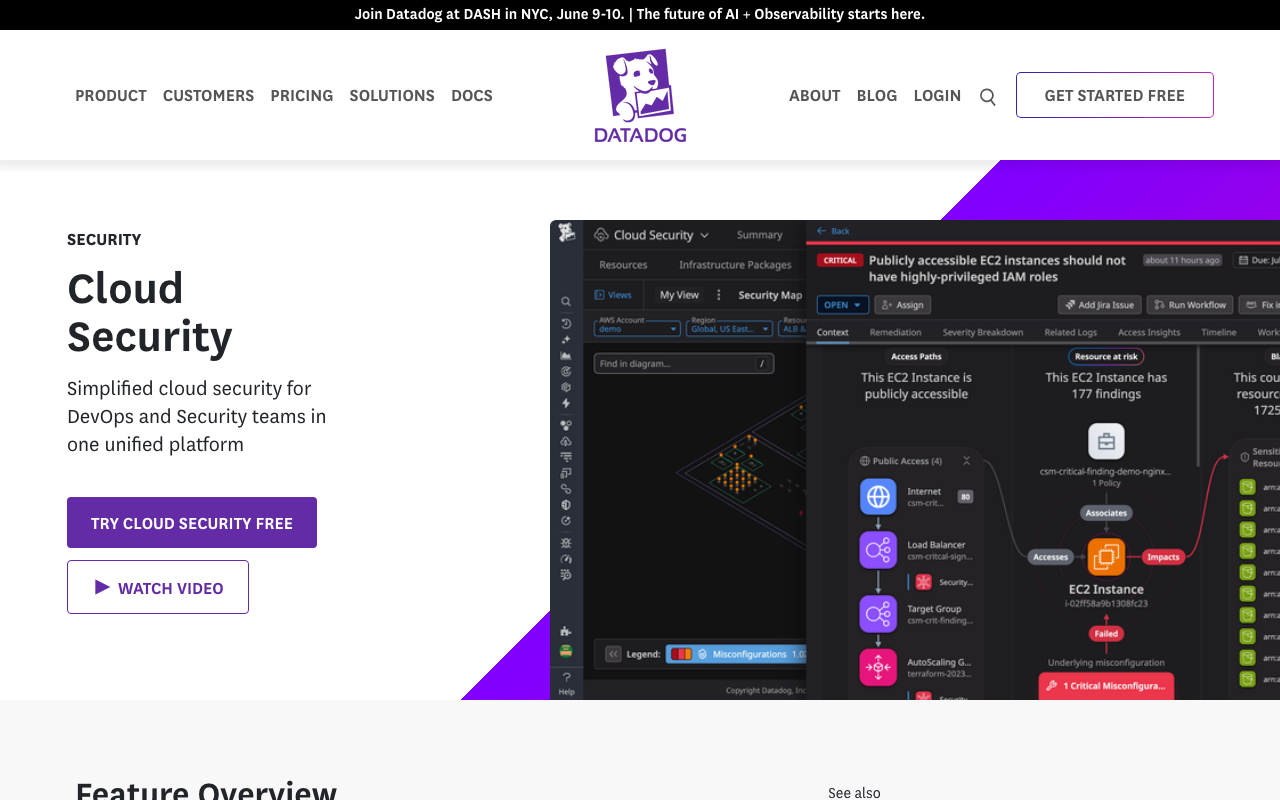
Datadog Cloud Security Management occupies a unique position among cspm tools. It is the only one with publicly listed pricing, and the only one that treats security as an extension of observability rather than a separate product.
If your team already runs Datadog for monitoring, Cloud Security Management (CSM) is a natural addition. Security findings land in the same platform as your logs, metrics, and traces. A misconfiguration alert can be investigated alongside the deployment that caused it, without switching tools. That context matters for teams where engineering and security overlap significantly.
CSM covers CSPM, CIEM, vulnerability management, and 1,000+ detection rules updated continuously by Datadog Security Labs. It supports agentless scanning across AWS, Azure, GCP, and Oracle Cloud, with an optional lightweight agent for deeper workload visibility.
The honest limitation: if you are not already a Datadog customer, the per-host pricing model can get complex as infrastructure scales. And while the security features are solid, they are not as purpose-built as dedicated CNAPP vendors like Wiz or Orca. You are getting roughly 80% of the capability for teams that value the unified observability angle above raw CSPM depth.
“
Incident response was enhanced since logs, traces, and metrics are combined, and security investigations are seamless for all cloud clients. Role-based dashboards help monitor attacks and anomalies on cloud accounts.
★★★★★Alvin O.· Information Technology and Services
Via Capterra ↗Key features:
- Agentless scanning with optional agent for deeper workload coverage
- CSPM with continuous checks across cloud accounts, hosts, containers, and Kubernetes
- CIEM for identity risk and excessive permission detection
- Security Inbox: prioritized finding queue with severity scoring
- 1,000+ pre-built detection rules from Datadog Security Labs
- Compliance monitoring for CIS Benchmarks, PCI DSS, SOC 2, and custom frameworks
- File integrity monitoring and workload protection (Enterprise tier)
- Multi-cloud support: AWS, Azure, GCP, and Oracle Cloud
Pros of Datadog Cloud Security Management
- Only tool on this list with publicly listed pricing
- Security findings correlate directly with logs and metrics in a single pane
- 4.4/5 across 808 reviews
- Strong fit for teams already running Datadog observability
Cons of Datadog Cloud Security Management
- Per-host pricing can scale unpredictably for large fleets
- Less purpose-built for CSPM than dedicated vendors; security is layered on observability
- No free tier; trial requires contacting sales
Pricing: DevSecOps Pro at $22/host/month (annual); Enterprise at $34/host/month (annual) Best for: Engineering teams already running Datadog who want security in the same observability platform
4. Palo Alto Prisma Cloud
Palo Alto Prisma Cloud is the most comprehensive CNAPP on this list, almost by definition. It covers code, IaC, CI/CD, containers, workloads, identities, and runtime in a single platform with 3,000+ built-in policies across 100+ compliance frameworks. Palo Alto is also partially rebranding this as “Cortex Cloud,” but the underlying product is the same.
The sheer breadth is both the selling point and the complexity warning. Prisma Cloud processes over 1 trillion events daily and supports 350+ cloud-native services across AWS, Azure, GCP, OCI, Alibaba, and IBM Cloud. If you need genuine code-to-cloud coverage and have the security team to operate it, nothing on this list is more complete.
For teams evaluating enterprise cspm tools with code-to-cloud requirements, Prisma Cloud is the most comprehensive option on this list.
Where it struggles: scan latency. Users consistently report that CSPM data can take 15 minutes to an hour to update after a configuration change, and scan intervals can be inconsistent. For teams that need real-time posture visibility, that gap matters. The pricing is also enterprise-scale: the Business Edition starts at roughly $9,000 per 100 credits per year (third-party estimates), and actual enterprise contracts typically run $100K or more.
“
RQL in Prisma Cloud is a feature where we can conduct any kind of investigation and create our own custom policies, which is really helpful. Runtime protection in CWP is a differentiator from competitors.
★★★★★Mohammed Talib Khan· 201–500 employees
Via PeerSpot ↗Key features:
- Agentless CSPM with near-real-time multicloud visibility across 6 cloud platforms
- CIEM, DSPM, AI-SPM, container security, and CWPP in one platform
- 3,000+ built-in compliance policies across 100+ frameworks
- Prisma Cloud Copilot: natural language queries via Precision AI
- Code-to-cloud remediation tracing misconfigurations back to the source IaC
- 100+ auto-remediation policies
- Custom policy creation via Resource Query Language (RQL)
- Attack path analysis with graph visualisation
Pros of Palo Alto Prisma Cloud
- Most complete CNAPP coverage on this list
- 100+ compliance frameworks built in: NIST 800-53, ISO 27001, PCI DSS, SOC 2, HIPAA
- Prisma Cloud crossed $500M ARR, signalling continued product investment
- RQL lets security teams write highly specific custom policies
Cons of Palo Alto Prisma Cloud
- CSPM data ingestion can lag 15 minutes to an hour; not suited for real-time posture needs
- Platform complexity requires a dedicated security team to operate well
- Enterprise contracts typically start at $100K; pricing is opaque
Pricing: Business Edition from ~$9,000/100 credits/year; Enterprise from ~$18,000/100 credits/year (third-party estimates; actual deals typically start higher) Best for: Large enterprises needing comprehensive code-to-cloud CNAPP coverage across multiple cloud providers
5. CrowdStrike Falcon Cloud Security
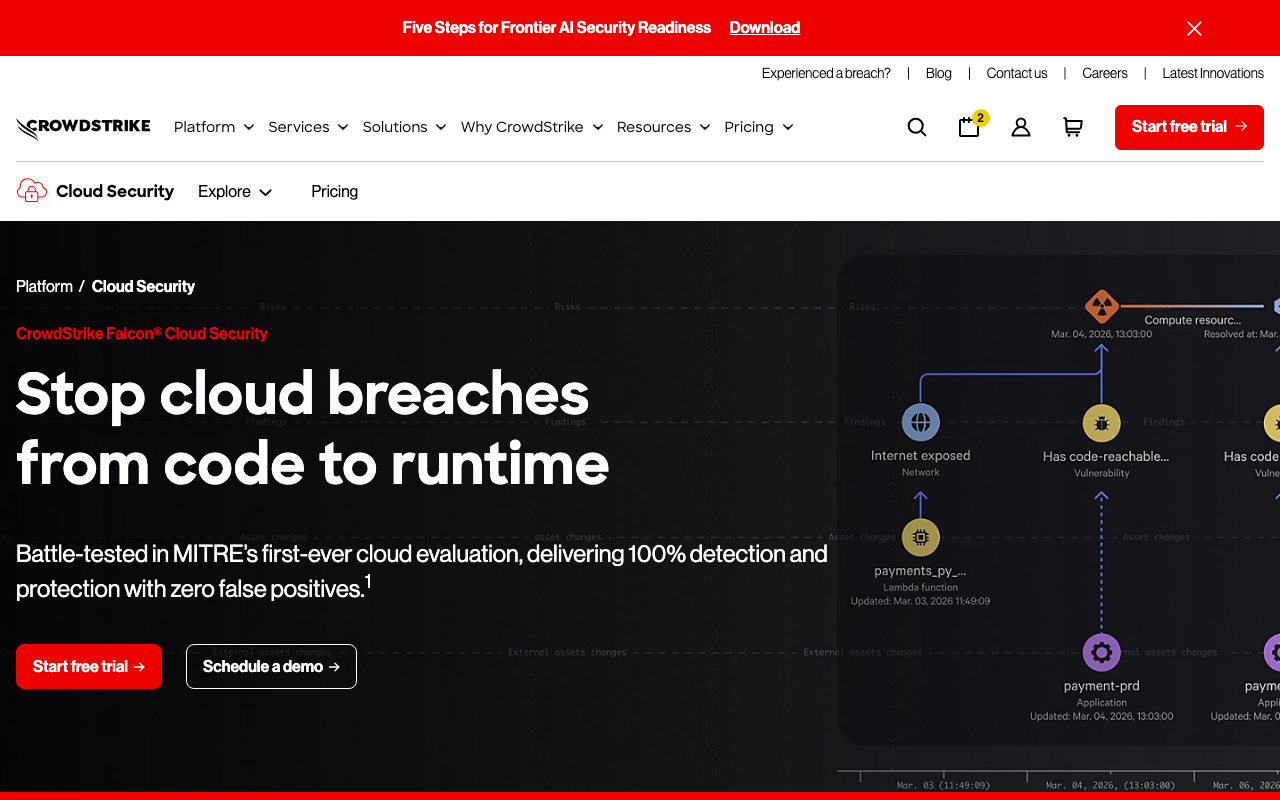
CrowdStrike Falcon Cloud Security makes a different bet than most cspm tools. Where Wiz and Orca lead with cloud visibility, CrowdStrike leads with adversary intelligence. The platform tracks 281+ threat actor groups and correlates their known tactics and techniques with your cloud posture. If a specific misconfiguration is known to be actively exploited by a tracked adversary, Falcon surfaces that context alongside the finding.
That threat-intelligence angle is genuinely useful for security teams that want to prioritize not just by severity, but by active threat landscape. It also means Falcon Cloud Security delivers most value for organisations already running CrowdStrike for endpoint protection: cloud and endpoint telemetry combine into a single picture of risk across the entire environment.
The platform covers CSPM, ASPM (Application Security Posture Management), AI-SPM, and cloud detection and response (CDR). It deploys agentlessly for posture management and adds the Falcon sensor for runtime depth when needed. The Timeline Explorer for root cause analysis is a practical standout feature that compresses investigation time significantly.
One honest framing: the endpoint protection tiers ($7.99 to $19.99 per device per month) do not include cloud security. Falcon Cloud Security is a separately quoted enterprise module. If you are not already a CrowdStrike customer, you are effectively signing up for two products.
“
Excellent for threat detection and its UI, with seamless integration. Technically superior but expensive.
★★★★★Verified Security Engineer· 11–50 employees
Via PeerSpot ↗Key features:
- CSPM with agentless discovery across multi-cloud environments
- Threat intelligence from 281+ tracked adversary groups correlated with posture findings
- Cloud Detection and Response (CDR)
- ASPM and AI-SPM for application and AI workload posture
- Graph database technology for attack path analysis
- Timeline Explorer for automated root cause analysis
- Compliance dashboard with audit-ready report generation
- Unified endpoint, identity, and cloud telemetry in a single platform
Pros of CrowdStrike Falcon Cloud Security
- Threat intelligence integration is a genuine differentiator: know who is likely to exploit a finding, not just what it is
- Strong fit for CrowdStrike-first organisations: single platform across endpoint and cloud
- Cloud Detection and Response is well-regarded in the industry
Cons of CrowdStrike Falcon Cloud Security
- Cloud Security module is separately quoted and not bundled with endpoint tiers
- Best value if you are already a CrowdStrike endpoint customer; weaker as a standalone CSPM
- No public pricing for the cloud module
Pricing: Fully quote-based for the cloud module; endpoint tiers from $7.99/device/month do not include CSPM Best for: Enterprise security teams already running CrowdStrike for endpoint who want unified endpoint and cloud posture management
6. Sysdig Secure
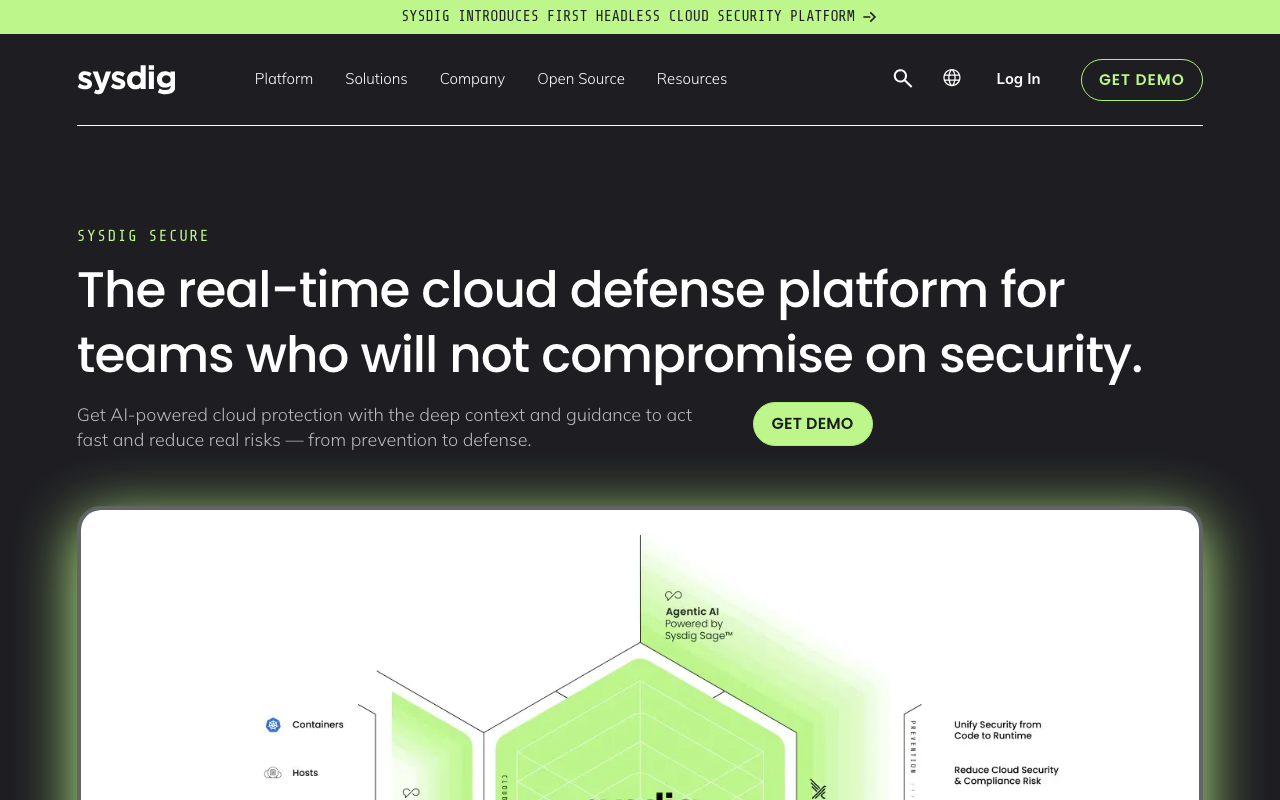
Sysdig Secure is the runtime-first CSPM platform on this list. It is built on Falco, the open-source cloud threat detection engine that Sysdig created and donated to the CNCF, and that heritage gives it a level of runtime visibility that purely agentless tools cannot match.
The key way Sysdig stands out from other cspm tools: runtime data filters findings rather than surfacing every misconfiguration. Rather than surfacing every misconfiguration, it prioritizes based on whether the affected workload is actually running and whether the misconfigured resource is being used. A vulnerability in an image that is deployed and actively running is treated differently from one sitting in a registry for months. That runtime context cuts noise significantly and produces a shorter, more actionable finding list.
Sysdig Sage, the AI analyst layer, handles investigation and remediation queries in natural language. The Cloud Attack Graph maps exploitable paths using both configuration data and runtime telemetry, which makes attack path analysis more accurate than configuration-only approaches.
The honest limitation: Sysdig is meaningfully more complex to deploy than agentless-only tools. The agent requirement for runtime depth adds operational overhead. If your engineering team does not have capacity for that, a simpler agentless tool will serve you better day-to-day.
“
Sysdig Secure does everything from a detection point of view — it identifies vulnerabilities and where they are. The intuitive UI clearly shows images with vulnerabilities and how to fix them, helping us stay ahead.
★★★★☆Sharan K Lakshman· 51–200 employees
Via PeerSpot ↗Key features:
- Runtime Insights powered by Falco: shows what is actively running, not just what is deployed
- Cloud Attack Graph: maps attack paths using real runtime behaviour alongside configuration data
- Sysdig Sage: AI analyst for investigation and remediation in natural language
- CSPM, CWPP, CIEM, DSPM, and KSPM in a single platform
- Agent and agentless deployment options
- Real-time threat detection via drift control, ML, and curated rules
- IaC scanning and shift-left pipeline integration
- Compliance across CIS, SOC 2, PCI DSS, ISO 27001, HIPAA, HITRUST, FedRAMP, and NIST 800-53
Pros of Sysdig Secure
- Runtime context for CSPM prioritization is genuinely better than configuration-only approaches
- Falco’s open-source foundation means rapid detection rule updates and large community support
- Gartner Peer Insights Customers’ Choice for CNAPP; strong Fortune 500 adoption
- One of the strongest compliance framework coverage sets on this list
Cons of Sysdig Secure
- Agent requirement for full runtime depth adds deployment and operational overhead
- No public pricing; fully quote-based
- Less suited for teams without containerized infrastructure or Kubernetes
Pricing: Fully quote-based; host-based licensing model; no public pricing Best for: Teams running containerized workloads and Kubernetes who need deep runtime visibility alongside CSPM
7. Aqua Security
Aqua Security built its reputation on container security before the CNAPP category existed, and that heritage shows throughout the platform. If your environment is heavily containerized, if you are running Kubernetes at scale, or if software supply chain security is a priority, Aqua is the most capable tool on this list for those specific use cases.
The CSPM capability covers real-time misconfiguration detection across AWS, Azure, and GCP with compliance automation against 30+ regulatory standards. But the real differentiator is end-to-end pipeline coverage: from scanning code and container images in CI/CD, through runtime protection of running containers, to cloud-level posture. The open-source Trivy scanner is integrated throughout, which matters for teams that want transparency into detection logic.
One honest callout: if you are comparing cspm tools purely for misconfiguration detection and container security is not a requirement, Aqua is over-engineered for that need. The UI is acknowledged as complex, and reviewers consistently note that navigating the platform requires genuine familiarity before it becomes productive.
“
It helps to detect security issues in our code that need to be handled before it will be too late. I like the insight it gives.
★★★★★Nir H.
Via AWS Marketplace ↗Key features:
- CSPM with real-time cloud misconfiguration detection across AWS, Azure, GCP
- Container and Kubernetes runtime protection
- Vulnerability scanning across code, images, and running workloads
- Software supply chain security with SBOM and secrets detection
- Agentless and agent-based hybrid scanning
- CI/CD pipeline integration and shift-left scanning
- Serverless security for AWS Lambda and equivalents
- Compliance automation against 30+ standards including NIST 800-53, PCI DSS, and HIPAA
Pros of Aqua Security
- Strongest container and software supply chain security of any tool on this list
- Open-source Trivy integration gives transparency into what is being checked
- End-to-end coverage from developer pipeline to cloud runtime
- Notable customers include GitLab, Thoughtworks, and NCR
Cons of Aqua Security
- Complex UI: reviewers consistently flag navigation as a steep learning curve
- CSPM is solid but secondary to container security; not the right pick if posture is your only need
- Fully quote-based pricing with no public tiers
Pricing: Fully quote-based; Dev Security, Cloud Security, and Platform tiers all require sales contact Best for: Engineering-led organisations with heavy container workloads who want CSPM integrated with supply chain and image scanning
8. Lacework (FortiCNAPP)
If you researched this category a few years ago, you know Lacework. It raised $1.8B at a peak valuation of $8.3B, then sold to Fortinet in August 2024 for an estimated $200 to $230 million. It now operates as FortiCNAPP under the Fortinet umbrella.
The product itself retains Lacework’s core differentiator: ML-based behavioral analytics. Rather than checking configuration against static rule sets, it establishes a behavioral baseline of what normal looks like in your cloud environment and flags deviations. An IAM role that suddenly starts making API calls it has never made before surfaces as an anomaly, even if that specific pattern is not in any rules library. That is a meaningfully different approach to threat detection, and it catches things rule-based systems miss.
The platform covers CSPM, CWPP, CIEM, CDR, IaC scanning, and DSPM (added January 2026). It is one of the more interesting cspm tools for behavioral detection, with genuinely useful anomaly analysis. The acquisition does bring uncertainty: the product roadmap and go-to-market under Fortinet are still settling, and users have noted UI quality issues that have persisted since before the acquisition.
“
Robust network segmentation and restricting access to network assets are key strengths. Automated policy recommendations help identify threats quickly and enable automated responses.
★★★★★Mark Freeborough· MLL Telecom Ltd
Via PeerSpot ↗Key features:
- ML-based behavioral baselines for anomaly detection across cloud activity
- CSPM with misconfiguration detection and KSPM
- CWPP with runtime behavioral monitoring
- CIEM with net-effective permissions analysis
- IaC scanning, SAST, SCA, and SBOM
- Cloud Detection and Response (CDR) without manual rule creation
- DSPM added January 2026
- Agentless scanning (24-hour default frequency)
Pros of Lacework
- ML behavioral analytics catches threats that rule-based systems miss
- Full CNAPP coverage across code, cloud, identity, and runtime
- 4.5/5 across 384 reviews
- AWS Marketplace Starter Pack at ~$22K/year is one of the few published price points in this category
Cons of Lacework
- Fortinet acquisition creates product direction uncertainty
- UI has been flagged by multiple users as clunky and not intuitive
- Default 24-hour agentless scan frequency is slower than most competitors
Pricing: Quote-based (Pro and Enterprise tiers); AWS Marketplace Starter Pack at ~$22,000/year Best for: Mid-market teams that want behavioral anomaly detection alongside standard CSPM; existing Fortinet customers get consolidation benefits
9. Check Point CloudGuard
Check Point CloudGuard comes from a company that has been in network security since 1993. That heritage is both the selling point and the context: CloudGuard is the strongest choice if you already run Check Point firewalls and want cloud security inside the same Infinity Platform. For everyone else, it is a capable CNAPP with a network-security-first perspective that differs from the pure cloud-native alternatives.
Among cspm tools with a network security heritage, CloudGuard unifies CSPM, CWPP, and cloud network security across AWS, Azure, and GCP, with 1,500+ built-in compliance rules. The prevention-first positioning means the platform emphasizes blocking threats before production rather than solely alerting after the fact. The risk prioritization engine with one-click remediation is consistently praised by users for cutting through large volumes of findings.
At roughly $2.76B in annual revenue, Check Point is a stable vendor. CloudGuard is not going anywhere. But it is also not the fastest-moving product in this category: pure cloud-native players ship features faster, and CloudGuard’s primary investment has historically followed network security priorities rather than cloud-native ones.
“
Check Point CloudGuard CNAPP flagged a misconfiguration in our AWS S3 bucket that had overly permissive access settings. The unified platform's risk prioritization engine is particularly valuable for managing the overwhelming volume of cloud security findings — it helps us cut through noise and focus on issues that pose real business risk.
★★★★☆Assistant Manager· 201–500 employees
Via PeerSpot ↗Key features:
- CSPM with automated compliance enforcement and 1,500+ built-in rules
- CWPP with agentless workload posture management
- AI-powered WAF for web application and API protection
- Container and Kubernetes security
- IaC scanning with CI/CD pipeline integration
- Risk prioritization engine with one-click remediation
- Network security with threat prevention and intelligence
- Multi-cloud support: AWS, Azure, GCP
Pros of Check Point CloudGuard
- 1,500+ built-in compliance rules is one of the strongest coverage sets on this list
- Prevention-first: blocks threats rather than just alerting
- Strong for existing Check Point customers: unified security across network and cloud
- 4.4/5 across 165 reviews
Cons of Check Point CloudGuard
- Feature velocity is slower than pure cloud-native vendors
- Most compelling as an extension of an existing Check Point environment; weaker as standalone CSPM
- Fully quote-based; no public pricing
Pricing: Fully quote-based; consumption-based per workload or cloud account Best for: Organisations already invested in Check Point for network security who want to extend posture management to cloud environments
10. Tenable Cloud Security
Tenable Cloud Security takes an identity-first approach that sets it apart from most cspm tools. Originally Ermetic (acquired by Tenable in 2023 for approximately $265M), its core strength is CIEM: cloud infrastructure entitlement management, which is the analysis of who has access to what, and whether that access is actually necessary.
Most CSPM tools check infrastructure configuration. Tenable Cloud Security checks configuration and identity risk together, treating excessive permissions and misconfigured IAM policies as first-class signals alongside storage exposure and network misconfigurations. It then correlates these into toxic combinations. A publicly exposed VM with an IAM role that has database write access is a fundamentally different risk profile from either issue in isolation.
Gartner Peer Insights named Tenable a Customers’ Choice for CNAPP in 2025, with 4.8/5 from 71 reviews: the highest Gartner score of any tool on this list. The limitations are the usual enterprise ones: pricing is not public, alert noise at scale requires manual tuning, and auto-remediation capabilities are limited compared to Wiz or Prisma Cloud.
“
When customers need this solution, demonstrations show its value for use cases in cloud visibility and compliance. Questions typically centre on pricing or expected technical capabilities they cannot locate in the product.
★★★★☆Antonio Scola· Small Business
Via PeerSpot ↗Key features:
- CSPM with continuous misconfiguration detection across AWS, Azure, GCP
- CIEM with human and service identity risk analysis and least-privilege enforcement
- IaC scanning across Terraform, CloudFormation, and Kubernetes manifests
- Sensitive Data Discovery and Classification (DSPM)
- AI-SPM for AI workload identification and posture
- Just-in-time (JIT) access controls
- Toxic combination risk prioritization across identity, network, and configuration
- Integrations with Jira, Slack, Microsoft Teams, Okta, Entra ID, and Google Workspace
Pros of Tenable Cloud Security
- Best CIEM capability of any tool on this list; identity-first approach is genuinely differentiated
- Gartner Peer Insights Customers’ Choice for CNAPP 2025; 4.8/5 across 71 Gartner reviews
- Available standalone or bundled into Tenable One Exposure Management
- Strong IaC scanning: Terraform and CloudFormation both natively supported
Cons of Tenable Cloud Security
- Alert noise at scale requires significant manual tuning to be productive
- Limited auto-remediation: findings are surfaced but action is often manual
- Expensive for smaller organisations; no public pricing
- Post-acquisition integration with Tenable’s broader vulnerability scanner has gaps
Pricing: Fully quote-based; free trial available on request Best for: Security teams with complex IAM sprawl across multi-cloud accounts who want identity risk treated as a primary CSPM signal
How to choose a CSPM tool
Do you need pure CSPM or a full CNAPP?
Most cspm tools in 2026 are full CNAPPs. Almost every option above bundles workload protection, identity management, and vulnerability scanning alongside posture management. The practical question is whether you want to pay for the full platform now, or find a vendor where posture management is the clear core and the rest is optional.
Free Demo
SOC 2 or ISO 27001 alongside your CSPM tool?
ComplyJet handles the full certification — policies, evidence, and the audit.
If misconfiguration detection is your primary need today, Tenable Cloud Security and Orca are both strong choices that do not force you to activate modules you are not using. If you are planning to consolidate your cloud security stack over the next year or two, Wiz or Prisma Cloud give you a roadmap for that in a single contract.
A useful question to ask vendors: “If I only want CSPM today, what does the pricing look like, and how does the contract change if I expand later?”
Agentless or agent-based?
Agentless tools (Wiz, Orca) deploy fast, require no ongoing agent management, and add no performance overhead to workloads. The tradeoff is less real-time signal about what is actively running versus what is just deployed.
Agent-based or hybrid tools (Sysdig, Aqua) give you deeper runtime visibility. You can see not just that a vulnerability exists in an image, but whether the vulnerable process is actively running. That context matters for prioritization but costs you deployment overhead and ongoing agent management.
The practical question: how many hosts and pods are you managing, and does your team have capacity to maintain agents at that scale?
What does your cloud footprint look like?
Multi-cloud parity matters more than vendors admit. Most advertise support for AWS, Azure, and GCP, but the depth of coverage varies. If Azure is your primary cloud and GCP is being added, verify that GCP coverage is feature-complete, not just checkbox support.
If you are AWS-only and plan to stay that way, native AWS tooling (AWS Security Hub, AWS Config) may cover basic posture needs at lower cost. But if there is any realistic chance of adding a second cloud in the next two years, a dedicated CSPM tool is a better investment now than a migration later.
Are you buying for compliance or for security?
These are different goals and the tools optimize differently for each. If your primary driver is generating audit-ready compliance reports for SOC 2 or ISO 27001, Prisma Cloud (100+ frameworks) and Lacework have the deepest framework libraries.
If your primary driver is finding real security risk before attackers do, Wiz and Sysdig’s attack path analysis and runtime correlation give you more signal that translates to actual risk reduction.
One thing worth noting: CSPM tools identify and report your cloud configuration posture; they do not issue compliance certifications. If you are a startup pursuing your first SOC 2 or ISO 27001 audit, you need a compliance platform alongside your CSPM tool. ComplyJet handles the full certification process: policies, controls, evidence collection, and the audit relationship, working alongside whatever cloud security posture tool you have deployed.
ComplyJet handles the entire compliance stack: policies, controls, evidence collection, and your SOC 2 or ISO 27001 audit. Book a free demo to see it in action.
Startup, scaling, or enterprise?
Startup (1–50 people, first serious cloud security investment): Datadog CSM if you are already a Datadog customer. Otherwise, Wiz and Orca both offer trials. Be realistic about budget: every tool on this list is expensive, and a lightweight approach that you actually use is better than a full CNAPP platform that sits unconfigured.
Scaling (50–500 people, multi-cloud, first dedicated security hire): Wiz or Orca are the most common choices at this stage. If your infrastructure is heavily containerized, Sysdig earns serious consideration.
Enterprise (500+, complex multi-cloud, existing compliance requirements): Prisma Cloud for code-to-cloud coverage and compliance breadth; CrowdStrike if you are already on Falcon for endpoint; Wiz for greenfield deployments where speed-to-value is the priority.
Frequently asked questions
What is cloud security posture management?
Cloud security posture management (CSPM) is the automated, continuous monitoring of cloud infrastructure configuration to detect misconfigurations, policy violations, and compliance gaps. It works by connecting to cloud provider APIs and checking your resource configurations against security baselines, rather than inspecting network traffic or running processes. Modern cloud security posture management CSPM tools also surface attack paths, scan IaC templates, and layer in identity and data risk alongside misconfiguration detection.
What is a CSPM tool?
CSPM tools connect to your cloud accounts (AWS, Azure, GCP) and scan the configuration of every resource: storage buckets, IAM roles, databases, security groups, and networking rules. They alert when something deviates from secure or compliant configuration. Modern cspm tools also scan IaC templates in CI/CD pipelines before they reach production, catching misconfigurations before deployment rather than after.
What is CSPM in cybersecurity?
CSPM sits alongside EDR (endpoint detection and response), SIEM (log analysis), and WAF (web application firewall) in a typical security stack. It fills the configuration gap those tools miss: your firewall does not know your S3 bucket is publicly accessible; your SIEM does not know your IAM role is over-privileged. CSPM covers the cloud configuration layer specifically, checking your posture continuously rather than at point-in-time.
How do I choose the right CSPM for my business?
Start with three questions when evaluating cspm tools: Which cloud providers do you need covered? Do you want agentless deployment or can you manage agents? Do you need CSPM only, or workload protection and identity management too? From there, shortlist two or three tools that match and run trials before committing to a multi-year contract. Never commit to cspm tools without running a trial first: scan coverage varies more than vendors admit.
What should I consider when selecting a CSPM?
When selecting cspm tools, the four things that matter most: agentless versus agent-based deployment model, multi-cloud parity (not just checkbox support), whether attack path analysis is included or an add-on, and whether compliance framework coverage meets your specific regulatory requirements. Also ask about scanning frequency when comparing cspm tools: some scan every few minutes, others default to 24-hour cycles.
Which CSPM is best for cloud security?
The best cspm tools for cloud security vary by use case. For overall coverage and fastest time-to-value: Wiz. For the best agentless implementation: Orca Security. For teams already on Datadog with the only transparent pricing in the category: Datadog CSM. For enterprise compliance breadth: Palo Alto Prisma Cloud. For Kubernetes-heavy environments: Sysdig Secure. For identity and IaC risk: Tenable Cloud Security.
Final thoughts
The cspm tools market has converged on CNAPP. Every tool on this list now bundles posture management with workload protection, identity risk, and vulnerability management. That is good for buyers who want a consolidated security platform. It makes pure comparison harder for buyers who only need one piece.
Free Demo
Ready to turn your clean cloud posture into a compliance certification?
SOC 2, ISO 27001, HIPAA — flat pricing, 350+ integrations.
If you are early in building a cloud security program, Wiz and Orca are where most teams land. If you have specific requirements around runtime, containers, or identity risk, Sysdig, Aqua, and Tenable have a clear edge on those dimensions.
And when your cloud posture is clean and you need to prove it through a formal certification, ComplyJet helps cloud-native startups get SOC 2 and ISO 27001 certified, pulling compliance evidence from the same infrastructure your CSPM tool is already monitoring.
If you’re a startup pursuing SOC 2 or ISO 27001 for the first time, ComplyJet is built for you: flat pricing, 350+ integrations, and a team that guides you through the entire compliance process.