.svg)

You hit Comp AI's pricing page expecting a number and get a form instead.
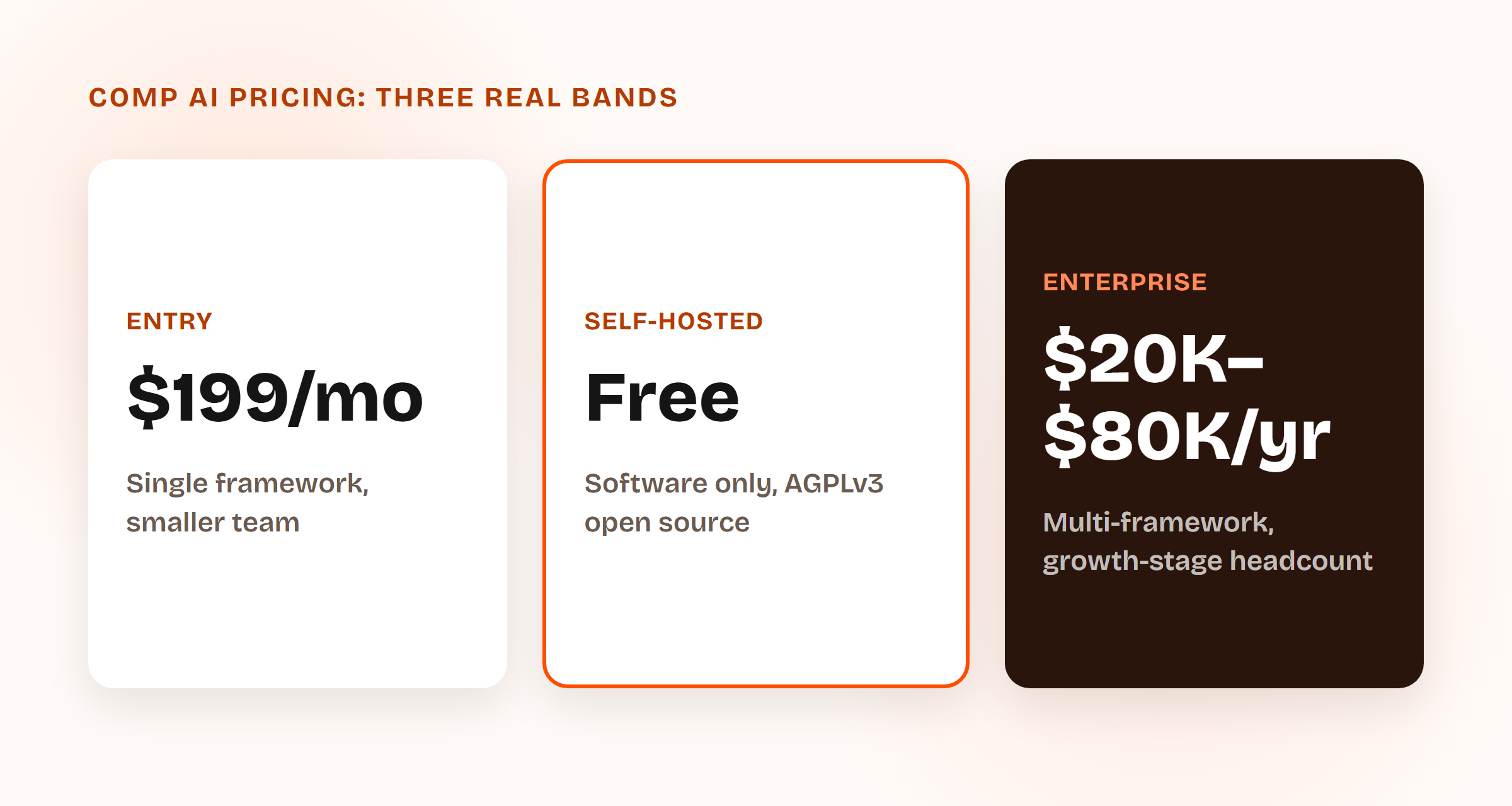
Comp AI pricing is not published as a fixed number. Trycomp.ai pricing is quote-gated, so there's no list price to point to directly. Third-party and public estimates put real-world comp ai cost in three bands: a $199/month entry tier, free if self-hosted (the open-source AGPLv3 version on GitHub), and $20,000 to $80,000/year for a managed plan at scale, depending on company size and how many frameworks are in scope.
The audit and pen test are bundled into that number rather than billed as separate line items.
One more thing worth flagging immediately: one of Comp AI's own content pages cites a $5,000-$10,000 price point, well under the $20K-$80K range found elsewhere. That's a documented inconsistency in Comp AI's own materials.
By the end of this, you'll know what actually drives Comp AI's price up or down, what's bundled into it, how trycomp.ai pricing compares to Vanta and Drata's published numbers, and the exact questions to ask Comp AI's sales team to get a real quote instead of a range.
Here's what's ahead:
- Why Comp AI doesn't publish a fixed price, and why that's not unusual in this category
- The real comp ai pricing range: entry tier, self-hosted, and enterprise
- What's actually bundled into that price, audit and pen test included
- The $5K-$10K discrepancy in Comp AI's own pricing claims
- How trycomp.ai pricing stacks up against Vanta, Drata, and ComplyJet
- How to get a real quote out of Comp AI's sales team
Why Comp AI Pricing (and Trycomp.ai Pricing) Isn't a Published Number
Trycomp.ai pricing is a form, not a price list. That's the first thing to understand before comparing it to anything else: there's no self-serve checkout, no plan grid, no monthly toggle. You fill out a form and wait for a sales conversation.
This isn't unique to Comp AI, and it isn't a sign the company is hiding something. Comp AI closed a $34M Series A in September 2026, and trycomp.ai pricing staying quote-gated at that stage is standard for the category. Vanta and Drata run the same quote-gated model for anything past a bare entry tier.
Company size, number of frameworks, and whether a customer wants Comp AI's managed offering or is self-hosting the open-source version all change the real cost enough that a single sticker price wouldn't be accurate on its own. That's a legitimate reason, not automatically an evasive one.
It does mean something for anyone comparing trycomp.ai pricing to a named competitor's public number, though: you're comparing a quote to a list price, not two list prices side by side.
Note
Comp AI has no official published price list. The figures in this piece come from third-party estimates and Comp AI's own public statements instead.
Comp AI Pricing: How Much Does Comp AI Cost? The Real Range
Trycomp.ai pricing and comp ai cost estimates range from $199/month for an entry-level managed plan, to free for a self-hosted open-source deployment, up to $20,000-$80,000 per year for a managed enterprise deployment covering multiple frameworks. None of these are Comp AI's own published numbers. They're third-party estimates, the same category of figure most compliance-automation cost articles work from when a vendor doesn't publish pricing.
| Tier | Price | Who it fits |
|---|---|---|
| Entry (managed) | $199/month | A single-framework, smaller team just starting compliance |
| Self-hosted (open source) | Free at the software layer | Teams comfortable owning their own infrastructure and evidence pipeline |
| Enterprise (managed, at scale) | $20,000-$80,000/year | Growth-stage companies with real headcount and multi-framework scope |
Quick take
Comp AI cost runs from free (self-hosted) to roughly $80K/year (managed enterprise), with a $199/month entry point in between. There's no confirmed published number; every figure here is a third-party estimate.
Comp AI Pricing Plans: Entry, Self-Hosted, and Enterprise Tiers
Break the range above into the three actual comp ai pricing plans a buyer will encounter, and each one comes with a different tradeoff, not just a different number.
Comp AI Plans at a Glance: Three Tiers, One Quote Call
All three comp ai plans route through the same quote-gated sales conversation. There's no self-serve checkout for either managed tier. Only the open-source self-hosted path skips a sales call entirely, since you're pulling the code from GitHub rather than signing anything.
Comp AI Monthly Cost: The $199 Entry Tier
The lowest publicly cited comp ai monthly cost figure is $199/month, per third-party estimates, for a managed entry-level plan. At that price point, expect single-framework scope and a smaller team, not multi-framework coverage or a large evidence volume. This is an estimate, not a confirmed published number, and it's worth asking Comp AI's sales team directly what specifically that tier includes before assuming it matches your scope.
Comp AI Self-Hosted Pricing: What "Free" Actually Means
Comp ai self-hosted pricing starts with the fact that Comp AI's core platform is roughly 99% AGPLv3-licensed and available on GitHub (trycompai/comp), so comp ai self-hosted pricing is genuinely free at the software layer. That's real, and it's the single biggest structural difference between Comp AI and closed-source platforms like Vanta and Drata, neither of which offers a self-hosted path at any price.
The real cost shifts, it doesn't disappear. Hosting infrastructure, the engineering time to deploy and maintain the platform, and the managed support and audit-bundling the paid tiers include are all costs a self-hosted team absorbs itself instead of paying Comp AI for.
Comp AI Free Plan Limits: Where Self-Hosting Stops Being Free
Watch out
The comp ai free plan is free software, not a free outcome. Self-hosting gets a team the platform. It doesn't get them the bundled audit, the pen test, or Comp AI's managed support, all of which are part of what the paid tiers are actually charging for.
A team weighing the self-hosted option should price out the engineering hours honestly, not just compare $0 against $199/month. Standing up and maintaining a compliance platform is a real, ongoing job, even when the license itself costs nothing, and comp ai self-hosted pricing should be evaluated on total cost of ownership, not license price alone.
Comp AI Annual Cost at Scale: $20,000 to $80,000 a Year
The upper end of comp ai annual cost estimates, $20K-$80K/year, is driven by company size and how many frameworks are in scope at once. SOC 2 alone sits toward the bottom of that range; SOC 2 plus ISO 27001 and HIPAA together pushes toward the top. This is the band a growth-stage company with real headcount and multi-framework needs should expect to land in.
Comp AI Enterprise Pricing: What Pushes a Quote Toward $80K
A handful of specific factors move comp ai enterprise pricing toward the top of the range: the number of frameworks in scope, company headcount, integration count (580+ integrations claimed), and whether the audit and pen test bundled into the price are being used at full scope rather than a lighter engagement.
A single-framework, 15-person startup and a 200-person company running SOC 2, ISO 27001, and HIPAA simultaneously are not going to land anywhere near the same number, even on the same pricing model.
What's Actually Bundled Into Comp AI Pricing Plans
The core structural difference from a typical platform-plus-separate-CPA-fee model: Comp AI's estimates fold the audit and pen test into the quoted price, with no separate line-item fee for either, per public claims.
Comp AI Audit Cost: Is the Audit Really Included?
The audit itself is still performed by an accredited third-party auditor. Comp AI is not itself an auditing firm, the same structural reality that applies to Vanta, Drata, and every other compliance automation platform in this category. What's different is that comp ai audit cost is described as bundled into the quoted price rather than billed as a separate line item on top of the platform fee, per Comp AI's public claims.
Comp AI also claims a 100% money-back guarantee on audit outcomes and markets "SOC 2 Type I audit-ready in as little as 24 hours." Both are stated here as claims to verify with Comp AI directly, not independently confirmed facts.
Comp AI Pen Test Cost: What "Bundled" Actually Covers
Same bundling logic applies to the pen test. Comp AI pen test cost is folded into the same quote rather than itemized separately, per the same public claims.
Try this yourself
Ask Comp AI's sales rep directly whether the pen test is a one-time engagement or recurring, and whether it covers the full scope needed for the specific framework(s) in play. "Bundled" doesn't say either on its own, and the answer changes what the quote is actually worth.
The $5K-$10K Discrepancy in Comp AI Pricing Claims
Comp AI's own "SOC 2 for AI Companies" hub page cites a $5,000-$10,000 price point, well under the $20,000-$80,000/year estimate found elsewhere for a managed enterprise deployment.
Note
Both figures trace back to sources tied to Comp AI, one from Comp AI's own content, the other from third-party estimates about Comp AI's actual pricing, and they don't reconcile cleanly. Possible explanations: the $5K-$10K figure may reflect an older price point, a narrower single-framework scope, or simply inconsistent messaging across Comp AI's own marketing. Neither number is confirmed as the "real" one.
A reader trying to budget off either number alone is working from an unreliable anchor. The honest move is to treat both figures as data points, not answers, and confirm the real number with Comp AI's sales team directly for your own company size and framework scope.
Trycomp.ai Pricing Compared to Vanta, Drata, and ComplyJet
A single number in isolation doesn't mean much without a reference point. Here's how comp ai pricing plans stack up against what's actually publicly known about comparable platforms.
| Platform | Public pricing model | Audit/pen test bundled | Self-hosted option |
|---|---|---|---|
| Comp AI | Quote-gated; third-party estimates $199/mo to $20K-$80K/year | Yes, per public claims | Yes, free (AGPLv3, open source) |
| Vanta | Quote-gated; roughly $10,000-$30,000/year platform subscription depending on plan | No, audit fee separate, Vanta's own estimate $30,000-$60,000 for a Type 2 engagement | No |
| Drata | Quote-gated; roughly $4,000-$8,000/year on shorter contract terms, scaling higher with framework count and headcount | No, audit fee separate, same structure as Vanta | No |
| ComplyJet | Flat, published, per-company pricing: $5,000/year for one framework, $8,000/year for two frameworks (e.g. HIPAA + SOC 2), for teams up to 50 employees | Not bundled the same way; ComplyJet's audit-partner network stays separate from the platform fee | No |
Comp AI's self-hosted option is the one row here that no other platform in this table can match at any price. That's a genuinely different model, not a marketing angle, and it's worth weighing on its own terms rather than folding into a simple cheaper-or-more-expensive comparison.
How to Get a Real Comp AI Pricing Quote (Not Just a Range)
The honest answer to "what does Comp AI cost for my company" is still "ask them." No outside source can give that number with certainty.
Try this yourself
When requesting a comp ai pricing quote, ask for three specific things: (1) the price broken out by framework, in case scope grows later, (2) written confirmation of what the audit and pen test bundle actually includes, and (3) whether the money-back guarantee has conditions attached. A vendor's answer to these three questions reveals more than the topline number alone.
A quote-gated price isn't a red flag by itself. What matters is whether the vendor's answer to a specific, itemized question is just as specific back. A vague answer to a direct question is the actual warning sign, not the quote gate. — Upendra Varma, CTO at ComplyJet
Where ComplyJet Fits for Teams Weighing Comp AI Pricing
Comp AI's open-source, self-hosted option is a genuinely different model. Teams comfortable owning their own infrastructure and evidence pipeline get real flexibility there that no closed-source platform offers, ComplyJet included.
Flat, per-company pricing
See a flat compliance quote that doesn't move once you sign
$5,000/year for one framework, $8,000/year for two. No self-hosting decision required.
Where ComplyJet fits differently: flat per-company pricing across frameworks, not per-seat, not usage-scaled. It stays the same as a team grows from a 5-person team to 30 or 40 people.
A team that has read this whole cost breakdown and wants a number that doesn't move once they sign is the team this fits, not necessarily the team that wants the cheapest possible number. ComplyJet supports SOC 1, SOC 2, ISO 27001, HIPAA, GDPR, PCI DSS, and 25+ other frameworks, backed by 350+ integrations, AI-assisted policy drafting, and white-glove support through the actual audit handoff.
FAQs
How much does Comp AI cost?
Comp AI doesn't publish a fixed price. Third-party estimates put comp ai cost in three bands: $199/month for an entry-level managed plan, free for the self-hosted open-source version, and $20,000-$80,000/year for a managed enterprise deployment, depending on company size and framework scope.
Is Comp AI free?
The core platform is roughly 99% AGPLv3-licensed and free at the software layer if you self-host it. Free doesn't mean free to run: hosting infrastructure, engineering time, and the managed support and audit-bundling the paid tiers include are all costs a self-hosted team takes on itself.
Is Comp AI really free if self-hosted?
The software license is genuinely free. What it doesn't include is Comp AI's managed support, the bundled audit, or the bundled pen test, all of which are part of what the paid tiers are charging for. Self-hosting gets you the platform, not the full managed outcome.
Does Comp AI charge extra for audits?
Per public claims, no. Comp AI's pricing estimates fold the audit into the quoted price rather than billing it as a separate line item, a real structural difference from platforms like Vanta and Drata, where the audit fee is billed separately by an outside CPA firm.
What is included in Comp AI pricing?
Per public claims, the audit and pen test are bundled into the quoted price at every managed tier, with no separate line-item fee for either. What exactly "bundled" covers, one-time versus recurring, full scope versus limited, is worth confirming directly with Comp AI's sales team before signing.
How much is trycomp.ai?
Trycomp.ai's own pricing page is quote-gated with no published number. Estimates place real-world cost between free (self-hosted) and roughly $80,000/year (managed enterprise), with a $199/month entry tier in between.
What does Comp AI cost per year?
At the high end, comp ai annual cost estimates run $20,000 to $80,000/year for a managed deployment, depending on company size and how many frameworks are in scope. A single-framework startup on the entry tier would land well under that.
Is Comp AI cheaper than Vanta?
It depends on the tier and the comparison point. Comp AI's $199/month entry tier and free self-hosted option are lower than Vanta's roughly $10,000-$30,000/year platform subscription. At the enterprise end, Comp AI's $20K-$80K/year estimate overlaps with Vanta's range rather than clearly undercutting it. Vanta's audit fee is billed separately on top of its subscription; Comp AI's estimates claim the audit is bundled in, which changes what "cheaper" actually means once both totals are compared honestly.
Related Reading
- Comp AI vs Vanta: the direct platform comparison, including how pricing models differ structurally.
- Comp AI Review: independent, receipts-based review covering funding, the open-source model, and this same pricing inconsistency in more context.
- Comp AI Alternatives: broader landscape for readers who found Comp AI's price out of range or the wrong fit.
- Does SOC 2 Cover AI?: background on the Comp AI content asset that surfaced the $5K-$10K pricing discrepancy.
- Vanta SOC 2: Pricing, Report Types, and the Real Process: the source for the Vanta and Drata pricing figures cited in the comparison table above.